
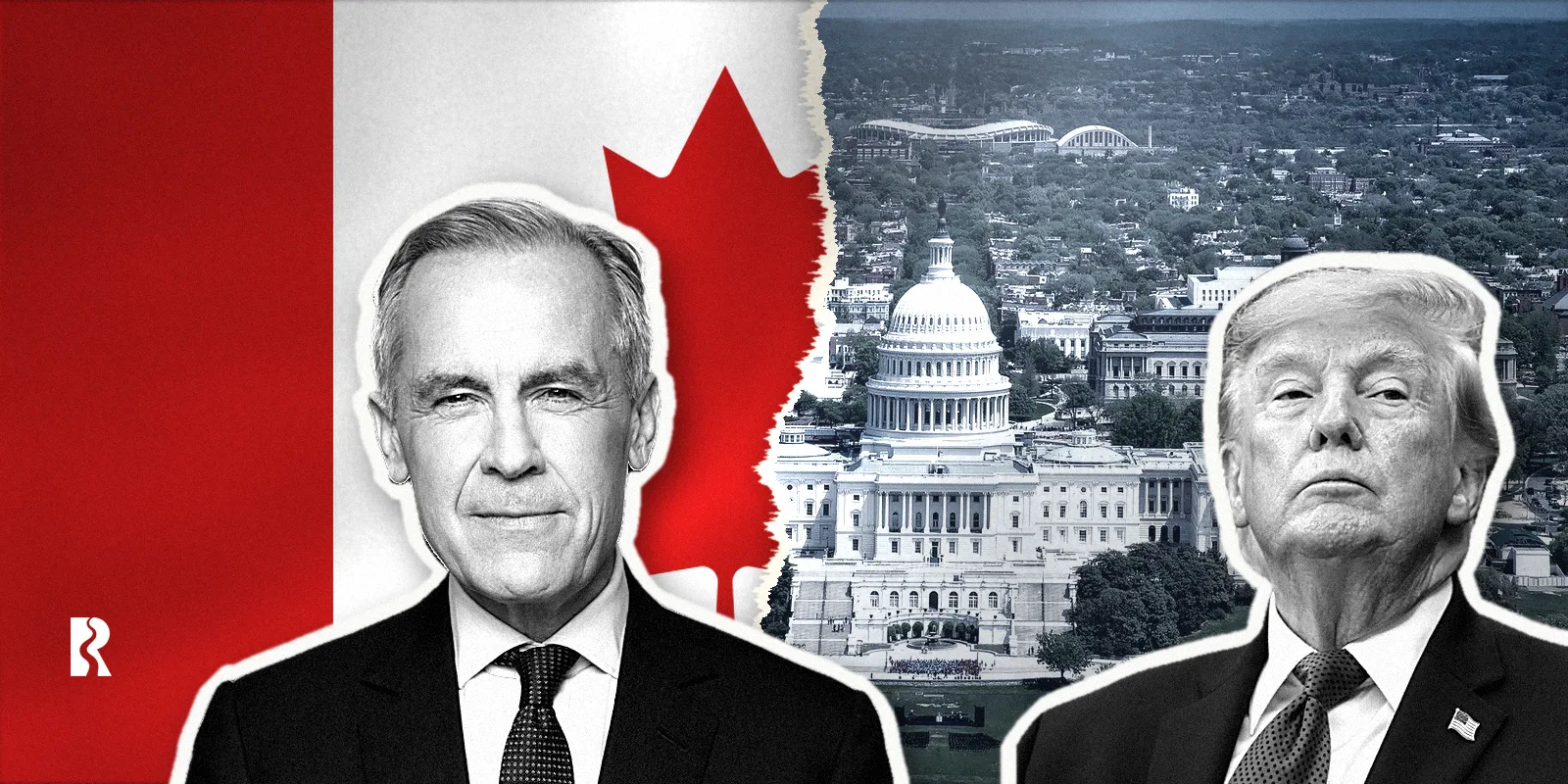
1. Trump bans $1 billion of Canadian goods
A US ban on nearly $1 billion of Canadian imports, including alcoholic beverages, dairy products and motorcycles, took effect at 00:01 on Tuesday. Donald Trump imposed it under a 1930 trade law to punish Ottawa for retaliating against the 50% tariffs he placed in August on about $20 billion of Canadian goods, after trade talks collapsed. The ban covers only about 0.25% of Canadian exports to the United States, according to Capital Economics, in a relationship worth some $880 billion a year. Its weight is political: Trump said he expected Canada to come back to the table within "three or four weeks", while Prime Minister Mark Carney's government says it is focusing on diversifying its trade partners.
https://x.com/abc/status/2105260134008066451?s=61
2. A breach of the Pentagon's personnel files, found nine months late
"Unauthorised users" accessed a server of the Defense Manpower Data Center, the Pentagon's vast personnel database, from last October, CNN reported, and the breach was only discovered and fixed in July. The exposed data includes Social Security numbers and, in some cases, service members' military specialty. The centre held at least 60 million records; according to Military Times, up to 4 million Defense Department personnel could be affected. The Pentagon says it has no indication the data has been misused, and has not said who was behind the breach. Experts warn the data could help foreign intelligence services map who does what in the US military, during the war with Iran.
3. The war's inflation bill: Spain at 4.9%, Australia raises rates
Spanish inflation jumped to 4.9% in September, above the 4.6% economists expected, according to a Reuters poll; it stood at 2.3% in late February, before the war with Iran began. The same day, Australia's central bank raised its main rate by a quarter point to a 15-year high and said further increases were not ruled out. Energy prices driven by the war in the Gulf are feeding through to consumer prices well beyond the region.
4. An 87-year-old's eviction shakes Spanish politics
The eviction on 23 September of María del Carmen Abascal, 87, carried out on a stretcher from the Madrid flat her family had rented since 1956, has become a national cause. According to the tenants' union, the building's new owner had raised her rent by 275%. On Saturday, 25,000 people marched in Madrid according to the government, 300,000 according to the organisers. Prime Minister Pedro Sánchez's coalition partner Sumar threatened to boycott the Cabinet unless it adopted a housing decree blocked since July, including protection against evictions without alternative housing and a rent freeze. According to NPR, the government has since presented measures on the housing crisis.
https://x.com/abcdesevilla/status/2104889336994877458?s=61
5. Anthropic's IPO filing warns of "existential risk"
The AI company Anthropic, which is preparing a stock market listing, devotes about 80 of the 261 pages of its prospectus to risks, according to Reuters. It warns that its AI models could pose a "catastrophic or existential risk to humanity". This is an unusual step for a company seeking investors: it lays out in writing the risks of the technology it is asking them to fund.
6. Brazil votes on Sunday
The first round of the presidential election is on Sunday 4 October. Datafolha's latest poll, published on 24 September, puts Lula at 40% and Flávio Bolsonaro at 36%, at the edge of the two-point margin of error; in a runoff, Lula leads 47 to 45, a statistical tie. The campaign ends on Saturday.