
1. What was signed
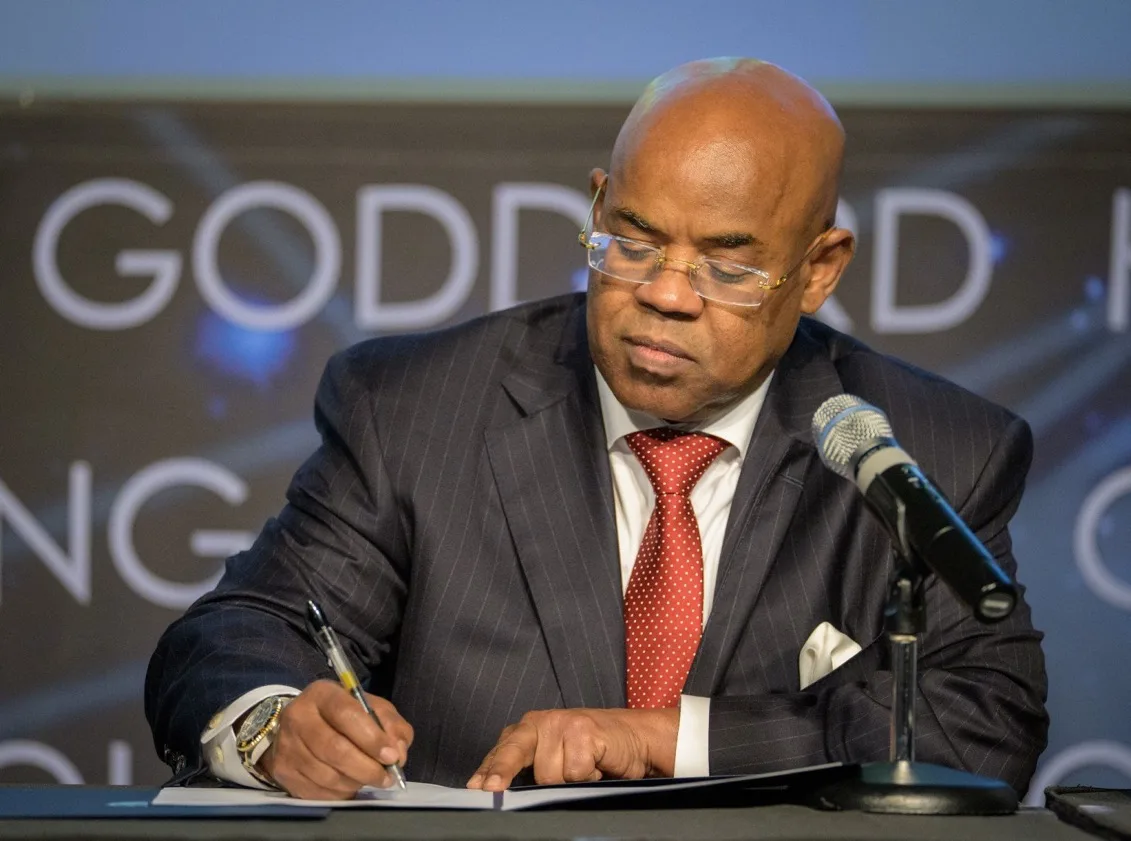
The ceremony took place at NASA's Mary W. Jackson headquarters in Washington. Djibouti's ambassador to the United States, Mohamed Siad Douale, signed for his government. NASA Deputy Administrator Matt Anderson hosted, and the State Department's Assistant Secretary for African Affairs, Frank Garcia, attended. "Djibouti joins this coalition of like-minded nations at an important time," Anderson said. The State Department's Bureau of African Affairs said the country had formalised its commitment to the peaceful exploration of space. Djibouti signed less than two weeks after Türkiye, which became the 71st signatory on 31 August.
https://x.com/nasa/status/2099558640319373599?s=61
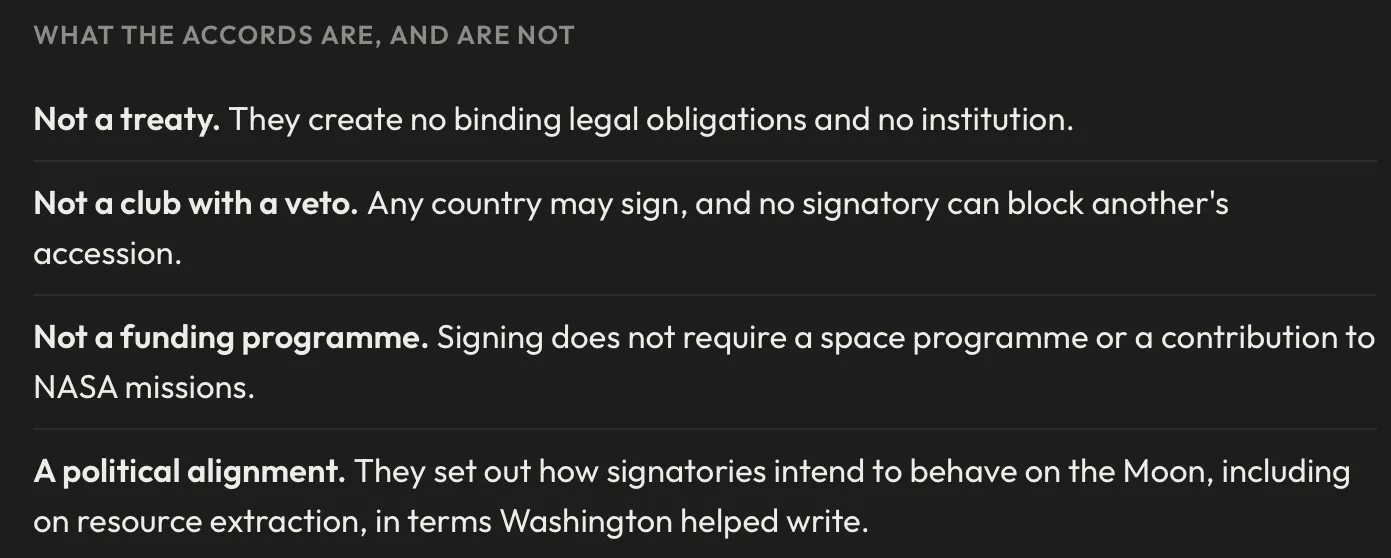
The Artemis Accords were launched in 2020 by the United States and seven other founding countries. They are a set of practical principles, which each new signatory affirms at a ceremony with the United States, that NASA describes as reinforcing and implementing key obligations of the 1967 Outer Space Treaty: transparency, interoperability, emergency assistance, registration of space objects, release of scientific data, preservation of historic sites, deconfliction of activities and mitigation of orbital debris.
2. A small programme with hardware in orbit
Djibouti did not sign with empty hands. Its national space programme, launched in 2020 and run by the Centre for Studies and Research of Djibouti (CERD) under the Ministry of Higher Education and Research, has put two nanosatellites in orbit.
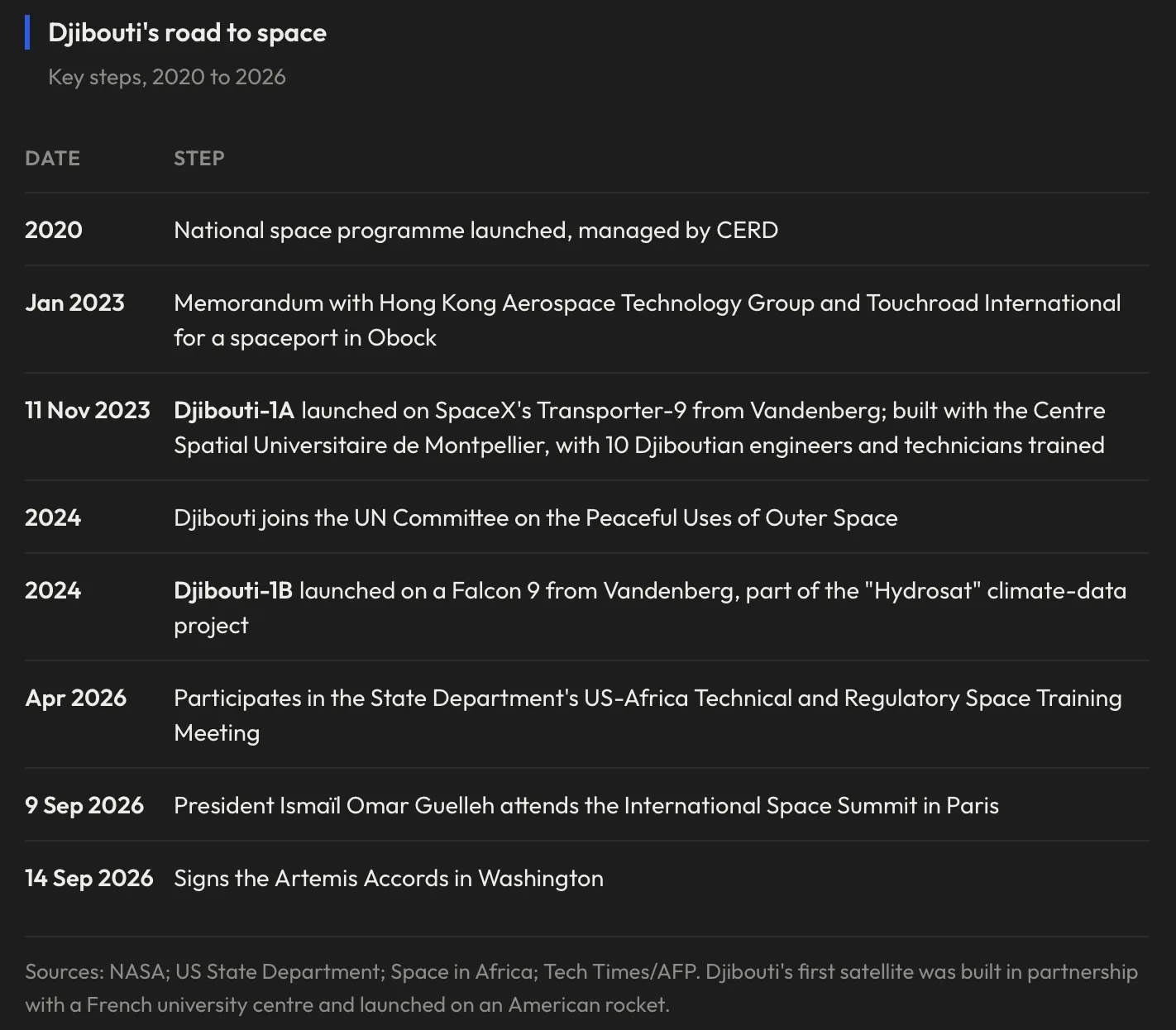
The two satellites serve a concrete need. They relay data from climatological and seismic stations across the country, including temperature, rainfall and river levels. A ministry official told Space in Africa in 2023 that the programme would let Djibouti receive such data three times a day instead of three times a year.
3. Why now: the Space Catalyst Partnership
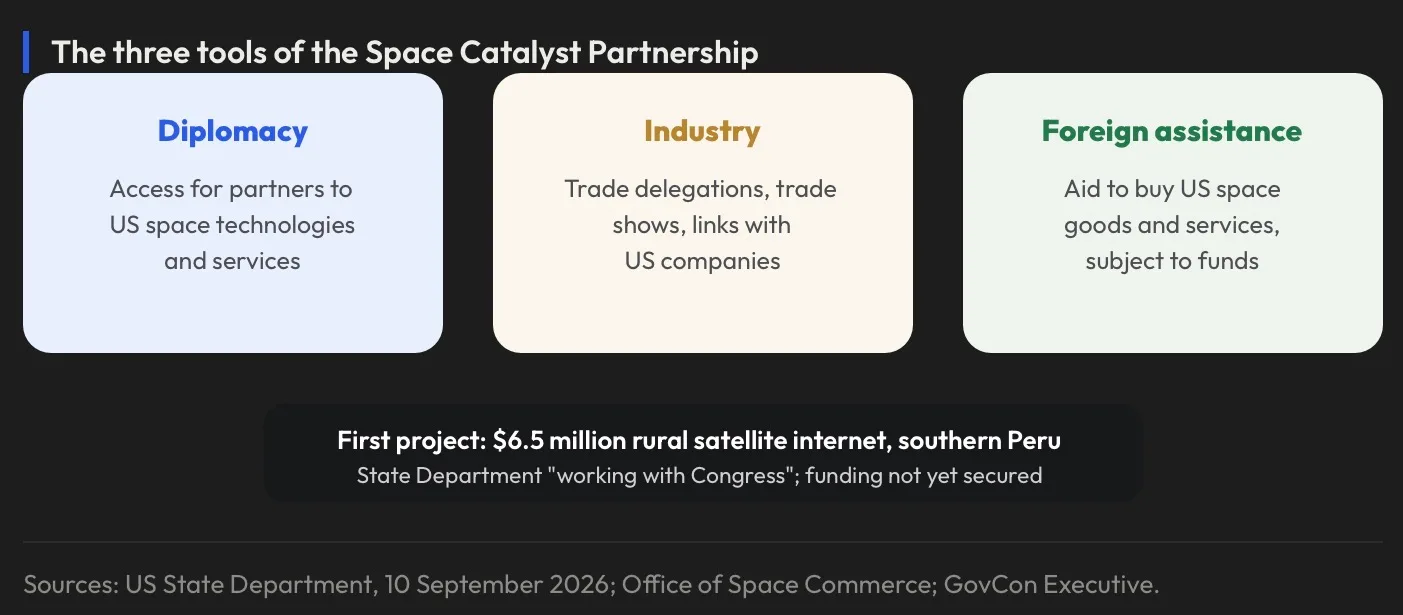
The timing is not accidental. On 10 September, four days before Djibouti signed, the State Department launched the Space Catalyst Partnership in Lima during Secretary of State Marco Rubio's visit to Peru. It is described as the Department's "flagship initiative" for civil and commercial space cooperation with Artemis Accords signatories.
4. Africa is choosing, and not choosing
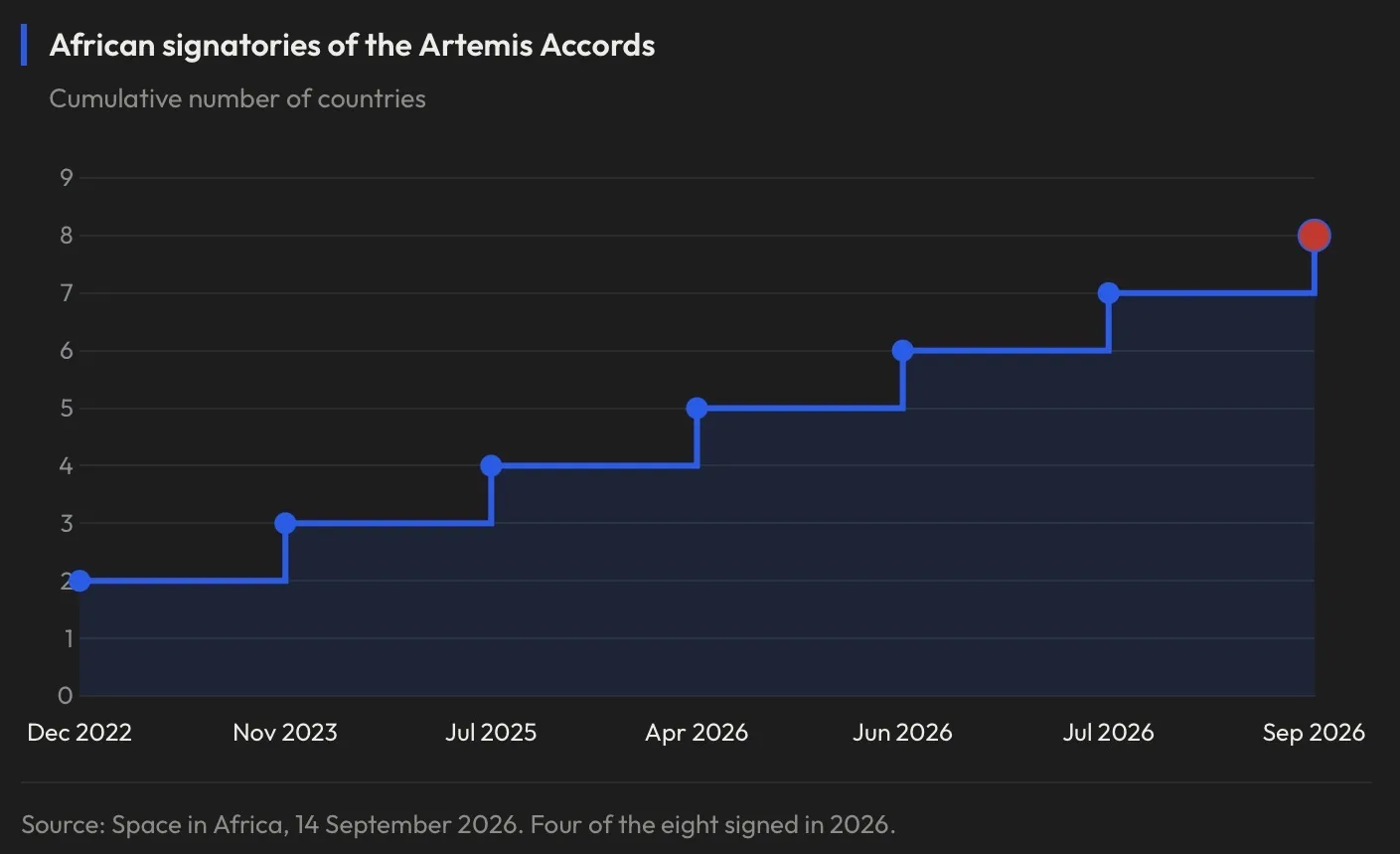
Djibouti is the eighth African signatory, and the fourth in 2026 alone. The pace has accelerated sharply.
But there is a second lunar coalition. China and Russia lead the International Lunar Research Station (ILRS), a planned base at the Moon's south pole. Its national members include South Africa and Egypt, which signed in 2023, and Senegal, which signed in 2024. Research institutions from Ethiopia and Kenya signed cooperation agreements the same year.
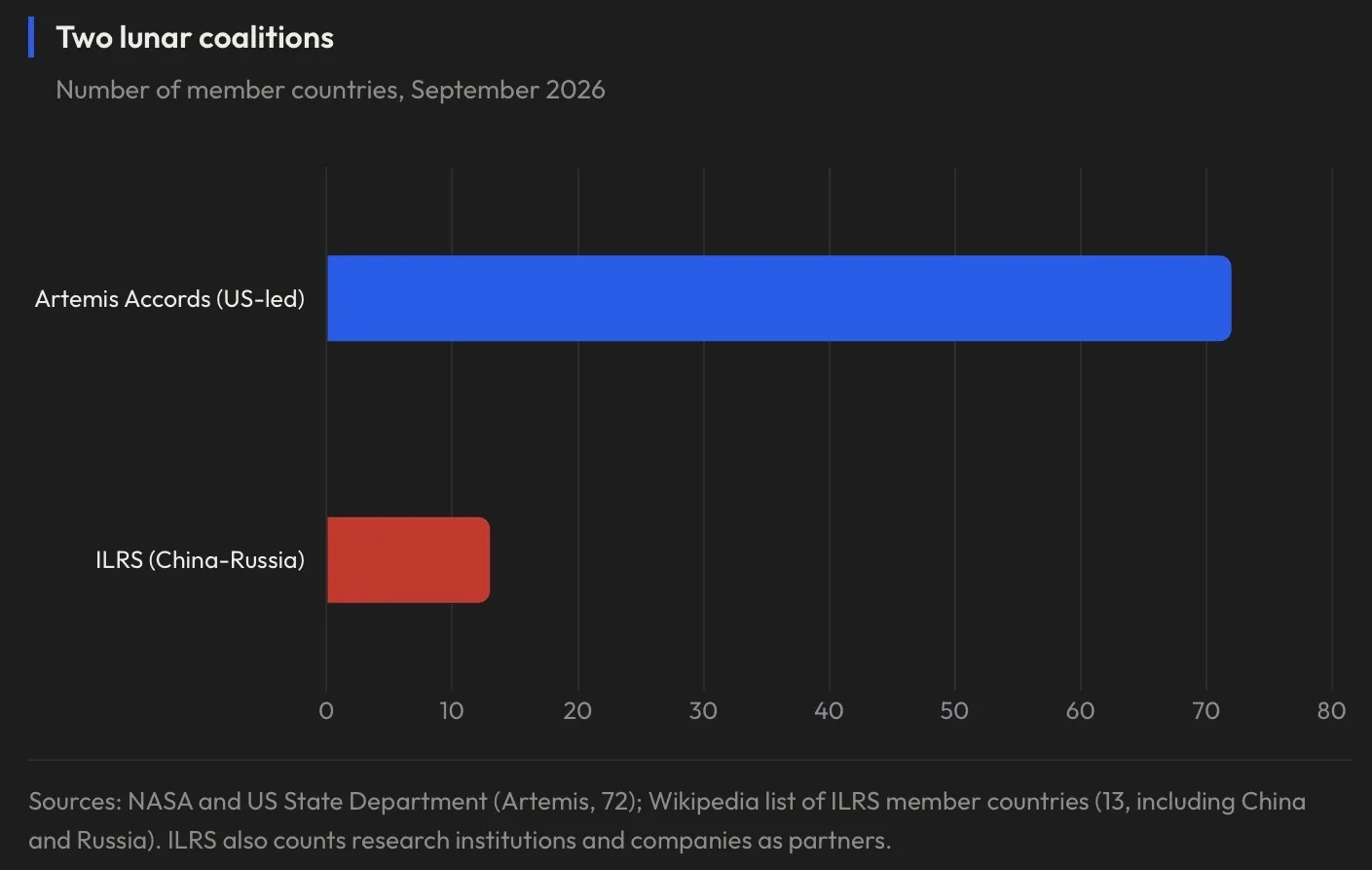
The map matters for Djibouti. Its giant neighbour Ethiopia, whose trade runs overwhelmingly through Djibouti's ports, engages with the Chinese framework through its space institute. Djibouti has now signed with Washington. On the Moon, as on the ground, the Horn of Africa does not move as a bloc.
5. The Djibouti method: host everyone
Djibouti's foreign policy rests on a simple asset: location at the mouth of the Red Sea. It has turned that into a business of hosting foreign militaries. The United States runs its main African base, Camp Lemonnier, there. China opened its first overseas military base in Djibouti in 2017. France and Japan also station forces.
The space file follows the same pattern. The first satellite was built with a French university centre and launched by an American company. In January 2023, the government signed a memorandum with the Hong Kong-based Hong Kong Aerospace Technology Group and Touchroad International for a spaceport in the northern Obock region, estimated at about $1 billion, with seven satellite launch pads and three rocket test pads. The memorandum provided for a land lease of at least 35 years and a transfer to Djibouti after 30 years of co-management.
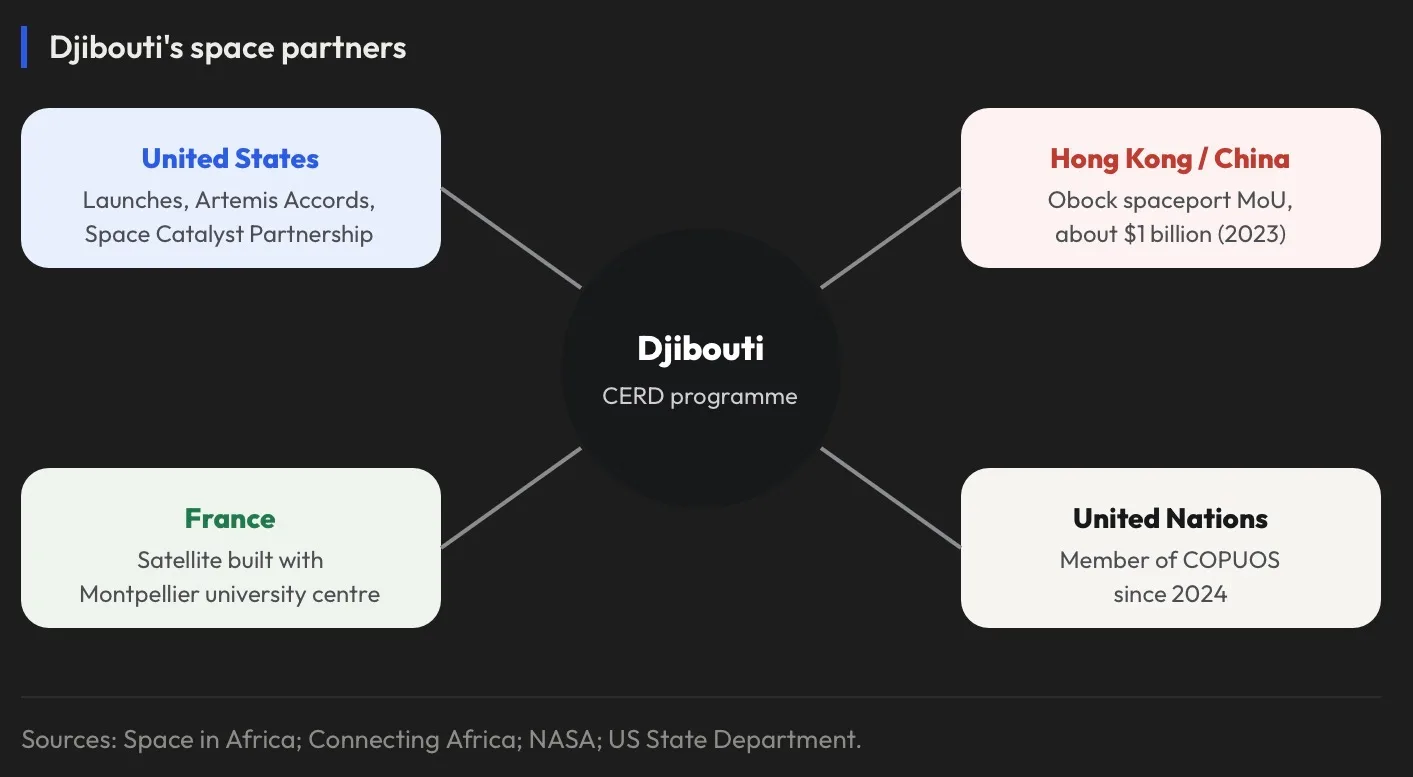
Djibouti hosts the militaries of rival powers on the same stretch of coast. It is now applying the same method to space.
Signing the Accords does not cancel the spaceport memorandum, and nothing in the Accords forbids a signatory from working with Chinese companies. But it raises a practical question Washington will eventually ask: can a country that has aligned with American rules for the Moon host a launch site built with Chinese-linked partners on the same coastline as Camp Lemonnier?
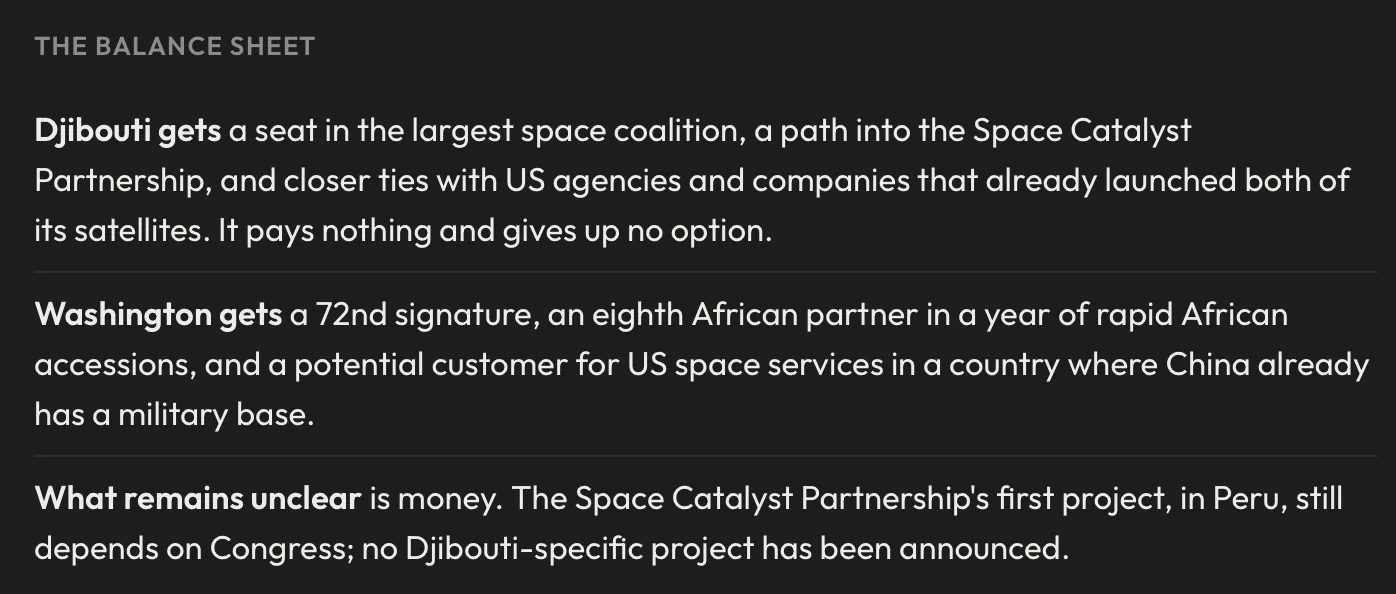
6. What each side gets
7. What to watch
A Djibouti project under the Space Catalyst Partnership, the first test of whether signing brings funding.
The Obock spaceport. Any public update on the 2023 memorandum will show how Djibouti reconciles its American and Chinese partners.
A third satellite. The next step for the CERD programme, and who builds and launches it.
Ethiopia's choice. Whether Addis Ababa moves from institutional ties with the ILRS to a national agreement, or follows Djibouti toward Artemis.