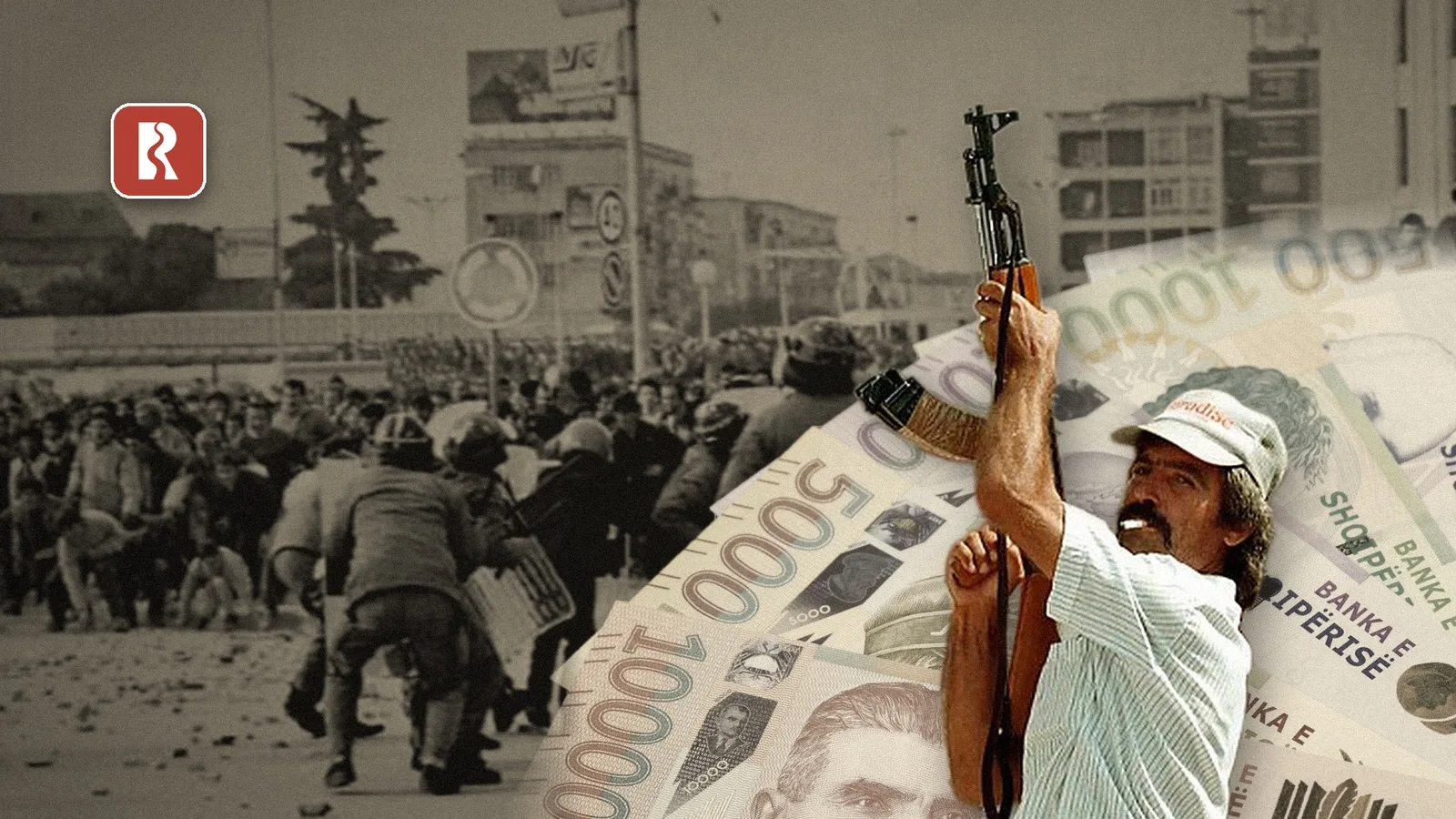
In 1997 Albania's pyramid schemes, owing about half of GDP to half the population, collapsed and pushed the country into armed revolt
By Le Détroit
The essentials
The scale. Eight schemes owed 177 billion lek ($1.7bn), 64% of Albania's 1996 GDP, to 1.69 million creditors, 51% of the population. By our calculation that was 1.15 times all the cash and bank deposits in the country.
Two machines. "Charity foundations" took small sums from almost nine in ten creditors at 30 to 47% a month; "companies" with real shopfronts took three-quarters of the money at 8 to 10%.
The warnings. The IMF and World Bank voiced concern from December 1994; in August 1996 an IMF mission urged the president to act and the prime minister asked, in a secret letter, for the newest schemes to be shut. The first public warning came in October, hedged.
The fall. Sude defaulted on 19 November 1996. By March 1997 the south was in revolt, arms depots were looted and the government fell; between about 1,600 and over 3,000 people died.
The lesson. Every flag was visible in public data and bank books. The same pattern now runs through apps, exchanges and "yield" products in cash-heavy, lightly supervised economies.
Key judgements
Our assessment, in the format of an intelligence estimate. Confidence reflects the quality of the evidence behind each judgement, not the probability of an event.
Albania's collapse was foreseeable in kind, not in timing: all ten warning signals we list were public or in official hands before Sude defaulted, the first of them 23 months ahead.Basis: Parts 7 and 8; Figures 5, 6 and 11
HighHigh confidenceSeveral independent sources, most of them primary, agree; the inference is short
The state turned a fraud into a national crisis: its endorsement, an unenforced law and a hedged warning let a believable rate draw in serious money.Basis: Parts 2, 7 and 10
ModerateModerate confidenceSourced facts, but the judgement rests on our screen and its thresholds
Pyramid risk today is highest where three conditions meet: savings without trusted banks, fast-growing unlicensed "yield" products and authorities that endorse or stay silent rather than warn.Basis: Parts 2, 7, 11 and 12; Figure 10
ModerateModerate confidenceSourced facts, but the judgement rests on our screen and its thresholds
Of the 13 economies we screened, Egypt, Nigeria and Lebanon meet the most of our six conditions drawn from Albania's 1996 record, a description of their economic setting, not of anyone's conduct; no recent case we found comes near Albania's 64% of GDP.Basis: Part 12; Figure 10
ModerateModerate confidenceSourced facts, but the judgement rests on our screen and its thresholds
Online and crypto rails are likely to shorten the warning window from Albania's two years to months, shifting the burden of detection onto banks' and payment firms' own data.Basis: Parts 11 and 12; Figures 8 and 11
LowLow confidenceA reasoned extrapolation from a few recent cases; plausible, not established
Contents13 parts
Part 1Half a country, all in: the scale of Albania's 1997 pyramid schemes
In the autumn of 1996, Albania's largest financial institutions were not banks. They were a holding company that ran supermarkets and package tours, an investment fund in the port of Vlorë and a "charity foundation" that collected cash in the villages around Lushnjë and Fier. When they stopped paying, eight of them owed 177.1 billion lek to 1,687,000 creditors, according to the reconstruction by Christopher Jarvis, an IMF economist, from administrators' and auditors' reports and Bank of Albania data. At the end-1996 exchange rate of 103.7 lek to the dollar, that is $1.7 billion: 64% of the country's GDP that year, owed to creditors equal to 51% of its people (Figure 1).
Figure 1
The pyramid ladder: eight schemes, half a country
The "foundations" had almost nine in ten creditors; the "companies" held three-quarters of the money
Hover or tap a scheme for its debts, assets and rate. Bars share one scale within each view
Companies"Charity foundations"
0$200m$400m$600m
VEFAcompany · from 1994$655m67,929m lekVEFA: company, taking money from 1994Owed 67,929m lek ($655m) to 85,000 creditorsOffered 8% a month in November 1996: 152% a year compoundedEstimated assets 4,999m lek, 7% of what it owed
Gjallicacompany · from 1993$496m51,467m lekGjallica: company, taking money from 1993Owed 51,467m lek ($496m) to 82,000 creditorsOffered 10% a month in November 1996: 214% a year compoundedEstimated assets 495m lek, 1% of what it owed
Xhafferifoundation · from 1996$297m30,833m lekXhafferi: "charity foundation", taking money from 1996Owed 30,833m lek ($297m) to 1,188,000 creditorsOffered 47% a month in November 1996: 10,081% a year compoundedEstimated assets 16,033m lek, 52% of what it owed (bank deposits seized in January 1997)
Cenajcompany · from 1994$68m7,021m lekCenaj: company, taking money from 1994Owed 7,021m lek ($68m); number of creditors not publishedOffered 10% a month in November 1996: 214% a year compoundedEstimated assets 750m lek, 11% of what it owed
Kambericompany · from 1994$61m6,330m lekKamberi: company, taking money from 1994Owed 6,330m lek ($61m); number of creditors not publishedOffered 10% a month in November 1996: 214% a year compoundedEstimated assets 519m lek, 8% of what it owed
Popullifoundation · from 1996$61m6,310m lekPopulli: "charity foundation", taking money from 1996Owed 6,310m lek ($61m) to 304,000 creditorsOffered 39% a month in November 1996: 5,102% a year compoundedEstimated assets 3,786m lek, 60% of what it owed (bank deposits seized in January 1997)
Sudefoundation · from 1994$38m3,900m lekSude: "charity foundation", taking money from 1994Owed 3,900m lek ($38m) to 13,000 creditorsOffered 41% a month in November 1996: 6,075% a year compoundedEstimated assets 0m lek, 0% of what it owed
Silvacompany · from 1994$32m3,332m lekSilva: company, taking money from 1994Owed 3,332m lek ($32m) to 15,000 creditorsOffered 10% a month in November 1996: 214% a year compoundedEstimated assets 871m lek, 26% of what it owed
Total$1,708m in all, 64% of 1996 GDP; foundations $396m (23%)
00.4m0.8m1.2m
Xhafferifoundation · from 19961,188,000Xhafferi: "charity foundation", taking money from 1996Owed 30,833m lek ($297m) to 1,188,000 creditorsOffered 47% a month in November 1996: 10,081% a year compoundedEstimated assets 16,033m lek, 52% of what it owed (bank deposits seized in January 1997)
Popullifoundation · from 1996304,000Populli: "charity foundation", taking money from 1996Owed 6,310m lek ($61m) to 304,000 creditorsOffered 39% a month in November 1996: 5,102% a year compoundedEstimated assets 3,786m lek, 60% of what it owed (bank deposits seized in January 1997)
VEFAcompany · from 199485,000VEFA: company, taking money from 1994Owed 67,929m lek ($655m) to 85,000 creditorsOffered 8% a month in November 1996: 152% a year compoundedEstimated assets 4,999m lek, 7% of what it owed
Gjallicacompany · from 199382,000Gjallica: company, taking money from 1993Owed 51,467m lek ($496m) to 82,000 creditorsOffered 10% a month in November 1996: 214% a year compoundedEstimated assets 495m lek, 1% of what it owed
Silvacompany · from 199415,000Silva: company, taking money from 1994Owed 3,332m lek ($32m) to 15,000 creditorsOffered 10% a month in November 1996: 214% a year compoundedEstimated assets 871m lek, 26% of what it owed
Sudefoundation · from 199413,000Sude: "charity foundation", taking money from 1994Owed 3,900m lek ($38m) to 13,000 creditorsOffered 41% a month in November 1996: 6,075% a year compoundedEstimated assets 0m lek, 0% of what it owed
Kambericompany · from 1994not publishedKamberi: company, taking money from 1994Owed 6,330m lek ($61m); number of creditors not publishedOffered 10% a month in November 1996: 214% a year compoundedEstimated assets 519m lek, 8% of what it owed
Cenajcompany · from 1994not publishedCenaj: company, taking money from 1994Owed 7,021m lek ($68m); number of creditors not publishedOffered 10% a month in November 1996: 214% a year compoundedEstimated assets 750m lek, 11% of what it owed
Total1,687,000 creditors, 51% of the population; foundations 89% of them
0%10%20%30%40%50%
Xhafferifoundation · from 199647%10,081% a yearXhafferi: "charity foundation", taking money from 1996Owed 30,833m lek ($297m) to 1,188,000 creditorsOffered 47% a month in November 1996: 10,081% a year compoundedEstimated assets 16,033m lek, 52% of what it owed (bank deposits seized in January 1997)
Sudefoundation · from 199441%6,075% a yearSude: "charity foundation", taking money from 1994Owed 3,900m lek ($38m) to 13,000 creditorsOffered 41% a month in November 1996: 6,075% a year compoundedEstimated assets 0m lek, 0% of what it owed
Popullifoundation · from 199639%5,102% a yearPopulli: "charity foundation", taking money from 1996Owed 6,310m lek ($61m) to 304,000 creditorsOffered 39% a month in November 1996: 5,102% a year compoundedEstimated assets 3,786m lek, 60% of what it owed (bank deposits seized in January 1997)
Gjallicacompany · from 199310%214% a yearGjallica: company, taking money from 1993Owed 51,467m lek ($496m) to 82,000 creditorsOffered 10% a month in November 1996: 214% a year compoundedEstimated assets 495m lek, 1% of what it owed
Kambericompany · from 199410%214% a yearKamberi: company, taking money from 1994Owed 6,330m lek ($61m); number of creditors not publishedOffered 10% a month in November 1996: 214% a year compoundedEstimated assets 519m lek, 8% of what it owed
Silvacompany · from 199410%214% a yearSilva: company, taking money from 1994Owed 3,332m lek ($32m) to 15,000 creditorsOffered 10% a month in November 1996: 214% a year compoundedEstimated assets 871m lek, 26% of what it owed
Cenajcompany · from 199410%214% a yearCenaj: company, taking money from 1994Owed 7,021m lek ($68m); number of creditors not publishedOffered 10% a month in November 1996: 214% a year compoundedEstimated assets 750m lek, 11% of what it owed
VEFAcompany · from 19948%152% a yearVEFA: company, taking money from 1994Owed 67,929m lek ($655m) to 85,000 creditorsOffered 8% a month in November 1996: 152% a year compoundedEstimated assets 4,999m lek, 7% of what it owed
TotalRates offered in November 1996, the peak; a year's compounding in small type
0$2k$4k$6k$8k
VEFAcompany · from 1994$7,707VEFA: company, taking money from 1994Owed 67,929m lek ($655m) to 85,000 creditorsOffered 8% a month in November 1996: 152% a year compoundedEstimated assets 4,999m lek, 7% of what it owed
Gjallicacompany · from 1993$6,053Gjallica: company, taking money from 1993Owed 51,467m lek ($496m) to 82,000 creditorsOffered 10% a month in November 1996: 214% a year compoundedEstimated assets 495m lek, 1% of what it owed
Sudefoundation · from 1994$2,893Sude: "charity foundation", taking money from 1994Owed 3,900m lek ($38m) to 13,000 creditorsOffered 41% a month in November 1996: 6,075% a year compoundedEstimated assets 0m lek, 0% of what it owed
Silvacompany · from 1994$2,142Silva: company, taking money from 1994Owed 3,332m lek ($32m) to 15,000 creditorsOffered 10% a month in November 1996: 214% a year compoundedEstimated assets 871m lek, 26% of what it owed
Xhafferifoundation · from 1996$250Xhafferi: "charity foundation", taking money from 1996Owed 30,833m lek ($297m) to 1,188,000 creditorsOffered 47% a month in November 1996: 10,081% a year compoundedEstimated assets 16,033m lek, 52% of what it owed (bank deposits seized in January 1997)
Popullifoundation · from 1996$200Populli: "charity foundation", taking money from 1996Owed 6,310m lek ($61m) to 304,000 creditorsOffered 39% a month in November 1996: 5,102% a year compoundedEstimated assets 3,786m lek, 60% of what it owed (bank deposits seized in January 1997)
Kambericompany · from 1994not publishedKamberi: company, taking money from 1994Owed 6,330m lek ($61m); number of creditors not publishedOffered 10% a month in November 1996: 214% a year compoundedEstimated assets 519m lek, 8% of what it owed
Cenajcompany · from 1994not publishedCenaj: company, taking money from 1994Owed 7,021m lek ($68m); number of creditors not publishedOffered 10% a month in November 1996: 214% a year compoundedEstimated assets 750m lek, 11% of what it owed
TotalAverage wage about $80 a month: VEFA's average creditor was owed about 8 years of pay
Kamberi and Cenaj: creditor numbers not published. Source Jarvis, IMF Working Paper 99/98 and IMF Staff Papers (2000), Table 2 (administrators', auditors' and Bank of Albania data; US$ at 103.7 lek, December 1996); average wage: RFE/RL, 16 January 1997; Le Détroit's arithmeticLe Détroit
Set that against the formal system and the hierarchy is plain. At the end of 1996, Albania's entire broad money, cash in circulation plus every lek and dollar deposited in its banks, came to 154.6 billion lek. The schemes owed 1.15 times that, by Le Détroit's calculation. They were not on the fringe of the financial system. For the people who used them, they were the financial system.
51%
of Albanians were creditors of the eight biggest schemes when they collapsed
1,687,000 creditorsJarvis (IMF), Table 2: depositors as a share of the populationJarvis also wrote that "about two-thirds" of Albanians invested; he does not reconcile the two (our reading: people in investing households)
64%
of 1996 GDP was owed by those eight schemes: 177.1bn lek, or $1.7bn
Two measures of sizeLiabilities found at the collapse, at 103.7 lek per dollar: $1,708m, 64% of 1996 GDPFace value at the November 1996 peak: $1.2bn, "almost half" of GDP (about 45% by our arithmetic)
1.15x
the schemes' debts, against all the cash and bank deposits in Albania
Bigger than the money supplyScheme liabilities 177.1bn lek; broad money 154.6bn lek at end-1996Le Détroit's calculation from Jarvis, Tables 2 and 3. A comparison of scale, not of cash: liabilities are creditors' claims at the collapse, and broad money also counts the schemes' own bank deposits
1,600to 3,000+
dead in the 1997 unrest, depending on the source
No official countInter-Parliamentary Union: about 1,600. IMF (Jarvis): some 2,000Albanian press accounts: over 3,000 (Shqiptarja, 2021)
The headline numbers vary, and the variation is itself instructive. Writing in the IMF's Finance & Development in 2000, Jarvis put the face value of the schemes' liabilities at $1.2 billion in November 1996, "almost half" of GDP, and said about two-thirds of Albanians invested. His own table gives 64% and 51%. The figures measure different things. The $1.2 billion is the face value in November 1996, about 45% of GDP by our arithmetic; the $1.7 billion is what the schemes owed their creditors when they collapsed, estimated later from administrators' and auditors' reports, after more weeks of deposits and of interest promised at 8 to 47% a month. Jarvis does not reconcile his two population figures; in our reading, "two-thirds" counts people in households that invested, while 51% counts the creditors on the schemes' books. Contemporary reports were looser still: The Christian Science Monitor put the sums invested over five years at about $3 billion on 6 March 1997, and the losses at about $1 billion two weeks later. No source disputes the order of magnitude: roughly half a country, and roughly half an economy.
The collapse took the state down with it. Protests began in January 1997 and became, in the south, an armed revolt. Arms depots were emptied, a government fell and an Italian-led force of about 7,000 troops arrived under a UN mandate. Estimates of the dead range from about 1,600, the figure given by the Inter-Parliamentary Union, to some 2,000 in Jarvis's work and over 3,000 in Albanian press accounts. This is how it happened, what it looked like from inside a bank, and why its warning signs matter again.
Part 2A financial system with no front door
Albania in the 1990s did not lack money. It lacked a safe place to put it. When the communist system ended in 1991, its state banks could not meet the demand for credit, Jarvis writes, and an informal market grew in their place, built on family ties and financed by remittances from Albanians working abroad. Those transfers were worth about $300 million a year, some 12% of GDP. They arrived as cash, in drachmas, lire, marks and dollars, as the anthropologist Smoki Musaraj describes in Tales from Albarado, her study of the period.
The price gap between the two systems was enormous. In 1992, a one-year deposit at a formal bank paid 32% a year; informal lenders paid an average of 240%, according to figures from ACER (1996) that the economist Dirk Bezemer published in 1999. By 1995 the gap had narrowed but not closed: 13.5% against 72%. In that period, Bezemer notes, the deposit-taking "companies" offered 8 to 12% a month for six-month money, and the "foundations" 50 to 100% for three or six months. Some of the early returns may have been real. Jarvis records the belief that smuggling in breach of the UN sanctions on Yugoslavia financed the high returns of some large companies; the sanctions were suspended at the end of 1995, and that income went with them.
The law was not silent. Law No. 8075 of 22 February 1996 provided that no one other than a bank could accept deposits from households, Jarvis notes. Nobody enforced it against the schemes. Bezemer described the resulting regime as "very strict for official banks but extremely lenient for informal financial intermediaries". The front door of the financial system was narrow, guarded and paid little. The side door was wide open, paid a fortune and was, for most people, the only one they knew.
That is Le Détroit's first reading: the schemes grew not because Albanians were uniquely credulous, but because a country with savings and no functioning banks will build its own intermediaries. Musaraj places the firms "at the interstices of formal and informal economic institutions". The danger lay in the gap between the two, and in the fact that no authority regarded the gap as its job.
Part 3Companies and "charity foundations": the look of a real business
Two different machines carried the same label. A World Bank typology from 1997, reproduced by Bezemer, sorted the main schemes into "companies" (VEFA, Kamberi, Gjallica), which had operated for three to five years, took unlimited deposits and accepted foreign currency, and "charity foundations" (Xhaferri, spelled Xhafferi in the IMF tables, Populli and Sude), which took lek only; Xhaferri capped deposits at 3,000 lek and Populli at 10,000.
The split mattered more than the label. By Le Détroit's arithmetic on Jarvis's table, the three foundations held 89% of all creditors but only 23% of the money. The average Xhafferi creditor was owed $250 and the average Populli creditor $200. The companies held 77% of the money with far fewer creditors: VEFA's average creditor was owed $7,707, Gjallica's $6,053. With the average wage at about $80 a month, as RFE/RL reported in January 1997, a typical VEFA creditor had placed about eight years of earnings; a typical Xhafferi creditor, about three months. The foundations were a mass lottery for the rural poor. The companies were where families with remittances and property put their capital.
The companies also looked like businesses, because in part they were. VEFA was founded as a commercial company in August 1992 and ran more than 200 activities in Albania, with joint ventures, and agencies in at least eight other countries, according to a European Court of Human Rights decision. It owned supermarkets and petrol stations, the journalist Gavin Haynes writes. The two advertisements below show the shopfront: Kamberi offering tourism at the Llogara pass, pig and poultry farming and sport; VEFA selling six-day coach trips to Budapest for 280 dollars from an office in Tirana's Palace of Culture. Neither mentions an interest rate. A 1996 VEFA advertisement reproduced with Musaraj's research celebrated the firm's fifth anniversary as the "incarnation of humane capitalism".
Shopfronts: how two schemes advertised themselves in 1996
Not a word about interest rates: the companies sold tourism, food and travel
Kamberi Company, Vlorë. A trading, tourism and farming group, by its own description. Kamberi promised 10% a month by July 1996.
The KAMBERI company, with its trading and production network, is present in several cities of Albania, especially in the south.Kompania "KAMBERI" me rrjetin e saj tregtar e prodhues është e pranishme në disa qytete të Shqipërisë, veçanërisht në ato të Jugut.Translated by Le DétroitKey line, transcribed as printed; ellipses mark omitted text
It is open to partnership in tourism, pig and poultry farming, sport and other activities. uncertain readingAjo është e hapur për bashkëpunim në këto aktivitete: turizëm, rritje dhe mbarështim derrash dhe pulash, sport ...Translated by Le DétroitThe words for pigs and chickens are partly blurred in the scan
... fresh mountain air with warm, iodine-rich sea air ... Llogara (a tourist complex on the pass above Vlorë). Everything fresh! uncertain reading... ajrit të freskët malor me atë të jodizuar e të ngrohtë detar ... Llogara. Gjithçka e freskët!Translated by Le DétroitThe lines printed over the photograph are partly illegible
Address: "Rakip Malili" street, building 1336, Vlorë uncertain readingAdresa: Rr. "Rakip Malili", Pall. 1336, VlorëTranslated by Le DétroitStreet name, building number and the telephone and fax numbers are hard to read
VEFA Holding, Tirana. The largest scheme by liabilities sold package trips from the Palace of Culture on Skanderbeg Square.
VEFA HOLDING offers you the pleasure of tourist trips abroad WITH VEFA TURIST: fantastic trips, reasonable pricesVEFA HOLDING ju ofron kënaqësinë e udhëtimeve turistike jashtë shtetit ME VEFA TURIST: udhëtime fantastike, çmime të arsyeshmeTranslated by Le DétroitKey line, transcribed as printed; ellipses mark omitted text
... six-day trips to Budapest (Hungary): five nights in Budapest and Yugoslavia; visas, meals, transport and guides included... udhëtimeve gjashtë ditore në Budapest (Hungari) ... pesë netë fjetje në Budapest e JugosllaviTranslated by Le DétroitThe agency also arranges Hungarian and Yugoslav visas, rooms, breakfasts and dinners
Price only 280 USD. Bookings every day until 27 November 1996 (new passport and 5 photographs required)Pagesa vetëm 280 USD. Prenotimet ... deri më dt. 27 nëntor 1996Translated by Le Détroit27 November 1996 is the booking deadline, not a departure date; the print has the typo "Frenotimet" for "Prenotimet" (bookings)
VEFA Travel Agency, Palace of Culture, Skanderbeg Square, TiranaAGJENSIA E UDHETIMEVE TURISTIKE "VEFA", PALLATI I KULTURES, SHESHI "SKENDERBEJ", TIRANETranslated by Le DétroitKey line, transcribed as printed; ellipses mark omitted text
Source advertisements published in the Albanian press, 1996; source publication to be confirmed. Transcription and translation by Le Détroit; rates from Jarvis, Finance & Development, March 2000Le Détroit
The shopfront was real; it was simply far too small for the promise. Administrators later estimated VEFA's remaining assets at 7% of what it owed and Gjallica's at 1%. Jarvis drew the line between companies with real investments and "pure" pyramids. The line made no difference to the outcome: both kinds paid old depositors with new money. It made a large difference to how they were perceived, and the misleading distinction would return, in an official warning, at the worst possible moment.
Part 4The arithmetic of a Ponzi scheme
A pyramid does not fail when it runs out of money. It is insolvent from its first month; it fails when it runs out of new money. Jarvis's working paper makes the point with a hypothetical scheme, rebuilt in Figure 2. It promises 10% a month, invests half of each deposit and keeps half as cash; depositors redeposit part of their interest. In January it takes 100 and pays nothing, yet its net worth is already minus 30, because the promised interest is a debt the moment it is promised.
From there the books follow a fixed path. Cash flow stays positive while deposits grow, peaks in April and turns negative in June, when withdrawals and interest overtake new money. The operator then does the only thing that works: he raises the rate, to 20% in July, 30% in September and 40% in November. Each rise brings one good month of fresh deposits and a bigger debt. By December no one new arrives, the cash runs out after 686 of withdrawals, and the scheme owes 10,304 against assets of 1,287: twelve units for every hundred owed.
Figure 2
The arithmetic of a Ponzi: insolvent in month one, bust when new money stops
Jarvis's hypothetical scheme, month by month: cash flow swings, the hole only grows
Pick a month; hover or tap a column or a figure for detail. Units are arbitrary
Net cash flow each month
in minus out, scale ±850
+0−
Jan: net cash flow +100New deposits 100; withdrawals 0; interest paid in cash 0Rate offered: 10% a month
Feb: net cash flow +200New deposits 200; withdrawals 0; interest paid in cash 0Rate offered: 10% a month
Mar: net cash flow +390New deposits 400; withdrawals 0; interest paid in cash 10Rate offered: 10% a month
Apr: net cash flow +770New deposits 800; withdrawals 0; interest paid in cash 30Rate offered: 10% a month
May: net cash flow +430New deposits 600; withdrawals 100; interest paid in cash 70Rate offered: 10% a month
Jun: net cash flow -34New deposits 400; withdrawals 300; interest paid in cash 134Rate offered: 10% a month
Jul: net cash flow +497New deposits 1,000; withdrawals 410; interest paid in cash 93Rate offered: 20% a month
Aug: net cash flow -201New deposits 500; withdrawals 441; interest paid in cash 260Rate offered: 20% a month
Sep: net cash flow +423New deposits 1,000; withdrawals 236; interest paid in cash 341Rate offered: 30% a month
Oct: net cash flow -820New deposits 400; withdrawals 780; interest paid in cash 440Rate offered: 30% a month
Nov: net cash flow +219New deposits 1,000; withdrawals 354; interest paid in cash 427Rate offered: 40% a month
Dec: net cash flow -686New deposits 0; withdrawals 686; interest paid in cash 0Rate offered: 40% a month
100 comes in and nothing goes out, yet the books already show a loss of 30.The promised 10% is a debt from day one; half of the money is invested, half kept as cash.
10%Rate offered · a monthThe promise10% a month is 214% a year compounded
100New depositsFresh moneyThe only source of cash: the investments earn nothing in Jarvis's example
10,304Owes · principal + promised interestLiabilitiesof which original principal 4,000
-9,016Net worth · assets - liabilitiesThe holeAssets 1,287 - liabilities 10,304; negative from the first month
At collapse: 5,530 of principal and 4,773 of interest due but not paid (printed totals; the monthly figures sum to 10,303). Source Jarvis, IMF Working Paper 99/98, Table 5 and Figure 2 (a hypothetical scheme); rebuilt and annotated by Le DétroitLe Détroit
What Jarvis's figure shows next is who pays. A sliver of early investors doubled their money or more. Many made smaller profits, many lost part of their stake, and a large group, the late arrivals, lost everything. His published paper summed up the real outcome in Albania in a single sentence.
"A few thousand people got richer, some of them much richer; many more got poorer, some of them much poorer."Christopher Jarvis, IMF Staff Papers, 2000
A pyramid destroys little wealth in aggregate. It moves it, from the last in to the first in and to the operators.
The real schemes traced the same path. The leading companies paid 4 to 5% a month in 1995, raised their rates to 6% in January 1996 and to 8% before the May elections; Kamberi went to 10% in July; Populli offered more than 30% in September; in November Xhafferi offered to treble deposits in three months and Sude to double them in two, Jarvis records. That is Le Détroit's second reading. The signal to watch in a scheme is not the level of its rate but its direction: a rising rate is a scheme borrowing at a higher price to repay old debts.
Part 5Rates that could not be real
The most dangerous rate in the story is the most modest-looking one. Next to Xhafferi's 47% a month, VEFA's 8% sounded almost prudent. Compounded, it is 152% a year: money doubles in nine months (Figure 3). After 1996 inflation of 12.7%, that is a real return of about 123% a year. Ten per cent a month, the rate of Gjallica, Kamberi, Silva and Cenaj, is 214% a year. At Sude's 41%, money doubles in two months; at Xhafferi's 47%, 100 lek becomes about 10,200 in a year.
Against that, the formal system offered almost nothing. The Bank of Albania raised the minimum rate on one-year deposits from 13.25% to 16% in 1996, Jarvis notes; at 16%, savings take more than four and a half years to double. Even the informal lenders, at 72% a year in 1995, look tame beside the schemes. Jarvis's own chart of the informal market shows monthly deposit rates of 5 to 6.5% early in 1996, about 8% from May and a peak above 10% in November: by then the "market rate" and the schemes' rates were the same thing.
Figure 3
Rates that could not be real: 8% a month doubles money in nine months
Bank deposits, informal lenders and the schemes' promises, on one footing
Hover or tap a row for the source and the arithmetic
Months to double your money
01 yr23456 yrs
Inflation, 199612.7% average, a year5.8yrsInflation, 1996Average consumer-price rise: 12.7% (Bezemer, Table 1)Prices would double in about 5.8 years at that pace
Bank deposit, 199616% 12-month minimum, a year4.7yrsA bank deposit, 1996The Bank of Albania raised minimum 12-month deposit rates from 13.25% to 16% in 1996 (Jarvis)At 16% a year, money doubles in about 4.7 years
Informal lenders, 199572% average, a year15.3moInformal lenders, 1995Average informal deposit rate: 72% a year, against 13.5% for a one-year bank deposit (Bezemer, Table 5, from ACER)In 1992 the informal average was 240% a year
VEFA8% a month, Nov 19969.0moVEFA: 8% a month2.52 times your money in a year: +152%Net of 1996 inflation, about +123% a year in real terms (our arithmetic)
Gjallica, Kamberi, Silva, Cenaj10% a month, Nov 19967.3mo10% a month3.14 times your money in a year: +214%Kamberi raised its rate to 10% in July 1996 (Jarvis, F&D)
Populli39% a month, Nov 19962.1moPopulli: 39% a monthOffered more than 30% a month by September 1996 (Jarvis, F&D)100 lek becomes about 5,200 in a year
Sude41% a month: "double in two months"2.0moSude: 41% a monthIn November 1996 Sude offered to double deposits in two months (Jarvis, F&D)It defaulted on 19 November 1996
Xhafferi47% a month: "treble in three months"1.8moXhafferi: 47% a monthTable 2 gives 47%; its November offer to treble deposits in three months works out at about 44% a month100 lek becomes about 10,200 in a year
What 100 lek becomes after a year (log scale)
100 lek1,00010,000
Inflation, 199612.7% average, a year113Inflation, 1996Average consumer-price rise: 12.7% (Bezemer, Table 1)Prices would double in about 5.8 years at that pace
Bank deposit, 199616% 12-month minimum, a year116A bank deposit, 1996The Bank of Albania raised minimum 12-month deposit rates from 13.25% to 16% in 1996 (Jarvis)At 16% a year, money doubles in about 4.7 years
Informal lenders, 199572% average, a year172Informal lenders, 1995Average informal deposit rate: 72% a year, against 13.5% for a one-year bank deposit (Bezemer, Table 5, from ACER)In 1992 the informal average was 240% a year
VEFA8% a month, Nov 1996252VEFA: 8% a month2.52 times your money in a year: +152%Net of 1996 inflation, about +123% a year in real terms (our arithmetic)
Gjallica, Kamberi, Silva, Cenaj10% a month, Nov 199631410% a month3.14 times your money in a year: +214%Kamberi raised its rate to 10% in July 1996 (Jarvis, F&D)
Populli39% a month, Nov 19965,202Populli: 39% a monthOffered more than 30% a month by September 1996 (Jarvis, F&D)100 lek becomes about 5,200 in a year
Sude41% a month: "double in two months"6,175Sude: 41% a monthIn November 1996 Sude offered to double deposits in two months (Jarvis, F&D)It defaulted on 19 November 1996
Xhafferi47% a month: "treble in three months"10,181Xhafferi: 47% a monthTable 2 gives 47%; its November offer to treble deposits in three months works out at about 44% a month100 lek becomes about 10,200 in a year
Try it: compounding, with no script
Monthly rateMonths
10,612lek after 3 months from 10,000
27%a year: what a real business must earn
35.0months for the money to double
11,262lek after 6 months from 10,000
27%a year: what a real business must earn
35.0months for the money to double
12,682lek after 12 months from 10,000
27%a year: what a real business must earn
35.0months for the money to double
11,576lek after 3 months from 10,000
80%a year: what a real business must earn
14.2months for the money to double
13,401lek after 6 months from 10,000
80%a year: what a real business must earn
14.2months for the money to double
17,959lek after 12 months from 10,000
80%a year: what a real business must earn
14.2months for the money to double
12,597lek after 3 months from 10,000
152%a year: what a real business must earn
9.0months for the money to double
15,869lek after 6 months from 10,000
152%a year: what a real business must earn
9.0months for the money to double
25,182lek after 12 months from 10,000
152%a year: what a real business must earn
9.0months for the money to double
13,310lek after 3 months from 10,000
214%a year: what a real business must earn
7.3months for the money to double
17,716lek after 6 months from 10,000
214%a year: what a real business must earn
7.3months for the money to double
31,384lek after 12 months from 10,000
214%a year: what a real business must earn
7.3months for the money to double
17,280lek after 3 months from 10,000
792%a year: what a real business must earn
3.8months for the money to double
29,860lek after 6 months from 10,000
792%a year: what a real business must earn
3.8months for the money to double
89,161lek after 12 months from 10,000
792%a year: what a real business must earn
3.8months for the money to double
31,765lek after 3 months from 10,000
10,081%a year: what a real business must earn
1.8months for the money to double
100,903lek after 6 months from 10,000
10,081%a year: what a real business must earn
1.8months for the money to double
1,018,141lek after 12 months from 10,000
10,081%a year: what a real business must earn
1.8months for the money to double
Monthly rates as offered in November 1996 (Jarvis, Table 2); annual rates as published. Source Jarvis, IMF Staff Papers (2000) and Finance & Development (March 2000); Bezemer (1999/2001), Tables 1 and 5 (ACER, 1996); compounding by Le DétroitLe Détroit
No legitimate business could have paid these sums out of profits. To pay 8% a month honestly, VEFA's supermarkets, tours and petrol stations would have had to earn more than 150% a year on every lek entrusted to them, and to keep doing so as deposits multiplied. The higher-rate foundations did not even pretend. Yet the believable rate did the most damage: VEFA, at 8%, ended up owing $655 million, more than any other scheme. That is why we chose its rate for our title. A promise that sounds sensible is the one that attracts serious money, and serious money is what turns a fraud into a national crisis.
Part 6The boom that hid the bubble
Albania's macroeconomic figures were at their best exactly while the schemes grew, and that was no coincidence. After output fell by 27.7% in 1991, the economy grew by 9.6%, 9.4%, 8.9% and 9.1% in the four years from 1993 to 1996, according to the series Bezemer compiled from the OECD, EBRD, World Bank, IMF and Albanian sources. Inflation fell from 226% in 1992 to 7.8% in 1995. The lek held between 94.5 and 103.7 to the dollar. Unemployment fell from 29% to 12.4% (Figure 4). By the usual indicators, Albania was the transition's star pupil.
The same table shows what the indicators concealed. The budget deficit was still 11.3% of GDP in 1996. Imports were four times exports, with a trade deficit of $692 million. The economy was running on remittances, aid and imports, and its savings were flowing into institutions that no statistic captured. Bezemer called this the "Albanian paradox" and read it as a case of Hyman Minsky's financial instability hypothesis. His warning is the one that matters for analysts today: identifying the trend "is hindered if policy makers and observers largely rely on macroeconomic indicators".
Figure 4
The boom that hid the bubble: four years of 9% growth, then the fall
Albania looked like the region's star pupil while its savings went into pyramids
Hover or tap a bar for the value. Inflation in 1992 (226%) runs off the scale
The boom years, 1993 to 19961997, the collapse
GDP growth% a year
GDP growth, 1990: -10.0%% a yearThe source table prints -9.8% for 1989 too, against the growth reported elsewhere; 1989 is not shown
GDP growth, 1991: -27.7%% a year
GDP growth, 1992: -7.2%% a year
GDP growth, 1993: +9.6%% a year
GDP growth, 1994: +9.4%% a year
GDP growth, 1995: +8.9%% a year
9.1%GDP growth, 1996: +9.1%% a year
-7.0%GDP growth, 1997: -7.0%% a year
GDP growth, 1998: +8.0%% a yearEstimate
1990919293949596971998
Inflationconsumer prices, % a year, average
Inflation, 1990: 0.0%consumer prices, % a year, average
Inflation, 1991: 35.5%consumer prices, % a year, average
226.0%Inflation, 1992: 226.0%consumer prices, % a year, average
Inflation, 1993: 85.0%consumer prices, % a year, average
Inflation, 1994: 22.6%consumer prices, % a year, average
Inflation, 1995: 7.8%consumer prices, % a year, average
Inflation, 1996: 12.7%consumer prices, % a year, average
32.1%Inflation, 1997: 32.1%consumer prices, % a year, average
Inflation, 1998: 20.6%consumer prices, % a year, averageEstimate
1990919293949596971998
Lek per US dollarend of year
Lek per US dollar, 1990: 24.2end of year
Lek per US dollar, 1991: 25.0end of year
Lek per US dollar, 1992: 98.7end of year
Lek per US dollar, 1993: 100.9end of year
Lek per US dollar, 1994: 95.0end of year
Lek per US dollar, 1995: 94.5end of year
Lek per US dollar, 1996: 103.7end of year
149.8Lek per US dollar, 1997: 149.8end of year
Lek per US dollar, 1998: 140.1end of yearEstimate
1990919293949596971998
Unemployment% of labour force, end of year
Unemployment, 1990: 9.8%% of labour force, end of year
Unemployment, 1991: 8.3%% of labour force, end of year
Unemployment, 1992: 27.9%% of labour force, end of year
Unemployment, 1993: 29%% of labour force, end of year
Unemployment, 1994: 19.6%% of labour force, end of year
Unemployment, 1995: 16.9%% of labour force, end of year
Unemployment, 1996: 12.4%% of labour force, end of year
17%Unemployment, 1997: 17%% of labour force, end of year
Unemployment, 1998Not available in the source table
1990919293949596971998
Budget balance% of GDP
Budget balance, 1990: -15.4%% of GDP
Budget balance, 1991: -30.7%% of GDP
Budget balance, 1992: -21.5%% of GDP
Budget balance, 1993: -13.7%% of GDP
Budget balance, 1994: -9.0%% of GDP
Budget balance, 1995: -8.7%% of GDP
Budget balance, 1996: -11.3%% of GDP
-12.2%Budget balance, 1997: -12.2%% of GDP
Budget balance, 1998Not available in the source table
1990919293949596971998
Trade balanceUS$m
Trade balance, 1990Not available in the source table
Trade balance, 1991: -208US$m
Trade balance, 1992: -454US$m
Trade balance, 1993: -490US$m
Trade balance, 1994: -460US$m
Trade balance, 1995: -474US$m
Trade balance, 1996: -692US$m
-518Trade balance, 1997: -518US$m
Trade balance, 1998: -634US$mEstimate
1990919293949596971998
Nominal GDP estimates of the period are uncertain (Bezemer); 1998 figures are estimates. Source Bezemer, "Post-socialist financial fragility: the case of Albania", Tinbergen Institute (1999) and Cambridge Journal of Economics (2001), Tables 1 and 6 (OECD, EBRD, World Bank, IMF, Albanian Ministry of Finance and Institute of Statistics)Le Détroit
Then the paradox resolved itself. In 1997 output fell by 7%, the lek lost almost a third of its value to end the year at 149.8 to the dollar, and average inflation rose to 32.1%. Jarvis put inflation above 40%, a figure that measures prices at the end of the period rather than the yearly average. He also judged that the schemes' direct economic effects were "difficult to specify and appear to have been limited": much of the money had changed hands rather than vanished. Le Détroit reads the episode differently on one point. The damage was not in the national accounts. It was in the state, which lost control of its territory, its arms depots and its credibility in the space of three months.
Part 7Warnings on paper: the IMF, the World Bank and the Meksi letter
Everyone who needed to know, knew. The IMF and the World Bank had expressed concern as early as December 1994 about the dangers of criminal enterprises, a worry as much about money laundering as about pyramid schemes, Jarvis writes. The strong warning came only in August 1996, when the Bank of Albania raised its concerns with a visiting IMF mission, which left a letter with the president urging early action. That month, on 20 August 1996, Prime Minister Aleksandër Meksi sent a secret letter, No. 2858, to the finance minister, Ridvan Bode, and the Bank of Albania governor, Kristaq Luniku, copied to President Sali Berisha. It described "extremely bad developments" in high-interest lending by VEFA, Gjallica, Kamberi and Sude and by the newer Silva and Populli, warned of economic, social, political and criminal risks, and asked for tax monitoring, compulsory balance sheets, foreign experts and the immediate closure of the newer firms, according to the journalist Hamdi Jupe, who published the letter in Shqiptarja in 2021 (translated by Le Détroit).
The World Bank in Washington. With the IMF, it had raised concerns about Albania's informal lenders as early as December 1994; the strong warning came only in August 1996. Photo World Bank (credit to be confirmed)
"... nga ana juaj të kërkohet menjëherë mbyllja e aktivitetit të tyre." "... you should demand the immediate closure of their activity."Prime Minister Aleksandër Meksi on the newer firms, secret letter No. 2858, 20 August 1996, as published by Shqiptarja (translated by Le Détroit)
None of that happened in time. The schemes were close to power. Several companies contributed to the governing Democratic Party's campaign for the May 1996 elections; senior officials attended their events; and in November 1996 the prime minister and the speaker of parliament accepted medals at one company's anniversary celebrations, Jarvis records. Ministers told television audiences that the schemes were safe, Haynes writes. A committee set up in November 1996 to deal with the problem never met.
Figure 5
Warnings on paper: two years of signals before the run
From the first informal lenders to the last trial
Hover or tap a line for its source
SchemesWarningsCollapse and violenceState and international response
1991Transition begins. With state banks unable to meet demand for credit, informal lenders financed by remittances fill the gap1991Source: Jarvis, F&D 2000
28 Aug 1992VEFA is founded as a commercial company; it later runs more than 200 activities28 Aug 1992Source: ECHR, Vefa Holding and Alimuçaj v. Albania
1993Gjallica starts collecting money; the Albanian press dates Sude to 1993 as well (Jarvis: 1994)1993Source: Jarvis, Table 2; Shqiptarja, 22 Nov 2021
1994VEFA, Kamberi, Silva and Cenaj start collecting money; so does Sude, in Jarvis's table1994Source: Jarvis, Table 2
Dec 1994The IMF and the World Bank voice concern about criminal enterprises, money laundering as much as pyramidsDec 1994Source: Jarvis, IMF Staff Papers 2000
End 1995UN sanctions on Yugoslavia are suspended, ending smuggling income believed to fund some companies' returnsEnd 1995Source: Jarvis, F&D 2000
Jan 1996The leading companies raise their rates from 4 to 5% a month to 6%; to 8% before the May electionsJan 1996Source: Jarvis, F&D 2000
22 Feb 1996Law 8075: no one other than a bank may accept household deposits. It is not enforced against the schemes22 Feb 1996Source: Jarvis, IMF Staff Papers 2000
Mar 1996"Populli" foundation is created (30 March); Xhaferri spreads through villages of Lushnjë, Fier and BeratMar 1996Source: Shqiptarja, 22 Nov 2021
Jul 1996Kamberi raises its rate to 10% a monthJul 1996Source: Jarvis, F&D 2000
Aug 1996Alerted by the Bank of Albania, a visiting IMF mission leaves a letter with the president urging early actionAug 1996Source: Jarvis, IMF Staff Papers 2000
20 Aug 1996PM Meksi's secret letter No. 2858 asks for monitoring of the firms and the immediate closure of the newer ones20 Aug 1996Source: Shqiptarja, 22 Nov 2021 (translated by Le Détroit)
Sep 1996Populli offers over 30% a month. VEFA's deposits exceed a third of all bank demand depositsSep 1996Source: Jarvis, F&D and Staff Papers 2000
Oct 1996The finance ministry's first public warning, drawing a misleading distinction between companiesOct 1996Source: Jarvis, F&D 2000
Nov 1996Xhafferi offers to treble deposits in three months, Sude to double them in two. The prime minister and the speaker accept medals at one company's anniversaryNov 1996Source: Jarvis, F&D 2000
19 Nov 1996Sude defaults. The run begins19 Nov 1996Source: Jarvis, F&D 2000
16 Jan 1997Riot police use batons on Sude's depositors; its owner tells them the scheme has failed16 Jan 1997Source: RFE/RL, 16 Jan 1997
Jan 1997Sude and Gjallica declare bankruptcy, Jarvis writes; the remaining schemes stop payingJan 1997Source: Jarvis, F&D and Staff Papers 2000
24 to 26 Jan 1997Rioters burn Lushnjë town hall; in Lushnjë's stadium, protesters hold the foreign minister for hours24 to 26 Jan 1997Source: RFE/RL, 28 Jan 1997; Balkanweb
26 Jan 1997The government freezes the bank accounts of Xhafferi and Populli: about $250 million26 Jan 1997Source: Jarvis, Staff Papers and F&D 2000
5 to 6 Feb 1997Gjallica's president says on television it has no money. Over 20,000 people take Vlorë's main square5 to 6 Feb 1997Source: RFE/RL, 5 and 6 Feb 1997
Feb 1997Parliament bans pyramid schemes, without defining themFeb 1997Source: Jarvis, F&D 2000
1 to 2 Mar 1997Prime Minister Meksi resigns; a state of emergency is declared1 to 2 Mar 1997Source: GlobalSecurity; Christian Science Monitor
Early Mar 1997Vlorë becomes the centre of the revolt; arms depots are looted; Sarandë declares self-ruleEarly Mar 1997Source: Christian Science Monitor, 6 Mar 1997
11 Mar 1997Bashkim Fino forms an interim coalition government; unrest spreads north11 Mar 1997Source: GlobalSecurity; CSM, 20 Mar 1997
28 Mar 1997UN Security Council Resolution 1101 authorises an Italian-led protection force (14 votes, China abstaining)28 Mar 1997Source: UN press release SC/6347
15 Apr 1997Operation Alba deploys: about 7,000 troops15 Apr 1997Source: GlobalSecurity; Spanish Army
9 May 1997Law 8215 on the financial control of non-bank legal persons9 May 1997Source: ECHR decision, Vefa Holding
29 Jun 1997Elections: the Socialist Party wins 101 of 155 seats after the 6 July run-off29 Jun 1997Source: Inter-Parliamentary Union
24 Jul 1997Parliament elects Rexhep Meidani president, a day after Sali Berisha resigned24 Jul 1997Source: Rulers.org; AP via Deseret News, 25 Jul 1997; Inter-Parliamentary Union
30 Jul 1997Law 8227 lets the government appoint administrators to the schemes30 Jul 1997Source: ECHR decision, Vefa Holding
11 Aug 1997Operation Alba completes its withdrawal11 Aug 1997Source: GlobalSecurity
Nov 1997Foreign administrators take up their duties; full control only by March 1998. VEFA's is appointed on 24 NovemberNov 1997Source: Jarvis, F&D 2000; ECHR
23 Dec 1997New law on the Bank of Albania (No. 8269)23 Dec 1997Source: Bank of Albania, Supervision Report 2002
28 Apr 1998VEFA's owner, Vehbi Alimuçaj, is arrested for fraud28 Apr 1998Source: ECHR decision, Vefa Holding
2 Jul 1998New law on banks (No. 8365)2 Jul 1998Source: Bank of Albania, Supervision Report 2002
2000 to 2002Alimuçaj sentenced to 5 years (2000), raised to 20 on appeal (2001), upheld by the Supreme Court (2002)2000 to 2002Source: ECHR decision, Vefa Holding
29 Mar 2002Deposit insurance law (No. 8873) creates the Deposit Insurance Agency29 Mar 2002Source: Bank of Albania, Supervision Report 2002
2004The state Savings Bank is sold to Raiffeisen2004Source: BIS, Bank of Albania speech, 2006
Jun 2011Strasbourg rules VEFA's complaint over the administration inadmissible, as out of timeJun 2011Source: ECHR decision via gjk.gov.al; BAILII index
Feb 2012Strasbourg finds Alimuçaj's 20-year sentence harsher than the law at the time of the offence; €8,000 awardedFeb 2012Source: Top Channel, 7 Feb 2012
1 Apr 2016Alimuçaj sentenced to 3 years and 8 months for hiding $328,000 in a Hungarian bank account1 Apr 2016Source: AP, via Fox News
27 Oct 2023Albania leaves the FATF "grey list" of jurisdictions under increased monitoring27 Oct 2023Source: FATF statement, via FIAU Malta
Source Jarvis (IMF, 1999 and 2000); Shqiptarja (22 Nov 2021); RFE/RL; Balkanweb; The Christian Science Monitor; UN; GlobalSecurity; Inter-Parliamentary Union; Rulers.org; European Court of Human Rights; Bank of Albania; AP; FATFLe Détroit
The public warning, when it came, made things worse. The finance ministry spoke out only in October 1996, and drew what Jarvis calls a misleading distinction between companies, implying that some schemes were sound. Parliament passed a law in November creating a panel to supervise them, with little visible effect, RFE/RL reported. Le Détroit's reading is that the warnings failed for three reasons that recur in every such case: they were private (a secret letter), late (October, when the rates were already exploding) and hedged (a distinction that gave the bigger schemes a certificate of respectability). Against an endorsement by the state, a confidential memo has no chance.
Part 8The run: Sude, Gjallica and the cash that left the banks
The first domino fell on 19 November 1996, when Sude defaulted. By mid-January 1997 riot police were using batons on protesting depositors, and its owner, a former shoe-factory worker, told them through a megaphone that the scheme had failed, RFE/RL reported. Sude and Gjallica declared bankruptcy, the other schemes stopped paying, and on 26 January the government froze the bank accounts of Xhafferi and Populli, holding about $250 million, Jarvis writes; Albania's envoy to the UN put the sum at about $300 million. VEFA, Kamberi, Silva and Cenaj cut their rates to 5% a month to reassure depositors. It did not work. In Vlorë, Gjallica's president announced on television on about 4 February that it had no money, RFE/RL reported.
The banks had seen the pyramid in their own books long before. By September 1996, VEFA's deposits alone made up more than a third of all demand deposits in the Albanian banking system, Jarvis notes. Bank of Albania data in his paper show private-sector demand deposits in lek quadrupling from 7.7 billion lek in September 1996 to 31.1 billion in December, as cash flowed in at the peak (the table does not identify the depositors). A single non-bank customer holding a systemic share of deposits is the kind of red flag a supervisor can see without any new law.
Figure 6
The run: cash fled the banks after the collapse, then came back
Albania's money, month by month, December 1995 to December 1997
Hover or tap a month for the values. Shaded: November 1996 to March 1997
Lek of cash outside banks per 100 lek of bank deposits
0
25
50
75
100
The run
Nov 96 42.9Jul 97 81.1
Dec 95: 63.9 lek of cash per 100 of depositsCash 41.9bn; deposits 65.5bn
Jan 96: 62.0 lek of cash per 100 of depositsCash 42.3bn; deposits 68.2bn
Feb 96: 61.8 lek of cash per 100 of depositsCash 42.9bn; deposits 69.4bn
Mar 96: 65.4 lek of cash per 100 of depositsCash 44.7bn; deposits 68.3bn
Apr 96: 64.8 lek of cash per 100 of depositsCash 45.9bn; deposits 70.7bn
May 96: 69.0 lek of cash per 100 of depositsCash 48.3bn; deposits 70.1bn
Jun 96: 68.2 lek of cash per 100 of depositsCash 49.8bn; deposits 73.0bn
Jul 96: 63.9 lek of cash per 100 of depositsCash 49.9bn; deposits 78.1bn
Aug 96: 63.8 lek of cash per 100 of depositsCash 51.5bn; deposits 80.7bn
Sep 96: 61.1 lek of cash per 100 of depositsCash 51.4bn; deposits 84.1bn
Oct 96: 50.6 lek of cash per 100 of depositsCash 48.2bn; deposits 95.4bn
Nov 96: 42.9 lek of cash per 100 of depositsCash 43.4bn; deposits 101.0bn
Dec 96: 44.8 lek of cash per 100 of depositsCash 47.8bn; deposits 106.7bn
Jan 97: 46.5 lek of cash per 100 of depositsCash 48.2bn; deposits 103.8bn
Feb 97: 50.8 lek of cash per 100 of depositsCash 51.9bn; deposits 102.3bn
Mar 97: 56.3 lek of cash per 100 of depositsCash 56.5bn; deposits 100.5bn
Apr 97: 64.9 lek of cash per 100 of depositsCash 63.5bn; deposits 97.8bn
May 97: 70.6 lek of cash per 100 of depositsCash 69.5bn; deposits 98.5bn
Jun 97: 77.1 lek of cash per 100 of depositsCash 75.7bn; deposits 98.2bn
Jul 97: 81.1 lek of cash per 100 of depositsCash 77.6bn; deposits 95.7bn
Aug 97: 75.4 lek of cash per 100 of depositsCash 77.4bn; deposits 102.7bn
Sep 97: 66.7 lek of cash per 100 of depositsCash 74.2bn; deposits 111.2bn
Oct 97: 59.7 lek of cash per 100 of depositsCash 70.4bn; deposits 117.8bn
Nov 97: 55.2 lek of cash per 100 of depositsCash 67.7bn; deposits 122.6bn
Dec 97: 57.8 lek of cash per 100 of depositsCash 72.7bn; deposits 125.7bn
Dec 95Jun 96Dec 96Jun 97Dec 97
Households' lek time deposits, billion lek
0
25
50
75
The run
Dec 96 27.3Dec 97 70.5
Dec 95: 27.7bn lekHouseholds' time deposits in lek at banks
Jan 96: 28.8bn lekHouseholds' time deposits in lek at banks
Feb 96: 30.0bn lekHouseholds' time deposits in lek at banks
Mar 96: 30.4bn lekHouseholds' time deposits in lek at banks
Apr 96: 30.8bn lekHouseholds' time deposits in lek at banks
May 96: 31.3bn lekHouseholds' time deposits in lek at banks
Jun 96: 31.1bn lekHouseholds' time deposits in lek at banks
Jul 96: 30.6bn lekHouseholds' time deposits in lek at banks
Aug 96: 31.6bn lekHouseholds' time deposits in lek at banks
Sep 96: 31.1bn lekHouseholds' time deposits in lek at banks
Oct 96: 29.7bn lekHouseholds' time deposits in lek at banks
Nov 96: 28.8bn lekHouseholds' time deposits in lek at banks
Dec 96: 27.3bn lekHouseholds' time deposits in lek at banks
Jan 97: 27.5bn lekHouseholds' time deposits in lek at banks
Feb 97: 28.4bn lekHouseholds' time deposits in lek at banks
Mar 97: 28.6bn lekHouseholds' time deposits in lek at banks
Apr 97: 30.5bn lekHouseholds' time deposits in lek at banks
May 97: 32.8bn lekHouseholds' time deposits in lek at banks
Jun 97: 35.7bn lekHouseholds' time deposits in lek at banks
Jul 97: 42.0bn lekHouseholds' time deposits in lek at banks
Aug 97: 49.3bn lekHouseholds' time deposits in lek at banks
Sep 97: 56.3bn lekHouseholds' time deposits in lek at banks
Oct 97: 63.3bn lekHouseholds' time deposits in lek at banks
Nov 97: 68.9bn lekHouseholds' time deposits in lek at banks
Dec 97: 70.5bn lekHouseholds' time deposits in lek at banks
Dec 95Jun 96Dec 96Jun 97Dec 97
The tables' heading says "billions of leks"; the magnitudes show the units are millions. Source Jarvis, IMF Working Paper 99/98, Tables 3 and 4 (Bank of Albania; end-period stocks, million lek, shown here in billions); Le Détroit's arithmeticLe Détroit
Then the money moved the other way. Cash outside the banks rose from 43.4 billion lek in November 1996 to 77.6 billion in July 1997, and the ratio of cash to bank deposits from 42.9% to 81.1% (Figure 6). Deposits fell from 106.7 billion lek in December 1996 to 95.7 billion in July: Albanians who had lost their savings in the pyramids trusted nothing they could not hold. The money that survived came back slowly. Households' lek time deposits at banks more than doubled during 1997, from 27.3 billion lek to 70.5 billion. Le Détroit's reading: the pyramids did not ruin the banks, which were too small to be ruined. They ruined trust in every promise of a return, and rebuilding it took the second half of 1997.
Part 9From bankruptcy to rebellion: Vlorë, the arms depots and Operation Alba
The pyramids' map became the rebellion's map. The Xhaferri foundation had worked mainly in the villages of Lushnjë, Fier and Berat, Shqiptarja reports, and it was in Lushnjë, on 24 January, that rioters set fire to the town hall, RFE/RL reported. In the same days, protesters in Lushnjë held the foreign minister, Tritan Shehu, in the town's stadium, the Albanian news site Balkanweb recounts; RFE/RL placed the episode in Vlorë. Gjallica was based in Vlorë. After it collapsed, more than 20,000 people reportedly took to the city's streets on 6 February and occupied its main square (Figure 7).
Vlorë and its port today. Home to Gjallica and Kamberi, the city became the centre of the 1997 revolt. Photo credit to be confirmed
The state then came apart in a matter of weeks. Prime Minister Meksi resigned on 1 March and a state of emergency was declared on 2 March. In Vlorë, by then the centre of the revolt, protesters stormed police stations and military warehouses; Sarandë declared an autonomous government; in Gjirokastër army tanks met little resistance, and two pilots flew a MiG to Italy saying they had been ordered to fire on civilians, The Christian Science Monitor reported. On 10 March rebels took Berat and the Kuçova air base and came within 50 miles of Tirana; thousands of the army's 54,000 soldiers were believed to have defected, the same paper reported. On 11 March, Bashkim Fino formed an interim coalition, and the unrest spread north; arms depots were looted across the country. Estimates of the weapons taken vary widely, from more than 500,000 rifles to about a million.
Figure 7
From the schemes' heartland to the rebellion's: the south rose first
Places named in the sources, on Albania's twelve present-day counties
Hover or tap a number for the source
1TiranaVEFA Holding, TiranaIts travel agency sat in the Palace of Culture, Skanderbeg SquareSource: Advertisement, 1996
2VlorëGjallica and Kamberi, VlorëGjallica was based in the port; Kamberi gave a Vlorë addressSource: RFE/RL, Feb 1997; advertisement, 1996
3LlogaraKamberi at LlogaraIt advertised a tourist complex on the pass above VlorëSource: Advertisement, 1996
4LushnjëXhaferri: LushnjëThe foundation worked mainly in the villages of Lushnjë, Fier and Berat in 1996Source: Shqiptarja, 22 Nov 2021
5FierXhaferri: FierDeposits capped at 3,000 lek, in lek onlySource: Shqiptarja; World Bank (1997) via Bezemer
6BeratXhaferri: Berat1,188,000 creditors at the collapse, $250 owed on averageSource: Shqiptarja; Jarvis, Table 2
Counties of the villages where Xhaferri collected, 1996Companies"Foundations"
1
VEFA Holding, TiranaIts travel agency sat in the Palace of Culture, Skanderbeg Square
VEFA Holding, TiranaSource: Advertisement, 1996
2
Gjallica and Kamberi, VlorëGjallica was based in the port; Kamberi gave a Vlorë address
Gjallica and Kamberi, VlorëSource: RFE/RL, Feb 1997; advertisement, 1996
3
Kamberi at LlogaraIt advertised a tourist complex on the pass above Vlorë
Kamberi at LlogaraSource: Advertisement, 1996
4
Xhaferri: LushnjëThe foundation worked mainly in the villages of Lushnjë, Fier and Berat in 1996
Xhaferri: LushnjëSource: Shqiptarja, 22 Nov 2021
5
Xhaferri: FierDeposits capped at 3,000 lek, in lek only
Xhaferri: FierSource: Shqiptarja; World Bank (1997) via Bezemer
6
Xhaferri: Berat1,188,000 creditors at the collapse, $250 owed on average
1LushnjëLushnjë, late JanuaryRioters set fire to the town hall on 24 January; the foreign minister was held in the stadiumSource: RFE/RL, 28 Jan 1997; Balkanweb
2VlorëVlorë, February to March20,000 in the streets after Gjallica fell; by March police stations and army stores stormedSource: RFE/RL, 6 Feb 1997; CSM, 6 Mar 1997
3TiranaTirana, 2 to 11 MarchState of emergency and curfew, then an interim coalition under Bashkim FinoSource: CSM; GlobalSecurity
4SarandëSarandë, early MarchResidents announced an autonomous governmentSource: CSM, 6 Mar 1997
5GjirokastërGjirokastër, early MarchArmy tanks entered with little resistance; two pilots fled to Italy in a MiGSource: CSM, 6 Mar 1997
6BeratBerat, 10 MarchRebels took the town and the Kuçova airfield, within 50 miles of TiranaSource: CSM, 12 Mar 1997
Counties of towns held or contested by rebels, March 1997Protest and revoltThe state
1
Lushnjë, late JanuaryRioters set fire to the town hall on 24 January; the foreign minister was held in the stadium
Lushnjë, late JanuarySource: RFE/RL, 28 Jan 1997; Balkanweb
2
Vlorë, February to March20,000 in the streets after Gjallica fell; by March police stations and army stores stormed
Vlorë, February to MarchSource: RFE/RL, 6 Feb 1997; CSM, 6 Mar 1997
3
Tirana, 2 to 11 MarchState of emergency and curfew, then an interim coalition under Bashkim Fino
Tirana, 2 to 11 MarchSource: CSM; GlobalSecurity
4
Sarandë, early MarchResidents announced an autonomous government
Sarandë, early MarchSource: CSM, 6 Mar 1997
5
Gjirokastër, early MarchArmy tanks entered with little resistance; two pilots fled to Italy in a MiG
Gjirokastër, early MarchSource: CSM, 6 Mar 1997
6
Berat, 10 MarchRebels took the town and the Kuçova airfield, within 50 miles of Tirana
Berat, 10 MarchSource: CSM, 12 Mar 1997
Counties shaded for orientation only: the sources name towns and villages, not county totals. Source boundaries: Natural Earth admin-1, 1:10m (public domain); places: advertisements (1996), Shqiptarja (2021), RFE/RL (1997), The Christian Science Monitor (1997), GlobalSecurity; Le Détroit's mapLe Détroit
The international response was fast once it came. On 28 March the UN Security Council adopted Resolution 1101, authorising a temporary multinational protection force for Albania under Italian command, by 14 votes to none, with China abstaining. Operation Alba began deploying on 15 April with about 7,000 troops, escorting humanitarian convoys and, later, election observers, and completed its withdrawal on 11 August. Elections on 29 June and 6 July gave the Socialist Party 101 of 155 seats; Berisha resigned on 23 July and parliament elected Rexhep Meidani president the next day. The risk that was most under-weighted beforehand, in Le Détroit's reading, was not financial at all. It was the state's capacity to absorb the anger of half its population on the same day.
Operation Silver Wake, Tirana, March 1997: US Marines evacuated nearly 900 people, Americans and other foreign nationals, in 13 days (DVIDS). Photo US Department of Defense
Part 10The clean-up: what Albania and the IMF learned, and what they under-weighted
Albania eventually did most of the right things, in the wrong order. Its best decision was a refusal: the government made clear it would not compensate depositors from the budget, which Jarvis counts, with the freezing of Xhafferi's and Populli's bank accounts, among the two best things it did; freezing the accounts of the other schemes too, he adds, would have been better. Parliament banned pyramid schemes in February 1997 without defining them. A law of 9 May 1997 (No. 8215) introduced financial controls on non-bank legal persons, and a law of 30 July (No. 8227) let the government appoint administrators. Foreign administrators took up their duties only in November 1997 and gained full control in March 1998. For VEFA, Albanian administrators appointed in August 1997 were annulled by a court in September and reappointed in October, before an international firm was named on 24 November, the Strasbourg court's decision records. Seventeen companies went into administration.
Recoveries were uneven. Populli's depositors got back 60% of their money and Xhafferi's about half, from the deposits frozen in January 1997; for the schemes as a whole, assets would cover less than a tenth of nominal liabilities, Jarvis estimated. Even VEFA's debts are disputed: 85,000 creditors and 67.9 billion lek in Jarvis's table, 57,923 creditors and 29.2 billion lek in a 2001 expert report cited by the court, 73,509 creditors in a 2010 letter. Its owner, Vehbi Alimuçaj, was arrested in April 1998 and sentenced to 20 years on appeal in 2001; in 2012 the European Court of Human Rights found that sentence harsher than the law in force at the time of the offence, Top Channel reported. In 2016 a Tirana court gave him three years and eight months for hiding $328,000 in a Hungarian bank account, AP reported.
The banking system was rebuilt around the gap the schemes had exploited. New laws on the Bank of Albania (December 1997) and on banks (July 1998) were followed in March 2002 by a deposit insurance law creating a Deposit Insurance Agency; by then the central bank was licensing non-bank lenders, savings and credit associations and exchange offices, its 2002 supervision report shows. The state Savings Bank was sold to Raiffeisen in 2004. Jarvis's lessons still read well: build a working formal financial system; regulate informal markets and assign clear responsibility for them; investigate suspected schemes fast, with outside experts if needed; close them at once; freeze their assets; hand them to independent administrators; void recent transfers to related parties; rule out compensation from the start; and have the IMF and World Bank watch for schemes and press governments to act.
Three risks were under-weighted, in Le Détroit's reading, and they are the ones that matter most for fragile states. First, political economy: the lessons treat governance as a background condition, when endorsement by the state was the schemes' most valuable asset. Second, time: between the first default and the administrators' arrival a year passed, enough for assets to vanish. Third, the limits of the IMF itself. Jarvis conceded that the Fund cannot supervise individual firms and that public warnings may be ignored during a mania. That is true, and it is why the warning has to come from the domestic authorities, early and without qualification.
Part 11The pyramid goes online: Ponzi risk in fragile and transition economies today
Albania was not alone, and its conditions travel. In Romania, Caritas drew at least 2 million depositors, about a fifth of households, with promises of eightfold returns in three months before collapsing in May 1994, the anthropologist Katherine Verdery found. In Russia, MMM took money from millions before its bank lost its licence in 1994. In Serbia in 1992 and 1993, Jugoskandik and Dafiment paid 200% a month on dinar accounts in a sanctions economy with inflation around 25,000% a year, until they could not; two trade ministers were arrested. In Bitola, in what is now North Macedonia, the TAT savings house collapsed in 1997 with about 30,000 depositors and $60 million, and a deputy central bank governor was detained. Pyramids appear in rich countries too, Jarvis noted, but stronger enforcement and more sceptical investors keep them small (Figure 8).
The shopfront has since moved online; the arithmetic has not. MMM Nigeria promised 30% a month to a membership its founder put at 3 million, then froze accounts in December 2016, CNN reported. OneCoin, launched in Sofia in 2014 and sold through multi-level marketing as the "Bitcoin killer", took more than $4 billion from at least 3.5 million people, according to the US Justice Department. In Turkey, the Thodex exchange went offline in April 2021 with more than 400,000 investors; its founder was sentenced to 11,196 years and was found dead in his cell in November 2025, Turkish officials said. In Kazakhstan, the financial monitoring agency dismantled 24 pyramids in the first months of 2025, some taking crypto deposits, and blocked 5,600 fraudulent websites, ForkLog reported. Chainalysis estimates that crypto scams received at least $14 billion in 2025, with high-yield investment programmes among the dominant types.
Figure 8
Then and now: the shopfront moved online, the arithmetic did not
Comparable collapses where a size is reliably sourced; no figure is shown where none is
Hover or tap a row for its source
Albania1990s transition casesOnline eraClaimed by the operator
People caught, log scale
10,000100,0001m10m
1990s: the transition wave
CaritasRomania, 1992 to 19942m+1.2 trillion lei, founder's claimCaritas, ClujAt least 2 million depositors, about 21% of households: Verdery's lowest plausible estimatePromised eightfold returns in three months; collapsed in May 1994. Verdery, CSSH 1995
MMMRussia, 1994millionsno countno reliable totalMMM, RussiaTook money from "millions of Russians"; no reliable countMMM-Bank licence revoked in April 1994; Mavrodi jailed for fraud in 2007. Moscow Times; Meduza
Dafiment, JugoskandikSerbia, 1992 to 1993tens of thousands queuedno countnot publishedDafiment and JugoskandikTens of thousands queued at a Belgrade stadium to withdrawTwo Serbian trade ministers arrested; inflation around 25,000% a year. CSM, 19 Mar 1993
Albania, eight schemes1993 to 19971.69m$1.7bn, 64% of GDPAlbania1,687,000 creditors, 51% of the population177.1bn lek owed, $1,708m. Jarvis, IMF
TATNorth Macedonia, 199730,000about $60mTAT savings house, BitolaAbout 30,000 depositors and $60 million lostA deputy central bank governor and the owner detained. RFE/RL, Apr 1997
The online era
OneCoinBulgaria and global, 2014 to 20173.5m+over $4bnOneCoinMore than 3.5 million victims; more than $4 billionA coin sold through multi-level marketing as the "Bitcoin killer". US Justice Department, 2023
MMM Nigeria20163m, claimednot publishedMMM NigeriaMembership of 3 million, as claimed by its founderPromised 30% a month; froze accounts on 13 December 2016. CNN
ThodexTurkey, 2021400,000+356m lira chargedThodex exchangeOver 400,000 investors; the indictment cites 356 million liraLocal media reported losses of up to $2 billion. Hurriyet Daily News, 2023
Amanat DriveKazakhstan, 20258,000+21bn tengeAmanat Drive, Almaty regionOver 8,000 investors and more than 21 billion tengeOne of 24 pyramids dismantled in Kazakhstan in early 2025. Kazinform; ForkLog
CaseThe promiseThe shopfrontHow it ended
CaritasRomania, 1992 to 1994PromiseEightfold in three monthsShopfrontA "game" run from ClujEndStopped paying; collapsed in May 1994CaritasSource: Verdery, CSSH 1995
MMMRussia, 1994PromiseNot stated in our sourcesShopfrontAn empire of 44 companiesEndBank licence revoked April 1994; founder jailed for fraud in 2007MMMSource: Moscow Times; Meduza
Dafiment, JugoskandikSerbia, 1992 to 1993Promise200% a month on dinars, 15% a month on hard currencyShopfrontPrivate banks in a sanctions economyEndCould not pay; ministers arrested; owner fledDafiment, JugoskandikSource: CSM, 19 Mar 1993
Albania1993 to 1997Promise8% to 47% a monthShopfrontSupermarkets, travel, tourism, "charity foundations"EndCollapse, armed revolt, 1,600 to 3,000+ deadAlbaniaSource: Jarvis; IPU; Shqiptarja
TATNorth Macedonia, 1997PromiseNot reportedShopfrontA savings house in Bitola, with public money placed in itEndAbout $60m lost; central bank deputy governor detainedTATSource: RFE/RL, Apr 1997
CaseThe promiseThe shopfrontHow it ended
OneCoin2014 to 2017PromiseA coin that would beat BitcoinShopfrontMulti-level marketing, "education packages"EndCo-founder jailed for 20 years in 2023; founder at largeOneCoinSource: US Justice Department
MMM Nigeria2016Promise30% a monthShopfrontAn online "mutual help" communityEndAccounts frozen in December 2016MMM NigeriaSource: CNN
ThodexTurkey, 2021PromiseCrypto tradingShopfrontA crypto exchange appEndWent offline in April 2021; founder sentenced to 11,196 yearsThodexSource: Hurriyet Daily News
Kazakhstan2025PromisePayouts from newcomers' moneyShopfrontCash, transfers, some crypto depositsEnd24 pyramids dismantled in early 2025; 5,600 sites blockedKazakhstanSource: ForkLog (AFM); Kazinform
Share of GDP is shown only for Albania: no comparable, reliable estimate was found for the others. Source Verdery (1995); The Moscow Times; Meduza; The Christian Science Monitor; Jarvis (IMF); RFE/RL; US Department of Justice; CNN; Hurriyet Daily News; Kazinform; ForkLogLe Détroit
Regulators know the pattern. A 2023 report by the FATF, Interpol and the Egmont Group of financial intelligence units describes cyber-enabled fraud as transnational organised crime whose proceeds move rapidly across borders, and calls for coordination between public and private sectors. In the EU, the MiCA regulation applies to many crypto-assets since December 2024, but the European supervisory authorities warned in October 2025 that protection varies by asset and service and may be limited, and that "finfluencers" on social media drive much of the interest. In Albania itself, the informal economy is still put at almost a third of GDP, and cash in it rose about 50% between 2018 and 2022, to €3.15 billion, the Global Initiative Against Transnational Organized Crime reported in 2024; the country left the FATF's grey list in October 2023.
Le Détroit's reading of the risk today: the economies most exposed are those that combine Albania's ingredients. Large remittance inflows and cash use; banks that pay little or lend little; non-bank and crypto products that no authority fully supervises; and politicians or celebrities willing to lend their names. Many transition economies of the Western Balkans and Central Asia, and most post-conflict states, tick several of those boxes. The schemes will not be called foundations this time. They will be called platforms.
Part 12Red zones: where the conditions rhyme today
No one can forecast a pyramid scheme. But the conditions that let a fraud grow into a national crisis can be measured, and Albania supplies the list: savings with no trusted bank to go to, remittances arriving as cash, prices that eat deposits, a supervisory gap the state did not close, and returns no honest business could pay. Le Détroit has turned that record into six echo conditions and screened 13 economies against them, using only values we could open and date (Figure 10).
Figure 10
Egypt, Nigeria and Lebanon meet the most of Albania's 1996 conditions
Six conditions from the Albanian record, latest data for 13 economies; Albania today ranks joint eighth
RedAmberBelown/a not assessed · n/c not comparableHover or tap a cell for its source
EconomySchemered 1,000s or $10m+ · amber 100sUnbankedred 50%+ · amber 30%+Remittances% of GDP: red 10+ · amber 5+Inflationred 20%+ · amber 10%+Grey listred: listedCrypto usered top 10 · amber 11 to 20
Albania, 1996the benchmark
1996Albania, 1996: recent pyramid, Ponzi or high-yield fraud caseEight schemes owed $1.7bn, 64% of GDP, to 1,687,000 creditorsSource: Jarvis (IMF), Table 2
n/cAlbania, 1996: adults without an accountNot comparableNo survey of account ownership existed in 1996; the banks could not meet demand for creditSource: Jarvis (IMF, 2000)
12%1996Albania, 1996: remittancesRemittances about $300m a year, some 12% of GDPSource: Jarvis, IMF Staff Papers 2000
12.7%1996Albania, 1996: inflationInflation 12.7% in 1996, 32.1% in 1997Source: Bezemer (1999/2001), Table 1
n/cAlbania, 1996: FATF grey listNot comparableNo equivalent public list applied to Albania in 1996Source: Le Détroit
n/cAlbania, 1996: crypto adoptionNot comparableCrypto-assets did not exist in 1996Source: Le Détroit
Egypt4 red · 0 amber
2023Egypt: recent pyramid, Ponzi or high-yield fraud caseHoggPool, March 202329 people arrested over a crypto-mining app that took about $620,000 from thousands of investorsSource: Al Jazeera, 6 Mar 2023
57%2024Egypt: adults without an account56.9% of adults had no account in 202443.1% had one at a bank, another financial institution or a mobile-money providerRed: 50% or more; amber: 30% or moreSource: World Bank, Global Findex 2025 (World Development Indicators)
11.4%2025Egypt: remittancesPersonal remittances received: 11.4% of GDP in 2025Red: 10% of GDP or more; amber: 5% or more. Albania, 1996: some 12%Source: World Bank staff estimates and IMF balance of payments data (WDI)
20.4%FY25Egypt: inflationAverage consumer price inflation: 20.4% in fiscal year 2024/25 (July to June), the IMF's basisWorld Bank calendar-2025 figure: 14.1%Red: 20% or more; amber: 10% or more. Albania, 1996: 12.7%Source: IMF, World Economic Outlook database (DataMapper), cross-checked with the World Bank
NoEgypt: FATF grey listNot on the FATF list of 30 October 2026Source: FATF lists via Latvia's FIU (19 Jun 2026); Citadel365, Regulation Tomorrow, AML UAE and FinTech Global (Oct to Nov 2026)
>202026Egypt: crypto adoptionNot in the published top 20 of 117 economies in 2026Red: top 10; amber: 11 to 20Source: Chainalysis, 2026 Global Crypto Adoption Index (23 Sep 2026)
Nigeria3 red · 2 amber
2025Nigeria: recent pyramid, Ponzi or high-yield fraud caseCBEX, April 2025An app promising 100% in 30 days froze withdrawals in April 2025, locking out thousands; the EFCC opened an investigation and said it would work with InterpolSource: TechCabal, 15 Apr 2025; TRT Afrika; AFP, 1 Jul 2025
37%2024Nigeria: adults without an account36.7% of adults had no account in 202463.3% had one at a bank, another financial institution or a mobile-money providerRed: 50% or more; amber: 30% or moreSource: World Bank, Global Findex 2025 (World Development Indicators)
7.8%2025Nigeria: remittancesPersonal remittances received: 7.8% of GDP in 2025Red: 10% of GDP or more; amber: 5% or more. Albania, 1996: some 12%Source: World Bank staff estimates and IMF balance of payments data (WDI)
23.0%2025Nigeria: inflationAverage consumer price inflation: 23.0% in 2025Red: 20% or more; amber: 10% or more. Albania, 1996: 12.7%Source: IMF, World Economic Outlook database (DataMapper), cross-checked with the World Bank
NoNigeria: FATF grey listNot on the FATF list of 30 October 2026Source: FATF lists via Latvia's FIU (19 Jun 2026); Citadel365, Regulation Tomorrow, AML UAE and FinTech Global (Oct to Nov 2026)
#32026Nigeria: crypto adoptionRanked 3 of 117 economies in 2026; 1 for peer-to-peer useRed: top 10; amber: 11 to 20Source: Chainalysis, 2026 Global Crypto Adoption Index (23 Sep 2026)
Lebanon3 red · 1 amber · 1 n/a
n/aLebanon: recent pyramid, Ponzi or high-yield fraud caseNot assessedPolice warnings about fake investment websites, but no pyramid case since 2023 that we could documentSource: Le Détroit search, November 2026
77%2024Lebanon: adults without an account77.0% of adults had no account in 202423.0% had one at a bank, another financial institution or a mobile-money providerRed: 50% or more; amber: 30% or moreSource: World Bank, Global Findex 2025 (World Development Indicators)
33.3%2023Lebanon: remittancesPersonal remittances received: 33.3% of GDP in 2023 (latest year published)Red: 10% of GDP or more; amber: 5% or more. Albania, 1996: some 12%Source: World Bank staff estimates and IMF balance of payments data (WDI)
14.6%2025Lebanon: inflationAverage consumer price inflation: 14.6% in 2025Red: 20% or more; amber: 10% or more. Albania, 1996: 12.7%Source: IMF, World Economic Outlook database (DataMapper), cross-checked with the World Bank
ListedLebanon: FATF grey listUnder FATF increased monitoring after the plenary of 30 October 2026Source: FATF lists via Latvia's FIU (19 Jun 2026); Citadel365, Regulation Tomorrow, AML UAE and FinTech Global (Oct to Nov 2026)
>202026Lebanon: crypto adoptionNot in the published top 20 of 117 economies in 2026Red: top 10; amber: 11 to 20Source: Chainalysis, 2026 Global Crypto Adoption Index (23 Sep 2026)
Bosnia and Herzegovina2 red · 1 amber
2023Bosnia and Herzegovina: recent pyramid, Ponzi or high-yield fraud caseeMagnetix, 2023An app that paid for clicking advertisements; nearly 70 complainants reported losses above 160,000 marks, and prosecutors opened investigations in September 2023Journalists estimated thousands of victimsSource: Raskrinkavanje and Detektor, via SEE Check, 16 Nov 2023
23%2024Bosnia and Herzegovina: adults without an account22.5% of adults had no account in 202477.5% had one at a bank, another financial institution or a mobile-money providerRed: 50% or more; amber: 30% or moreSource: World Bank, Global Findex 2025 (World Development Indicators)
10.7%2025Bosnia and Herzegovina: remittancesPersonal remittances received: 10.7% of GDP in 2025Red: 10% of GDP or more; amber: 5% or more. Albania, 1996: some 12%Source: World Bank staff estimates and IMF balance of payments data (WDI)
4.0%2025Bosnia and Herzegovina: inflationAverage consumer price inflation: 4.0% in 2025Red: 20% or more; amber: 10% or more. Albania, 1996: 12.7%Source: IMF, World Economic Outlook database (DataMapper), cross-checked with the World Bank
ListedBosnia and Herzegovina: FATF grey listUnder FATF increased monitoring after the plenary of 30 October 2026, added on 19 June 2026Source: FATF lists via Latvia's FIU (19 Jun 2026); Citadel365, Regulation Tomorrow, AML UAE and FinTech Global (Oct to Nov 2026)
>202026Bosnia and Herzegovina: crypto adoptionNot in the published top 20 of 117 economies in 2026Red: top 10; amber: 11 to 20Source: Chainalysis, 2026 Global Crypto Adoption Index (23 Sep 2026)
Pakistan2 red · 1 amber
2025Pakistan: recent pyramid, Ponzi or high-yield fraud caseKarachi, December 2025The cyber-crime agency raided an alleged Ponzi network in Karachi and detained several foreign nationals; its statement said the fraud had affected thousandsSource: Dawn, 18 Dec 2025
73%2024Pakistan: adults without an account72.7% of adults had no account in 202427.3% had one at a bank, another financial institution or a mobile-money providerRed: 50% or more; amber: 30% or moreSource: World Bank, Global Findex 2025 (World Development Indicators)
9.9%2025Pakistan: remittancesPersonal remittances received: 9.9% of GDP in 2025 (just under the 10% line)Red: 10% of GDP or more; amber: 5% or more. Albania, 1996: some 12%Source: World Bank staff estimates and IMF balance of payments data (WDI)
4.5%FY25Pakistan: inflationAverage consumer price inflation: 4.5% in fiscal year 2024/25 (July to June), the IMF's basisWorld Bank calendar-2025 figure: 3.5%Red: 20% or more; amber: 10% or more. Albania, 1996: 12.7%Source: IMF, World Economic Outlook database (DataMapper), cross-checked with the World Bank
NoPakistan: FATF grey listNot on the FATF list of 30 October 2026Source: FATF lists via Latvia's FIU (19 Jun 2026); Citadel365, Regulation Tomorrow, AML UAE and FinTech Global (Oct to Nov 2026)
>202026Pakistan: crypto adoptionNot in the published top 20 of 117 economies in 2026Red: top 10; amber: 11 to 20Source: Chainalysis, 2026 Global Crypto Adoption Index (23 Sep 2026)
Turkey2 red · 1 amber
2026Turkey: recent pyramid, Ponzi or high-yield fraud case131 funds liquidated, September 2026The regulator ordered 131 funds of seven firms liquidated; 455,758 investors; prosecutors are investigating alleged Ponzi-type methodsAbout $18bn, roughly 1% of GDP by our arithmeticSource: Euronews, 23 Sep 2026; Al-Monitor, 22 Sep 2026; World Bank (GDP)
18%2024Turkey: adults without an account18.5% of adults had no account in 202481.5% had one at a bank, another financial institution or a mobile-money providerRed: 50% or more; amber: 30% or moreSource: World Bank, Global Findex 2025 (World Development Indicators)
<0.1%2025Turkey: remittancesPersonal remittances received: 0.05% of GDP in 2025Red: 10% of GDP or more; amber: 5% or more. Albania, 1996: some 12%Source: World Bank staff estimates and IMF balance of payments data (WDI)
34.9%2025Turkey: inflationAverage consumer price inflation: 34.9% in 2025Red: 20% or more; amber: 10% or more. Albania, 1996: 12.7%Source: IMF, World Economic Outlook database (DataMapper), cross-checked with the World Bank
NoTurkey: FATF grey listNot on the FATF list of 30 October 2026Source: FATF lists via Latvia's FIU (19 Jun 2026); Citadel365, Regulation Tomorrow, AML UAE and FinTech Global (Oct to Nov 2026)
#202026Turkey: crypto adoptionRanked 20 of 117 economies in 2026; 17 for peer-to-peer useRed: top 10; amber: 11 to 20Source: Chainalysis, 2026 Global Crypto Adoption Index (23 Sep 2026)
Vietnam2 red · 1 amber · 1 n/a
2024Vietnam: recent pyramid, Ponzi or high-yield fraud case"Mr Pips", 2024 to 2026An alleged fake brokerage: police seized assets worth over $197m; 920 fraud cases worth VND1.568 trillion ($59.6m); 188 suspects proposed for prosecutionSource: The Investor, 6 Dec 2024; Viet Nam News, 2026
29%2024Vietnam: adults without an account29.5% of adults had no account in 202470.5% had one at a bank, another financial institution or a mobile-money providerRed: 50% or more; amber: 30% or moreSource: World Bank, Global Findex 2025 (World Development Indicators)
n/aVietnam: remittancesNot assessedThe World Bank publishes no recent remittances-to-GDP value (latest: 2004)Source: World Bank staff estimates and IMF balance of payments data (WDI)
3.3%2025Vietnam: inflationAverage consumer price inflation: 3.3% in 2025Red: 20% or more; amber: 10% or more. Albania, 1996: 12.7%Source: IMF, World Economic Outlook database (DataMapper), cross-checked with the World Bank
ListedVietnam: FATF grey listUnder FATF increased monitoring after the plenary of 30 October 2026Source: FATF lists via Latvia's FIU (19 Jun 2026); Citadel365, Regulation Tomorrow, AML UAE and FinTech Global (Oct to Nov 2026)
#182026Vietnam: crypto adoptionRanked 18 of 117 economies in 2026; 14 for peer-to-peer useRed: top 10; amber: 11 to 20Source: Chainalysis, 2026 Global Crypto Adoption Index (23 Sep 2026)
Albania today1 red · 2 amber
2025Albania today: recent pyramid, Ponzi or high-yield fraud caseXueX, Fier county, September 2025Police arrested six people over a crypto platform that promised a 1% return for liking set pages each day; recruits had to bring in at least five others, Shqiptarja reportedInvestigators suspect thousands of victims, Report TV's sources said; police recorded about 580 participants in Divjakë alone, BIRN reportedSource: Shqiptarja, 14 Sep 2025; BIRN via Balkanweb, 19 Sep 2025
54%2024Albania today: adults without an account53.9% of adults had no account in 202446.1% had one at a bank, another financial institution or a mobile-money providerRed: 50% or more; amber: 30% or moreSource: World Bank, Global Findex 2025 (World Development Indicators)
8.4%2025Albania today: remittancesPersonal remittances received: 8.4% of GDP in 2025Red: 10% of GDP or more; amber: 5% or more. Albania, 1996: some 12%Source: World Bank staff estimates and IMF balance of payments data (WDI)
2.2%2025Albania today: inflationAverage consumer price inflation: 2.2% in 2025Red: 20% or more; amber: 10% or more. Albania, 1996: 12.7%Source: IMF, World Economic Outlook database (DataMapper), cross-checked with the World Bank
NoAlbania today: FATF grey listNot on the FATF list of 30 October 2026Albania left the list on 27 October 2023Source: FATF lists via Latvia's FIU (19 Jun 2026); Citadel365, Regulation Tomorrow, AML UAE and FinTech Global (Oct to Nov 2026)
>202026Albania today: crypto adoptionNot in the published top 20 of 117 economies in 2026Red: top 10; amber: 11 to 20Source: Chainalysis, 2026 Global Crypto Adoption Index (23 Sep 2026)
Uzbekistan1 red · 2 amber
2024Uzbekistan: recent pyramid, Ponzi or high-yield fraud case"Whats", 2024; Ml Share, 2026Interior ministry criminal case: over 500 complaints, about 4 billion somMl Share recruits through "charitable" events, Kun.uz reported in February 2026Source: Kun.uz, 23 Oct 2024 and 2 Feb 2026
40%2024Uzbekistan: adults without an account40.3% of adults had no account in 202459.7% had one at a bank, another financial institution or a mobile-money providerRed: 50% or more; amber: 30% or moreSource: World Bank, Global Findex 2025 (World Development Indicators)
14.4%2025Uzbekistan: remittancesPersonal remittances received: 14.4% of GDP in 2025Red: 10% of GDP or more; amber: 5% or more. Albania, 1996: some 12%Source: World Bank staff estimates and IMF balance of payments data (WDI)
8.8%2025Uzbekistan: inflationAverage consumer price inflation: 8.8% in 2025Red: 20% or more; amber: 10% or more. Albania, 1996: 12.7%Source: IMF, World Economic Outlook database (DataMapper), cross-checked with the World Bank
NoUzbekistan: FATF grey listNot on the FATF list of 30 October 2026Source: FATF lists via Latvia's FIU (19 Jun 2026); Citadel365, Regulation Tomorrow, AML UAE and FinTech Global (Oct to Nov 2026)
>202026Uzbekistan: crypto adoptionNot in the published top 20 of 117 economies in 2026Red: top 10; amber: 11 to 20Source: Chainalysis, 2026 Global Crypto Adoption Index (23 Sep 2026)
Kazakhstan1 red · 1 amber
2025Kazakhstan: recent pyramid, Ponzi or high-yield fraud case24 pyramids closed in early 2025; Amanat DriveThe financial monitoring agency dismantled 24 pyramids and blocked 5,600 sites by April 2025In June 2025 a scheme called Amanat Drive was found to have taken over 21 billion tenge from more than 8,000 depositorsSource: ForkLog (AFM), 8 Apr 2025; Kazinform, Dec 2025
13%2024Kazakhstan: adults without an account13.0% of adults had no account in 202487.0% had one at a bank, another financial institution or a mobile-money providerRed: 50% or more; amber: 30% or moreSource: World Bank, Global Findex 2025 (World Development Indicators)
0.1%2025Kazakhstan: remittancesPersonal remittances received: 0.1% of GDP in 2025Red: 10% of GDP or more; amber: 5% or more. Albania, 1996: some 12%Source: World Bank staff estimates and IMF balance of payments data (WDI)
11.4%2025Kazakhstan: inflationAverage consumer price inflation: 11.4% in 2025Red: 20% or more; amber: 10% or more. Albania, 1996: 12.7%Source: IMF, World Economic Outlook database (DataMapper), cross-checked with the World Bank
NoKazakhstan: FATF grey listNot on the FATF list of 30 October 2026Source: FATF lists via Latvia's FIU (19 Jun 2026); Citadel365, Regulation Tomorrow, AML UAE and FinTech Global (Oct to Nov 2026)
>202026Kazakhstan: crypto adoptionNot in the published top 20 of 117 economies in 2026Red: top 10; amber: 11 to 20Source: Chainalysis, 2026 Global Crypto Adoption Index (23 Sep 2026)
Kenya1 red · 1 amber
2025Kenya: recent pyramid, Ponzi or high-yield fraud caseCBEX, 2025; Quant Vest, 2026Kenyans lost money in CBEX; investors in the Quant Vest app found their accounts frozen on 7 September 2026, and the Capital Markets Authority blacklisted itNo victim count publishedSource: AFP, 1 Jul 2025; Business Daily, 14 Sep 2026
10%2024Kenya: adults without an account9.9% of adults had no account in 202490.1% had one at a bank, another financial institution or a mobile-money providerRed: 50% or more; amber: 30% or moreSource: World Bank, Global Findex 2025 (World Development Indicators)
3.8%2025Kenya: remittancesPersonal remittances received: 3.8% of GDP in 2025Red: 10% of GDP or more; amber: 5% or more. Albania, 1996: some 12%Source: World Bank staff estimates and IMF balance of payments data (WDI)
4.1%2025Kenya: inflationAverage consumer price inflation: 4.1% in 2025Red: 20% or more; amber: 10% or more. Albania, 1996: 12.7%Source: IMF, World Economic Outlook database (DataMapper), cross-checked with the World Bank
ListedKenya: FATF grey listUnder FATF increased monitoring after the plenary of 30 October 2026Source: FATF lists via Latvia's FIU (19 Jun 2026); Citadel365, Regulation Tomorrow, AML UAE and FinTech Global (Oct to Nov 2026)
>202026Kenya: crypto adoptionNot in the published top 20 of 117 economies in 2026Red: top 10; amber: 11 to 20Source: Chainalysis, 2026 Global Crypto Adoption Index (23 Sep 2026)
Kosovo1 red · 1 amber · 1 n/a
n/aKosovo: recent pyramid, Ponzi or high-yield fraud caseNot assessedNo investment-pyramid case since 2023 that we could document from a source we could openSource: Le Détroit search, November 2026
36%2024Kosovo: adults without an account35.8% of adults had no account in 202464.2% had one at a bank, another financial institution or a mobile-money providerRed: 50% or more; amber: 30% or moreSource: World Bank, Global Findex 2025 (World Development Indicators)
17.3%2025Kosovo: remittancesPersonal remittances received: 17.3% of GDP in 2025Red: 10% of GDP or more; amber: 5% or more. Albania, 1996: some 12%Source: World Bank staff estimates and IMF balance of payments data (WDI)
3.9%2025Kosovo: inflationAverage consumer price inflation: 3.9% in 2025Red: 20% or more; amber: 10% or more. Albania, 1996: 12.7%Source: IMF, World Economic Outlook database (DataMapper), cross-checked with the World Bank
NoKosovo: FATF grey listNot on the FATF list of 30 October 2026Kosovo's last anti-money-laundering assessment was a Council of Europe and EU project report (PECK II, December 2018), not a FATF-network evaluationSource: FATF lists via Latvia's FIU (19 Jun 2026); Citadel365, Regulation Tomorrow, AML UAE and FinTech Global (Oct to Nov 2026)
>202026Kosovo: crypto adoptionNot in the published top 20 of 117 economies in 2026Red: top 10; amber: 11 to 20Source: Chainalysis, 2026 Global Crypto Adoption Index (23 Sep 2026)
Kyrgyzstan1 red · 1 amber
2024Kyrgyzstan: recent pyramid, Ponzi or high-yield fraud caseCharge Fast, 2024; MCN Coin, 2025Suspected organisers of Charge Fast, which drew hundreds of investors, arrested in March 2024; 358 criminal cases over fraudulent investment plans were opened in 2023Feb 2025: a former head of the financial-market supervisor detained, accused in the MCN Coin caseSource: RFE/RL, 14 Mar 2024; 24.kg, 11 Feb 2025
28%2024Kyrgyzstan: adults without an account27.7% of adults had no account in 202472.3% had one at a bank, another financial institution or a mobile-money providerRed: 50% or more; amber: 30% or moreSource: World Bank, Global Findex 2025 (World Development Indicators)
17.6%2024Kyrgyzstan: remittancesPersonal remittances received: 17.6% of GDP in 2024 (latest year published)Red: 10% of GDP or more; amber: 5% or more. Albania, 1996: some 12%Source: World Bank staff estimates and IMF balance of payments data (WDI)
8.2%2025Kyrgyzstan: inflationAverage consumer price inflation: 8.2% in 2025Red: 20% or more; amber: 10% or more. Albania, 1996: 12.7%Source: IMF, World Economic Outlook database (DataMapper), cross-checked with the World Bank
NoKyrgyzstan: FATF grey listNot on the FATF list of 30 October 2026Source: FATF lists via Latvia's FIU (19 Jun 2026); Citadel365, Regulation Tomorrow, AML UAE and FinTech Global (Oct to Nov 2026)
>202026Kyrgyzstan: crypto adoptionNot in the published top 20 of 117 economies in 2026Red: top 10; amber: 11 to 20Source: Chainalysis, 2026 Global Crypto Adoption Index (23 Sep 2026)
EconomyUnbankedred 50%+ · amber 30%+Remittances% of GDP: red 10+ · amber 5+Inflationred 20%+ · amber 10%+
Albania, 1996the benchmark
n/cAlbania, 1996: adults without an accountNot comparableNo survey of account ownership existed in 1996; the banks could not meet demand for creditSource: Jarvis (IMF, 2000)
12%1996Albania, 1996: remittancesRemittances about $300m a year, some 12% of GDPSource: Jarvis, IMF Staff Papers 2000
12.7%1996Albania, 1996: inflationInflation 12.7% in 1996, 32.1% in 1997Source: Bezemer (1999/2001), Table 1
Egypt3 red · 0 amber
57%2024Egypt: adults without an account56.9% of adults had no account in 202443.1% had one at a bank, another financial institution or a mobile-money providerRed: 50% or more; amber: 30% or moreSource: World Bank, Global Findex 2025 (World Development Indicators)
11.4%2025Egypt: remittancesPersonal remittances received: 11.4% of GDP in 2025Red: 10% of GDP or more; amber: 5% or more. Albania, 1996: some 12%Source: World Bank staff estimates and IMF balance of payments data (WDI)
20.4%FY25Egypt: inflationAverage consumer price inflation: 20.4% in fiscal year 2024/25 (July to June), the IMF's basisWorld Bank calendar-2025 figure: 14.1%Red: 20% or more; amber: 10% or more. Albania, 1996: 12.7%Source: IMF, World Economic Outlook database (DataMapper), cross-checked with the World Bank
Lebanon2 red · 1 amber
77%2024Lebanon: adults without an account77.0% of adults had no account in 202423.0% had one at a bank, another financial institution or a mobile-money providerRed: 50% or more; amber: 30% or moreSource: World Bank, Global Findex 2025 (World Development Indicators)
33.3%2023Lebanon: remittancesPersonal remittances received: 33.3% of GDP in 2023 (latest year published)Red: 10% of GDP or more; amber: 5% or more. Albania, 1996: some 12%Source: World Bank staff estimates and IMF balance of payments data (WDI)
14.6%2025Lebanon: inflationAverage consumer price inflation: 14.6% in 2025Red: 20% or more; amber: 10% or more. Albania, 1996: 12.7%Source: IMF, World Economic Outlook database (DataMapper), cross-checked with the World Bank
Nigeria1 red · 2 amber
37%2024Nigeria: adults without an account36.7% of adults had no account in 202463.3% had one at a bank, another financial institution or a mobile-money providerRed: 50% or more; amber: 30% or moreSource: World Bank, Global Findex 2025 (World Development Indicators)
7.8%2025Nigeria: remittancesPersonal remittances received: 7.8% of GDP in 2025Red: 10% of GDP or more; amber: 5% or more. Albania, 1996: some 12%Source: World Bank staff estimates and IMF balance of payments data (WDI)
23.0%2025Nigeria: inflationAverage consumer price inflation: 23.0% in 2025Red: 20% or more; amber: 10% or more. Albania, 1996: 12.7%Source: IMF, World Economic Outlook database (DataMapper), cross-checked with the World Bank
Albania today1 red · 1 amber
54%2024Albania today: adults without an account53.9% of adults had no account in 202446.1% had one at a bank, another financial institution or a mobile-money providerRed: 50% or more; amber: 30% or moreSource: World Bank, Global Findex 2025 (World Development Indicators)
8.4%2025Albania today: remittancesPersonal remittances received: 8.4% of GDP in 2025Red: 10% of GDP or more; amber: 5% or more. Albania, 1996: some 12%Source: World Bank staff estimates and IMF balance of payments data (WDI)
2.2%2025Albania today: inflationAverage consumer price inflation: 2.2% in 2025Red: 20% or more; amber: 10% or more. Albania, 1996: 12.7%Source: IMF, World Economic Outlook database (DataMapper), cross-checked with the World Bank
Kosovo1 red · 1 amber
36%2024Kosovo: adults without an account35.8% of adults had no account in 202464.2% had one at a bank, another financial institution or a mobile-money providerRed: 50% or more; amber: 30% or moreSource: World Bank, Global Findex 2025 (World Development Indicators)
17.3%2025Kosovo: remittancesPersonal remittances received: 17.3% of GDP in 2025Red: 10% of GDP or more; amber: 5% or more. Albania, 1996: some 12%Source: World Bank staff estimates and IMF balance of payments data (WDI)
3.9%2025Kosovo: inflationAverage consumer price inflation: 3.9% in 2025Red: 20% or more; amber: 10% or more. Albania, 1996: 12.7%Source: IMF, World Economic Outlook database (DataMapper), cross-checked with the World Bank
Pakistan1 red · 1 amber
73%2024Pakistan: adults without an account72.7% of adults had no account in 202427.3% had one at a bank, another financial institution or a mobile-money providerRed: 50% or more; amber: 30% or moreSource: World Bank, Global Findex 2025 (World Development Indicators)
9.9%2025Pakistan: remittancesPersonal remittances received: 9.9% of GDP in 2025 (just under the 10% line)Red: 10% of GDP or more; amber: 5% or more. Albania, 1996: some 12%Source: World Bank staff estimates and IMF balance of payments data (WDI)
4.5%FY25Pakistan: inflationAverage consumer price inflation: 4.5% in fiscal year 2024/25 (July to June), the IMF's basisWorld Bank calendar-2025 figure: 3.5%Red: 20% or more; amber: 10% or more. Albania, 1996: 12.7%Source: IMF, World Economic Outlook database (DataMapper), cross-checked with the World Bank
Uzbekistan1 red · 1 amber
40%2024Uzbekistan: adults without an account40.3% of adults had no account in 202459.7% had one at a bank, another financial institution or a mobile-money providerRed: 50% or more; amber: 30% or moreSource: World Bank, Global Findex 2025 (World Development Indicators)
14.4%2025Uzbekistan: remittancesPersonal remittances received: 14.4% of GDP in 2025Red: 10% of GDP or more; amber: 5% or more. Albania, 1996: some 12%Source: World Bank staff estimates and IMF balance of payments data (WDI)
8.8%2025Uzbekistan: inflationAverage consumer price inflation: 8.8% in 2025Red: 20% or more; amber: 10% or more. Albania, 1996: 12.7%Source: IMF, World Economic Outlook database (DataMapper), cross-checked with the World Bank
Bosnia and Herzegovina1 red · 0 amber
23%2024Bosnia and Herzegovina: adults without an account22.5% of adults had no account in 202477.5% had one at a bank, another financial institution or a mobile-money providerRed: 50% or more; amber: 30% or moreSource: World Bank, Global Findex 2025 (World Development Indicators)
10.7%2025Bosnia and Herzegovina: remittancesPersonal remittances received: 10.7% of GDP in 2025Red: 10% of GDP or more; amber: 5% or more. Albania, 1996: some 12%Source: World Bank staff estimates and IMF balance of payments data (WDI)
4.0%2025Bosnia and Herzegovina: inflationAverage consumer price inflation: 4.0% in 2025Red: 20% or more; amber: 10% or more. Albania, 1996: 12.7%Source: IMF, World Economic Outlook database (DataMapper), cross-checked with the World Bank
Kyrgyzstan1 red · 0 amber
28%2024Kyrgyzstan: adults without an account27.7% of adults had no account in 202472.3% had one at a bank, another financial institution or a mobile-money providerRed: 50% or more; amber: 30% or moreSource: World Bank, Global Findex 2025 (World Development Indicators)
17.6%2024Kyrgyzstan: remittancesPersonal remittances received: 17.6% of GDP in 2024 (latest year published)Red: 10% of GDP or more; amber: 5% or more. Albania, 1996: some 12%Source: World Bank staff estimates and IMF balance of payments data (WDI)
8.2%2025Kyrgyzstan: inflationAverage consumer price inflation: 8.2% in 2025Red: 20% or more; amber: 10% or more. Albania, 1996: 12.7%Source: IMF, World Economic Outlook database (DataMapper), cross-checked with the World Bank
Turkey1 red · 0 amber
18%2024Turkey: adults without an account18.5% of adults had no account in 202481.5% had one at a bank, another financial institution or a mobile-money providerRed: 50% or more; amber: 30% or moreSource: World Bank, Global Findex 2025 (World Development Indicators)
<0.1%2025Turkey: remittancesPersonal remittances received: 0.05% of GDP in 2025Red: 10% of GDP or more; amber: 5% or more. Albania, 1996: some 12%Source: World Bank staff estimates and IMF balance of payments data (WDI)
34.9%2025Turkey: inflationAverage consumer price inflation: 34.9% in 2025Red: 20% or more; amber: 10% or more. Albania, 1996: 12.7%Source: IMF, World Economic Outlook database (DataMapper), cross-checked with the World Bank
Kazakhstan0 red · 1 amber
13%2024Kazakhstan: adults without an account13.0% of adults had no account in 202487.0% had one at a bank, another financial institution or a mobile-money providerRed: 50% or more; amber: 30% or moreSource: World Bank, Global Findex 2025 (World Development Indicators)
0.1%2025Kazakhstan: remittancesPersonal remittances received: 0.1% of GDP in 2025Red: 10% of GDP or more; amber: 5% or more. Albania, 1996: some 12%Source: World Bank staff estimates and IMF balance of payments data (WDI)
11.4%2025Kazakhstan: inflationAverage consumer price inflation: 11.4% in 2025Red: 20% or more; amber: 10% or more. Albania, 1996: 12.7%Source: IMF, World Economic Outlook database (DataMapper), cross-checked with the World Bank
Kenya0 red · 0 amber
10%2024Kenya: adults without an account9.9% of adults had no account in 202490.1% had one at a bank, another financial institution or a mobile-money providerRed: 50% or more; amber: 30% or moreSource: World Bank, Global Findex 2025 (World Development Indicators)
3.8%2025Kenya: remittancesPersonal remittances received: 3.8% of GDP in 2025Red: 10% of GDP or more; amber: 5% or more. Albania, 1996: some 12%Source: World Bank staff estimates and IMF balance of payments data (WDI)
4.1%2025Kenya: inflationAverage consumer price inflation: 4.1% in 2025Red: 20% or more; amber: 10% or more. Albania, 1996: 12.7%Source: IMF, World Economic Outlook database (DataMapper), cross-checked with the World Bank
Vietnam0 red · 0 amber · 1 n/a
29%2024Vietnam: adults without an account29.5% of adults had no account in 202470.5% had one at a bank, another financial institution or a mobile-money providerRed: 50% or more; amber: 30% or moreSource: World Bank, Global Findex 2025 (World Development Indicators)
n/aVietnam: remittancesNot assessedThe World Bank publishes no recent remittances-to-GDP value (latest: 2004)Source: World Bank staff estimates and IMF balance of payments data (WDI)
3.3%2025Vietnam: inflationAverage consumer price inflation: 3.3% in 2025Red: 20% or more; amber: 10% or more. Albania, 1996: 12.7%Source: IMF, World Economic Outlook database (DataMapper), cross-checked with the World Bank
EconomySchemered 1,000s or $10m+ · amber 100sGrey listred: listedCrypto usered top 10 · amber 11 to 20
Albania, 1996the benchmark
1996Albania, 1996: recent pyramid, Ponzi or high-yield fraud caseEight schemes owed $1.7bn, 64% of GDP, to 1,687,000 creditorsSource: Jarvis (IMF), Table 2
n/cAlbania, 1996: FATF grey listNot comparableNo equivalent public list applied to Albania in 1996Source: Le Détroit
n/cAlbania, 1996: crypto adoptionNot comparableCrypto-assets did not exist in 1996Source: Le Détroit
Vietnam2 red · 1 amber
2024Vietnam: recent pyramid, Ponzi or high-yield fraud case"Mr Pips", 2024 to 2026An alleged fake brokerage: police seized assets worth over $197m; 920 fraud cases worth VND1.568 trillion ($59.6m); 188 suspects proposed for prosecutionSource: The Investor, 6 Dec 2024; Viet Nam News, 2026
ListedVietnam: FATF grey listUnder FATF increased monitoring after the plenary of 30 October 2026Source: FATF lists via Latvia's FIU (19 Jun 2026); Citadel365, Regulation Tomorrow, AML UAE and FinTech Global (Oct to Nov 2026)
#182026Vietnam: crypto adoptionRanked 18 of 117 economies in 2026; 14 for peer-to-peer useRed: top 10; amber: 11 to 20Source: Chainalysis, 2026 Global Crypto Adoption Index (23 Sep 2026)
Nigeria2 red · 0 amber
2025Nigeria: recent pyramid, Ponzi or high-yield fraud caseCBEX, April 2025An app promising 100% in 30 days froze withdrawals in April 2025, locking out thousands; the EFCC opened an investigation and said it would work with InterpolSource: TechCabal, 15 Apr 2025; TRT Afrika; AFP, 1 Jul 2025
NoNigeria: FATF grey listNot on the FATF list of 30 October 2026Source: FATF lists via Latvia's FIU (19 Jun 2026); Citadel365, Regulation Tomorrow, AML UAE and FinTech Global (Oct to Nov 2026)
#32026Nigeria: crypto adoptionRanked 3 of 117 economies in 2026; 1 for peer-to-peer useRed: top 10; amber: 11 to 20Source: Chainalysis, 2026 Global Crypto Adoption Index (23 Sep 2026)
Bosnia and Herzegovina1 red · 1 amber
2023Bosnia and Herzegovina: recent pyramid, Ponzi or high-yield fraud caseeMagnetix, 2023An app that paid for clicking advertisements; nearly 70 complainants reported losses above 160,000 marks, and prosecutors opened investigations in September 2023Journalists estimated thousands of victimsSource: Raskrinkavanje and Detektor, via SEE Check, 16 Nov 2023
ListedBosnia and Herzegovina: FATF grey listUnder FATF increased monitoring after the plenary of 30 October 2026, added on 19 June 2026Source: FATF lists via Latvia's FIU (19 Jun 2026); Citadel365, Regulation Tomorrow, AML UAE and FinTech Global (Oct to Nov 2026)
>202026Bosnia and Herzegovina: crypto adoptionNot in the published top 20 of 117 economies in 2026Red: top 10; amber: 11 to 20Source: Chainalysis, 2026 Global Crypto Adoption Index (23 Sep 2026)
Kenya1 red · 1 amber
2025Kenya: recent pyramid, Ponzi or high-yield fraud caseCBEX, 2025; Quant Vest, 2026Kenyans lost money in CBEX; investors in the Quant Vest app found their accounts frozen on 7 September 2026, and the Capital Markets Authority blacklisted itNo victim count publishedSource: AFP, 1 Jul 2025; Business Daily, 14 Sep 2026
ListedKenya: FATF grey listUnder FATF increased monitoring after the plenary of 30 October 2026Source: FATF lists via Latvia's FIU (19 Jun 2026); Citadel365, Regulation Tomorrow, AML UAE and FinTech Global (Oct to Nov 2026)
>202026Kenya: crypto adoptionNot in the published top 20 of 117 economies in 2026Red: top 10; amber: 11 to 20Source: Chainalysis, 2026 Global Crypto Adoption Index (23 Sep 2026)
Turkey1 red · 1 amber
2026Turkey: recent pyramid, Ponzi or high-yield fraud case131 funds liquidated, September 2026The regulator ordered 131 funds of seven firms liquidated; 455,758 investors; prosecutors are investigating alleged Ponzi-type methodsAbout $18bn, roughly 1% of GDP by our arithmeticSource: Euronews, 23 Sep 2026; Al-Monitor, 22 Sep 2026; World Bank (GDP)
NoTurkey: FATF grey listNot on the FATF list of 30 October 2026Source: FATF lists via Latvia's FIU (19 Jun 2026); Citadel365, Regulation Tomorrow, AML UAE and FinTech Global (Oct to Nov 2026)
#202026Turkey: crypto adoptionRanked 20 of 117 economies in 2026; 17 for peer-to-peer useRed: top 10; amber: 11 to 20Source: Chainalysis, 2026 Global Crypto Adoption Index (23 Sep 2026)
Egypt1 red · 0 amber
2023Egypt: recent pyramid, Ponzi or high-yield fraud caseHoggPool, March 202329 people arrested over a crypto-mining app that took about $620,000 from thousands of investorsSource: Al Jazeera, 6 Mar 2023
NoEgypt: FATF grey listNot on the FATF list of 30 October 2026Source: FATF lists via Latvia's FIU (19 Jun 2026); Citadel365, Regulation Tomorrow, AML UAE and FinTech Global (Oct to Nov 2026)
>202026Egypt: crypto adoptionNot in the published top 20 of 117 economies in 2026Red: top 10; amber: 11 to 20Source: Chainalysis, 2026 Global Crypto Adoption Index (23 Sep 2026)
Kazakhstan1 red · 0 amber
2025Kazakhstan: recent pyramid, Ponzi or high-yield fraud case24 pyramids closed in early 2025; Amanat DriveThe financial monitoring agency dismantled 24 pyramids and blocked 5,600 sites by April 2025In June 2025 a scheme called Amanat Drive was found to have taken over 21 billion tenge from more than 8,000 depositorsSource: ForkLog (AFM), 8 Apr 2025; Kazinform, Dec 2025
NoKazakhstan: FATF grey listNot on the FATF list of 30 October 2026Source: FATF lists via Latvia's FIU (19 Jun 2026); Citadel365, Regulation Tomorrow, AML UAE and FinTech Global (Oct to Nov 2026)
>202026Kazakhstan: crypto adoptionNot in the published top 20 of 117 economies in 2026Red: top 10; amber: 11 to 20Source: Chainalysis, 2026 Global Crypto Adoption Index (23 Sep 2026)
Lebanon1 red · 0 amber · 1 n/a
n/aLebanon: recent pyramid, Ponzi or high-yield fraud caseNot assessedPolice warnings about fake investment websites, but no pyramid case since 2023 that we could documentSource: Le Détroit search, November 2026
ListedLebanon: FATF grey listUnder FATF increased monitoring after the plenary of 30 October 2026Source: FATF lists via Latvia's FIU (19 Jun 2026); Citadel365, Regulation Tomorrow, AML UAE and FinTech Global (Oct to Nov 2026)
>202026Lebanon: crypto adoptionNot in the published top 20 of 117 economies in 2026Red: top 10; amber: 11 to 20Source: Chainalysis, 2026 Global Crypto Adoption Index (23 Sep 2026)
Pakistan1 red · 0 amber
2025Pakistan: recent pyramid, Ponzi or high-yield fraud caseKarachi, December 2025The cyber-crime agency raided an alleged Ponzi network in Karachi and detained several foreign nationals; its statement said the fraud had affected thousandsSource: Dawn, 18 Dec 2025
NoPakistan: FATF grey listNot on the FATF list of 30 October 2026Source: FATF lists via Latvia's FIU (19 Jun 2026); Citadel365, Regulation Tomorrow, AML UAE and FinTech Global (Oct to Nov 2026)
>202026Pakistan: crypto adoptionNot in the published top 20 of 117 economies in 2026Red: top 10; amber: 11 to 20Source: Chainalysis, 2026 Global Crypto Adoption Index (23 Sep 2026)
Albania today0 red · 1 amber
2025Albania today: recent pyramid, Ponzi or high-yield fraud caseXueX, Fier county, September 2025Police arrested six people over a crypto platform that promised a 1% return for liking set pages each day; recruits had to bring in at least five others, Shqiptarja reportedInvestigators suspect thousands of victims, Report TV's sources said; police recorded about 580 participants in Divjakë alone, BIRN reportedSource: Shqiptarja, 14 Sep 2025; BIRN via Balkanweb, 19 Sep 2025
NoAlbania today: FATF grey listNot on the FATF list of 30 October 2026Albania left the list on 27 October 2023Source: FATF lists via Latvia's FIU (19 Jun 2026); Citadel365, Regulation Tomorrow, AML UAE and FinTech Global (Oct to Nov 2026)
>202026Albania today: crypto adoptionNot in the published top 20 of 117 economies in 2026Red: top 10; amber: 11 to 20Source: Chainalysis, 2026 Global Crypto Adoption Index (23 Sep 2026)
Kyrgyzstan0 red · 1 amber
2024Kyrgyzstan: recent pyramid, Ponzi or high-yield fraud caseCharge Fast, 2024; MCN Coin, 2025Suspected organisers of Charge Fast, which drew hundreds of investors, arrested in March 2024; 358 criminal cases over fraudulent investment plans were opened in 2023Feb 2025: a former head of the financial-market supervisor detained, accused in the MCN Coin caseSource: RFE/RL, 14 Mar 2024; 24.kg, 11 Feb 2025
NoKyrgyzstan: FATF grey listNot on the FATF list of 30 October 2026Source: FATF lists via Latvia's FIU (19 Jun 2026); Citadel365, Regulation Tomorrow, AML UAE and FinTech Global (Oct to Nov 2026)
>202026Kyrgyzstan: crypto adoptionNot in the published top 20 of 117 economies in 2026Red: top 10; amber: 11 to 20Source: Chainalysis, 2026 Global Crypto Adoption Index (23 Sep 2026)
Uzbekistan0 red · 1 amber
2024Uzbekistan: recent pyramid, Ponzi or high-yield fraud case"Whats", 2024; Ml Share, 2026Interior ministry criminal case: over 500 complaints, about 4 billion somMl Share recruits through "charitable" events, Kun.uz reported in February 2026Source: Kun.uz, 23 Oct 2024 and 2 Feb 2026
NoUzbekistan: FATF grey listNot on the FATF list of 30 October 2026Source: FATF lists via Latvia's FIU (19 Jun 2026); Citadel365, Regulation Tomorrow, AML UAE and FinTech Global (Oct to Nov 2026)
>202026Uzbekistan: crypto adoptionNot in the published top 20 of 117 economies in 2026Red: top 10; amber: 11 to 20Source: Chainalysis, 2026 Global Crypto Adoption Index (23 Sep 2026)
Kosovo0 red · 0 amber · 1 n/a
n/aKosovo: recent pyramid, Ponzi or high-yield fraud caseNot assessedNo investment-pyramid case since 2023 that we could document from a source we could openSource: Le Détroit search, November 2026
NoKosovo: FATF grey listNot on the FATF list of 30 October 2026Kosovo's last anti-money-laundering assessment was a Council of Europe and EU project report (PECK II, December 2018), not a FATF-network evaluationSource: FATF lists via Latvia's FIU (19 Jun 2026); Citadel365, Regulation Tomorrow, AML UAE and FinTech Global (Oct to Nov 2026)
>202026Kosovo: crypto adoptionNot in the published top 20 of 117 economies in 2026Red: top 10; amber: 11 to 20Source: Chainalysis, 2026 Global Crypto Adoption Index (23 Sep 2026)
A screen of conditions, not a forecast: no country is accused of anything. Source World Bank; IMF; FATF; Chainalysis; police, prosecutors and regulators as reported in the press (each tooltip names its source); Le DétroitLe Détroit
Method. A screen of conditions, not a forecast; no country, firm or person is accused of anything. Each cell holds the latest public value, with its year and source in the tooltip; thresholds start from Albania's 1996 benchmark, when remittances were some 12% of GDP and inflation 12.7%. Ranks count two points per red cell and one per amber; a case with no published count is amber. A cell we could not source is marked "not assessed" and counts for nothing, so Kosovo, Lebanon and Vietnam may score lower than a complete record would show.
Egypt, Nigeria and Lebanon echo the most conditions, followed by Bosnia and Herzegovina, Pakistan, Turkey and Vietnam; Albania itself comes just behind, level with Uzbekistan. Three clusters stand out. The first is the cash economies, where most adults still have no account and money arrives from abroad. In Egypt, Pakistan and Lebanon, between 57% and 77% of adults had no account in 2024, against 54% in Albania itself; remittances were worth 11% of GDP in Egypt and almost 10% in Pakistan in 2025, and a third of GDP in Lebanon in 2023. That is Albania's 1996 profile almost line for line: a country with savings and no front door. Egypt adds inflation of 20% in fiscal 2024/25 and HoggPool, a crypto-mining app that took about $620,000 from thousands of investors before 29 arrests in March 2023.
The second cluster swaps the cash box for a phone. Nigeria and Turkey have more banked adults, but savings there lose value fast, with inflation of 23% and 35% in 2025, and crypto use is among the world's highest: Nigeria ranks third in Chainalysis's 2026 index, Turkey 20th. Each has had a recent collapse that echoes the Albanian pattern. CBEX, an app that promised to double deposits in 30 days, froze withdrawals in April 2025 and locked out thousands of Nigerians. In Turkey, the capital-markets regulator ordered 131 investment funds liquidated in September 2026 after two fund firms struggled to meet withdrawals, and prosecutors are investigating alleged Ponzi-type methods; no court has ruled. The funds, held by 455,758 investors, were worth about $18 billion, roughly 1% of GDP by our arithmetic.
The third cluster is closest to home. In Kosovo, Bosnia and Herzegovina, Kyrgyzstan and Uzbekistan, remittances are worth 11 to 18% of GDP, close to or above Albania's 12% in 1996, and the schemes recur in small, familiar shapes: an app paying for clicks in Bosnia in 2023, recruitment pyramids in Kyrgyzstan and Uzbekistan in 2024. In Uzbekistan a scheme called Ml Share recruits through "charitable" events, Kun.uz reported in February 2026: the foundations' disguise, thirty years on. And in Albania, police arrested six people over XueX, a crypto platform that asked each member to recruit at least five others, Shqiptarja reported, in September 2025, around Lushnjë and Divjakë in Fier county, where the Xhaferri foundation had collected its cash in 1996.
What differs from 1996 matters as much as what rhymes. No recent case we found comes near Albania's scale: the largest, in Turkey, is about 1% of GDP against 64%. Albania now has a deposit insurance agency, created in 2002. Supervisors elsewhere act, if late: Kazakhstan's monitoring agency closed 24 pyramids in a few months of 2025, Nigeria's new securities law makes Ponzi schemes a crime, and Vietnam's police seized assets worth over $197 million from the "Mr Pips" network. Digital rails cut both ways. In Kenya, 90% of adults now have an account, counting mobile money, yet CBEX reached Kenyans through Telegram and Quant Vest through a mobile app, which the market regulator blacklisted in September 2026. The rails also speed up the cycle: CBEX ran for about nine months. Albania's warning window was two years. Today's may be a season.
Indicators and warnings: what an analyst could have seen
A screen says where to look; the Albanian sequence says what to look for once there. Read as an early-warning file, the record holds ten signals before Sude's default, the first of them 23 months ahead (Figure 11). Four were in plain sight: the rates were printed, advertised and rising. The hardest evidence sat in bank and supervisory data, where VEFA's share of demand deposits and a doubling of private lek deposits in a single month gave about two months of unambiguous warning. The official warnings started early, in private; the public one came last, hedged. In a red zone today the order of watching is the same: the rate, then the bank data, then whether anyone in authority says no in public.
Figure 11
Indicators and warnings: ten signals in the 23 months before the default
When each signal became visible before Sude's default (T0, 19 November 1996), and who could see it
PublicBank and supervisory dataOfficial warningsDefault and afterHover or tap for details
T−24−18−12−6Default+6
Dec 1994T−23IMF and World Bank concern about criminal enterprisesDec 1994: official warningsThe IMF and the World Bank voice concern about criminal enterprises, a worry as much about money laundering as about pyramids23 months before the default. Who could see it: IMF and World Bank staff, the governmentSource: Jarvis, IMF Staff Papers 2000
Jan 1996T−10Leading companies raise their rate to 6% a monthJan 1996: visible to the publicThe leading companies raise their rate from 4 to 5% a month to 6%10 months before the default. Who could see it: Anyone: the schemes' own offersSource: Jarvis, F&D 2000
Feb 1996T−9Law 8075 reserves deposits for banks; no one enforces itFeb 1996: in bank and supervisory dataLaw 8075 of 22 February 1996: no one but a bank may take household deposits. It is not enforced against the schemes9 months before the default. Who could see it: The government and the Bank of AlbaniaSource: Jarvis, IMF Staff Papers 2000
May 1996T−68% a month before the elections; firms fund the campaignMay 1996: visible to the publicRates reach 8% a month before the May elections; several companies contribute to the governing party's campaign6 months before the default. Who could see it: Anyone, and the governing partySource: Jarvis, F&D 2000
Jul 1996T−4Kamberi raises its rate to 10% a monthJul 1996: visible to the publicKamberi raises its rate to 10% a month4 months before the default. Who could see it: AnyoneSource: Jarvis, F&D 2000
Aug 1996T−3IMF letter to the president; Meksi's secret letterAug 1996: official warningsAlerted by the Bank of Albania, an IMF mission leaves a letter with the president; on 20 August the prime minister's secret letter No. 2858 asks for the newer firms to be closed3 months before the default. Who could see it: The president, the government, the central bank, the IMFSource: Jarvis, IMF Staff Papers 2000; Shqiptarja, 22 Nov 2021
Sep 1996T−2VEFA holds over a third of all bank demand depositsSep 1996: in bank and supervisory dataVEFA's deposits alone exceed a third of all demand deposits in the Albanian banking system2 months before the default. Who could see it: The banks and the Bank of AlbaniaSource: Jarvis, IMF Staff Papers 2000
Sep 1996T−2A daily prints the rates; Populli offers 30%+ a monthSep 1996: visible to the publicA daily prints the schemes' rates beside the exchange rates; Populli offers over 30% a month2 months before the default. Who could see it: AnyoneSource: Musaraj supplement (SCA, 2011); Jarvis, F&D 2000
Oct 1996T−1Private lek demand deposits double in a monthOct 1996: in bank and supervisory dataPrivate-sector lek demand deposits rise from 7.7bn lek in September to 15.8bn in October, and 31.1bn by December1 month before the default. Who could see it: The banks and the Bank of AlbaniaSource: Jarvis, Table 3 (Le Détroit's arithmetic; the table does not identify depositors)
Oct 1996T−1The finance ministry's first public warning, hedgedOct 1996: official warningsThe finance ministry's first public warning draws a misleading distinction between companies, implying some are sound1 month before the default. Who could see it: AnyoneSource: Jarvis, F&D 2000
Nov 1996T0Offers to treble money in three months; Sude defaultsNov 1996: the default and afterXhafferi offers to treble deposits in three months, Sude to double them in two; on 19 November Sude defaultsThe month of the default. Who could see it: AnyoneSource: Jarvis, F&D 2000
Nov 1996T0 to +8Cash climbs from 42.9% to 81.1% of bank depositsNov 1996: the default and afterFrom November 1996 to July 1997, cash outside banks rises from 42.9% to 81.1% of bank deposits as savers flee to cashFrom the default to 8 months after. Who could see it: The banks and the Bank of AlbaniaSource: Jarvis, Tables 3 and 4
T−24−18−12−6Default+6
Visible to the public
Jan 1996T−10Leading companies raise their rate to 6% a monthJan 1996: visible to the publicThe leading companies raise their rate from 4 to 5% a month to 6%10 months before the default. Who could see it: Anyone: the schemes' own offersSource: Jarvis, F&D 2000
May 1996T−68% a month before the elections; firms fund the campaignMay 1996: visible to the publicRates reach 8% a month before the May elections; several companies contribute to the governing party's campaign6 months before the default. Who could see it: Anyone, and the governing partySource: Jarvis, F&D 2000
Jul 1996T−4Kamberi raises its rate to 10% a monthJul 1996: visible to the publicKamberi raises its rate to 10% a month4 months before the default. Who could see it: AnyoneSource: Jarvis, F&D 2000
Sep 1996T−2A daily prints the rates; Populli offers 30%+ a monthSep 1996: visible to the publicA daily prints the schemes' rates beside the exchange rates; Populli offers over 30% a month2 months before the default. Who could see it: AnyoneSource: Musaraj supplement (SCA, 2011); Jarvis, F&D 2000
Nov 1996T0Offers to treble money in three months; Sude defaultsNov 1996: the default and afterXhafferi offers to treble deposits in three months, Sude to double them in two; on 19 November Sude defaultsThe month of the default. Who could see it: AnyoneSource: Jarvis, F&D 2000
In bank and supervisory data
Feb 1996T−9Law 8075 reserves deposits for banks; no one enforces itFeb 1996: in bank and supervisory dataLaw 8075 of 22 February 1996: no one but a bank may take household deposits. It is not enforced against the schemes9 months before the default. Who could see it: The government and the Bank of AlbaniaSource: Jarvis, IMF Staff Papers 2000
Sep 1996T−2VEFA holds over a third of all bank demand depositsSep 1996: in bank and supervisory dataVEFA's deposits alone exceed a third of all demand deposits in the Albanian banking system2 months before the default. Who could see it: The banks and the Bank of AlbaniaSource: Jarvis, IMF Staff Papers 2000
Oct 1996T−1Private lek demand deposits double in a monthOct 1996: in bank and supervisory dataPrivate-sector lek demand deposits rise from 7.7bn lek in September to 15.8bn in October, and 31.1bn by December1 month before the default. Who could see it: The banks and the Bank of AlbaniaSource: Jarvis, Table 3 (Le Détroit's arithmetic; the table does not identify depositors)
Nov 1996T0 to +8Cash climbs from 42.9% to 81.1% of bank depositsNov 1996: the default and afterFrom November 1996 to July 1997, cash outside banks rises from 42.9% to 81.1% of bank deposits as savers flee to cashFrom the default to 8 months after. Who could see it: The banks and the Bank of AlbaniaSource: Jarvis, Tables 3 and 4
Official warnings
Dec 1994T−23IMF and World Bank concern about criminal enterprisesDec 1994: official warningsThe IMF and the World Bank voice concern about criminal enterprises, a worry as much about money laundering as about pyramids23 months before the default. Who could see it: IMF and World Bank staff, the governmentSource: Jarvis, IMF Staff Papers 2000
Aug 1996T−3IMF letter to the president; Meksi's secret letterAug 1996: official warningsAlerted by the Bank of Albania, an IMF mission leaves a letter with the president; on 20 August the prime minister's secret letter No. 2858 asks for the newer firms to be closed3 months before the default. Who could see it: The president, the government, the central bank, the IMFSource: Jarvis, IMF Staff Papers 2000; Shqiptarja, 22 Nov 2021
Oct 1996T−1The finance ministry's first public warning, hedgedOct 1996: official warningsThe finance ministry's first public warning draws a misleading distinction between companies, implying some are sound1 month before the default. Who could see it: AnyoneSource: Jarvis, F&D 2000
Source Jarvis (IMF, 1999 and 2000), Tables 3 and 4; Shqiptarja (22 Nov 2021); Musaraj supplement (SCA, 2011); Le Détroit's readingLe Détroit
Part 13Le Détroit's reading
Albania's pyramid crisis is usually told as a story of naive people in a strange country. The record says otherwise. The schemes grew because a society with real savings had no functioning bank to put them in, and because the state, which knew, preferred to endorse rather than to close. Depositors acted on the information they had: rates printed in the newspaper beside the exchange rates, ministers on television, medals pinned at anniversary dinners. The fraud was in the schemes. The failure was in the institutions around them.
For banks and compliance teams, the lesson is that a pyramid shows up in their own data before it shows up in the news. A non-bank customer holding a third of the system's demand deposits; a fourfold jump in private-sector deposits in three months; fan-in from thousands of small payers; cash in four currencies: none of that needed a new law to see. Neither did the most important signal, which is not a high rate but a believable one that keeps rising. Eight per cent a month was never modest. It was 152% a year, promised by a company with supermarkets.
For supervisors, especially in transition and fragile economies, Albania argues for four rules. Warn in public, early and without distinctions between "good" and "bad" schemes. Give one authority the duty to act against anyone taking repayable funds from the public, whatever they call themselves. Freeze first and investigate second, because the assets leave faster than the administrators arrive. And treat political endorsement as a red flag in itself. The IMF learned that prevention is better than cure. The harder lesson is that prevention needs someone with the power, and the will, to say no while the scheme is still paying.
Red flags: a checklist for banks and regulators
The checklist below distils the Albanian record into ten signals, each shown as it appeared in 1996, as it looks today and as a bank or supervisor can test it (Figure 9). No single flag proves a fraud; the pattern does. The short self-check under it counts the flags with the page's style sheet alone, so nothing leaves your screen.
Figure 9
Ten red flags, then and now
What Albania showed in 1996, how the same signals look today, and what to check
Hover or tap a flag for its source
01
Fixed, high, "safe" returnsCompanies paid 8 to 10% a month, foundations 30 to 47%, when a one-year bank deposit paid 16% a year
Fixed, high, "safe" returnsSource: Jarvis; Bezemer; Chainalysis via PYMNTS
02
Rates that rise as the end nears4 to 5% a month in 1995, 6% in January 1996, 8% before the May elections, then offers to double or treble money in Nov 1996
Rates that rise as the end nearsSource: Jarvis, F&D 2000
03
A legal disguiseThree of the biggest took deposits as "charity foundations"; VEFA was a holding with over 200 activities
A legal disguiseSource: World Bank (1997) via Bezemer; ECHR; CNN; DOJ
04
A real business as a shopfrontSupermarkets, petrol stations, package tours to Budapest, a tourist complex at Llogara
A real business as a shopfrontSource: UnHerd; advertisements; Jarvis Table 2
05
Political endorsementCampaign contributions, ministers at company events, medals in November 1996, ministers on television saying the schemes were safe
Political endorsementSource: Jarvis; UnHerd; European Supervisory Authorities, Oct 2025
06
Media normalisationA daily printed the schemes' rates next to the exchange rates (September 1996); advertising on new private TV
Media normalisationSource: Musaraj supplement (SCA, 2011); UnHerd
07
Cash, foreign notes, no bank trailSude had no bank account; savings arrived in drachmas, lire, marks and dollars from remittances
Cash, foreign notes, no bank trailSource: Shqiptarja; Musaraj (2020); FATF, Interpol and Egmont (2023)
08
Concentration in bank dataBy September 1996 VEFA held over a third of all demand deposits; private-sector lek demand deposits quadrupled from September to December
Concentration in bank dataSource: Jarvis, Staff Papers 2000; Jarvis Table 3
09
A regulatory no man's landLaw 8075 (Feb 1996) reserved deposit-taking for banks, but no authority enforced it against the schemes; the first official warning came in October 1996, hedged
A regulatory no man's landSource: Jarvis; European Supervisory Authorities, Oct 2025
10
A boom on thin foundations9% growth a year, falling inflation, remittances worth about 12% of GDP, and state banks that could not meet the demand for credit
A boom on thin foundationsSource: Bezemer; Jarvis; GI-TOC (2024)
01
Fixed, high, "safe" returnsFixed daily or monthly "yields" on staking and investment apps; high-yield investment programmes remain a leading crypto-scam type
Fixed, high, "safe" returnsSource: Jarvis; Bezemer; Chainalysis via PYMNTS
02
Rates that rise as the end nearsBonus rates, referral boosts and "last chance" windows
Rates that rise as the end nearsSource: Jarvis, F&D 2000
03
A legal disguise"Clubs", "mutual help" communities, multi-level marketing and token sales
A legal disguiseSource: World Bank (1997) via Bezemer; ECHR; CNN; DOJ
04
A real business as a shopfrontA working app or exchange, sponsorships, real offices
A real business as a shopfrontSource: UnHerd; advertisements; Jarvis Table 2
05
Political endorsementPoliticians, celebrities and "finfluencers" promoting unlicensed products
Political endorsementSource: Jarvis; UnHerd; European Supervisory Authorities, Oct 2025
06
Media normalisationPaid social-media ads and influencer posts
Media normalisationSource: Musaraj supplement (SCA, 2011); UnHerd
07
Cash, foreign notes, no bank trailCash, peer-to-peer transfers, crypto deposits, money mules
Cash, foreign notes, no bank trailSource: Shqiptarja; Musaraj (2020); FATF, Interpol and Egmont (2023)
08
Concentration in bank dataFan-in from thousands of retail payers into one business account, then fan-out
Concentration in bank dataSource: Jarvis, Staff Papers 2000; Jarvis Table 3
09
A regulatory no man's landProducts outside MiCA's scope, unauthorised providers, offshore platforms
A regulatory no man's landSource: Jarvis; European Supervisory Authorities, Oct 2025
10
A boom on thin foundationsTransition and fragile economies with large cash and informal sectors: Albania's is put at almost a third of GDP
A boom on thin foundationsSource: Bezemer; Jarvis; GI-TOC (2024)
01
Fixed, high, "safe" returnsCompare any promised yield with the policy rate; a fixed return several times the deposit rate on a "low-risk" product is a stop sign
Fixed, high, "safe" returnsSource: Jarvis; Bezemer; Chainalysis via PYMNTS
02
Rates that rise as the end nearsWatch for rate increases while market rates are flat or falling: a scheme paying more to attract new money is borrowing to repay old
Rates that rise as the end nearsSource: Jarvis, F&D 2000
03
A legal disguiseMatch the legal form to the activity: anyone taking repayable funds from the public without a licence is taking deposits
A legal disguiseSource: World Bank (1997) via Bezemer; ECHR; CNN; DOJ
04
A real business as a shopfrontSet the revenue of the operating business against the money raised: VEFA's estimated assets were 7% of what it owed
A real business as a shopfrontSource: UnHerd; advertisements; Jarvis Table 2
05
Political endorsementTreat endorsement as a risk factor, not comfort; screen for politically exposed persons among promoters and beneficiaries
Political endorsementSource: Jarvis; UnHerd; European Supervisory Authorities, Oct 2025
06
Media normalisationFlag advertising by entities absent from the regulator's registers; report to the supervisor and to platforms
Media normalisationSource: Musaraj supplement (SCA, 2011); UnHerd
07
Cash, foreign notes, no bank trailLook for structured cash deposits, unusual currency exchange and many small payers feeding one account
Cash, foreign notes, no bank trailSource: Shqiptarja; Musaraj (2020); FATF, Interpol and Egmont (2023)
08
Concentration in bank dataA single non-bank customer with a systemic share of deposits is a supervisory event, not just a good client
Concentration in bank dataSource: Jarvis, Staff Papers 2000; Jarvis Table 3
09
A regulatory no man's landCheck authorisation registers; ask who supervises the product, not just the firm
A regulatory no man's landSource: Jarvis; European Supervisory Authorities, Oct 2025
10
A boom on thin foundationsRead country risk through informal finance, not GDP alone; Bezemer warned that macro indicators hide the trend
A boom on thin foundationsSource: Bezemer; Jarvis; GI-TOC (2024)
Source Le Détroit, from Jarvis (IMF, 1999 and 2000), Bezemer (1999/2001), the World Bank (1997), the European Supervisory Authorities (2025), FATF, Interpol and Egmont (2023), Chainalysis, GI-TOC (2024) and the sources in the textLe Détroit
Score what you see
Tick the signs present in a product or a customer's activity. Nothing is sent anywhere: the count is done by the page's style sheet.
of 10
Tick what you see. One flag alone proves nothing; several together are the pattern Albania showed.Ask questions. Document the source of the returns and who supervises the product.Escalate. Enhanced due diligence; review the account's inflows and the promoters' links.Treat it as a probable Ponzi. File a suspicious transaction report and alert the supervisor.
Recommendations
Four audiences, four recommendations each. Every one is tied to a red flag or a lesson in the record, and comes with a way to check that it has been done.
A1Screen for concentration
Flag any non-bank customer whose balances pass 1% of the bank's retail deposits, or treble within a quarter, and escalate it to the money-laundering reporting officer.
How to test itRun the screen on the last 24 months of data: it should fire on known cases and on few others.From the recordPart 8, Figure 11 and red flag 08: VEFA held over a third of all demand deposits
A2Read the promised yield
Treat any customer or counterparty advertising a fixed return above twice the central bank's policy rate as high risk until the source of the returns is documented.
How to test itShare of such customers with a documented source of returns within 30 days.From the recordPart 5, Figure 3; red flags 01 and 02
A3Map fan-in and fan-out
Alert on accounts that receive money from hundreds of new small payers a month and pass it on to exchanges or abroad; file a suspicious transaction report when the pattern persists.
How to test itAlerts reviewed within ten working days; reports filed per alert.From the recordFigure 9, red flags 07 and 08; Part 12
A4Price endorsement as a risk
Make the endorsement of an unlicensed investment product by officials, celebrities or influencers a trigger for enhanced due diligence, with screening of promoters for political exposure.
How to test itAn endorsement field in onboarding and monitoring; count of reviews it triggers.From the recordPart 7; red flag 05
B1Warn early, in public, without grades
Publish a register of who may take repayable funds from the public and a weekly warning list; never distinguish "sound" from "unsound" schemes.
How to test itDays from first complaint to public warning: under 30.From the recordPart 7: the hedged warning of October 1996
B2Give one authority the duty
Assign by law a single authority to act against unlicensed deposit-taking, whatever the legal form: foundation, club, app or token.
How to test itA named authority with a budget, staff and a published count of cases.From the recordPart 2: Law 8075 existed but was not enforced; red flag 09
B3Freeze first
Prepare court-ready procedures to freeze a suspected scheme's bank and exchange accounts within days, before administrators are named.
How to test itTime from first default to freeze. In Albania the first freeze came about two months after the first default; administrators took charge a year after it.From the recordPart 10: freezing Xhafferi's and Populli's accounts was among the best decisions
B4Watch the monetary footprint
Add retail deposit concentration, the cash-to-deposit ratio and peer-to-peer crypto volumes to the monthly financial-stability dashboard.
How to test itIndicators published monthly, each with an alert threshold.From the recordFigures 6 and 11
C1Write informal finance into surveillance
Add a section on unlicensed deposit-taking and "yield" products to Article IV and financial-sector reports wherever a screen like Figure 10 shows three or more red cells.
How to test itShare of such reports that carry the section.From the recordPart 7: concern in 1994, strong warning only in 1996
C2Ask for public warnings
Where schemes are documented, make a published warning and a public register a structural benchmark in programmes.
How to test itBenchmark met on time.From the recordPart 10: Jarvis's lesson that the Fund should press governments to act
C3Bring remittances into licensed accounts
Fund low-cost accounts at the receiving end of remittance corridors, and judge success by account ownership in the next Findex round.
How to test itThe unbanked share falls in the next survey.From the recordPart 2; Figure 10, unbanked and remittances
C4Connect the investigators
Fund joint work by financial intelligence units along corridors where one platform takes money in several countries.
How to test itJoint cases opened and assets frozen.From the recordPart 11 (FATF, Interpol and Egmont, 2023); Part 12: CBEX in Nigeria and Kenya
D1Price the scenario
In any market with three or more red cells, add a scheme-collapse scenario to country risk: a demand shock, a rush to cash and civil unrest.
How to test itThe scenario sits in the annual risk review, with named owners.From the recordParts 8 and 9; Figure 10
D2Protect staff savings
Pay salaries into licensed accounts, brief staff on "yield" apps and treat staff recruiting colleagues into schemes as a conduct issue.
How to test itBriefings held; recruitment cases logged.From the recordPart 12: XueX recruits had to bring in at least five others, Shqiptarja reported
D3Vet sponsorships and partners
Check regulators' registers and warning lists before any sponsorship, co-marketing or payment partnership with an investment platform.
How to test itA register check logged for every deal.From the recordPart 3: the real shopfronts; red flags 04 and 06
D4Plan for the run to cash
Keep liquidity and currency plans for a sudden switch to cash: in 1997 the cash-to-deposit ratio nearly doubled and the lek lost almost a third of its value.
How to test itPlans tested once a year.From the recordParts 6 and 8; Figure 6
What to watch today
"Yield" products in emerging markets. Fixed daily or monthly returns on staking and investment apps, the modern form of the 8% a month; Chainalysis counts high-yield programmes among the largest scam categories.
MiCA at the edges. How EU supervisors treat crypto-assets and providers outside the regulation's scope, and how far warnings reach social-media promotion.
The FATF's February 2027 plenary. Whether Bosnia and Herzegovina, listed in June 2026, advances on its action plan, and whether any other economy in Figure 10 joins or leaves the list.
Turkey's fund liquidations. The sale of the 131 funds' holdings, whose deadline was extended to six months, and what prosecutors establish about the alleged Ponzi-type methods.
Charity as cover. Whether Uzbek authorities act against schemes that recruit through "charitable" events, the closest modern echo of Albania's foundations.
Albania's cash economy. Cash in the informal economy rose by about half between 2018 and 2022; watch the XueX case in Fier county and the central bank and financial intelligence unit on cash and real-estate inflows.
Remittance corridors. Any product that offers migrants' families a fixed return on transfers or savings outside a licensed bank, above all where remittances pass 10% of GDP.
Key questions
What were the Albanian pyramid schemes of 1997?
They were deposit-taking firms that paid high monthly returns to earlier investors out of later investors' money. Some presented themselves as companies with real businesses, such as VEFA, Gjallica and Kamberi; others as "charity foundations", such as Xhaferri, Populli and Sude. The eight largest owed 177 billion lek, about $1.7 billion, when they collapsed between November 1996 and early 1997.
How many Albanians lost money, and how much?
The eight main schemes had 1,687,000 creditors, equal to 51% of the population, according to the IMF economist Christopher Jarvis; he also wrote that about two-thirds of Albanians invested. Their liabilities equalled 64% of 1996 GDP. Recoveries ranged from about 60% for Populli's depositors to less than a tenth of nominal liabilities overall.
Why did so many people invest?
Albania had savings, largely from remittances, but a weak state banking system that paid little and lent little. Informal lenders filled the gap, rates of 8% a month or more looked normal, the press printed them, and senior politicians associated themselves with the firms. For many families the schemes were the only financial institutions they knew.
What were the main red flags?
Fixed returns far above bank rates; rates that kept rising; deposit-taking by entities that were not banks, including "charity foundations"; small real businesses used as a shopfront; political endorsement; heavy advertising; cash in several currencies; and a concentration of deposits visible in bank data, with VEFA holding over a third of all demand deposits by September 1996.
What did the IMF and Albania learn?
Jarvis's lessons were to build a sound formal financial system, regulate informal finance with clear responsibility, investigate and close schemes fast, freeze assets, appoint independent administrators, void related-party transfers and rule out compensation. Albania adopted new banking laws in 1997 and 1998 and a deposit insurance law in 2002.
How many people died in the 1997 unrest?
There is no official count. Estimates range from about 1,600 (Inter-Parliamentary Union) to some 2,000 (IMF) and over 3,000 in Albanian press accounts. Hundreds of thousands of weapons were looted from army depots.
Could it happen again, and where?
The ingredients are common in transition and fragile economies: large cash and remittance flows, weak banks, unsupervised non-bank or crypto products and political patronage. Recent cases include MMM Nigeria (2016), OneCoin (2014 to 2017), Thodex in Turkey (2021) and dozens of schemes closed in Kazakhstan in 2025.
What should a bank's compliance team watch for?
Customers taking repayable funds from the public without a licence; promised yields far above market rates, especially rising ones; inflows from many small payers into one account; structured cash and unusual currency exchange; and promoters with political or celebrity backing. Several of these together justify enhanced due diligence and a suspicious transaction report.
Figures labelled as Le Détroit's calculations are ours, with inputs in the figures' tooltips. Albanian-language sources are translated by Le Détroit. The photographs of a present-day Albanian politician named Xhaferri supplied with our research material show a different person from the founder of the 1990s Xhaferri foundation; they are not used, and no living person is linked to the schemes in this article. Third-party tables are not reproduced: every chart is rebuilt from the published numbers.