
FIVE WORDS TO READ THIS PIECE
Security. An investment product covered by US securities law: registration, disclosure, anti-fraud rules, insider-trading rules.
Howey test. A 1946 Supreme Court test: money invested in a common enterprise, with profits expected from the efforts of others, is an "investment contract", therefore a security.
Buyback. A project using its revenue or treasury to buy its own token on the market, often to burn it and reduce supply.
Liquid staking token. A token you receive when you deposit crypto with a staking provider. It represents your stake and can be traded or used elsewhere.
Staff FAQ. Answers written by SEC employees, not voted by the Commission. Useful as a signal, not binding as law.
1. What was actually published
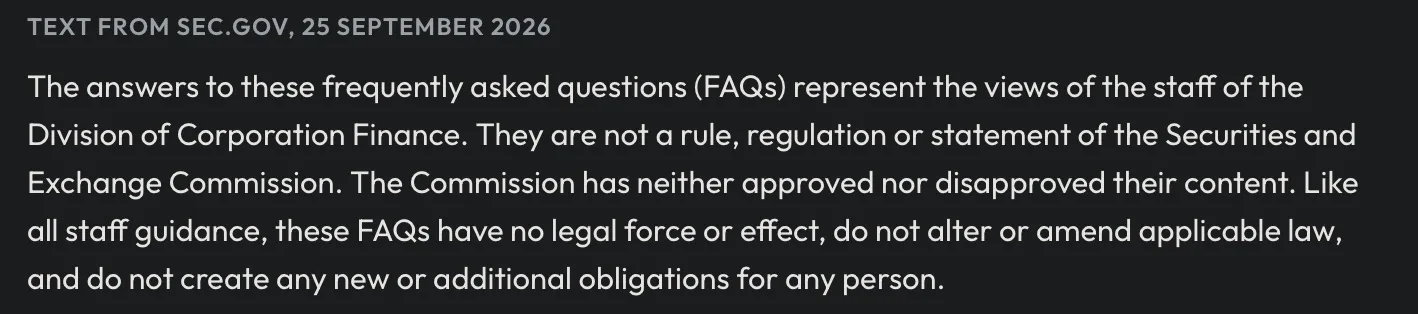
The document comes from the SEC's Division of Corporation Finance. Its opening disclaimer is unusually blunt: these are staff views, not a rule or a statement of the Commission, which has neither approved nor disapproved them; they have no legal force or effect and create no obligations.
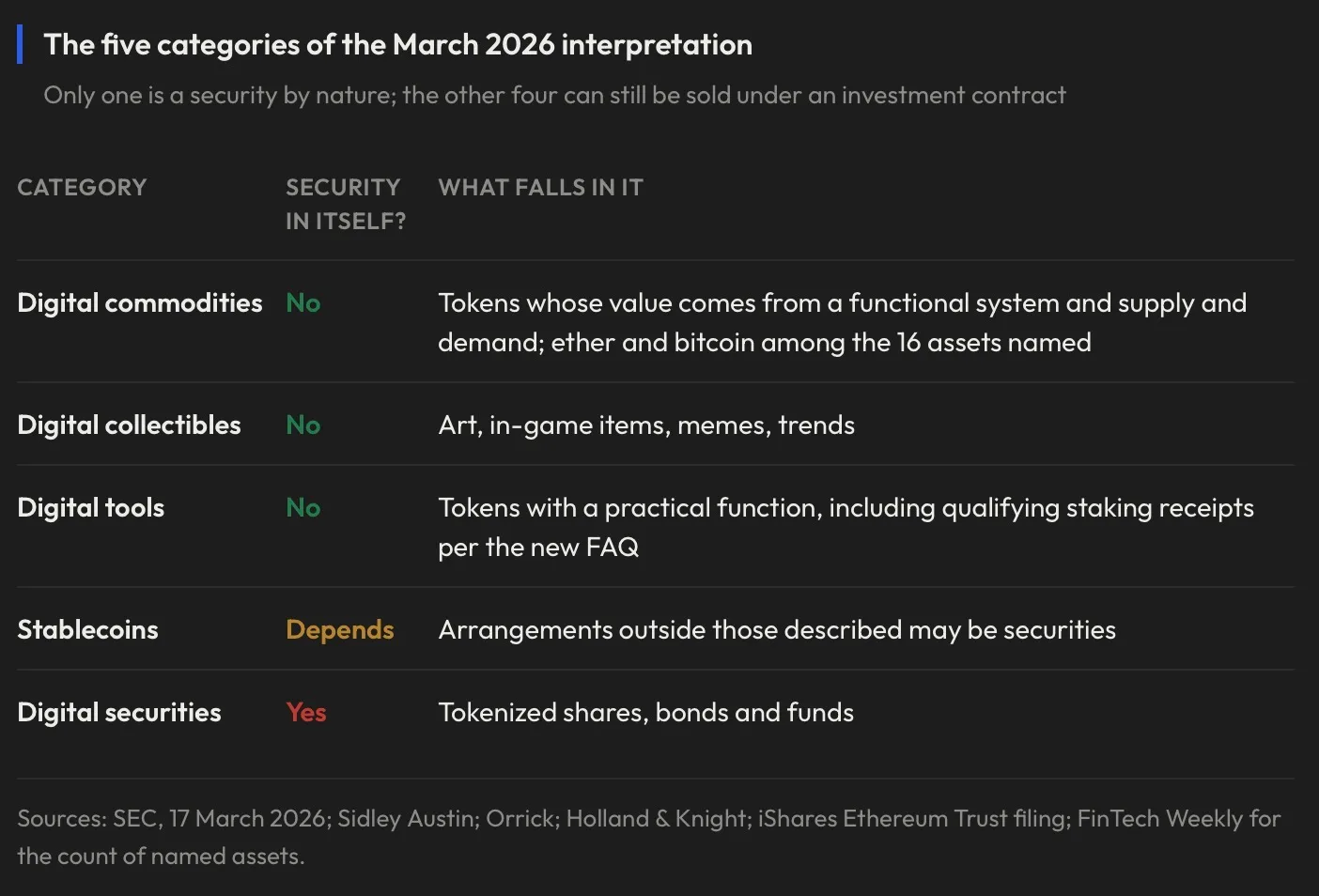
The FAQ applies a framework that already exists: a Commission-level Interpretive Release of 17 March 2026, joined by the CFTC and in effect since 23 March. That release replaced the SEC's 2019 "framework" and sorted crypto assets into five categories. Even that release is not final: the Commission said it was soliciting comment and could refine, revise or expand it, Gibson Dunn notes.
2. The three definitions everything hangs on
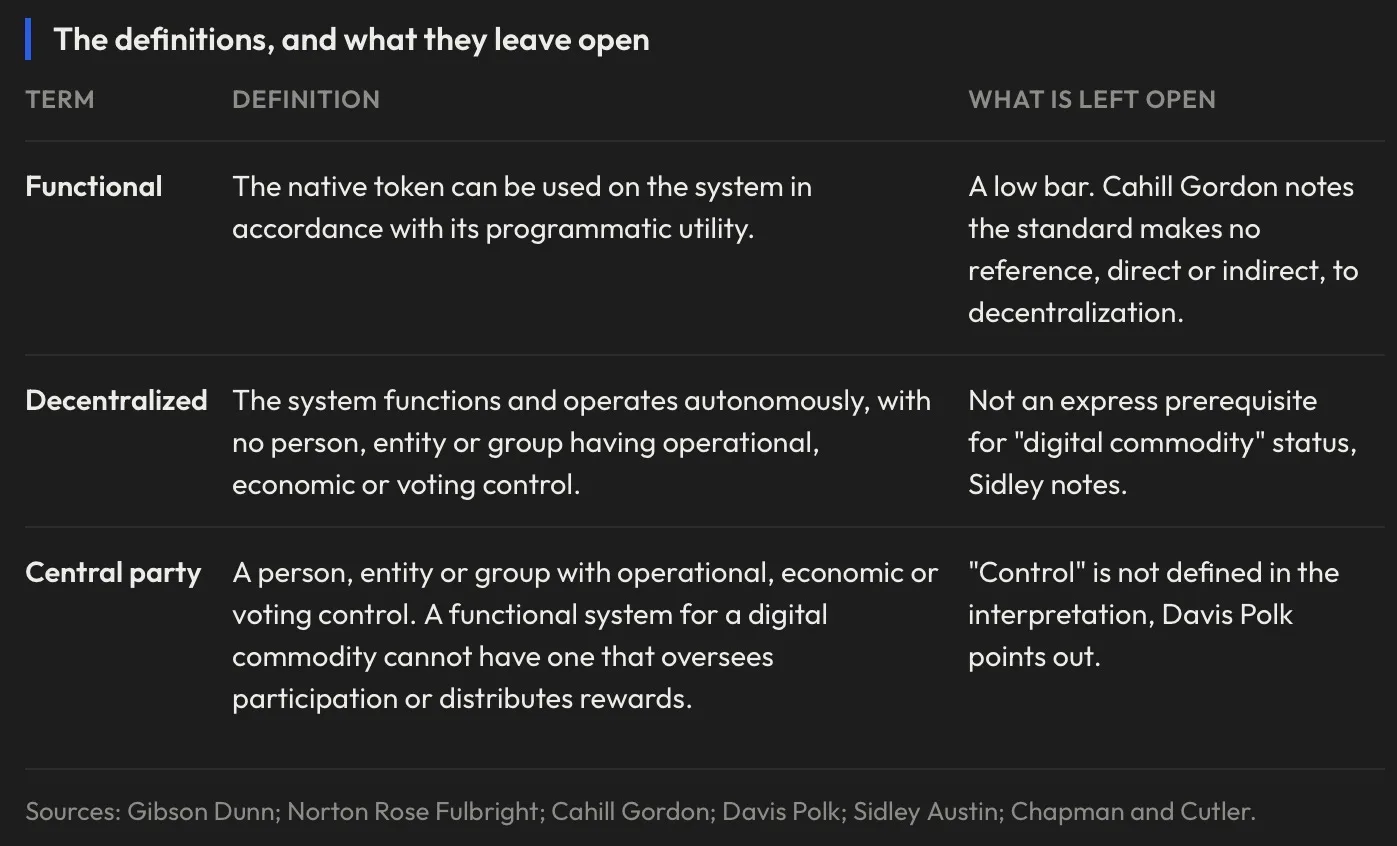
The whole system turns on three terms defined in the March release. Their exact wording matters, because the risks in section 7 live in their gaps.
3. Why the legal weight matters
US crypto rules now sit on four layers, each weaker than the one above. The viral reading treats the bottom layer as if it were the top.
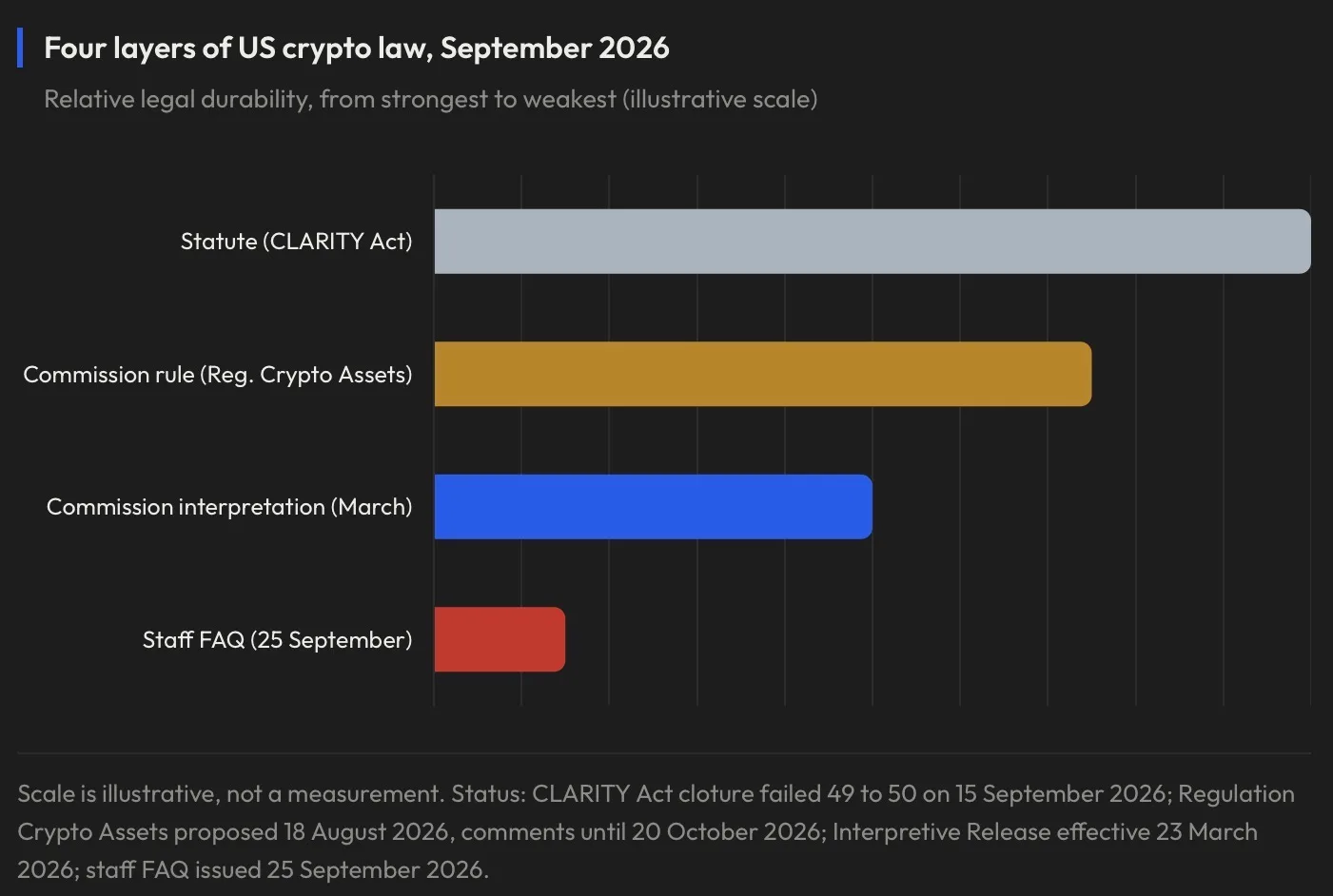
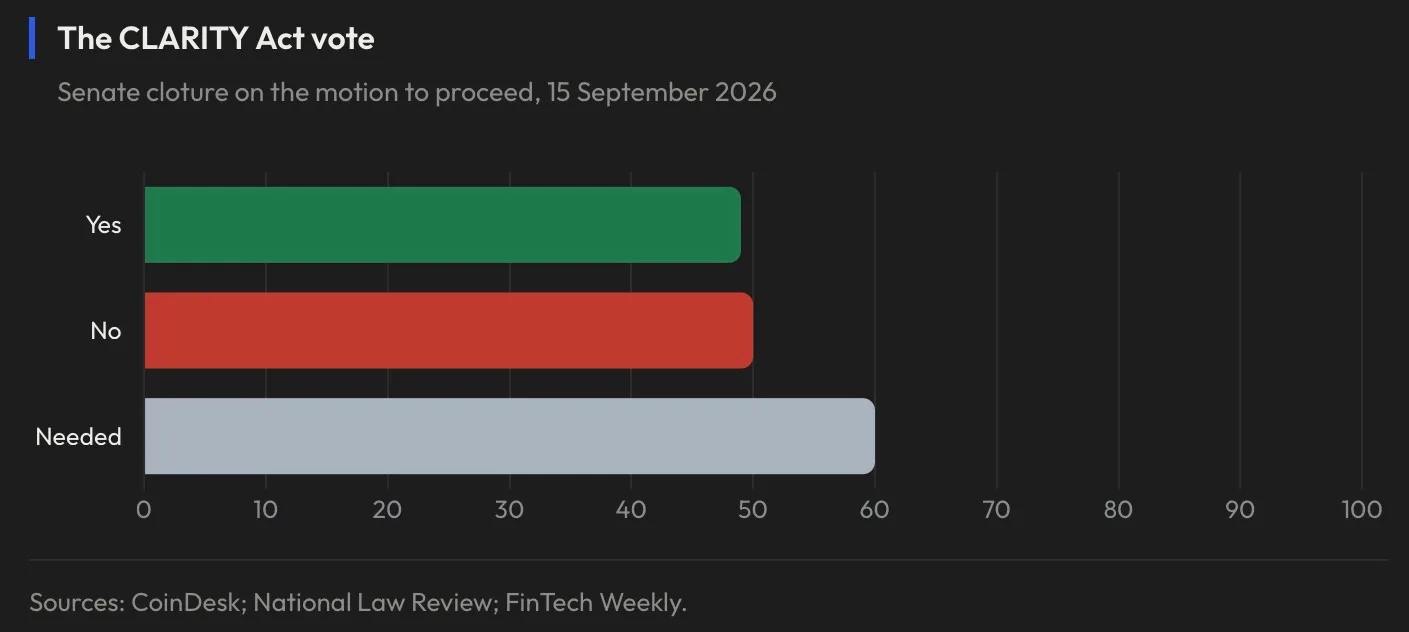
Ten days before the FAQ, the Senate failed to advance the CLARITY Act, the market-structure bill the industry had pushed since 2025. The cloture vote went 49 to 50, short of even a simple majority, against the 60 required. FinTech Weekly reports the sticking point was ethics language on officials' crypto holdings, not the split between the SEC and the CFTC.
The consequence goes beyond the SEC. Without that law, the CFTC cannot create a registration regime for spot digital-commodity exchanges, brokers and dealers; its spot-market powers are limited to anti-fraud and anti-manipulation enforcement, Troutman Pepper notes. Every token that leaves securities law lands in a market with no federal registration regime.
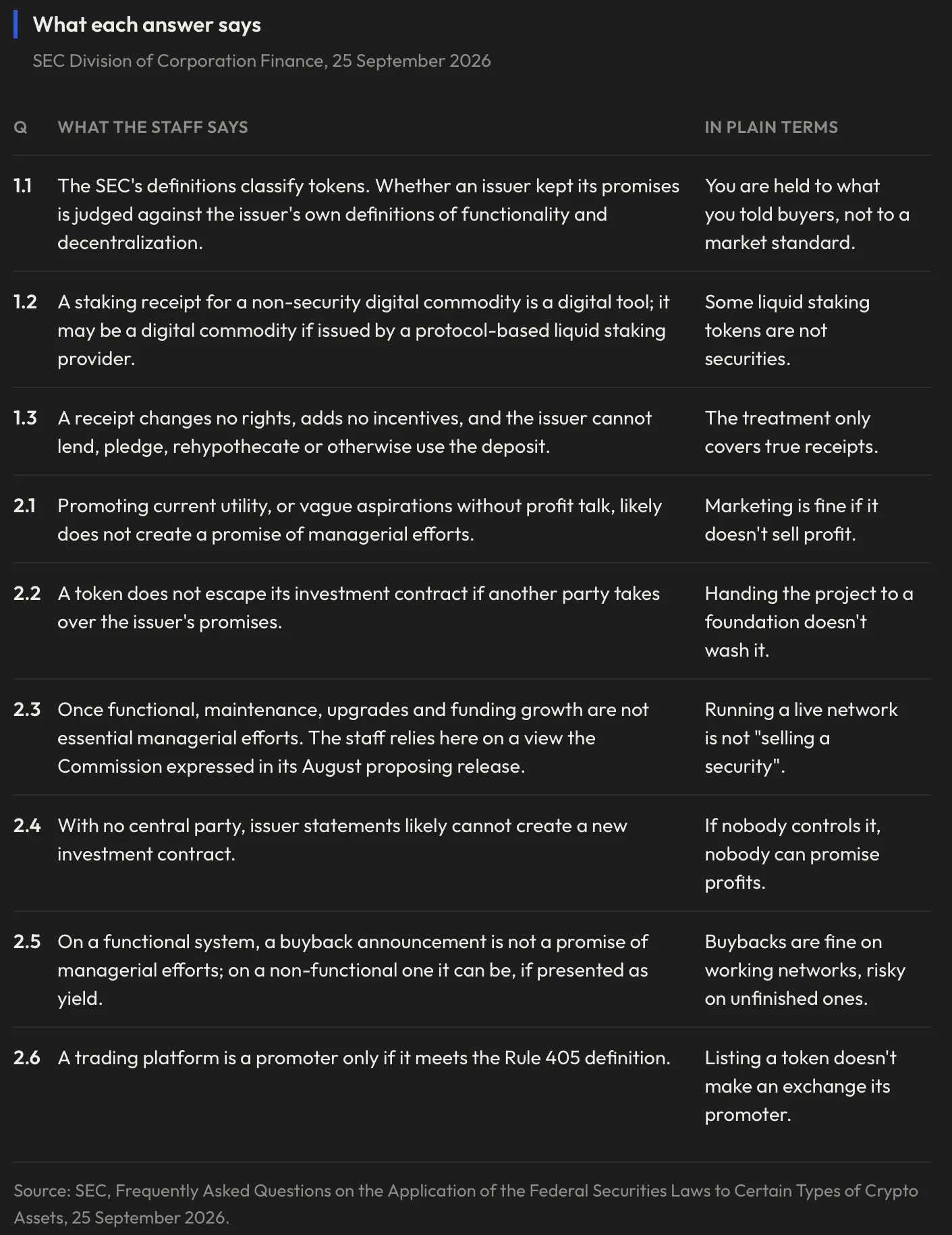
4. The nine answers, in plain terms
5. Buybacks: the money at stake
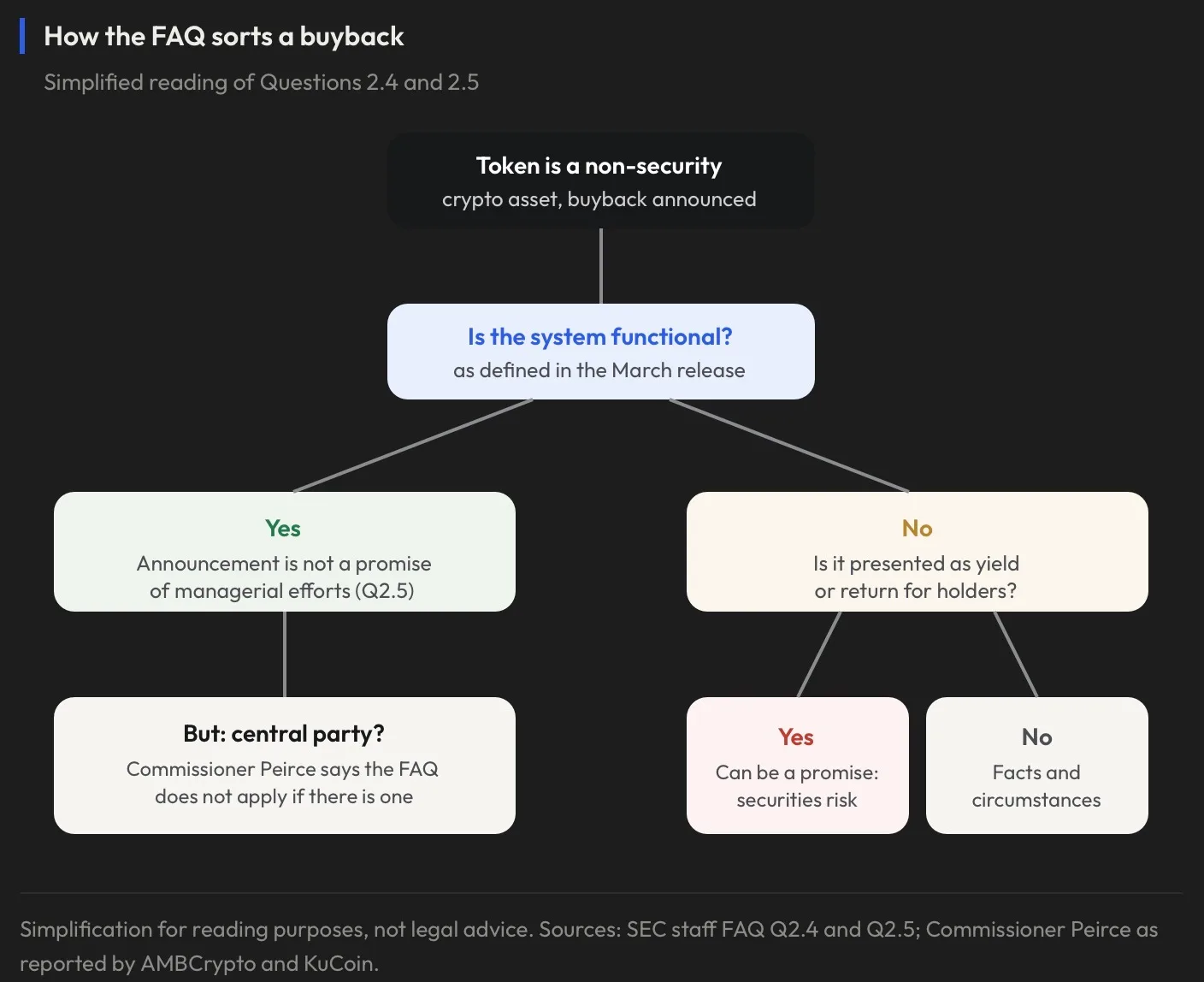
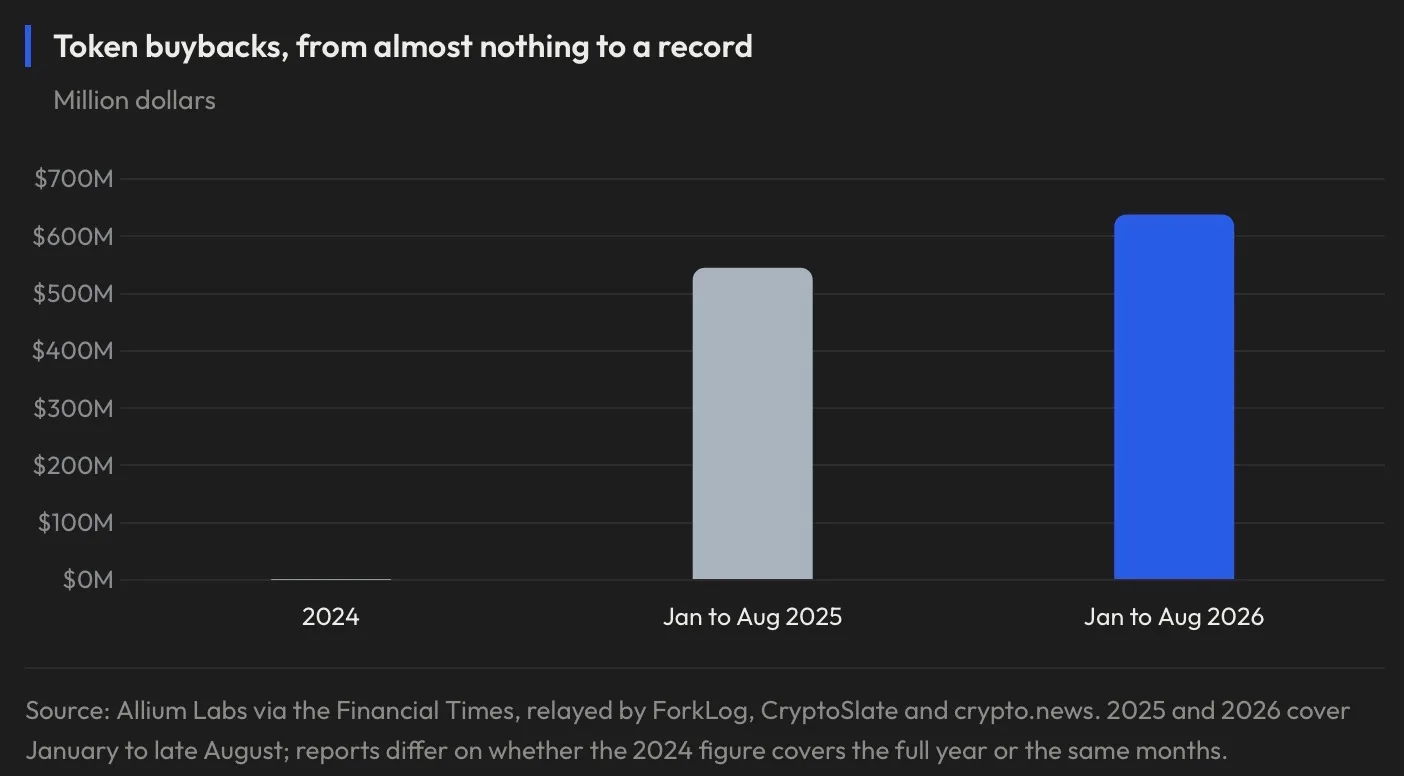
The buyback answer is the one the market cared about, because the money is already moving. According to Allium Labs data cited by the Financial Times, crypto projects spent about $638 million buying back their own tokens between 1 January and late August 2026, up from $545 million over the same months of 2025, and from just $366,000 in 2024.
The two leaders work differently. Hyperliquid routes nearly all eligible trading fees into an "Assistance Fund" that buys HYPE on the market and burns it; the platform had bought back roughly $1.3 billion of HYPE since launch, several outlets report. Pump.fun commits 50% of designated revenue to buying and burning PUMP through a locked smart contract. In the week ending 9 August, it spent about $5 million on buybacks, crypto.news reported, and in July it distributed about $86.5 million of vested PUMP to 121 team and investor wallets.
That last pairing is legal and publicly disclosed. It also illustrates the question the FAQ leaves open: when a project buys its token with revenue while insiders receive tokens they can sell, who is the buyback really for?
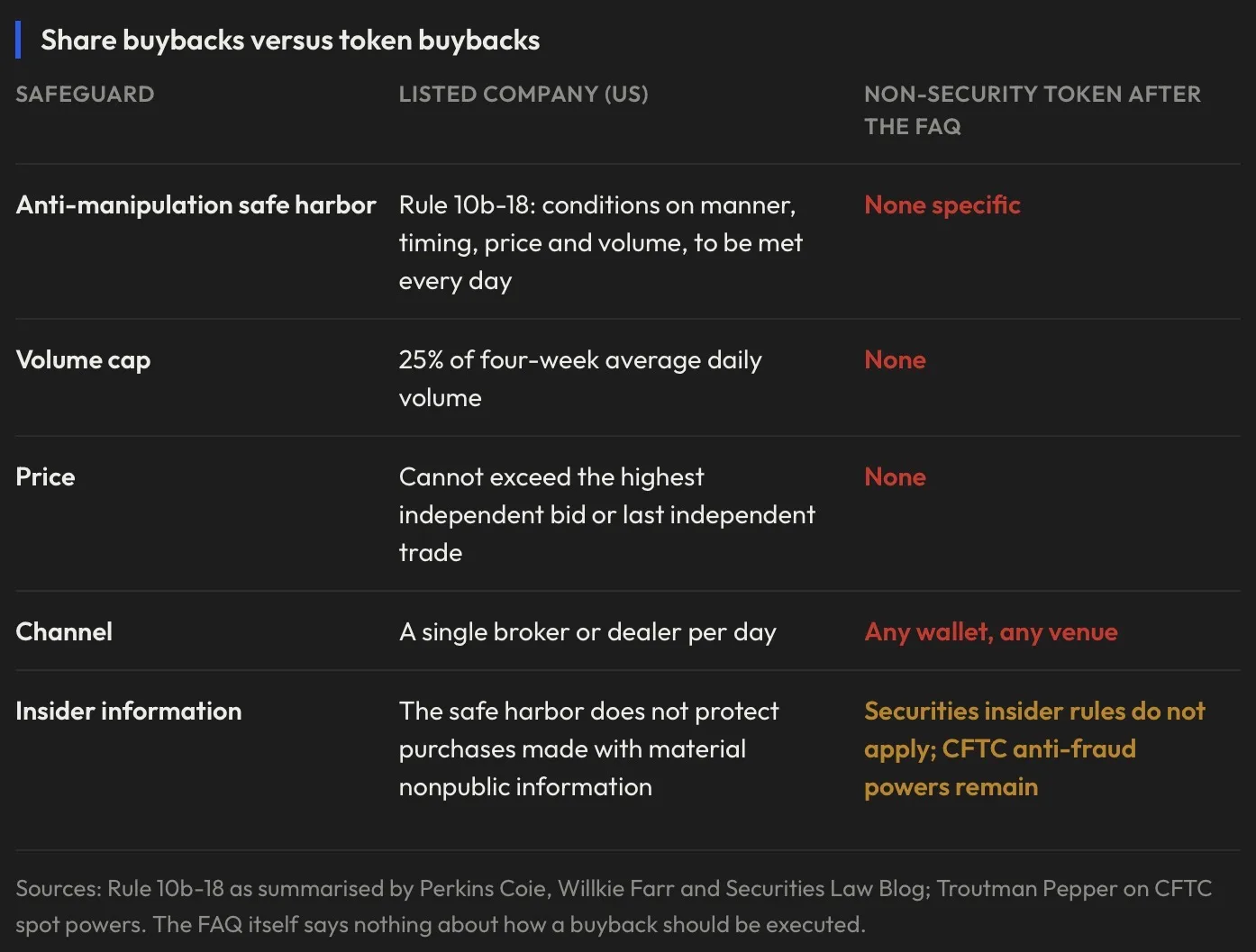
What a stock buyback has to respect, and a token buyback does not
6. Can companies now issue tokens without the SEC?
Partly, and most readers missed it. Under the March interpretation, a token that is a digital commodity, collectible or tool, and is not sold under an investment contract, needs no SEC registration at all. The issuer makes that call itself. No filing, no approval.
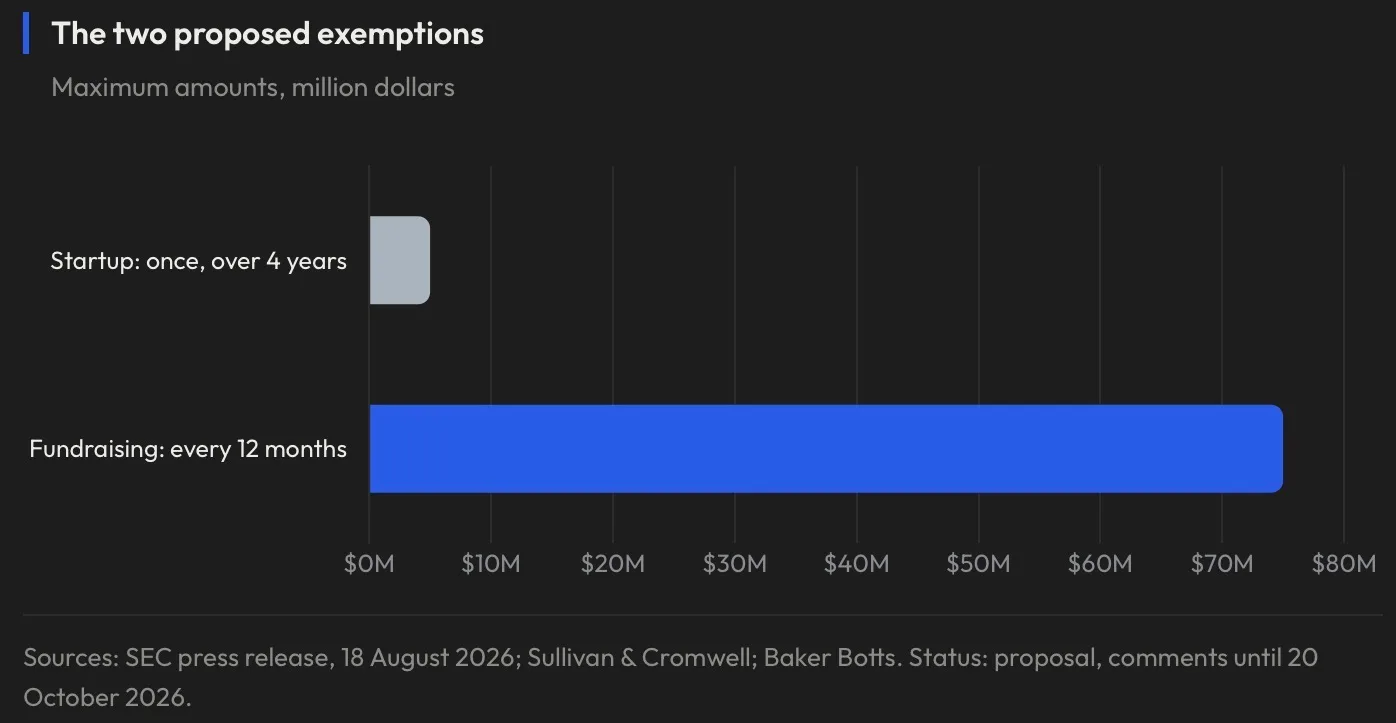
For tokens that are sold as investment contracts, the SEC proposed on 18 August a lighter road than a full public offering: Regulation Crypto Assets, a roughly 400-page proposal, White & Case notes.
7. What some companies could do, and why
None of what follows describes a specific company. These are the incentives the texts create, read against their own safeguards. For each: the move, why it pays, what already stands in the way, and what is still missing.
Each safeguard exists. What is missing is someone whose job it is to check, continuously, that the facts still match the label.
8. The AML and market-integrity angle
The FAQ answers one question: is this a security? For compliance teams, the more important effect is what happens to activity that ends up outside securities law.
FOR COMPLIANCE AND AML TEAMS
No federal spot regulator. Tokens pushed out of securities law land in a market with no federal registration regime for exchanges, brokers and dealers; the CFTC's spot powers are limited to anti-fraud and anti-manipulation enforcement.
Who is the obliged entity? Question 2.4 reasons that when nobody controls a network, nobody can make binding promises. The same absence leaves no identifiable party to run sanctions screening or answer a regulator.
Securities status and AML duties are different questions. Ashurst Perkins Coie warns that sanctions, anti-money-laundering, custody and payments rules may apply regardless of the securities analysis.
Buyback flows are hard to read. Treasury wallets buying on DEXs and CEXs, often continuously, make it harder to separate genuine demand from price support, and to spot insiders trading around known schedules.
Handover does not cleanse. Question 2.2 closes one escape route: transfers of promises to a foundation or DAO keep the token under its contract. Such transfers deserve scrutiny, not reassurance.
RED FLAGS THE FAQ MAKES MORE RELEVANT
A buyback announced before the network is demonstrably functional, marketed with words like "yield", "returns" or "revenue share".
Large insider unlocks scheduled during an active buyback, without disclosure of how the two interact.
"Decentralization" claims contradicted by admin keys, upgrade multisigs, or one foundation controlling treasury and development.
Liquid staking terms that allow lending, pledging or restaking of the underlying stake.
An issuer that defines "functionality" or "decentralization" in narrow, easily met terms in its own documents.
Promotion that shifts from current utility to price or profit after a listing.
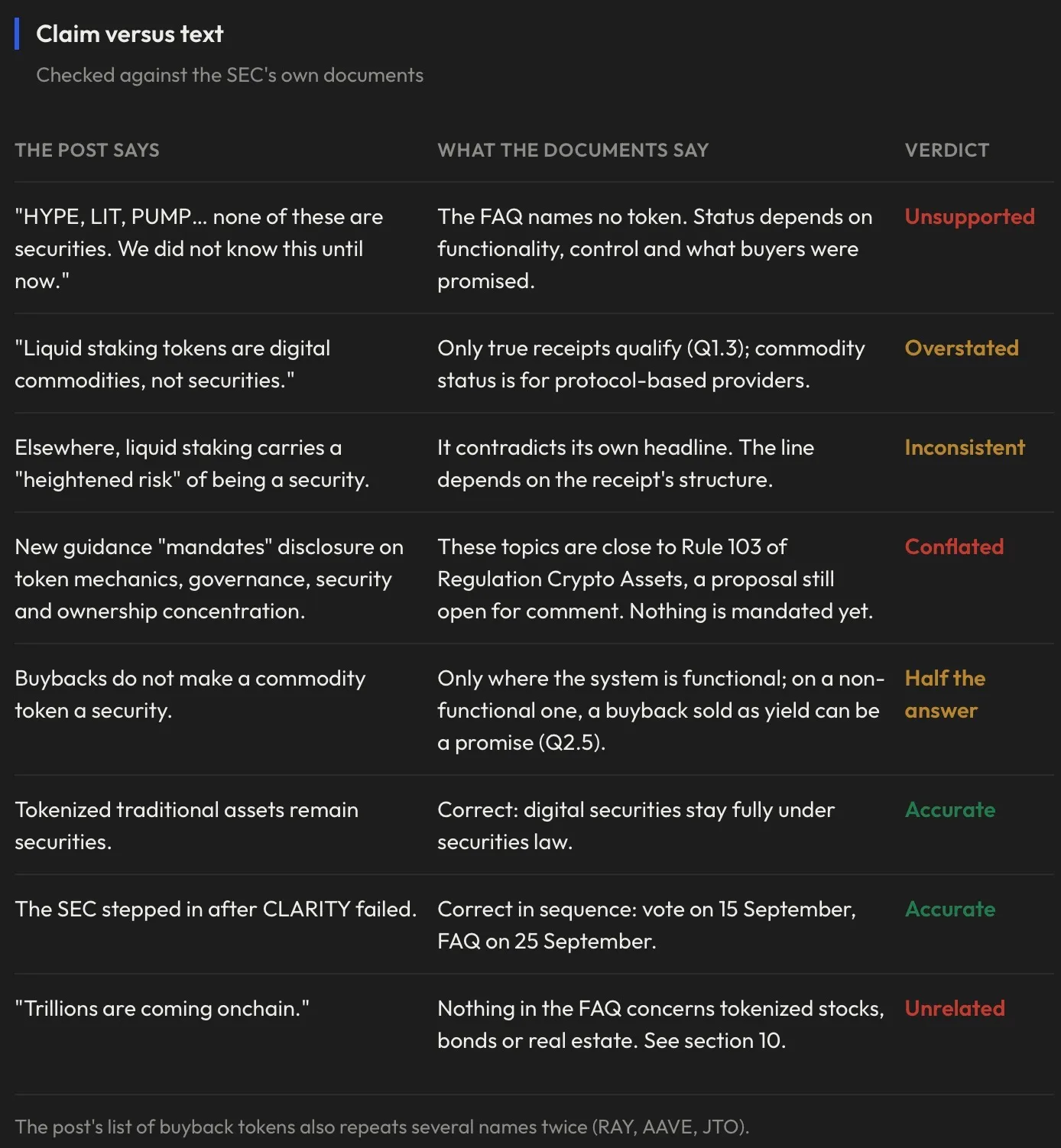
9. What the viral post gets wrong
10. The "mass tokenization" numbers
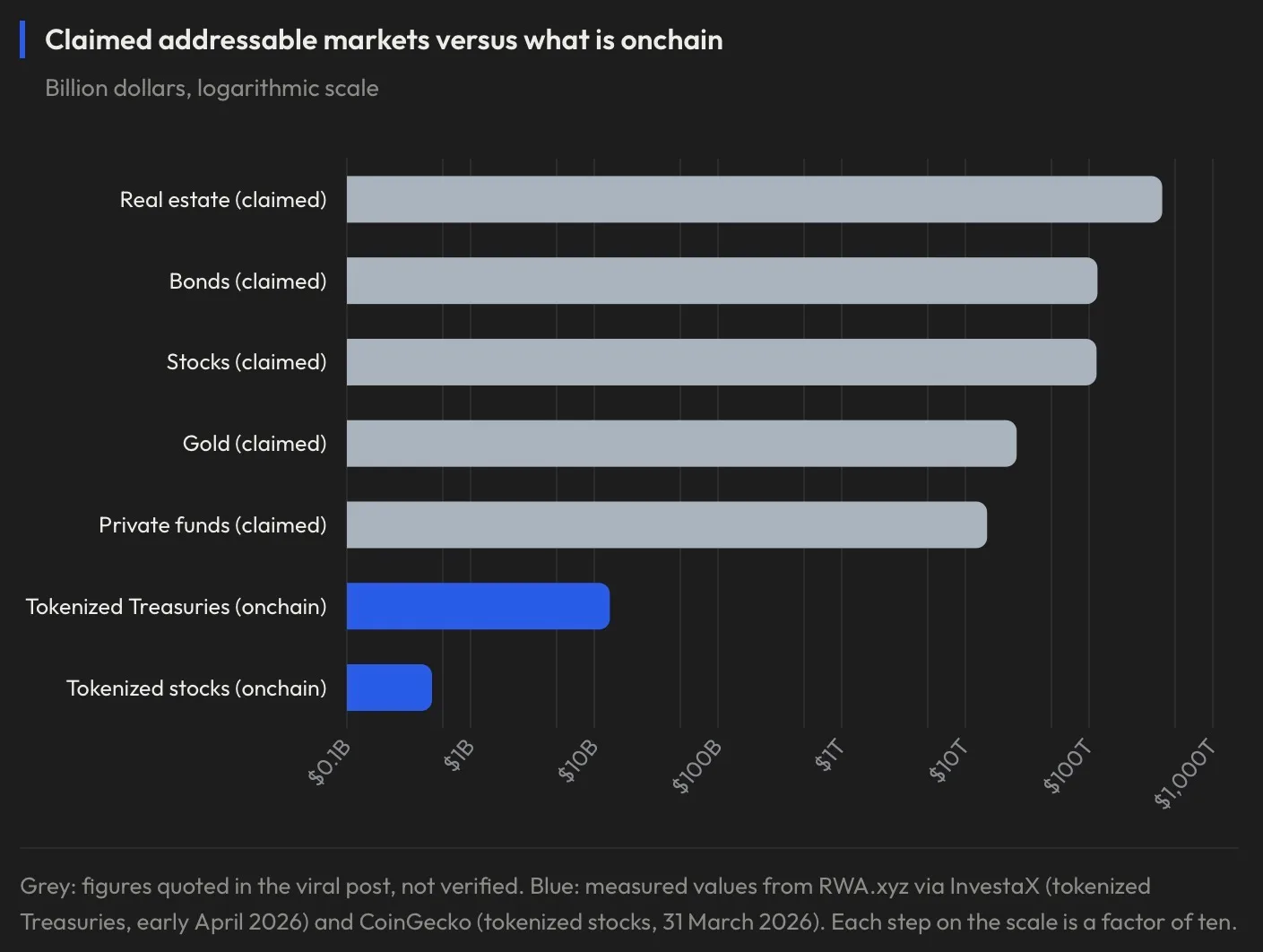
The post ends with figures meant to show what is coming: $115 trillion of stocks, $117 trillion of bonds, $390 trillion of real estate, $26 trillion of gold and $15 trillion of private funds "will be tokenized". These are the post's figures for entire asset classes, not forecasts, and Le Détroit has not verified them. What can be measured is what is onchain today.
11. What to watch
NEXT STEPS
20 October 2026. Comment deadline on Regulation Crypto Assets. The final text will decide whether the self-certified exit and the disclosure topics survive.
A definition of "control". The single word that would close most of the gaps in section 7.
Peirce's "central party" caveat, in writing. If the staff adds it to the FAQ, the loophole debate narrows sharply.
The first court test. Any private suit over a buyback token will show how much weight judges give staff views.
Buyback disclosure. Whether the industry adopts its own standards on funding source, wallets and insider trading before a scandal forces one.
CLARITY in 2027. The only route to a statutory framework and a real spot-market regulator.