
The essentials
- The news. Nvidia said on Thursday that Jensen Huang has resigned as president, chief executive and director, effective immediately. Its filing says the board accepted the resignation on Wednesday 11 November. No reason is given and Huang is not quoted.
- The new set-up. Chief financial officer Colette Kress is interim chief executive and keeps the finance job. Harvey C. Jones, a director since 1993, becomes the company's first-ever chair. The search will look at internal and external candidates.
- The background. On 8 November Huang told staff he had been unfaithful to his wife, naming no one. The New York Times had reported his relationship with a former executive of an Nvidia customer, then a US intelligence assessment that she was passing information to Beijing. The board's investigation has not reported, and China denies the claims.
- The market. The shares opened 13.1% lower at about $151, then rallied: $162.73 (-6.33%) at 9.59am New York time, according to Zonebourse, and $163.12 (-6.11%) at 10.18am, according to Stock Analysis.
- The calculation. At the opening price, about $548bn of market value had gone; by 9.59am about $283bn had come back, by Le Détroit's calculation.
1. A resignation written by the board
Thirty-three years end in a release that does not quote the man who built the company. Nvidia said on Thursday that Jensen Huang has resigned as president, chief executive and director, effective immediately; its filing says the board accepted the resignation on Wednesday 11 November. The documents give no reason and disclose no separation terms. The board thanks Huang for his "immeasurable contributions to the company and the industry".
The replacements say as much as the departure. Colette Kress, finance chief since 2013, becomes interim chief executive and keeps the finance job. Harvey C. Jones, a director since 1993 and a former Synopsys boss, becomes Nvidia's "first-ever Chair of the Board". "The Board has full confidence in Colette and the leadership team," he says. The search will "consider internal and external candidates", and results stay on Tuesday.
Resigned, or pushed? Nvidia says resigned. On Wednesday evening The Wall Street Journal reported that the board was preparing to oust him, and Reuters, citing a source, that directors were meeting to decide whether to oust him; on Thursday an NPR headline described him as ousted by the board. We found no statement from Huang on his departure.
2. What is alleged, and by whom
The crisis began with a customer, not a product. In late October The New York Times reported Jensen Huang's relationship with Alice Huang, a former executive of Megaspeed, a Singapore-based buyer of Nvidia chips, whom US authorities were investigating; on 6 November it reported a US intelligence assessment that she was passing information to Beijing. She is not related to Jensen Huang. On Sunday 8 November he wrote to staff, "I was unfaithful to my wife", naming no one, and the board opened an independent investigation into reports that he "has been the target of a foreign intelligence effort", saying it had "no reason to believe" that national security or Nvidia secrets were compromised.
On Wednesday the Times reported a second relationship, with an Nvidia executive who reports to him. Neither Nvidia nor Huang has confirmed it, and the Associated Press says it could not independently confirm the Times's reports; reached by the paper, Huang said: "I don't think you should be talking to me directly." China denies trying to ensnare him. The investigation has not reported, and Thursday's documents do not mention it.
3. From the bell to the open
The market started its verdict before the board delivered one. Nvidia closed on Wednesday at $173.73 and slid after hours as the reports spread. The release was out before Thursday's opening bell (the Associated Press had it by 9.06am New York time): by about 9.11am (3.11pm Paris) the shares were about 11% lower, near $155. The real fall came at the open: about $151 at 9.30am, down 13.1%, then lower still: ABC News had $150.05 at 9.32am, and Stock Analysis showed a low of $148.80 for the day. Then buyers returned. At 9.59am (3.59pm Paris) the price was $162.73, down 6.33%, according to Zonebourse: a rebound of 7.8% from the opening price in under half an hour. At 10.18am (4.18pm Paris) it was $163.12, down 6.11%, according to Stock Analysis. At 9.59am Zonebourse still had the stock down 11.97% over five days, and 14.29% since 1 January.
Switch the view; hover or tap a point or a bar for details
by 9.06am$173.73Wednesday close: $173.734pm New York, 10pm Paris, NasdaqMarket value at the close: about $4.19tn (24.1bn shares, Le Détroit's calculation)Reports that the board was preparing to oust Huang broke after the bell$159.37-8.3%After-hours low: $159.37Wednesday evening, New York time; 8.3% below the closeHyperliquid's Nvidia contract, which is not the share, went as low as $156.14 late on Wednesday (The Block)Both figures from our analysis this morning$155.00about -11%Premarket: about $155By about 9.11am New York (3.11pm Paris), after the release, about 11% down (Trending Topics)TokenPost: -12% at 9.15amEarlier, ZeroHedge had the stock 5.5% to 7% lower in premarket trading$150.99-13.1%Open: $150.999.30am New York, 3.30pm Paris; down 13.09% (ANI)SF Standard: $151.00; Stock Analysis: $151.01Market value lost at this price: about $548bn$150.05-13.6%9.32am: $150.05"More than 13%" down, ABC News, story timed 9.32am New YorkNot the day's low: Stock Analysis showed a low of $148.80 by 10.18am, 14.3% below the close (about $601bn of market value, Le Détroit's calculation)The deepest prices came at and just after the open, not before it$162.73-6.33%9.59.43am New York: $162.733.59pm Paris, Cboe BZX estimated real time, according to ZonebourseUp 7.8% from the opening price in under 30 minutes; down 11.97% over five days and 14.29% since 1 JanuaryLater: $163.12 (-6.11%) at 10.18am, 4.18pm Paris (Stock Analysis)
Points are evenly spaced, not to time scale. New York times; Paris is six hours ahead. The premarket point is approximate.
Market value moves are share count × price change, by Le Détroit's calculation. Bars to scale, $bn.
4. Le Détroit's calculation
The swings are measured in companies, not points. Nvidia had 24.1 billion shares outstanding in August, according to its latest quarterly filing, so Wednesday's close valued it at about $4.19tn. At the opening price, about $548bn of market value had gone; at the $148.80 low shown by Stock Analysis, about $601bn. By 9.59am the loss had narrowed to about $265bn: some $283bn came back within half an hour of the open, more than half of what had been lost. For scale, the loss at the open equals almost six quarters of Nvidia's revenue at its latest quarterly figure, $96.2bn; the rebound alone, almost three (Chart 1).
5. The night markets had priced an exit
Crypto venues said "soon" before Nvidia said "now". As our analysis "Nvidia's Night Shift" showed this morning, Polymarket's contract on Huang leaving by year-end went from 16% on Wednesday morning (24/7 Wall St) to 88% that night (Reuters), while Hyperliquid's Nvidia contract, deployed by Trade[XYZ], traded while Wall Street slept. On Thursday, before the release, Polymarket gave 40% to an announcement by the end of the day, 63% by Friday and 71% by the end of November. These markets traded on the press reports; nothing shows they knew more, and 40% also meant 60% against.
6. Who runs Nvidia now
The interim choice favours the accounts over the roadmap. Kress has joined Huang on results calls for 13 years and knows the numbers investors will scrutinise on Tuesday; her career has been in finance, not engineering. The name most often cited for the permanent job is Ian Buck, Nvidia's vice president of hyperscale and high-performance computing and a pioneer of CUDA, the software that ties developers to its chips: ahead on Polymarket, at 42% on Kalshi, and "the strongest long-term internal candidate" for Futurum's Shay Boloor. Outside names include Arm's Rene Haas. Mandeep Singh, global head of technology research at Bloomberg Intelligence, said Nvidia was unlikely to be "as aggressive" under new leadership, AFP reported on Thursday morning (Chart 2).
Hover or tap a card or a name for details
Jensen Huang
Co-founder, chief executive since 1993. Resignation accepted 11 Nov, effective immediately
Jensen HuangLeaves all three roles, including his board seatNo reason and no separation terms disclosed; he is not quoted in the releaseRelease: the board thanks him for his "immeasurable contributions to the company and the industry"Colette Kress
Finance chief since 2013, aged 59. Runs the company and its accounts
Colette KressJoined Nvidia in September 2013 after about 25 years in finance, including Cisco and MicrosoftKress, in the release: "NVIDIA's strength has always come from its people"Some directors favoured her as interim chief, Semafor reported before the decision (via Reuters)Harvey C. Jones
Director since 1993, aged 73. Former chief executive of Synopsys
Harvey C. JonesAppointed chair on 11 November, a post Nvidia never hadManaging partner of Square Wave Ventures, a family office, since 2004In the release, Jones expects operations, customer commitments and the product roadmap "to continue without interruption"7. Le Détroit's reading
The board is building in one night the counterweights Nvidia never had. A company worth more than $4tn had never had a chair of its board and, in one analyst's words, no succession plan in place. Thursday's set-up splits power three ways: a chair, an interim chief, a search. That is governance arriving late, under pressure.
The market's half-hour rebound is the other lesson. Investors sold the man, then bought back the business: the order books for Nvidia's chips did not resign. What they cannot yet price is the vacuum. Our reading: the real test is not the scandal, which the investigation will judge, but Tuesday, when a finance chief, now also chief executive, presents the numbers without Huang and has to show that Nvidia's strategy did not leave with its founder.
What to watch
- Tuesday 17 November: third-quarter results at about 1.20pm Pacific time (10.20pm Paris), call at 2pm Pacific (11pm Paris), as scheduled. It will be the first results call without Huang, with Kress in both jobs.
- The investigation: whether the committee of independent directors publishes findings, and whether the House China committee still seeks a briefing from Huang. Its chairman, John Moolenaar, said on Wednesday that Huang would likely be subpoenaed if he declined a briefing.
- The terms: the filing discloses no separation agreement. Watch for an amended filing and for any change in Huang's shareholding.
- The search: whether the board picks an engineer from inside, such as Ian Buck, or goes outside; and how long Kress holds both roles.
- The close: whether the morning's rebound holds through the session ($163.12, down 6.11%, at 10.18am New York time, according to Stock Analysis).
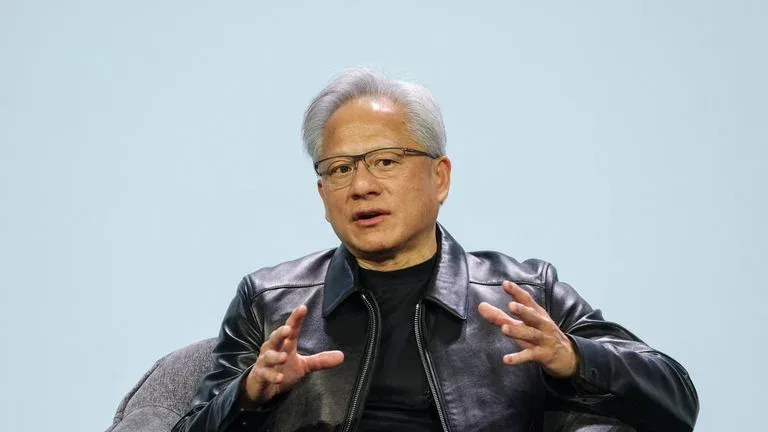
The reports about Jensen Huang's private life and about Alice Huang come from The New York Times and other outlets named in the text. They are allegations: Nvidia and Huang have not confirmed the second relationship, the board's investigation has not reported, and China denies the claims. We do not name the Nvidia executive identified by the Times; her name is not needed for this story. Share prices are those reported by the outlets cited, at the times stated (New York is six hours behind Paris). Figures labelled as Le Détroit's calculations are ours. The photograph was supplied to Le Détroit. This article is not investment advice.