
The essentials
- The order. The DGA, France's arms procurement agency, notified the production contract on Thursday 5 November and announced it on Monday 9 November: two IRIS satellites and their ground segments, with prime contracting shared by Airbus Defence and Space and Thales Alenia Space.
- The money. More than €1.5bn for the whole consortium, running to the end of the 2030s, according to Airbus. The DGA published no amount, and no one has disclosed how it is split.
- The mission. Extremely high-resolution optical imagery, by day and night in visible and infrared light, to replace the three CSO satellites. First satellite in service around 2033, both in orbit around 2035.
- The calculation. Even if every euro went to Thales, the order would equal about three and a half weeks of its 2025 sales; spread to 2039, about 0.5% a year, by Le Détroit's calculation.
- The market. Thales rose 3.16% to €228.70 on Monday and 1.75% to €232.70 on Tuesday, but Monday was a broad rally as oil fell.
1. France buys continuity, three years behind its 2025 horizon
France's next eyes in orbit are first of all a replacement. The DGA notified the production contract for IRIS on Thursday 5 November and made it public on Monday: two satellites that will take over from the three CSO satellites launched in 2018, 2020 and 2025, the backbone of the Musis system France shares with eight European partners. The new pair will shoot extremely high-resolution images of any point on Earth, by day and by night, in visible and infrared light, and will also photograph objects in space, a sign of where military threats are moving. The Space Command will operate them.
The calendar is the story. The DGA expects the first satellite in service "à l'horizon 2033" and both in orbit by 2035, in line with the updated 2024-2030 military programming law. In March 2025, the ministry's CSO-3 press kit described IRIS, a programme started in 2019, as a sovereign relay for CSO "à l'horizon 2030", with production starting in 2025. CSO satellites are designed for ten years: by Le Détroit's calculation, CSO-1 will be about fourteen years old when its successor is due.
Switch the view; hover or tap a block for details
Red dashed line: contract notified, 5 November 2026. Grey dashed line: the "horizon 2030" relay in the ministry's March 2025 press kit. Actual CSO lifetimes can exceed design life.
2. Two prime contractors, two versions of the first instrument
The DGA has given industrial prime contracting to a group formed by Airbus Defence and Space and Thales Alenia Space, the joint venture owned 67% by Thales and 33% by Leonardo. The split of the work is clear on the second satellite and blurred on the first. Airbus builds both platforms and leads the ground segment. Thales Alenia Space builds the second satellite's instrument, which it calls "the most advanced observation instrument ever built in Europe". On the first, Airbus claims "a significant share" of the payload and credits its partner with "critical elements"; Thales Alenia Space says it develops the imaging systems.
The money is just as blurred. The DGA gave no amount. The "more than €1.5bn" comes from Airbus, covers the whole consortium and runs to the end of the 2030s, operations and maintenance included. Nor should the name mislead: IRIS has nothing to do with IRIS², the EU's secure connectivity constellation, on which the same two companies took on work in September. IRIS watches; IRIS² connects.
3. Le Détroit's calculation: small money, long horizon
For Thales, the cheque is modest. The group sold €22.1bn in 2025 and guided in March to €23.3bn to €23.6bn this year, a forecast it firmed up in October. Even if all €1.5bn went to Thales, which it will not, the order would equal about three and a half weeks of 2025 sales. Spread evenly to 2039, it comes to about €115m a year, roughly 0.5% of annual sales.
The market cheered anyway, within limits. Thales rose 3.16% to €228.70 on Monday and 1.75% to €232.70 on Tuesday; Airbus gained about 4.9%. But Monday was a broad rally: the CAC 40 rose 1.16% as Brent fell 4.5%. Over one year the share is down 3.6%, according to the data provider Upside, while sales grew by 8.8% organically in 2025. Valuation is in the eye of the provider: from about 20 times estimated 2027 earnings (MarketScreener) to 32 times trailing earnings (Upside).
Hover or tap a bar, a point or a figure for the working
The €1.5bn is Airbus's figure for the whole consortium, so the bars almost certainly overstate Thales's share. Bars are drawn to scale.
4. Le Détroit's reading
What Thales gains is time. A State contract that runs to the end of the 2030s anchors workload and gives investors what defence groups sell best: visibility. Thales Alenia Space keeps its place at the heart of French military optics, after building CSO-3's instrument.
But the contract will outlive the structure that signed it. Airbus, Thales and Leonardo agreed in October 2025 to merge their space businesses in "Project Bromo": Airbus would hold 35%, Thales and Leonardo 32.5% each, in a group of about 25,000 staff with roughly €6.5bn of revenue. The deal still needs Brussels: the EU's competition chief has promised full scrutiny, OHB and Indra Space have raised competition concerns, and Leonardo's chief executive said in June he expected approval by the second half of 2027. Our reading: if the deal goes through, the space arms of IRIS's two co-primes become one company, and Thales's stake in the work falls from 67% of Thales Alenia Space to 32.5% of a bigger group. France would then, in effect, be buying its military eyes in orbit from a single supplier.
What to watch
- The split: whether the DGA, Airbus or Thales discloses each partner's share of the "more than €1.5bn", and whether Thales books its part in its full-year order intake.
- Bromo: the formal EU merger filing for the planned combination of the Airbus, Thales and Leonardo space businesses. Leonardo's chief executive said in June he expected approval by the second half of 2027; OHB and Indra Space have raised competition concerns.
- The calendar: IRIS 1 in service around 2033 and both satellites in orbit around 2035, against three CSO satellites built for ten-year lives. Any slip lengthens the gap.
- Partners: IRIS is "open to cooperation", like Musis and its eight European partners. Watch for the first partner country to sign up for access.
- The name: IRIS is not IRIS², the EU's secure connectivity constellation, whose first low-orbit satellites are due for delivery in 2029. Expect headlines to mix them up.
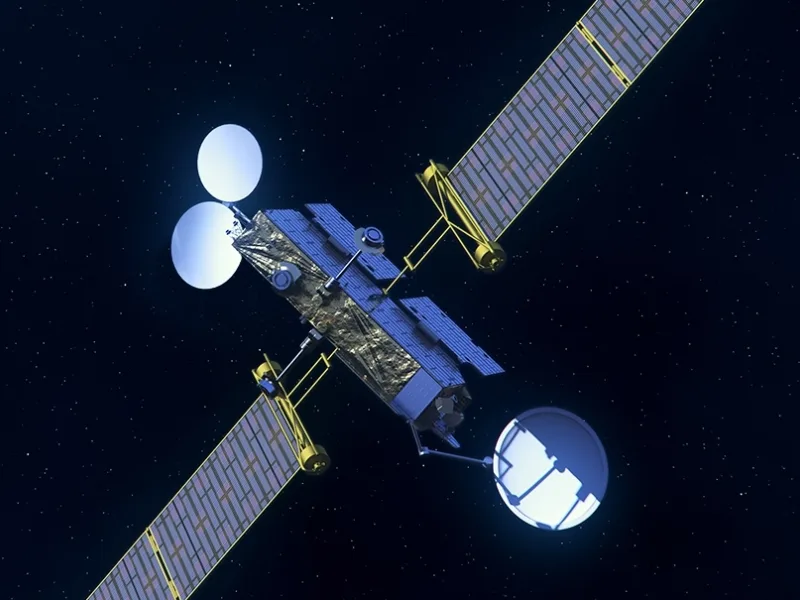
The contract value is Airbus's figure for the whole consortium; neither the DGA nor Thales published one. Figures labelled as Le Détroit's calculations are ours and, as a deliberate overstatement, treat the whole €1.5bn as if it went to Thales. Share prices are Euronext Paris closes as reported by MarketScreener and Upside. The lead image is an illustration of a satellite and does not show IRIS. French sources are translated by Le Détroit.