
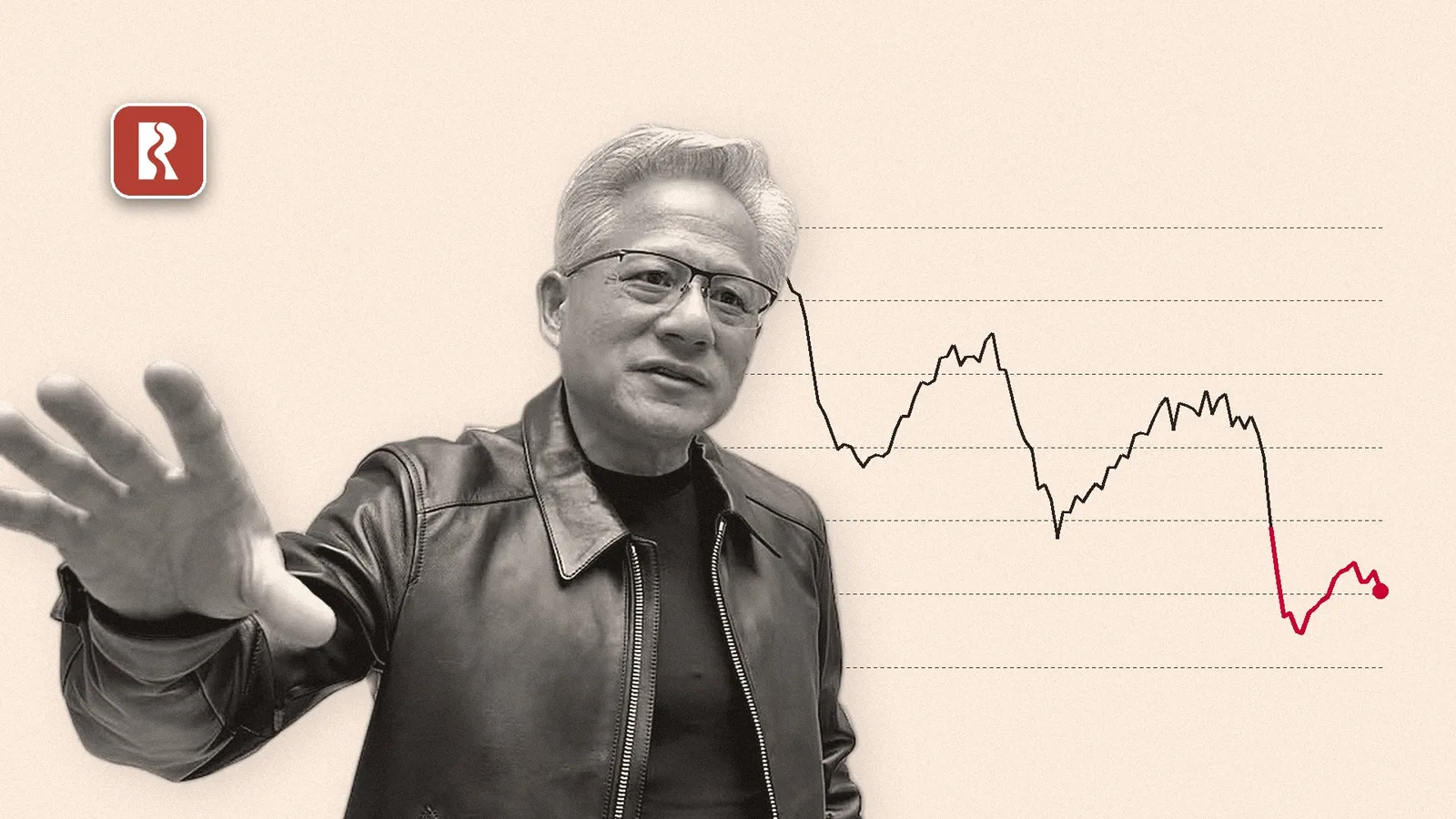

The essentials
- The night. After Nasdaq's regular session closed on Wednesday, The New York Times reported a second relationship involving Jensen Huang and The Wall Street Journal reported that Nvidia's board was preparing to remove him. As of Thursday morning in Paris, the board had announced no decision; the allegations are unproven.
- The contract. On Hyperliquid, a crypto exchange, a perpetual contract on Nvidia fell as low as $156.14, The Block reported, 10.1% below the close, and traded more than $1bn in a day for the first time, according to on-chain data cited by Odaily and PANews.
- The odds. Polymarket's market on Huang leaving by year-end went from 16% on Wednesday morning to 88% that night. The Huang markets were not new: both Polymarket and Kalshi listed them after Huang acknowledged a relationship in a memo to staff on Sunday 8 November.
- The money. ICE, owner of the New York Stock Exchange, has put $1.6bn into Polymarket and on 29 October took a stake in Trade[XYZ], the company that lists the Nvidia contract on Hyperliquid. It has not invested in Hyperliquid itself, which took no venture capital.
- The hole. Nasdaq and NYSE Arca plan to move to 23 hours a day, five days a week, on 6 December, subject to remaining SEC approvals. The weekend stays dark: about 48 hours, more than a quarter of every week, when no US venue quotes Nvidia and crypto venues keep trading it (Le Détroit's calculation).
1. The night shift
On Wednesday night, Nvidia's price was not made on Nasdaq alone. The stock closed at $173.73 at 4pm New York time, 10pm in Paris, up 2.9% on the day. Shortly afterwards The New York Times reported that Jensen Huang, Nvidia's co-founder and chief executive, had also had a relationship with a senior executive who reports to him, citing five people who worked at the company. The Wall Street Journal then reported that the board was preparing to remove him and could meet that night. Both landed after the closing bell; whether by design is not known. The San Francisco Standard places the Times story minutes after 4.42pm.
Traders could still use Nasdaq's after-hours session until 8pm, then the overnight systems brokers route orders to. Many went elsewhere. On Hyperliquid, a crypto exchange that lists a perpetual contract on Nvidia, the price began sliding around 5pm and fell as low as $156.14, The Block reported: 10.1% below the close, by Le Détroit's calculation. More than $1bn of the contract changed hands in a day for the first time, according to on-chain data compiled by Odaily and PANews, and CoinDesk ranked the contract fourth on the venue by open interest, behind only bitcoin, ether and Hyperliquid's own token. At 12.32 in Paris on Thursday, Hyperliquid's own screen showed $1.32bn traded over the previous 24 hours and $528m of open interest, with the contract 9.3% below its level a day earlier.
Hyperliquid was not alone. Binance's Nvidia perpetual traded about $2bn in 24 hours, roughly half of it after the US close, Finwire reported, and contracts on OKX and Bybit posted similar losses, according to CoinDesk. The shares themselves fell as far as $159.37 after hours, 8.3% below the close, BigGo Finance reported; by about 11pm the Hyperliquid contract, at $160.99, was back near the after-hours price. As of 10.30am in Paris on Thursday the board had announced no decision, and Nvidia was about 7% lower in early Frankfurt trading, Reuters reported. Nvidia did not immediately respond to requests for comment, according to Reuters; asked by the Times about the relationship, Huang said: "I don't think you should be talking to me directly." The allegations are unproven. On Sunday 8 November Huang acknowledged, in a memo to staff, a separate extramarital relationship, Reuters reported, and the board announced an independent investigation that day.
Hover or tap a dot, a row or a bar for the source
New York time, Paris below
- 16:0022:00Regular session closes: $173.73, up 2.9%.Yahoo Finance live blogClose at 4pm New York time, 10pm in Paris (up 2.9%). Nasdaq's after-hours session runs to 8pm, then overnight trading moves to alternative systems
- 16:4222:42Minutes later: the NYT reports a second relationship, with an executive who reports to Huang.Timing, attributedThe San Francisco Standard says the story ran shortly after investor Ron Conway's post at 1.42pm Pacific timeConway's post came minutes before the Times story; exact publication time not found. Huang to the Times, by phone: "I don't think you should be talking to me directly"
- 17:0023:00About 5pm: the Hyperliquid contract starts to slide.The BlockSliding from around 5pm; down as much as 10% late Wednesday, to a low of roughly $156.14
- 17:4023:40By 5.40pm: the WSJ says the board is preparing to oust him. Shares −7.1% after hours.AttributedThe San Francisco Standard published its account of both reports at 2.40pm Pacific time; TechCrunch says the WSJ report followed the NYT storyAfter-hours $161.40 at 5.40pm (BigGo Finance)
- 18:4500:45Kalshi: exit before 1 December at 80%.Kalshi News, 23.45 UTCBefore 1 December 80%; before 1 January 86%; before 1 July 2027 90%
- 19:5001:50Contract $158.86. Polymarket: 67% he is out by 12 November.The BlockPolymarket: 67% by 12 November, 71% by 13 November. Kalshi: departure before 13 November rose to 64%, from about 37% a few hours earlierTokenised Nvidia (NVDAx) fell as much as 9%
- 23:0305:03Contract $160.99. Binance, OKX and Bybit contracts show similar losses.CoinDesk; FinwireCoinDesk: Nvidia is the largest market linked to traditional assets on Hyperliquid by open interest, fourth overallBinance's NVDAUSDT contract: $2bn in 24 hours, about half after the US close (Finwire)
- LatenightLate: the board meets. Shares fell more than 8% after hours.ReutersThe board met late on Wednesday, New York time; no outcome reported overnightPolymarket's year-end market reached 88% late Wednesday
- 03:0309:03Thursday: no decision announced; about −7% in Frankfurt.The Next Web, 08.03 GMT; ReutersAs of 10.30am in Paris we found no announcement from the board. Nvidia did not immediately respond to requests for comment, Reuters said
Polymarket: out by 31 December
Wednesday night, other contracts
Listed before Wednesday, volume traded
2. A borrowed price, not a share
The contract at the centre of the night is a derivative, and an unusual one. It confers no claim on Nvidia: it is a perpetual future, a bet on the price that never expires, settled in the USDC stablecoin, with periodic funding payments between buyers and sellers to keep it near a reference price. Hyperliquid did not create it. Under a framework called HIP-3, any developer that stakes 500,000 HYPE tokens can deploy its own markets on Hyperliquid's order books and choose their price feed and leverage limits; validators can slash that stake for misconduct. The Nvidia market belongs to Trade[XYZ], whose deployment held 97% of open interest across these builder markets in late October, by TokenPost's count.
When Nasdaq is open, the reference is the share price, fed in by an oracle (Pyth, according to DefiLlama's listing cited by Finance Magnates). When it is closed, the contract trades on its own order book, within "discovery bounds" equal to one divided by the maximum leverage: 5% for a contract offering 20 times, as Finance Magnates explained; since March such bands can re-anchor, a Hyperliquid Research Collective study says.

3. Not the first night
Wednesday was a rerun. Huang's memo and the board's first statement came on Sunday 8 November, while the exchanges were shut. At 7am New York time on Monday the Hyperliquid contract stood at $177.69, 4.8% below Friday's close of $186.64, after $328.8m of trading in 24 hours, TokenPost reported; Blue Ocean, an overnight trading system used by retail brokers, had quoted about $180.30 on Sunday night, according to Reuters.
The template was set in February. Donald Trump announced US and Israeli strikes on Iran at 8.30am Paris time on Saturday 28 February, with every major exchange shut. Oil-linked perpetuals on Hyperliquid rose more than 5% almost at once, Euronews reported, while tokenised gold, Tether's XAUT, traded more than $300m in 24 hours. CME's oil futures reopened on Sunday evening, about 40 hours after the announcement, by our count.
The record also shows the limits. A study by the Hyperliquid Research Collective found that the oil contract, held back by its price bands, absorbed only about 44% of the gap to CME's reopening price on the first weekend of the war and about 29% on the second, when CME's April contract first printed at $106.89 against Friday's $91.35. Discovery happened, in instalments.
4. Pricing the boardroom
Prediction markets turned the reports into a number. Polymarket's contract on Huang resigning or being removed by year-end stood at 16% on Wednesday morning, according to 24/7 Wall St; by late evening it was 88%, Reuters reported. On Kalshi, its regulated US rival, the probability of a departure before 13 November went from about 37% to 64% within hours, and by 6.45pm New York time the market put an exit before 1 December at 80% (Chart 1).

Read across its deadlines, Polymarket's market tells a sharper story than any single number. When we checked it on Thursday, the year-end contract had eased to 79%, but traders gave 40% to an announcement by the end of Thursday, 63% by the end of Friday and 71% by the end of November. Most of the probability sits in the next few days: the crowd is betting less on whether the board acts than on how fast.
These markets were not created on Wednesday night. Both platforms listed Huang contracts after his memo of 8 November: by Monday afternoon Polymarket's resignation market had traded more than $305,000 and Kalshi's departure market more than $266,000, Fortune reported. Polymarket's "Next CEO of Nvidia" market opened at 9.17pm on 9 November. Depth is another matter. By Thursday morning that successor market had traded $45,257 in total, with Ian Buck, a senior Nvidia executive, the favourite at 32%: less than one twenty-thousandth of the Hyperliquid contract's daily volume. A headline probability built on a few thousand dollars can be moved by one trader.
The business is now regulated in the US. Polymarket left the country in 2022 after a settlement with the Commodity Futures Trading Commission, bought the CFTC-licensed exchange QCEX for $112m in July 2025 and won an amended order in November 2025 that lets it run an intermediated US platform, with customers trading through brokers and futures commission merchants, Covers reported. The arguments have not gone away. France's gambling regulator, the ANJ, ordered internet providers to block Polymarket in July; it considers prediction sites illegal gambling, Cointelegraph reported. In May US prosecutors charged a Google engineer with fraud over Polymarket bets allegedly based on inside information, The Block reported; the charges are unproven. A contract on a boardroom decision raises an obvious question about who knows the answer first. We have seen no evidence of trading ahead of Wednesday's reports.
5. Who pays for the plumbing
The clearest sign that these venues have grown up is who pays for them. Intercontinental Exchange, owner of the New York Stock Exchange, agreed in October 2025 to invest up to $2bn in Polymarket at a valuation of about $8bn before the money; it put in $1bn then and $600m in March 2026, saying that this and up to $40m of share purchases from existing holders would complete its obligations. On 29 October it announced a minority stake, of undisclosed size, in Trade[XYZ], the company behind the Nvidia contract, and agreed to be the exclusive operator of a regulated US market built on Hyperliquid, subject to regulatory approvals (Chart 3). "We see these perp markets as additive to our futures markets, not a replacement for them," said Jeffrey Sprecher, ICE's chair and chief executive.

Hyperliquid itself has no such backer. It took no venture capital: Jeff Yan, its Harvard-educated co-founder, a former Hudson River Trading algorithm developer according to eFinancialCareers, paid for it from the team's trading profits, Fortune reported, and the company had 11 employees in 2025; venture firms such as Paradigm hold its token. In place of shareholders it has a token, HYPE, and a fee machine: $918m of fees and $694m of protocol revenue over the year to late September, on $216.9bn of perpetual volume in 30 days, by DefiLlama figures compiled by Datawallet. Builder markets such as Trade[XYZ]'s made up about 30% of trading in the 30 days to early September.
 Polymarket
 Hyperliquid
Hover or tap a box or a bar
ICE owner of the New York Stock Exchange
Money in both venues of this story, but not in Hyperliquid itselfIntercontinental ExchangePolymarket: up to $2bn agreed in October 2025 at about $8bn before the investment; $1bn then, $600m in March 2026Trade[XYZ]: minority stake announced 29 October 2026, amount not disclosed; ICE to operate the regulated US markets, subject to approvalPolymarket
Prediction markets. Back in the US under CFTC oversight after an amended order in November 2025; $14.9bn traded on its US arm in OctoberPolymarketBought the CFTC-licensed exchange QCEX for $112m in July 2025; amended CFTC order in November 2025 (Covers)Polymarket US: $14.9bn in October 2026 (DeFi Rate). Blocked in France since July 2026 (Cointelegraph)Trade[XYZ]
Deploys the Nvidia contract and most stock, index and commodity markets on Hyperliquid. Also backed by Stanley DruckenmillerTrade[XYZ]95.1% of builder-market volume in the second quarter (Datawallet); its deployment held 97% of builder-market open interest on 28 October (TokenPost)Offers 24/7 contracts to eligible users outside the US (ICE). Druckenmiller said he is an investor (The Block)Kalshi
The CFTC-regulated rival; about $98bn traded in October, more than six times Polymarket USKalshiAbout $98.15bn in October 2026, DeFi Rate data compiled by Exploding TopicsIts Huang departure market had traded more than $266,000 by 9 November (Fortune)Hyperliquid exchange and blockchain
No venture capital: funded by its founders' trading profits. $918m of fees in a yearHyperliquidJeff Yan funded it himself; 11 employees in 2025 (Fortune). A token, HYPE, instead of outside shareholders$918.4m of fees and $693.7m of protocol revenue over the year to late September; $216.9bn of perpetual volume in 30 days (DefiLlama via Datawallet)Not like for like: perpetual volume is notional and includes leverage; prediction contracts are counted at $1 face value; overnight share trading is cash. The point is the order of magnitude.
6. The hole in the week
Wall Street is closing the gap on weeknights, not at weekends. Today an investor can trade Nvidia's shares on an exchange from 4am to 8pm on weekdays and through overnight systems from 8pm to 4am, Sunday to Thursday. Nasdaq and NYSE Arca plan to trade 23 hours a day, five days a week, from 6 December, from 9pm on Sunday to 8pm on Friday with a one-hour pause each weeknight, subject to remaining SEC approvals, Skadden notes; CME's equity and oil futures already run from Sunday 6pm to Friday 5pm. None of them covers the weekend (Chart 2).
Le Détroit's calculation
The regular session that sets Nvidia's official close lasts 32.5 hours a week, 19% of the 168. All US venues together offer 120 hours today; exchanges will offer 115 from 6 December, the same as CME. That leaves 48 hours each weekend with no US cash market today, and 49 on exchanges after the change: about 29% of the week.
In those hours no US venue quotes Nvidia, and the only order books open around the clock are on crypto venues; some brokers offer round-the-clock contracts for difference, but they set those prices themselves, Finance Magnates notes. Huang's memo landed on a Sunday; the strikes on Iran began on a Saturday.
Hover or tap a lane or a red marker
Paris
- 11 Nov, about 5pm: the reports
- 28 Feb, 2.30am: Iran strikes announced
- 8 Nov: Huang's memo (hour not public)
Paris
- 11 Nov, about 5pm: the reports
- 28 Feb, 2.30am: Iran strikes announced
- 8 Nov: Huang's memo (hour not public)
7. What the night is worth
Round-the-clock markets add three things. Speed: on the weekend of 8 November the contract was trading while the exchanges were shut, and on Wednesday it repriced within the hour of the reports. Access: that price is open every hour of the week to eligible users outside the US. Information: odds on a chief executive's departure are a public signal, and ICE has agreed to distribute Polymarket's data to its customers.
The limits are as visible. At its low the Hyperliquid contract stood about 2% below the lowest after-hours price reported for the shares, $159.37, by our calculation: first prices on thin books overshoot. Leverage magnifies the error: 83% of the 9,517 wallets in the contract were long by Thursday, with an average entry of $169.55 and unrealised losses of about $14.6m, Odaily's data showed. One deployer runs nearly all of Hyperliquid's stock, index and commodity markets and picks their price feed. Regulation remains a patchwork: US residents are kept out of Trade[XYZ]'s contracts, and the CFTC only opened a route for onshore perpetuals in May, through a staff advisory and no-action relief, according to The Block.
8. Le Détroit's reading
For a decade crypto's promised mass-market application kept failing to arrive. It turned out to be neither payments nor digital art but the hours Wall Street does not keep. On oil in February and on Nvidia over the weekend of 8 November, crypto venues were trading the news while the exchanges were shut; on Wednesday night they traded alongside the cash market and fell further. The most telling proof of maturity is the buyer list: the owner of the New York Stock Exchange has put $1.6bn into Polymarket and taken a stake in the company that lists Nvidia on Hyperliquid, so that it can run those markets inside a regulated perimeter.
That is also the paradox. The more these venues matter, the more they are absorbed. Weeknights pass to 23-hour exchanges in December; a regulated US version of Trade[XYZ] would be operated by ICE; prediction markets live under CFTC rules and state and foreign bans. What stays theirs is the weekend and the global user outside the US. That is a real franchise, not yet a revolution: a successor market worth $45,257 is a mood, not a price.
Wednesday's practical lesson is that the first price is not the final one. The Hyperliquid contract told the world within an hour that traders feared Huang's exit, overshot the after-hours market by about two points, then moved back towards it. The harder lesson is for boards, newsrooms and regulators: a market on a boardroom decision now stays open while the board is still meeting. Whether that is information or temptation depends on rules that, for now, differ by venue and by country.
What to watch
- Nvidia's board: whether it announces a decision on Huang, and what Nvidia says before its quarterly results on 17 November. How the Huang contracts on Polymarket and Kalshi resolve, under rules written before Wednesday.
- 6 December: the planned start of 23-hour trading on Nasdaq and NYSE Arca, subject to the remaining SEC approvals. The test is whether night liquidity moves back to regulated venues on weeknights.
- The regulatory path for ICE and Trade[XYZ]: which approvals they obtain for a US market built on Hyperliquid, and whether US customers, now excluded from Trade[XYZ]'s contracts, gain access through futures brokers.
- Any inquiry by an exchange or regulator into trading in Nvidia contracts or Huang markets ahead of Wednesday's reports. We have seen no evidence of such trading.
The reports about Jensen Huang's private life are allegations made by The New York Times and The Wall Street Journal; they are unproven, and we have kept personal details to what the market story requires. Nvidia did not immediately respond to requests for comment on Wednesday night, according to Reuters. Prices of the Hyperliquid contract and prediction-market odds come from the outlets cited, at the times stated; calculations labelled as Le Détroit's are ours. Volumes on different venues are not like for like. This article is not investment advice; perpetual contracts and prediction markets are not available to residents of some countries, including the United States for Trade[XYZ]'s contracts and France for Polymarket.