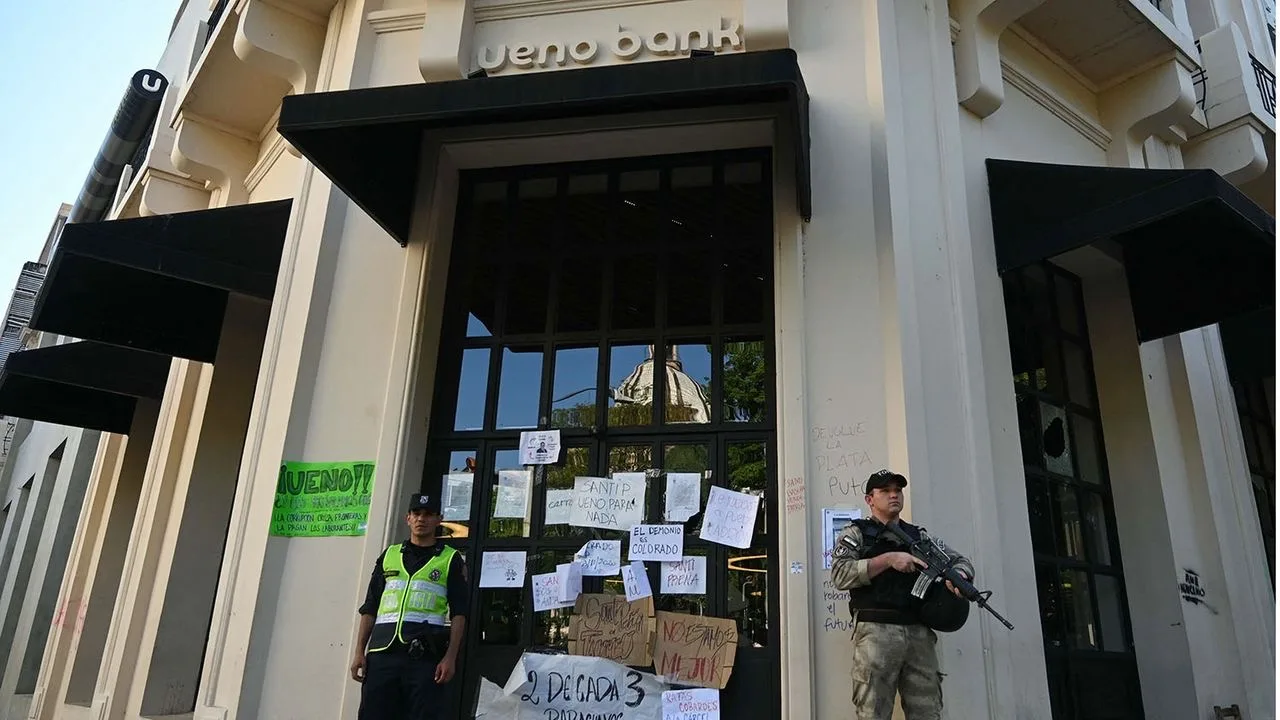
A Collapse, a Heist and a Hacked Safety Net: Sorting Out a Week of Bank Shocks
A Paraguayan bank failed, 128 Japanese banks went offline and France's Arkéa disclosed a roughly €100m theft in early November. The viral "130 banks" tally blurs what broke; the sharper test fell on the safety nets themselves.
By Le Détroit
Daniel Duarte/AFP
The essentials
Failure. Paraguay's ueno bank, with 2.9 million clients, was seized on 3 November and its deposit guarantee began paying on 5 November. The Senate removed President Santiago Peña on 6 November; on 7 November a judge ordered his pretrial detention, replacing house arrest. He denies wrongdoing.
Outages. On 6 November an equipment fault at a shared centre cut counters and ATMs at 128 Japanese shinkin banks for about five and a half hours; that evening Brazil's Pix payment system failed for some users.
Theft. Attackers who came in through a provider's platform moved about €100m out of Crédit Mutuel Arkéa's own account; part was blocked. The bank says customers lose nothing.
Data. Records of up to 320,118 borrowers leaked from SMBC Consumer Finance's loan-guarantee system. Brazil's deposit insurer, the FGC, disclosed that intruders had reached its payout systems.
Noise. Bank Rakyat's third-party-managed website in Malaysia was defaced, with no data taken, officials say. Indonesia's "350,600 attacks" is a dashboard count of detections, not breaches.
1. Count what broke, not the banks
The tally doing the rounds online, 130 banks hit in a week, is arithmetic rather than analysis: one Paraguayan bank, 128 Japanese shinkin banks and France's Crédit Mutuel Arkéa. It puts a bank failure, a hardware fault and a theft on one scale, while the breach that matters most, at Brazil's deposit insurer, does not even count. For customers, the question is what broke: money, access or data.
Sorted that way, the week shrinks. Only in Paraguay were savers locked out of their savings for days, and only there do some stand to lose money above the guarantee. The roughly €100m taken from Arkéa came out of the bank's own account; it says clients lose nothing. In Japan, counters and ATMs at 128 shinkin banks were down from about 1.30 pm to just after 7 pm on 6 November: an equipment fault, not a cyberattack, said the operators. That evening Pix, Brazil's instant-payment system, failed for some users.
2.9m
ueno clients whose accounts were frozen when Paraguay seized the bank on 3 November
ueno bank, ParaguayFunds of about 2.9 million clients, nearly half the population (EFE, Dólar Hoy)About 97% of depositors fully covered by the guarantee, the central bank says
128
Japanese shinkin banks whose counters and ATMs went down for about 5.5 hours on 6 November
Shinkin Kyodo Center networkFrom about 1.30 pm to shortly after 7 pm (NHK, Jiji, Kyodo)Equipment failure, not a cyberattack, the operators said
≈€100m
taken from Crédit Mutuel Arkéa's own account through a provider's platform
Crédit Mutuel Arkéa, FranceAbout €100m ($112m), per AFP; part of the funds blockedLe Détroit's calculation: about 43% of its €230m net profit in the first half of 2026
320,118
borrowers at most whose records leaked from SMBC Consumer Finance's guarantee system
SMBC Consumer Finance, JapanDetected on 2 November, disclosed on 5 NovemberDriver's licence numbers included; no ID images, the company says
Chart 1
What actually broke
Eight incidents reported from 3 to 7 November 2026, sorted by what customers risked
Hover or tap a tile for dates, scale and what customers lost
1 + 128 + 1 = 130 banks. One failure, one fault, one theft; the five other incidents are left out
Moneytaken or locked
counted: 1
Crédit Mutuel Arkéa
≈€100m
from the bank's own account
Clients: no loss, says the bankFrance, disclosed on 4 NovemberAttackers came in through a provider's platform and used Arkéa's own account to wire funds to other banks, from which they were converted into crypto-assetsAbout €100m ($112m), per AFP; the investigator ZachXBT had estimated more than $133m. Part of the funds blocked; some customer transfers delayed
counted: 1
ueno bank
2.9m clients
accounts frozen on 3 Nov
Clients: covered up to ≈G228mParaguay, seized on 3 NovemberSolvency ratio about 5.56% against 12% required, per the central bank. The guarantee covers 75 minimum wages per depositor, about 228.3m guaraníes; about 97% of depositors fully coveredPayouts from 5 November: 1,196,000 depositors paid by 7 November. Sums above the cap depend on what ueno's remaining assets yield
Accesscut for hours
counted: 128
128 shinkin banks
≈5.5 hours
counters and ATMs down
Clients: delays, no loss reportedJapan, 6 NovemberFrom about 1.30 pm to just after 7 pm, from Tokai and Hokuriku westward, on the network run by the Shinkin Kyodo CenterEquipment failure, not a cyberattack, said the operators. Osaka Shinkin: some transfers dated 9 November
not counted
Pix
≈10,000
Downdetector complaints by 7.15 pm
Clients: failed payments for a timeBrazil, evening of 6 NovemberUsers of several banks could not pay or transfer; Itaú said it had identified a problemThe central bank spoke of a "partial instability" and said its own systems worked normally (A Tarde). No cause or restoration time published
Dataexposed, no money
not counted
SMBC Consumer Finance
≤320,118
borrowers' records leaked
Clients: identity data leakedJapan, disclosed on 5 NovemberUnauthorised access detected on 2 November. Names, addresses, phone numbers, employer details and incomes, driver's licence numbers; no ID imagesBorrowers of partner lenders: Docomo SMTB Net Bank alone counts up to 122,635
not counted
FGC, deposit insurer
Undisclosed
number of people affected
Clients: identity data reachedBrazil, disclosed on 5 NovemberSuspected intrusion identified on 26 October. Names, CPF tax numbers, emails, dates of birth, tax withheld on guarantee paymentsNo evidence of disclosure, misuse or financial loss so far, says the FGC; ANPD informed
Nothingtaken, officially
not counted
Bank Rakyat
1 website
defaced, run by a third party
Clients: nothing taken, says the bankMalaysia, night of 6 NovemberCorporate portal disrupted late on Friday; the bank blamed a technical issue at a third-party provider. The minister said it was "limited to web defacement"A hacker using the name MARLANWG reportedly claimed it (FMT). Customers redirected to iRakyat
not counted
Indonesia
≈350,600
live-dashboard detections, 7 Nov
Clients: no breach confirmedFortiGuard Labs threat map, as reported on 7 NovemberAbout 214,000 in banking, finance and insurance. Detections are not intrusions; Fortinet and BSSN had not confirmed the figuresLe Détroit's calculation: 350,600 over 86,400 seconds is about 4 a second
Source Company and bank notices; BCP via Última Hora; AP; AFP; Jiji; NHK; Kyodo; Next.ink; Seu Dinheiro; Times Brasil; A Tarde; Bernama; FMT; Industry.co.id; Le Détroit's calculationsLe Détroit
2. Paraguay: the guarantee pays, the politics breaks
Paraguay is the week's only real solvency failure, and its deposit guarantee is doing its job. Regulators seized ueno bank on 3 November, after the central bank (BCP) put its solvency ratio at about 5.56%, against 12% required. The digital bank held the funds of 2.9 million clients, nearly half the population. The guarantee covers 75 monthly minimum wages per depositor, about 228.3 million guaraníes or $36,800 at 6,200 to the dollar, the rate Última Hora used on 7 November, enough to protect about 97% of depositors in full, the BCP says.
Payouts for balances of up to 10 million guaraníes began on 5 November. By 7 November, 1,196,000 depositors had received 994.6 billion guaraníes, about $160m at that rate. By Le Détroit's calculation, that is about 830,000 guaraníes per saver, roughly $134: the first wave was one of very small balances.
The politics moved faster than the money. All 44 senators present voted on 6 November to remove President Santiago Peña; lawmakers accuse him of letting the state pension fund place $355m at the bank beyond legal limits. On 7 November judge Humberto Otazú ordered his pretrial detention for breach of trust and administration for personal benefit, Última Hora reported. Peña denies wrongdoing. His successor, Pedro Alliana, is also under investigation; neither has been convicted.
Chart 2
Two safety nets under strain
ueno's deposit guarantee, and the breach at Brazil's insurer, as of 7 November 2026
Hover or tap the bars and figures for details
Paraguay: what each saver gets back
Balances up to G10mpaid from 5 Nov
Paid by transfer to another bank, first to savers with no debts to ueno
First tranche, from 5 NovemberThe first group: depositors with no debts to ueno and an account at another bank (EFE, Última Hora); for savers who owe the bank, overdue sums are deducted first in a later phase1,196,000 depositors had received 994.6bn guaraníes by 7 November, the central bank said
Advance up to 40 minimum wages≈G122m
Announced by the central bank; timing of the rest not confirmed
Announced by the central bankAn advance of up to 40 minimum wages per depositor (iProUP), about 122m guaraníes by Le Détroit's calculationA Senate text for an advance of up to 121m still needs corrections in the lower house (Dólar Hoy); we could not confirm when larger balances will be paid
Cap: 75 minimum wages≈G228.3m
≈$36,800 at G6,200 to the dollar; covers about 97% of depositors in full
The legal ceiling per depositorAbout 228.3m guaraníes; AP gives about $35,000, Le Détroit's conversion at 6,200 gives $36,800Balances above it depend on what can be recovered from ueno's remaining assets
1,196,000depositors paid by 7 NovCentral bank, 7 NovemberFirst tranche completed for balances of 1 to 10 million guaraníesSome reported missing or odd credits; the central bank says its portal shows only processed lots
G994.6bn≈$160m at G6,200 to the dollarPaid from the guarantee fundÚltima Hora put it at about $168mThe fund is fed by state bonds and quarterly bank contributions of 0.12% of average deposits
669,336accounts still pendingLarger balances, fewer accountsLater tranches involve fewer accounts, more money per account and more checks, the central bank said on 7 NovemberBalances above the cap wait for the final balance of ueno's assets
≈G830,000average first-tranche payout, about $134Le Détroit's calculation994.6bn guaraníes divided by 1,196,000 depositorsOnly balances of up to 10 million guaraníes are in this tranche
Brazil: the insurer itself breached
OctNov
26272829303112345
10 days between detection and public notice
26 Oct: intrusion suspectedmeasures taken
Access to the affected systems restricted, rogue accounts blocked, evidence preserved
What the FGC says it didRestricted access to the affected environments and blocked improper accountsReviewing permissions and security controls with specialist firms
5 Nov: public statementANPD told
No evidence of misuse or financial loss so far; number of people not disclosed
What is still openWhether data was copied or disclosed is under investigationThe FGC warns the data could make scam calls more convincing
Data reached
NameCPF tax numberEmailDate of birthTax withheld on payoutsWhere the investment was sold
Bars are proportional to the 228.3m-guaraní cap. Source BCP via Última Hora (7 Nov 2026), AP, Dólar Hoy, iProUP; FGC via Seu Dinheiro (5 Nov 2026); Le Détroit's calculations, at 6,200 guaraníes per dollarLe Détroit
3. One centre, one provider, one guarantor
Shared plumbing is the second lesson. The Japanese outage hit 128 banks at once because they share a network run by the Shinkin Kyodo Center; Kyodo reported that they had updated their systems there in mid-October, though no link to the fault has been shown.
Arkéa's attackers "went through the platform of one of our providers", the bank said, then used its own account to wire money to other banks, from which it was converted into crypto-assets. Part is blocked. By Le Détroit's calculation, €100m equals about 43% of Arkéa's net profit of €230m in the first half of 2026.
SMBC Consumer Finance's leak fits the pattern. The breached system runs its guarantee business for card loans sold by regional, shinkin and internet banks, so one intrusion, detected on 2 November, exposed the borrowers of many lenders: Docomo SMTB Net Bank alone counts up to 122,635 of the 320,118. Names, incomes and driver's licence numbers leaked, but no ID images.
4. The insurer breached, and a dashboard taken for a siege
The week's most telling breach hit a safety net. Brazil's Fundo Garantidor de Créditos (FGC), which repays savers when a bank fails, said on 5 November that intruders had reached the systems behind its guarantee payments and accessed names, CPF tax numbers, emails and dates of birth. It first suspected the intrusion on 26 October. It reports no misuse or loss, has told the data regulator and has not said how many people are affected. As the FGC itself warns, the data could make scam calls more convincing.
Indonesia's alarming number is a screenshot. Local media reported about 350,600 "attack activities" on FortiGuard Labs' live threat map on 7 November, about 214,000 of them in banking, finance and insurance: 61% by our calculation, with about four detections a second overall. These are detections, not breaches; neither Fortinet nor BSSN, the national cyber agency, had confirmed them, and later readings gave different totals.
Chart 3
Indonesia's "350,600 attacks": one dashboard, three readings
FortiGuard Labs' live threat map as reported by Indonesian media on 7 and 8 November 2026; each square is 1% of the figures shown
Switch the reading; hover or tap a row or figure for details
7 November, 24 hours: Indonesia, about 350,600 detections
Banking, finance and insurance214,00061%About 214,000 detectionsLe Détroit's calculation: 61% of 350,600, more than all other sectors combinedAnother screenshot showed about 206,000
Government and vital facilities79,00023%About 79,000 detectionsLe Détroit's calculation: 23% of 350,600Another screenshot showed about 73,000
Everything else (residual)57,60016%About 57,600, by subtractionLe Détroit's residual: 350,600 minus the two sectors reportedNot broken down in the reports
≈4.06 a second350,600 over 86,400 seconds, Le Détroit's calculationIf the window really is 24 hoursReports say the dashboard is real-time and keeps changingIndustry.co.id gives no window; Warta Ekonomi says 24 hours
0breaches confirmed in the reportsDetections are not intrusionsThe reports stress the data shows detected activity, not successful attacksNo statement from Fortinet or BSSN, the national cyber agency, confirmed the figures
8 November: five sectors alone add up to 671,000, nearly twice the 7 November national total
Banking, finance and insurance255,00038%About 255,000 on 8 November38% of the five sectors shown, Le Détroit's calculationReported by Warta Ekonomi on 8 November from the same dashboard
Health184,00027%About 184,000 on 8 November27% of the five sectors shown, Le Détroit's calculationReported by Warta Ekonomi on 8 November from the same dashboard
Government112,00017%About 112,000 on 8 November17% of the five sectors shown, Le Détroit's calculationReported by Warta Ekonomi on 8 November from the same dashboard
Manufacturing75,00011%About 75,000 on 8 November11% of the five sectors shown, Le Détroit's calculationReported by Warta Ekonomi on 8 November from the same dashboard
Technology45,0007%About 45,000 on 8 November7% of the five sectors shown, Le Détroit's calculationReported by Warta Ekonomi on 8 November from the same dashboard
At another check, around 8 am local time, health topped the panel with about 2,500. Either the sector panel is not Indonesia-only, or its windows differ: the reports do not say.
Asia-Pacific panel: Indonesia at about 189,000, fourth of four, behind Malaysia
New Zealand993,000New Zealand: about 993,000Asia-Pacific panel of the dashboard, as reported by Warta Ekonomi on 8 NovemberSame dashboard, same reporting
Australia558,000Australia: about 558,000Asia-Pacific panel of the dashboard, as reported by Warta Ekonomi on 8 NovemberSame dashboard, same reporting
Malaysia496,000Malaysia: about 496,000Asia-Pacific panel of the dashboard, as reported by Warta Ekonomi on 8 NovemberSame dashboard, same reporting
Indonesia189,000Indonesia: about 189,000Asia-Pacific panel of the dashboard, as reported by Warta Ekonomi on 8 NovemberOn this reading Indonesia ranks fourth of the four countries shown
Bar lengths are proportional to New Zealand's count. A different moment, a different Indonesian total: the "350,600" was one reading of a moving counter.
Detections are signals logged by Fortinet sensors, not confirmed intrusions. Source Industry.co.id (7 Nov 2026); Warta Ekonomi (8 Nov 2026); FortiGuard Labs threat map; Le Détroit's calculationsLe Détroit
Malaysia shows the gap between noise and harm. The communications minister, Fahmi Fadzil, said the Bank Rakyat incident on 6 November was "limited to web defacement" of a site run by a third party, and that online transactions were safe. There is history: Bank Negara Malaysia fined it RM1m in January after an external intruder reached its IT systems.
5. Le Détroit's reading
The real story sits beneath the banks. Two incidents struck the institutions meant to catch customers when something fails: Paraguay's guarantee fund, paying out amid a presidential crisis, and Brazil's FGC, whose payout systems were breached. Paraguay's fund is paying, and the FGC reports no loss so far. But a deposit insurer's files are a list of people expecting money, and the FGC took ten days to say so publicly.
The other thread is concentration. One shared centre took 128 banks offline; one provider's platform opened Arkéa's own account; one guarantor's system exposed many lenders' borrowers; a third-party host carried Bank Rakyat's defacement. A bank can be sound on its own and still fail its customers through what it shares. The viral tally flattened all this, and its most alarming number, Indonesia's 350,600, tells customers least.
What to watch
Paraguay: the next payout tranches, for balances above 10 million guaraníes, and the 669,336 accounts still pending on 7 November; Peña's defence against his detention; the case of former central bank chief Carlos Carvallo, whom a judge ordered held in pretrial detention on 7 November, initially for 15 days.
Arkéa: the final loss, the share recovered and the name of the provider whose platform was used; the investigation opened by the Paris prosecutor.
Brazil's FGC: how many people were affected, whether data was copied, any step by the ANPD, and scam attempts aimed at people awaiting guarantee payments.
Japan: the Shinkin Kyodo Center's account of the equipment failure and any response from the Financial Services Agency; SMBC Consumer Finance's findings on the cause and its notices to borrowers.
Malaysia: the National Security Council review of potential security threats ordered by Prime Minister Anwar Ibrahim, according to FMT, and whether Bank Negara Malaysia comments on the Bank Rakyat incident.
Santiago Peña, Pedro Alliana, Carlos Carvallo and ueno's former managers are presumed innocent: charges, investigations and prosecutors' damage estimates are allegations, not findings of guilt, and Peña denies wrongdoing. Accounts of each incident are attributed to the companies, officials or outlets cited. Figures labelled as Le Détroit's calculations are ours. Cyber "detections" are not breaches. Spanish, Portuguese, French, Japanese, Indonesian and Malay sources are translated by Le Détroit.