1. A vote behind closed doors
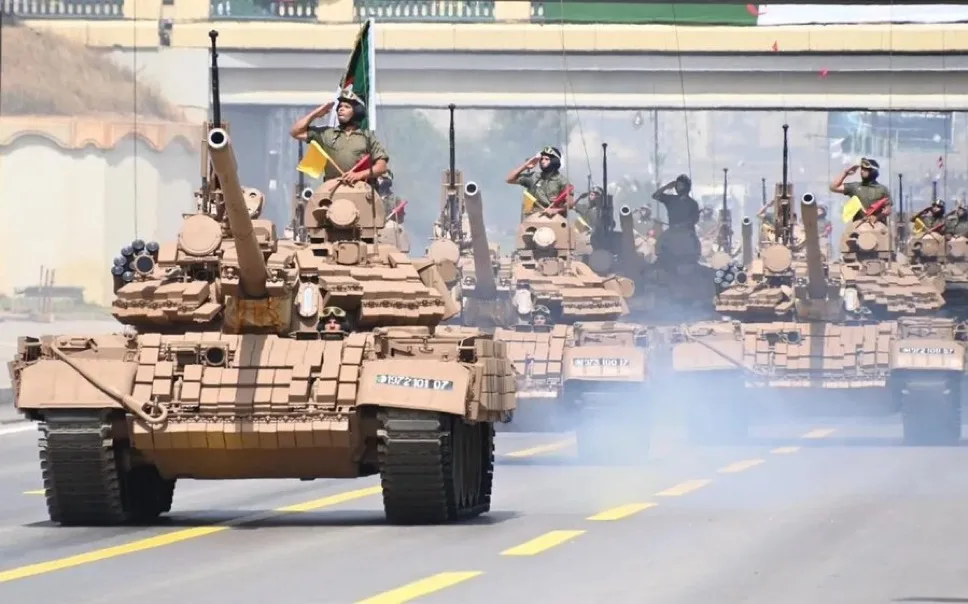
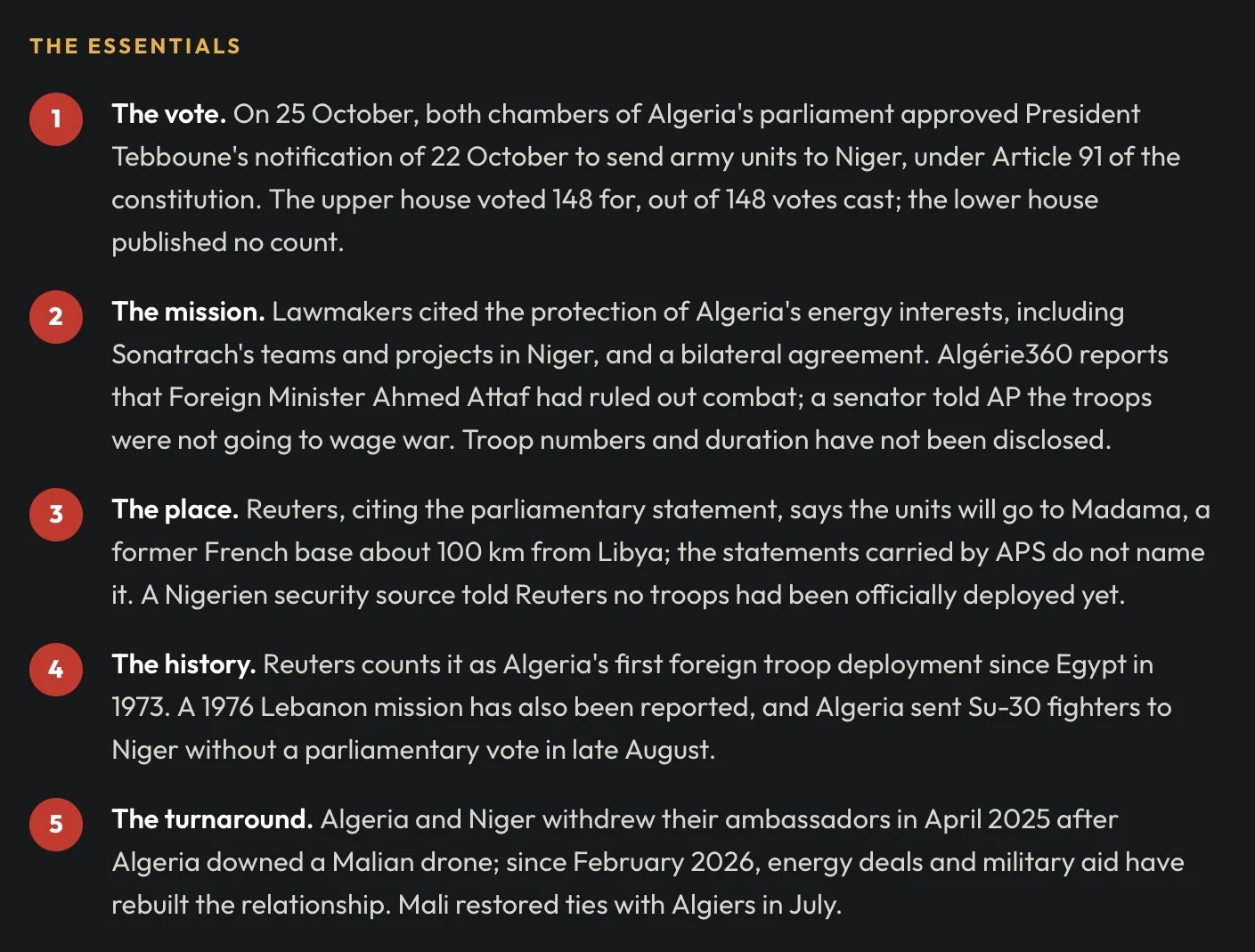
Both chambers of Algeria's parliament approved on 25 October the dispatch of units of the national army, the ANP, to Niger. They were voting on a notification from President Abdelmadjid Tebboune dated 22 October and made under Article 91 of the constitution, which, as revised on 26 March 2026, says the president "décide de l'envoi des unités de l'Armée Nationale Populaire à l'étranger" after approval by a two-thirds majority of each chamber.
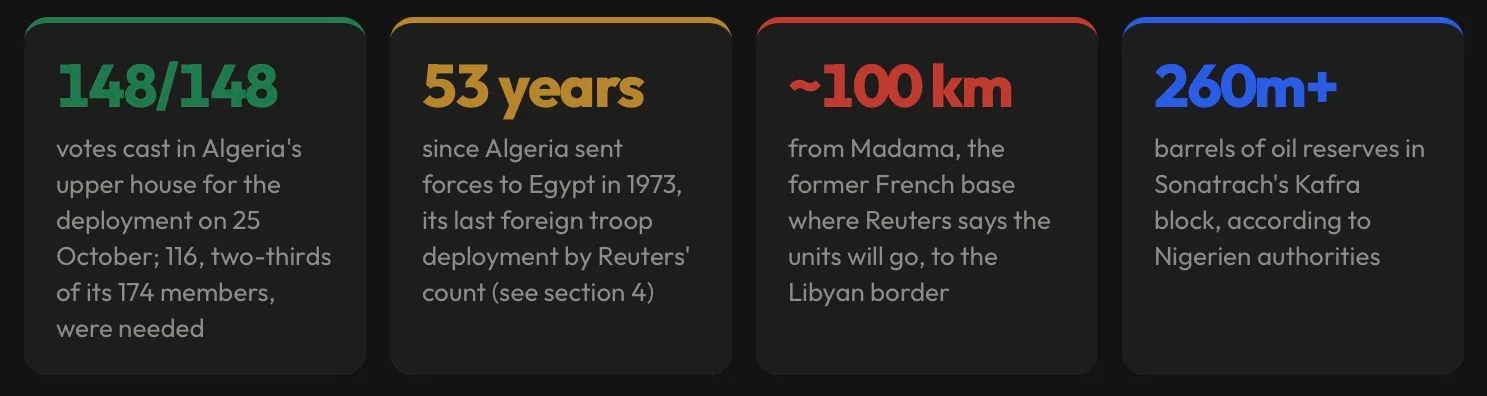
The Council of the Nation, the upper house, voted first, behind closed doors: 148 votes for out of 148 cast, with 131 members present and 17 voting by proxy, against a threshold of 116, two-thirds of its 174 members, according to its statement as reported by Algérie Eco; a senator gave AFP the same 148. The National People's Assembly (APN) followed in the evening, also in closed session; its statement, carried by the state agency APS, says the text passed by an absolute majority, without giving a count, which does not show whether the two-thirds bar was cleared. Reuters described the lawmakers' vote as unanimous. Group leaders in both chambers cited two aims: protecting Algeria's energy interests and applying a bilateral agreement with Niger.
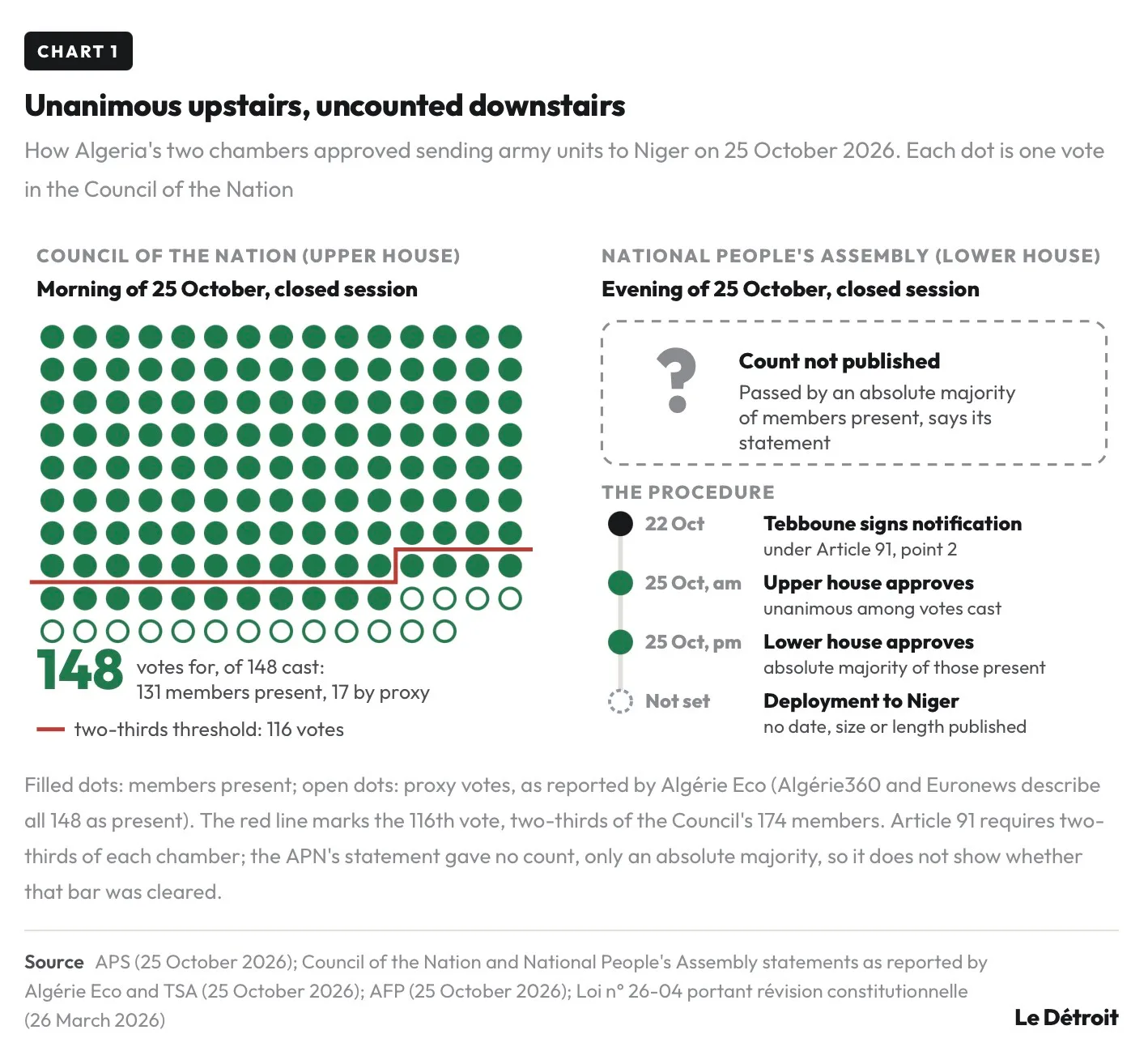
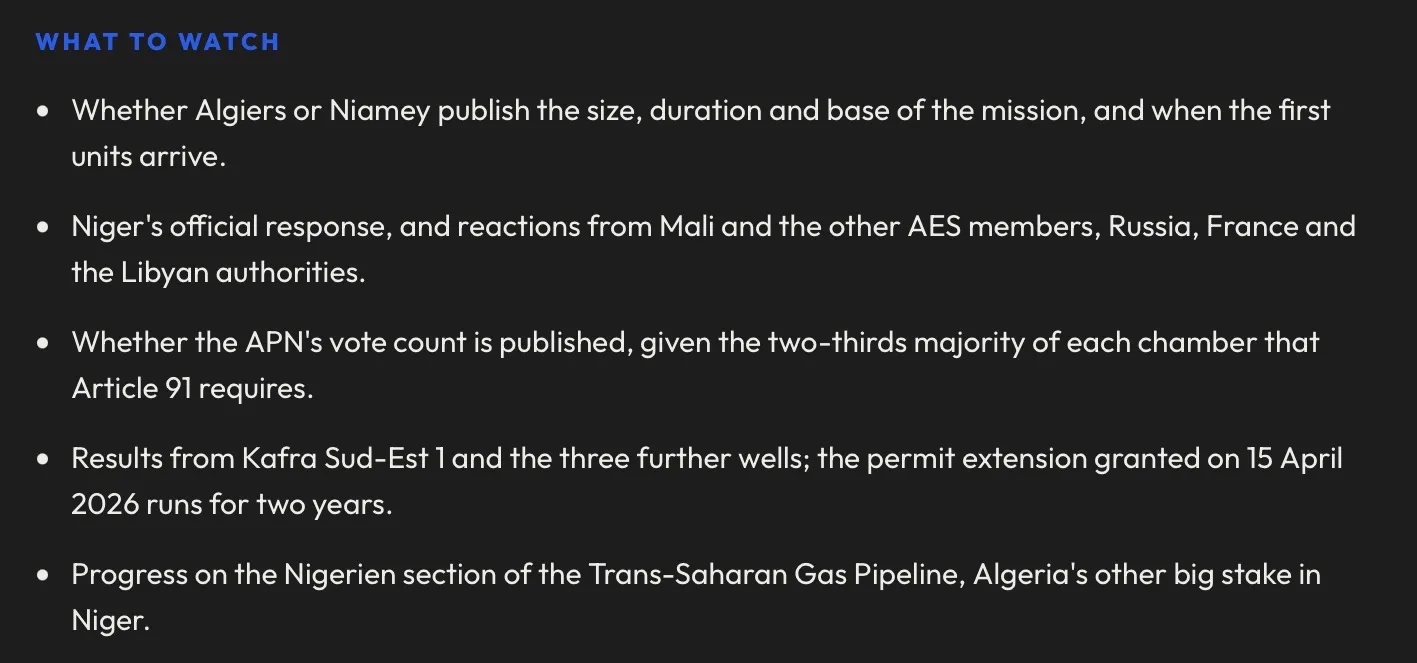
Neither troop numbers nor the mission's length have been published. Reuters, citing the parliamentary statement, reported that the units would go to Madama, in northern Niger near the Libyan border; Le JDD, citing Jeune Afrique, also placed them there, but the statements as carried by APS and Algerian outlets do not name the site. A Nigerien security source told Reuters that no troops had yet been officially deployed, but that General Bacharou Ibro Amadou, chief of staff of Niger's presidency, had been in the Kawar area since 19 October and had visited Madama to meet commanders.
2. A fort on the smugglers' road
Madama lies about 100 km south of the Libyan border. France announced in October 2014 that it would station troops and helicopters there for Operation Barkhane, its Sahel force. AFP reported in January 2015 that the base was being built for up to 350 soldiers, on a route used by jihadist fighters and arms traffickers travelling from southern Libya towards Mali and Niger. In 2015, French paratroopers operated around the nearby Salvador Pass, described at the time as a crossroads for drug and arms trafficking.
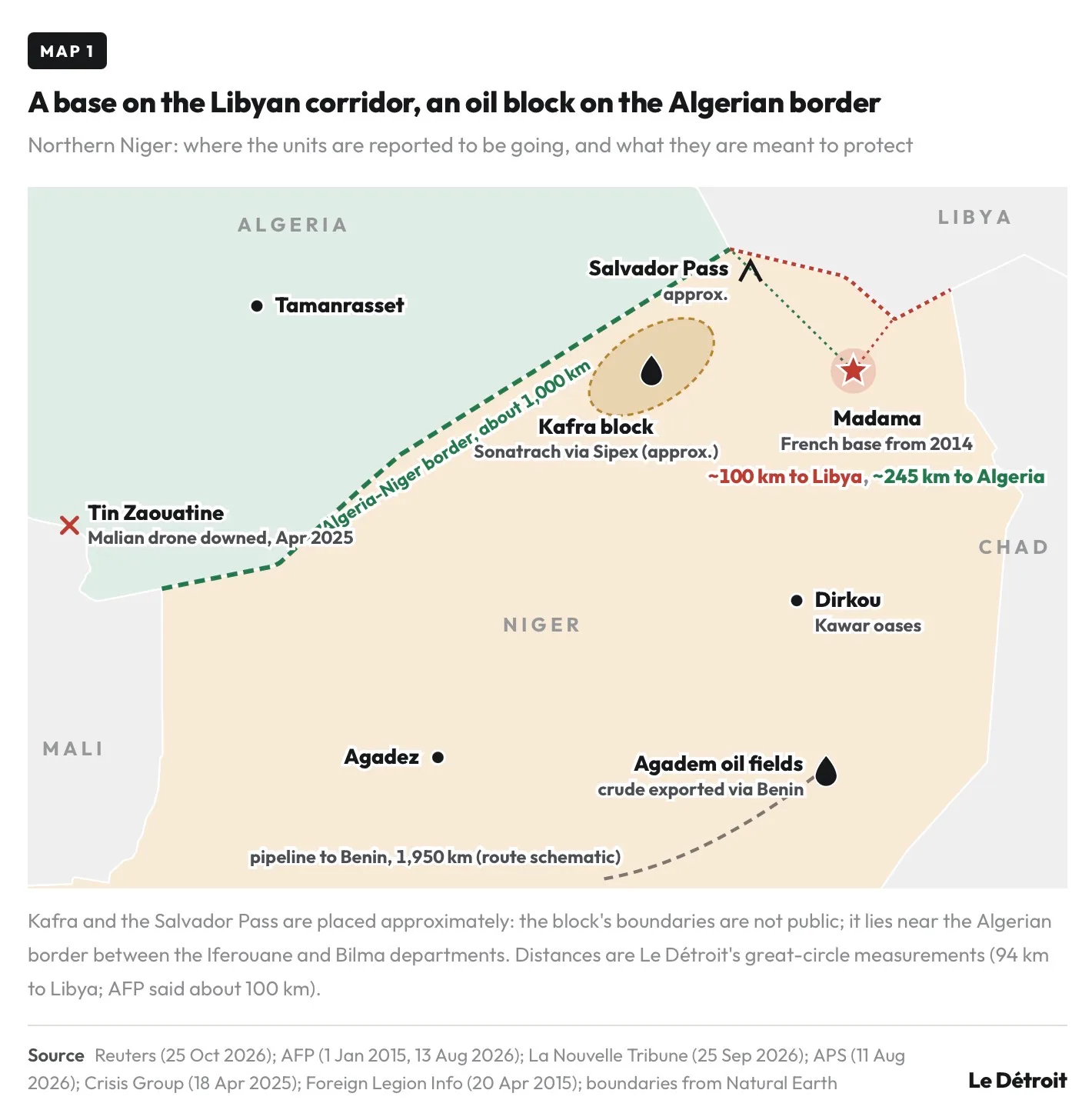
France's last soldiers left Niger on 22 December 2023, after the junta that seized power that July renounced several defence agreements with Paris. Jihadist violence in Niger is concentrated near Mali and Burkina Faso, but the north is not quiet: at the end of February 2025, an ambush claimed by JNIM, an al-Qaeda affiliate, killed 11 soldiers near the Algerian border, AFP reported. ACLED, a conflict monitor, had by then counted at least 2,400 people killed in attacks across Niger since the coup.
3. Soldiers for Sonatrach
Senators were told the mission was to protect the teams and projects of Sipex, the foreign arm of Sonatrach, Algeria's state oil company, and Foreign Minister Ahmed Attaf had already ruled out any part in combat or military operations on Nigerien soil, Algérie360 reported, without saying where he did so. A senator, Belkacem Boulghiti, told the Associated Press, as quoted by Al Jazeera: "We are not sending our soldiers to wage war in Niger, but for a mission to secure economic infrastructure."
In early October, Mr Tebboune had told Algerian media: "Nous sommes en mesure de défendre, d'abord nos amis, et puis les intérêts que nous avons en commun" (we are able to defend, first our friends, and then the interests we have in common), according to Algérie Eco. AFP quoted him on 3 October as saying Algeria would protect Niger "no matter what".
Sonatrach has held the Kafra permit, a 23,737 sq km block on the Algerian border, since 2005, under a production-sharing contract signed in 2015 and renewed in 2022, AFP reported. Two wells drilled in 2018 and 2019 found an estimated 168 million barrels of heavy oil and nearly 100 million barrels respectively, according to Agence Ecofin; Nigerien authorities put the block's reserves at more than 260 million barrels. On 13 August, the two countries' prime ministers launched a four-well campaign, starting with Kafra Sud-Est 1, planned to reach 3,900 metres.
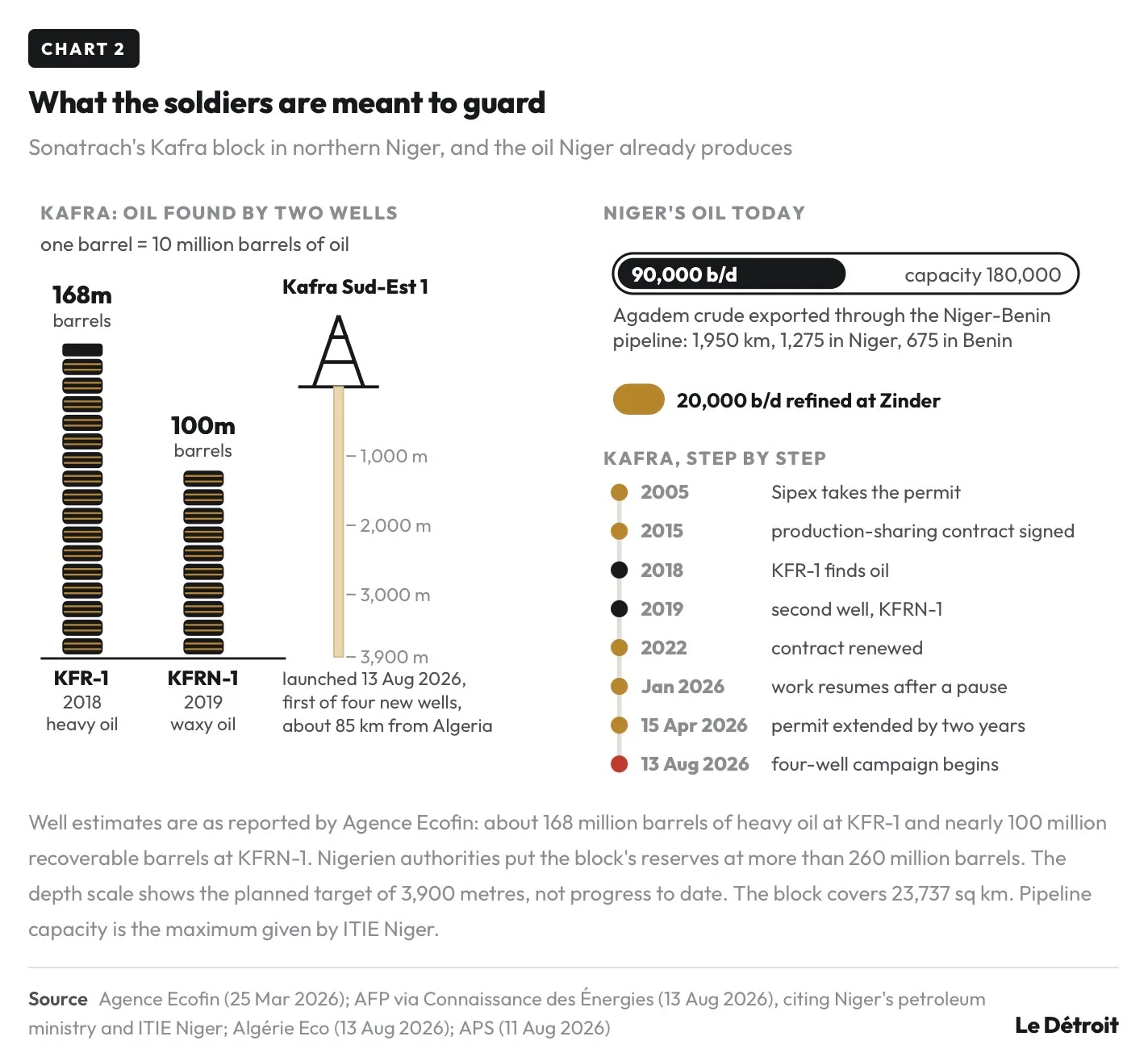
For Niger the stakes are national: it exports about 90,000 barrels a day from its Agadem fields through a 1,950 km pipeline to Benin and refines 20,000 barrels a day at home, according to AFP. Algiers also needs Niger for the Trans-Saharan Gas Pipeline, a project of more than 4,000 km to carry Nigerian gas north. Officials have not explained one oddity: Madama is about 245 km from the nearest point of the Algerian border, by Le Détroit's measurement, while the Kafra block adjoins that border.
4. Not quite the first since 1973
Reuters described the deployment as Algeria's first foreign troop deployment since it sent forces to support Egypt in the 1973 war. According to TSA, an Algerian news site, Algeria sent about 1,500 men and a squadron of MiG-17s to Egypt in 1967 and an armoured brigade with about 50 MiG jets in 1973; citing the specialist site Mena-Défense, it also reported that about 400 Algerian soldiers went to Lebanon during its civil war in 1976. At Amgala, in Western Sahara, in 1976, an Algerian unit clashed with Moroccan troops; TSA says it was carrying aid and does not count the episode as an intervention.
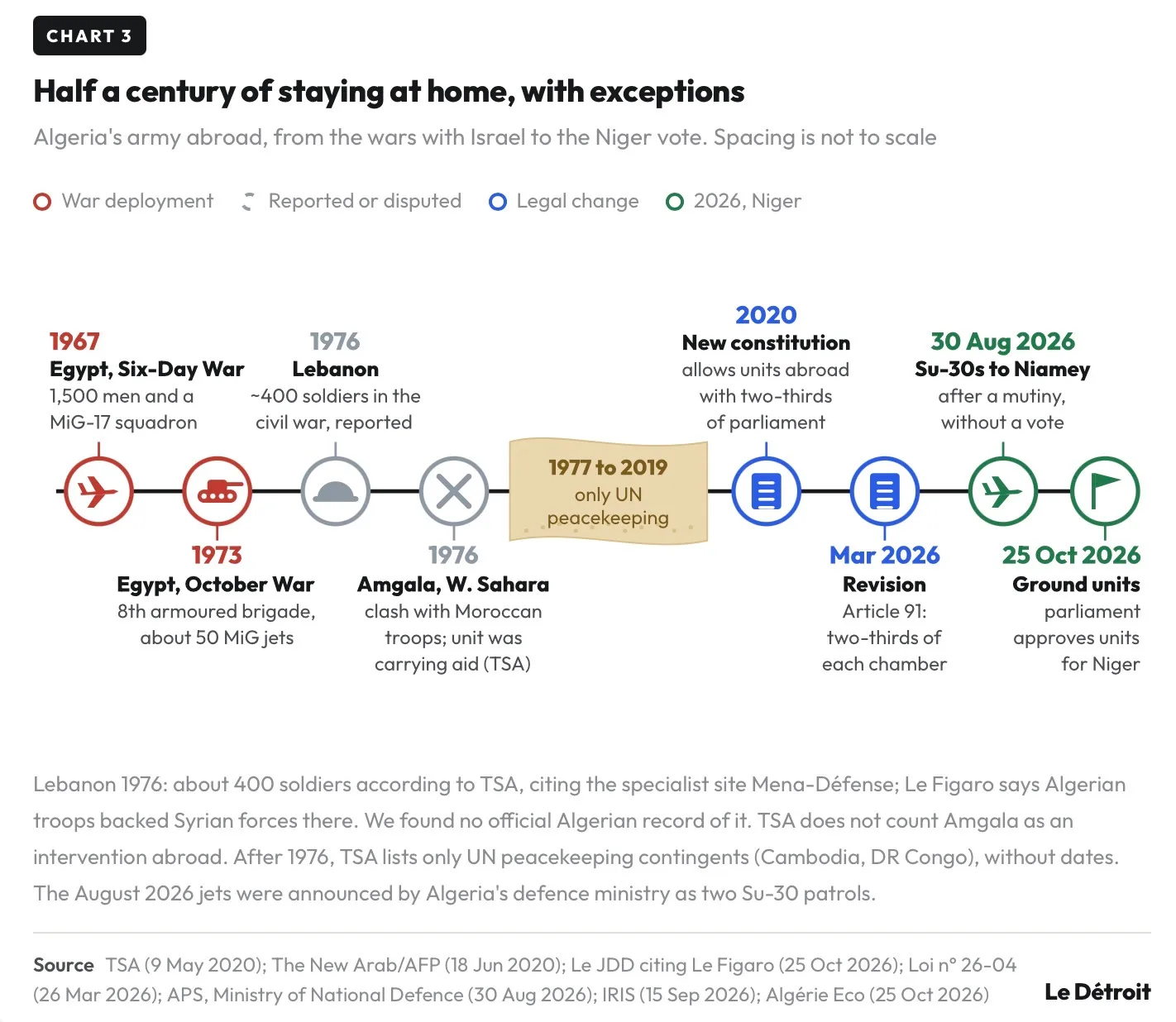
Staying at home was an unwritten rule; the 2020 constitution was the first to allow troops abroad, with parliament's approval. The armed forces have already crossed the border this year: after a mutiny in Niamey on the night of 28 to 29 August, Algeria's defence ministry announced on 30 August that two patrols of Su-30 fighters had been sent at Niger's request; Fides, the Vatican news agency, counted four jets, a tanker and a transport aircraft in Niamey. IRIS, a French think-tank, noted that this was decided urgently and without a parliamentary vote. What is new is the use of Article 91 for ground units, the first such vote reported.
5. From drone row to brothers in arms
The vote caps a reversal. Algeria opposed the 2023 coup that brought General Abdourahamane Tiani to power. On 1 April 2025, it said it had shot down an armed Malian drone near Tin Zaouatine; on 6 April, Mali, Niger and Burkina Faso, the military-led members of the Alliance of Sahel States (AES), recalled their ambassadors from Algiers, and the next day Algeria withdrew its own from Bamako and Niamey, the International Crisis Group recorded.
Energy reopened the door. Algeria's energy minister, Mohamed Arkab, went to Niamey in January 2026; Niger's ambassador returned to Algiers on 12 February; and on 15 and 16 February General Tiani visited Algiers, where Mr Tebboune said an abnormal period of coldness was over, AFP reported. Military ties followed: four helicopters on 9 August, the jets on 30 August and, on 21 October, a military cooperation protocol signed in Algiers by the army chief of staff, General Saïd Chanegriha, and Niger's defence minister, Salifou Mody.
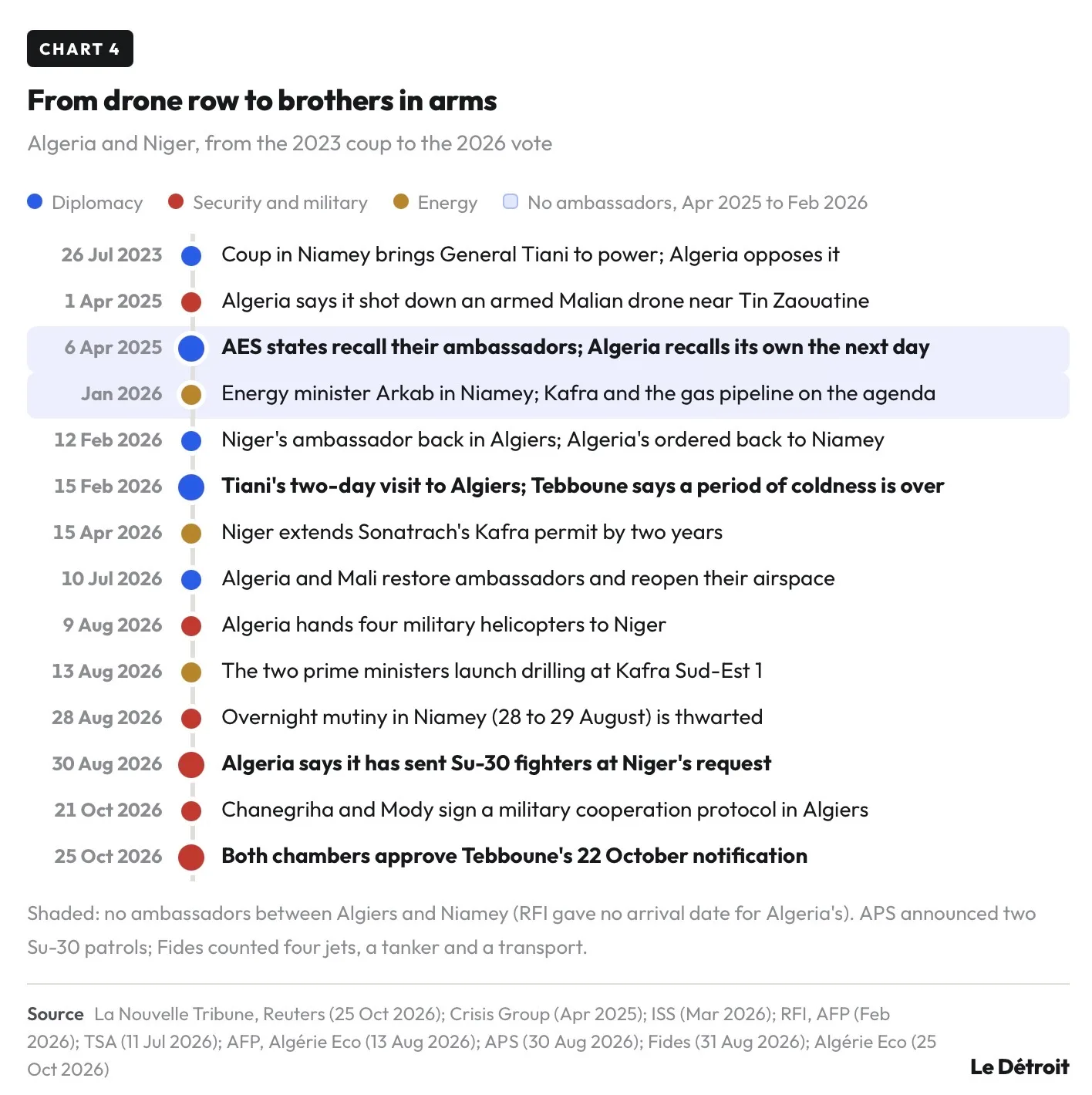
Mali, at the centre of the drone row, has since made its own peace with Algiers: on 10 July 2026, the two governments announced the return of their ambassadors and reopened their airspace to each other, TSA reported. After Tiani's February visit, a Malian foreign ministry diplomat had told AFP that Niger was free to deal with whomever it wanted, provided this did not harm the confederation's interests. By 15:30 Paris time on 26 October, we had found no public reaction to the vote from Niger's government, Bamako, the AES, France, Russia, the Libyan authorities or the African Union. Russia's Africa Corps helped thwart the August mutiny, according to Fides.