
1. What was said
A French military source, quoted by Le Monde and relayed widely on Saturday, said France is already carrying out undisclosed conventional military responses to Russian hybrid attacks. Asked whether Paris could retaliate militarily without making it public, the source answered that this was already the case. The original article and its exact French wording should be read before drawing conclusions; the sentence circulating is a translation.
The timing is not incidental. On Friday, Emmanuel Macron convened party leaders and 2027 candidates at the Élysée for a closed-door briefing by the heads of the DGSE, DGSI, DRM and SGDSN. The services presented hybrid attacks that have hit France in recent weeks, whose content has not been made public. The president then ordered the government to produce a plan to protect critical infrastructure and sensitive defence-industry sites against drones and cyberattacks. The préfets de zone had been convened the day before.
2. Why it matters: the threshold has moved
Every European response to Russian sabotage so far has been non-military: expulsions, consulate closures, sanctions, public attribution. Germany's answer to the Leipzig airport attack was to shut Russia's consulate in Bonn. That is the visible ceiling.
If the Le Monde source is accurate, France has been operating above that ceiling without announcing it. Conventional military responses, by definition, are not cyber and not diplomatic. Whatever they are, they place France in a category no other NATO member has publicly entered: a state retaliating with military means against a nuclear power, below the threshold of declared conflict, and choosing deniability.
That is a coherent strategy. It is also the mirror image of what Russia does, and it carries the same risk: neither side can be certain how the other reads a given act. Deniable retaliation is calibrated for one audience, the adversary's intelligence services. It is invisible to the public that would have to support escalation if calibration fails.
The exposure is concrete. The SGDSN counts roughly 1,500 vital sites in France and has acknowledged that security forces cannot provide counter-drone coverage for all of them. Donald Tusk warned the Sejm on Wednesday that Russia intends to send drones or missiles into NATO territory and call it an accident. A state known to be retaliating is a more attractive target for that kind of test than one known to be merely protesting.
Deniable retaliation buys freedom of action. It spends public understanding.
3. What to watch
The original text. Le Monde's exact wording, and whether the ministry disowns or confirms it. Silence would itself be a signal.
Russian messaging. A pro-Kremlin military channel, Rybar, has circulated a map of French targets hypothetically reachable by Geran-5 drones launched from Algeria: nuclear plants, refineries, air bases, ports. Le Détroit has not independently verified the post. Its plausibility rests on the drone's specifications as assessed by Ukrainian intelligence: roughly 850 kg at take-off, 450 to 600 km/h, a range of up to 950 km. Watch whether this framing migrates from Telegram to official Russian statements.
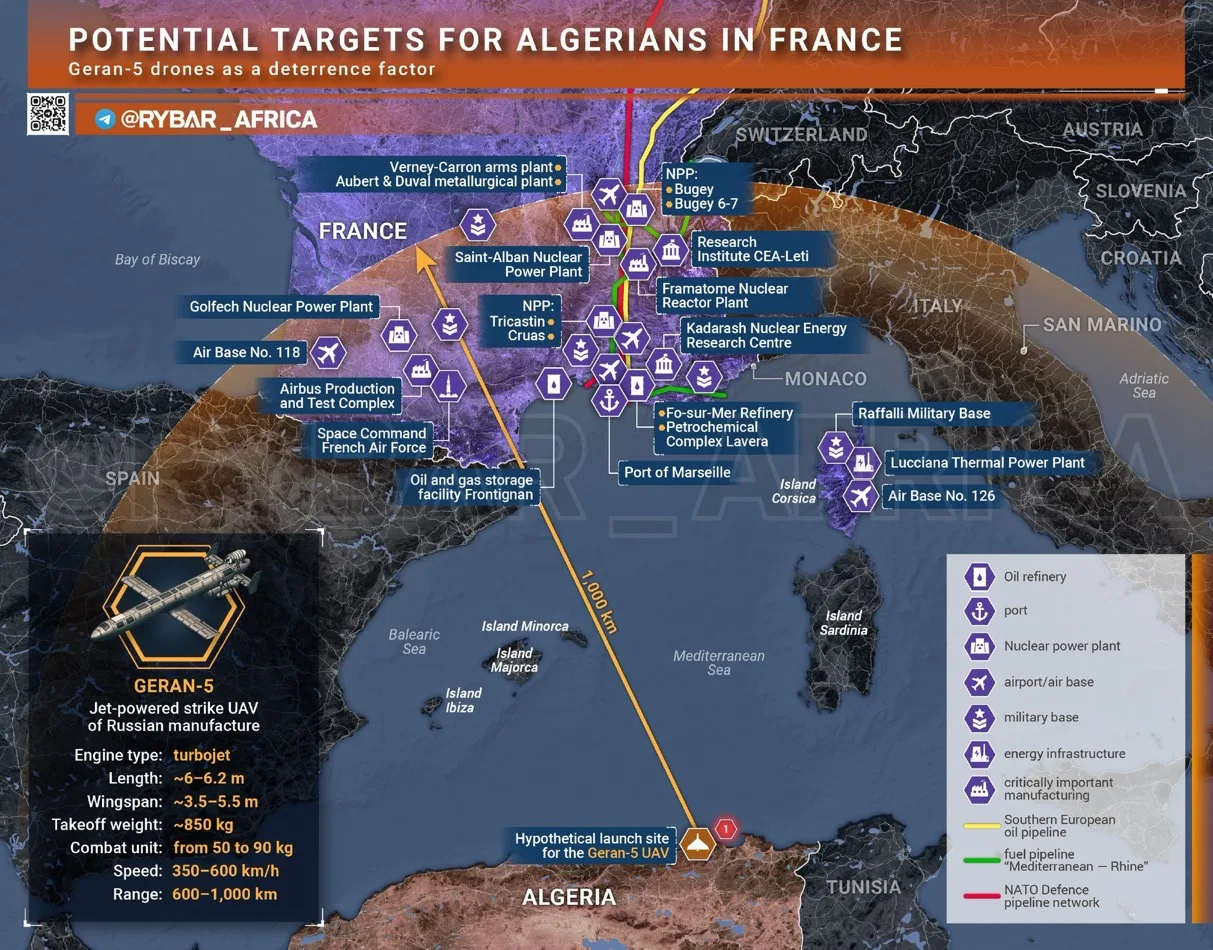
· RYBAR (PRO KREMLIN CHANNEL) The infrastructure plan. Macron's order has no public deadline. The gap between 1,500 sites and existing counter-drone capacity is the measurable vulnerability.
Allied alignment. Whether Berlin, Warsaw or London follow Paris into acknowledged covert retaliation, or leave France exposed as the only capital saying it out loud.