
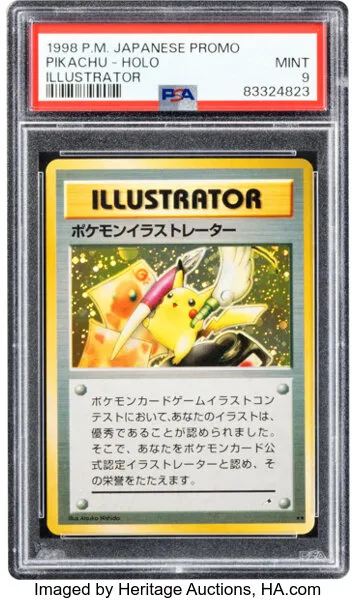
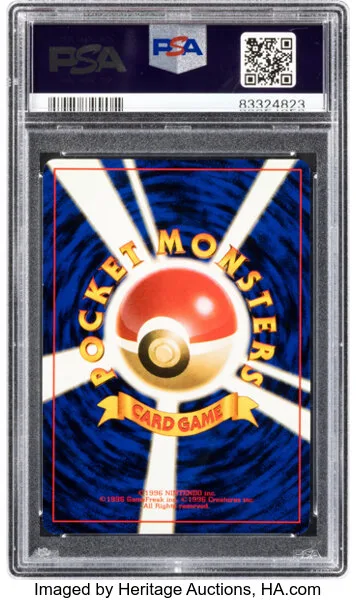
On 16 February 2026, a single Pokémon card sold at Goldin Auctions in New Jersey for 16,492,000 dollars, buyer's premium included. Guinness World Records certified it as the most expensive trading card ever sold at auction, any sport, any game. The seller, Logan Paul, had bought the same card privately in July 2021 for 5,275,000 dollars.
Six weeks later, on 4 April 2026, Spain's national police announced that a Swedish criminal organisation based in Marbella had been offering its clients a way to clean drug money: buy Pokémon cards, hold them as a safe investment, resell. One arrest on the Costa del Sol, several in Sweden, an album of cards seized.
Those two events are the same story. This is an attempt to lay it out end to end: what makes the asset useful to criminals, how the schemes actually run, which networks have been caught doing it, and why the law that is supposed to close the gap, in Europe at least, was written without the gap in it.
1. Why the asset works
A compliance analyst evaluates a store of value on a handful of properties. Cards score well on almost all of them, and the comparison with instruments regulators already treat as high-risk is instructive.
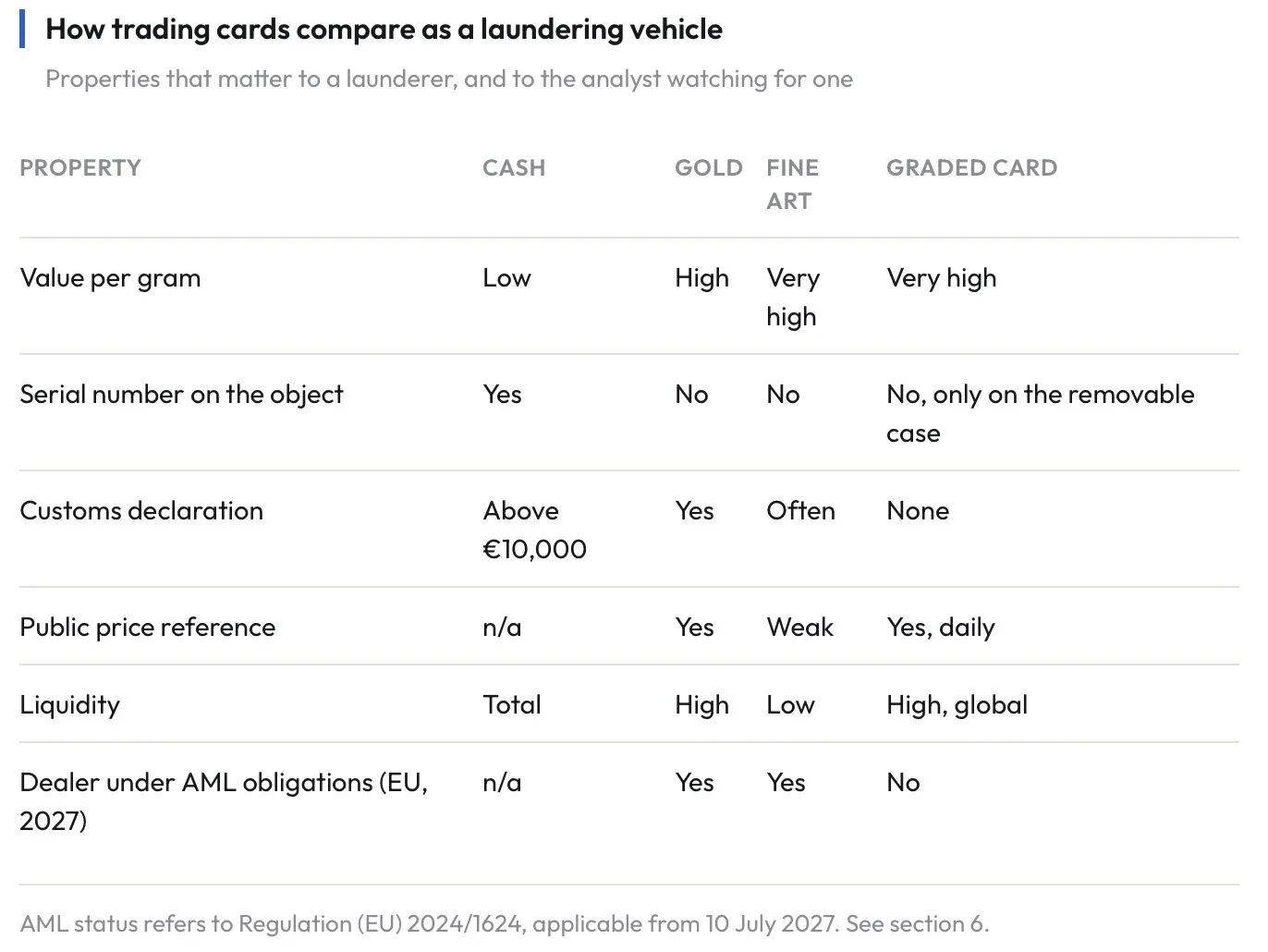
The combination is the point. Gold is dense but declared at borders and sold through obliged dealers. Art is anonymous but illiquid and hard to price. A graded card is dense, undeclared, priced in public every day on eBay and at auction, and sold through shops that no European AML regime covers. The physical serial number lives on the plastic slab issued by the grading company, not on the card, and slabs can be opened.
A bearer instrument is any asset whose ownership is proven by holding it. That is a precise description of a Pokémon card.
2. The price ladder
The reason this became a financial story is a vertical price curve, and the reason the curve matters for compliance is what it does to valuation. When a single object can be reasonably priced at 1.4 million dollars in March and 4 million the previous September, depending on grade, venue and buyer, any price a launderer needs to justify is available somewhere in the recent comparables.
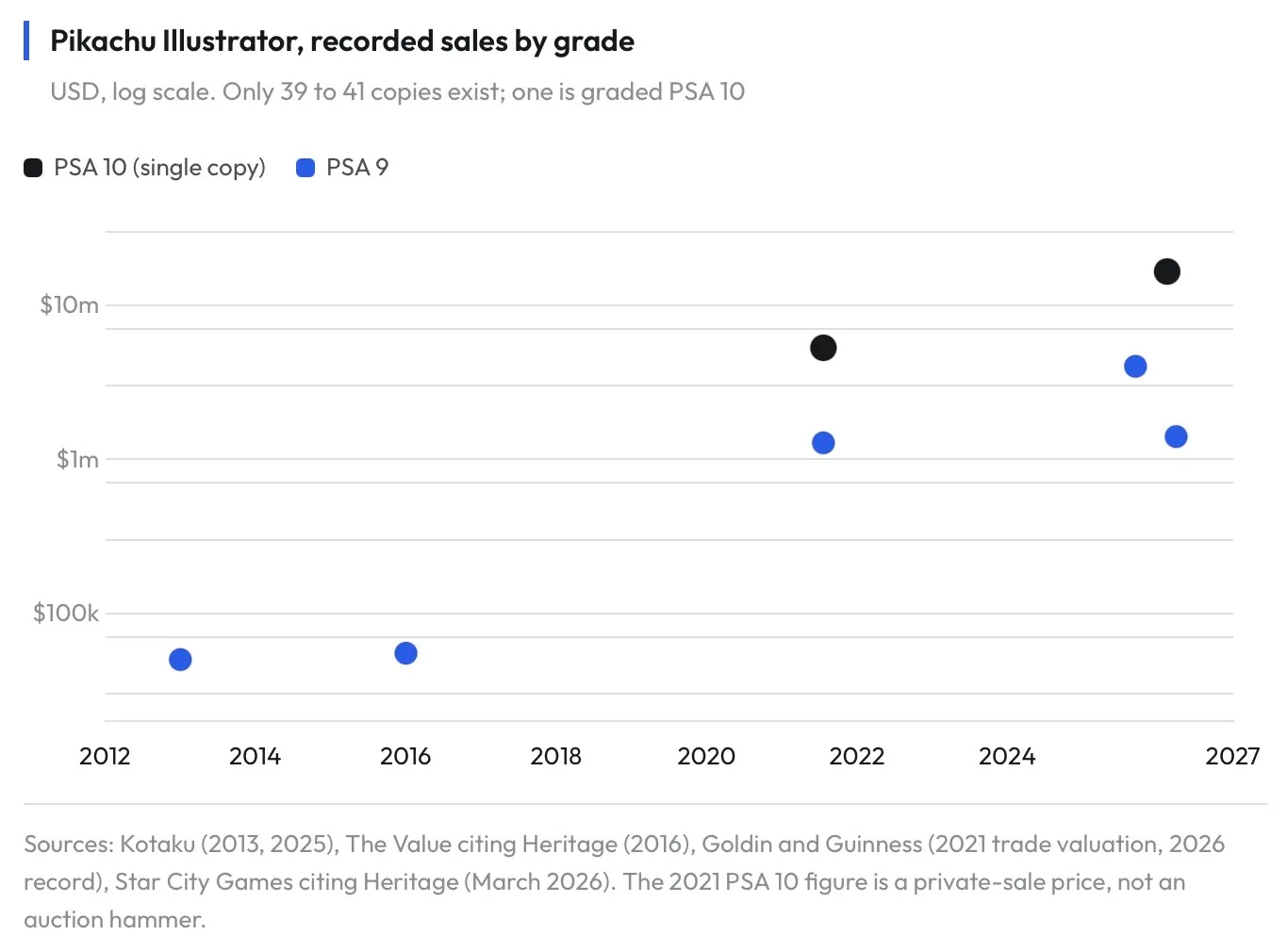
Two things stand out.
First, the PSA 10 tripled in under five years, in a market whose broad index fell 30 to 50 percent from its 2021 peak according to one hobby pricing service. The top does not move with the middle.
Second, the PSA 9 series is not a line, it is a cloud: 4 million dollars on eBay in September 2025, 1.4 million at Heritage in March 2026. Same card, same grade, six months apart, a factor of nearly three. For an analyst, that dispersion is the vulnerability: it means no single sale price is prima facie suspicious.
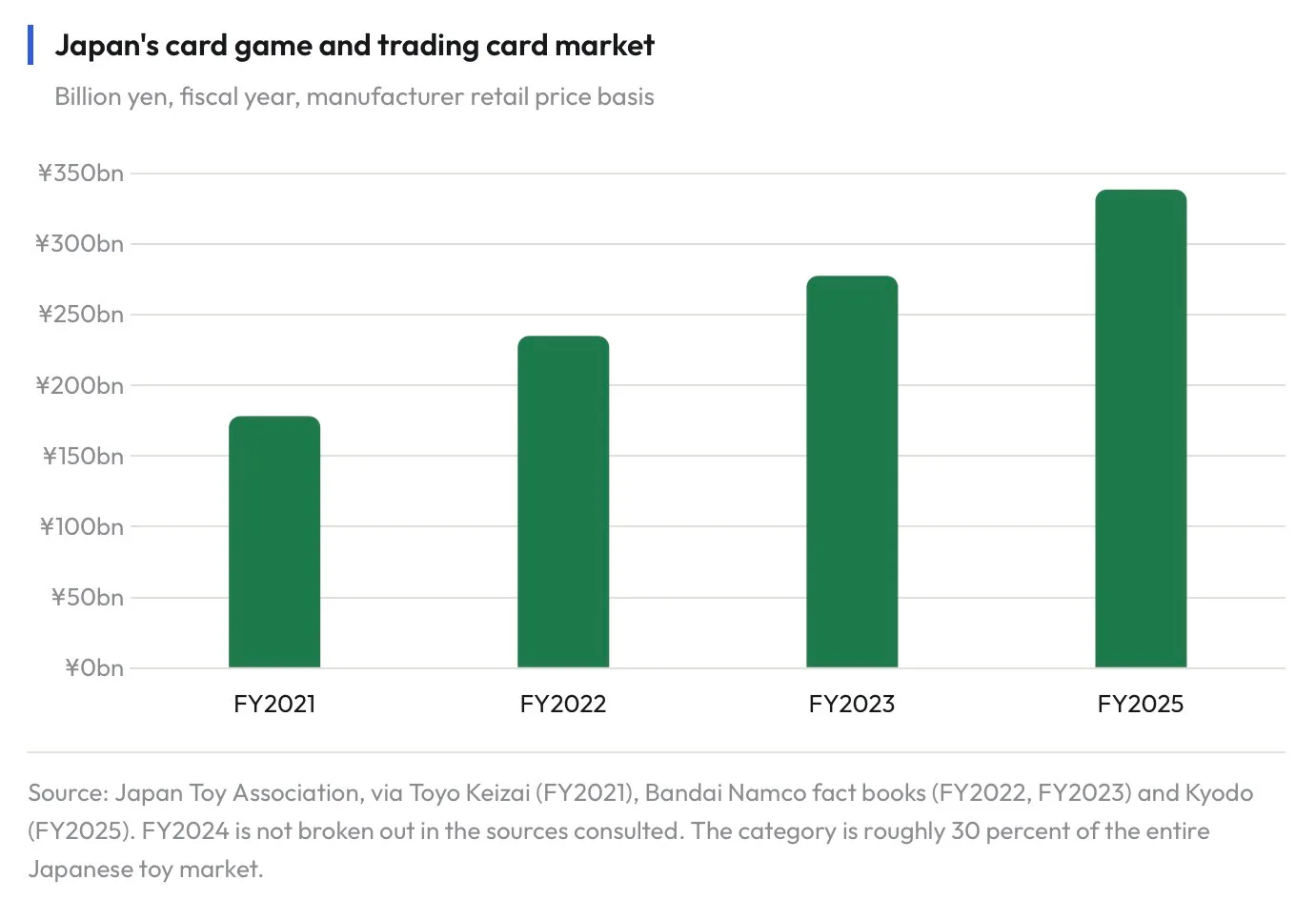
3. The mechanics
Money laundering is conventionally described in three stages: placement, where illicit cash enters the economy; layering, where its origin is obscured through transactions; and integration, where it re-emerges as apparently legitimate wealth. Cards fit each stage unusually well.
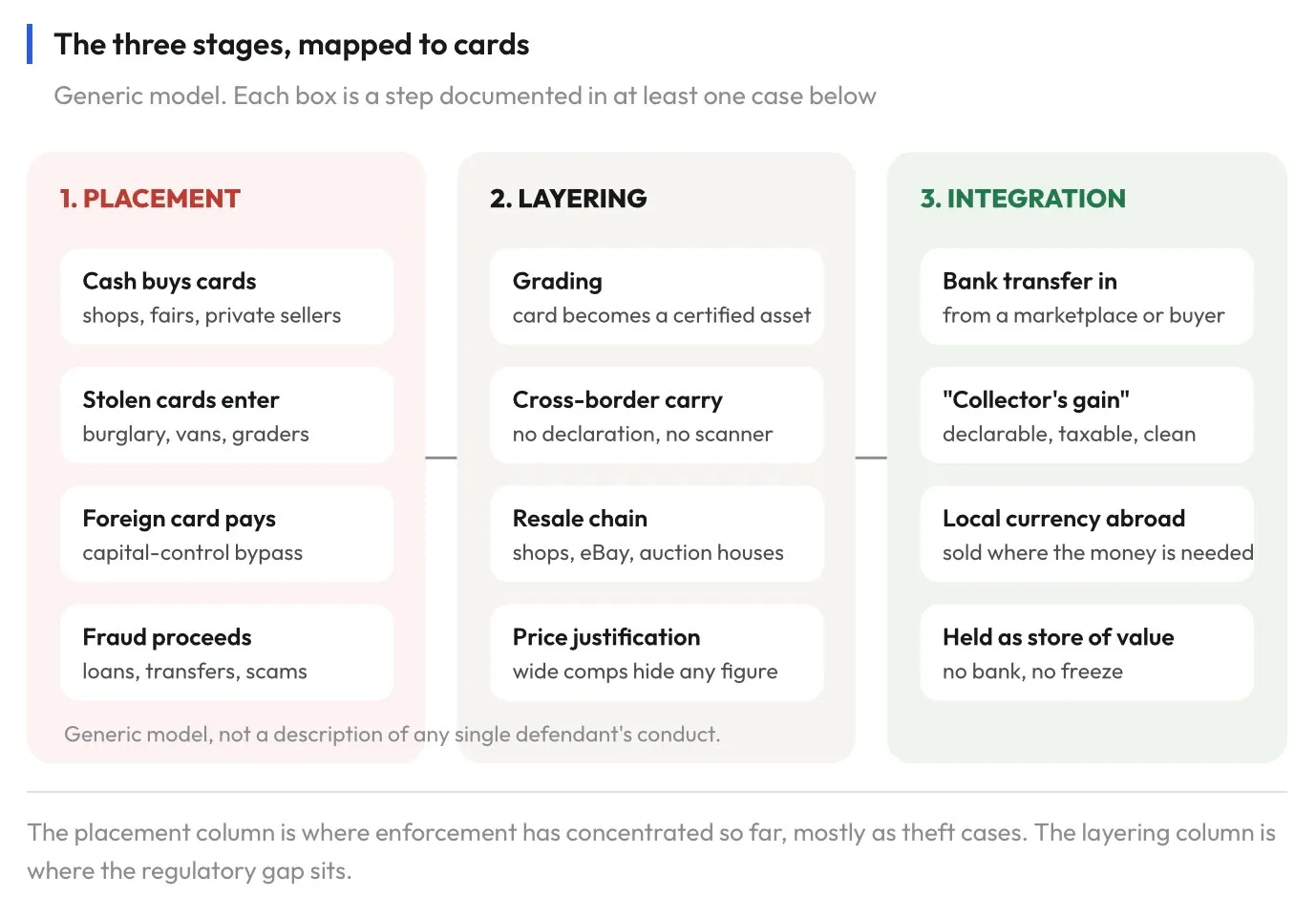
What makes cards unusual is the grading step in the middle. When a card is sent to PSA or a competitor, it comes back sealed in a tamper-evident case with a numerical grade and a certification number that anyone can look up in a public database. That converts an anonymous piece of paper into a standardised, certified asset with a market price. It is, functionally, the step that turns a commodity into a security. And, as the American cases below show, it is also the step that can be forged.
4. Four networks, mapped
4a. Japan: from theft to cash
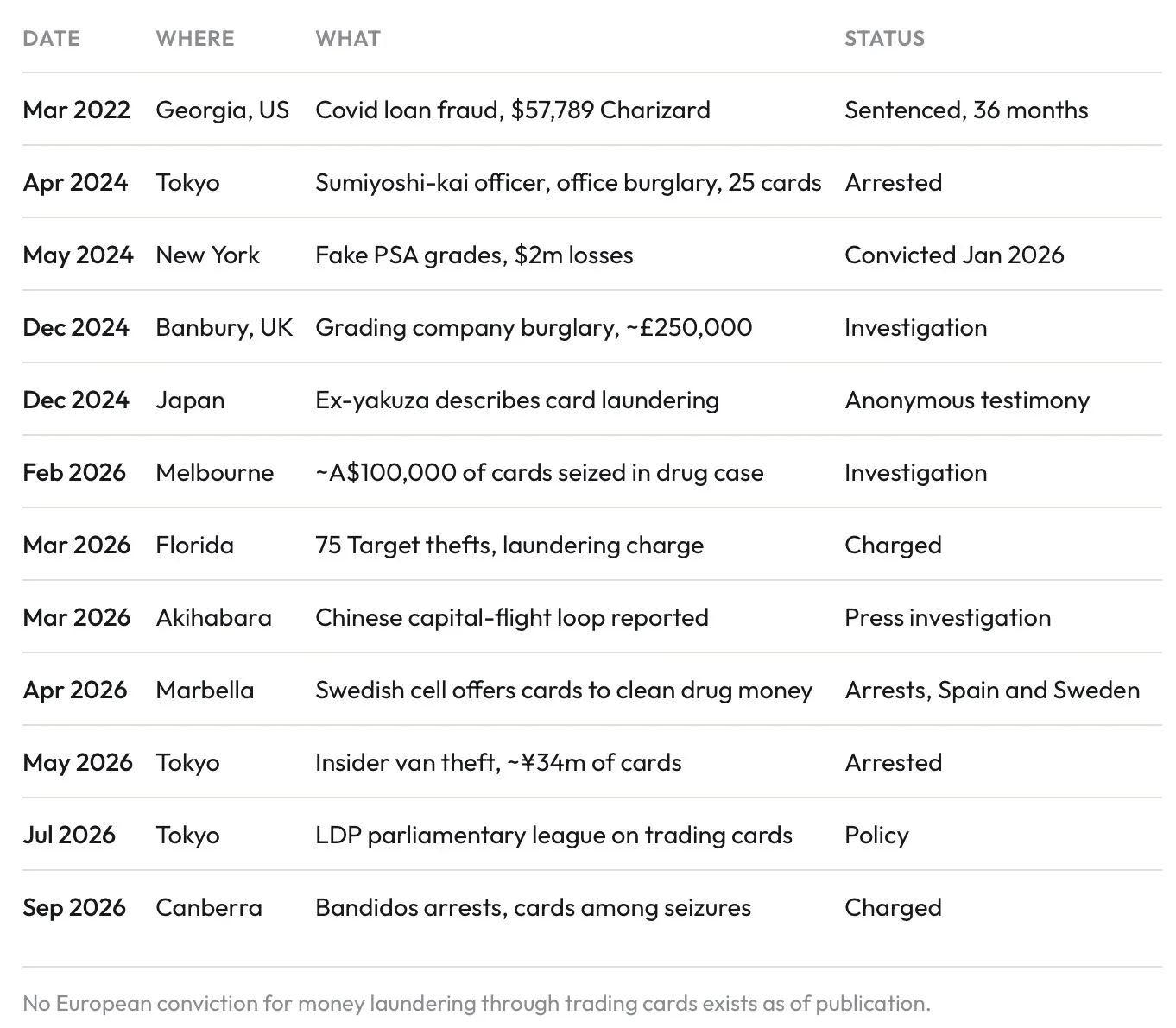
Japan is where the underlying market is largest and where organised crime has been caught in the supply chain most often. In April 2024, Tokyo police arrested Hidefumi Kuboshita, 56, and Keita Saito, 39, an officer of a group affiliated with the Takinogawa-ikka of the Sumiyoshi-kai, Japan's second-largest yakuza syndicate, over a December 2022 break-in at a company office in Ogano, Saitama. Twenty-five Pokémon cards among 29 items, valued at around 252,000 yen. Two other participants had been recruited through so-called yami baito posts on X, the anonymous "dark part-time job" ads that Japanese police associate with the loose criminal networks known as tokuryu.
In May 2026, police arrested Kota Kobayashi, 26, a former employee of a delivery subcontractor, and a second man over the theft of roughly 300 cards worth about 34 million yen from a transport vehicle. Kobayashi knew the route and schedule, used a duplicate key, and emptied the van in about two minutes. Around 50 cards had already been sold for an agreed 12.5 million yen, of which 5.7 million had been received as a deposit.
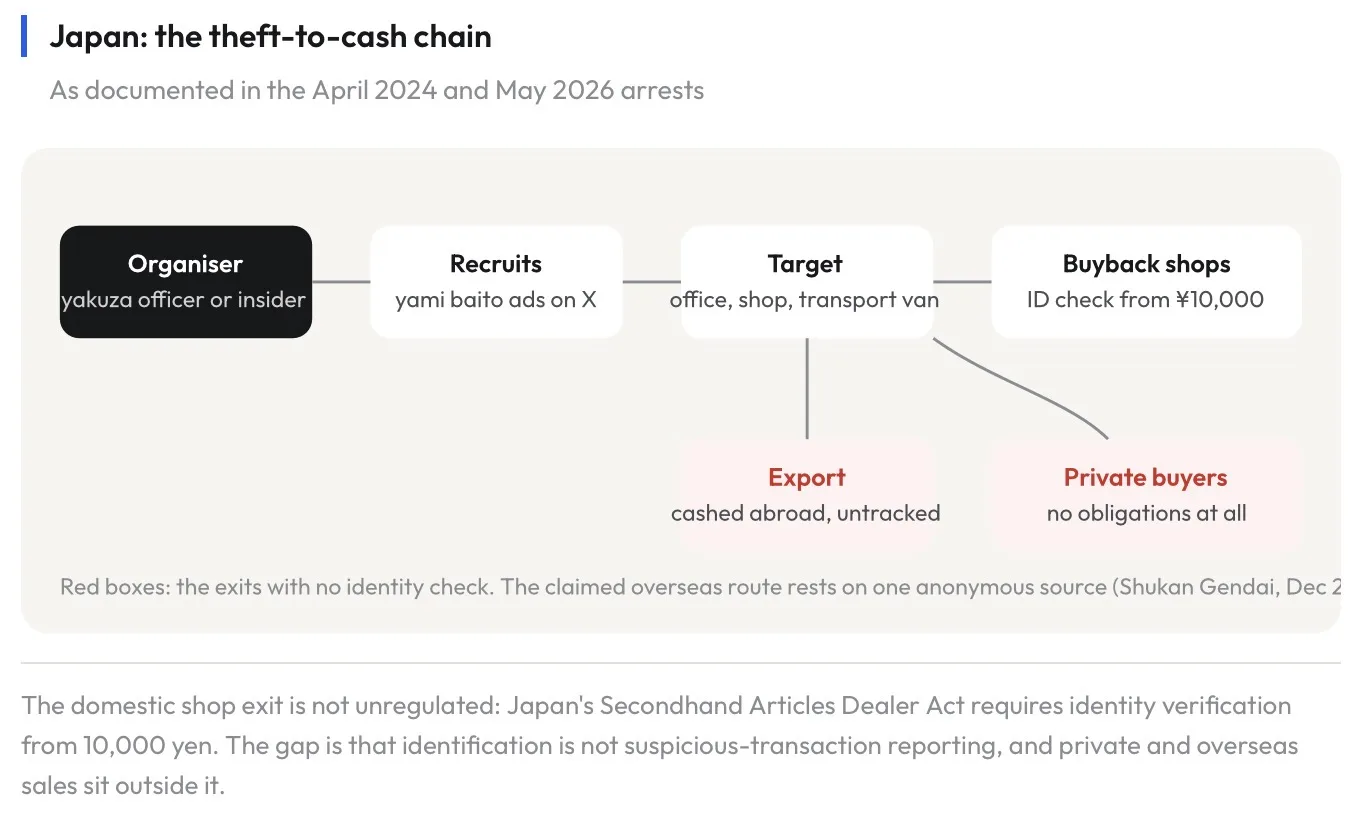
The link from theft to laundering rests on a single, anonymous source. In December 2024, Shukan Gendai quoted a former officer of a designated yakuza group saying that bank-transfer fraudsters were converting their takings into cards because dirty money cannot be deposited, cash gets stolen, and cards can be taken abroad and cashed there without a trace. He described sorting sealed booster packs with metal detectors and precision scales to find the foil rare cards. That is one witness in one magazine. It is consistent with the arrests, but it is not corroborated by a court record, and this article does not present it as more than that.
4b. The Chinese capital-flight loop
The cleanest scheme in the dossier involves no theft, no cash and no border crossing. Shukan Gendai reported it in March 2026 from a card shop in Akihabara, Tokyo's electronics and hobby district. Staff described Chinese customers buying around 10 million yen of cards, returning a few days later, and selling the same cards back. No counterfeits were being swapped in. The purchases were paid with UnionPay cards or platinum credit cards linked to accounts in China.
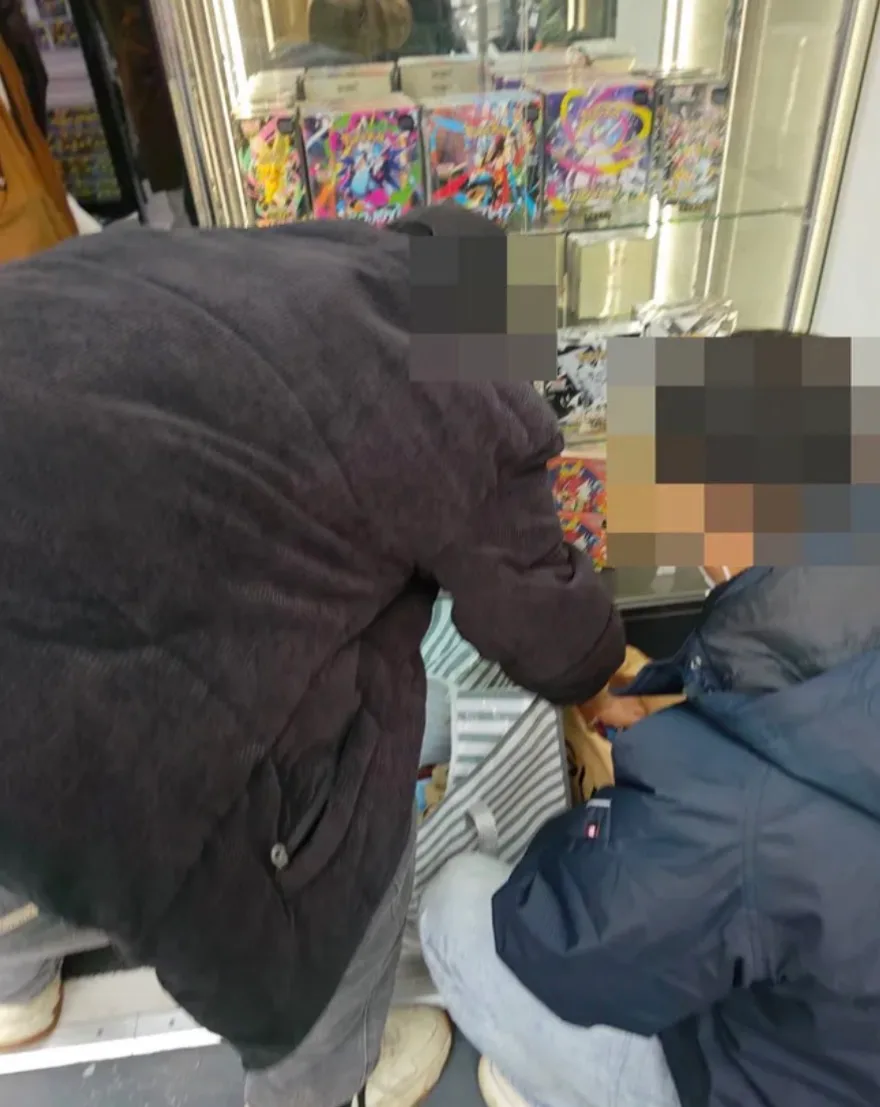
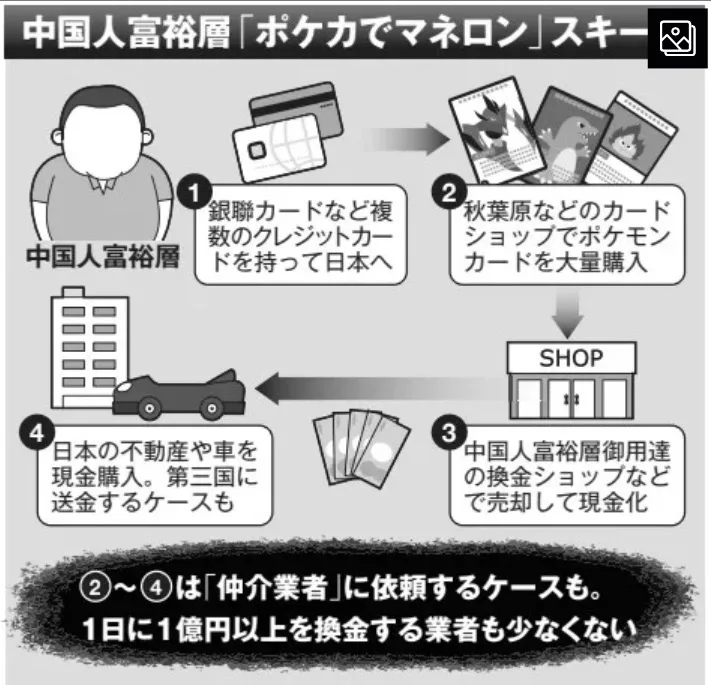
The mechanism is a currency conversion disguised as a hobby. The purchase is debited in renminbi against a Chinese account. The resale is paid out in yen in Japan. Money has crossed from China to Japan without a bank transfer, without a declaration and without touching China's strict controls on moving capital abroad. A source presented as an intermediary told the magazine that underground banks charge around 8 percent for the same service, and that anyone can now do it themselves through a card shop at the cost of a small loss on the spread.
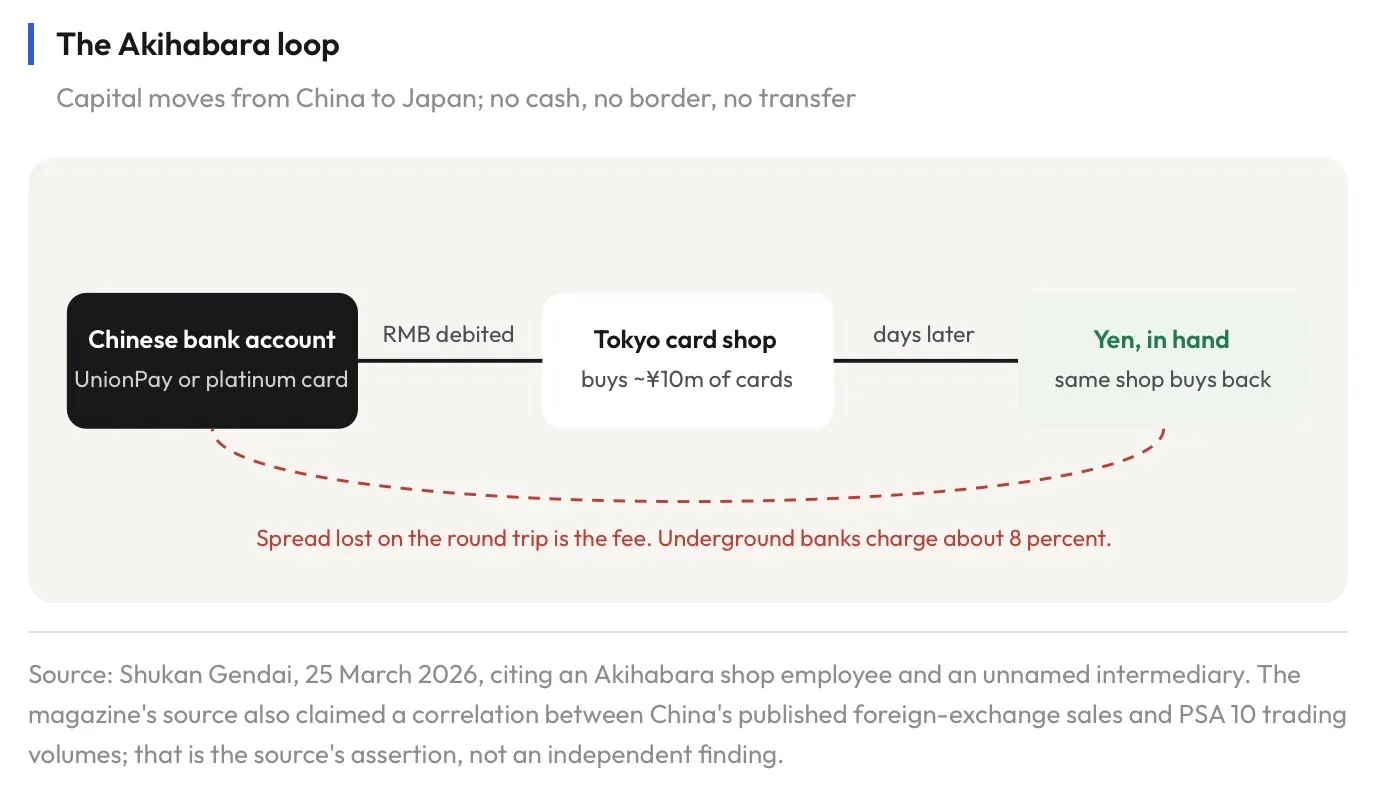
This is not, strictly, laundering. The money may be entirely legal in origin. It is the evasion of a capital control, and it is the same mechanism a launderer would use, which is why it belongs in the same analysis. Any asset that is bought with a payment card and resold for cash in another currency is a foreign-exchange channel. Cards are simply the most convenient one: compact, standardised, and with a narrow bid-ask spread.
4c. Sweden to Marbella: cards as a laundering product
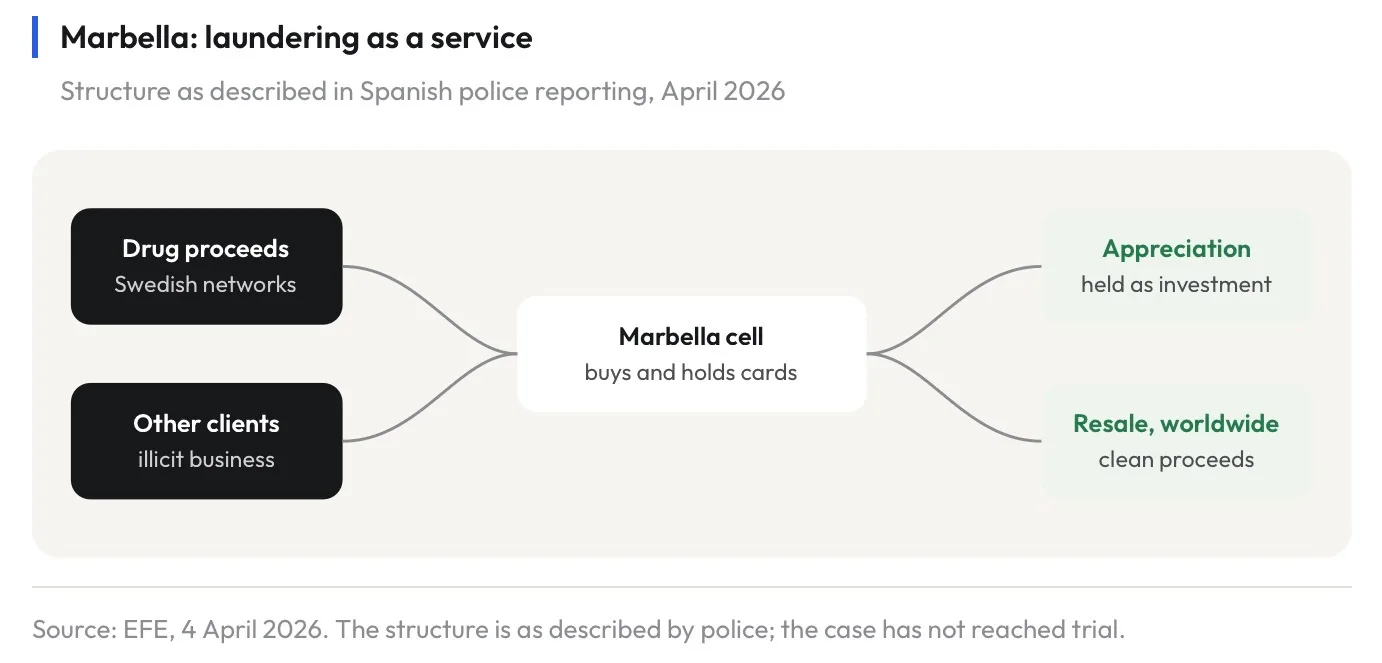
The European case is different again, because here the cards were not a by-product of crime but a service sold to criminals. According to the EFE agency, citing reporting first published by Diario Sur and SER Málaga, the group's members lived in Marbella but were Swedish, and some were linked to drug trafficking and violent acts in Sweden. Others handled only the money. The offer to clients was explicit: cards as a safe investment that appreciates over time, as a route to clean money from illicit business. The operation was run by the GRECO Costa del Sol unit of the Policía Nacional in coordination with Swedish authorities, with arrests in both countries. No amounts have been published and no one has been convicted.
4d. The United States: attacking the trust layer
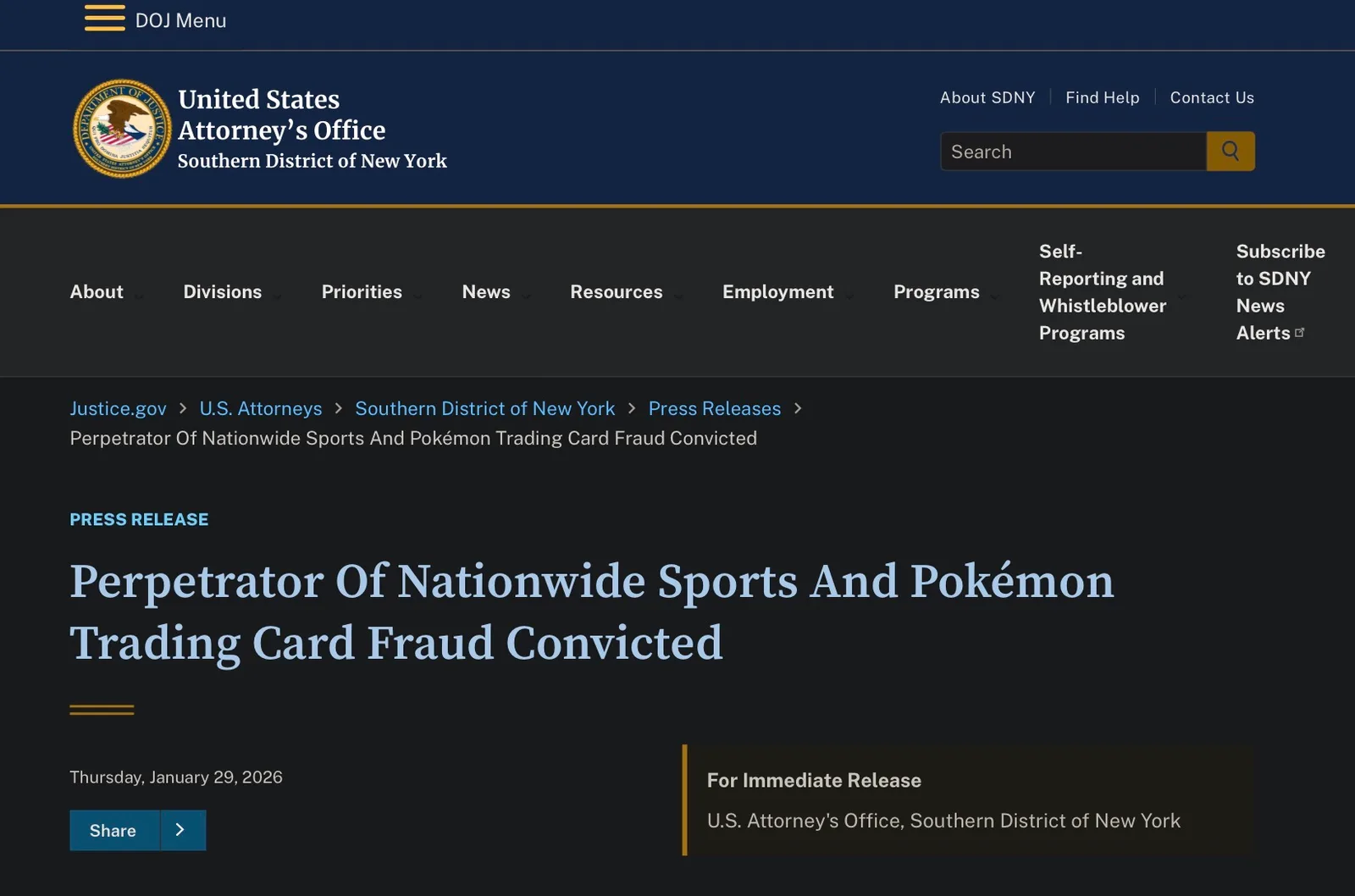
The American cases are prosecuted as fraud, not laundering, and they matter for a different reason: they show the certification layer can be faked. In January 2026, a Manhattan federal jury convicted Anthony Curcio of wire fraud and conspiracy for selling sports and Pokémon cards in counterfeit PSA cases bearing grades the cards had never received. When he and a co-defendant were arrested in May 2024, the FBI put victims' losses at two million dollars. The tools seized tell the story: grading cases, thermal barcode labels, a handheld inkjet printer, a lock-cutting kit, an engraving pen, polishing wheels.
In March 2022, Vinath Oudomsine of Dublin, Georgia, was sentenced to 36 months for lying to obtain an 85,000 dollar pandemic relief loan and spending 57,789 dollars of it on a single Charizard card, which he forfeited. And in Florida, Keith Wallis was arrested in March 2026 over 75 thefts of cards from Target stores between July 2025 and February 2026; the charges include money laundering, and he faces up to 90 years.
Every certification system creates a forgery market for its own certificates. Grading slabs are no exception.
Elsewhere: the supply side hardens
In December 2024, thieves broke into Ace Grading in Banbury, England, in what the company called a targeted attack, taking cards belonging to customers that Thames Valley Police valued at around 250,000 pounds. In Australia, Victoria Police recorded nine trading-card burglaries, break-ins or thefts at retailers in 2021 and close to one a week in 2025. In February 2026, roughly 100,000 Australian dollars of Pokémon and One Piece cards were seized from a Melbourne home in a drug-trafficking investigation; in September, the ACT police arrested seven alleged Bandidos members and listed Pokémon cards alongside gems, drugs and weapons among the seizures.
5. The trust layer
Everything in the layering stage depends on grading. The slab is what lets a card be sold sight unseen to a buyer on another continent, listed with a lookup number, and insured. It is also the only place a serial number exists, and it is not attached to the card. Open the case and the number goes with the plastic.
The Curcio case demonstrates the obvious attack: forge the slab. The Ace Grading burglary demonstrates the less obvious one: the grader is where the highest-value cards physically concentrate, in transit and on shelves, owned by hundreds of different customers. And the Akihabara loop demonstrates that the trust layer can be entirely legitimate and the transaction still be a capital-control evasion. The grade is real, the card is real, the shop is honest, and money has still crossed a border it was not allowed to cross.
6. The regulatory map, and the hole in it
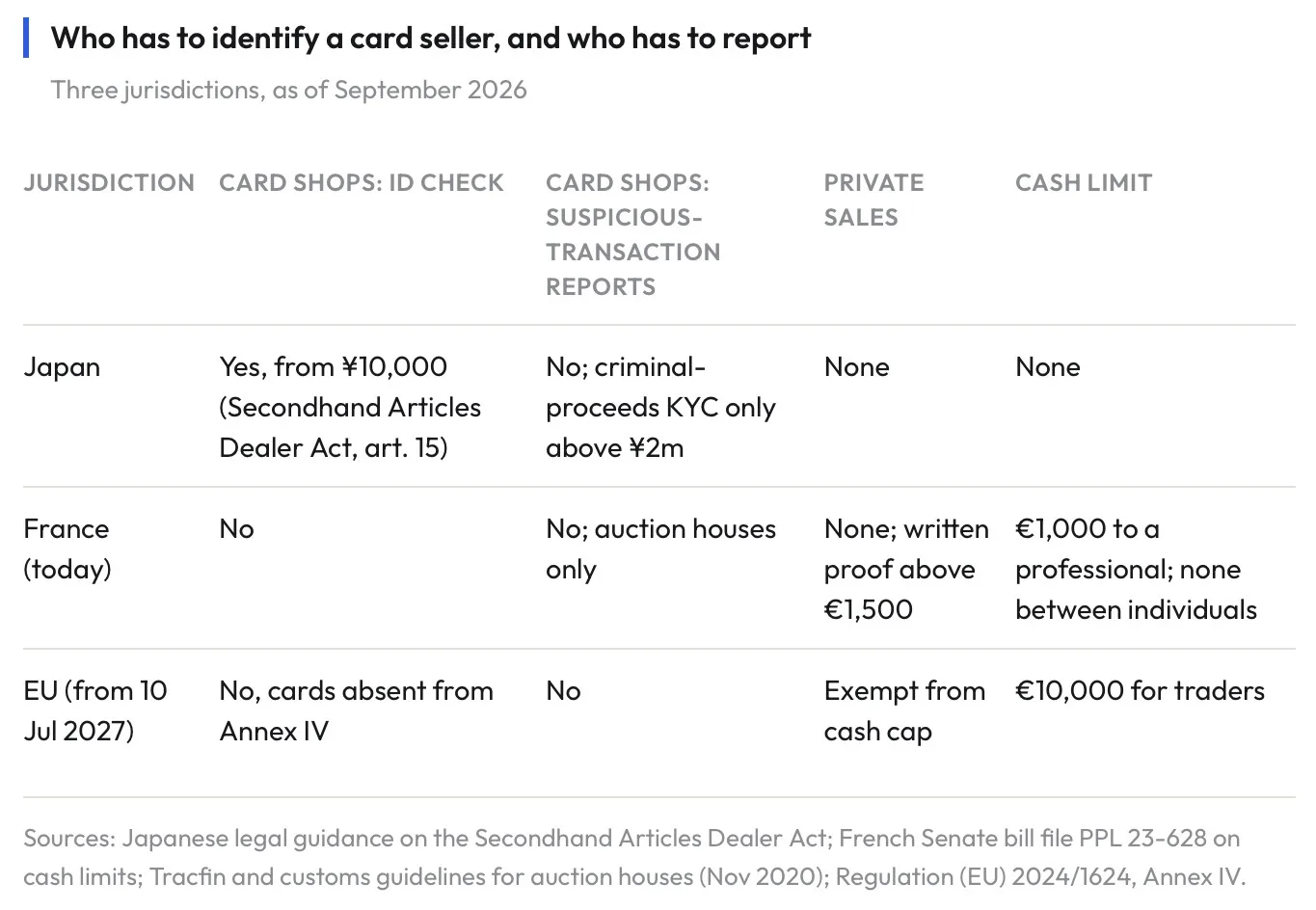
The European Union rewrote its anti-money-laundering rulebook in 2024. Regulation 2024/1624 applies from 10 July 2027, imposes a bloc-wide 10,000 euro cap on cash payments in trade, and extends AML obligations to traders in high-value goods. Annex IV lists what counts: jewellery and gold or silver articles above 10,000 euros, clocks and watches above 10,000 euros, motor vehicles above 250,000 euros, aircraft and watercraft above 7.5 million. Cultural goods are covered separately, defined by reference to a 2009 regulation that concerns antiquities, paintings and archaeological objects.
Trading cards appear nowhere. A dealer selling a 200,000 euro card in 2027 will have no customer due diligence obligation, no reporting duty, and no supervisor. And because the cash cap applies only to commercial transactions, two individuals may lawfully exchange that same card for cash, in any amount, anywhere in the Union.
The 2027 regulation lists the watch on your wrist and the car in your garage. It does not list the object in your pocket that is worth more than both.
France is already stricter on cash, with a 1,000 euro ceiling for any payment to a professional by a tax resident, and no ceiling at all between private individuals. The practical effect is to push the risk out of shops and into the private and cross-border market, which is exactly where the Marbella and Akihabara cases sit. Japan, by contrast, does make its buyback shops identify sellers from 10,000 yen, but identification is not reporting, and the LDP parliamentary league founded in July 2026 has so far framed its work around counterfeiting and bulk-buying rather than financial crime. Its chairman, Seiji Kihara, said regulation must not be strengthened to the point of killing the market.
7. What an analyst should be looking for
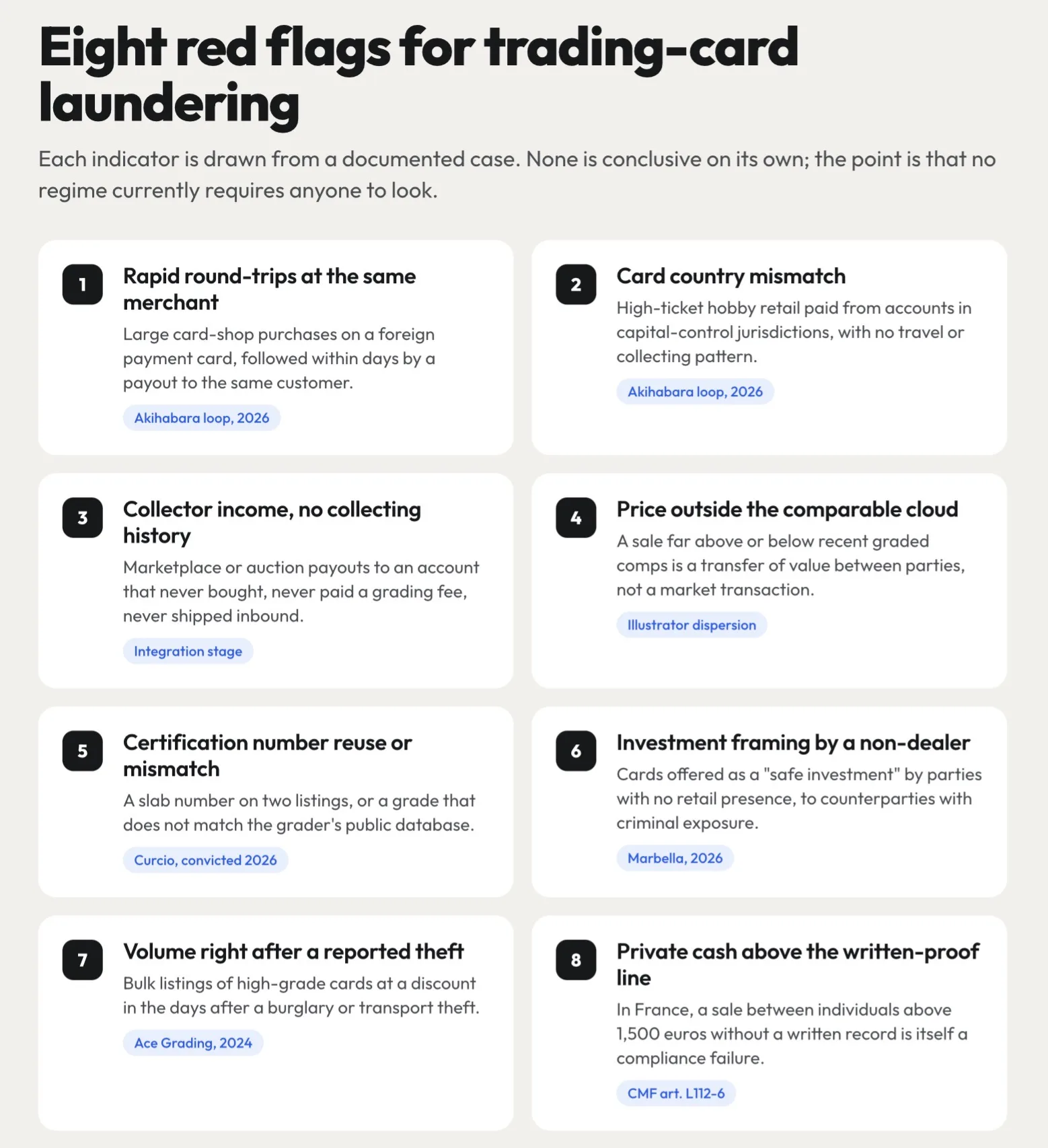
None of this is invisible. It is simply unmonitored. For a compliance function at a bank, a payment provider or a marketplace, the patterns below are the ones the documented cases would have surfaced.
8. What happens next
Three things will decide whether this stays a curiosity or becomes a recognised typology
Whether Marbella reaches trial. A conviction would give European supervisors their first case file, and a case file is what typology guidance is built from. The FATF and national FIUs write red-flag lists from prosecutions, not from magazine articles.
Whether the market keeps its price ladder. The laundering value of a card is a function of how much value it can carry per object. If the top of the market reverses, the incentive weakens. The 16.5 million dollar sale in February pushed it the other way.
Whether anyone amends Annex IV. The regulation delegates the power to update the high-value goods list. Adding collectible cards above a threshold would, at a stroke, bring dealers under due diligence and put the marketplace-to-bank leg under reporting. Nothing in the public record suggests it is being considered.