1. Two kinds of laundering
People use "antiquities laundering" for two different things. The first is laundering the object: giving a freshly dug piece a false history so that it can be sold openly. The second is using antiquities to move or store criminal money. The two often overlap, because once an object has a clean-looking history it becomes a store of value that can be sold, lent or pledged.
Vincent Michel, a professor at the University of Poitiers, put the point bluntly to the French Senate's commission of inquiry into financial crime on 14 April 2025. "Si rien n'est plus simple que de piller, rien n'est plus simple non plus que de blanchir," he said: if nothing is simpler than looting, nothing is simpler than laundering either (our translation). He cited the French penal code's definition of laundering (article 324-1), which includes facilitating "la justification mensongère de l'origine des biens", the false justification of where goods came from. In Le Détroit's reading, a forged provenance fits that definition.

He also told senators that traffickers often assume "personne n'ira vérifier la provenance des objets", that nobody will check where the objects came from. He described cultural property trafficking as "une question d'argent, qui concerne tout le spectre criminel": a question of money that runs across the whole criminal spectrum.
2. Who Vincent Michel is, and why his view matters
Michel has directed the French Archaeological Mission in Libya since 2011, according to his CV published by the École du Louvre. Since the same year he has worked as an expert, consultant and trainer for France's cultural property police unit (OCBC), the customs services DNRED and SNDJ, and the World Customs Organization. He coordinated the ICOM emergency Red List of Libyan cultural objects in 2014 to 2015 and has been a UNESCO consultant on the 1970 Convention since 2017.
His link to the Louvre Abu Dhabi is institutional, not judicial. The CV lists a training course on illicit trafficking that he coordinated for Louvre Abu Dhabi staff in March 2023, and an October 2022 interview with Les Échos about the museum. We found no source showing that he acted as a court expert in the Martinez case, and we do not describe him as one.
His central idea is the "orphan" object. "La grande vulnérabilité du marché de l'art et des musées, ce sont les objets « orphelins »," he told the Senate. An object stolen from a museum is in an inventory and can be matched against databases. An object dug from an unrecorded tomb is in no inventory at all. In Michel's account, that absence of a record is what laundering exploits: an orphan object can circulate with apparent legality.
3. The Louvre Abu Dhabi case: what is established
The case began in New York. The Manhattan District Attorney's office seized the gilded coffin of the priest Nedjemankh from the Metropolitan Museum of Art in 2019. The Met had bought it in 2017 from French dealers Christophe Kunicki and Richard Semper, and it was returned to Egypt, according to ARTnews. French investigators then followed the same supply chain to the Louvre Abu Dhabi, which had bought Egyptian antiquities through Kunicki between 2014 and 2018.
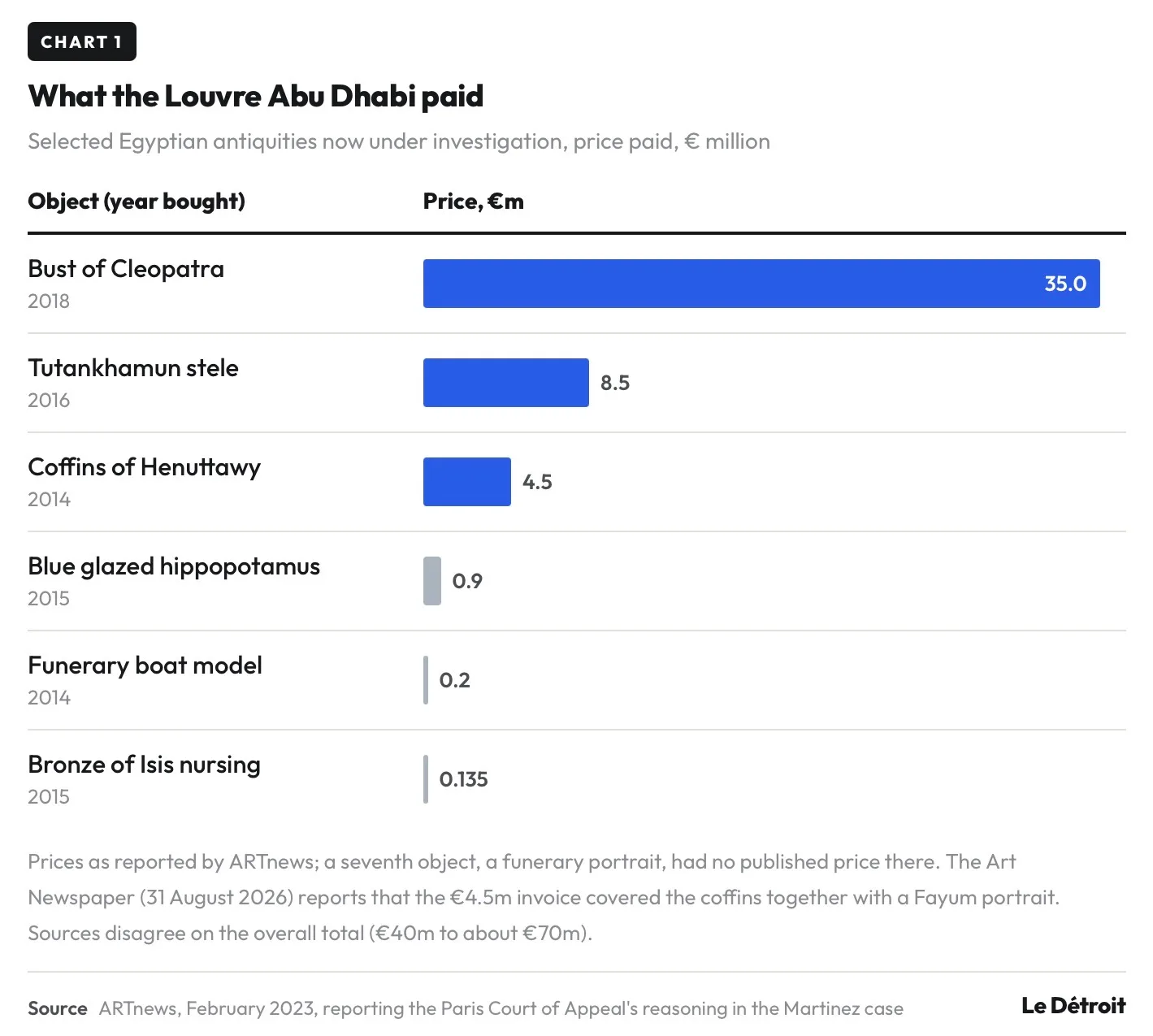
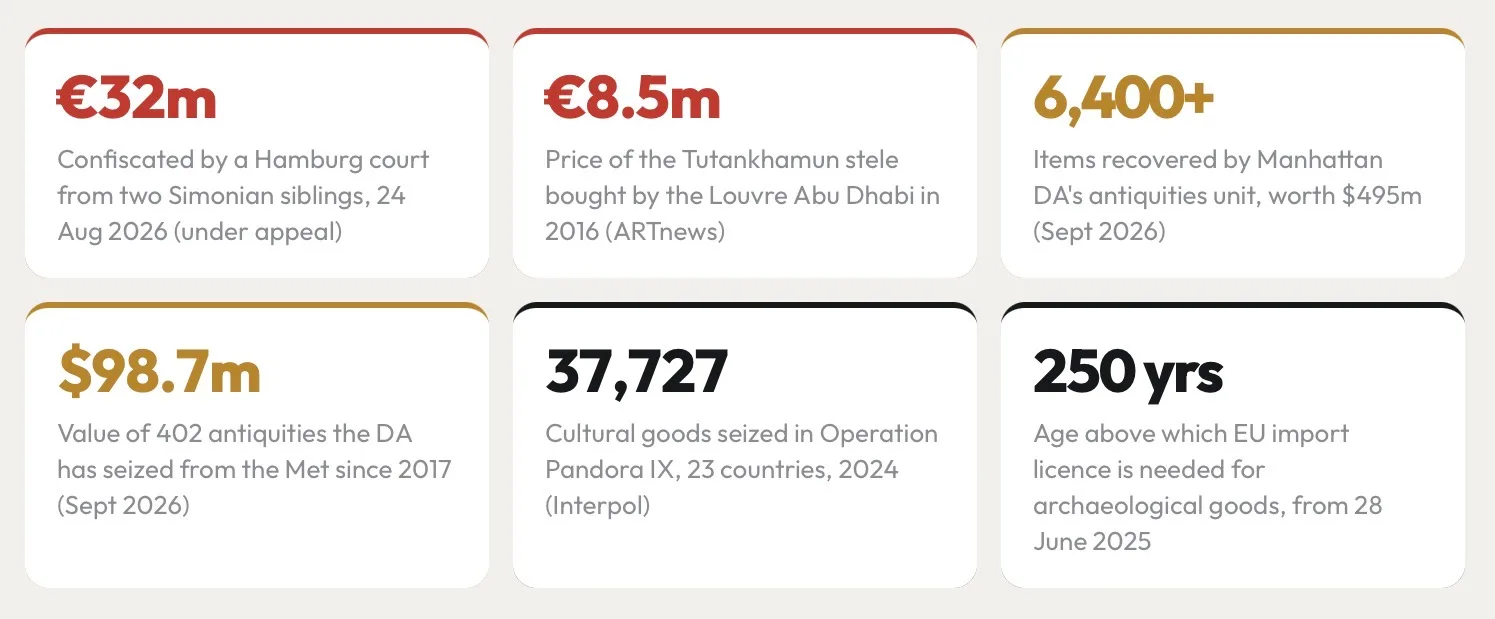
ARTnews listed the prices in February 2023, when it reported the Paris appeals court's reasoning in the case. They include €35m for a bust of Cleopatra in 2018, €8.5m for a pink granite stele bearing the name of Tutankhamun in 2016, and €4.5m for the nested coffins of Princess Henuttawy in 2014. Totals differ by source: The Art Newspaper put Louvre Abu Dhabi's purchases from Kunicki at €40m in 2023, Artnet put the approved acquisitions at more than €50m, and The Art Newspaper in 2026 put combined sales to both museums at about €70m.
Warnings came late. Egyptologist Marc Gabolde began researching the Tutankhamun stele in 2018 and by 2019 had gathered several red flags about its origins, which ARTnews links to the Egyptian merchant Habib Tawadros, said to have held the stele in the 1930s and also connected to the Met coffin. He shared his concerns with Louvre curators and with Martinez, according to ARTnews, which cites his 2021 deposition to the OCBC as reported by Libération. "The curators, Egyptologists, and Egypt are victims, not accomplices in this affair," he told ARTnews.
4. What is alleged, and where the Paris case stands
Martinez, Louvre president from 2013 to 2021, was charged in May 2022. Reports differ on the exact charge: OCCRP described it as money laundering and organised fraud, The Art Newspaper reported at the time a charge of "complicity of gang fraud and laundering", and in 2023 described the indictment upheld as one for "complicity in gang fraud". He is accused of failing to act on provenance doubts while chairing the scientific council that oversaw Louvre Abu Dhabi purchases. He denies wrongdoing and says the doubts surfaced only in 2019, years after the purchases. In November 2022 the prosecution asked for the charges to be dropped, citing a lack of serious or consistent evidence, according to Artnet and ARTnews; the Paris Court of Appeal refused in February 2023, and France's highest court rejected his appeal on 14 November 2023.
The same ruling helped curator Jean-François Charnier. The court found a defect in how his July 2022 police custody was handled; The Art Newspaper reported that the charges against him were being dropped, while Artnet noted the investigating judge could question him again. Kunicki and Richard Semper are charged with gang fraud and money laundering, according to ARTnews; Kunicki maintains his innocence. Hamburg dealer Roben Dib, extradited to Paris in March 2022 according to OCCRP, faces the same charges and denies them.
The alleged source of the objects, Serop Simonian, was jailed in Paris on 15 September 2023 on gang fraud and laundering charges. After 15 months in pre-trial detention, a magistrate released him under judicial control and allowed him to return to Hamburg on 31 December 2024. The appeal court overturned that release two weeks later, but he had not answered French summonses to return to jail, The Art Newspaper reported in March 2025. He is now 84, and the French case against him "appears stalled", the same paper reported in August 2026. None of these people has been convicted in France.
5. Follow the money: the Hamburg verdict
The clearest financial evidence so far has come from Germany. On 24 August 2026 a Hamburg criminal court convicted two of Serop Simonian's children of money laundering, according to The Art Newspaper, citing AFP. Their names were not disclosed, but the charges match those brought against Abraham Simonian and Alice Simonian Schad. The court ordered €26m confiscated from Abraham and €6m from Alice, plus fines above €120,000 in total. A further gang trafficking charge against Abraham was dismissed for lack of evidence. Both have appealed, and the verdict is not final.
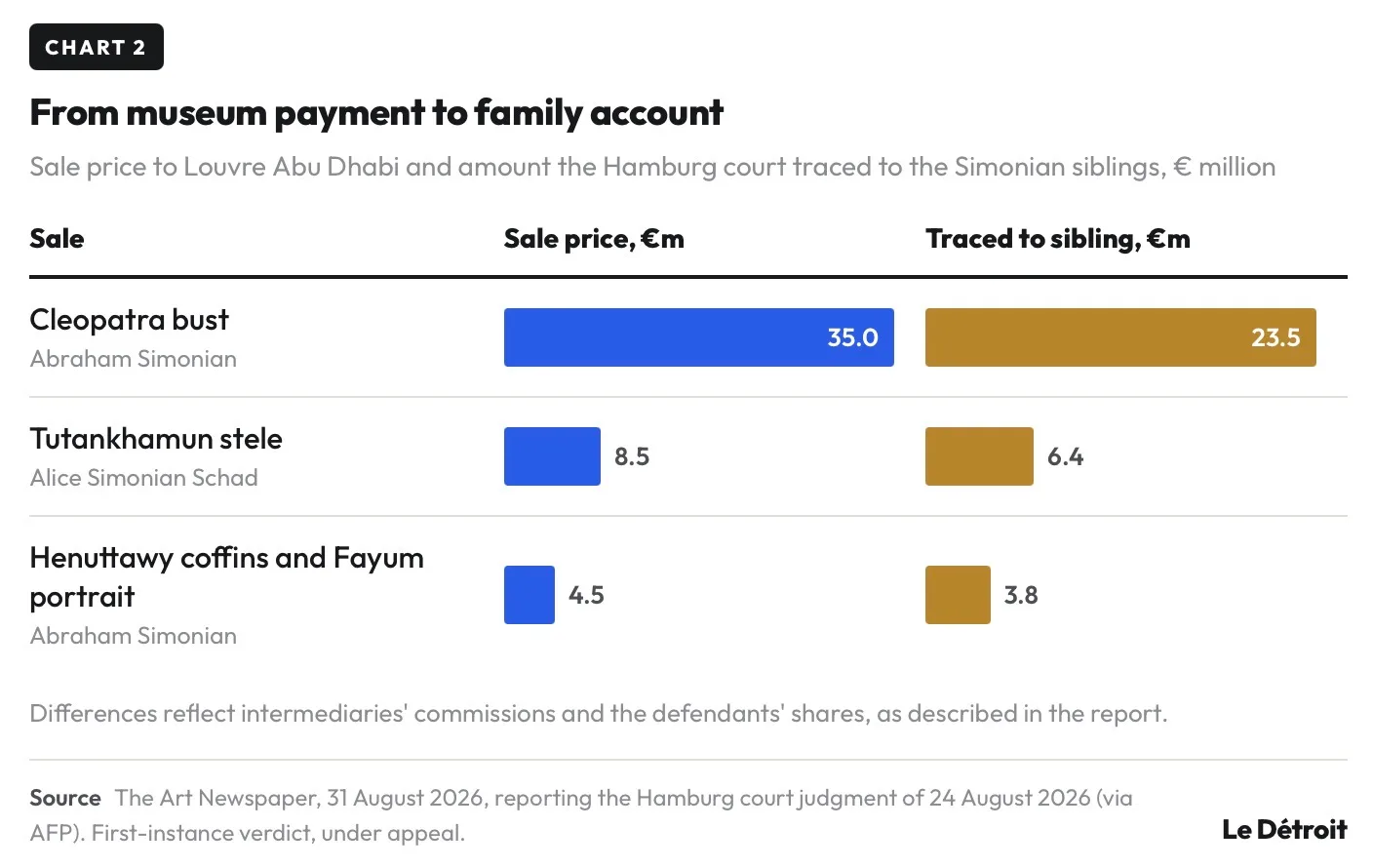
The judgment traced specific sales. According to the report, Abraham billed the Louvre Abu Dhabi €4.5m in 2014 for the princess's coffins and a Fayum portrait, describing them as gifts from his grandparents, and €3.8m reached his Hamburg bank accounts after commissions. Alice collected €6.4m from the €8.5m stele sale, and Abraham's share of the €35m Cleopatra sale was €23.5m.
German authorities had already seized €4.6m from accounts at six banks and real estate worth €16.5m in 2020, the report said. About 200 antiquities registered in Abraham's name were seized in Antwerp in June 2021. A 2020 French arrest warrant for the siblings was refused by German courts as insufficiently substantiated. In our reading, that helps explain why a German court, not a French one, delivered the first verdict.
6. Syria, Iraq and Libya: from bureaucracy to Facebook groups
Michel dates the turning point to 2011. Before then, he told senators, trafficking was treated as damage to heritage; once it was linked to organised crime, "tout a changé". He said the Islamic State had "ouvert une boîte de Pandore" by turning looting into a funding source, and described a move "d'un stade artisanal à une industrialisation du pillage", often with mechanical diggers.
US court filings support the picture of a looting administration. In a December 2016 civil forfeiture complaint, federal prosecutors in Washington said documents recovered in a May 2015 raid near Deir Ezzor, Syria, on senior ISIS leader Abu Sayyaf showed him styling himself president of an "Antiquities Department", with excavation permits and receipts on ISIS letterhead. The investigation found that "ISIL sold antiquities in U.S. dollars," the Justice Department said.
Syria is again the main concern. The ATHAR project, which monitors online trafficking, has documented about 1,500 Syrian cases since 2012, nearly a third of them in the months after the Assad government fell, The National reported in June 2025. In August 2026 NPR quoted ATHAR co-director Amr Al-Azm saying looting "has exploded since the fall of the regime", while a deputy director at Syria's museums and antiquities agency described a "gradual but substantial decline" in the new government's second year. The two accounts conflict, and we cannot settle which is right.
Libya is Michel's own field. He told senators that anonymous Libyan funerary portraits have been sold as portraits of Caesar, Augustus or Domitian, that objects from Libya, Iraq or Syria have been presented as coming from a Roman province of North Africa, and that Libyan funerary portraits have turned up in Jerusalem's souks as Holy Land relics. On Egypt, he told AFP in 2022 that clandestine digs rose from about 1,500 a year to 8,960 in 2020.
7. How a dirty object gets a clean history
Public enforcement documents describe the methods at a general level. The FATF's February 2023 report on the art and antiquities market says looters and smugglers "often use false documentation or false invoices to disguise or mislead their provenance", and that goods are moved using false export certificates, and stored for some time to dissociate them from their source country. Michel gave the Senate concrete cases: a fictitious collection, a provenance dated to 1970, the year of the UNESCO Convention, and an object checked in 2016 on its way from Lebanon to Bangkok, declared as a 108kg garden ornament stone.
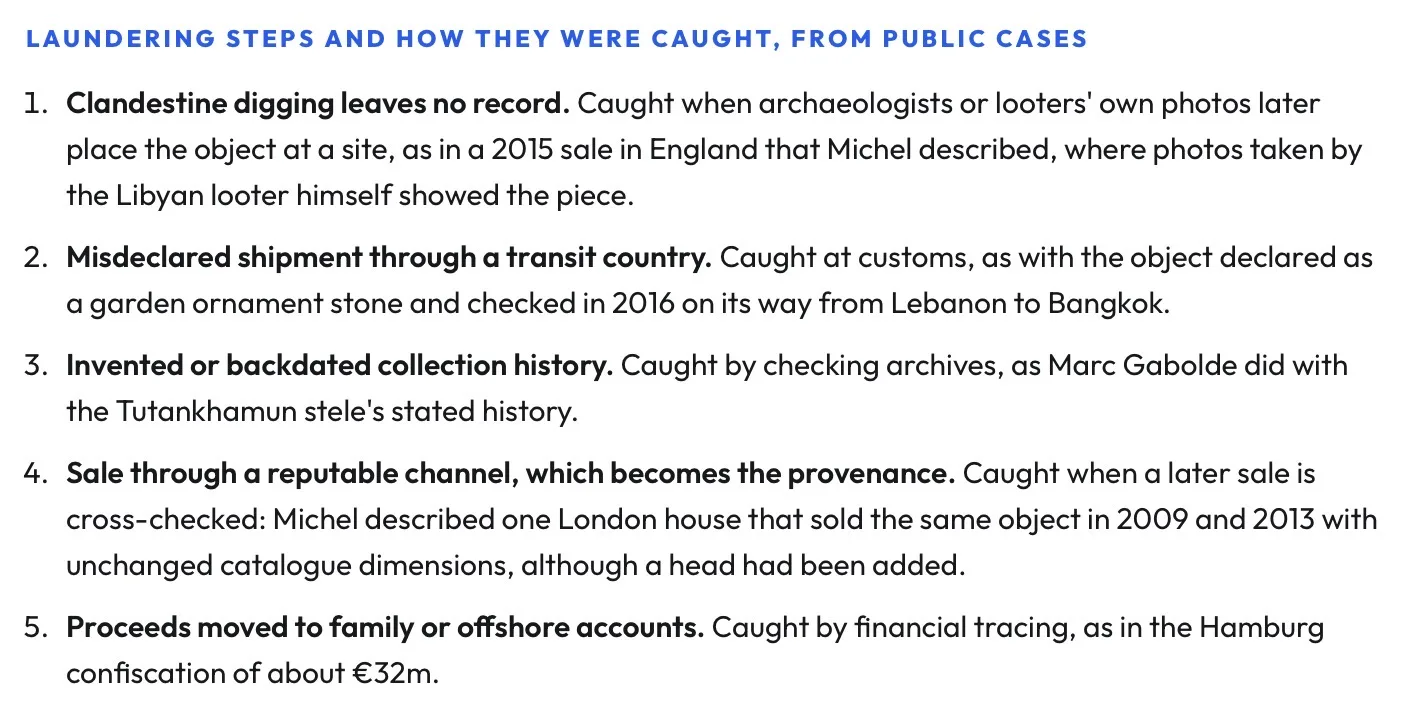
Auction houses are part of both the problem and the solution. The FATF notes their commission gives them "a financial incentive to sell objects at a higher price" and that "some isolated auction house experts may act as accomplices". Michel said of one sale that even the minimum check against the Interpol stolen art database "n'a pas été fait". At the same hearing, auctioneer and court expert Marie-Charlotte Pillon said large houses now have dedicated anti-money-laundering teams while small provincial ones struggle.
Freeports are the third element. The FATF says such storage facilities may offer "the possibility of buyers and sellers conducting transactions anonymously", while noting that Switzerland requires freeports to keep inventories and owners' names. In 2022 Xavier Delestre, a French regional archaeology official, told AFP that high-value looted works "vont échouer dans les ports francs" before reappearing "avec une fausse histoire".
8. The rules: Europe moves, Washington stalls
The EU has two layers. Its fifth anti-money-laundering directive, adopted in 2018 and due to be transposed by 10 January 2020, made art traders, including galleries and auction houses, and those storing art in free ports, obliged entities for transactions of €10,000 or more. Regulation (EU) 2019/880 then added customs controls. Its ban on importing cultural goods illegally exported from their source country has applied since 28 December 2020.
The second stage started on 28 June 2025. Archaeological objects and dismembered monuments over 250 years old now need an import licence whatever their value, and other cultural goods over 200 years old and worth €18,000 or more need an importer statement, filed through a central electronic system, according to the European Commission. The rules also cover goods placed in customs warehouses and free zones, which in our reading matters for freeport storage. Recital 11 of the regulation names pillaged goods as "a possible source of terrorist financing and money laundering activities".
The United States has a law but no rule. Section 6110 of the Anti-Money Laundering Act of 2020 brought antiquities dealers under the Bank Secrecy Act. FinCEN published an advance notice in September 2021, but the proposed rule was never published and the notice was withdrawn, Senator John Fetterman wrote to Treasury on 3 June 2026, asking for a reply by 2 July. We found no public answer.
Enforcement in the US has come instead from one prosecutor's office. On 23 September 2026 the Manhattan DA's office returned 36 antiquities valued at more than $5m to Syria. Its Antiquities Trafficking Unit said at that point that it had recovered more than 6,400 items valued at $495m, returned more than 6,200 of them to 40 countries and convicted 18 people. The office says it has seized 402 antiquities from the Met since 2017, valued at $98.7m.
9. What the numbers say, and what they do not
The most common figure, that cultural goods trafficking is worth about €10bn a year and ranks third after drugs and arms, is not one Michel defends. He cited it to the Senate and added: "En réalité, nous n'en savons rien." The FATF agrees that "it is challenging to estimate the amount of illicit proceeds", partly because "the lack of reliable statistics concerning looting activities" makes the scale hard to assess.
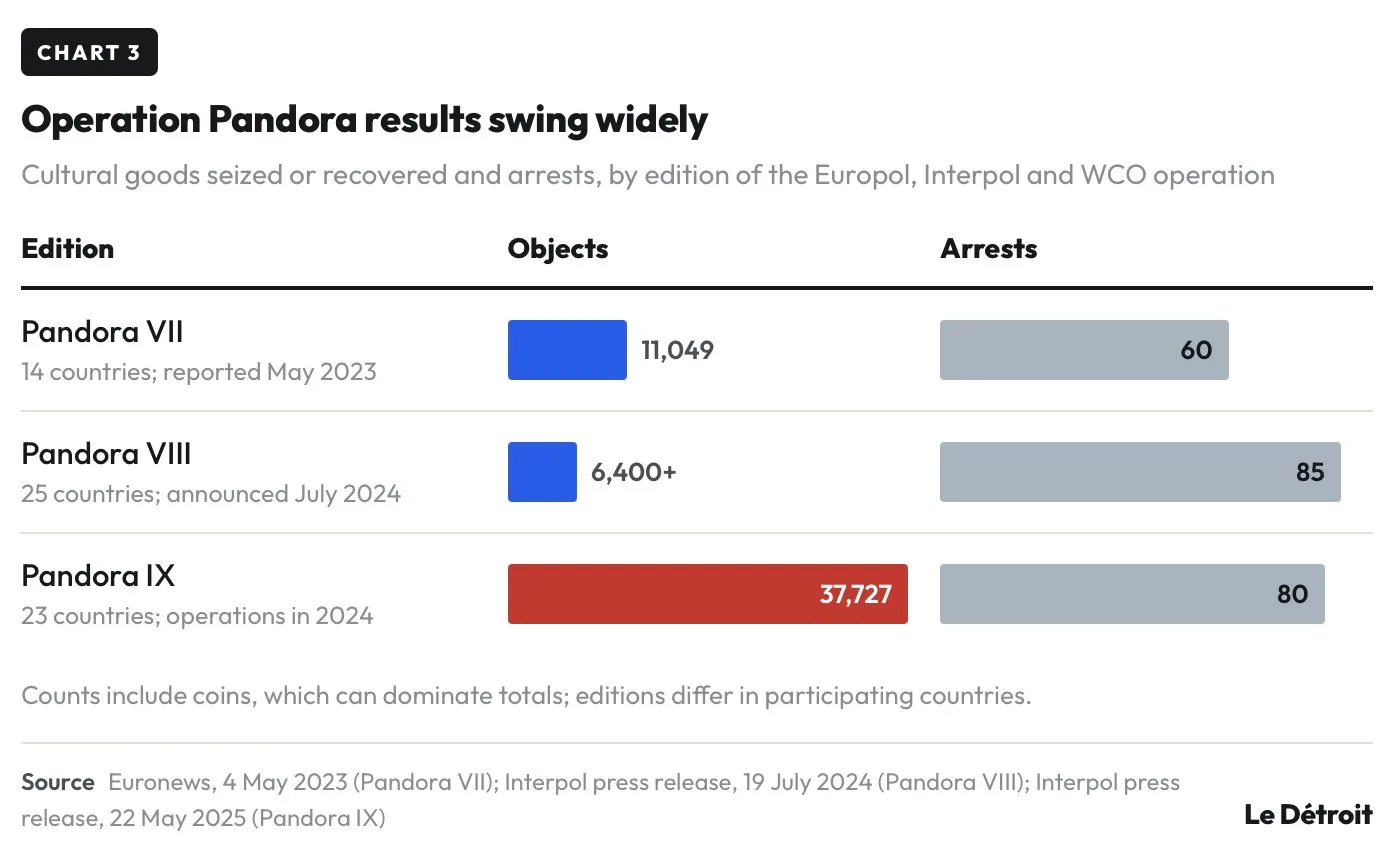
Seizure data are firmer but measure police effort. Michel cited Interpol's figure of 854,742 cultural goods seized in 2020. The annual Europe-wide Operation Pandora shows how much results swing: 11,049 objects in its seventh edition, reported in May 2023, over 6,400 in the eighth, announced in July 2024, and 37,727 in the ninth, carried out in 2024 across 23 countries, with 80 arrests and 4,298 items seized through online patrols.