
1. The facts
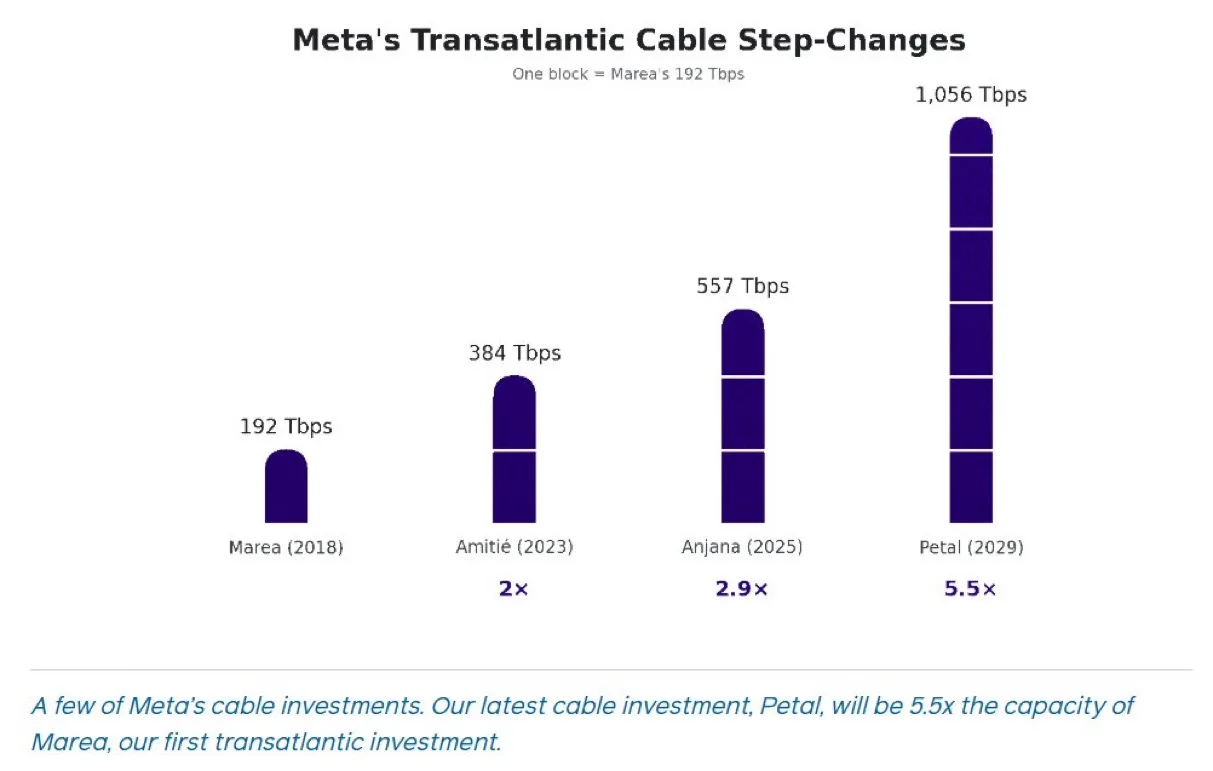
Meta announced on Monday Petal, a subsea cable of roughly 7,000 kilometres linking the United States to France's Atlantic coast. It is designed to carry 1 petabit per second, or 1,000 terabits, double what today's most advanced cables carry over that distance. Meta calls it the single largest generational increase in capacity of any repeatered subsea system. It is due to enter service in 2029, built with NEC and Sumitomo Electric Industries, with Orange supporting the French landing. Meta's own comparison: roughly the network capacity needed for three quarters of the world's population to stream music at the same time.
The engineering is the real news. Each generation of Meta's transatlantic cables has added fibres: eight fibre pairs in Marea, sixteen in Amitié, twenty-four in Anjana, the first transatlantic system at half a petabit. Meta says it had three ways to double again: go to 48 fibre pairs, open the L-band as it did on its Pacific Light cable, or put two light-carrying cores inside each fibre. It chose the third. Petal keeps 24 fibre pairs but each carries two cores, the equivalent of 48, inside the same 125-micron fibre. The difficulty is keeping the two cores from bleeding into each other; Meta says ultra-pure synthetic silica and sending signals in opposite directions through each core reduce crosstalk to near-immeasurable levels. It is the first time multi-core fibre will be laid at transoceanic scale.
Meta's shares rose more than 7 percent on Monday. The cable was not the reason. Market coverage attributed the move to Wells Fargo lifting its price target from 640 to 796 dollars, a broad technology rally as oil fell below 100 dollars, and anticipation of Meta Connect on 23 and 24 September, where the company is expected to showcase its Muse AI agent.
2. Why it matters: who owns the ocean floor
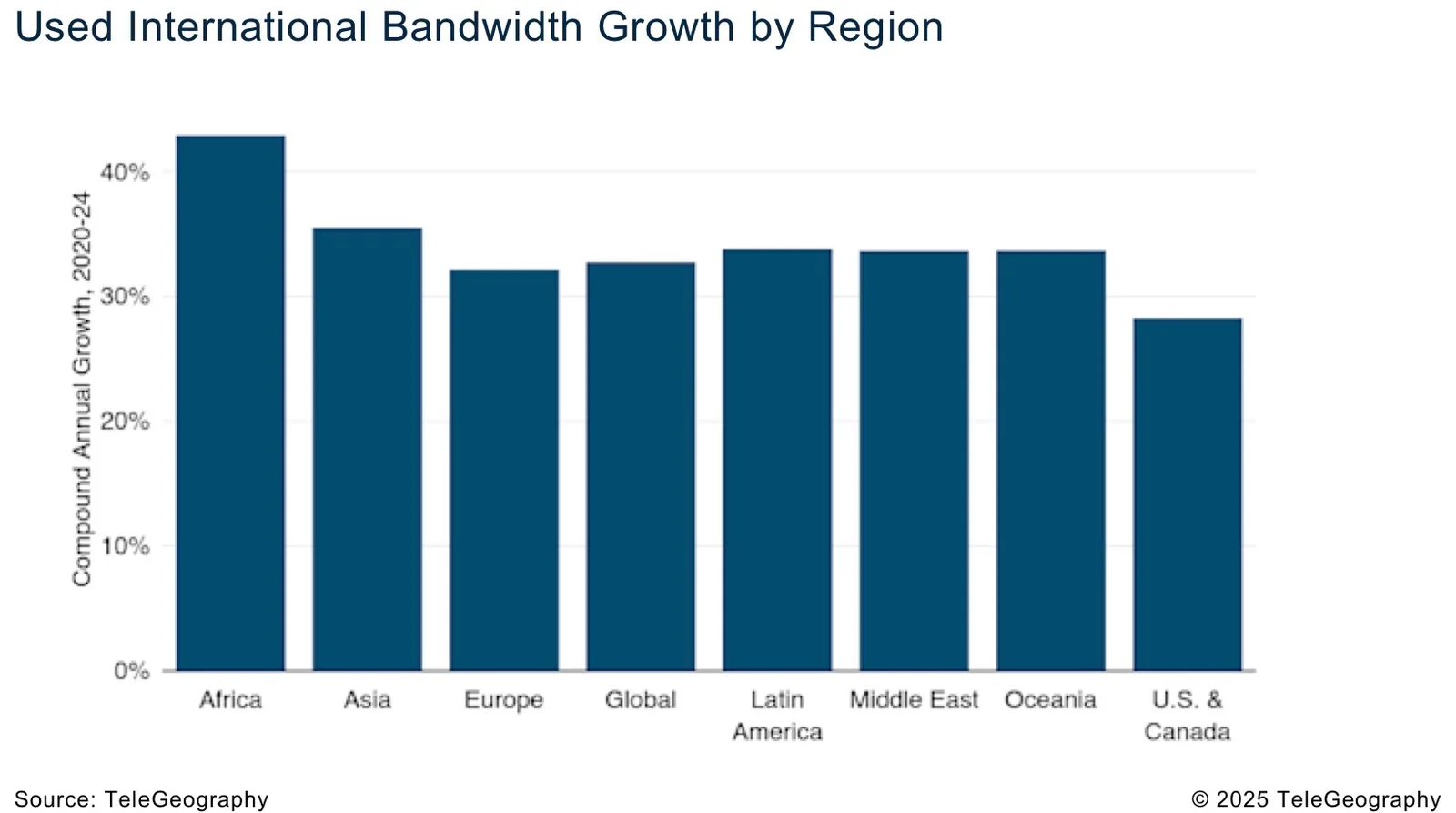
Around 99 percent of intercontinental data travels through cables on the seabed. For most of the internet's history they were financed by consortiums of national telecom operators. That has inverted. TeleGeography data shows that as recently as 2016, internet backbone providers accounted for most international bandwidth demand; by 2024, content and cloud networks, above all Google, Meta, Microsoft and Amazon, accounted for almost three quarters of it, and at least 80 percent on the transatlantic route.
When you are the main user, you stop renting and start owning. Meta now designs the cables, specifies the fibre and sets the capacity records. The driver is traffic between its own data centres, increasingly for training and running AI models, which is why the company building the cable is also building what sits at either end.
For Europe, the landing is the story. Petal comes ashore in France on a route where the dominant user, the owner and the technology suppliers are all non-European, with Orange in a supporting role at the beach. That is good for French connectivity. It is also a measure of how far control over the continent's most important data corridor has moved.
3. What to watch
The landing site. Meta says France's Atlantic coast. Which town, and which data-centre cluster it feeds, decides who benefits.
Third-party access. Meta has not said whether European operators will be able to buy capacity on Petal.
Regulatory conditions. Subsea cables landing in the EU are increasingly treated as critical infrastructure. Whether Paris or Brussels attaches security or access conditions is open.
The 2029 date. Multi-core fibre has never been laid across an ocean. First-of-a-kind cables slip.