Too Connected to Fail: How ueno's Collapse Put Paraguay's President on Trial
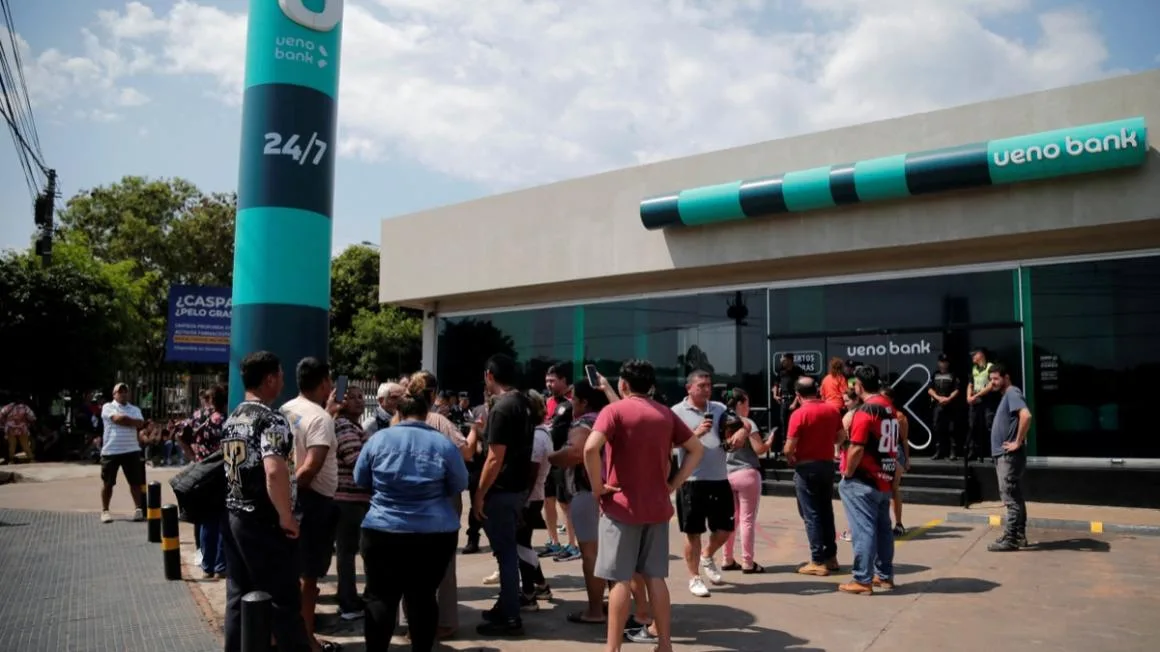
Paraguay has seized ueno, a digital bank serving six in ten adults and holding some $850m of public money. Lending to its owners' firms and ties to the regulator and president turned its failure into a political crisis.
By Le Détroit
REUTERS/Cesar Olmedo
The essentials
The seizure. On 2 November Paraguay's central bank voted unanimously to put ueno bank into resolution, after adjustments to its accounts left its solvency ratio below half the legal minimum. Its app, cards and transfers stopped on 3 November.
The reach. ueno counted 2.94m clients in June, about 63% of adults by its own count, and issued 43% of the country's credit cards, though it held only about 9% of deposits.
The warnings. Supervisors flagged loans to companies tied to its owner, Grupo Vázquez, in June, and Fitch turned negative on 16 October. Prosecutors have charged 27 people and six executives are in pre-trial detention; nobody has been convicted.
The money. About $850m of public money was inside, $355m to $380m of it from the IPS pension fund. The guarantee covers G228.3m per person per bank. Payouts began on 5 November with a first group, depositors holding up to G10m; an advance of up to G121.76m is due within five working days (as of Friday morning, Paris time).
The politics. President Santiago Peña, a 1.58% shareholder in ueno's holding company until March 2025, asked the governor he had appointed, a former chairman of ueno's predecessor, to resign. On 5 November he announced his own resignation, on which Congress has not voted, and deputies sent him to trial in the Senate, which was to hear his defence on 6 November (as of Friday morning, Paris time).
1. A bank in six of ten pockets
ueno's collapse matters less for its balance sheet than for where it sat: in the phones of most Paraguayan adults, and between the state's money and the president's circle. On Monday 2 November the board of the Banco Central del Paraguay (BCP) voted unanimously to put the bank into resolution, the procedure for winding up a failed lender, after adjustments to its accounts left its solvency ratio below half the legal minimum. When the decision was announced early on 3 November, ueno's app, cards and transfers stopped.
By deposits, ueno was mid-sized: fifth among private banks at the end of 2025, with 8.9% of the system's deposits, according to the rating agency FIX. By reach, it was the biggest private bank, by its own count. It counted 2.94m clients in June, about 63% of adults by its own reckoning, issued 43% of the country's credit cards and handled 28% of the transfers on SPI, the instant-payment system.
63%
of Paraguay's adults were ueno clients in June by the bank's own count: 2.94m people
About $850m
of public money sat in ueno when it was seized, $355m to $380m of it from the IPS pension fund
G228.3m
guaranteed per person per bank, about $38,000; preliminary estimates put 97% of depositors within it
78
deputies voted on 5 November to send President Santiago Peña to trial in the Senate
That makes it a different kind of failure from Paraguay's banking crises of 1995, 1997-98 and 2002-03, when the banks that closed held between 13% and 21% of deposits. ueno's weight lay in daily payments, and in whose money it held.
Chart 1
Small in deposits, everywhere in payments
ueno's clients among Paraguay's adults, its share of the banking system, and the size of earlier failures
Hover or tap the shapes for details
Paraguay's adults, as 100 people
ueno clients: 63Others: 37
ueno's share of the system, June 2026
Credit cards issuedlargest issuer
43%
Credit cards issued: 43% of the marketueno, second-quarter 2026 investor presentationBloomberg counted almost 1.1m cards issued by September
Instant transferson SPI
28%
Instant transfers on SPI: 28%ueno, second-quarter 2026 investor presentationA share of the country's payment plumbing three times its share of deposits
Debit cards issued
27%
Debit cards issued: 27% of the marketueno, second-quarter 2026 investor presentation
Depositsfifth of private banks
9.1%
Deposits: 9.1% of the system, $2.83bn, in June 2026 (ueno)8.9% at the end of 2025, fifth among private banks, according to the rating agency FIX$2.836bn in September 2026, Superintendency of Banks data via Forbes Argentina
Loans
7.8%
Loans: 7.8% of the system in June 2026 (ueno)5.9% at the end of 2025, according to FIXGross loans: $2.46bn in June 2026, up 31.6%, ueno said
Earlier failures: share of deposits held by the banks closed
1995four banks
13%
1995: four locally owned banks intervenedThey held 13% of system deposits in 1994There was no deposit guarantee; the central bank disbursed about 6% of GDP that year
1997 to 1998second wave
21%
1997 to 1998: a second wave of closuresThe banks closed held 21% of system deposits in 1996Direct costs of the 1995 to 2003 crises: 15.7% of GDP in all, an IMF economist estimated
2002 to 2003two banks
16%
2002 to 2003: a foreign-owned and a locally owned bank intervenedThey held 16% of system depositsLaw 2334, which created today's deposit guarantee, followed in 2003
025%50%
Market shares are ueno's own June 2026 figures. Earlier failures: deposits held by the banks closed, as a share of the system, from a 2020 economic history of Paraguay (Becker Friedman Institute).
Source ueno bank, Q2 2026 earnings presentation (July 2026); FIX SCR rating report (Mar 2026); Forbes Argentina and AP (3 Nov 2026); Senate of Paraguay (4 Nov 2026); Charotti, Fernández Valdovinos and González Soley, The Case of Paraguay (BFI, 2020)Le Détroit
2. Five months of warnings about lending to its owners
The bank did not fall to a run but to whom it lent, and the warnings came early. In June supervisors flagged loans to companies tied to Grupo Vázquez, ueno's controlling shareholder, above legal limits; the bank says it fixed the breach that month, within the deadline it was given. It did so by moving a portfolio of those loans to Vinanzas SA, a related company: $74.4m, according to Última Hora. Supervisors suspected that Vinanzas had been financed indirectly by ueno itself; the bank's president, Juan Manuel Gustale, said it had not.
The questions reached the top of the BCP. In September senators asked it for a memo dated 10 July by Fernando Rivarola, then its supervision manager, and for the circumstances of his transfer to the AFD, a state development bank, ABC Color reported. The BCP opened a four-month inquiry in late September.
Chart 2
Five months of warnings, then four days
What supervisors, markets and politicians did around the central bank's vote of 2 November 2026. Filter by actor
Hover or tap the shapes for details
JunSupervisors flag loans above legal limits to Grupo Vázquez companies.June 2026: the central bank says it warned ueno that it was lending too much to companies tied to its owners (AP)ueno acknowledges a breach of the limits on related-party lendingIt says it corrected the breach in June, within the deadline regulators set (economia.com.py, citing Bloomberg)
JunThe loans are moved to Vinanzas SA, a related company.June 2026: ueno transfers a loan portfolio to Vinanzas SA$74.4m, according to Última Hora as cited by Infobae; ABC Color put the operation at about $40m ($35m plus G36.9bn)Supervisors suspected ueno financed the purchase indirectly; its president, Juan Manuel Gustale, said it had not
10 JulThe supervision manager signs a memo that senators later demand.D-11510 July 2026: memo by Fernando Rivarola, then the central bank's supervision managerIn September senators requested it and asked about his transfer to the AFD, a state development bankSource: ABC Color, 14 September 2026
SepSenators press the central bank; it opens a four-month inquiry.By mid-September: ABC Color publishes internal central bank documents on ueno's lending14 September: senators ask whether the Vinanzas deal was a genuine cash sale; ABC Color argued it was indirect financing, which central bank rules prohibitLate September: the central bank opens a four-month administrative inquiry (Bloomberg Línea)
9 OctPeña: an inquiry is not an intervention or a closure.D-249 October 2026: President Santiago Peña says opening an investigation does not mean intervening in or closing the bankAs reported by economia.com.py, citing BloombergOn 27 October he asked for calm and prudence; he had described the alerts as the creation of some media outlet, ABC Color reported
16 OctFitch turns negative; the 2031 bond is down to about 87 cents.D-1716 October 2026: Fitch affirms ueno at BB and moves its outlook from stable to negativeIt cited rapid balance-sheet growth and a high level of intangible assetsThe $350m bond due 2031, sold in March, traded near 99 cents then and about 87 cents by 21 October
29 Octueno announces a $100m capital plan and reports a 13.8% capital ratio.D-429 October 2026: $50m from the holding company, U Holdings, in November and $50m from local investorsueno said its total capital ratio would rise from 13.8% to 15.9%; the legal minimum is 12%The same day a central bank director, Carmen Marín, resigned; no reason was given (The Rio Times)
2 NovCentral bank votes to resolve ueno: solvency under half the minimum.D-day2 November 2026: unanimous board vote under Law 2334/03Trigger: a solvency ratio below 50% of the legal minimum after adjustments to ueno's financial statementsAnnounced early on 3 November; the app, cards and transfers stopped
3 NovEight arrest orders; the governor resigns at Peña's request.D+13 November 2026: prosecutors order the arrest of eight people linked to uenoCarlos Carvallo, who had chaired ueno's predecessor until mid-2023, resigns at Peña's requestPeña: those responsible must answer to the courts, without exceptions or privileges (AP, Reuters)
4 NovLaw 7745 speeds payouts; an impeachment motion is filed.D+24 November 2026: Congress passes, and Peña signs, Law 7745: an advance of up to G121.76m within five working days35 deputies file an impeachment motion against Peña and Vice-President Pedro Alliana
5 NovPeña announces his resignation; 78 deputies send him to trial.D+35 November 2026: Peña announces his resignation in a video; a joint session of Congress to consider it loses its quorumDeputies send the impeachment to the Senate with 78 votes and reject a motion against Alliana, 48 to 30A judge remands six ueno executives and puts two under house arrestThe Senate summons Peña or his lawyers for 10:00 on 6 November in Asunción (14:00 Paris); a vote could follow that night (as of Friday morning, Paris time)
SupervisorBank and marketsGovernment and CongressD-: days before the 2 November vote
Allegations are attributed; ueno denies that it financed Vinanzas.
Source AP, Reuters (3 Nov 2026); Infobae (5 and 6 Nov); ABC Color (14 Sep, 5 Nov); Bloomberg Línea (3 Nov); economia.com.py (21 Oct); The Rio Times (30 Oct); central bank statements via La Nación and ABC Color; Cámara de Diputados, La Nación and Diario HOY (5 Nov)Le Détroit
Markets moved faster than the regulator. On 16 October Fitch moved ueno's outlook to negative, citing rapid balance-sheet growth and a high level of intangible assets, and the $350m bond ueno had sold in March near par slipped to about 87 cents. On 29 October ueno announced a $100m capital plan and put its total capital ratio at 13.8%, above the 12% minimum. Four days later the BCP found its solvency ratio below half the minimum.
Chart 3
Four readings of one bank's capital
Capital ratios reported by ueno and Fitch, and the central bank's finding, against the legal thresholds. Pick a reading
Below 6%: under half the 12% minimum, the trigger for resolution6% to 12%: below the legal minimum12% and above: meets the total capital minimum
14.5%total capital ratio, as ueno reportedueno's own figure, 30 June 2026. A total capital ratio of 14.5% against a legal minimum of 12%, and a core ratio of 12.1% against 8%, in its second-quarter investor presentation.Source: ueno bank, Q2 2026 earnings presentation
10.3%Fitch core capital, its own measureFitch's yardstick, end-June 2026. Fitch's core capital ratio, calculated differently from the legal one, was 10.3%. Fitch moved ueno's outlook to negative on 16 October; ueno said a return to stable would need more than 13%.Source: Fitch, via The Rio Times
13.8%total capital ratio, as ueno reportedueno's figure four days before the seizure. Announcing a $100m capital plan on 29 October, ueno put its total regulatory capital ratio at 13.8%, rising to 15.9% once the money arrived.Source: The Rio Times, citing ueno
below halfthe legal minimum, after the regulator's adjustmentsThe central bank's verdict, 2 November. After adjustments to ueno's financial statements, its solvency ratio was below half the legal minimum, the trigger for resolution under article 13 of Law 2334/03. The exact figure was not published; against the 12% total capital minimum, it would mean below 6%.Source: central bank statement, via La Nación and ABC Color
The legal ratio and Fitch's core capital measure are calculated differently. The dial puts the resolution line at 6%, half of the 12% total capital minimum; the central bank did not say which ratio it applied or publish ueno's figure.
Source ueno bank, Q2 2026 earnings presentation; Fitch via The Rio Times (30 Oct 2026); central bank statement of 3 Nov 2026 via La Nación and ABC Color; Law 2334/03, art. 13Le Détroit
Prosecutors now treat the lending as a crime. On 4 November they charged 27 people, eight of them ueno directors, with misconduct in a crisis, breach of trust, attempted fraud and bookkeeping offences, alleging that loans and overdrafts went to group companies in 2025 and 2026 on terms outside normal credit standards. They put balances still to be recovered at about $166.9m and G343bn. On 5 November a judge remanded six executives in custody, among them Miguel Vázquez, ueno's chief executive and the group's controlling shareholder, and Mr Gustale, and put two under house arrest. The charges are provisional and must be proved in court.
3. The state piled in first and is covered least
Public money stands to lose most, because the guarantee was built for savers, not for the state. Deposits by public bodies at ueno grew from a first G70bn placement by the IPS, the pension and health fund, in September 2023, a month after Santiago Peña took office, to G3.2 trillion in guaraníes alone by December 2025, plus $144.6m in dollars, Ministry of Economy data compiled by ABC Color show. By then ueno held more public money than any bank except the state-owned Banco Nacional de Fomento. When it closed, it held about $850m, $355m to $380m of it from the IPS.
Chart 4
The state's money poured in under Peña
Public-sector deposits at ueno: in guaraníes above the line (blue, G trillion), in dollars below it (green, US$ m)
Hover or tap the shapes for details
Public deposits at ueno, end of period
When the doors closed
About $850mpublic money held at ueno, the figure Reuters gave; AP said $800m to $850mPublic money at ueno: about $850mReuters, 3 November 2026; AP gave $800m to $850mABC Color counted about $855m at the end of September, from Ministry of Economy data
$355m to $380mof it from the IPS, the pension and health fundThe IPS$355m invested, according to its finance manager (BBC Mundo, 5 November)About $380m, according to APAbout 32,000 pensioners were paid through ueno; the IPS says pensions are guaranteed
29%of ueno's deposits were public at the end of JunePublic deposits: 29% of ueno's total at end-June 2026About G5 trillion, $869m, Bloomberg calculatedAP: about a quarter, according to the bank
Undisclosedwhat other state bodies holdAmounts not disclosedOther public bodies also held deposits at uenoTheir amounts had not been published (as of Friday morning, Paris time)
Deposits held in guaraníes and in dollars are shown separately, as ABC Color reported them. September 2023 is the IPS's first large placement. The totals of $855m and $862m are ABC Color's conversions at the exchange rates of the time.
Source Ministry of Economy and IPS data compiled by ABC Color (20 Mar and 21 Oct 2026); Bloomberg Línea (3 Nov 2026); Reuters and AP (3 Nov); BBC Mundo (5 Nov); Infobae (3 Nov)Le Détroit
The deposit guarantee, created by Law 2334 in 2003 after the last crises, covers 75 monthly minimum wages per person per bank: G228.3m, about $38,000. Preliminary estimates put 97% of ueno's depositors within it, AP reported. Law 7745, rushed through Congress and signed on 4 November, adds an advance of up to G121.76m within five working days. Payouts began on 5 November with a first group: depositors with up to G10m, no debts to ueno and an account at another bank (as of Friday morning, Paris time).
For the state, the cap is close to irrelevant. It applies per depositor, so a pension fund holding hundreds of millions of dollars is covered for at most the same G228.3m as a pensioner, and a bill to extend the guarantee to all public funds at ueno was rejected on 3 November. What the IPS, ministries and state companies recover above the cap depends on the liquidation. The fund itself held $1.29bn in July 2025; its largest past rescue, of the finance company CEFISA in 2022, moved G480bn of guaranteed deposits. ueno held $2.84bn of deposits in September.
Calculator
What is a ueno deposit worth?
Pick a balance to see what the guarantee pays, when, and what is left to the liquidation
Balance at ueno, all accounts combined
Advance, within 5 working daysG5mG10mG50mG121.76mG121.76mG121.76mG121.76mabout $830about $1,670about $8,330about $20,300about $20,300about $20,300about $20,300The advanceLaw 7745, 4 November 2026: up to 40 monthly minimum wages, G121.76mPaid by the Deposit Guarantee Fund into the depositor's account with the highest balance at another bank, or a new oneOverdue debts owed to ueno are deducted first
Rest of the guaranteeG0G0G0G0G106.54mG106.54mG106.54m$0$0$0$0about $17,800about $17,800about $17,800The rest of the guaranteeLaw 2334/03 covers 75 monthly minimum wages per person per bank: G228.3mBy law it is due within 15 calendar days of the resolution, extendable by 15; the central bank said the remainder would follow on a staggered schedule
Not guaranteedG0G0G0G0G0G271.7mG1.77bn$0$0$0$0$0about $45,300about $295,300Above the guaranteeDepends on what the liquidation of ueno's remaining assets recoversThe central bank said it would address balances above the cap as far as possible, without promising full repaymentA bill to extend the guarantee to all public funds at ueno was rejected on 3 November (Última Hora)
All of it is guaranteed and falls within the advance.All of it is guaranteed and falls within the advance.All of it is guaranteed and falls within the advance.All of it is guaranteed and falls within the advance.All of it is guaranteed: G121.76m in the advance, the other G106.54m with the rest of the guarantee.G228.3m is guaranteed; the other G271.7m, 54% of the balance, depends on what the liquidation recovers.G228.3m is guaranteed; the other G1.77bn, 89% of the balance, depends on what the liquidation recovers.
Le Détroit's illustration of the two laws as published. Overdue debts owed to ueno are deducted first, and people linked to the bank or in its management are excluded. Dollar figures at an indicative G6,000 per dollar. Not financial advice.
One cap per person per bank, all accounts combined: 75 monthly minimum wages of G3,044,000. The advance is 40 of them.
Source Law 2334/03, art. 1; Law 7745 (4 Nov 2026) via ABC Color and the Senate of Paraguay; central bank statements via ABC Color (3 to 5 Nov 2026); Diario HOY (5 Nov 2026)Le Détroit
4. From a bank's books to the president's office
What turned a bank failure into a constitutional crisis was the circle around it. Mr Peña held 1.58% of ueno Holding, its fourth-largest shareholder, until late March 2025, when he said he had sold his shares. The governor he appointed to the BCP, Carlos Carvallo, had chaired ueno's predecessor until mid-2023; the BCP says he recused himself from decisions on the bank.
On 3 November he asked Mr Carvallo to resign and said that those responsible would answer to the courts without exceptions. It was not enough. On 4 November 35 deputies filed an impeachment motion accusing him of a conflict of interest, of appointing Mr Carvallo, of pushing changes to the conflict-of-interest law and of letting IPS money pile up in ueno above legal limits. Horacio Cartes, the former president who leads the ruling Colorado Party and backed Mr Peña's candidacy in 2023, said the party would support it: "no estaremos del lado del latrocinio de los fondos públicos, privados y de los jubilados" (we will not side with the plunder of public, private and pensioners' funds).
Chart 5
Too connected: the ties around ueno
Owners, regulators, depositors and the president. Hover or tap a name to light its ties
OwnershipMoney or loansOffice or supervisionCharges or impeachmentEnded
Hover or tap a name to light its ties and read what links it to ueno. Dotted lines are ties that have ended.
Santiago Peña, president since 2023, held 1.58% of ueno Holding until March 2025, when he says he sold. He appointed Carlos Carvallo and asked him to resign on 3 November. He announced his resignation on 5 November but stays in office during his Senate trial (as of Friday morning, Paris time).
The holding company. ueno Holding listed Peña as a 1.58% shareholder in March 2025, behind Grupo Vázquez, ITTI and ueno Seguros. The bank's parent in 2026, U Holdings, promised $50m of the $100m capital plan; OTP Bank owns 9.99% of it.
Grupo Vázquez controls ueno and ITTI; Miguel Vázquez, ueno's chief executive, holds 94% of its votes, the rating agency FIX says. Prosecutors allege ueno lent to group companies outside normal credit standards. Mr Vázquez was remanded in custody on 5 November.
ITTI, Grupo Vázquez's technology company, is also a shareholder of ueno Holding. ABC Color reported in April 2025 that its billing with government bodies had tripled since Peña took office.
OTP Bank, Hungary's largest bank, paid $47m for 9.99% of U Holdings: $30m in December 2025 and $17m in May 2026. ueno called it a long-term strategic partner.
ueno bank had 2.94m clients, $4.22bn of assets and $2.83bn of deposits in June 2026. A bank since December 2023, it absorbed Visión Banco in June 2024. In resolution since 2 November.
Vinanzas SA, a related company, bought a portfolio of ueno's loans to group-linked firms in June 2026, after supervisors flagged lending above legal limits. Investigators suspect ueno financed the purchase indirectly; ueno's president said it had not.
Carlos Carvallo chaired ueno's predecessor, Financiera ueno, until mid-2023, then became central bank governor. The central bank says he recused himself from decisions on ueno. He resigned at Peña's request on 3 November.
The central bank (BCP) and its Superintendency of Banks flagged related-party loans in June, opened an inquiry in September and resolved ueno on 2 November. Peña's nominee to succeed Carvallo, Raúl Vera Bogado, awaits Senate approval (as of Friday morning, Paris time).
Congress. On 5 November deputies voted 78 to send Peña to trial in the Senate and rejected a motion against Vice-President Pedro Alliana, 48 to 30. Colorado Party leader Horacio Cartes backed the trial. Removal needs 30 of 45 senators.
Prosecutors and courts. 27 people charged, eight of them ueno directors, with misconduct in a crisis, breach of trust, attempted fraud and bookkeeping offences. Six remanded, two under house arrest. Nobody has been convicted.
Public depositors. About $850m of public money, $355m to $380m of it from the IPS pension and health fund, plus deposits by other state bodies. Deputies accuse Peña of letting IPS money pile up in ueno above legal limits.
Ties are as reported by the sources listed; allegations against Peña and the bank's managers are unproven. Mr Peña's 1.58% stake was in ueno Holding, the group's holding company (ABC Color, April 2025).
Source ABC Color (4 Apr 2025, 14 Sep 2026); La Nación (4 Jun and 5 Nov 2026); ueno Q2 2026 presentation; FIX SCR (Mar 2026); AP and Reuters (3 Nov 2026); Infobae (5 and 6 Nov); RCC and Diario HOY (5 Nov); Cámara de Diputados and BBC Mundo (5 Nov)Le Détroit
As deputies debated the motion on 5 November, Mr Peña announced in a video that he had decided to resign. They voted 78 to send him to trial in the Senate and rejected a motion against Vice-President Pedro Alliana by 48 votes to 30; a joint session of Congress called to consider the resignation lost its quorum when ruling-party lawmakers walked out. Mr Peña said he would present his defence, adding: "el pago a los ahorristas no puede quedar pendiente de lo que ocurra conmigo" (payment to depositors cannot wait on what happens to me). The Senate was to hear his defence at 10:00 on 6 November (as of Friday morning, Paris time).
5. Paraguay has paid for this before
The pattern is an old one. The three waves of bank failures between 1995 and 2003 had a cumulative direct cost estimated at 15.7% of GDP, according to a 2020 economic history of Paraguay published by the Becker Friedman Institute. Lending to related enterprises "was common", it notes, and the IPS lost the equivalent of 3% of GDP after acquiring shares of a local bank that had shut down.
This time the shock hits a country that has just been promoted. Moody's raised Paraguay to investment grade in July 2024 and S&P followed in December 2025; Fitch, one notch below at BB+, kept a positive outlook on 30 September while citing "indicadores de gobernanza débiles", weak governance indicators. Markets at first treated ueno as an isolated case: on 3 November Paraguay's dollar bonds due 2055 fell almost a cent, Bloomberg reported, and the vice-president of the banks' association said its members saw no sign of deposits draining away.
What happens next
The Senate, sitting as a court, summoned Mr Peña or his lawyers for Friday 6 November at 10:00 in Asunción (14:00 in Paris). Evidence, closing arguments and a roll-call vote are to follow, possibly that night, its president said (as of Friday morning, Paris time). Removal needs 30 of its 45 votes. If he leaves office, by resignation or removal, Vice-President Pedro Alliana serves out the term, which ends in August 2028.
Under article 189 of the Constitution, former presidents become senators for life unless they have been impeached and found guilty. BBC Mundo noted that such a seat would bring parliamentary immunity.
The advance under Law 7745 must be paid within five working days of the law taking effect. The full guarantee is due within 15 calendar days of the resolution, by 17 November, unless the central bank extends the deadline by 15 days.
The Senate must also ratify Raúl Vera Bogado, Mr Peña's nominee to replace Mr Carvallo at the central bank (pending as of Friday morning, Paris time).
6. Le Détroit's reading
ueno is less the story of a bank that grew too big than of one that grew too connected. A lender that issued 43% of Paraguay's credit cards and carried 28% of its instant transfers had become a chokepoint in the country's payments, while its former chairman ran its supervisor and the president had owned shares in its holding company. The guarantee should make most small savers whole quickly, which is what Law 7745 is for. It cannot do the same for the state: the IPS, ministries and state companies, whose deposits at ueno multiplied under Mr Peña, now depend on what the liquidation recovers, though Law 2334 puts social-security deposits such as the IPS's first in line.
The losers so far are public bodies and ueno's shareholders, Hungary's OTP Bank among them; the winners are the banks taking in its clients. Three signals will show whether Paraguay contains the damage: the Senate's verdict, which decides whether Mr Peña leaves with a senator's seat; how much of the $850m of public money the BCP's exclusion balance shows as recoverable; and whether Fitch, the one agency still below investment grade, keeps its positive outlook. A large public loss would test the governance story on which the country's upgrades rest.
What to watch
The Senate trial: Mr Peña or his lawyers were summoned for 10:00 on 6 November in Asunción, with a vote possible that night (as of Friday morning, Paris time). Removal needs 30 of 45 votes, and a guilty verdict would deny him the life seat in the Senate that the Constitution grants former presidents.
Payouts: the advance within five working days of Law 7745, the full guarantee by 17 November unless extended by 15 days, and the exclusion balance showing what is left for depositors above the cap, the IPS among them.
The Senate's vote on Raúl Vera Bogado as central bank governor, and what the central bank's announced inquiry into legal responsibilities finds.
Fitch, the one major agency that still rates Paraguay below investment grade, at BB+ with a positive outlook: whether it keeps that outlook.
People and companies named in connection with the ueno case are presumed innocent. The charges brought on 4 November are provisional and must be proved in court; six executives are in pre-trial detention. The impeachment of President Santiago Peña is a political proceeding, not a criminal case, and he has not been charged with any offence, although the Attorney General's office opened a criminal inquiry concerning him on 5 November, ABC Color reported, as cited by BBC Mundo. Spanish quotations are translated by Le Détroit; dollar conversions are approximate.