1. Five names on a list
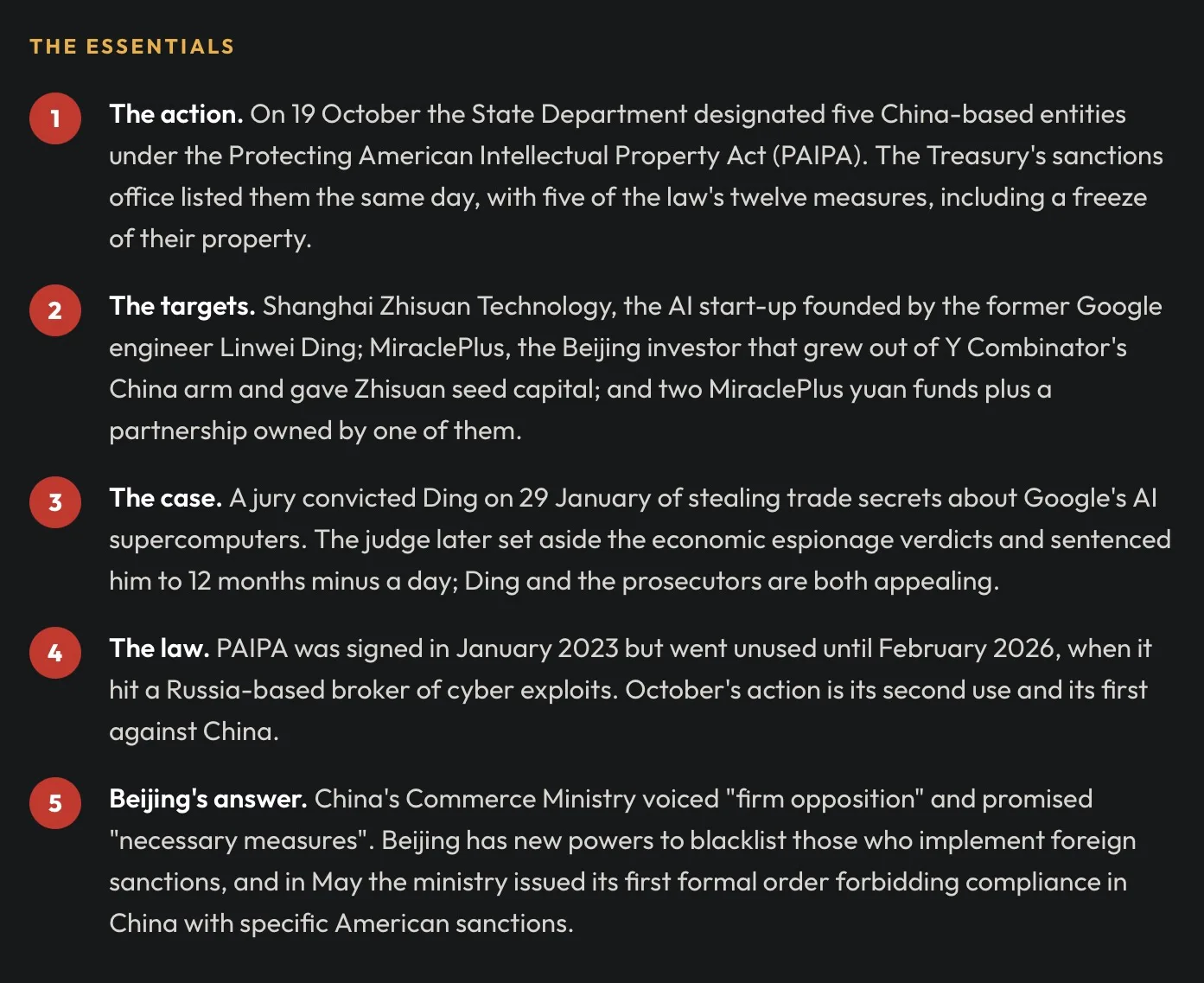
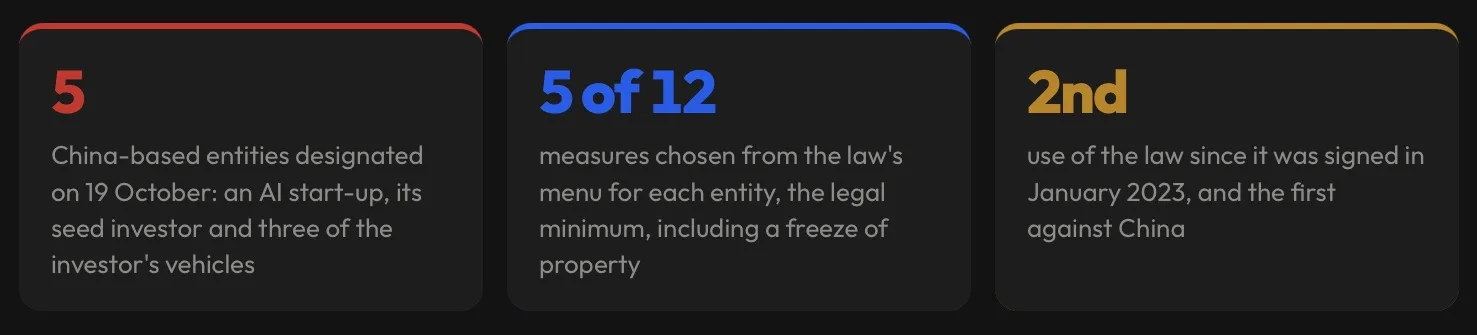
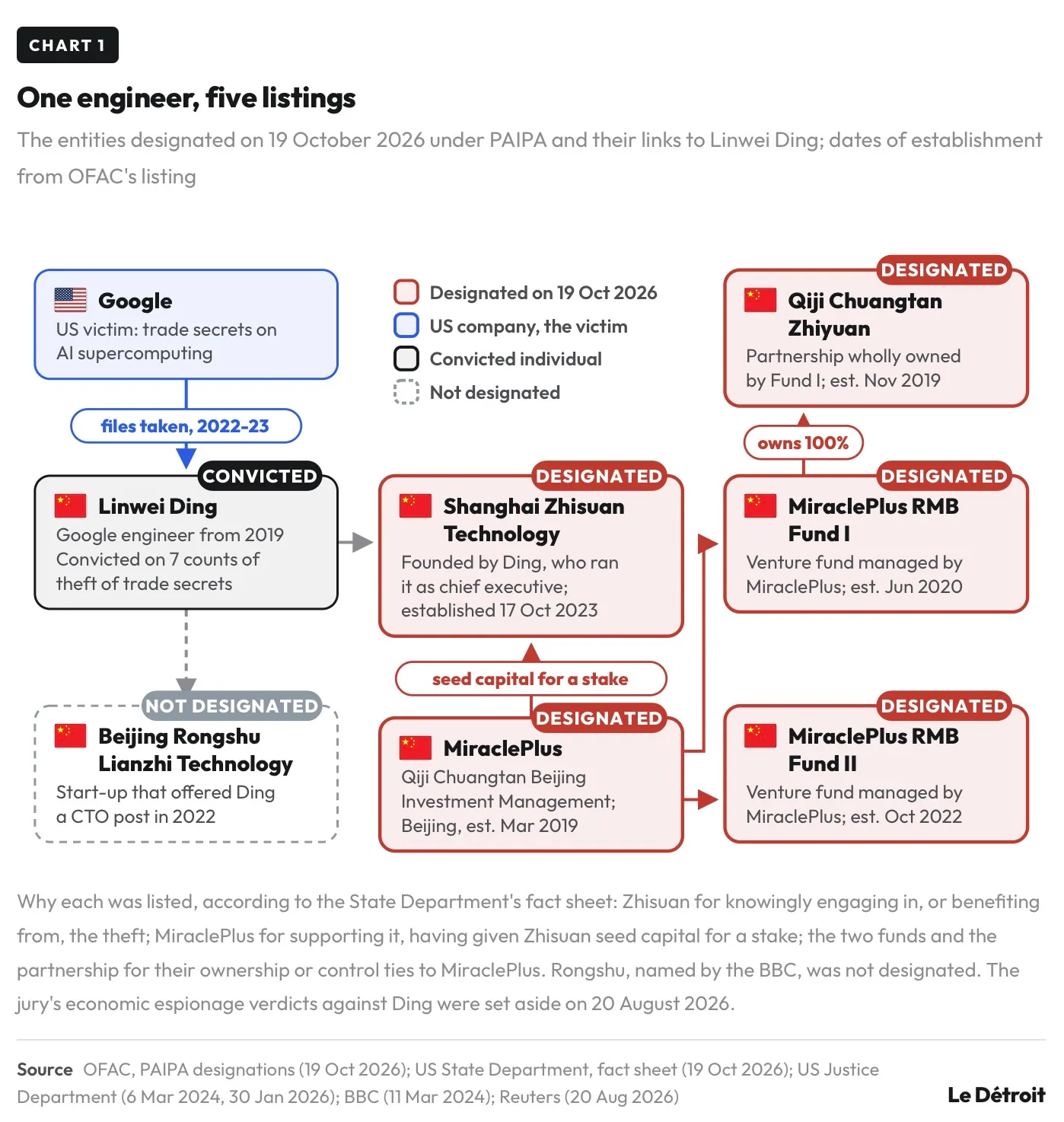
On 19 October the State Department designated five China-based entities under the Protecting American Intellectual Property Act (PAIPA), a 2023 law that lets Washington punish foreigners who steal, or benefit from, American trade secrets. It was the law's first use against China. The Treasury's Office of Foreign Assets Control (OFAC) listed all five the same day.
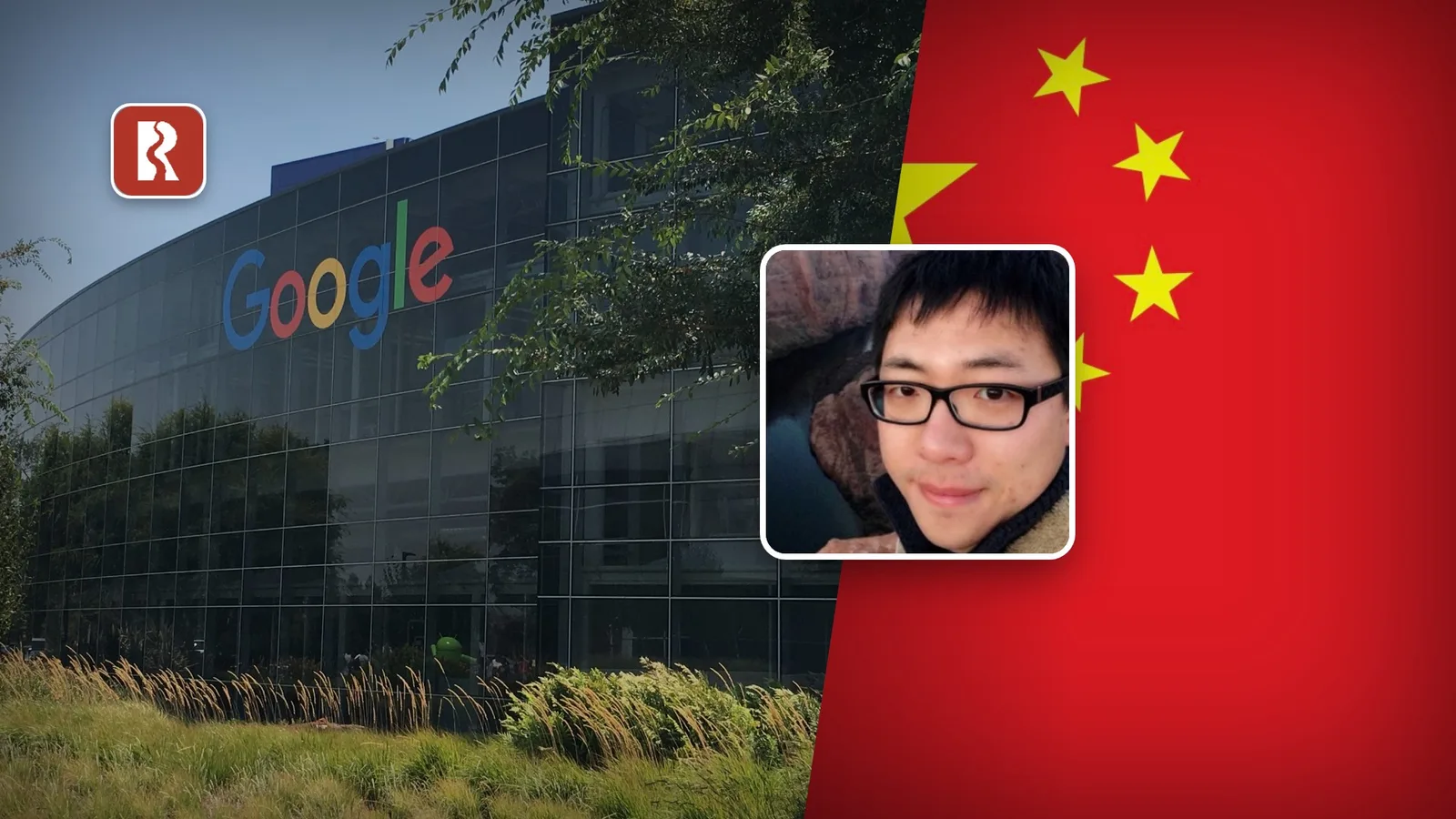
Each is tied to Linwei Ding, a former Google software engineer convicted in January of stealing the company's AI trade secrets. The targets are Shanghai Zhisuan Technology, the AI start-up he founded in 2023; MiraclePlus, a Beijing investor that grew out of Y Combinator's China arm; and three MiraclePlus vehicles. The State Department called the theft of trade secrets a serious threat to America's economic, foreign-policy and national-security interests.
2. From Google's data centres to Shanghai
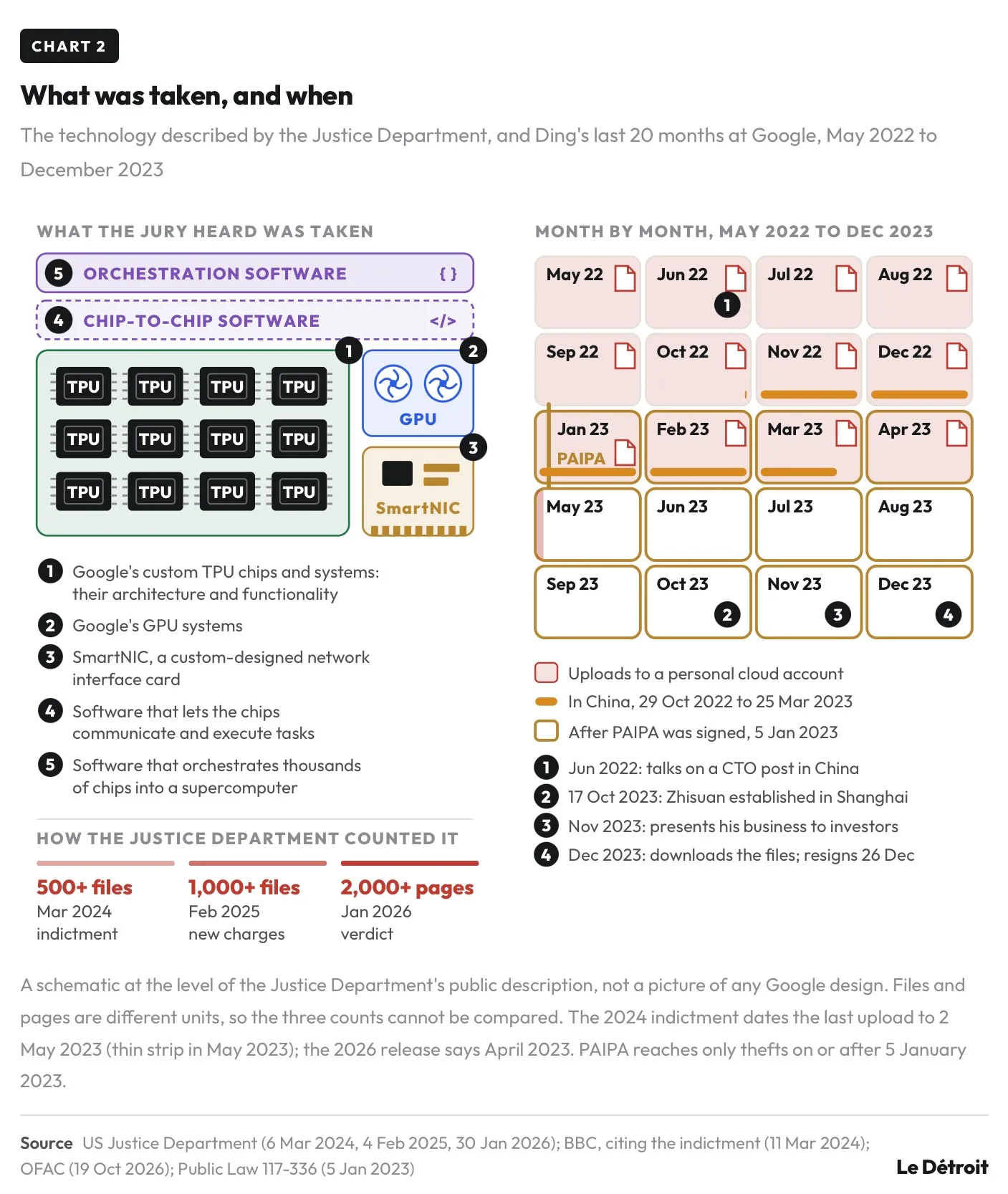
Google hired Ding in 2019. Between May 2022 and April 2023, prosecutors said, he uploaded more than 2,000 pages of confidential material to his personal Google Cloud account, covering Google's custom Tensor Processing Unit (TPU) chips, its GPU systems, a custom network card and the software that makes thousands of chips work as one supercomputer. By early 2023, after talks about a technology chief's post at a Chinese start-up, he was founding his own company in China and acting as its chief executive.
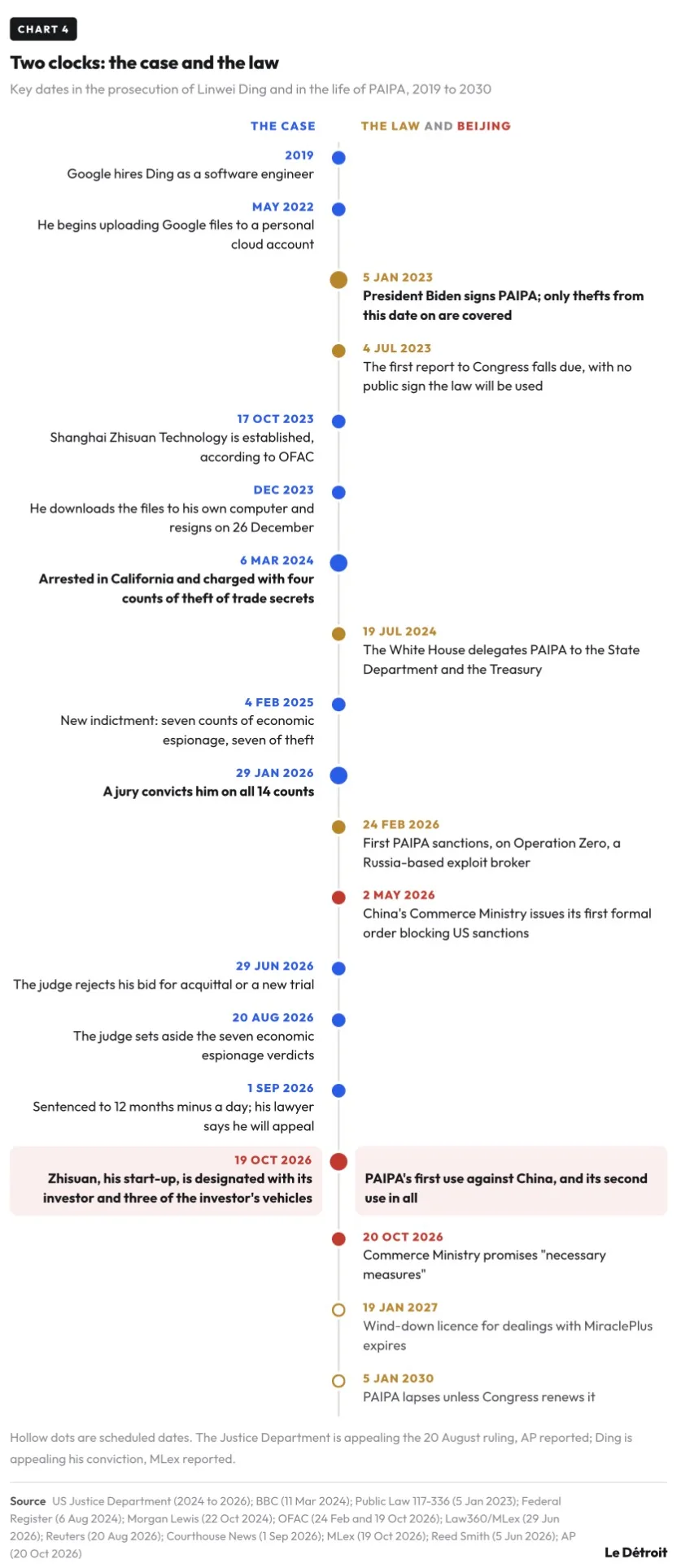
He told potential investors he could build an AI supercomputer by copying and modifying Google's technology, the Justice Department said. He also applied to a Chinese start-up incubator, pitched his company to investors in Beijing on 24 November 2023 and wrote, applying to a government-sponsored talent plan in Shanghai, that his company's product "will help China to have computing power infrastructure capabilities that are on par with the international level", prosecutors said. He downloaded the files to his own computer in December, resigned on 26 December and was arrested on 6 March 2024.
On 29 January 2026 a San Francisco jury convicted him on all 14 counts, seven of economic espionage and seven of theft of trade secrets; Google's Lee-Anne Mulholland told Axios the company was "grateful to the jury for making sure justice was served today". On 29 June Judge Vince Chhabria rejected Ding's bid for an acquittal or a new trial, citing "overwhelming evidence that Ding intended to benefit himself and Zhisuan", but reserved his decision on the espionage counts. On 20 August he set those aside, finding too little evidence that Ding intended or knew his conduct would benefit the Chinese government.
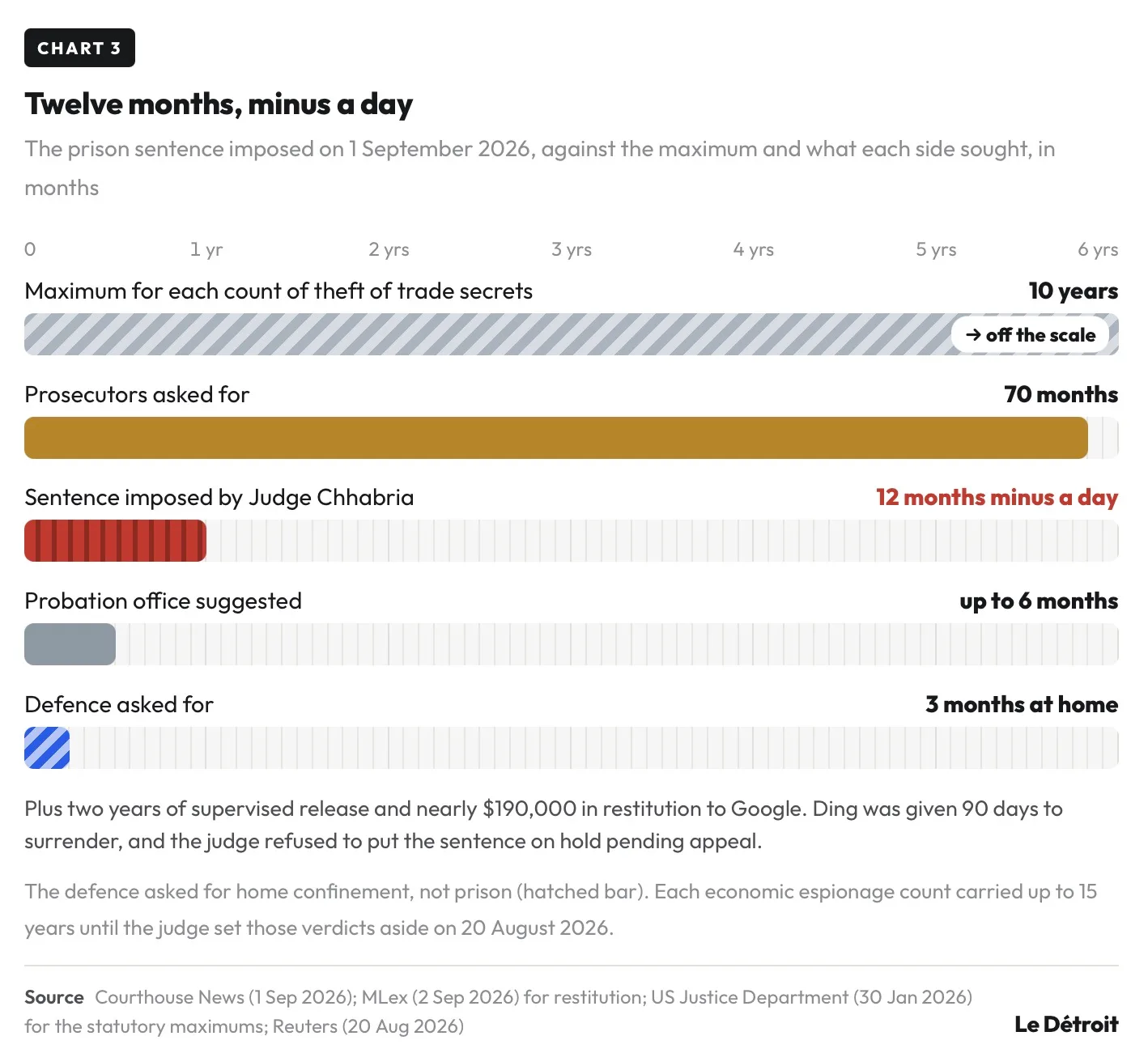
On 1 September the judge sentenced him to 12 months minus a day in prison and ordered nearly $190,000 in restitution to Google; prosecutors had asked for 70 months and his lawyer, Grant Fondo, for three months of home confinement. "This was a systematic, brazen effort to steal Google's property and to benefit himself with it," Chhabria said, according to Courthouse News. Ding apologised in court "for the pain and sadness all these years". He is appealing his conviction, and the Justice Department the espionage ruling.
3. A law that waited
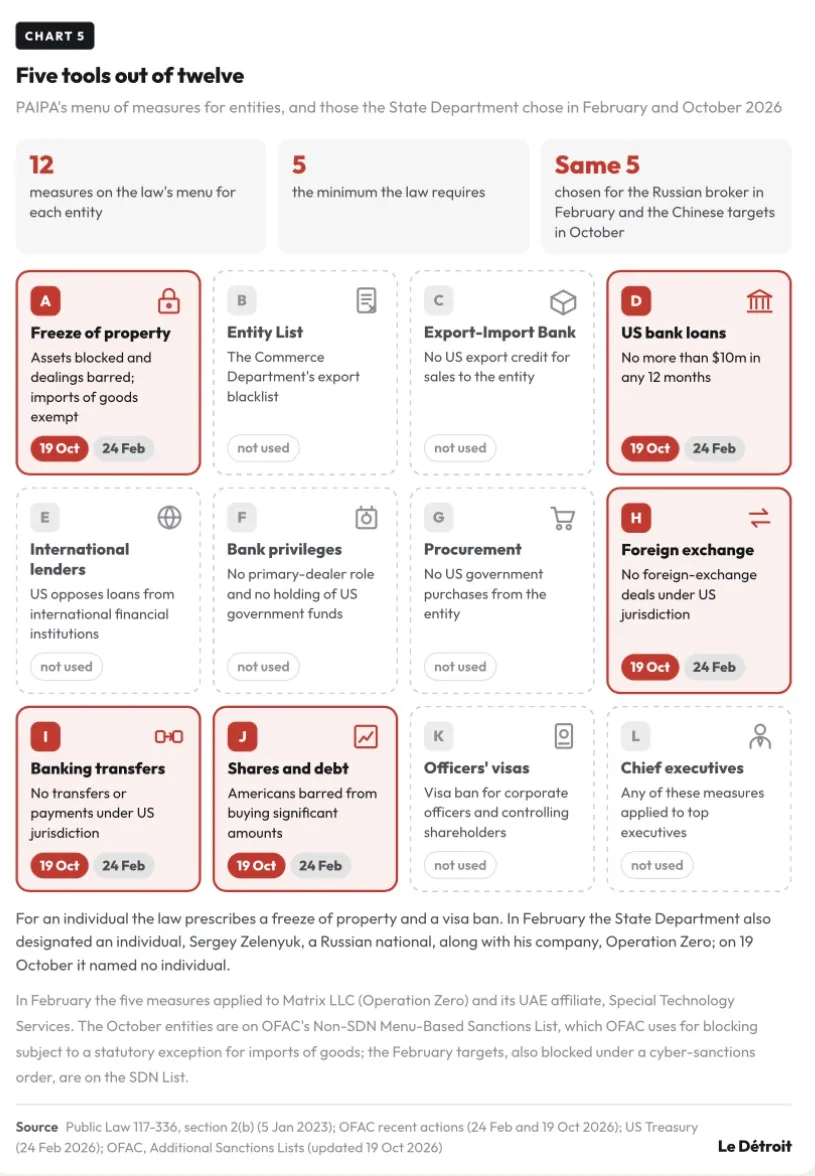
PAIPA, a bill from Senators Chris Van Hollen, a Democrat, and Ben Sasse, a Republican, passed Congress unanimously and was signed by President Joe Biden on 5 January 2023. It requires a yearly report to Congress naming foreigners who knowingly engaged in or benefited from significant thefts of American trade secrets that threaten national security, foreign policy or economic health, along with those who gave them significant support, entities they control and the firms' chief executives and board members. Each entity named faces at least five of 12 listed measures; each individual, a freeze and a visa ban. Thefts before the signing are not covered, and the law lapses in January 2030.
For three years the law sat unused. The first report was due by 4 July 2023, a date that "passed without any indication that it would in fact be used", a Morgan Lewis lawyer wrote in 2024. Only on 19 July 2024 did the White House give the job to the State Department, which identifies targets and picks measures, and the Treasury, which implements freezes. The first designations came on 24 February 2026, against Sergey Zelenyuk, a Russian exploit broker, his company Operation Zero and an affiliated firm in the UAE; "If you steal U.S. trade secrets, we will hold you accountable," said Scott Bessent, the Treasury secretary, announcing them.
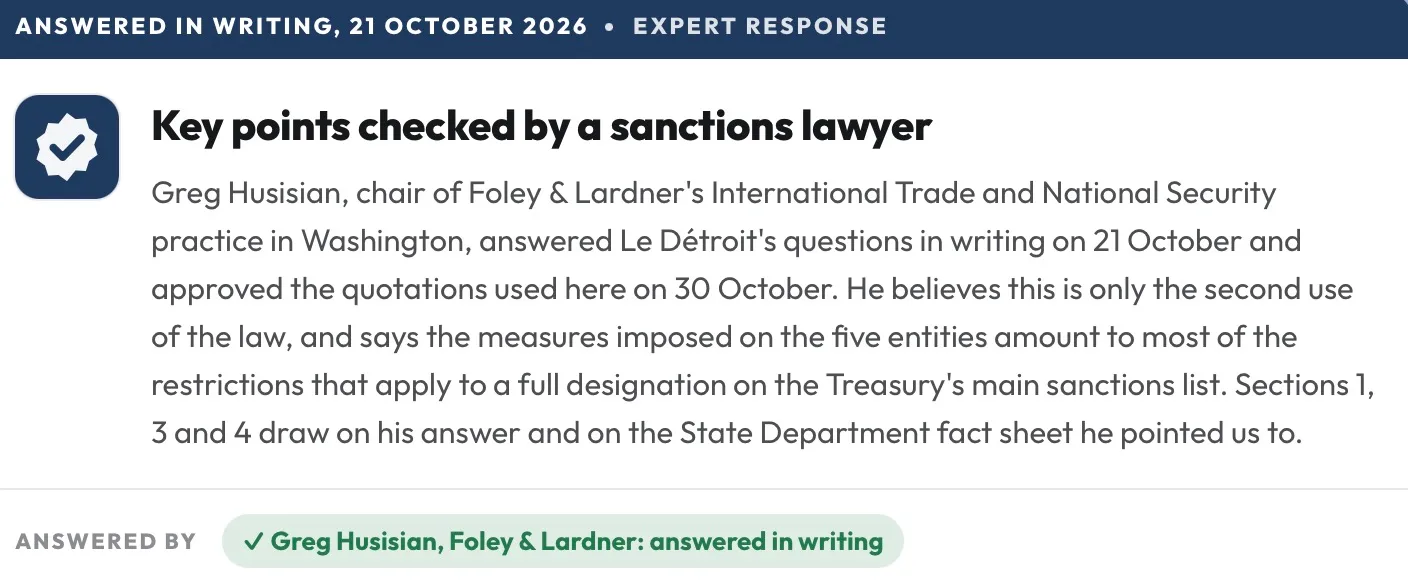
The record is still thin: two actions in nearly four years, the second aimed at China. Greg Husisian, who chairs Foley & Lardner's International Trade and National Security practice in Washington, wrote to Le Détroit on 21 October that the law is new and that he believes October's action is "only the second time it has been used".
4. What the listing does
The State Department chose five measures for each entity, the legal minimum and the same five it picked in February: a freeze of property; a $10m cap on loans from American banks in any 12 months; bans on foreign-exchange and banking transactions under American jurisdiction; and a ban on Americans buying significant amounts of the entities' shares or debt. It left aside the Commerce Department's Entity List, procurement bans and visa bans for executives.
OFAC put the five on its Non-SDN Menu-Based Sanctions List, not the better-known SDN list, where February's targets, also hit under a cyber-sanctions order, went. OFAC uses that list for sanctions short of full blocking, including "blocking prohibitions subject to a statutory exception for the importation of goods", the kind PAIPA imposes: each entry blocks the entity's property and bars all dealings with it, imports of goods aside. A general licence gives Americans until 12:01 a.m. eastern time on 19 January 2027 to wind down dealings with MiraclePlus, its funds and partnership and any entity they own 50% or more of; Zhisuan is not among the entities it names.
The "non-SDN" label describes where OFAC files the names, not how lightly they are treated, and a compliance check run only against the SDN list will miss all five. Husisian calls the measures "pretty broad", from the freeze of property to the bans on banking transactions and on investment by Americans. "These are most of the restrictions that apply to full SDNs," he wrote.
The reach to an investor is the novelty. "PAIPA's reach extends beyond the immediate actors in a trade secret theft," King & Spalding lawyers wrote after the February action. MiraclePlus, founded by Lu Qi, a former Microsoft executive vice-president and Baidu chief operating officer, took over Y Combinator's Chinese operations in November 2019 and says it has supported more than 612 start-ups; in 2020 the University of Michigan approved a commitment of up to $10m to one of its funds, Miracle Plus Fund I L.P., which is not listed.
5. Beijing's answer
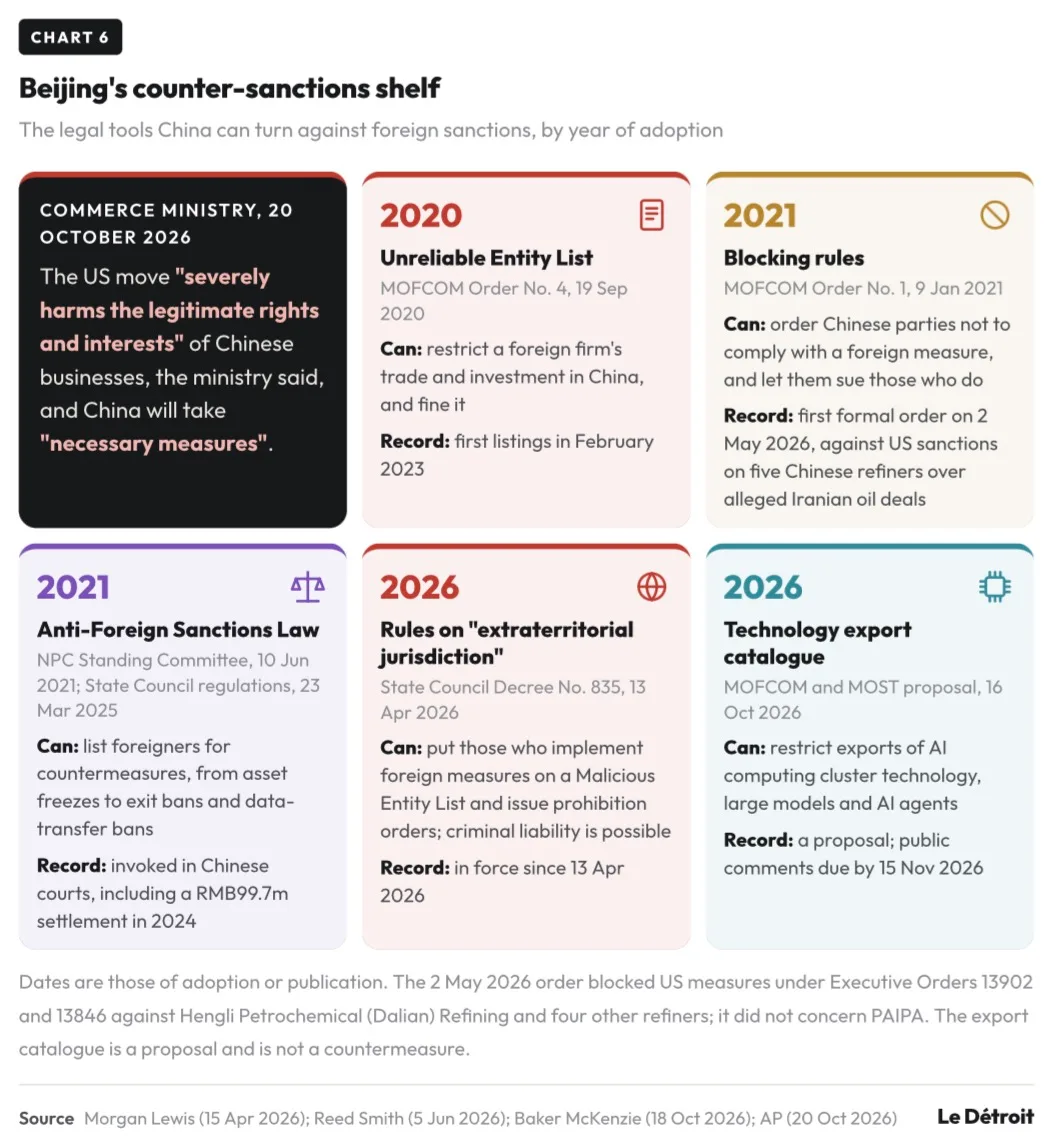
In a statement on 20 October, China's Commerce Ministry voiced "firm opposition", saying the move "severely harms the legitimate rights and interests" of Chinese businesses. It urged Washington to "correct its erroneous practice", promised "necessary measures" and said China's AI progress had "nothing to do with the so-called 'stealing of trade secrets'". We found no public comment from Zhisuan, MiraclePlus or Google on the designations by 22 October.
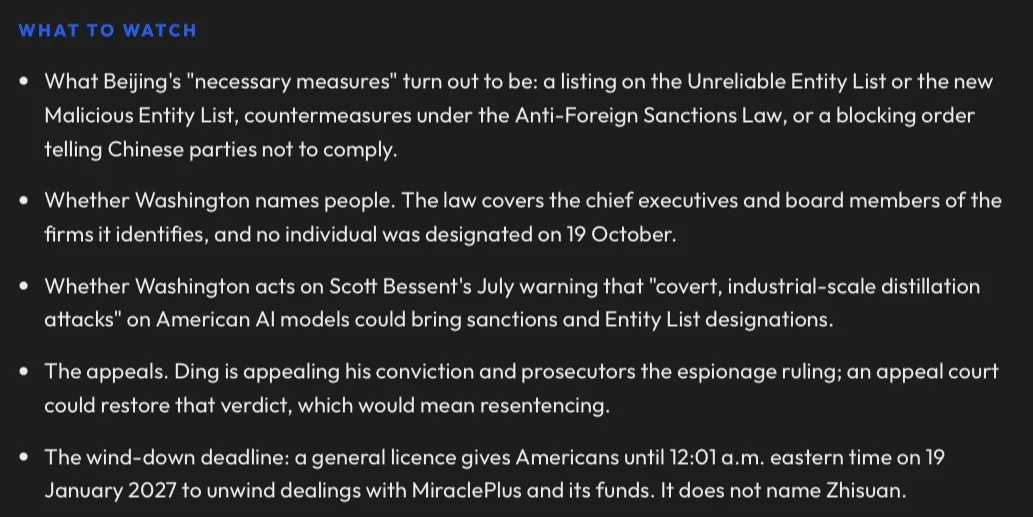
Beijing has spent six years building the tools for a reply: an Unreliable Entity List in 2020, blocking rules and an Anti-Foreign Sanctions Law in 2021, and regulations for that law in March 2025. In April 2026 the State Council added rules against "improper extraterritorial jurisdiction", including a Malicious Entity List, and on 2 May the Commerce Ministry issued its first formal blocking order, forbidding compliance in China with American sanctions on five refiners over alleged Iranian oil deals.
6. What comes next
More may follow. In July Bessent wrote on X that "open source is not open season on American IP", warning that when Chinese firms conduct "covert, industrial-scale distillation attacks that cross the line into IP theft", "sanctions and Entity List designations will be on the table". He wrote after Michael Kratsios, the White House science and technology chief, said the government had information indicating Moonshot AI, a Beijing-based start-up, had distilled a model made by Anthropic, an American AI company. Moonshot has rejected suggestions that its model's performance came from distillation, and on 27 July the Commerce Ministry accused America of "AI hegemonism", Reuters reported.
Tests are on the calendar, from the wind-down deadline of 19 January 2027 to the appeals, where a higher court could restore the espionage verdicts and force a resentencing. Whether Washington next names people, bigger firms or a distillation case will show whether PAIPA becomes a routine weapon or stays a warning shot.