
1. What was signed
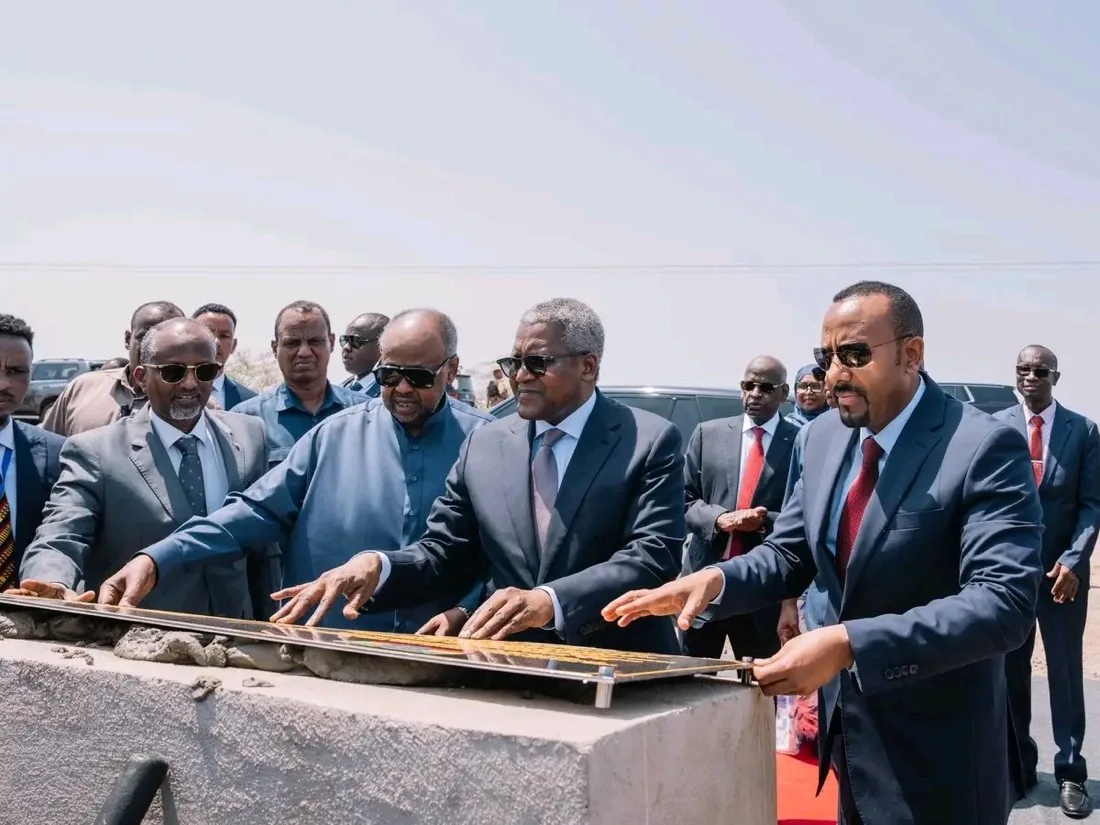
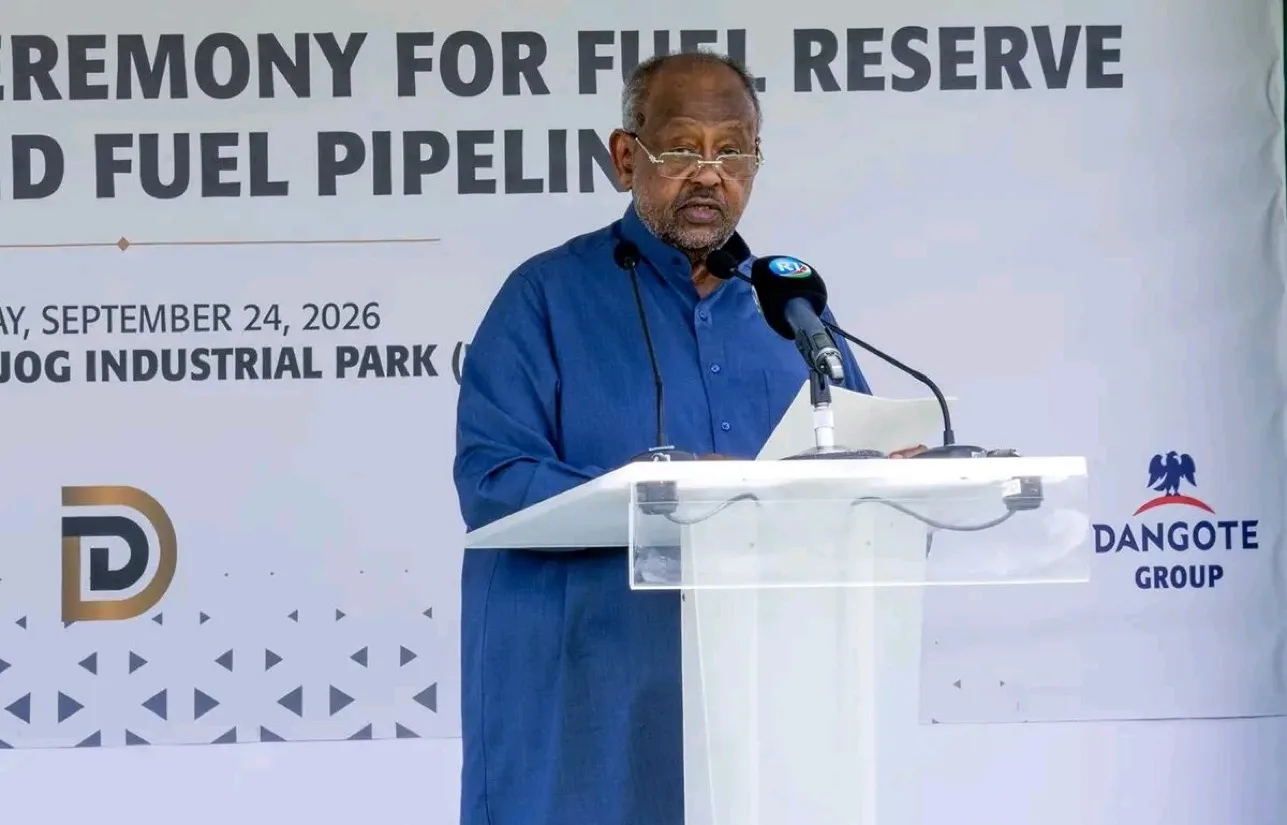
On Thursday 24 September, Ethiopian Prime Minister Abiy Ahmed, Djibouti's President Ismaïl Omar Guelleh and Nigerian industrialist Aliko Dangote laid the foundation stone of a petroleum-products pipeline and storage project at the Damerjog Industrial Park in Djibouti. Ethiopia's state investment arm, Ethiopian Investment Holdings (EIH), signed a memorandum of understanding with Dangote Industries and Djibouti's Great Horn Investment Holding (GHIH), a company wholly owned by the Djibouti Ports and Free Zones Authority.
https://x.com/abiyahmedali/status/2103127718128726212?s=61
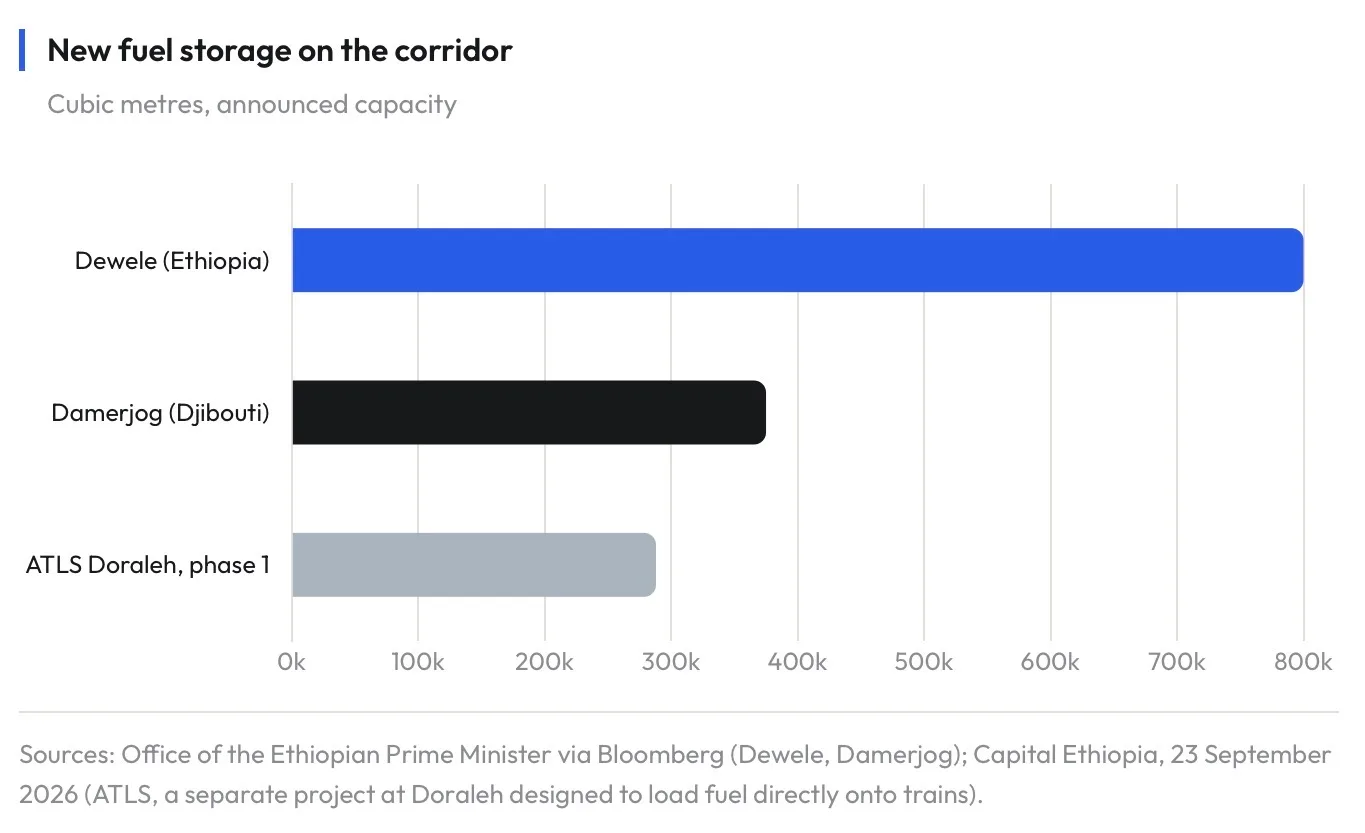
According to Billene Seyoum, spokeswoman in Abiy's office, the project will cost 660 million dollars. It combines a 120-kilometre multi-product pipeline from Damerjog to Dewele, on the Ethiopian side of the border, with two storage sites: about 375,000 cubic metres at Damerjog and 800,000 cubic metres at Dewele. She told Reuters it should be operational within 18 months; EIH gives a timeline of under two years.
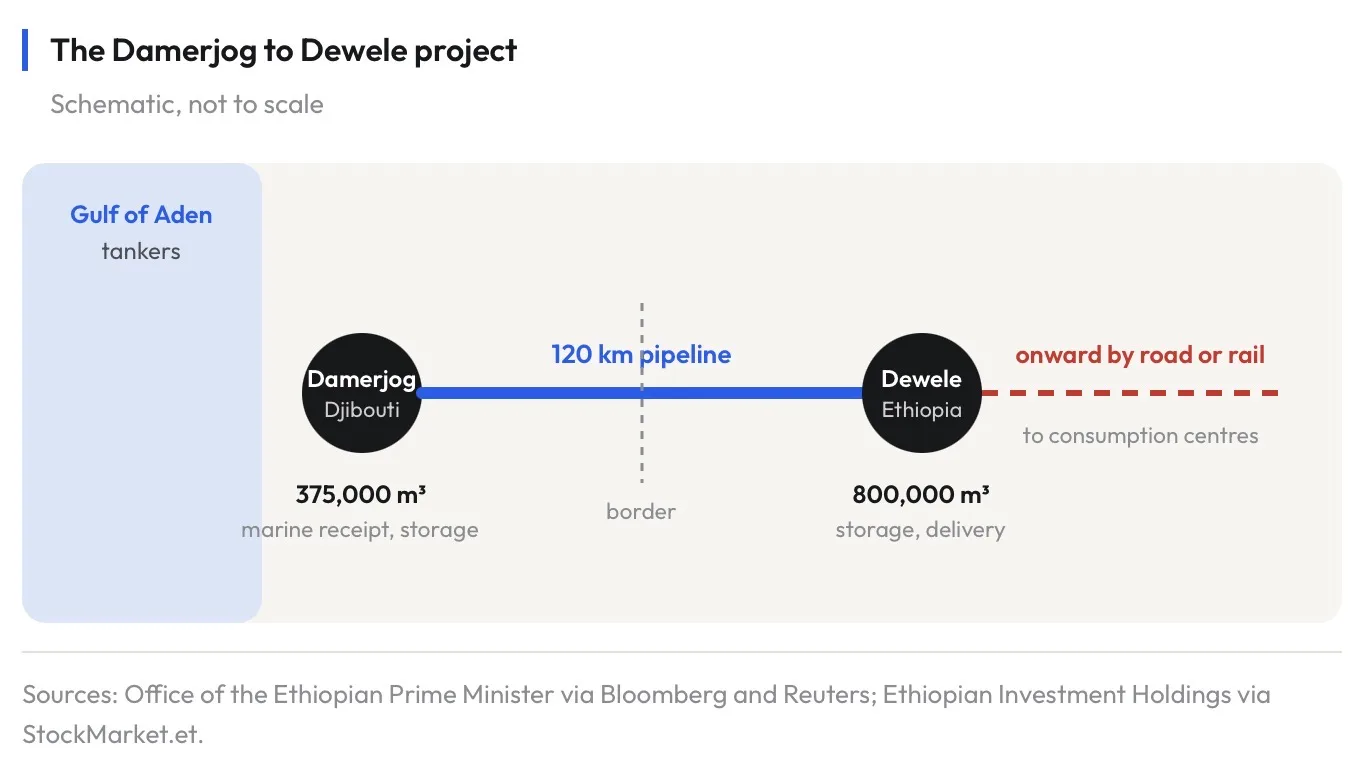
Damerjog is not a blank site. In 2023, GHIH secured a 155 million dollar loan led by Afreximbank and BCIMR to build an oil jetty and a 150,000 cubic metre tank farm in the same free zone, according to the lenders' and borrower's legal advisers.
2. The dependence it addresses
Ethiopia has had no coastline since Eritrea's independence in 1993. The figure repeated by Ethiopia's state broadcaster EBC is that about 95 percent of the country's tradepasses through Djibouti, for more than a billion dollars a year in port and transit fees.
Fuel is the sharpest edge of that dependence. Ethiopia produces no oil and imports nearly all its refined products through Djibouti. In the 2024/25 fiscal year it imported more than 4.3 billion litres, according to The Reporter, at a cost of about 3.32 billion dollars, close to a fifth of all merchandise imports, Birr Metrics reports. The state-owned Ethiopian Petroleum Supply Enterprise holds a monopoly on fuel imports.
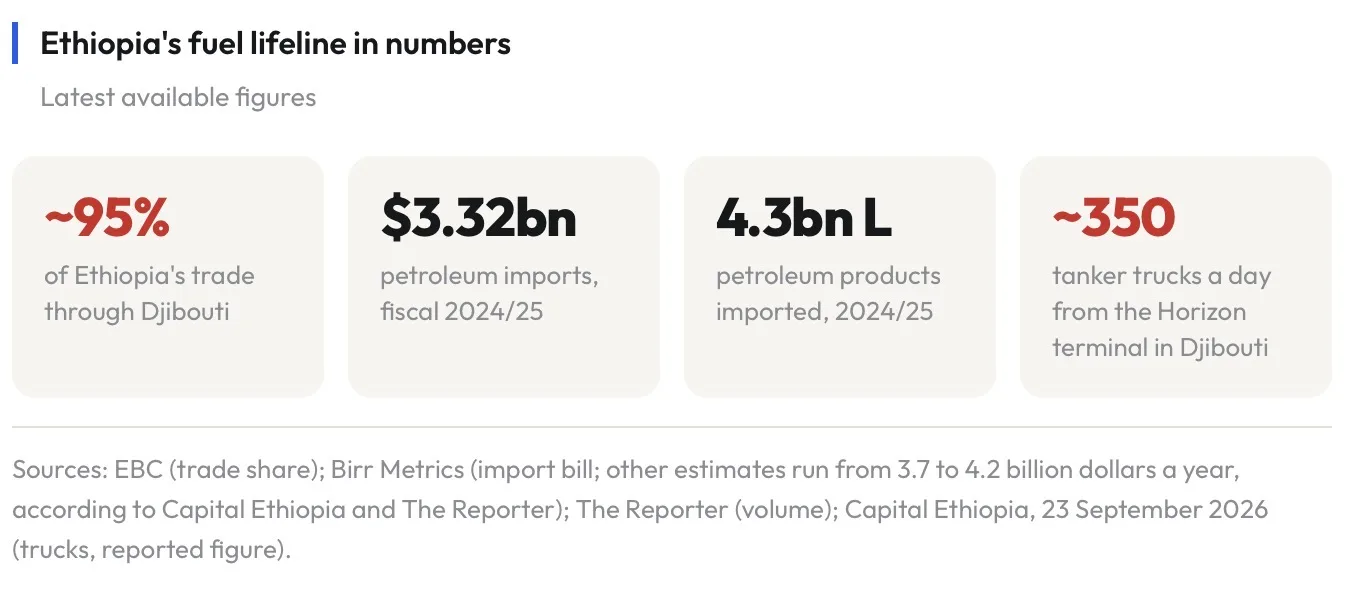
Almost all of it moves by road. Capital Ethiopia reports that roughly 350 tanker trucks a day carry fuel from the Horizon Djibouti Terminal into Ethiopia, and that congestion, border procedures, truck availability and shipping delays can all disrupt supply. This year showed how fragile that is: amid the war with Iran, the government introduced a priority list for fuel in March, The Reporter wrote.
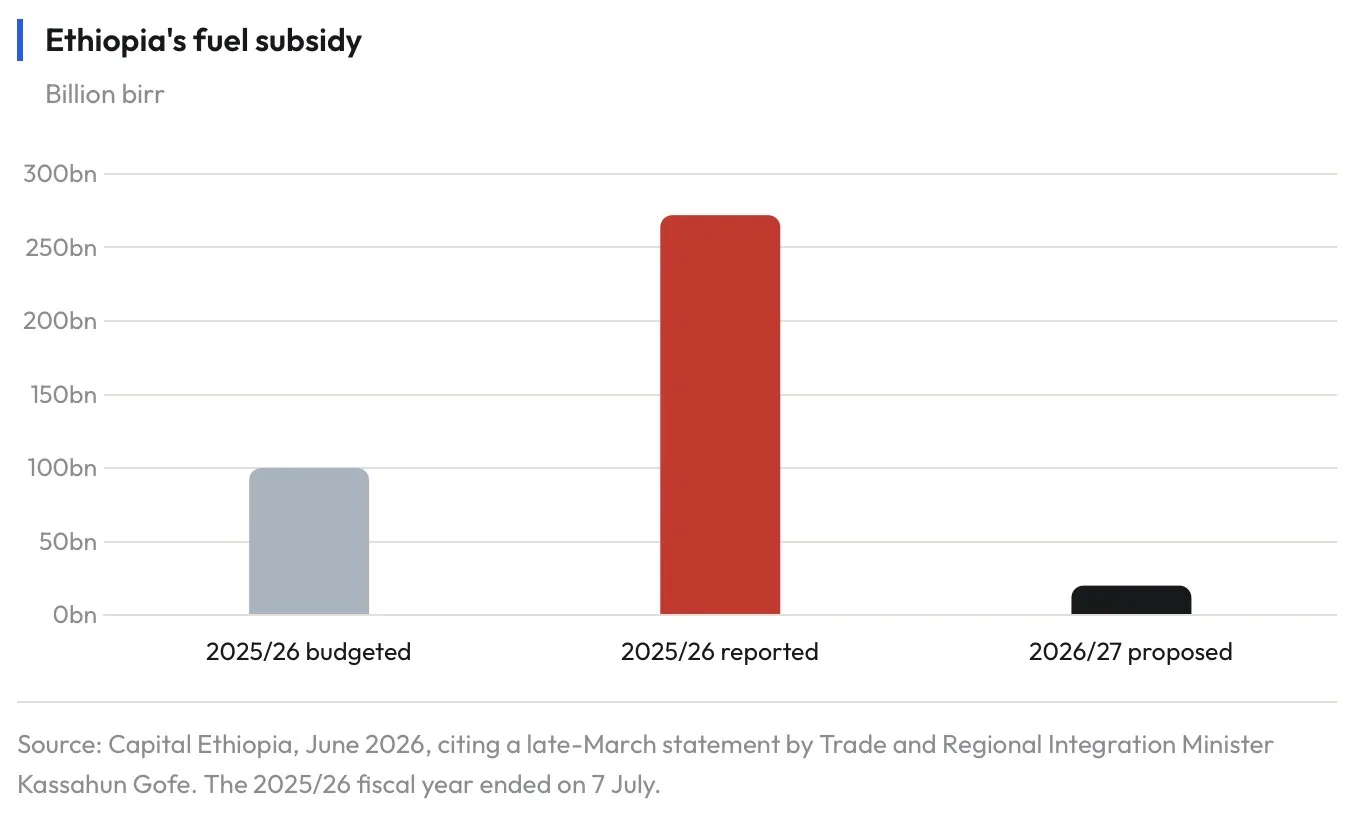
The fiscal cost is just as visible. The government had budgeted 100 billion birr for fuel subsidies in 2025/26. In late March, Trade and Regional Integration Minister Kassahun Gofe said the subsidy for the year had reached 272 billion birr. For 2026/27, the government has proposed 20 billion.
3. What the pipeline changes, and what it does not
Abiy said the project will "reduce logistics costs and delays", strengthen energy security and make the corridor more resilient. Dangote said it will reduce Ethiopia's dependence on long-distance road transport for fuel, make supply more reliable and strengthen strategic reserves.
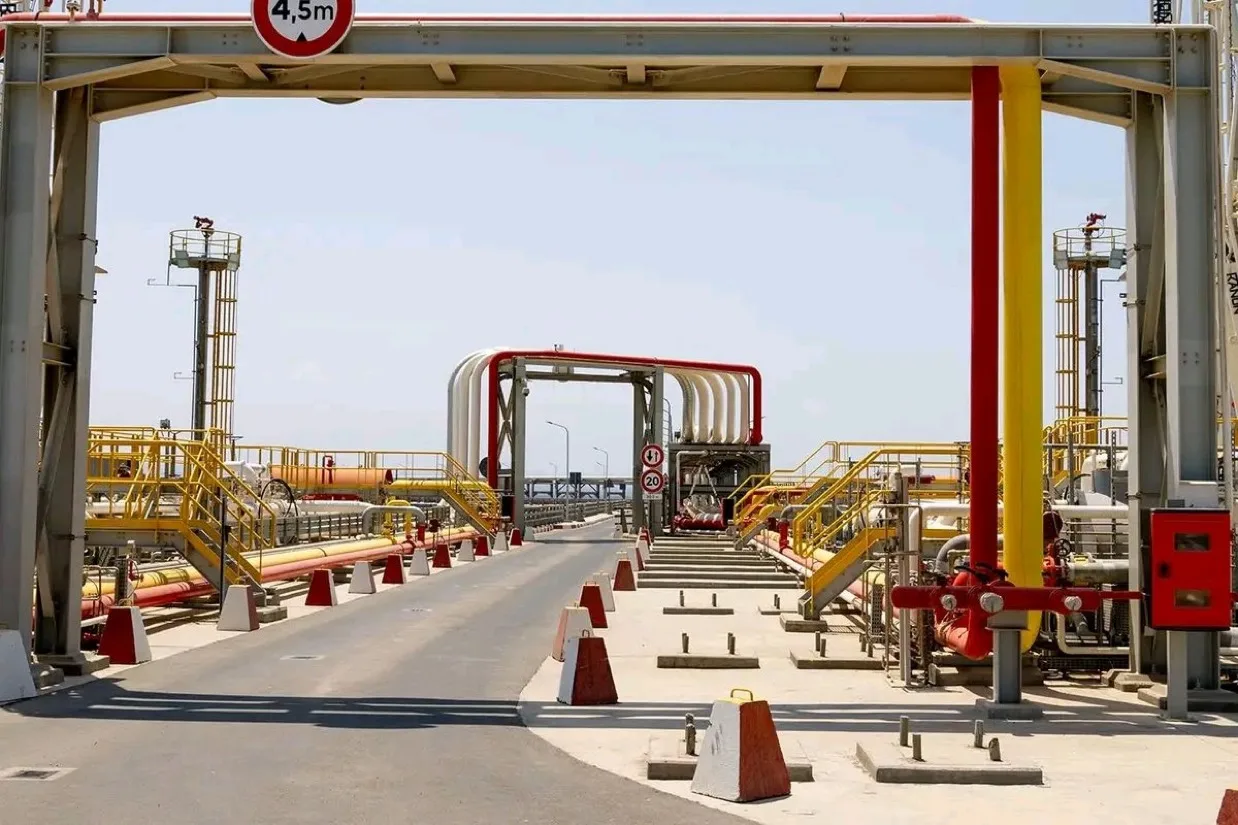
The storage may matter more than the pipe. The 800,000 cubic metres at Dewele would give Ethiopia a large buffer on its own side of the border. Capital Ethiopia notes that storage for jet fuel, which Ethiopian Airlines consumes in large volumes, is particularly short.
The pipe itself is short. At 120 kilometres, it stops at the border. From Dewele, fuel still has to reach Addis Ababa and the rest of the country by road or rail. The trucks will not disappear; their first leg will.
The pipeline moves Ethiopia's fuel depot to its own side of the border. It does not move its coastline.
4. This has been promised before
In 2015, Ethiopia and Djibouti signed framework agreements for the Horn of Africa Pipeline: 550 kilometres from Damerjog to Awash in central Ethiopia, costing 1.55 billion dollars, developed by Blackstone-backed Black Rhino and South Africa's MOGS, with completion scheduled for 2018. Black Rhino's chief executive said work was put on hold in early 2017. That December, a transport ministry official told The Reporter the government had cancelled the project for financial reasons, and to protect the Ethiopian Railway Corporation, which was about to start carrying petroleum products. Fuel still moves by truck.
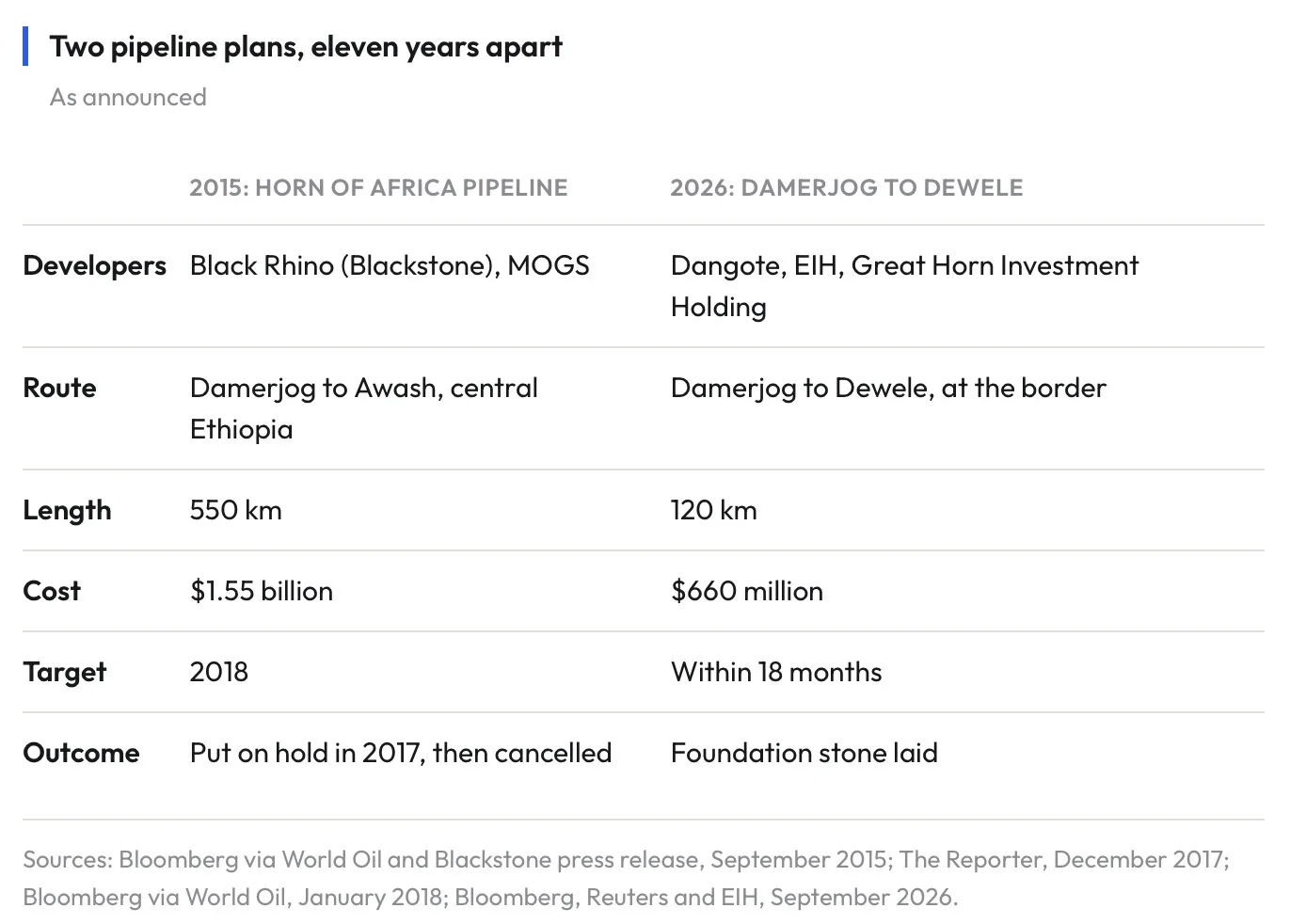
Two things are different this time. The route is much shorter, which cuts cost and risk. And the partner is already committed in the country: Dangote and EIH are partners of a 2.5 billion dollar urea fertiliser complex at Gode, in Ethiopia's Somali region, according to EIH.
WHAT TO WATCH
Financing. How the 660 million is split between Dangote, EIH and Djibouti's partner.
The supplier. Whether fuel for the pipeline will keep coming largely from the Gulf, or from Dangote's refinery in Nigeria.
The 18-month clock. The 2015 project shows how far a signing can be from a pipe in the ground.
The last mile. Whether onward road and rail links are upgraded, so that the pipeline's gains are not lost between Dewele and Addis Ababa.