
1. The number
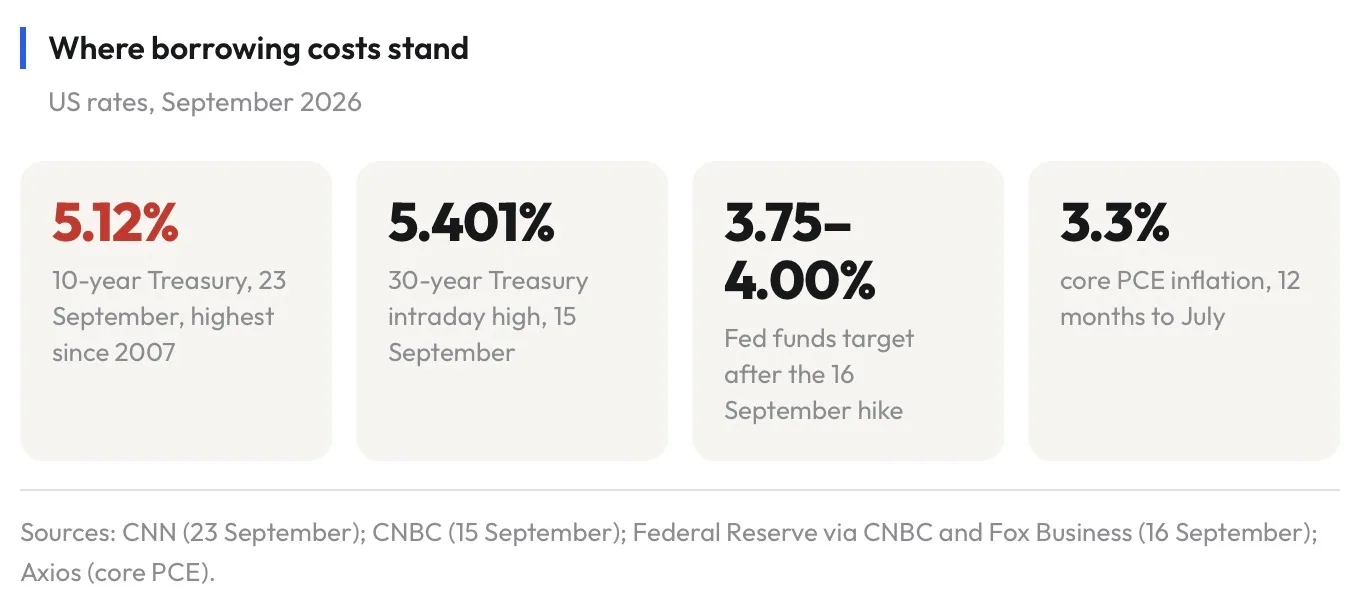
The yield on the 10-year US Treasury note jumped 17 basis points to 5.12 percent on Wednesday 23 September, its highest level since 2007, according to CNN. The move followed S&P Global data showing US business activity in September accelerating at its fastest pace since July 2021. At the time of CNN's report, the S&P 500 was down 0.65 percent and the Nasdaq 1.1 percent.
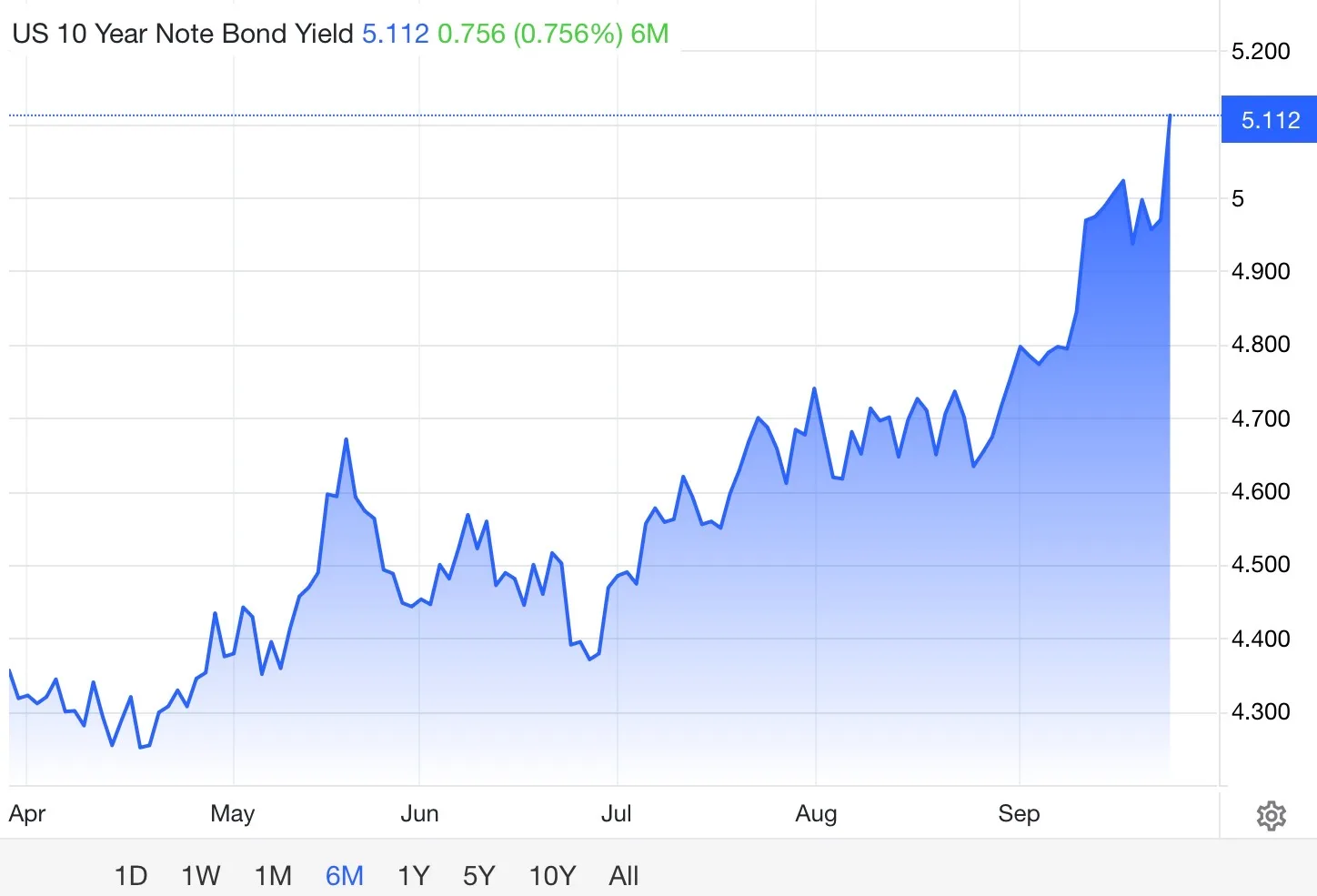
It is the second breach of the 5 percent line this month. On 15 September, the 10-year touched 5.041 percent intraday, its highest since July 2007, and the 30-year bond hit 5.401 percent, its highest since June 2007, CNBC reported.
2. Why yields are rising
Inflation and oil. Bloomberg describes a global bond selloff driven by booming capital investment and soaring energy prices, with oil pushed up by the widening war in the Middle East. The Fed's preferred gauge, core PCE inflation, stood at 3.3 percent in the year to July.
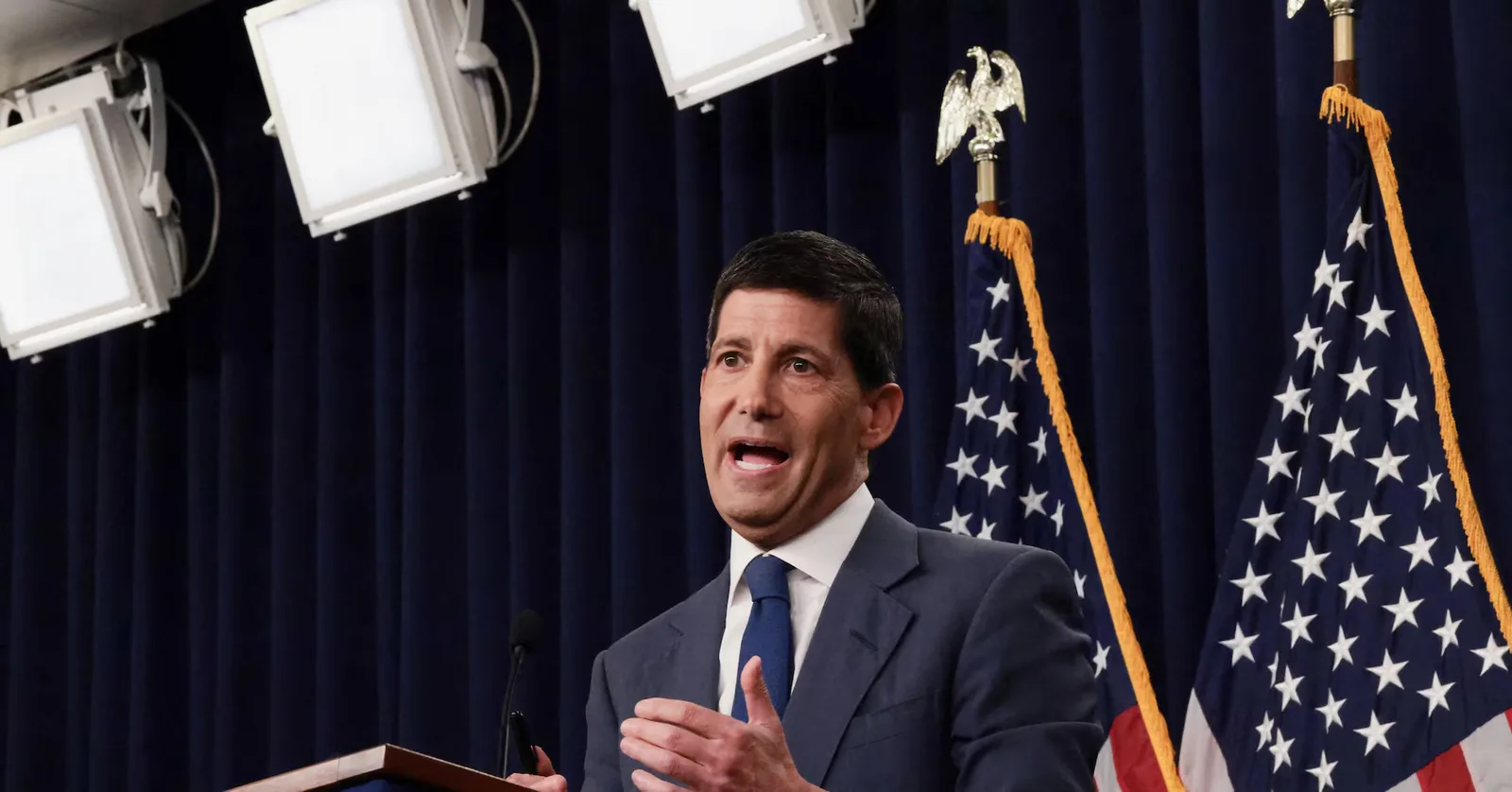
The Fed has turned. On 16 September, the Federal Open Market Committee voted 12 to 0 to raise its target range by a quarter point to 3.75 to 4 percent, the first hike since July 2023 and the first of Kevin Warsh's chairmanship. Its projections showed 16 of 18 participants expecting at least one more hike this year.
A strong economy. Warsh said the decision came as the American economy "appears to be strengthening". Wednesday's business activity data reinforced that reading, and with it the case for higher rates.
3. The fiscal loop
This is the part that makes 5 percent different from 2007. Debt held by the public now equals about 101 percent of GDP, according to the CBO, and every rise in yields feeds into the government's interest bill.
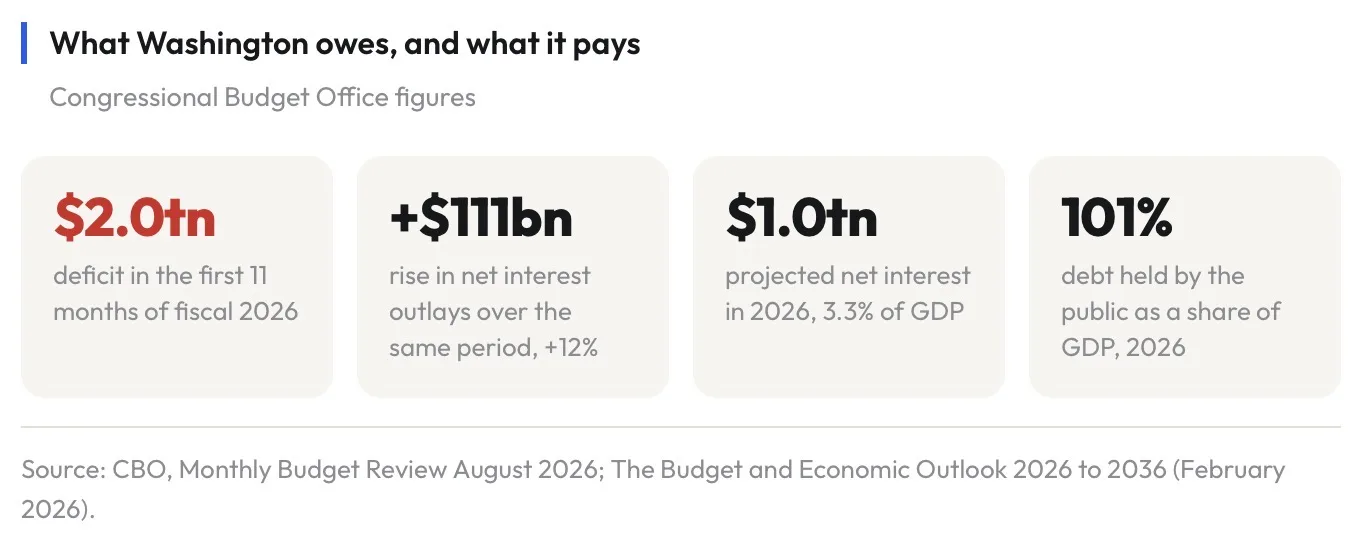
The CBO attributes the 12 percent rise in interest outlays to two things: a larger debt and higher long-term interest rates. Its February baseline, drawn up before the latest surge, already had net interest doubling from 1.0 trillion dollars in 2026 to 2.1 trillion in 2036, and debt held by the public rising to 120 percent of GDP, above the 1946 record of 106 percent. The CBO's own conclusion: the fiscal trajectory is not sustainable.
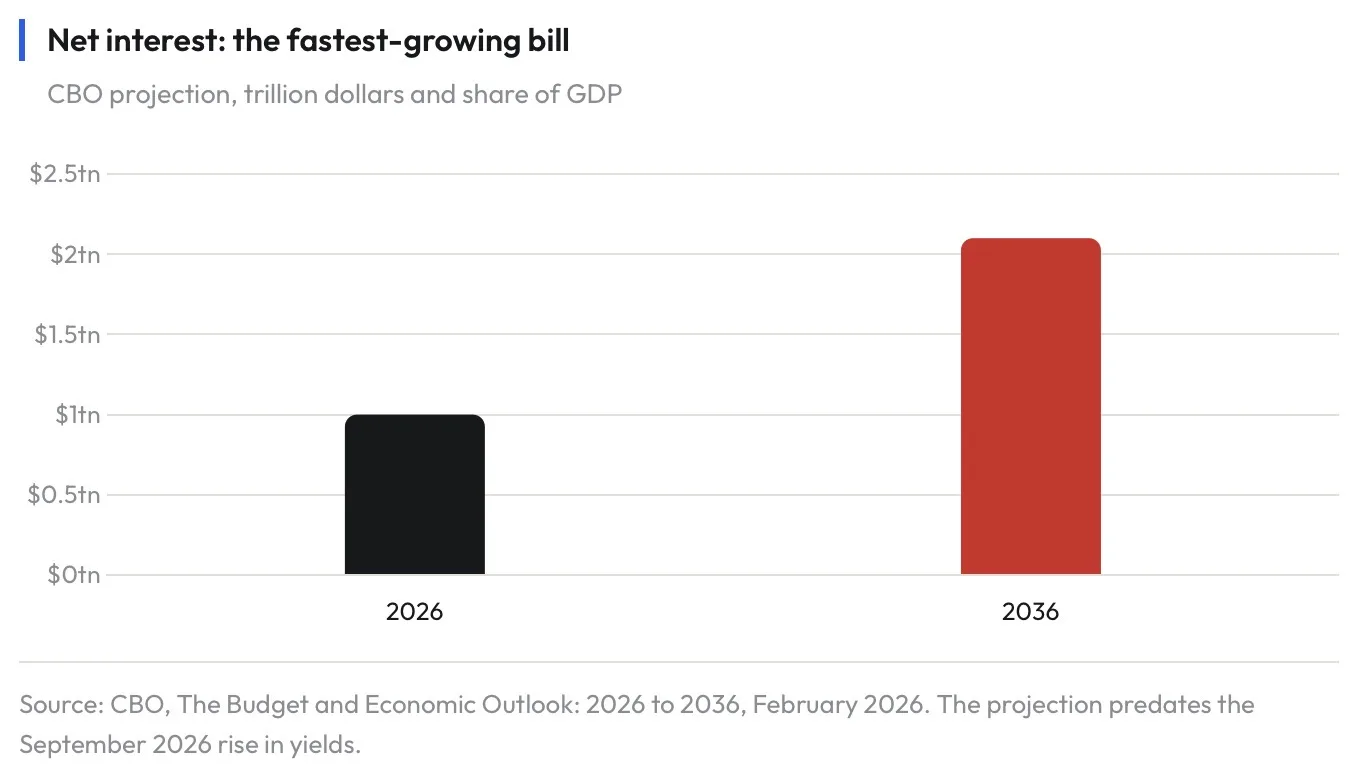
Higher rates raise the interest bill, which raises the deficit, which raises the supply of bonds. That loop is on the CBO's own pages.
Some investors go further and argue that the loop will force the Fed to cap long-term yields, a policy known as yield curve control, and that this will be inflationary. That is a forecast, not a fact. Neither the Fed nor the Treasury has announced any such plan: the Fed has just raised rates and signalled more, and Warsh said inflation has been too high for too long.
4. What the Treasury has tried
Bessent's answer has been buybacks: the Treasury repurchasing long-dated bonds to support their prices. After an expanded programme was announced in August, the Treasury said it would at least double its long-duration buybacks from their typical 2 billion dollar size. The first larger operation, on 10 September, bought back 5.2 billion dollars, below its 6 billion ceiling.
Yields initially fell after the announcement, then reversed. Analysts quoted by CNN said the buybacks are too small to matter in a Treasury market of more than 30 trillion dollars and do not change the forces driving yields higher. Bessent defended the programme before Congress on 15 September, suggesting the spike could have been worse without it.
5. What history says, and does not
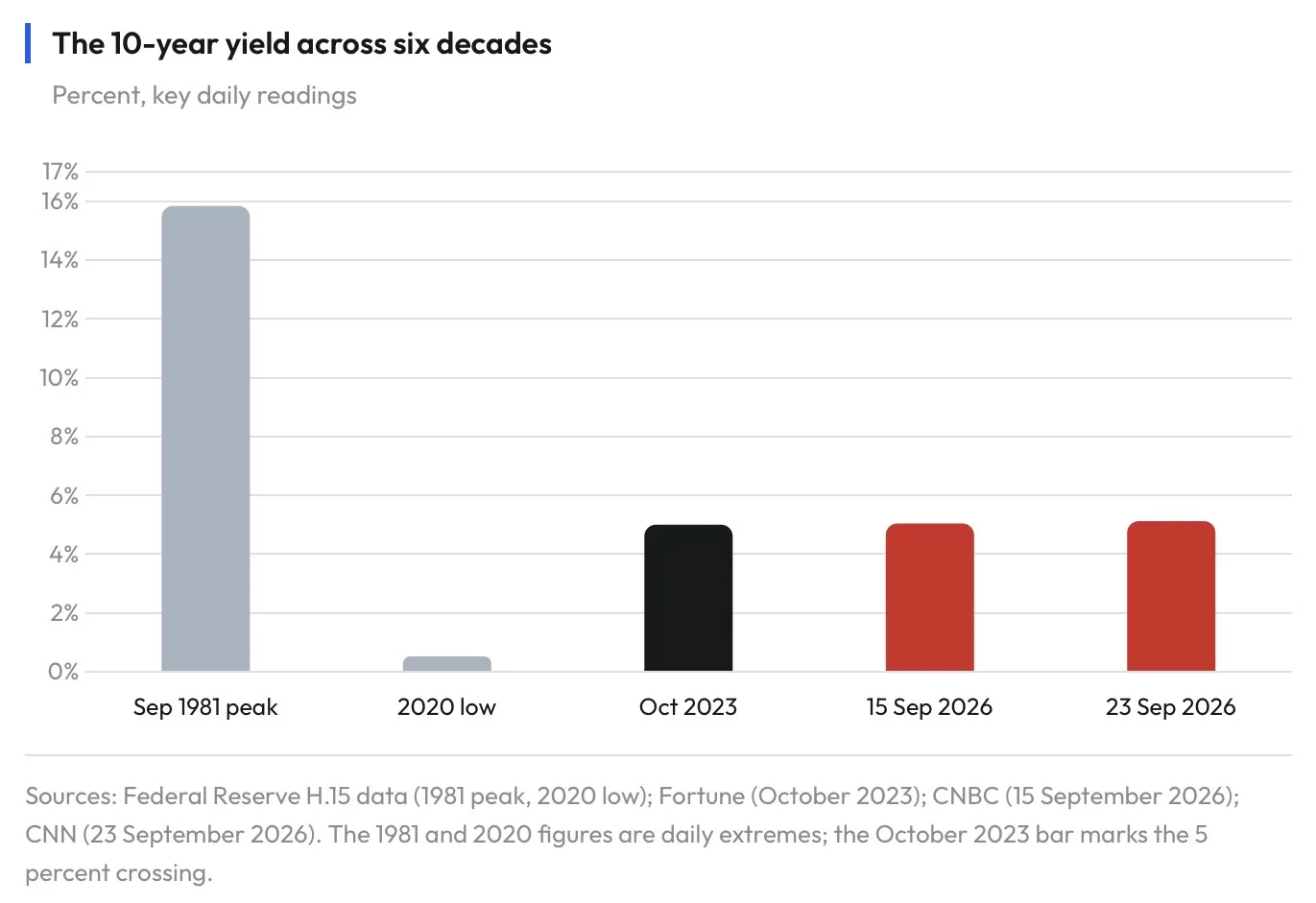
5 percent is high for this century and low for the last one: the 10-year peaked at 15.84 percent in September 1981, when Paul Volcker pushed the federal funds rate to 20 percent, and bottomed at 0.52 percent in 2020.
A claim circulating on social media says the last time the 10-year was this high, the economy entered recession and stocks halved. That skips October 2023, when the yield crossed 5 percent intraday and then fell back as markets anticipated rate cuts; the S&P 500 went on to set record highs, as Advisor Perspectives notes. 2007 is the wrong comparison, and 1981 is a different world.
The number is not the danger. The danger is what it costs a government that already spends a trillion dollars a year on interest.
WHAT TO WATCH
The next FOMC. Traders have raised the odds of another hike before the end of the year.
Oil. Every move in crude now feeds straight into inflation expectations and yields.
Treasury auctions. Weak demand at a long-bond sale would confirm that supply, not only inflation, is driving the move.
Buyback size. Whether Bessent scales the programme up, or quietly lets it fade.
Japan. Any sign that Japanese investors are selling Treasuries despite US support for the yen.