

On 30 July, Eurostat's first flash estimate put euro area growth for the second quarter of 2026 at 0.4 percent. On 7 September, the same number came out at 0.6 percent, the strongest quarter since 2022. Nothing had happened in Germany, France, Italy or Spain in between. What had happened was Ireland: its quarterly growth was revised from 3.9 percent to 10.2 percent, and a country that accounts for less than 4 percent of the currency bloc's output moved the whole bloc's headline by a fifth of a point.
1. The number, and where it comes from
The arithmetic is simple. Multiply Ireland's weight in euro area GDP, roughly 3.8 percent, by its quarterly growth of 10.2 percent, and you get a contribution of about 0.4 percentage point. The euro area grew 0.6. Strip Ireland out and the remaining nineteen members grew about 0.2 percent.
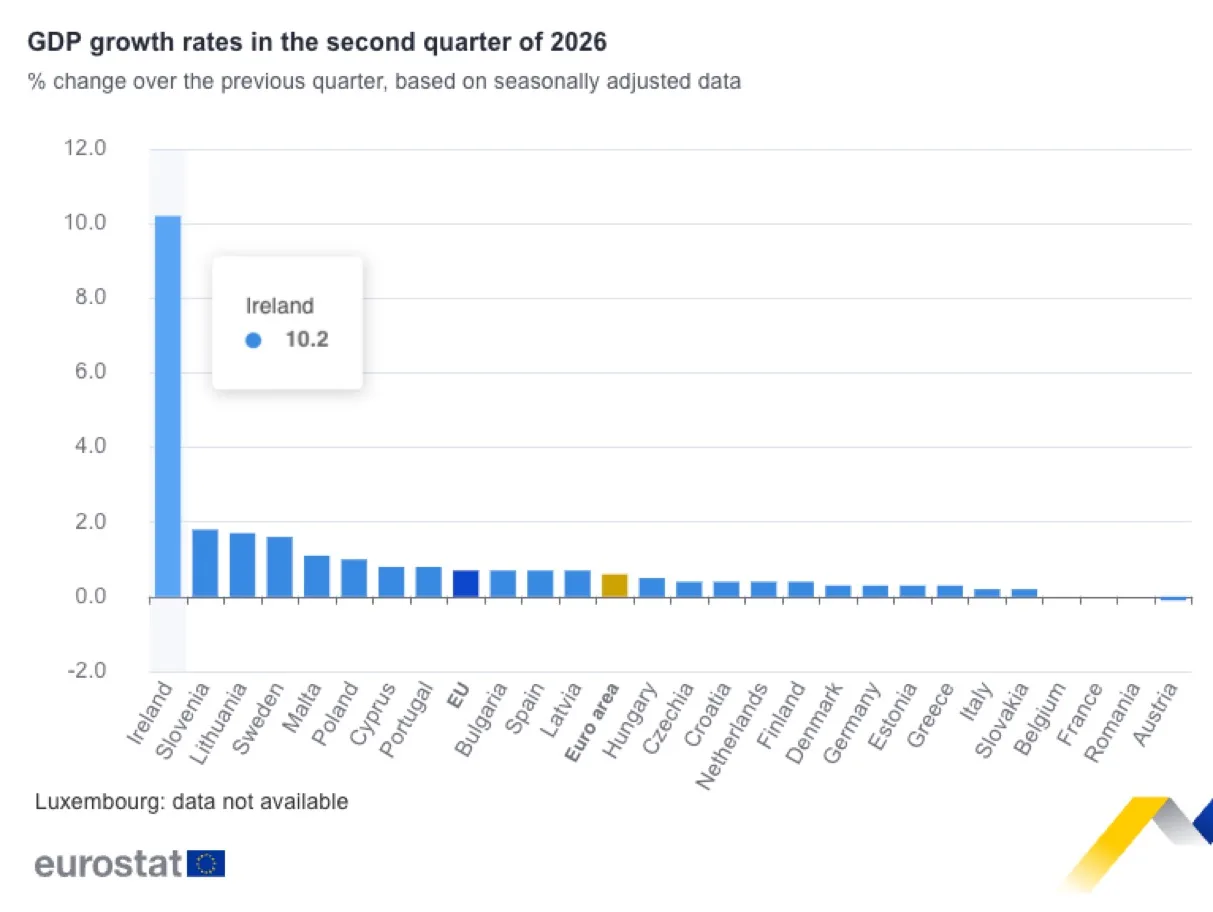
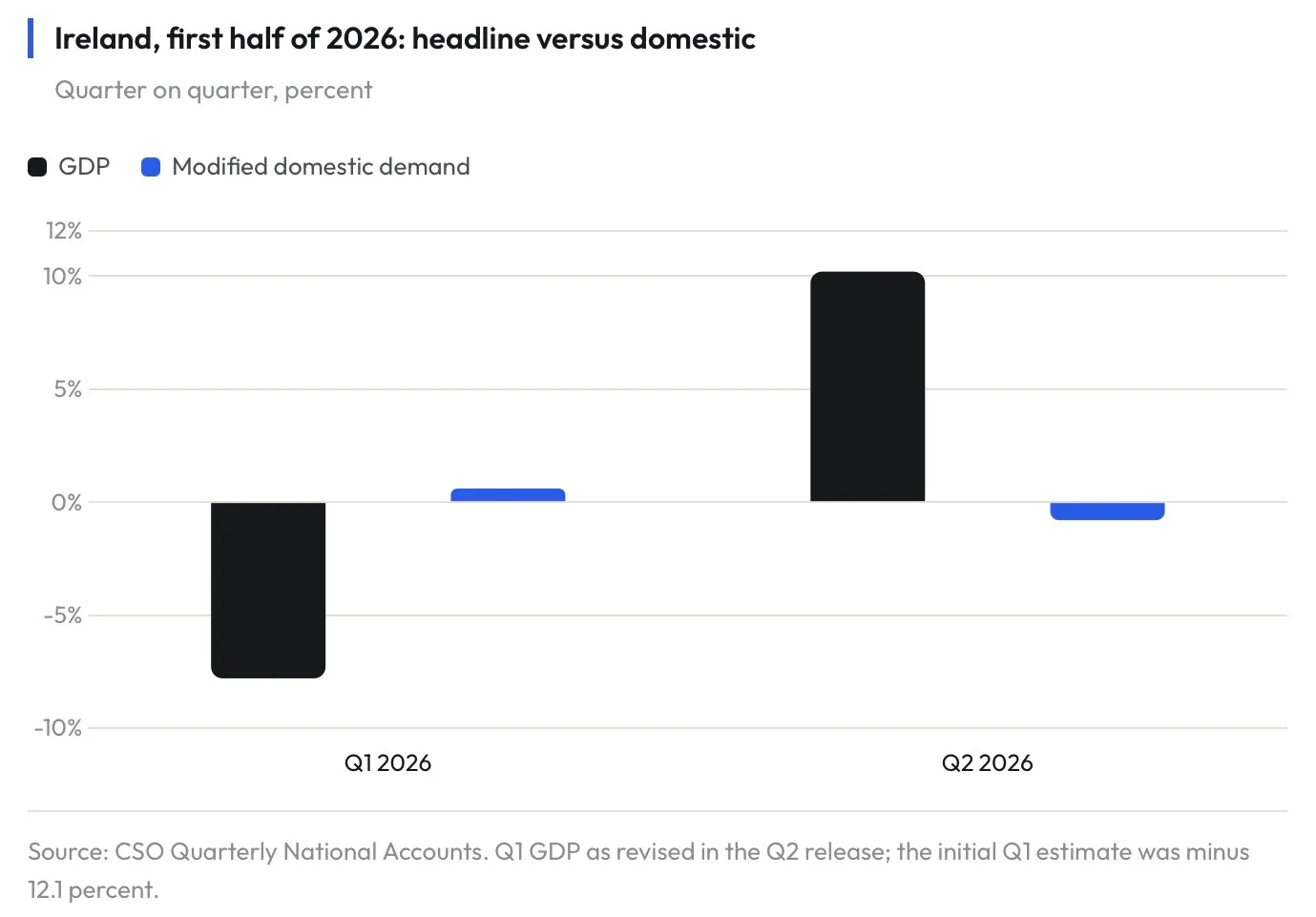
That 0.2 percent is the number that describes the economy most Europeans live in. It is not a collapse. It is a plateau: France at zero, Belgium at zero, Austria contracting, Germany and Italy at 0.3 and 0.2, Spain again the strongest of the large economies at 0.7. In the first quarter, when Ireland's GDP had fallen 7.8 percent, the same exercise runs in reverse: the euro area printed zero, but the bloc excluding Ireland grew about 0.3 percent. On an ex-Ireland basis, the currency union went from 0.3 to 0.2. A tassement, not a slowdown.
The euro area did not accelerate in the second quarter. Its statistics did.
2. Why Irish GDP does not measure Ireland
The problem is not new, and Ireland's own statisticians are the first to say so. In 2015, Irish GDP grew 26 percent in a single year, a figure since revised upward, after a small number of multinationals relocated intellectual property and aircraft-leasing assets to Irish balance sheets. The economist Paul Krugman called it leprechaun economics. The Central Statistics Office responded by convening a review group and, in 2017, publishing a new headline measure, modified gross national income, or GNI*, which strips out the profits of foreign-owned firms, the depreciation of their intellectual property, and the leased aircraft.
The gap between the two measures is the size of the distortion. In 2024, GNI* stood at 321 billion euros, or 57.1 percent of GDP.
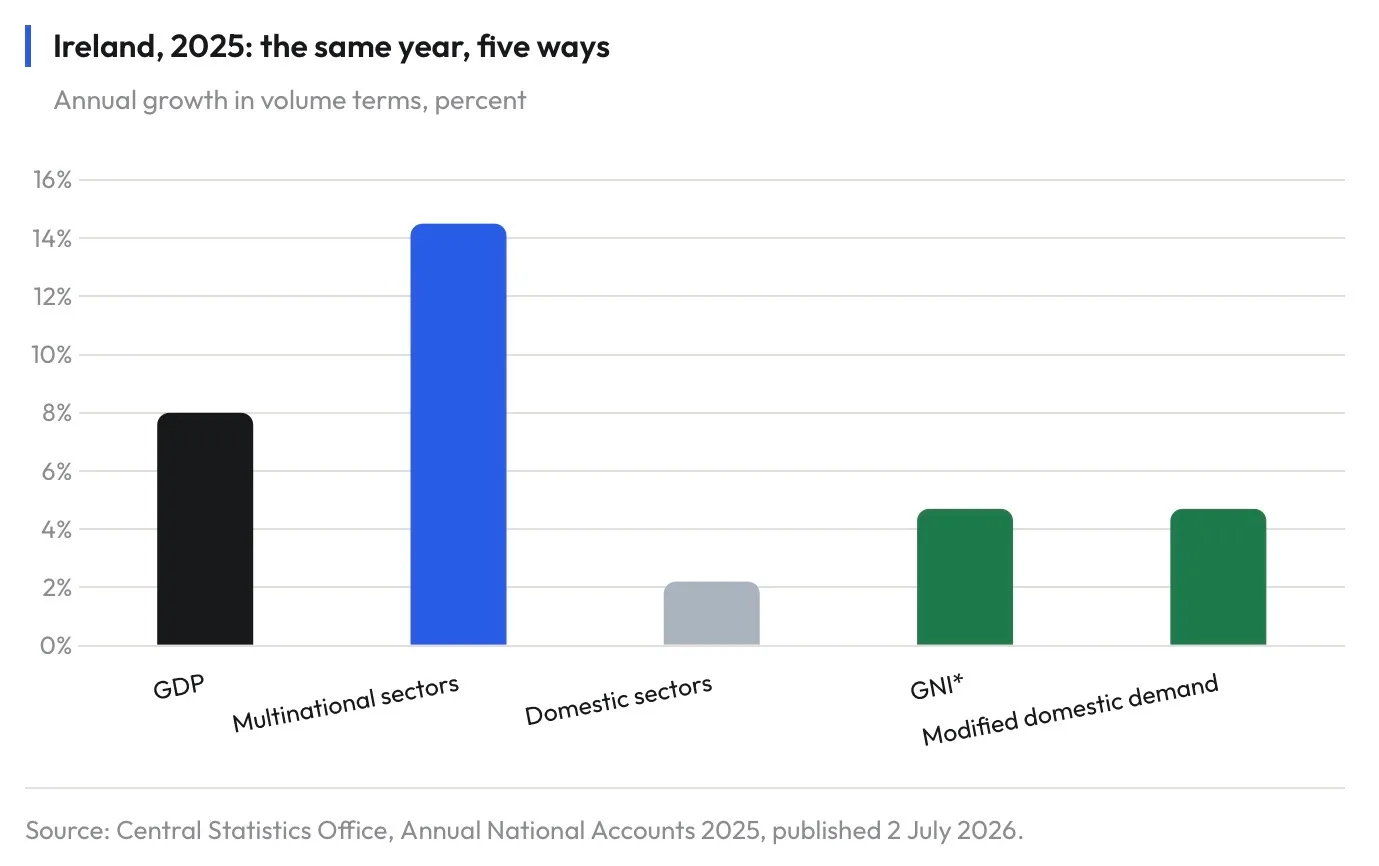
The second quarter of 2026 is the mechanism in its purest form. According to the CSO's quarterly accounts, output in the globalised industrial sector rose 22.1 percent in three months and exports 17.1 percent, largely from information and communication and pharmaceutical multinationals. Over the same quarter, modified domestic demand, the CSO's measure of what Irish households, government and firms actually spent, fell 0.8 percent. Personal spending rose a solid 1.0 percent. Nothing in the domestic economy explains a 10 percent swing, in either direction.
3. The tax rate behind the statistic
None of this is accidental, and none of it is illegal. It is the product of a fifty-year policy of attracting foreign direct investment with a low, stable corporate tax rate, 12.5 percent on trading income, and a legal environment that made Dublin the natural place for American technology and pharmaceutical groups to hold their non-US intellectual property. Profits follow the IP. Exports follow the contracts. GDP follows both.
The fiscal consequences are on the record. Ireland collected a record 106 billion euros in tax in 2025. Corporation tax accounted for 34.7 billion of that, close to a third of all revenue; the 2024 figure had been inflated by roughly 11 billion from the Apple state-aid judgment, and stripping that out, underlying corporate receipts rose 17 percent in a year. Finance Minister Simon Harris said part of the increase reflected companies front-loading exports ahead of US tariffs, which is the same phenomenon that produced the second-quarter GDP number.
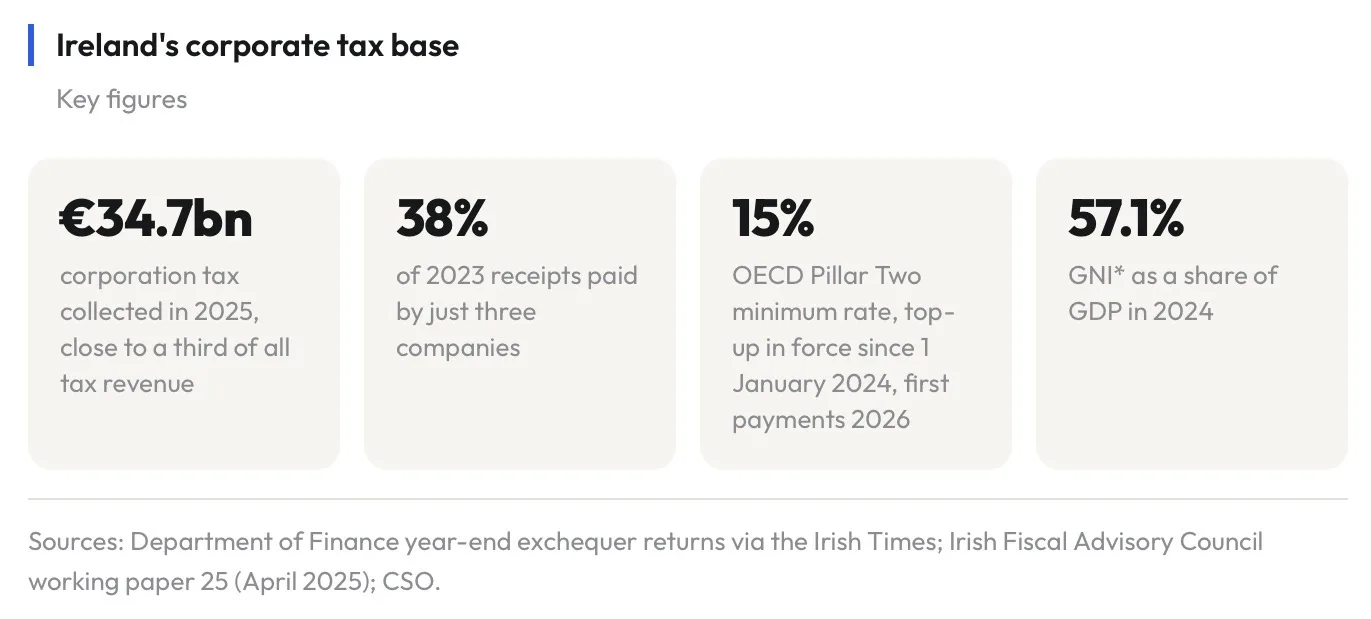
Two things changed the picture without changing the mechanism. Since 1 January 2024, groups with turnover above 750 million euros pay a domestic top-up to reach the 15 percent minimum agreed under the OECD's Pillar Two, with the first payments due in 2026 and an additional yield of around 3 billion euros expected. And Dublin, aware that windfall receipts can leave as fast as they arrive, created two sovereign funds in Budget 2024, the Future Ireland Fund and the Infrastructure, Climate and Nature Fund, to park the surplus rather than spend it.
Ireland's GDP measures where profits are taxed, not where things are made. Its own government budgets on that assumption.
4. Why it matters beyond Dublin
The distortion is harmless as long as everyone corrects for it. The problem is that the headline number is what gets reported, traded on, and cited in speeches, and it is what the European Central Bank's staff projections are benchmarked against. A central bank reading 0.6 percent as evidence of resilience, and a central bank reading 0.2 percent as evidence of stagnation, do not reach the same conclusion about the timing of the next rate move. Eurostat's own release attributed 0.9 point of second-quarter growth to net trade, with exports up 3.4 percent; a large share of that export surge is Irish and, by the CSO's own account, multinational.
Several economists have argued for years that Eurostat should publish an ex-Ireland aggregate alongside the headline, the way the CSO publishes GNI* alongside GDP. It has not done so. Until it does, the exercise falls to readers: take the euro area figure, subtract four percent of the Irish number, and you have the economy the other 340 million people live in.
One last point, because it will come up again in October. Ireland's GDP has now moved by more than 7 percent in three consecutive quarters. That volatility is not noise around a trend. It is the footprint of a handful of corporate decisions about where to book exports in a year of tariff uncertainty. The third-quarter estimate, due on 30 October, will move the euro area again, in whichever direction Dublin's multinationals moved their invoices.