
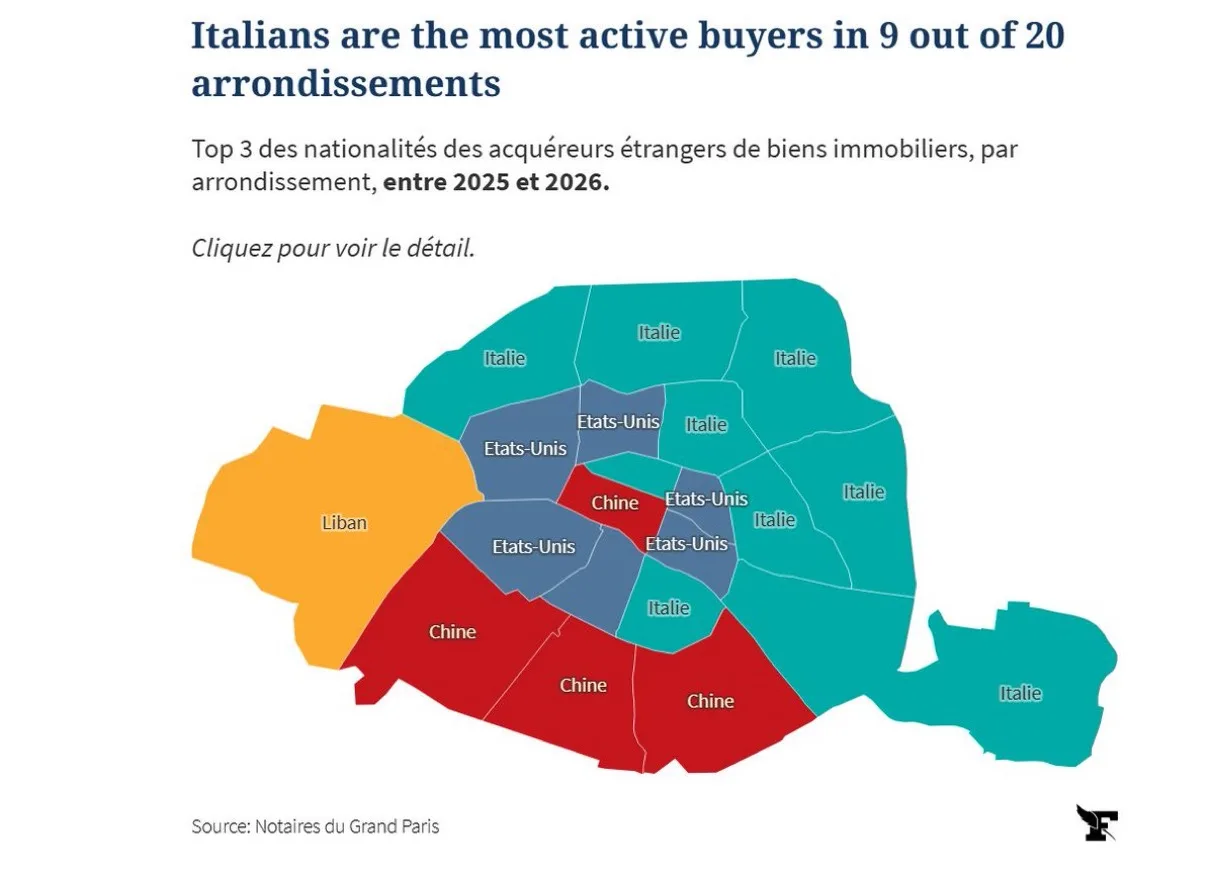
New data from the Notaires du Grand Paris, published by Le Figaro and covering 2025 to 2026, breaks down the top three foreign buyer nationalities in Paris arrondissement by arrondissement. Italians lead in nine of the twenty. Americans lead across several central arrondissements. Chinese buyers lead in the southern ones. Lebanon leads in one: the 16th
I. What the map shows
That single data point is worth isolating. The 16th is the only arrondissement in Paris where a country of roughly five million people, whose banking system has been in collapse since 2019, outranks every other foreign nationality.
The scale needs stating first, since it is routinely misrepresented. Le Figaro's own framing is that the idea of a Paris owned by foreigners does not survive contact with the numbers. Foreign buyers living outside France accounted for roughly 1.1 percent of home sales in Île-de-France in 2023. Foreign buyers already resident in France accounted for around 10 percent. The phenomenon is concentrated, not dominant.
Where they do matter is the prestige segment. The agency Vaneau reports that foreign buyers represent 28 percent of its sales, rising above 45 percent in the 7th arrondissement, and that international clients account for roughly 30 percent of demand between 1 and 2.5 million euros, 50 percent between 2.5 and 4 million, and 70 to 80 percent above 4 million.
II. The national picture, and why the 16th is different
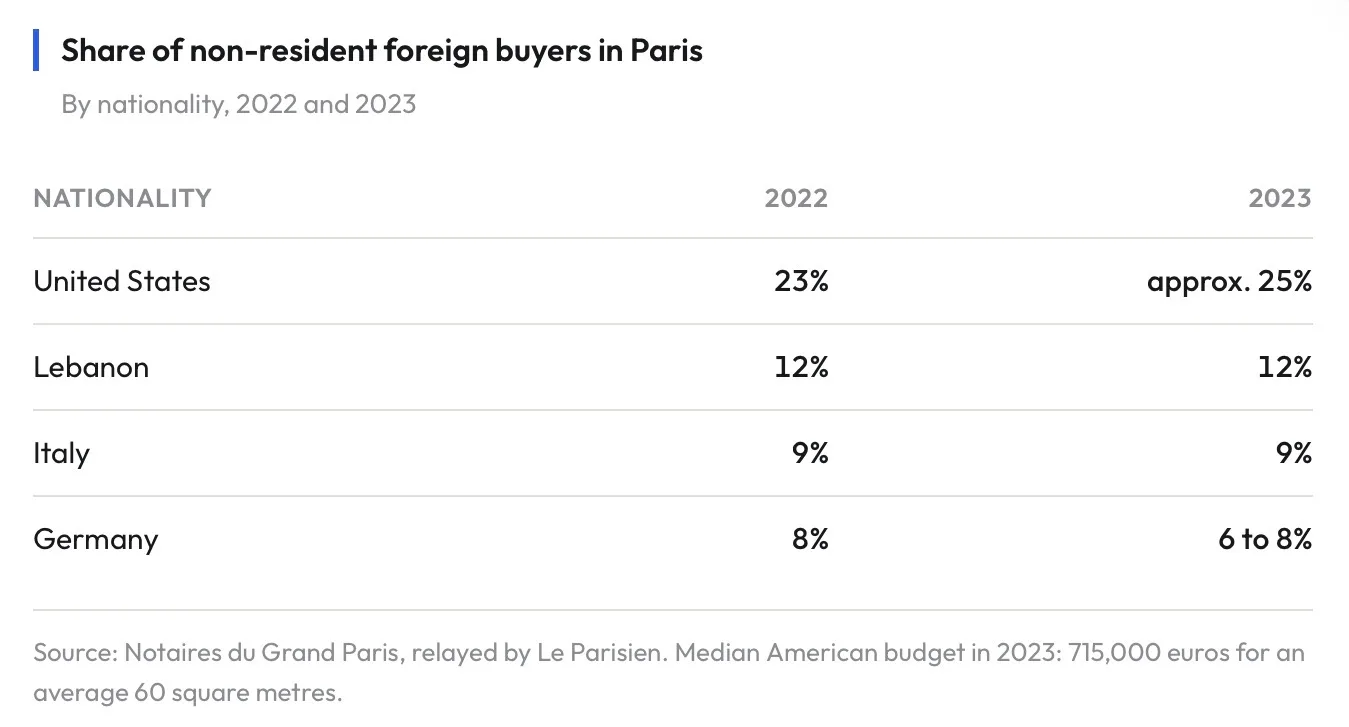
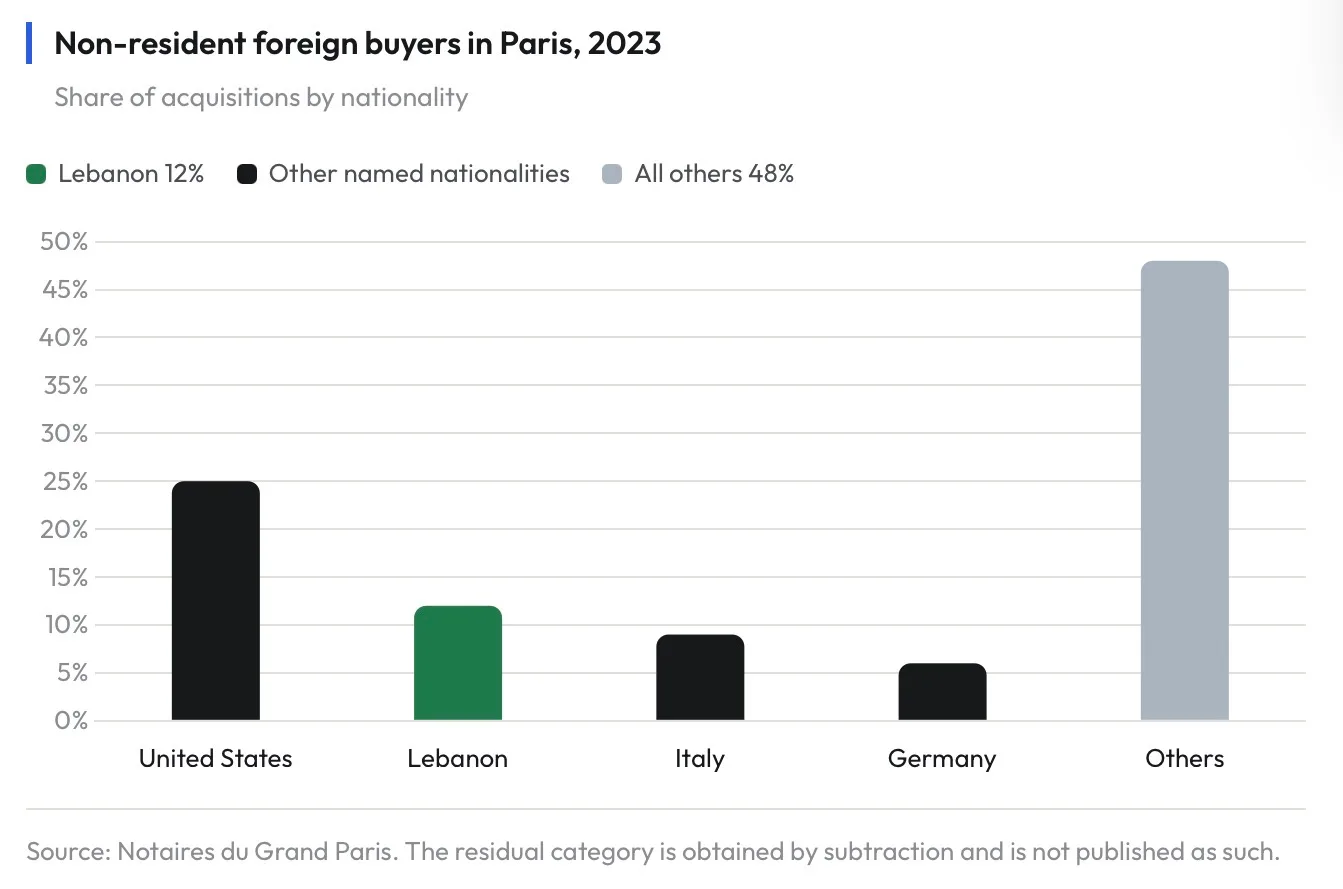
On aggregate figures, Lebanon has been the second most represented nationality among non-resident foreign buyers in Paris for several years. In 2023, according to Notaires du Grand Paris data relayed by Le Parisien, 62 different nationalities bought in the capital, a record. Americans came first at around a quarter, with a median budget of 715,000 euros for an average 60 square metres. Lebanon followed at 12 percent, ahead of Italy at 9 percent and Germany. In 2022 the ranking was the same, with the United States at 23 percent and over 200 acquisitions.
Concentration inside Paris has intensified. In 2023, 68 percent of non-resident foreign buyers in Île-de-France bought within the capital itself, against 49 percent in 2021.
The arrondissement split explains what the aggregate hides. Americans cluster in the central arrondissements, which estate agents describe as pied-à-terre territory: smaller units, high price per square metre, occasional use. The 16th is the opposite profile. It is residential, with large bourgeois apartments, family layouts, parks and established schools, and it is the arrondissement estate agents associate with foreigners buying a main residence rather than a second home.
The distinction is between a foothold and a relocation. Lebanon leads the arrondissement associated with the second.
III. The 2019 rupture
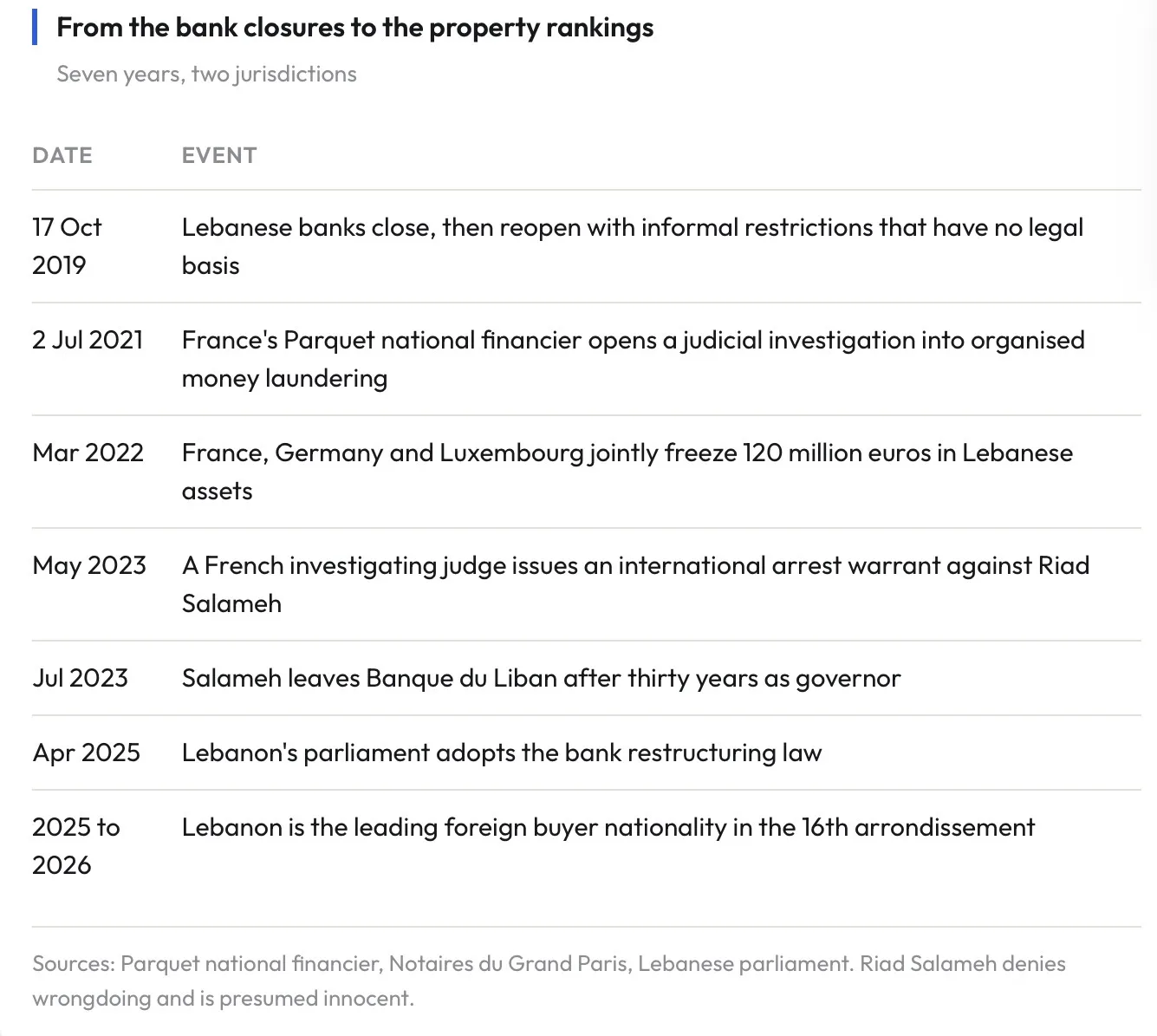
Lebanese banks closed for two weeks from 17 October 2019. When they reopened, they applied informal restrictions with no legal basis, blocking most depositors from withdrawing or transferring dollars. No capital control law was ever passed. Government estimates put the damage to the Lebanese economy at around 70 billion dollars.
Three separate populations are visible behind a single nationality, and they behave differently.
The first is the historic diaspora. Lebanese emigration to France long predates the civil war and accelerated through it. Dual nationals, families with French schooling and French professional lives, wealth built in the Gulf, West Africa, Latin America or France itself. For this group, a Paris apartment is an ordinary allocation and the money often never passed through a Lebanese bank.
The second is depositors exiting a frozen system. For anyone who held funds offshore before October 2019, or who holds post-2019 dollars outside the system, converting them into an asset a Beirut bank cannot freeze is a rational and lawful decision.
The third is the category Lebanese law now addresses explicitly. Lebanon's parliament adopted a bank restructuring law in April 2025. A subsequent draft banking law published by the government provides that politically exposed persons and major shareholders who transferred significant capital abroad from 2019 onward, while ordinary depositors were locked out of their savings, must repatriate it within three months or face fines. The legislation presupposes that such transfers occurred.
Documented cases exist. OCCRP, working from leaked bank statements, reported that Nady Salameh, son of then central bank governor Riad Salameh, transferred more than 6.5 million dollars abroad during the period when ordinary depositors could not access their accounts.
IV. Where the two stories meet
Paris is not a hypothetical destination in this file. It is a documented one.
France's Parquet national financier opened a judicial investigation on 2 July 2021 into organised money laundering and criminal conspiracy, following complaints from the NGO Sherpa and a collective of Lebanese depositors. In March 2022, France, Germany and Luxembourg jointly froze 120 million euros in Lebanese assets. A French investigating judge issued an international arrest warrant against Riad Salameh in May 2023. Among the assets placed under seizure in France were apartments in the 16th arrondissement and on the Champs-Élysées. Salameh, who ran Banque du Liban from August 1993 to July 2023, denies wrongdoing and is presumed innocent. The proceedings are ongoing.
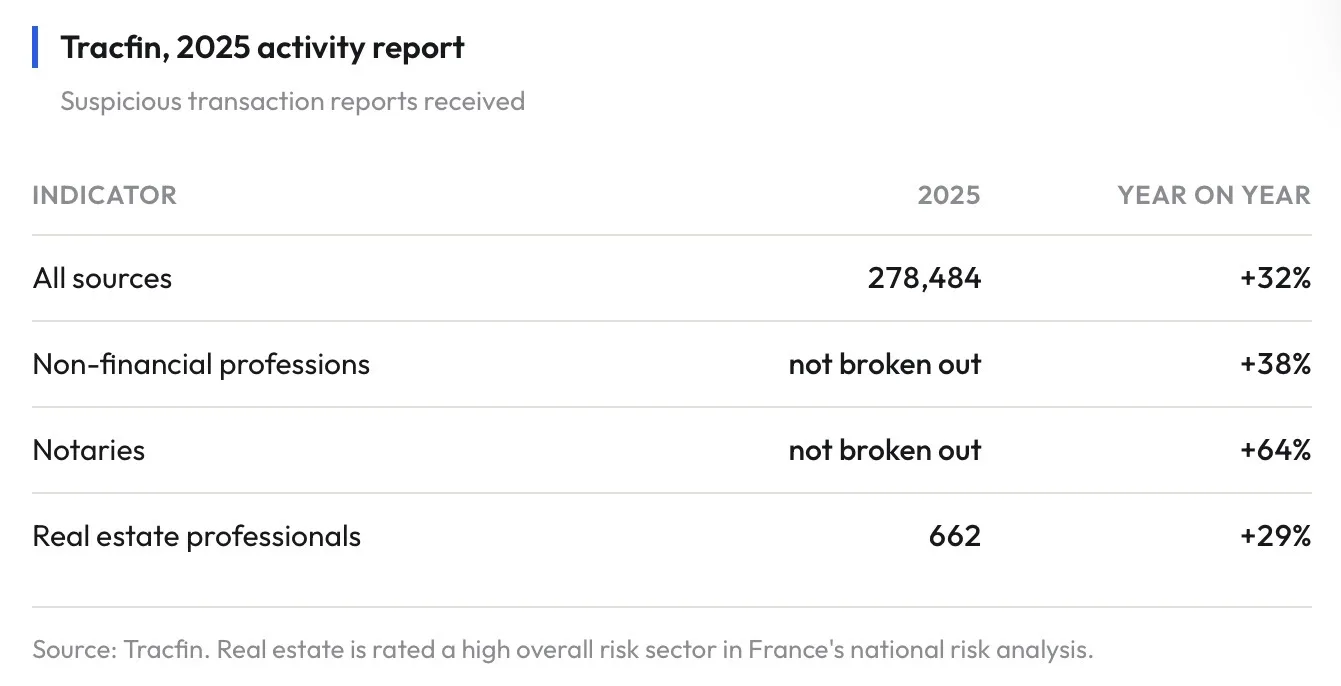
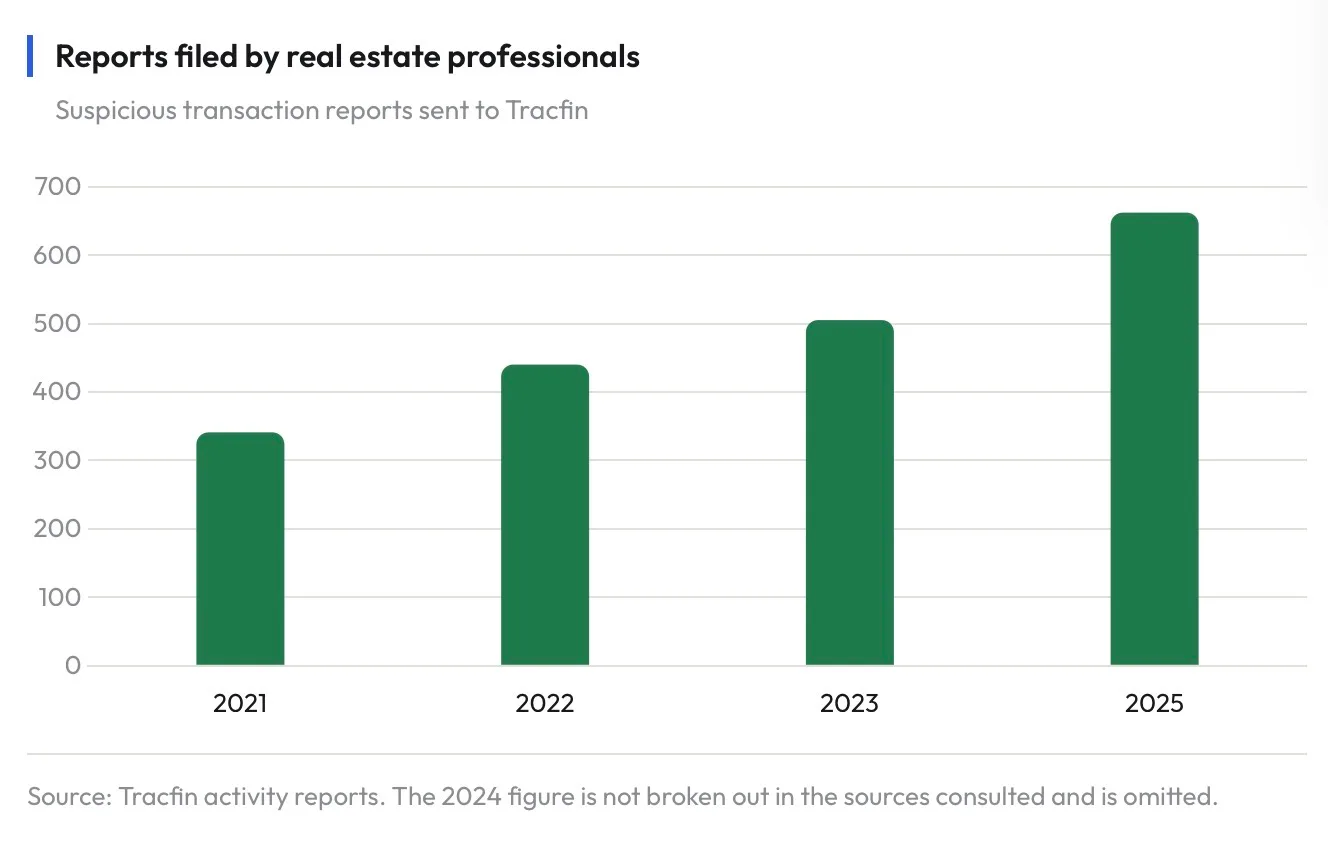
French authorities classify real estate as a high overall risk sector in the national risk analysis, independently of any nationality. Tracfin's 2025 activity report, published this month, records 278,484 suspicious transaction reports, up 32 percent year on year. Non-financial professions rose 38 percent, with notaries up 64 percent. Real estate professionals filed 662 reports in 2025, up 29 percent.
The typologies Tracfin publishes are generic: nominee buyers acquiring on behalf of a concealed beneficial owner through an SCI or shell company, part of the price settled outside the banking circuit, deliberate over or undervaluation. In notaries' filings, the single most frequent alert criterion is the absence of a mortgage, present in roughly two thirds of declarations, followed by questions on the origin of funds.
That overlap is the analytical difficulty, and it is not solvable at the notary's desk. A cash purchase through a corporate vehicle, funded from a jurisdiction that answers mutual legal assistance requests slowly, describes both lawful capital flight from a collapsed banking system and the concealment of illicit funds. Distinguishing them requires upstream information about where the money originated, which is precisely what Lebanon's banking legislation would produce if enforced.