1. A rescue expected, not yet announced
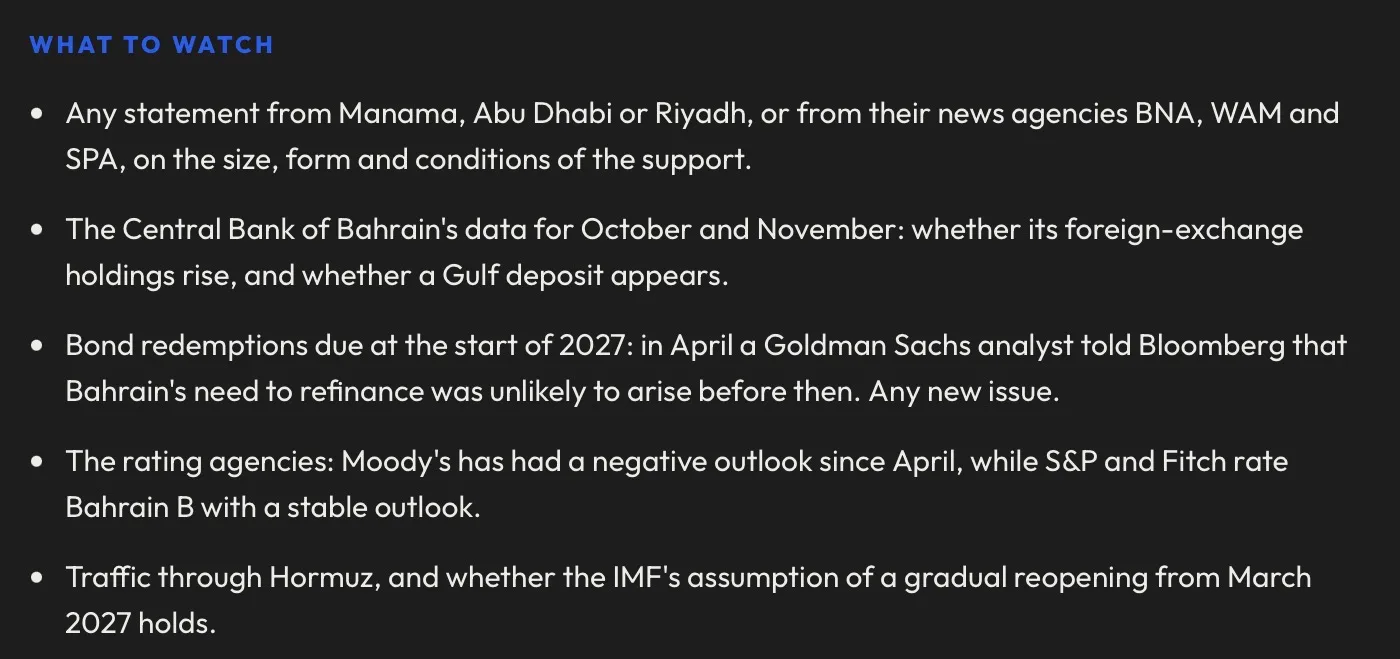
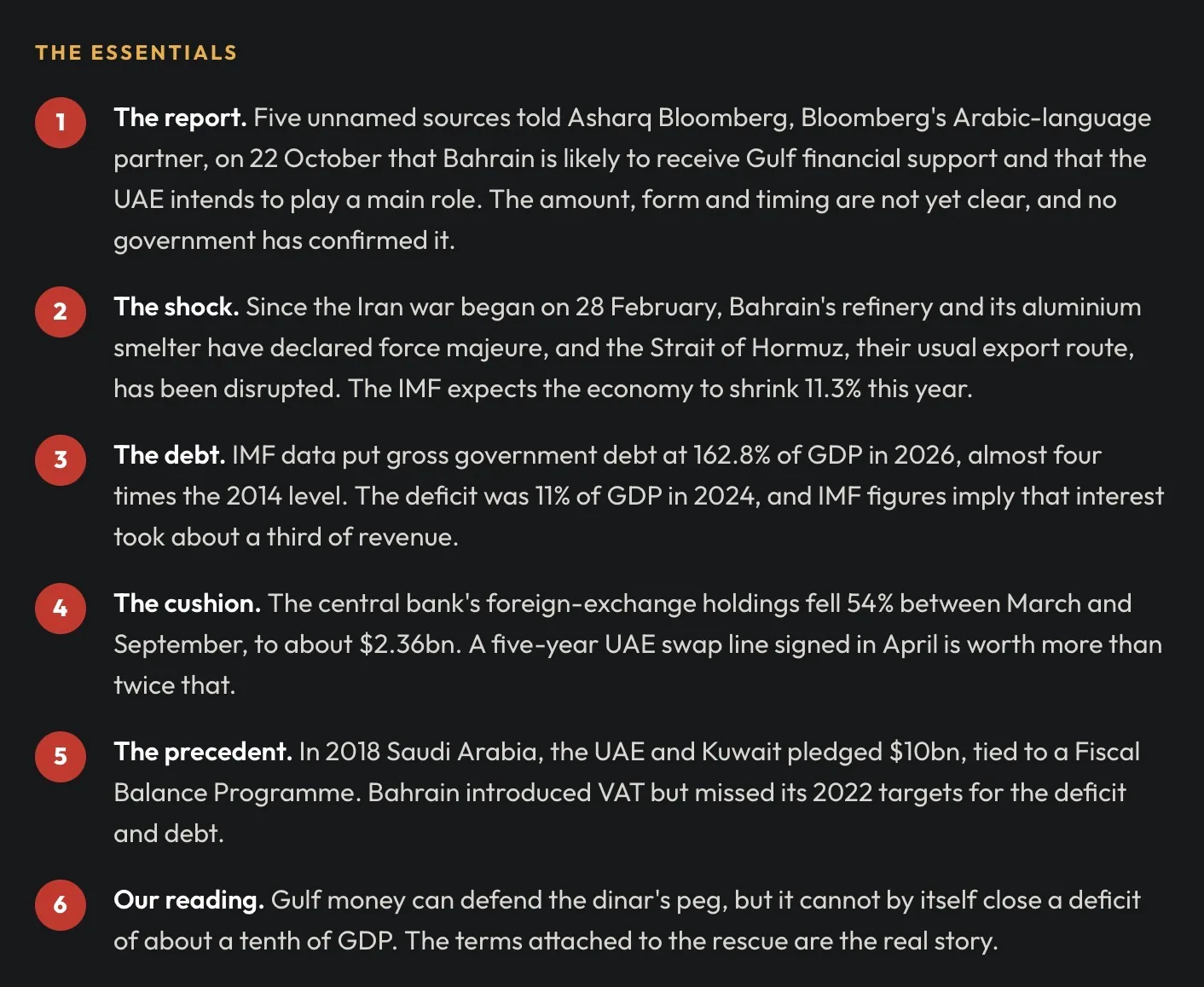
Bahrain's neighbours rescued it in 2018, and they appear ready to do so again. Five unnamed sources told Asharq Bloomberg, Bloomberg's Arabic-language partner, on 22 October that Bahrain is likely to receive fresh Gulf support and that the United Arab Emirates intends to play a main role. The value and timing are "not yet clear", the form is not described, and the report does not say that Bahrain asked for help. One source said Saudi Arabia, Manama's traditional backer, knows of Abu Dhabi's move and views additional support positively. By 26 October no government had confirmed or denied the report.
The urgency is real; the panic is not. By 25 October Arabic searches for "the truth about Bahrain announcing its bankruptcy" were trending, Egypt Telegraph noted, though no such announcement exists. Bahrain has not defaulted, and all three rating agencies still place it in the B range. Ziad Daoud, chief emerging-markets economist at Bloomberg Economics, argued on LinkedIn that Gulf support had become a matter of timing and form rather than of whether it would come, Asharq Bloomberg reported. The harder question is what the money can fix.
2. Hormuz hit the exit, not the oil
The war struck Bahrain where it is weakest: not in producing, but in shipping. Its crude arrives by land, through the 112km AB-4 pipeline from Saudi Aramco's Abqaiq plant, which can carry up to 350,000 barrels a day and brings oil from the offshore Abu Safa field the two countries share. What it sells leaves by sea, through Hormuz. Since the United States and Israel struck Iran on 28 February, that exit has been disrupted, and Bahrain, home to the headquarters of US Naval Forces Central Command, has itself been hit by Iranian missiles and drones.
The two pillars of its export economy stopped within days. Aluminium Bahrain (Alba), which produced 1.62 million tonnes in 2025, declared force majeure on 4 March: "It's because what's happening in the Strait of Hormuz, we are not able to ship," a spokesperson told Reuters. The state energy group Bapco followed on 9 March, after what Argus described as Iranian drone strikes on its Sitra refinery complex.
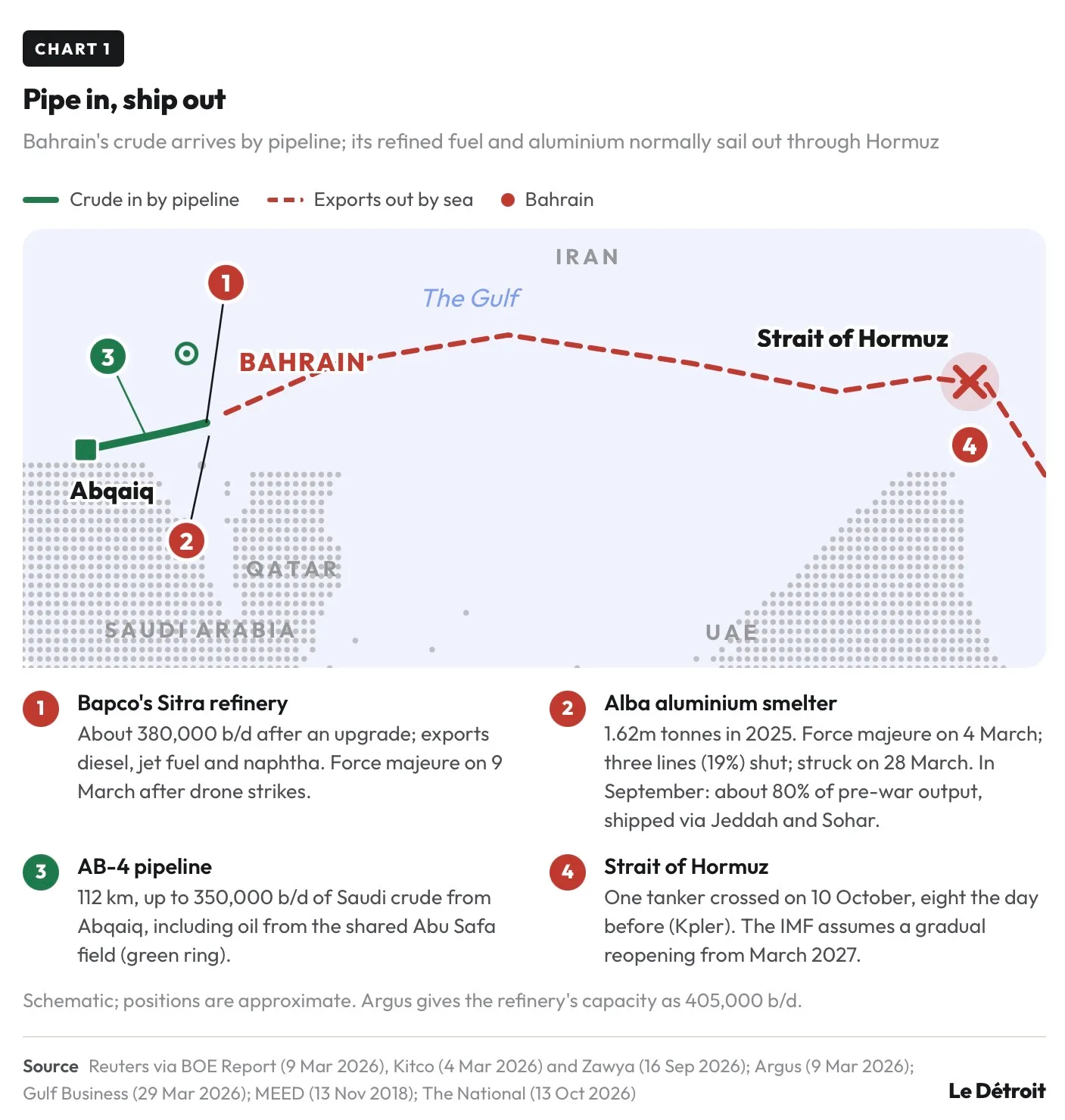
Aluminium has since found a partial way round. In April Moody's warned that Bahrain could not reroute its trade; by 16 September Alba, struck on 28 March and forced to shut three lines, was back to about 80% of pre-war levels, exporting through Jeddah on the Red Sea and Sohar in Oman, its chief executive told Reuters. We found no sign that the refinery has done the same. The strait shows little sign of reopening: after an April truce and a June memorandum, hostilities resumed in September, tanker attacks reached their highest weekly count of the year on 9 October, The National reported, and the IMF's October forecasts assume only a gradual reopening from March 2027.
3. Broken before the war
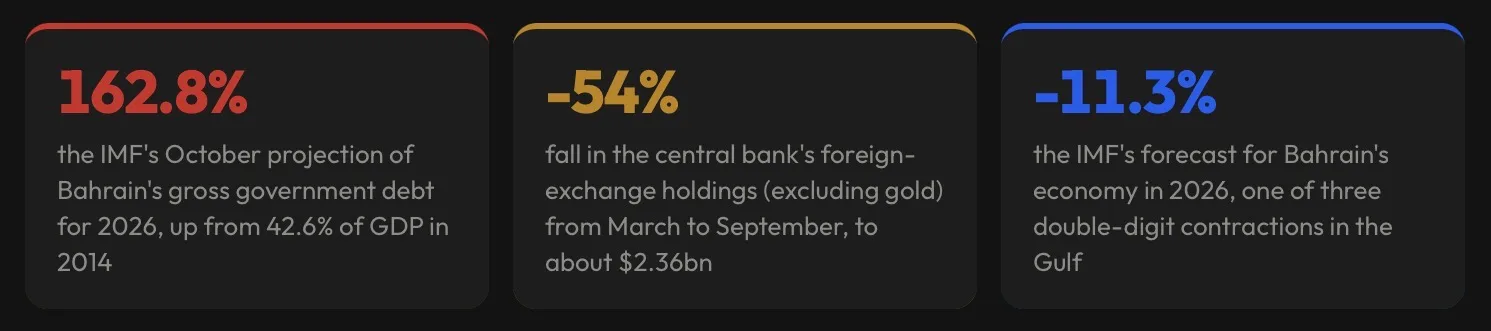
Hormuz did not create Bahrain's fiscal problem; it removed the room to manage it. Gross government debt rose from 42.6% of GDP in 2014, when oil prices collapsed, to 133.7% in 2024, and the IMF's October projections put it at 162.8% this year, as the economy shrinks by a forecast 11.3%. The budget has been in deficit every year since 2014, and the IMF projects a gap of 10.6% of GDP in 2026.
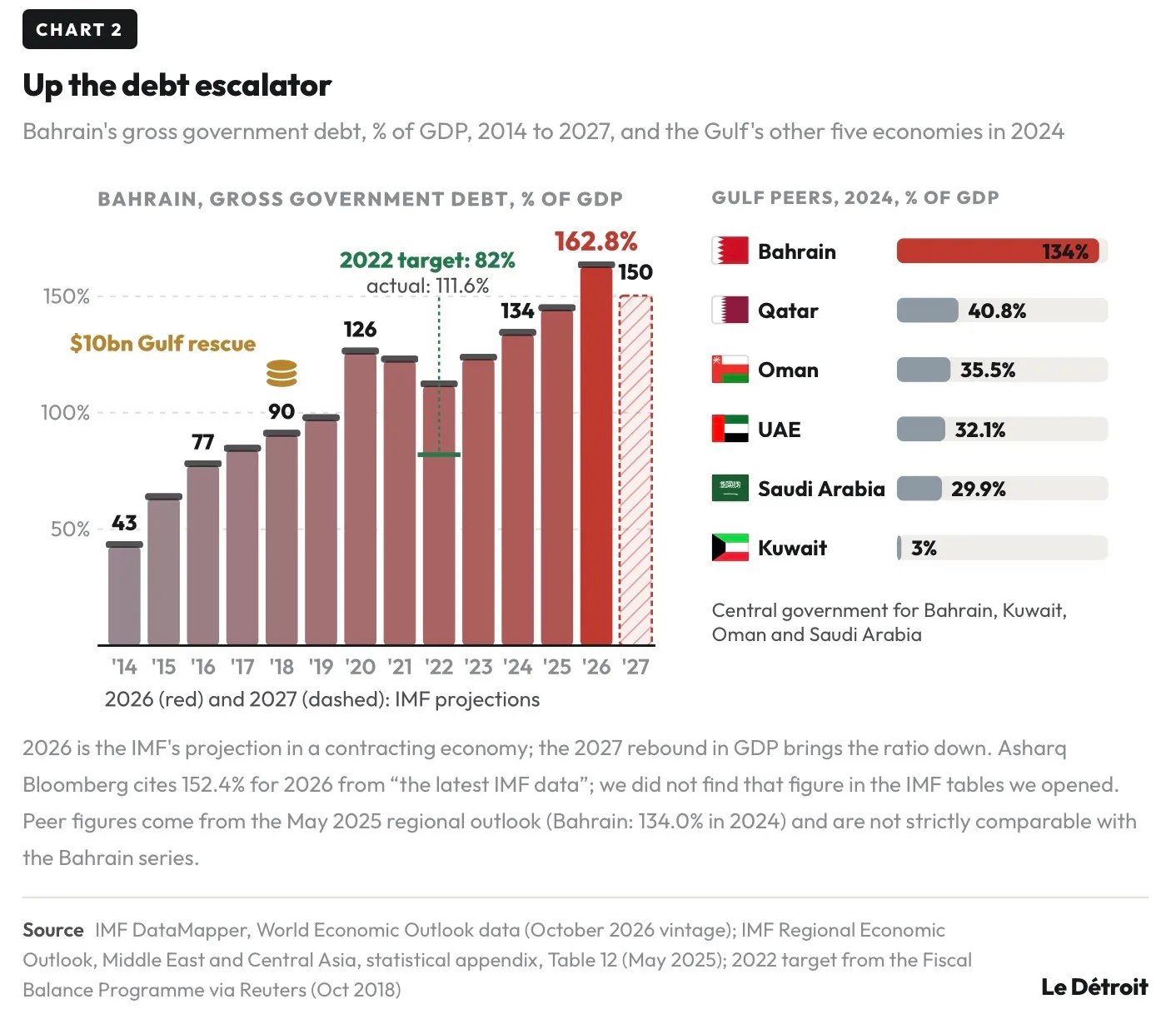
Much of that gap is the cost of past borrowing. By Le Détroit's calculation from IMF data, the difference between the overall and primary balances implies interest of about 6% of GDP in 2024, roughly a third of government revenue. In January the IMF warned that "delayed or insufficient fiscal adjustment could exacerbate debt sustainability concerns and financing challenges"; the authorities did not consent to the publication of the full staff report.
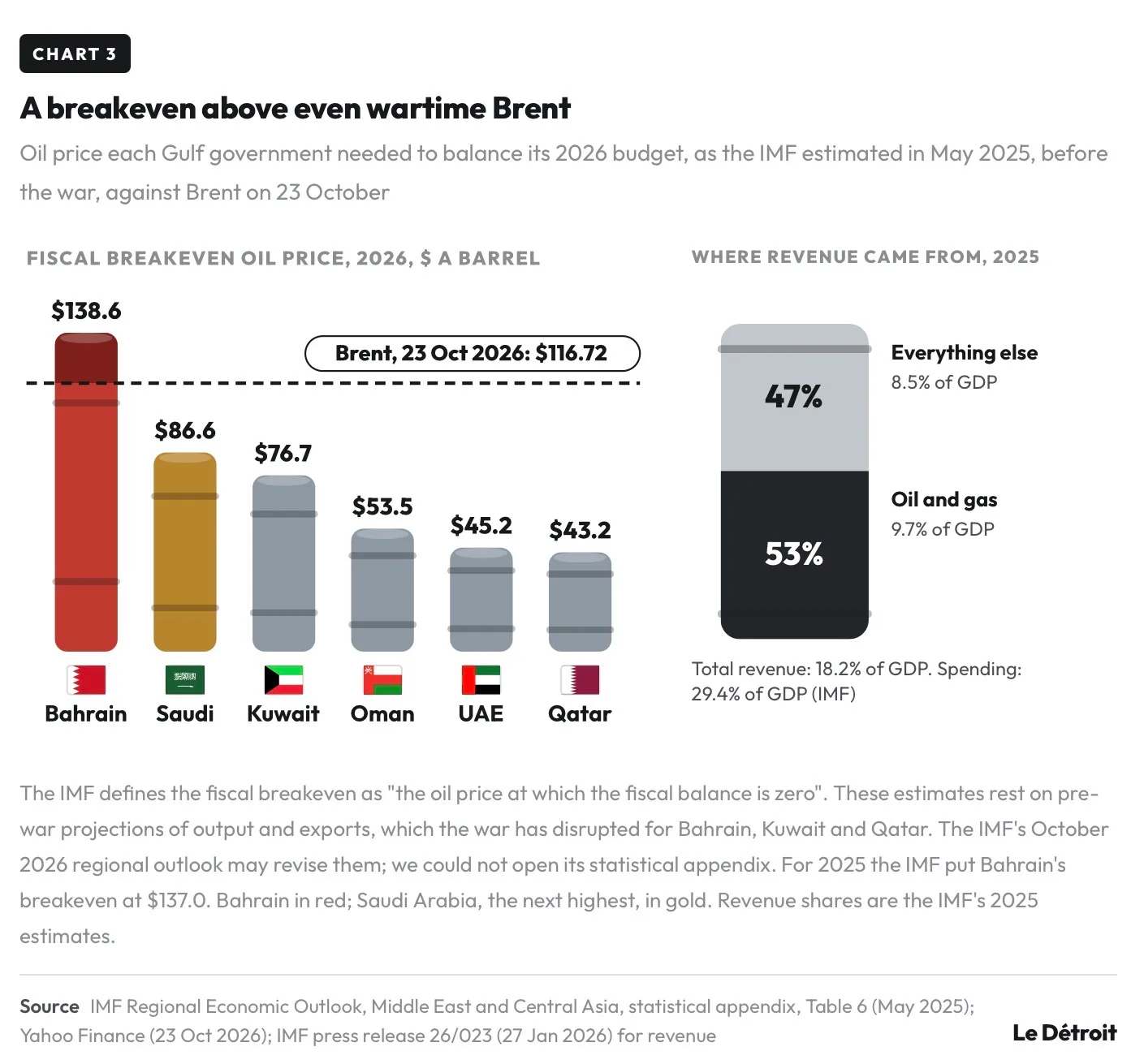
Nor will high oil prices bail Bahrain out. Before the war, in May 2025, the IMF estimated that Bahrain needed oil at $138.6 a barrel to balance its 2026 budget, against $86.6 for Saudi Arabia and $45.2 for the UAE. Brent settled at $116.72 on 23 October, a war-time price that still falls short, and the estimate assumed pre-war volumes. Oil and gas brought in revenue worth 9.7% of GDP in 2025, more than half the total, and what Bahrain cannot ship, it cannot sell.
4. The peg is the front line
What a rescue buys first is time for the dinar. The currency is pegged to the dollar, and the peg runs on foreign currency, which has been draining fast: the central bank's foreign-exchange holdings, excluding gold, fell from BD1.95bn ($5.17bn) in March to BD594m ($1.58bn) in August. Asharq Bloomberg, citing the same data, reported a rebound to BD886.6m ($2.36bn) in September, without explaining it. The IMF had judged reserves "low" even before the war, at just over two months of non-hydrocarbon imports.
The UAE has already put a backstop in place. On 8 April the two central banks signed a five-year AED20bn (BD2bn) currency swap, which Bahrain's governor, Khalid Humaidan, said "is expected to stimulate economic growth and reinforce financial stability in both countries". Five days later the Central Bank of Bahrain offered banks unlimited dinar liquidity for six months against collateral, up to BD7bn ($18.6bn), and in June Bahrain still sold a $1bn ten-year bond at 7.125%, with orders above $3.2bn.
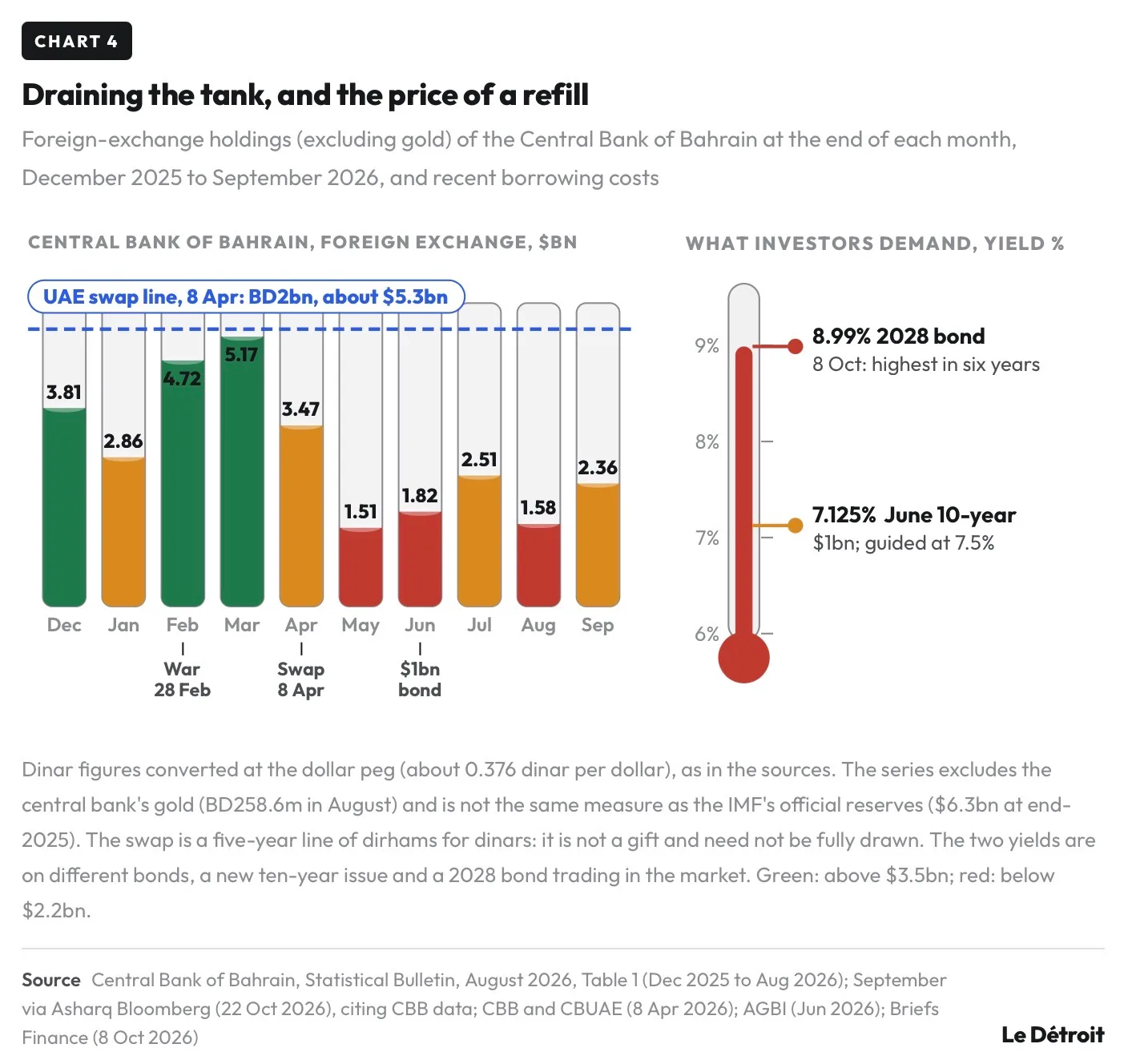
Investors are betting on that backstop. Bonds rallied after the April truce and the swap, then sold off again from late August: by 8 October the 2028 dollar bond yielded 8.99%, its highest in six years, according to Briefs Finance, and Bloomberg wrote that the sell-off had revived memories of the 2018 rescue. Asharq Bloomberg reported that bonds recovered in the week before its 22 October report. The rating agencies point the same way: S&P and Fitch cut Bahrain to B before the war, Fitch expecting the "very high government debt-to-GDP ratio to continue increasing", and Moody's moved its B2 rating to a negative outlook in April. In May S&P said assistance from its Gulf neighbours would ease the pressure.
5. Gulf money comes with terms
The last rescue shows what the next one may demand. In October 2018 Saudi Arabia, the UAE and Kuwait announced $10bn, described by a source to Reuters as a long-term, interest-free loan paid in stages; Bahrain said it received $2.3bn in 2018, with the rest due in instalments to 2023. In return it signed a Fiscal Balance Programme with "targeted indicators": a deficit of 0.1% of GDP and debt of 82% of GDP by 2022, BD800m of annual savings, a 5% VAT, voluntary retirement and higher utility tariffs.
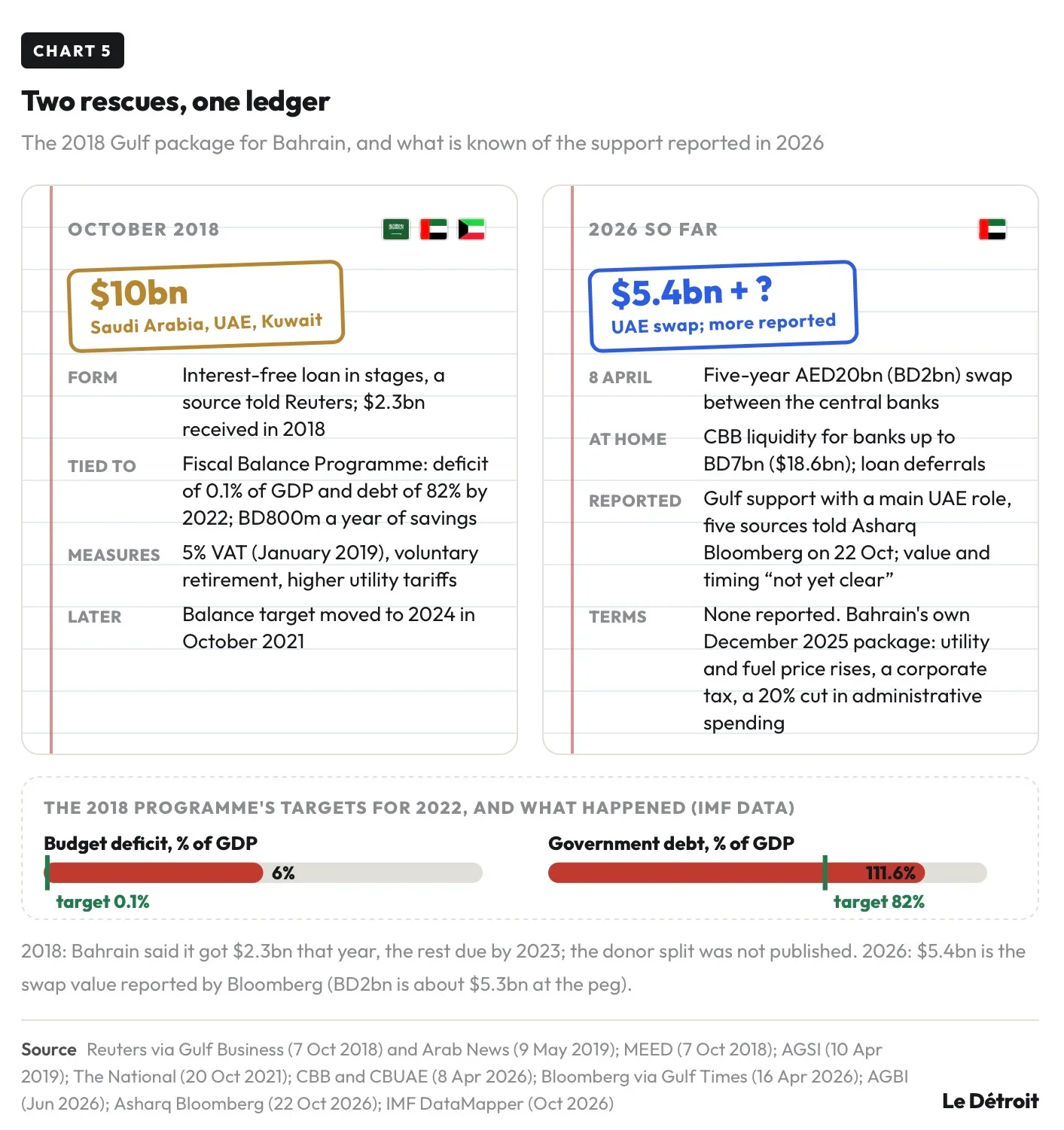
Bahrain delivered the reforms but not the results. VAT arrived on schedule in January 2019 and thousands of civil servants retired early, yet in 2022 the deficit was still 6% of GDP and debt 111.6%, and after Covid-19 the donors accepted a new balanced-budget date of 2024. The government announced 11 more measures in December 2025, including higher utility rates and a corporate tax, and in April a spokesperson said Bahrain "remains firmly committed to its fiscal reform agenda". "A meaningful reform program will be needed to bring the fiscal position into a more sustainable position," Monica Malik, chief economist at Abu Dhabi Commercial Bank, told Bloomberg in April.
This time the lender of first resort may be Abu Dhabi rather than Riyadh, because it has the deepest pockets in a region where every donor is shrinking. Fitch put Abu Dhabi's net foreign assets at about 164% of UAE GDP in 2025. The IMF expects the UAE economy to contract 3.9% this year, Saudi Arabia 3.3% and Kuwait, the third donor of 2018, 16.7%.
6. Le Détroit's reading
A Gulf rescue can save the peg; it cannot, on its own, save the budget. Deposits and swap lines refill the central bank and calm bondholders, but they do not close a deficit of about a tenth of GDP or reverse a debt ratio the IMF projects at 162.8% this year. That takes years of adjustment and a reopened strait, and the IMF assumes only a gradual reopening from March 2027.
That makes the terms the real story. Conditions in the style of 2018 would land on an economy shrinking by more than a tenth, which has already introduced VAT and raised utility prices, and whose last reforms fell short of their targets. For Abu Dhabi, the return would be mostly strategic: a stable neighbour that hosts the US Navy's regional command, and more weight in Manama.