1. A bank behind a rental desk
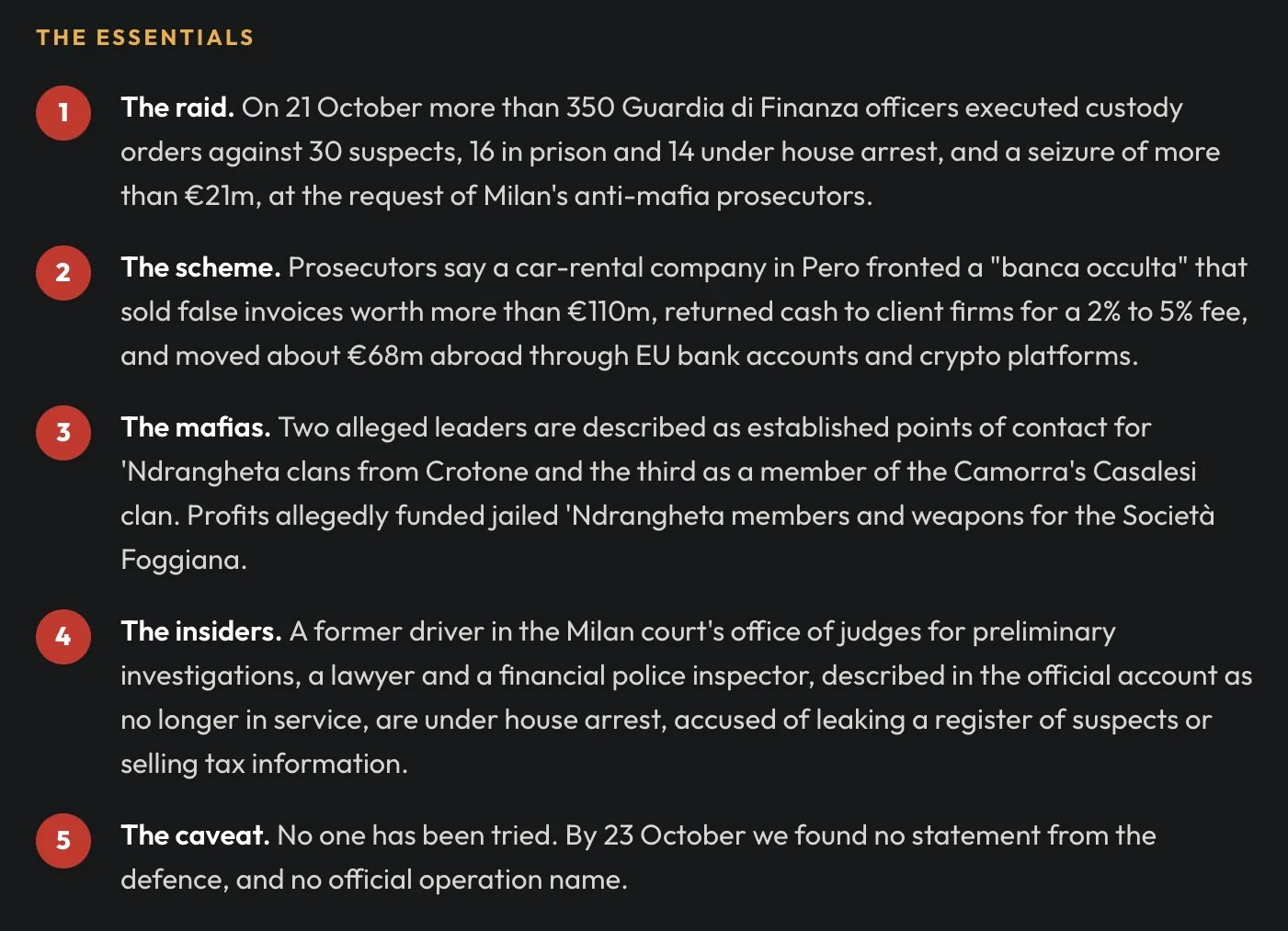
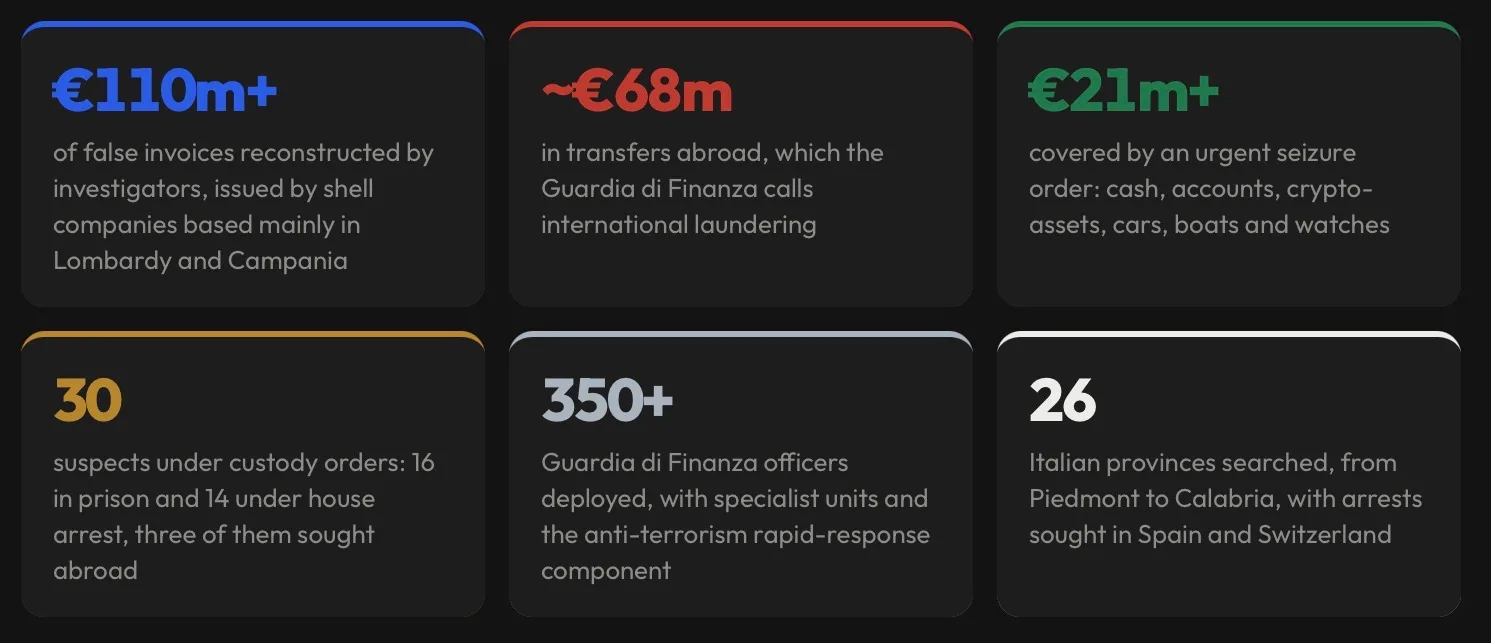
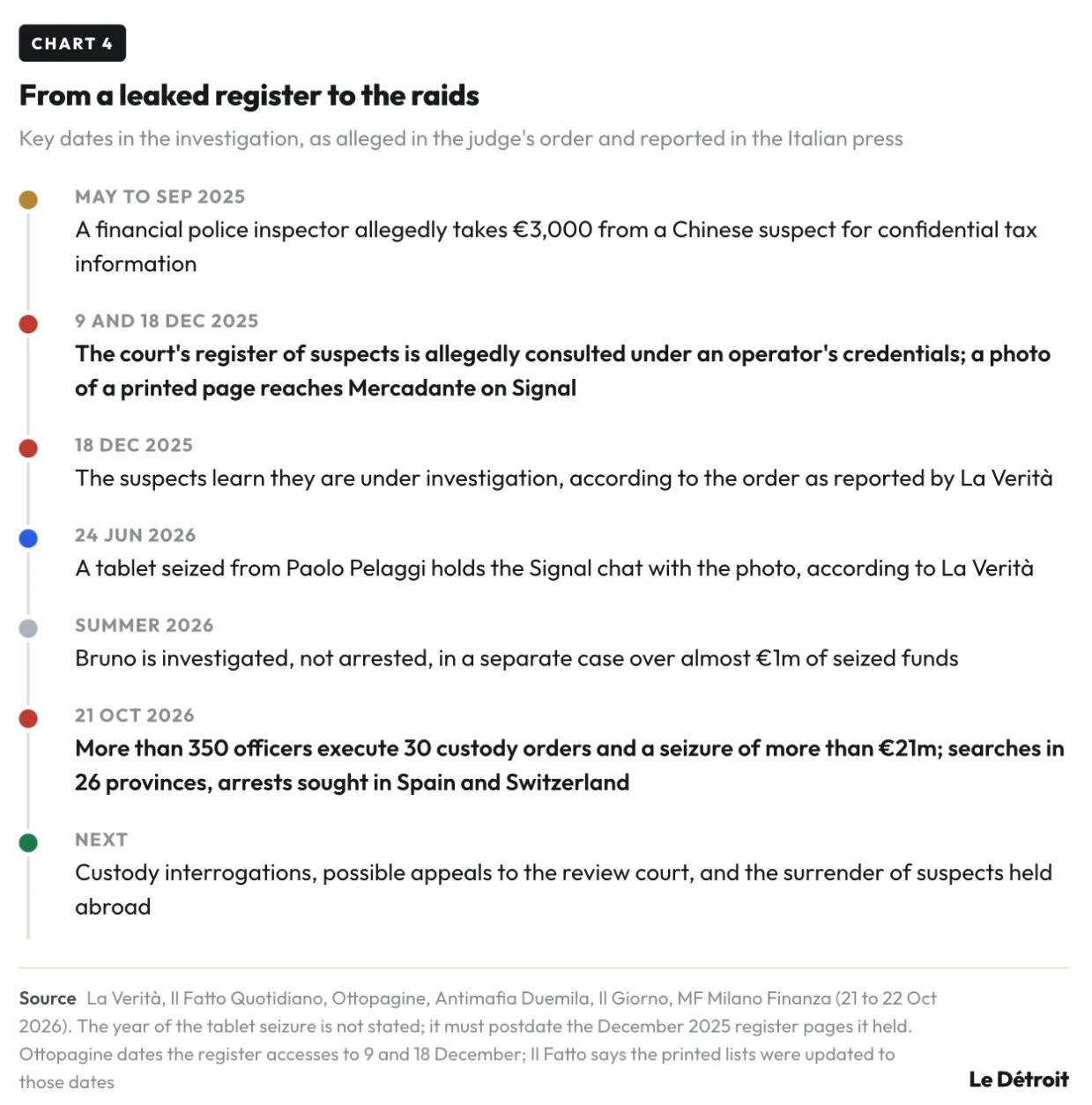
On 21 October 2026 more than 350 officers of the Guardia di Finanza, Italy's financial police, executed custody orders against 30 people and searched premises in 26 provinces from Piedmont to Calabria. Their target, prosecutors say, was a "banca occulta", a hidden bank, run from a car-rental company in Pero, in Milan's hinterland. A Milan judge for preliminary investigations, Luca Milani, ordered 16 suspects into prison and 14 under house arrest, in an order of more than 500 pages with almost 90 charges.
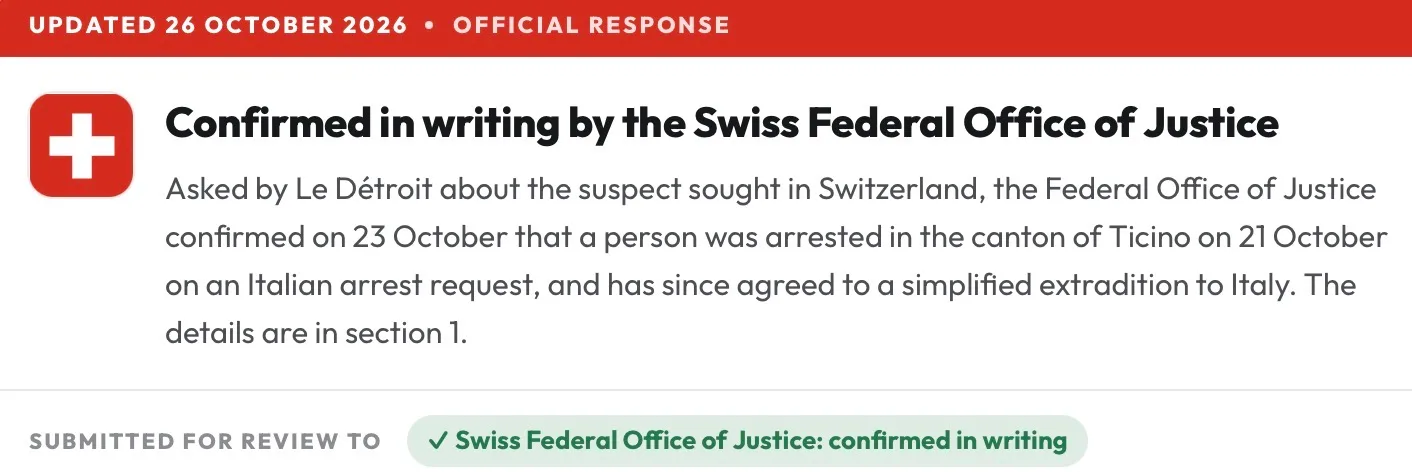
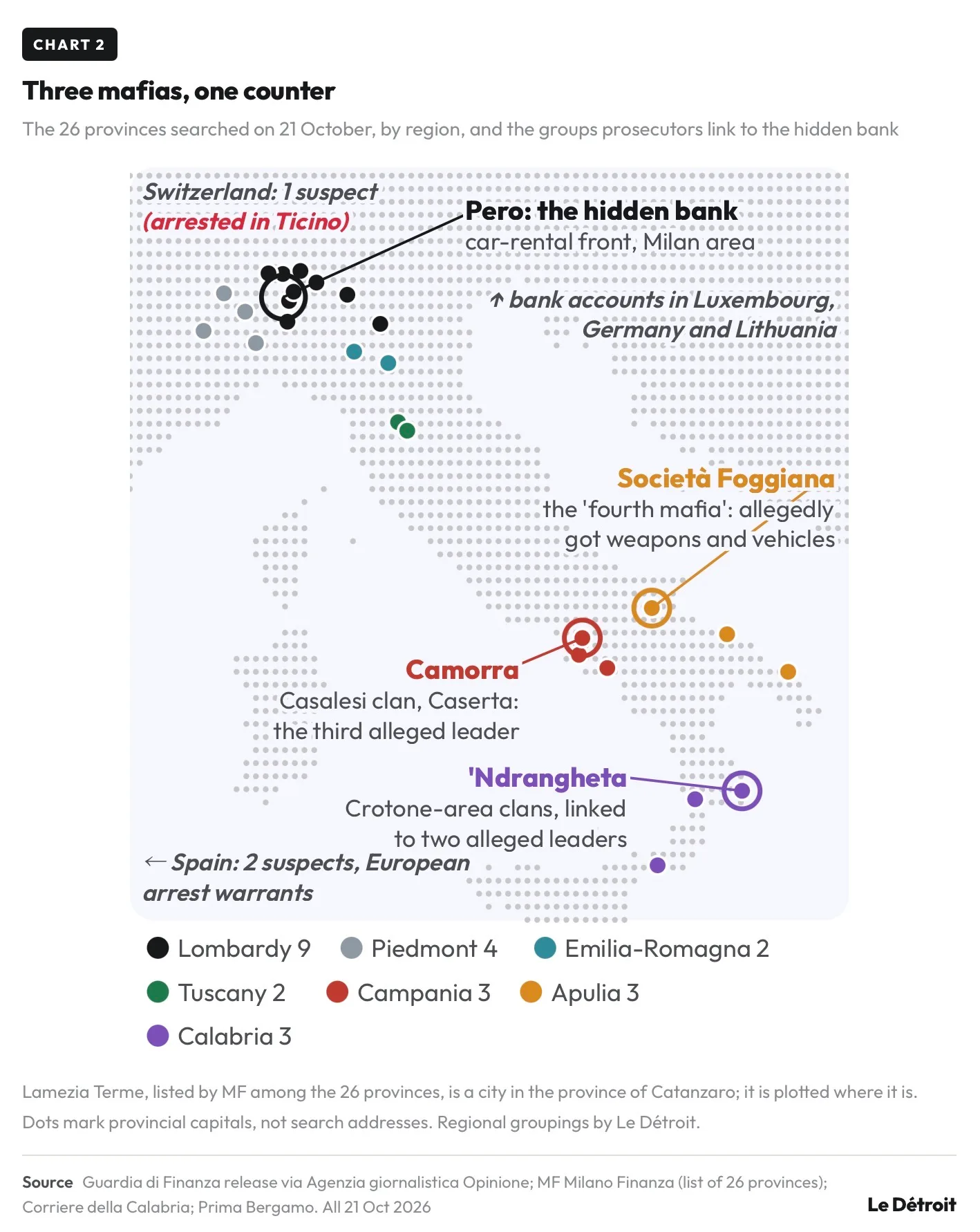
Investigators reconstructed more than €110m of false invoices and transfers abroad of about €68m, and obtained an urgent order to seize more than €21m. They found cash, bank accounts, crypto-assets, cars, boats, jewellery, luxury watches and cash-counting machines. Two suspects were sought in Spain on European arrest warrants and one in Switzerland by letter rogatory, with help from Interpol's I-CAN unit and Italian police attachés in Madrid and Bern. On the basis of an Italian arrest request, a person was arrested in the canton of Ticino on 21 October on behalf of the Swiss Federal Office of Justice and placed in extradition detention. The person has since agreed to a simplified extradition and will be extradited to Italy shortly, the Federal Office of Justice told Le Détroit.
"Dietro la formale copertura di una società di autonoleggio, era stata costituita una vera e propria 'banca occulta'" (behind the formal cover of a car-rental company, a real hidden bank had been set up), said Marcello Viola, Milan's chief prosecutor, in a note on 21 October reported by Radiocor. The charges include criminal association aggravated by the mafia method and by the aim of helping mafia groups, international money laundering, tax fraud, bankruptcy offences, drug trafficking, arms offences and corruption. The case is at the preliminary stage, and the Guardia di Finanza notes that guilt is established only by a final conviction. By 23 October we found no statement from the defence; interrogations before the judge were still to come, Juorno.it reported on 22 October.
2. How a hidden bank works
Prosecutors describe four phases. Two Chinese nationals collected cash, mostly the proceeds of tax evasion, and a man of Calabrian origin allegedly delivered more than €5m of drug money, sometimes through couriers. Shell companies, known in Italy as "cartiere", run by straw men and based mainly in Lombardy and Campania, issued invoices for work never done to firms in construction, logistics and services, which used them to cut their taxable income.
The firms paid the invoices by bank transfer and got the same sums back in cash, minus a commission of 2% to 5%. The shells were then bankrupted and replaced. Money in their accounts went to banks in Luxembourg, Lithuania and Germany, then to crypto exchanges and wallets controlled by the group, while the cash suppliers were repaid in crypto or through accounts in Asia, Canada and South America. The same channel, the prosecutors' note says, laundered money from online scams.
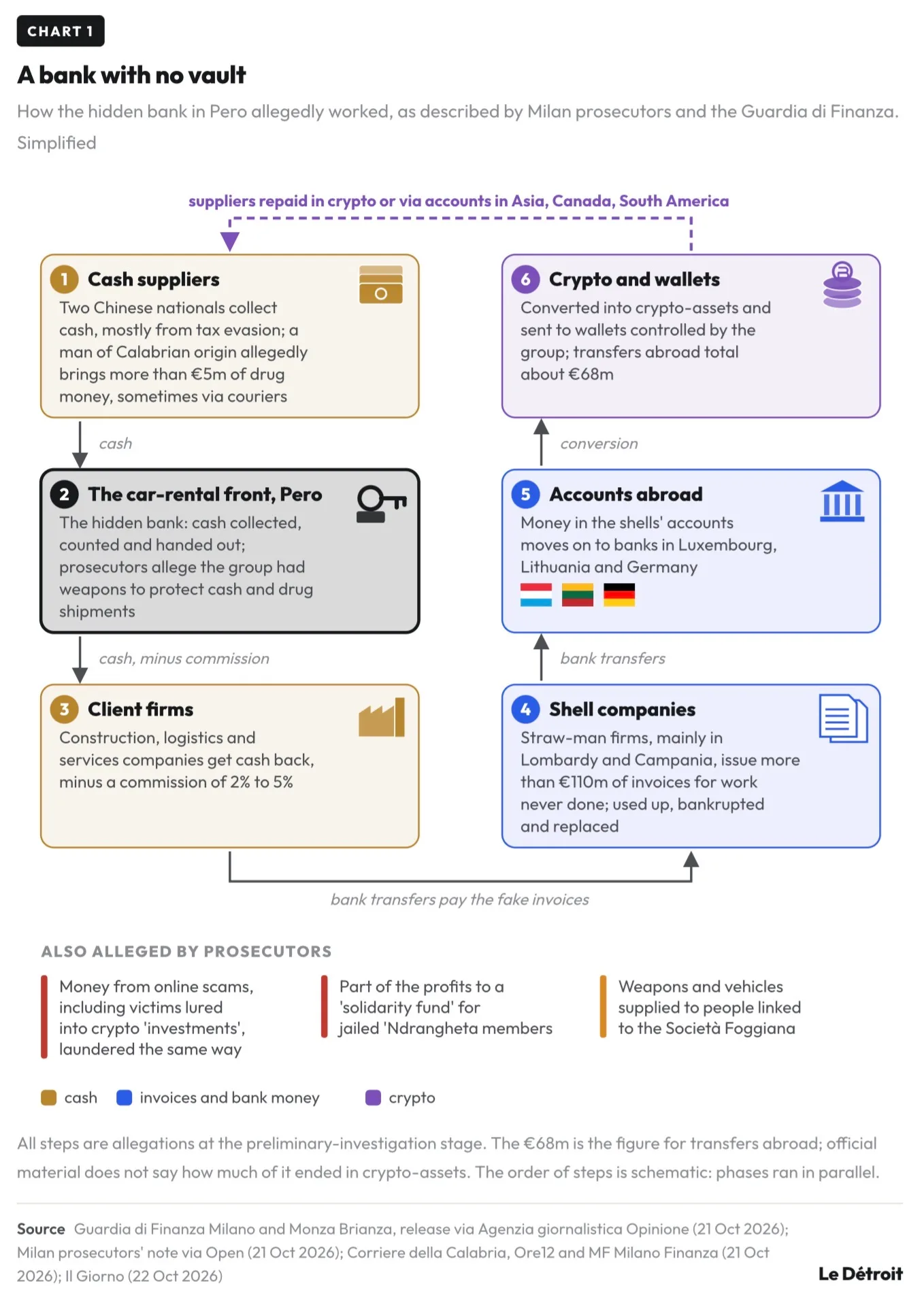
Some early reports said all €68m went through crypto. The official material is more cautious: it speaks of transfers abroad of about €68m, through foreign accounts and crypto platforms, without a split. What it does describe is a service for hire. Europol's 2025 threat assessment warns of money brokers "offering extensive, unregulated financial services to multiple criminal networks" through "parallel, underground financial systems".
3. Three mafias at one counter
The hidden bank was allegedly run by a triad, now all in prison: Giuseppe Piscioneri, Paolo Pelaggi and Luigi Mercadante. The official account describes two of the three as established points of contact ("referenti") for 'Ndrangheta clans from the Crotone area, with final convictions from the "Infinito" and "Aemilia" investigations, without saying which conviction is whose, and the third as a member of the Camorra's Casalesi clan. Press reports say Piscioneri was once convicted as an affiliate of the 'Ndrangheta's Pioltello local (Il Quotidiano del Sud, Antimafia Duemila), Pelaggi of tax and bankruptcy offences aggravated by helping the mafia (La Verità), and Mercadante as a Casalesi affiliate (Il Giorno). All three are presumed innocent, and we found no statement from them or their lawyers by 23 October.
Their accomplices allegedly included Chinese and Albanian nationals. Part of the proceeds allegedly went to support jailed 'Ndrangheta members, "configurando così un vero e proprio fondo di solidarietà mafioso" (thus amounting to a real mafia solidarity fund), Viola said. Investigators also allege that weapons and vehicles went to people linked to the Società Foggiana, the Foggia group known as the "fourth mafia", and that the group used threats, weapons and ammunition to protect cash and drug shipments.
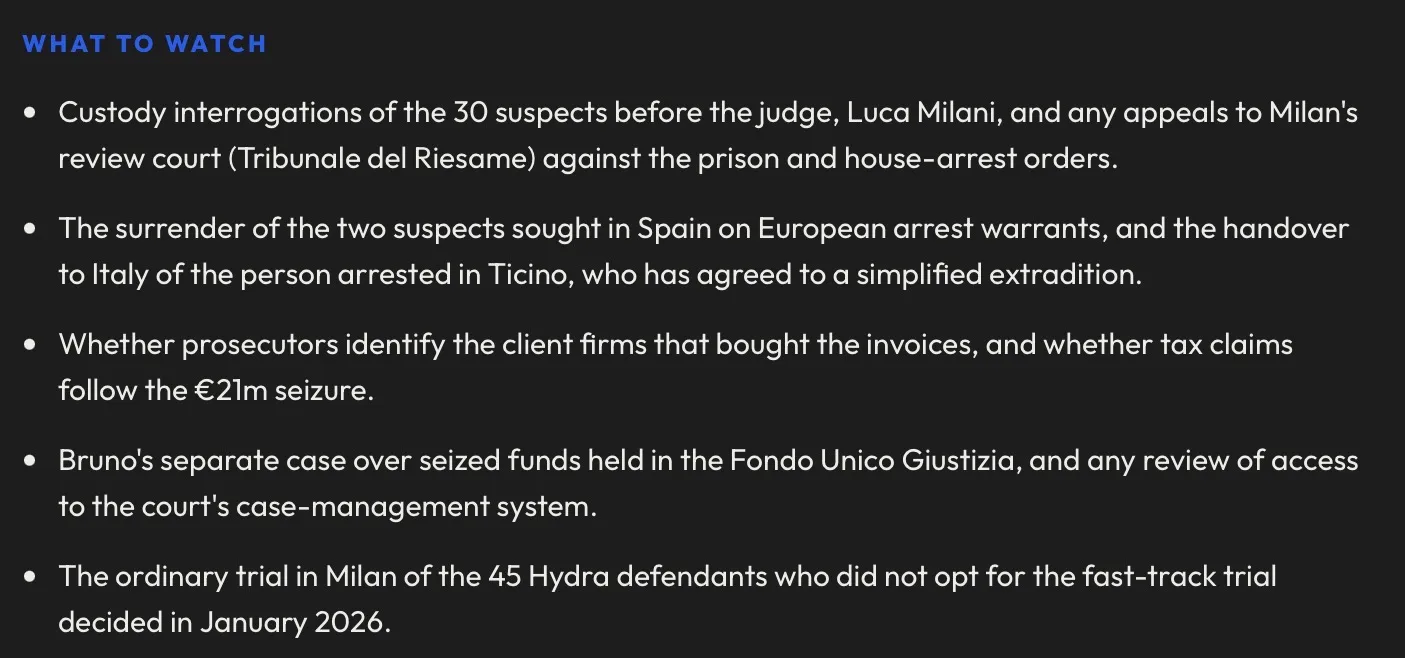
Such alliances are not new in Lombardy. The 2010 Infinito raids led to about 300 arrests, 160 of them in Lombardy, CBS News reported. In January 2026 a Milan judge in the "Hydra" case convicted 62 defendants in a fast-track trial and accepted the central charge of a mafia-type association made up of members of different groups; 45 others were sent to an ordinary trial. In October 2023 a judge had rejected almost all custody requests in that case, before the review court and the Court of Cassation overturned that assessment.
4. The people inside
Three suspects stand out. Domenico Bruno, 55, for years a driver in the office of Milan's judges for preliminary investigations and later given administrative tasks on seized assets, is accused of illegally accessing the justice system's IT network and revealing secret information. The prosecutors, Grazia Colacicco and Pasquale Addesso, allege he consulted the register of suspects in December 2025 at Piscioneri's request, relayed by Rocco Romellano, a lawyer who has defended clients in 'Ndrangheta trials. Both are under house arrest.
Piscioneri and Pelaggi allegedly sent Mercadante a photo of a printed page of that register through the Signal app, Il Fatto Quotidiano reports, citing Corriere della Sera; according to La Verità, the chat was found on a tablet seized from Pelaggi on 24 June. In the order, as quoted by La Verità on 22 October, the judge wrote that Romellano and Bruno showed "un'assoluta assenza di remore" (a complete lack of scruple) in serving the group. Bruno, defended by Roberto Grittini according to Antimafia Duemila, was already under separate investigation, not arrested, over an alleged attempt to release almost €1m of seized funds to an 'Ndrangheta figure. Both are presumed innocent.
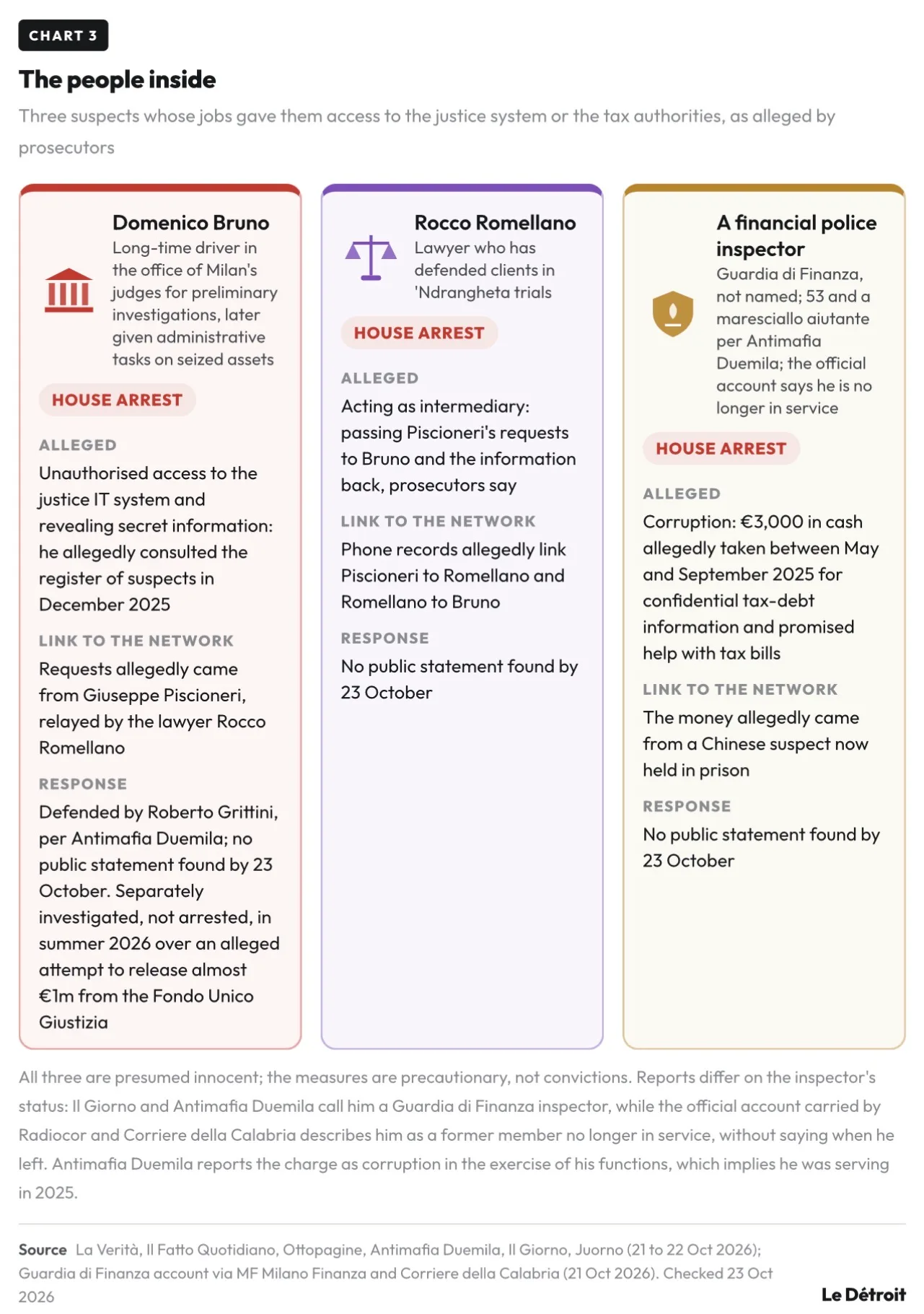
The third is a Guardia di Finanza inspector, aged 53 according to Antimafia Duemila, under house arrest for corruption. He allegedly took €3,000 in cash between May and September 2025 from a Chinese suspect, now in prison, for confidential tax-debt information and promises of help with tax bills. The official account carried by Radiocor calls him a former member no longer in service, without saying when he left; Antimafia Duemila, which gives his rank as maresciallo aiutante, reports the charge as corruption in the exercise of his functions, implying he was serving at the time. He too is presumed innocent.
5. Why the last leg was crypto
Europol says "virtual currencies are increasingly used to launder money" and that new technologies serve as "a digital cloak to hide money laundering". Italy's financial intelligence unit, the UIF, sees the same shift. It received 162,059 suspicious transaction reports in 2025, up 11.5% after two years of decline. Reports from virtual-currency operators rose 85.1%, to 5,859, or 3.6% of the total. About 13.8% of all reports were closely connected to organised crime, and laundering linked to tax offences made up about 20%.
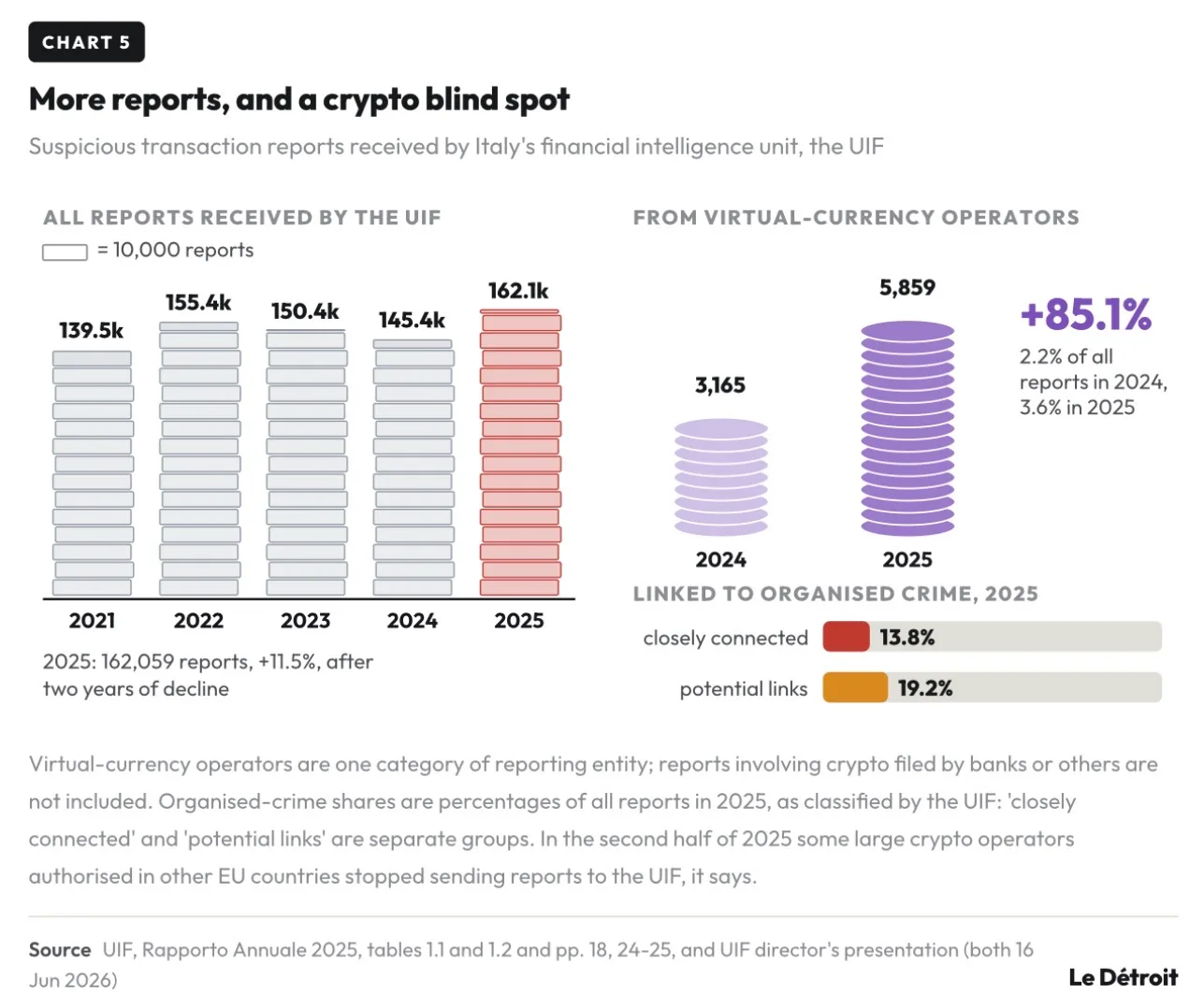
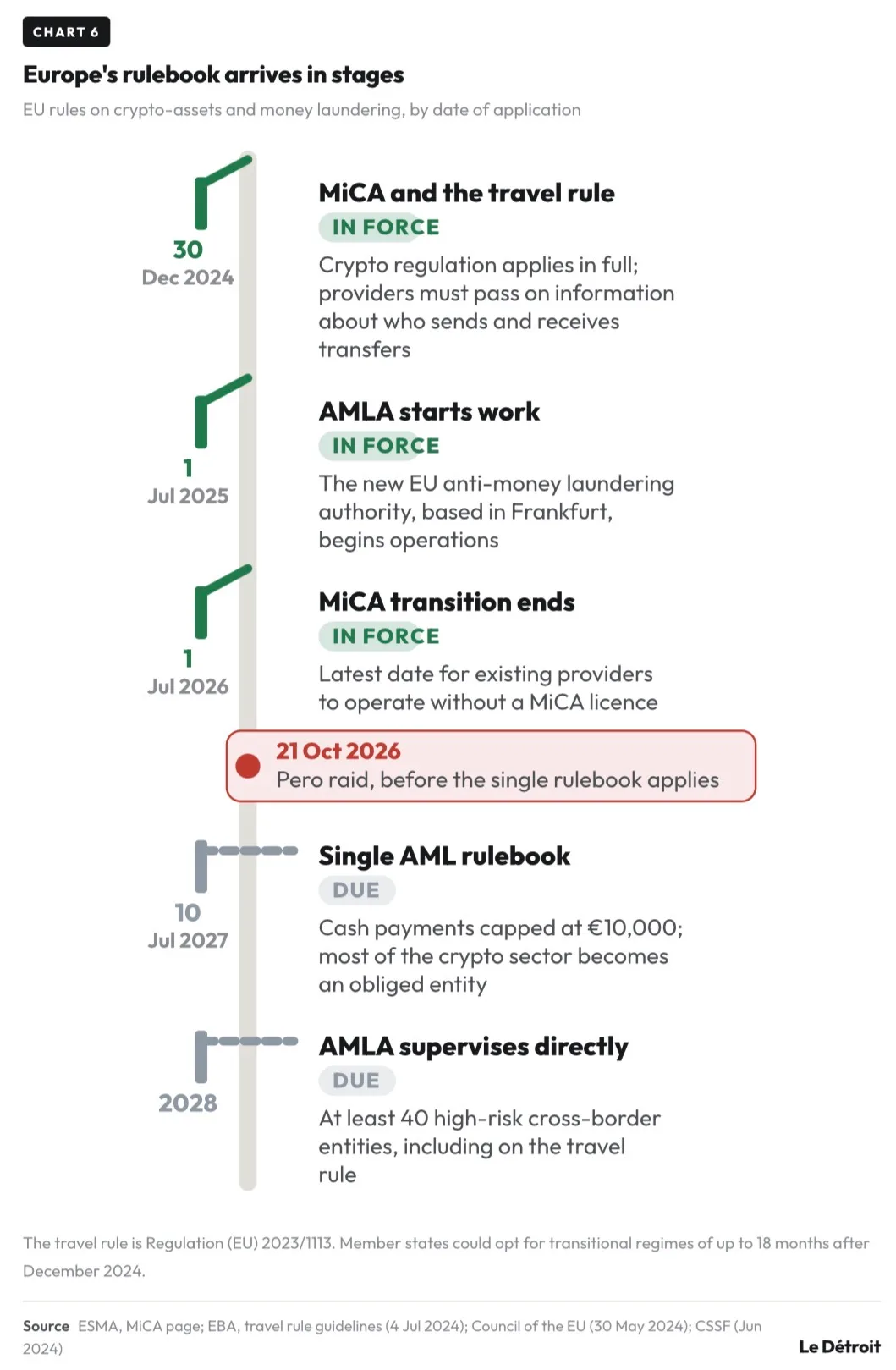
The UIF also flags a gap. In the second half of 2025, it says, some virtual-currency operators, including large ones, stopped sending reports to Italy after being authorised in other EU countries under MiCA, the bloc's crypto regulation. MiCA has applied in full since 30 December 2024, as has the travel rule, which requires crypto-asset service providers to pass on information about who sends and receives each transfer. The transitional period for existing providers ended on 1 July 2026 at the latest.
The next layer is still to come. The EU's single anti-money laundering rulebook applies from 10 July 2027, capping cash payments at €10,000 and bringing most of the crypto sector under its rules. AMLA, the new Frankfurt-based authority that began work in 2025, is due to start direct supervision of at least 40 selected high-risk entities in 2028.
6. A pattern, not an exception
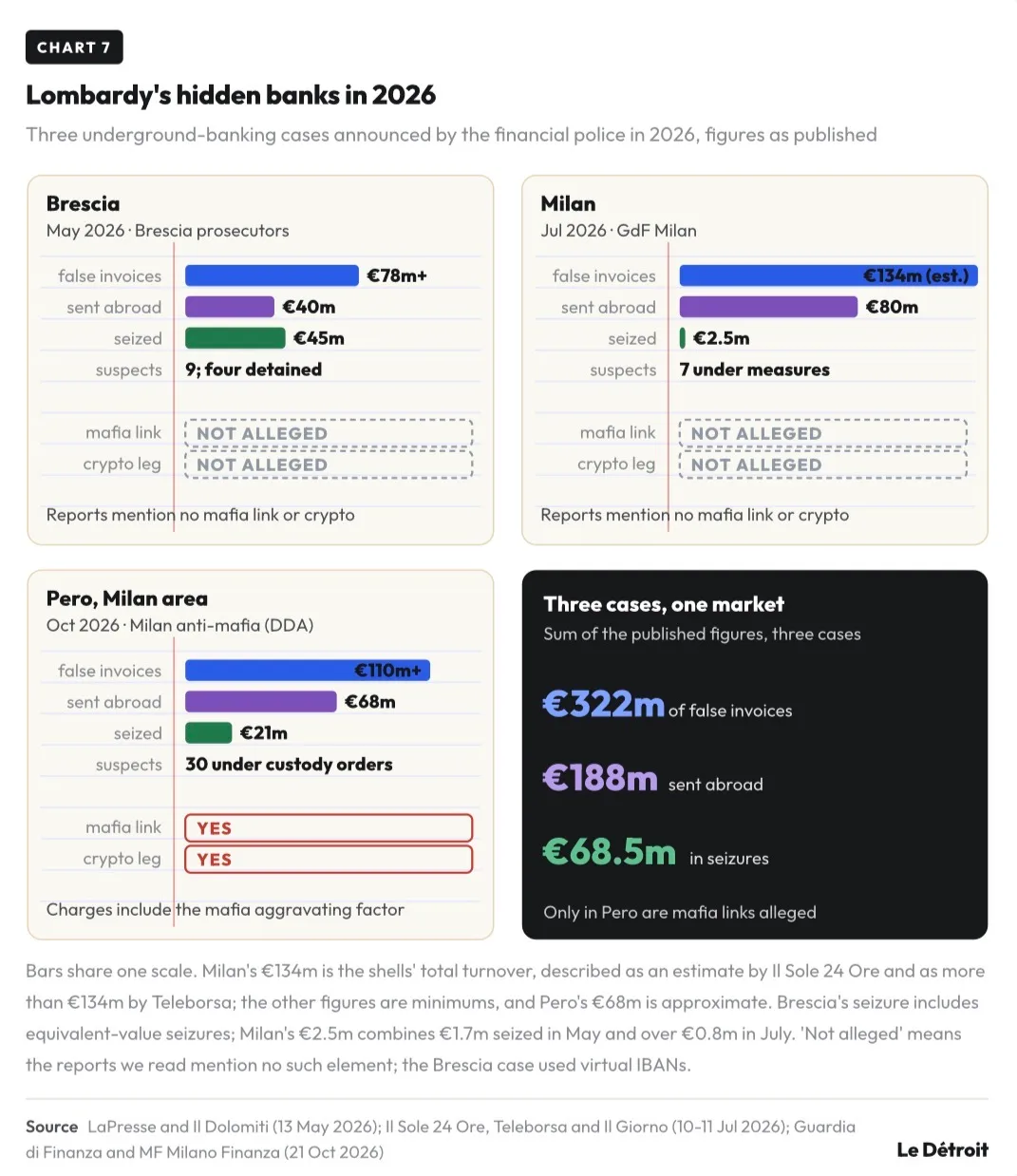
Pero is not isolated. In May 2026 financial police in Brescia detained four Chinese nationals over 24 shell companies that issued more than €78m of false invoices and sent over €40m abroad; more than €45m was ordered seized. In July, Milan investigators dismantled a Chinese-run hidden bank whose shells issued invoices worth €134m, mostly to metals firms, and moved more than €80m abroad. Reports on neither case mention a mafia link or crypto. Pero, prosecutors allege, has both.
The suspects are presumed innocent and can challenge the orders before Milan's review court. The extraditions, the identities of the client firms and the fate of the €21m will show how much of the prosecutors' account survives.