
1. Thirty countries and a ghost
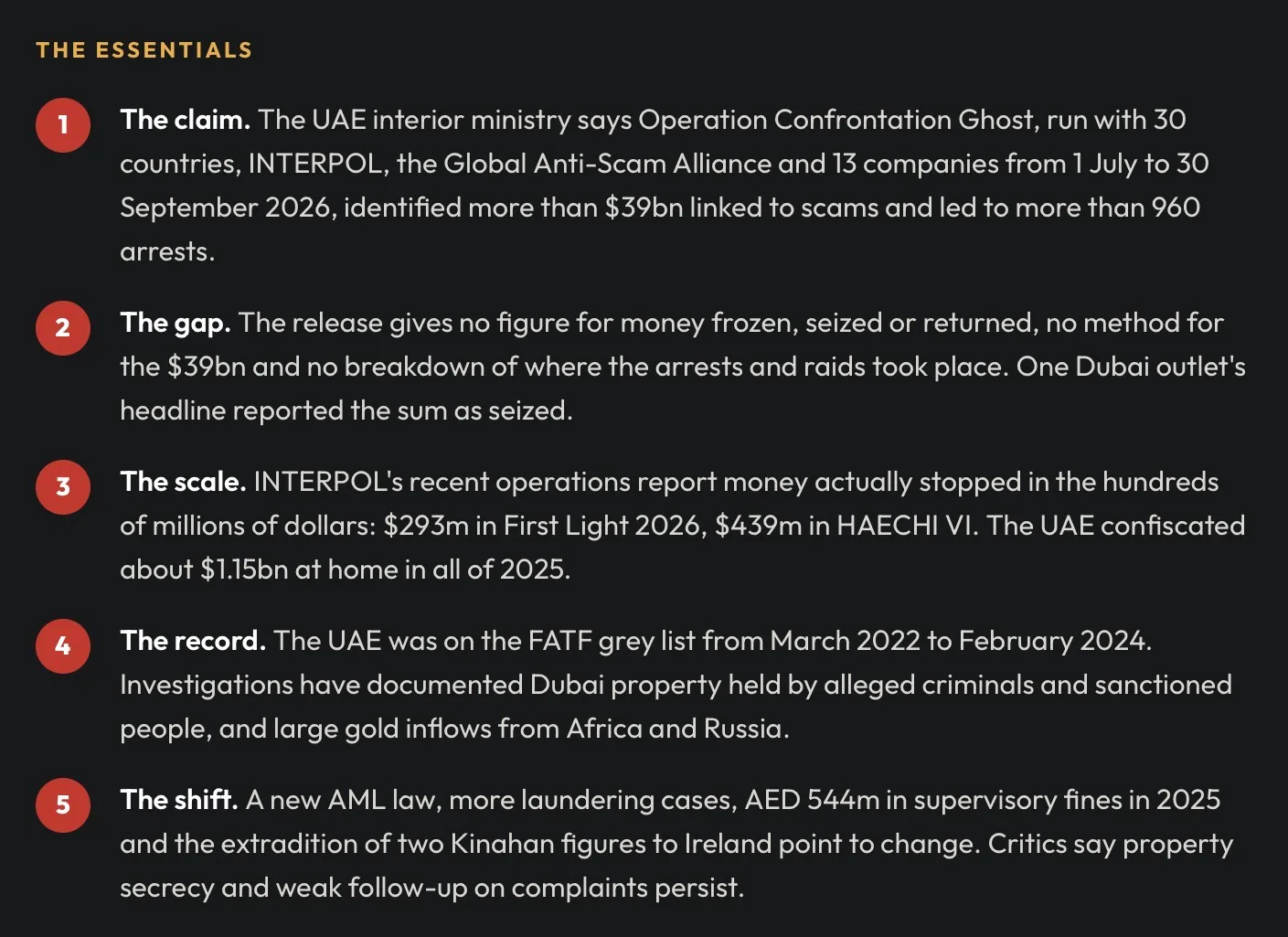
On 21 October the United Arab Emirates made public the results of Operation Confrontation Ghost, a campaign run by its interior ministry from 1 July to 30 September 2026 against AI-enabled fraud, digital financial fraud and sextortion. The ministry's English release, dated 22 October, says the results were unveiled at a UAE-led side event of COP13, the conference of the parties to the UN Convention against Transnational Organized Crime, in Vienna.
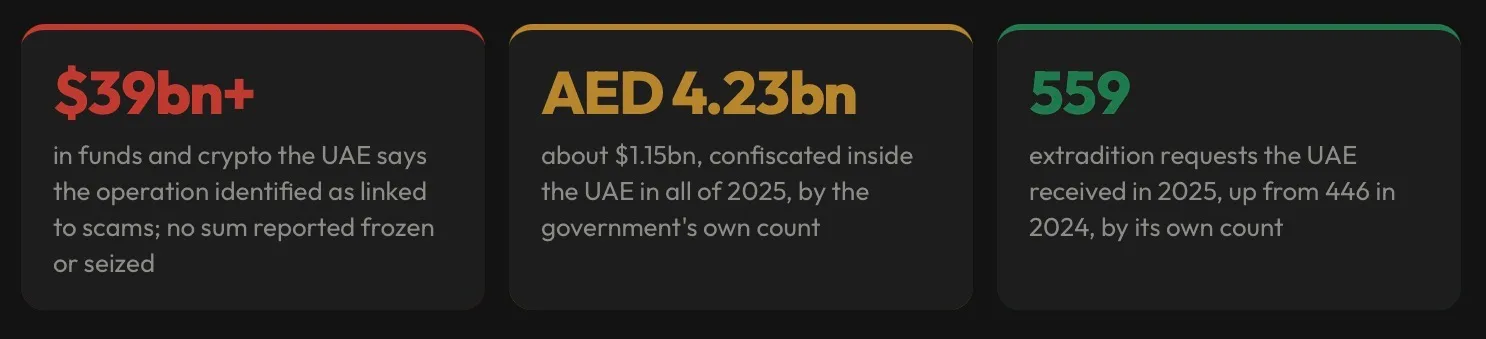
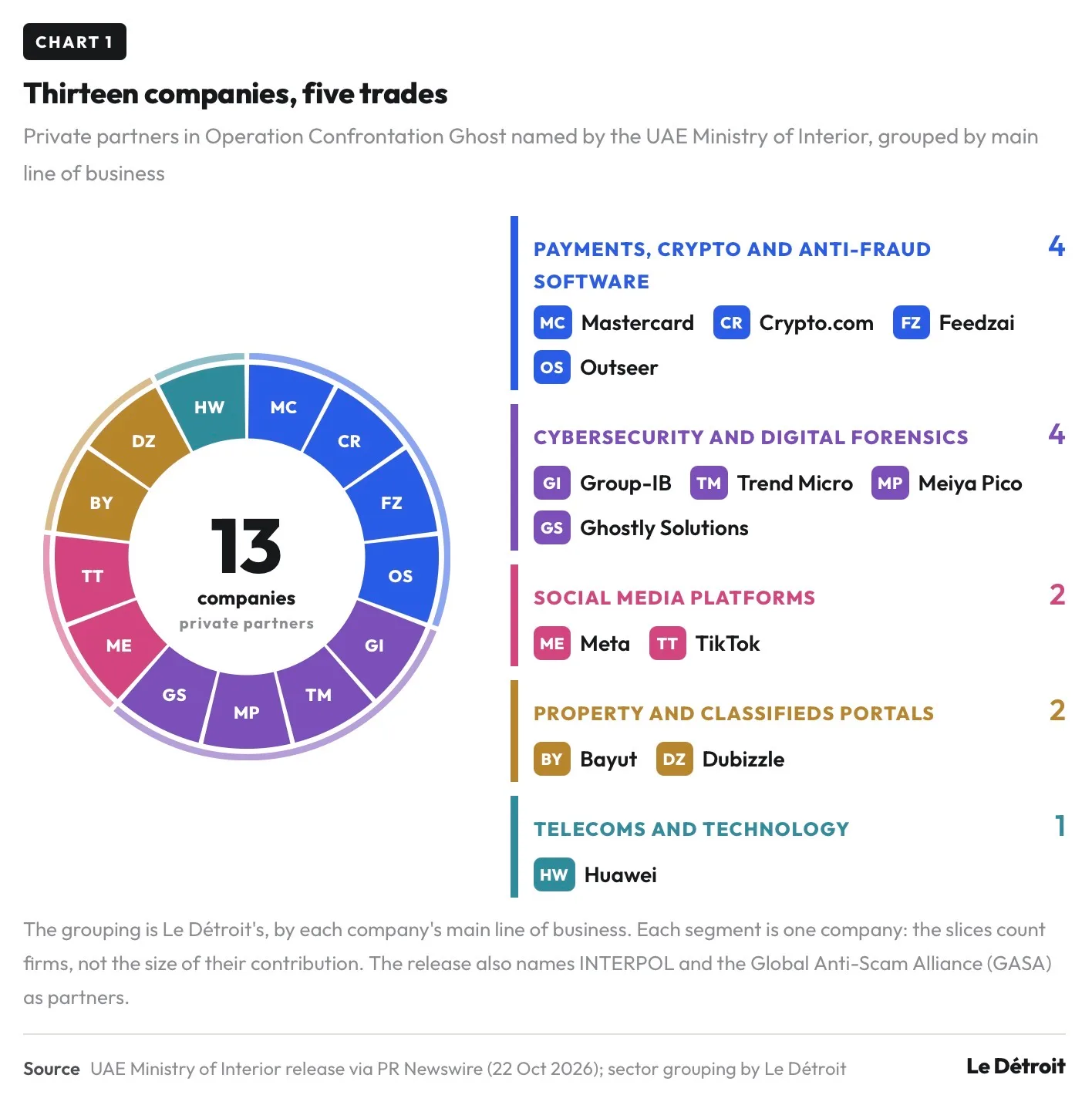
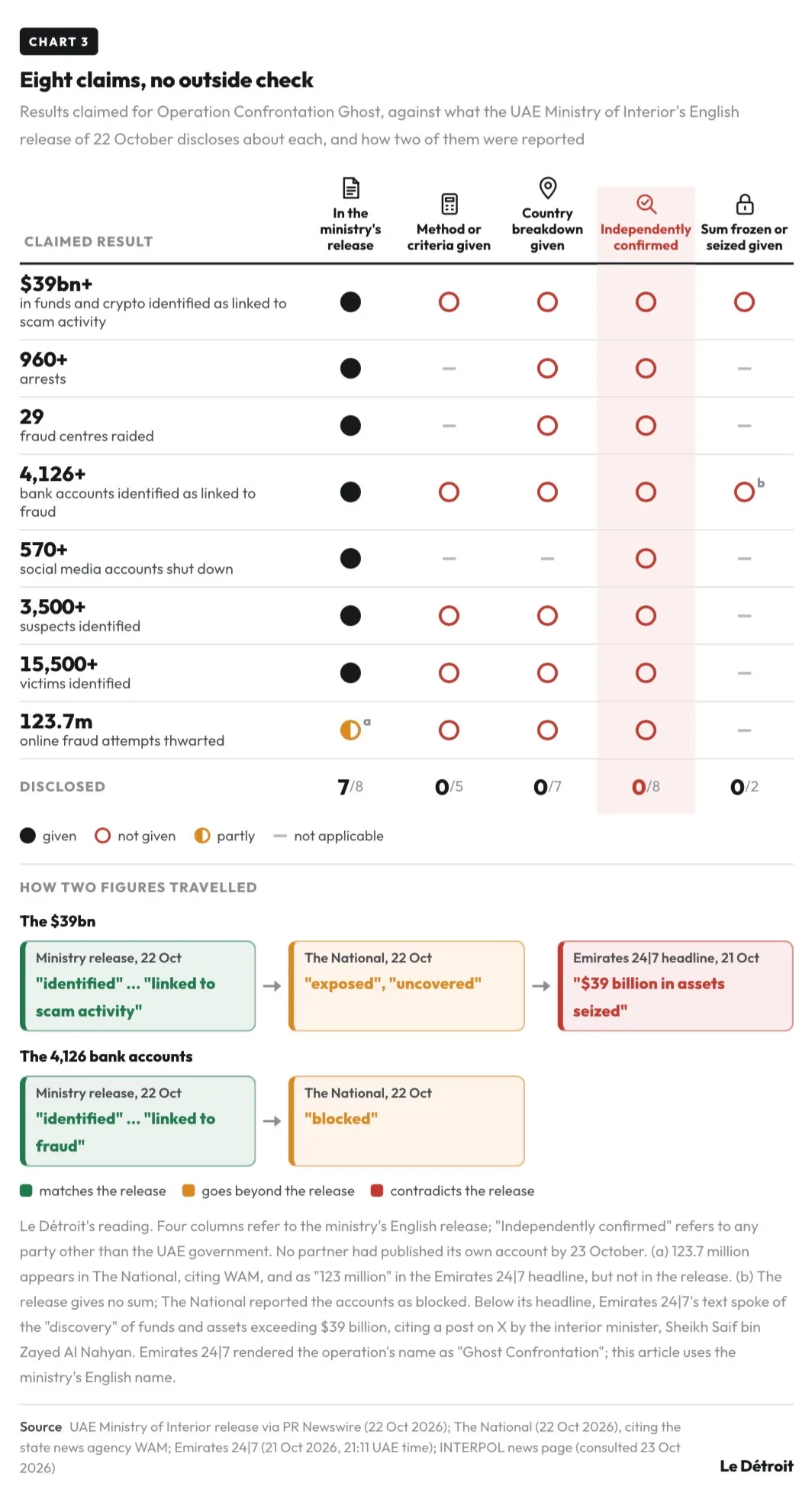
Thirty countries took part, the ministry says, alongside INTERPOL, the Global Anti-Scam Alliance (GASA) and 13 companies, among them Meta, TikTok, Mastercard, Huawei, Crypto.com and Group-IB. The claimed results are large: more than $39bn in funds and cryptocurrencies "linked to scam activity", more than 960 arrests, more than 3,500 suspects and 15,500 victims identified, and raids on 29 fraud centres.
"Under the UAE's global leadership, Operation Confrontation Ghost transformed international shared intelligence into coordinated operational impact," Colonel Dana Humaid Al Marzouqi, director general of the ministry's International Affairs Bureau, said in the release. In the same release Monica Juma, executive director of the UN Office on Drugs and Crime (UNODC), commended the UAE "for using their convening power and making this operation possible".
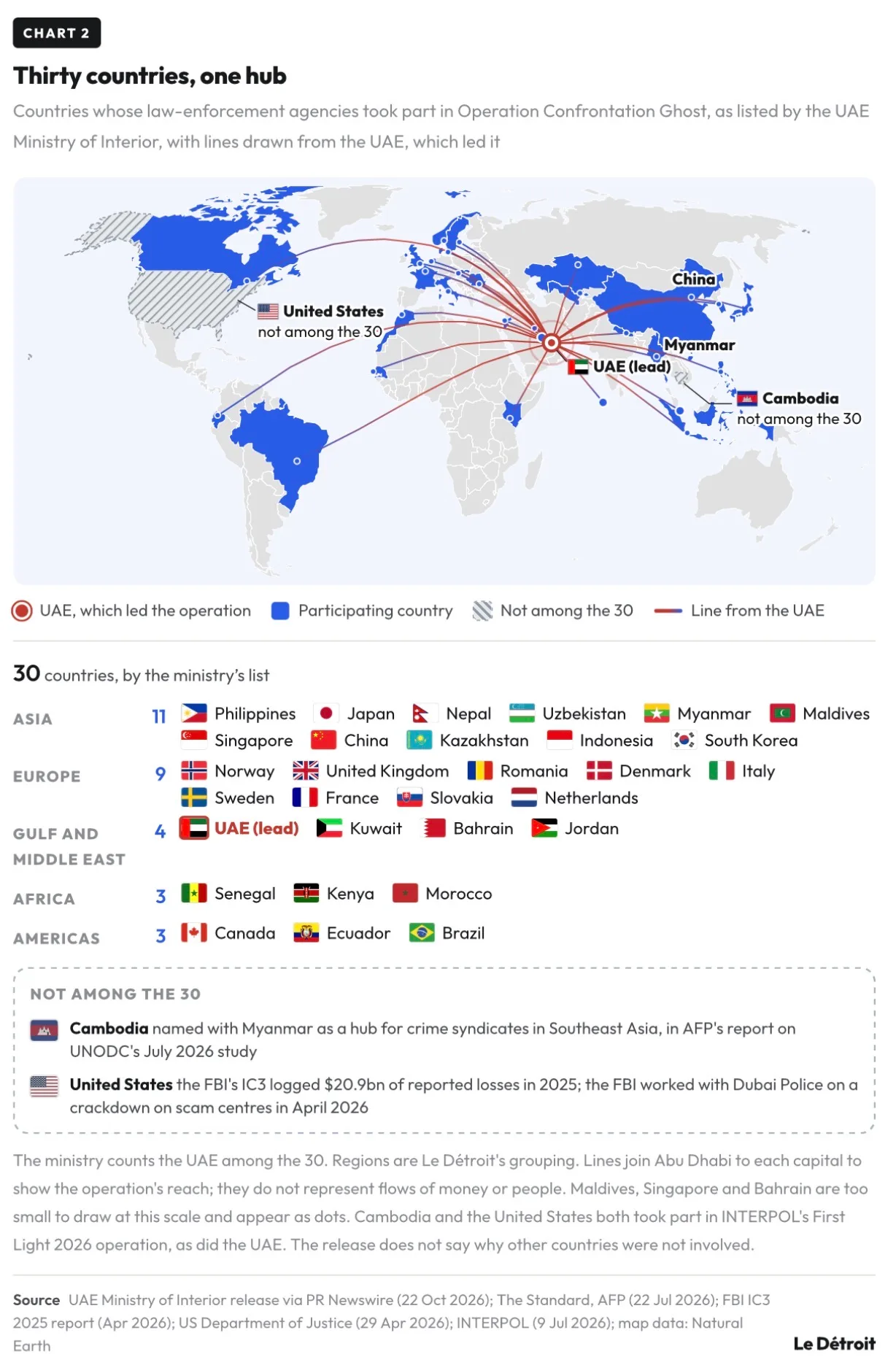
The participants span five regions. They include Myanmar and China, but not Cambodia, which AFP's report on a July UNODC study named with Myanmar as a hub for crime syndicates, nor the United States, where the FBI logged $20.9bn of internet-crime losses in 2025. The release does not say where the arrests and raids took place.
2. Identified is not seized
The operative word is "identified". The ministry says partners are "working towards the recovery of these assets", but gives no figure for money frozen, seized or returned, and does not explain how the $39bn was calculated or over what period it moved. The release describes 4,126 bank accounts as identified; The National, an Abu Dhabi daily, reported them as blocked, and Emirates 24|7, a Dubai news site, headlined "$39 billion in assets seized". No partner had published its own account by 23 October. INTERPOL's news page carried Serengeti III, announced the same day as the ministry's release, but nothing on Confrontation Ghost.
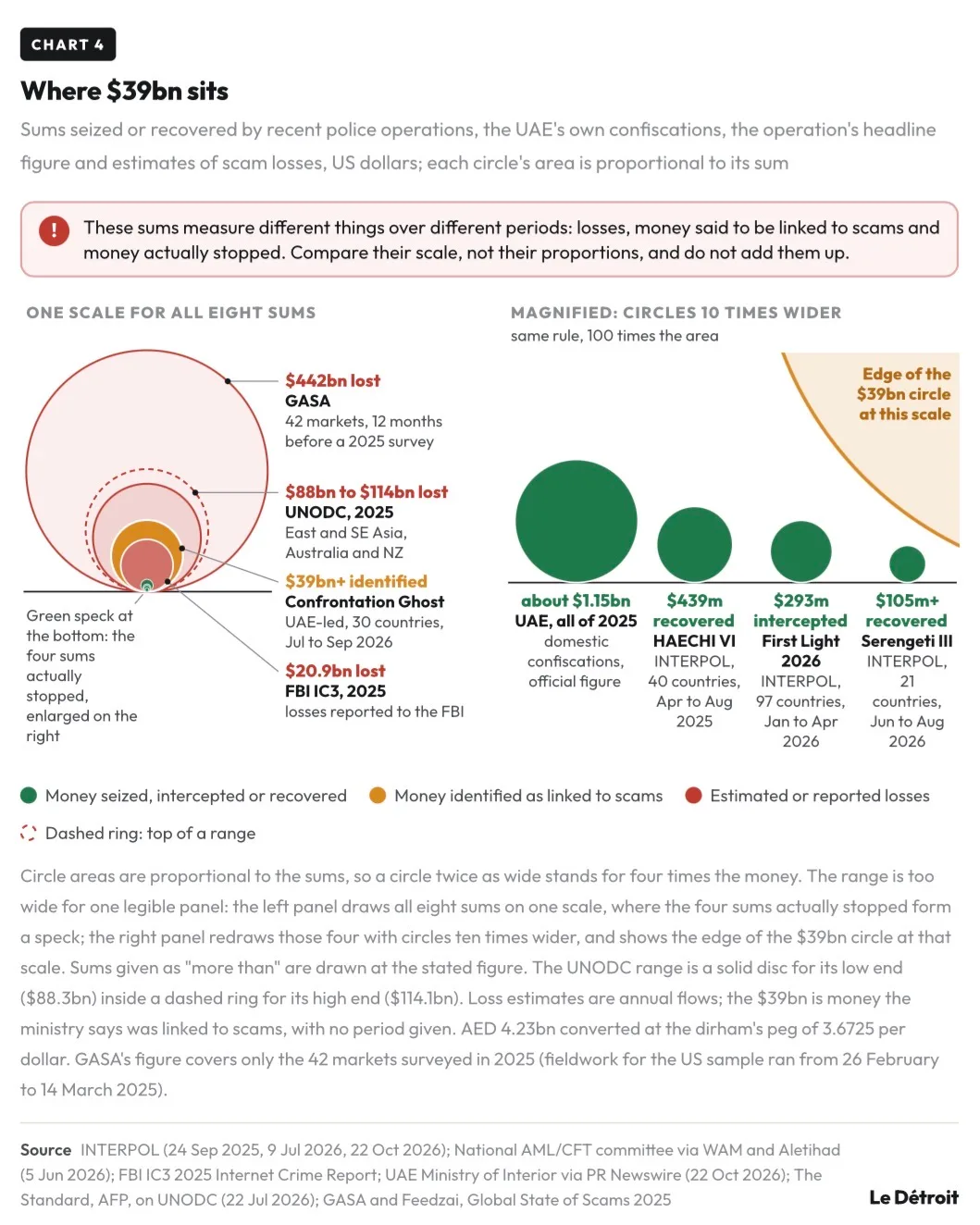
INTERPOL's own operations count money actually stopped. First Light 2026, run in 97 countries including the UAE from January to April, intercepted $293m and led to 5,811 arrests. HAECHI VI recovered $439m in 2025, and Serengeti III, announced on 22 October, recovered more than $105m across 21 countries. At home, the UAE confiscated AED 4.23bn, about $1.15bn, in the whole of 2025, according to its national anti-money-laundering (AML) committee.
The $39bn is closer in scale to estimates of what victims lose. UNODC put 2025 scam losses in East and Southeast Asia, Australia and New Zealand at $88.3bn to $114.1bn. GASA estimated $442bn lost in the 12 months before its 2025 survey of 42 markets. Those are yearly flows that partly overlap; the UAE figure is money "linked" to scams, with no period given. The comparison gives scale, not proportion.
3. The case file
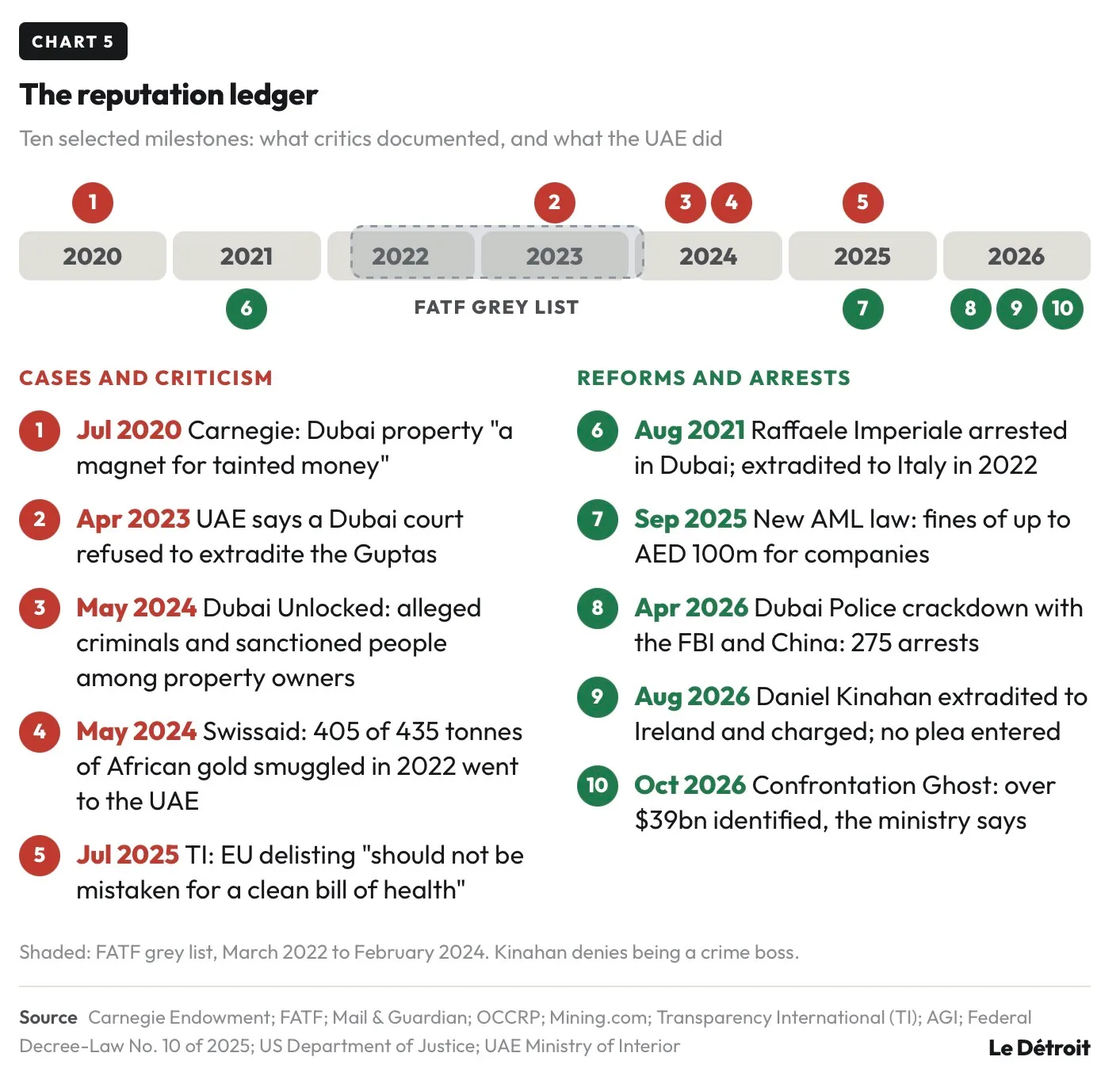
The UAE's reputation as a laundering haven is documented. The Financial Action Task Force (FATF) placed it under increased monitoring, its "grey list", in March 2022. Its action plan required, among other things, more outbound requests for legal assistance, more and better suspicious-transaction reports, a sustained rise in laundering investigations and prosecutions consistent with its risk profile, and proactive action against sanctions evasion. The FATF removed it in February 2024.
Property and gold drew most of the criticism. Dubai Unlocked, a 2024 project coordinated by OCCRP and built on property data, mostly from 2020 and 2022, obtained by the US non-profit C4ADS, highlighted about 200 people, among them alleged criminals, fugitives and sanctioned individuals, who owned more than 1,000 Dubai properties. Swissaid estimated that 435 tonnes of gold were smuggled out of Africa in 2022, 405 tonnes of it to the UAE, according to Mining.com's account of the study; the economy ministry replied that the government could not be held responsible for other countries' export records, only its own. Russian customs data showed 75.7 tonnes of Russian gold going to the UAE in the year after the invasion of Ukraine, against 1.3 tonnes in 2021, Reuters found.
Fugitives were the third complaint. Raffaele Imperiale, whom the Italian news agency AGI described as one of the world's most powerful drug traffickers, was arrested in Dubai in August 2021 and extradited to Italy in March 2022. But in April 2023 the UAE told South Africa that a Dubai court had refused to extradite Atul and Rajesh Gupta, who face fraud, corruption and money-laundering charges in South Africa, after finding that an arrest warrant had been cancelled and that the UAE had jurisdiction over the laundering charge. South Africa's then justice minister, Ronald Lamola, called the reasons "inexplicable".
4. Signs of an awakening
Since the grey listing, the tools have sharpened. Federal Decree-Law No. 10 of 2025, issued on 30 September 2025, replaced the 2018 AML law. It sets fines of up to AED 100m for companies in laundering cases, punishes dealing in virtual assets that offer total anonymity or obstruct tracing, and lets the head of the financial intelligence unit freeze funds for up to 30 days. The old caps were AED 50m and seven days, says the law firm DLA Piper.
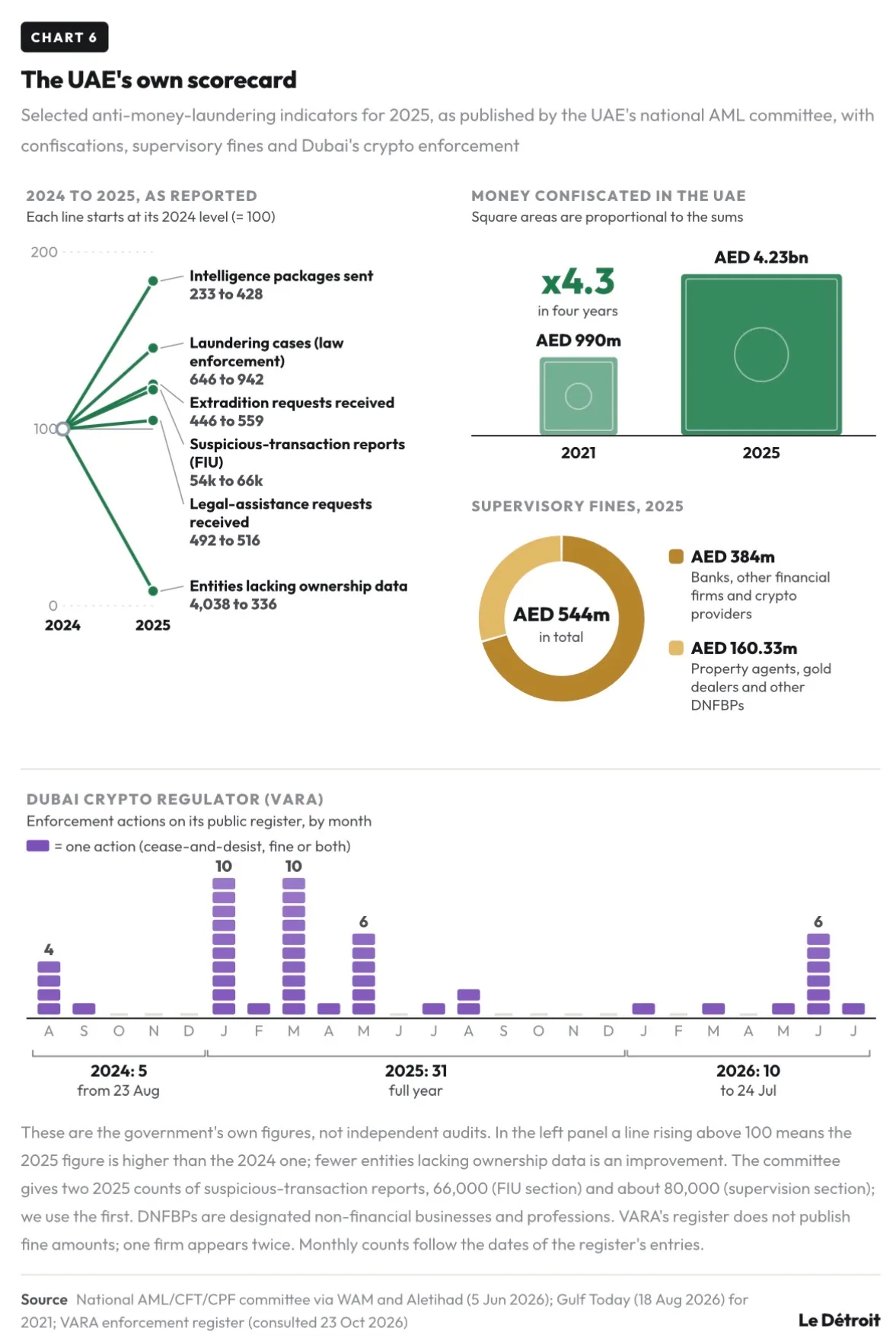
The official numbers point the same way. In 2025, the national AML committee says, laundering cases brought by law enforcement rose to 942 from 646, incoming extradition requests to 559 from 446, and the number of legal entities without beneficial-ownership data fell to 336 from 4,038. Supervisors fined financial firms and crypto providers AED 384m, and businesses such as property agents and gold dealers AED 160.33m. Dubai's crypto regulator, VARA, listed 46 enforcement actions on its register on 23 October, dated August 2024 to July 2026, mostly for unlicensed activity or advertising.
Fugitives are being handed over, too. Sean McGovern, a senior Kinahan associate arrested in Dubai in 2024, became the first such figure extradited from the UAE to Ireland, and was sentenced to 24 years in June 2026 after pleading guilty. Daniel Kinahan, sanctioned by the US in 2022, was detained in Dubai in April and flown to Dublin on 9 August, where he was charged with directing a criminal organisation. He has not entered a plea and has denied being a crime boss.
The UAE has also moved against scam operations on its own soil. In April 2026 a crackdown led by Dubai Police, with the FBI and China's Ministry of Public Security, dismantled at least nine scam centres, and Dubai authorities arrested 275 people, according to the US attorney's office in San Diego, which charged six people, including alleged managers and recruiters. The Record, a cybersecurity news site, reported that the centres were in Dubai. The European Union took the UAE off its list of high-risk third countries in August 2025.
5. The critics' column
Critics say the reforms have not yet reached the core of the problem. Eka Rostomashvili of Transparency International said the EU delisting "should not be mistaken for a clean bill of health", after the European Parliament failed on 9 July 2025 to block it. A June 2025 brief by its EU office, which noted that an index of real-estate ownership transparency ranks the UAE near the bottom, set out the gaps it sees.
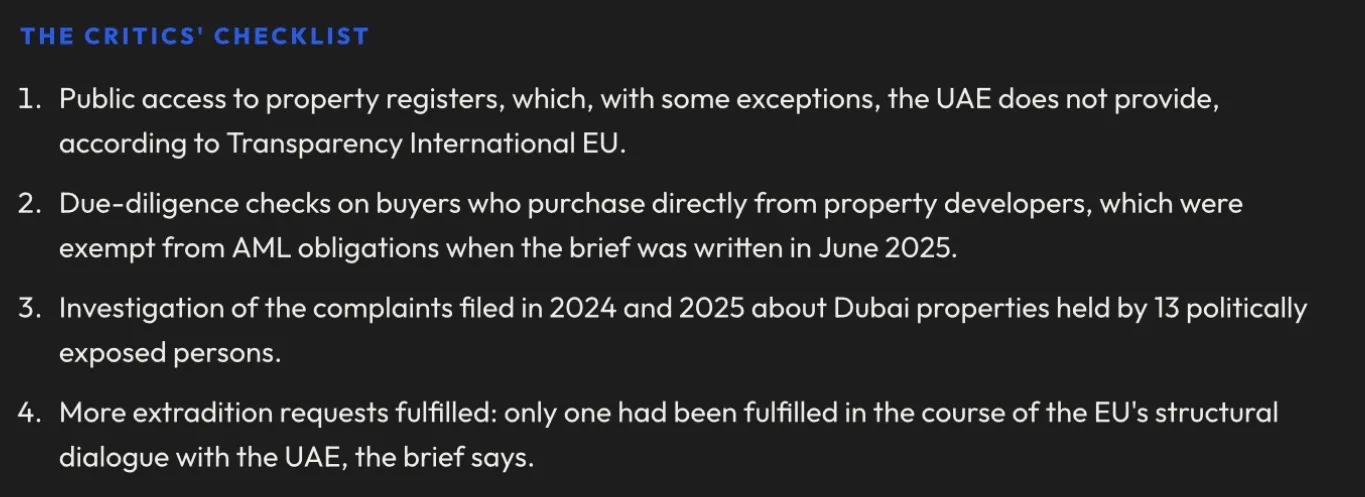
The brief found "no public indication" that the complaints about politically exposed persons had been investigated. Writing for the Carnegie Endowment in 2020, Matthew Page and Jodi Vittori called Dubai's property market "a magnet for tainted money", adding: "With approximately thirty free trade zones, Dubai is a haven for trade-based money laundering." The UAE's answer has been consistent: its embassies told Dubai Unlocked reporters that the country "takes its role in protecting the integrity of the global financial system extremely seriously" and "works closely with international partners to disrupt and deter all forms of illicit finance". Its Gold Bullion Committee told Reuters in 2023 that "the UAE will continue to trade openly and honestly, with its international partners, in compliance with all current international norms as set down by the United Nations".
6. A haven at the turn?
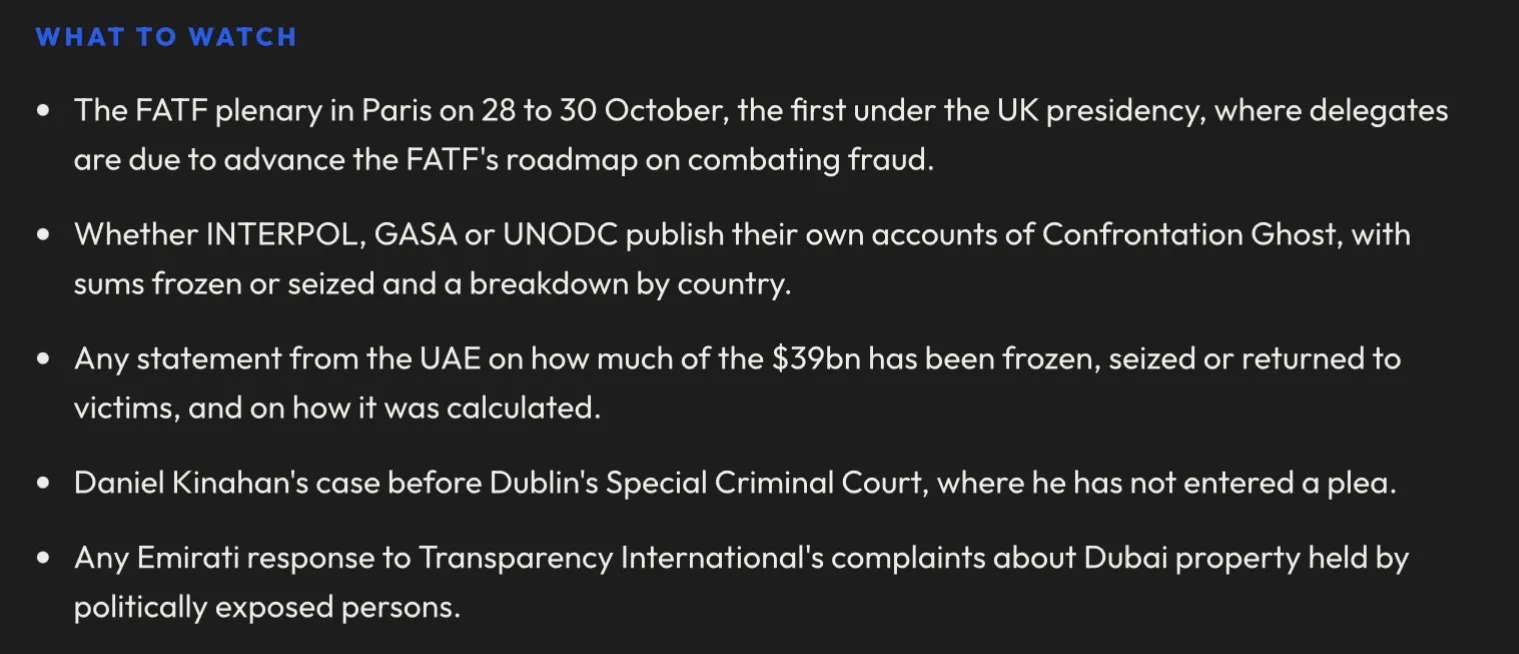
The test is publication. A country that has woken up would say how much of the $39bn was frozen, seized and returned, and where the 960 arrests were made. It would also open its property registers and act on the complaints about property owned by politically exposed persons. Until then, the safest reading is the ministry's own word: identified.