1. A shortage that keeps getting worse
Memory chips store the data that processors work on. There are two main kinds: DRAM, the fast working memory, and NAND, the flash storage in phones and data-centre drives. A third, HBM (high-bandwidth memory), stacks DRAM chips on top of each other to feed AI processors, and it is what the AI boom consumes most hungrily.
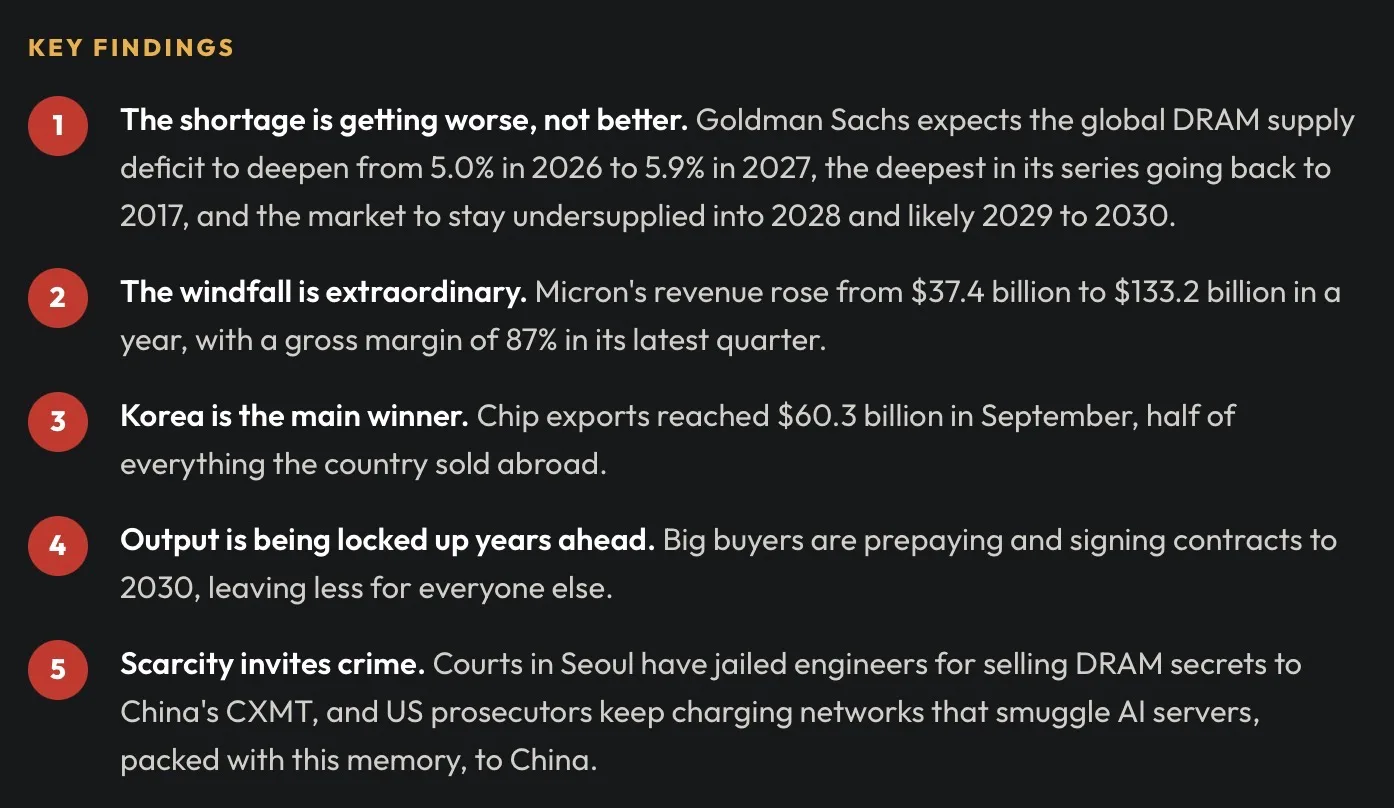
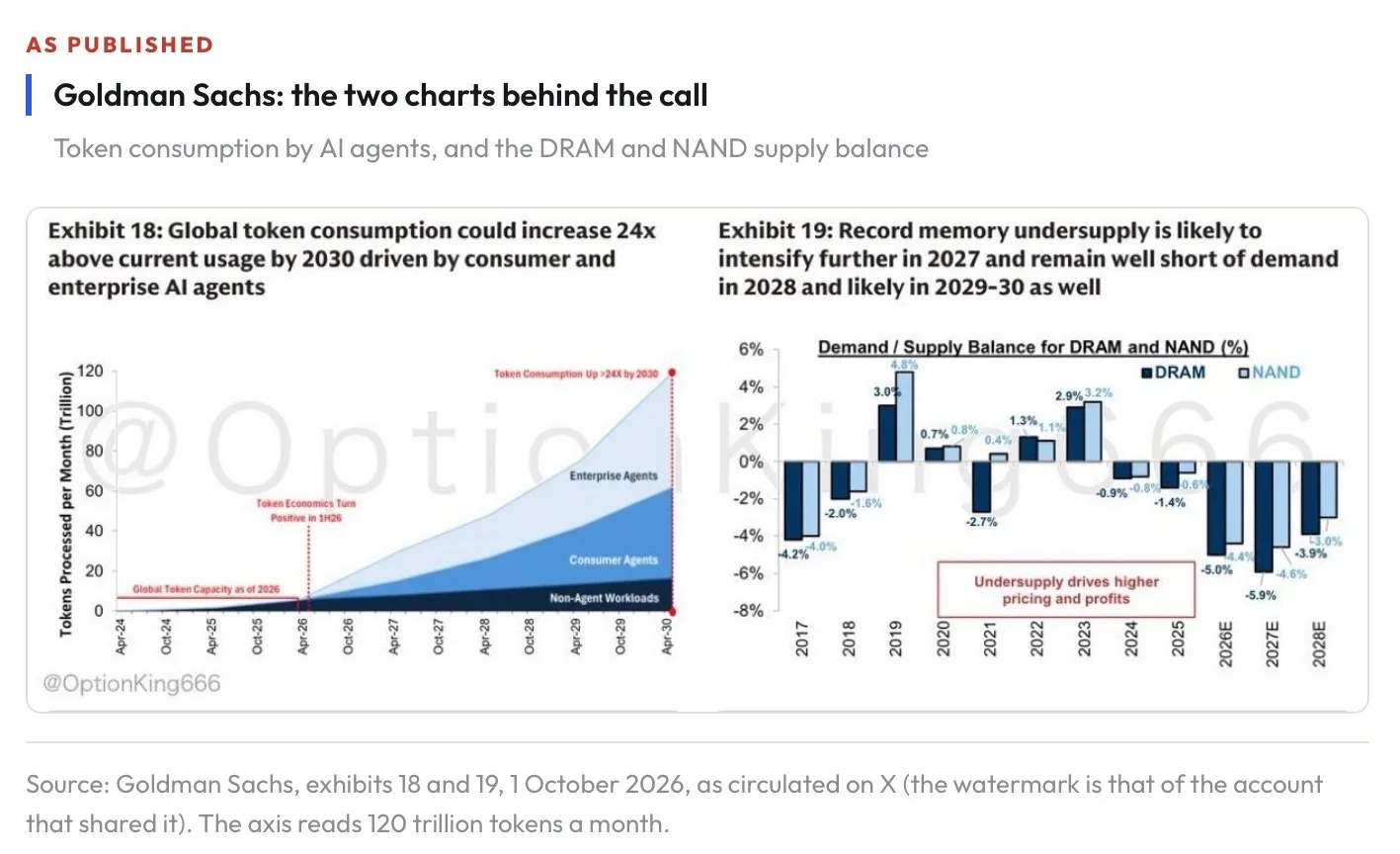
On 1 October, Goldman Sachs reiterated that the shortage would deepen. It expects DRAM supply to fall short of demand by 5.0% in 2026 and 5.9% in 2027, and NAND by 4.4% and 4.6%, with the market likely to remain undersupplied in 2028 and through 2029 to 2030. The bank links it to AI agents: it projects global token consumption, the units AI models process, to rise 24-fold by 2030, to about 120 trillion tokens a month.
2. Three companies, one windfall
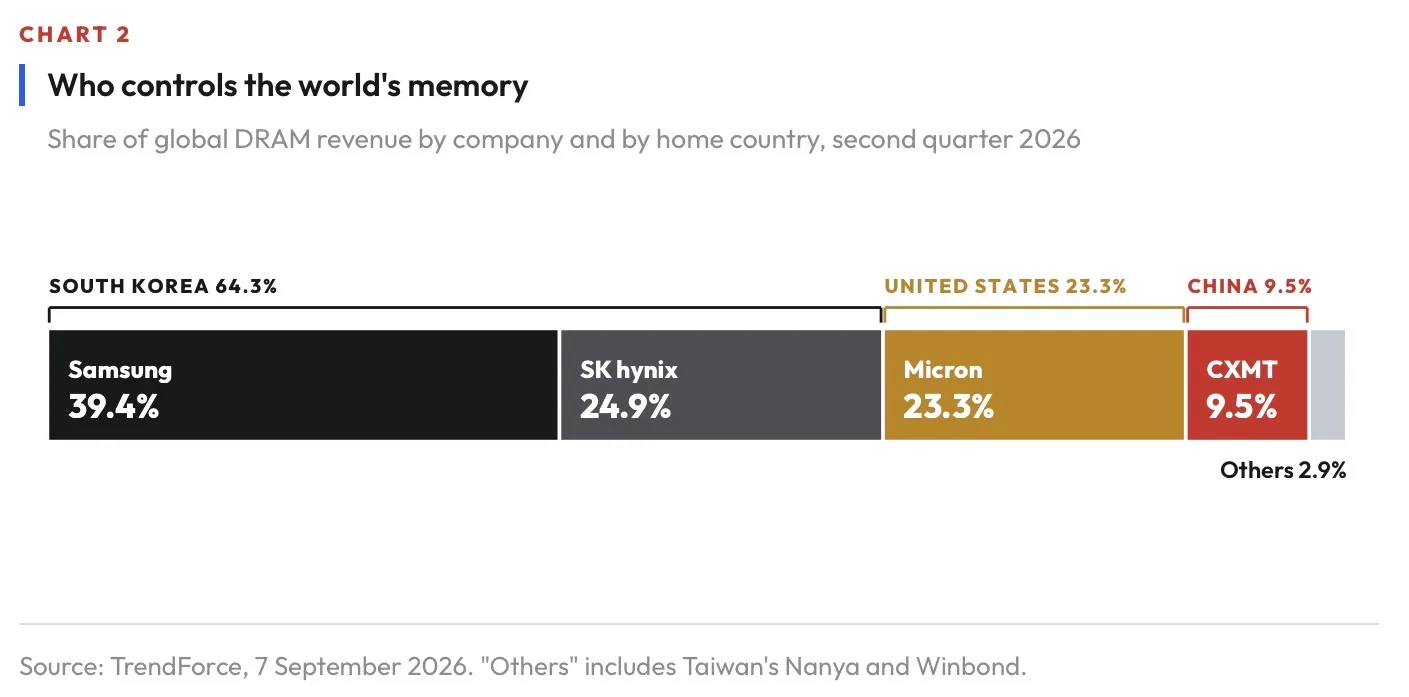
The market is a near-oligopoly. Samsung, SK hynix and Micron took almost 88% of global DRAM revenue in the second quarter, according to TrendForce. That revenue jumped 59.5% in a single quarter, to $154.7 billion.
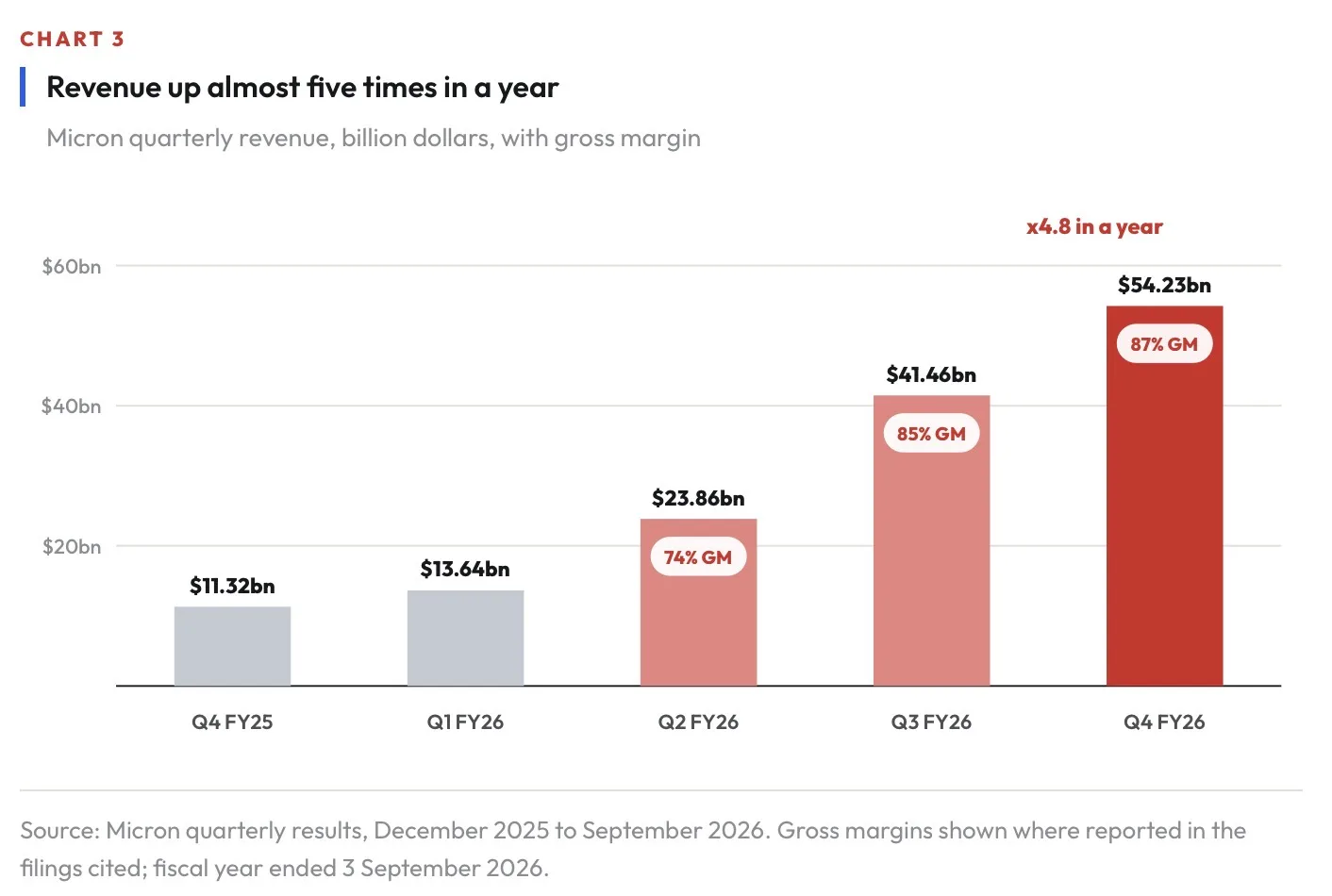
Micron's results, published on 30 September, show what scarcity is worth. Revenue for the fiscal year rose to $133.2 billion, three and a half times the previous record, and net income to $85 billion. Its gross margin reached 87% in the fourth quarter, with an operating margin of 82%, levels more often associated with software than with manufacturing.
Korea's jackpot
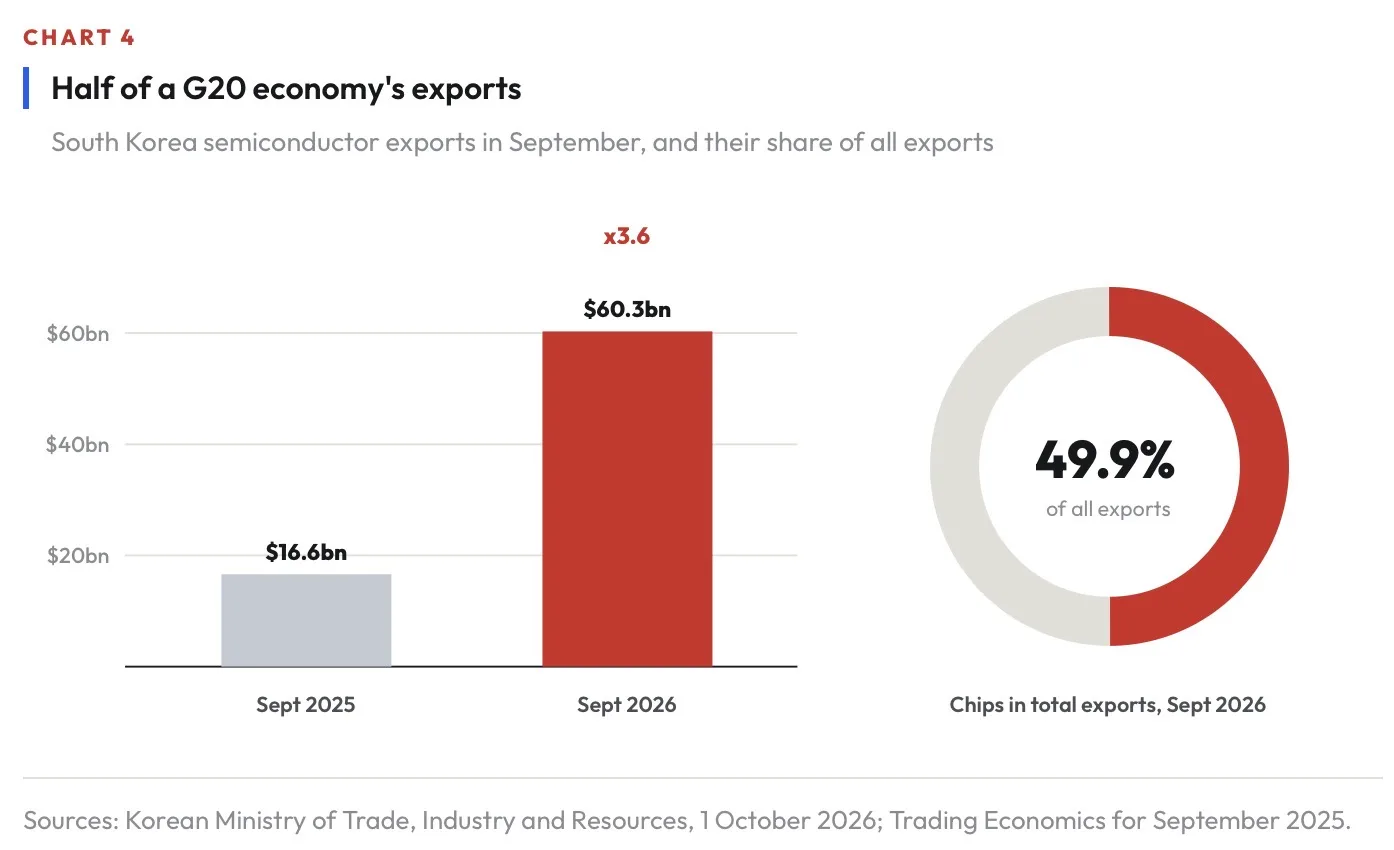
For South Korea, home to Samsung and SK hynix, the shortage is a national windfall. On 1 October, the trade ministry reported record exports of $120.9 billion in September. Chips alone brought in $60.3 billion, up 263% in a year and about half of all exports; memory accounted for $54.1 billion. The country posted a record monthly trade surplus of nearly $50 billion and is on track to become only the fourth nation to export $1 trillion in a year.
3. Locking up the future
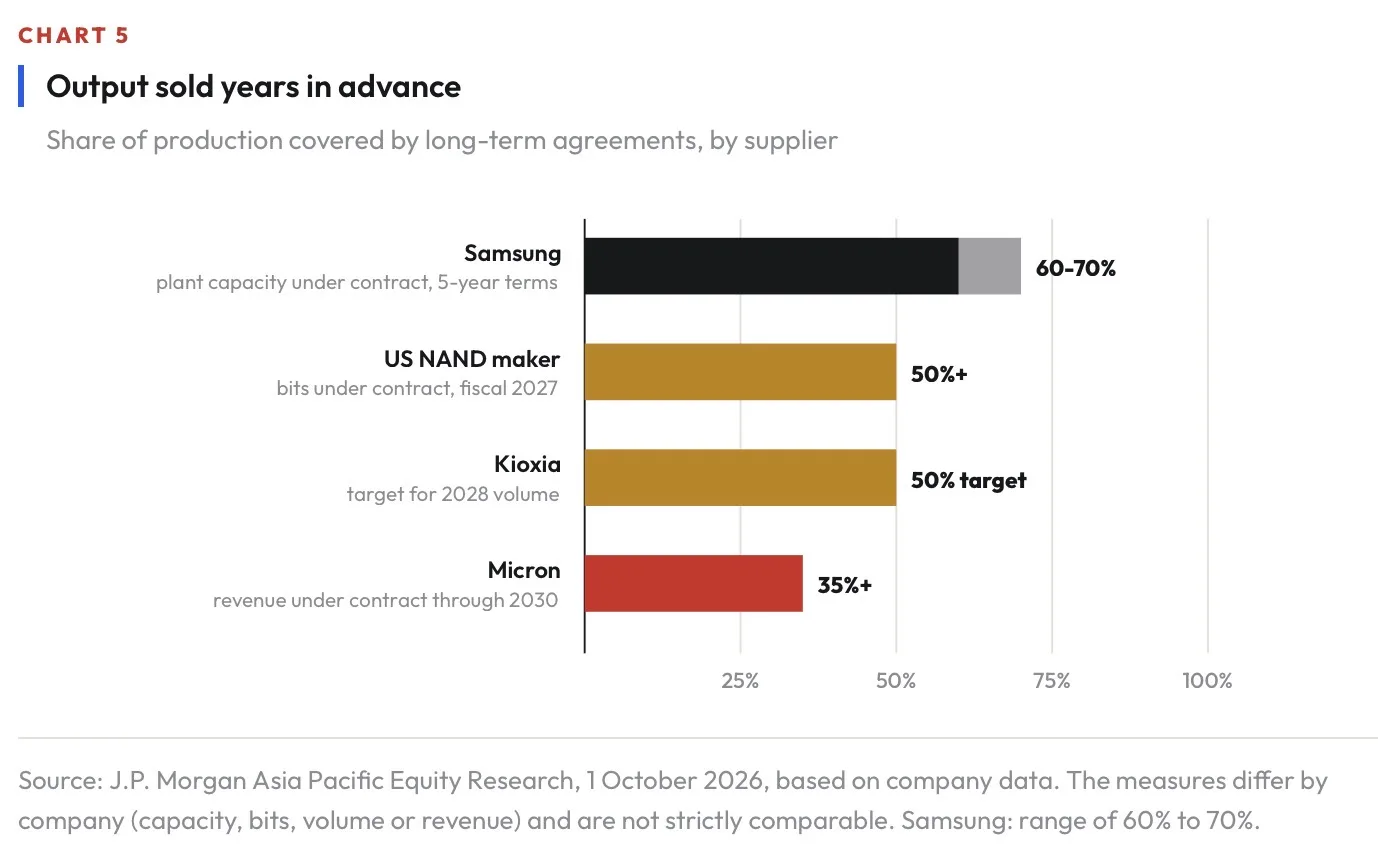
The most telling change is contractual. Much of the world's memory used to be sold at prevailing market prices. Now the biggest buyers, the AI hyperscalers first among them, are locking in supply years ahead, often paying upfront. Micron disclosed 26 strategic customer agreements, covering more than 35% of its revenue through 2030, with $32 billion of customer prepayments, up from $22 billion a quarter earlier, according to J.P. Morgan.
4. The geopolitics of memory
Since December 2024, the United States has banned the sale of advanced HBM to China and restricted the tools needed to make it. China's answer is CXMT, ChangXin Memory Technologies, whose DRAM revenue doubled in the second quarter to $14.6 billion, lifting its global share to 9.5%. It still lags in HBM, but the shortage gives it room: buyers short of memory are less fussy about where it comes from.
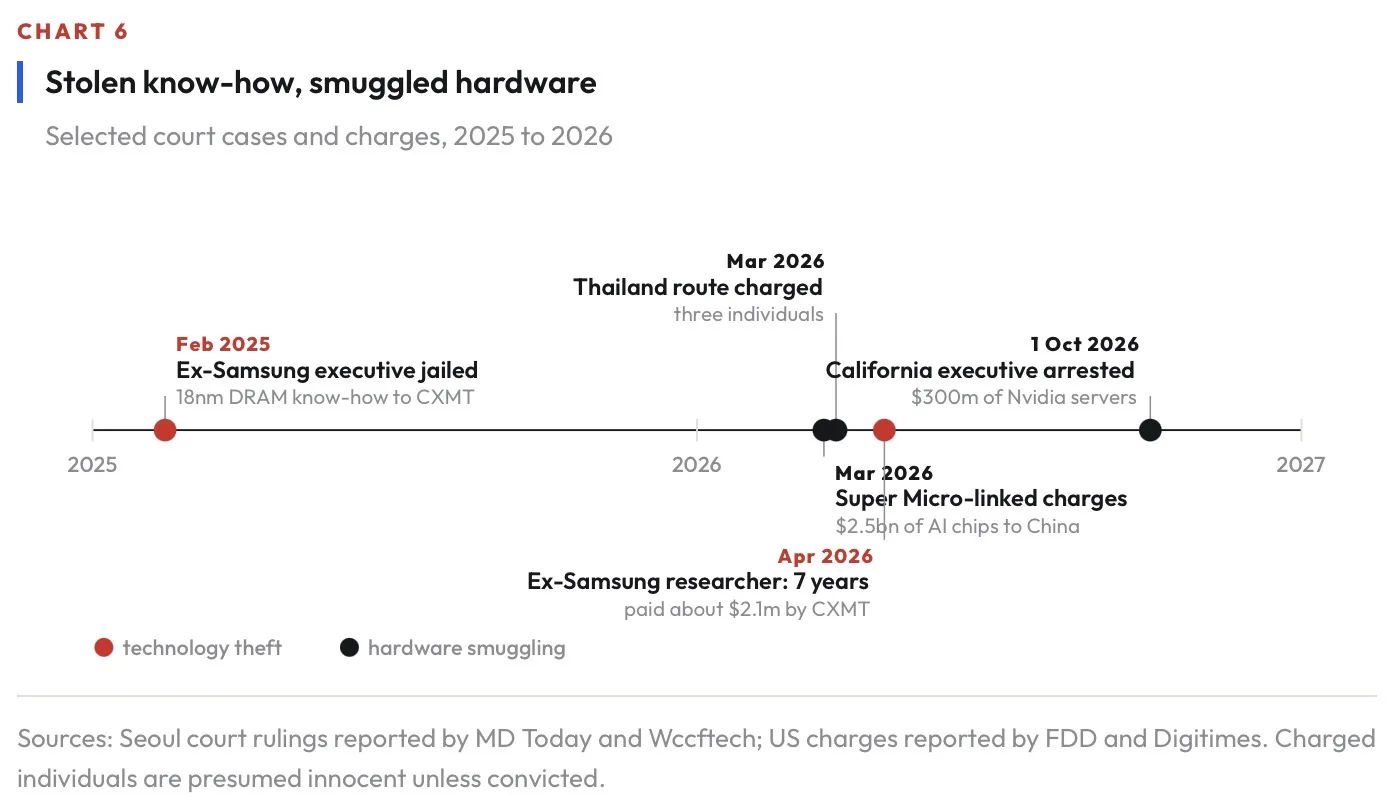
CXMT's rise has a darker chapter. On 22 April, a Seoul court sentenced a former Samsung researcher to seven years in prison for leaking Samsung's DRAM process technology to CXMT, for which he received about 2.9 billion won, roughly $2.1 million, over six years. A former Samsung executive was jailed in 2025 for leaking 18-nanometre DRAM technology to the same company. Prosecutors say CXMT used a front company to recruit former Samsung employees. CXMT did not respond to requests for comment in those cases.
5. The grey market
Memory rarely travels alone: it reaches users inside servers and AI accelerators, and that is where smuggling concentrates. The research firm SemiAnalysis has estimated that HBM accounts for roughly half of the manufacturing cost of an Nvidia AI chip, so every smuggled accelerator is also smuggled memory. US prosecutors charged people linked to Super Micro Computer in March with diverting an estimated $2.5 billion of AI chips to China through offices in Taiwan and elsewhere in the region; another case the following week involved shipments through contacts in Thailand. On 1 October, a California executive was arrested and accused of smuggling servers containing $300 million of Nvidia AI chips to China.
The money trail is often visible in the accounts before it is in court. Revenue that Nvidia billed to Singapore grew from less than $1 billion in the fourth quarter of 2022 to nearly $8 billion in the third quarter of 2024, after US export controls took effect, according to the Center for Strategic and International Studies. Billing location is not proof of destination, but CSIS questioned whether Singapore even had the power capacity to run all those chips, and described networks of shell companies used to keep acquiring restricted US technology. The Information had found at least eight Chinese AI chip-smuggling networks, each handling deals worth more than $100 million.
6. What could break the cycle
Demand disappointment. If consumer AI adoption slows, as Goldman Sachs flags, some of today's orders could prove to be double-ordering.
New capacity. Fabs announced during the boom start producing between 2027 and 2029.
China. CXMT and YMTC compete aggressively on price; a faster catch-up in HBM would loosen the Korean-American grip.
Politics. Tariffs on Korean and Taiwanese chips, or a looser US export regime, would redraw who can buy what.