
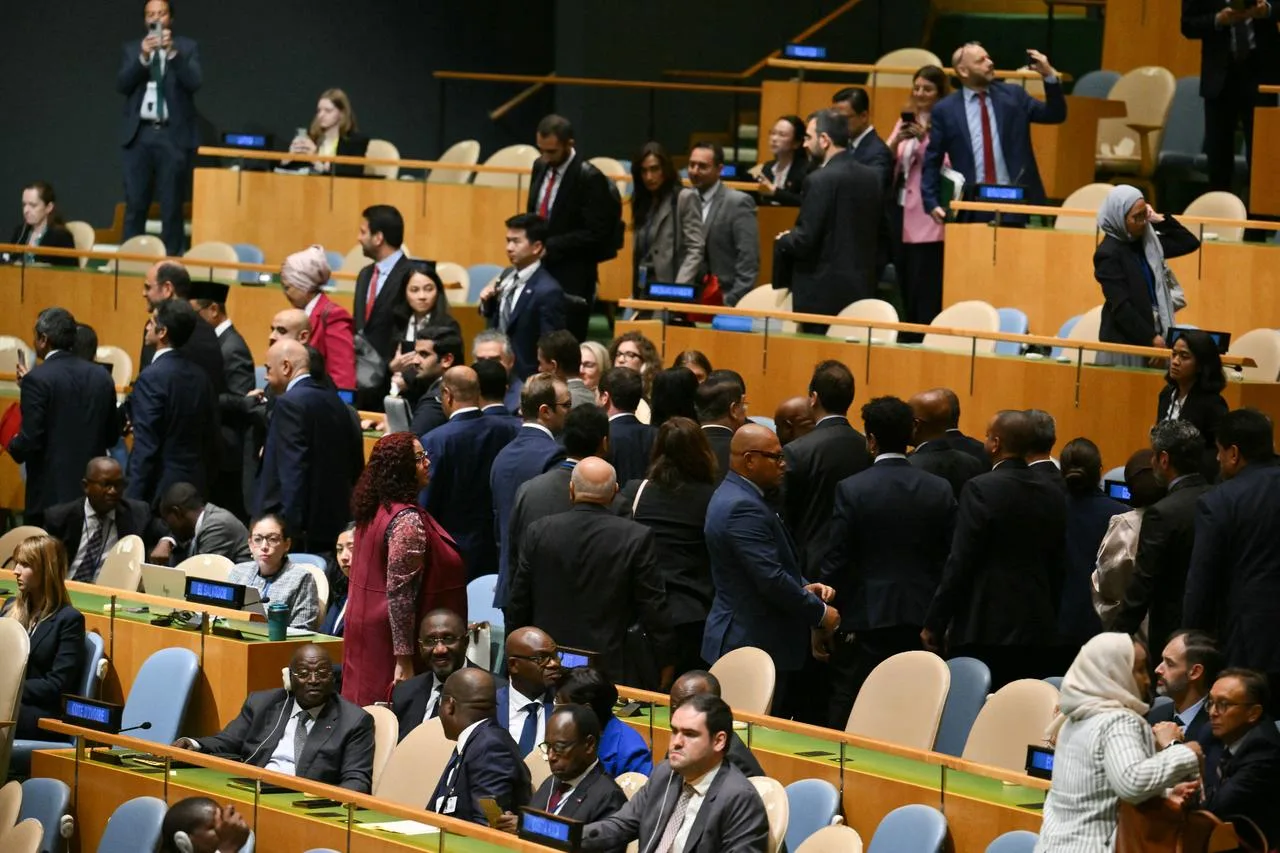
1. Netanyahu speaks to empty seats
Scores of delegates walked out as Benjamin Netanyahu took the rostrum at the UN General Assembly on Thursday, leaving a majority of seats empty; Assembly president Khalilur Rahman repeatedly called for order. The Palestinian mission had urged member states to walk out together. Others stayed, and some stood and applauded, CNN reported. Netanyahu opened by inviting any remaining "moral cowards" to leave, called genocide allegations "the biggest lie of the century" and said attacking Iran was one of the easiest decisions he had ever made. Earlier, Mahmoud Abbas addressed the Assembly by video after the United States denied Palestinian officials visas for the second year running. Netanyahu faces elections next month.
2. France will send troops to protect Yanbu
Emmanuel Macron said on TF1 and France 2 that France will deploy soldiers, radar systems and defence systems to protect Yanbu, Saudi Arabia's Red Sea export hub, in agreement with Riyadh and strictly defensively, not to get us involved in any conflicts, but to protect this site. The announcement came the day the Saudi-led coalition said it had intercepted six ballistic missiles fired by the Houthis at Taif and Yanbu. In the same interview, Macron said a US ban on diesel exports would be "catastrophic", denied a Spanish report that the CIA had warned European services of drone attacks from the Mediterranean, and warned that France could face strikes like the failed attack at Leipzig.
3. Oil jumps, then eases on Hormuz talks
Brent closed up 3.4 percent at 106.60 dollars a barrel and WTI at 94.61 dollars, after the Houthi missile barrage; Brent is up more than 17 percent in September, CNBC reported. Prices came off their highs after a senior Iranian official told Reuters the most realistic path is for Tehran to allow navigation through Hormuz in exchange for the US ending its naval blockade. After settlement, the Houthis said they had also targeted Aramco facilities in Yanbu and a site in Riyadh. Iranian flights to Gulf neighbours appeared to have been cancelled after a US deadline for firms to stop working with Iran's airlines, Reuters reported.
4. Trump and Xi buy two months
Xi Jinping met Donald Trump at the White House on Thursday, on his first US state visit since 2015. The main outcome came the night before: Treasury Secretary Scott Bessent said the trade truce agreed in Busan, which suspended Chinese rare-earth export controls and cut US tariffs, is extended by two months to 10 January. NPR noted Beijing had not officially confirmed it. Many had expected six months or more, CNBC reported. The European Chamber of Commerce in China said the extension does not fix the lack of a standard process for rare-earth export licences. The two leaders may meet again at APEC in Shenzhen in November and the G20 in Miami in December.
5. BlackRock's models go onchain, through Ondo
Ondo Finance launched three tokenized portfolios built on BlackRock strategies, BLKHIon, BLKDIGon and BLKGRWon, for eligible investors outside the US. BlackRock says it supplies non-discretionary models only and does not manage, issue, distribute or hold the tokens. Ondo's documentation shows the tokens are screened at mint and redemption, but freely transferable afterwards. Our analysis: "Powered by BlackRock", Issued by Ondo.
6. Dangote breaks ground on the Djibouti route
Aliko Dangote, Abiy Ahmed and Ismaïl Omar Guelleh laid the foundation stone of a 660 million dollar project: a 120-kilometre fuel pipeline from Damerjog to Dewele, with 1.175 million cubic metres of storage on both sides of the border, due in 18 months. Ethiopia imports nearly all its fuel through Djibouti, mostly by truck. A 2015 pipeline plan on the same corridor was shelved in 2017. Our World: A Pipeline to the Border: What Dangote's $660 Million Buys Ethiopia.