
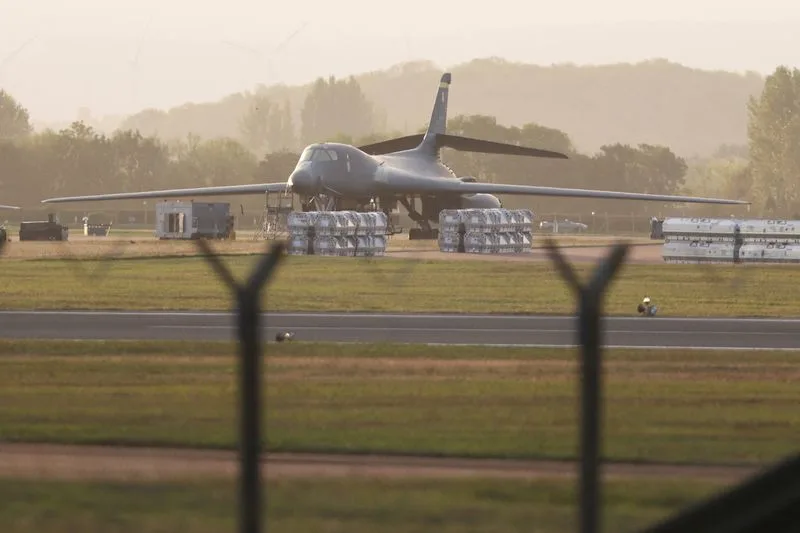
1. Five men held near the base the US uses to strike Iran
Police received a call at 00:45 on Sunday about three suspicious vehicles travelling towards RAF Fairford in Gloucestershire. Armed officers arrested five men in the nearby village of Whelford, first under the Explosives Act, then on suspicion of preparing a terrorist act; counter-terrorism police lead the inquiry. About 85 households were evacuated behind a 400-metre cordon while the Army's bomb disposal unit examined the vans, and two controlled detonations were heard in the evening. Fairford has hosted B-1 and B-52 bombers used against Iran since February. Donald Trump said the men had been "under view for a long time"; ITV and GB News report the operation was not intelligence-led. ITV says one line of inquiry is whether the Iranian regime paid others to act; police have confirmed no link.
https://x.com/politlcsuk/status/2104171079149482301?s=61
2. Washington and Beijing agree to cut tariffs on $30 billion each way
At the close of Xi Jinping's state visit, the White House said the new US-China Board of Trade reached "consensus on recommendations" for lower tariffs on $30 billion of non-sensitive goods in each direction: US farm goods, seafood, wood, cosmetics and medical devices one way; small appliances, toys, holiday decorations and children's car seats the other. The fact sheet adds that China "will import at least 10 million metric tons" of US coal in 2027 and again in 2028; Beijing's statement does not mention it. No rates or start date have been published, and rare earths remain unresolved.
https://x.com/nikkeiasia/status/2103728334844670336?s=61
3. Trump rejects Iran's seven-day plan for Hormuz
Iran offered to reopen the Strait of Hormuz and resume nuclear talks within seven days if the United States lifts its naval blockade, waives oil sanctions, releases frozen funds and observes a ceasefire that includes Lebanon. Donald Trump said the offer "would not be acceptable" and that Iran wanted a deal only because it was "losing so badly". Foreign Minister Abbas Araghchi said nothing had yet come through the mediators. NPR notes the proposal resembles the memorandum of understanding agreed in June. Iran closed the strait shortly after the war began on 28 February.
4. Riyadh under fire again
Saudi Arabia said it intercepted another missile it blames on Yemen's Iran-backed Houthis, and Bloomberg reported that the capital came under attack over the weekend. It follows last week's barrage on Taif and Yanbu, after which the Houthis claimed to have targeted Aramco facilities in Yanbu and France announced it would send troops, radars and air defences to protect the port.
https://x.com/business/status/2103156275173290108?s=61
5. Pezeshkian vouches for the Supreme Leader
In a CBS interview, President Masoud Pezeshkian, a physician by training, said Mojtaba Khamenei has "no specific ongoing health issues" and described a recent meeting with him lasting more than seven hours. The Supreme Leader has not been seen or heard in public since the war began in February. Pezeshkian also said Iran would let UN nuclear inspectors in if Washington accepted its Hormuz proposal.
6. Brazil votes in a week
The first round of the presidential election is on Sunday 4 October. Datafolha's poll published on 17 September puts Lula at 39 percent and Flávio Bolsonaro at 36, a statistical tie within the two-point margin; in a runoff, Lula leads 46 to 44, the same result in Datafolha's last three polls. A runoff has been needed in every presidential election since 2002. The campaign ends on 3 October.