1. The Fed holds, but two dissenters wanted another rise
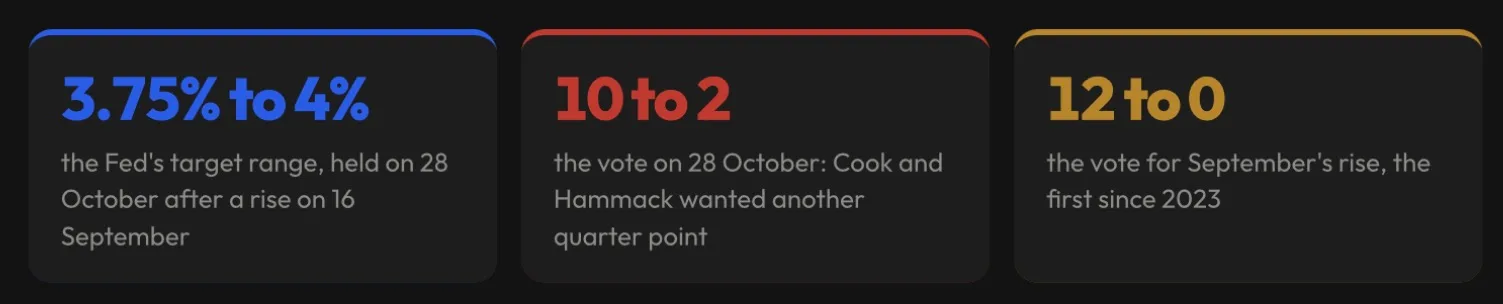
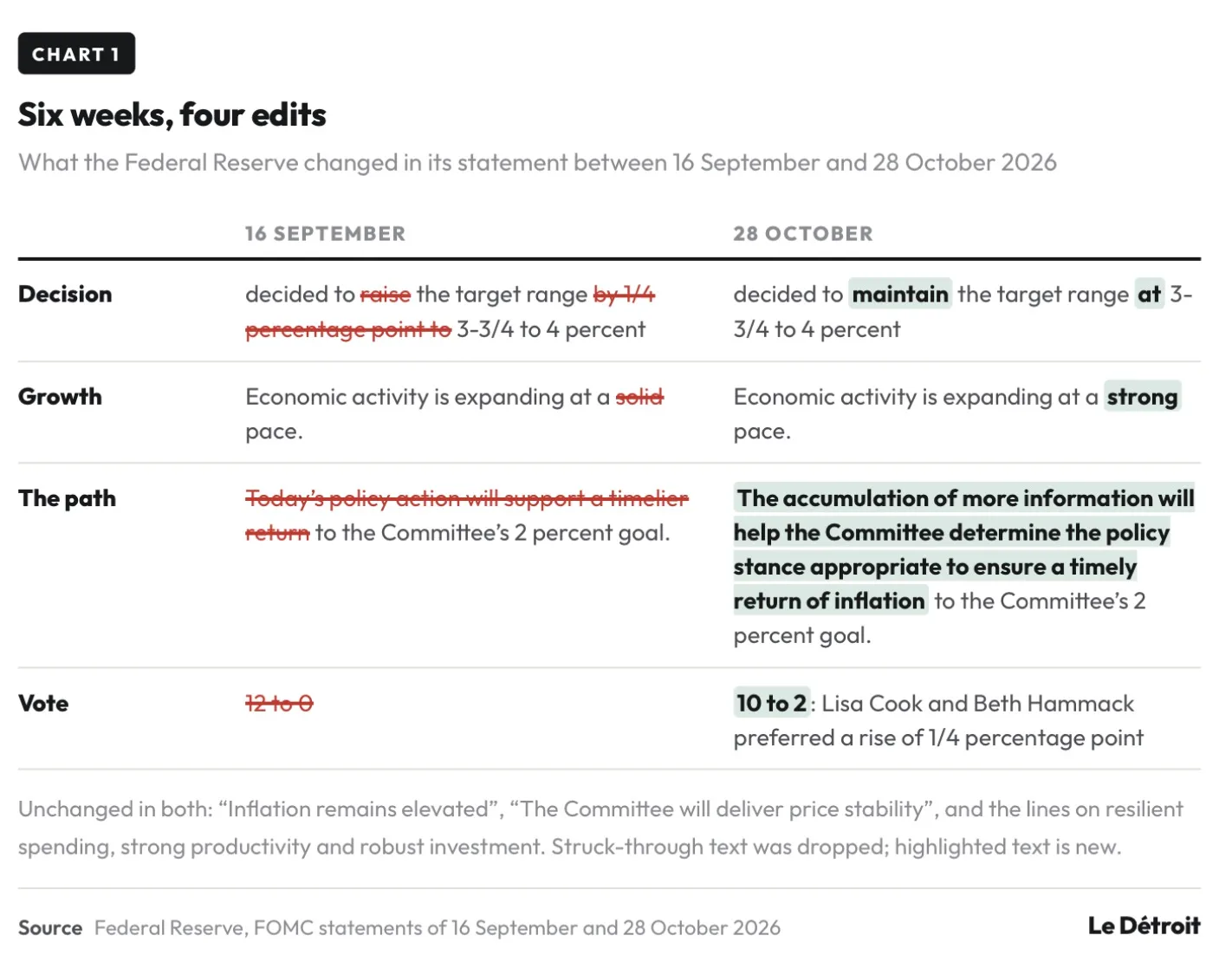
The Federal Reserve has paused, but two of its 12 voters wanted to keep tightening. On Wednesday 28 October, the Federal Open Market Committee held its range at 3.75% to 4%, set by its first rise since 2023, on 16 September. The vote was 10 to 2, after 12 to 0 in September: Lisa Cook, a governor, and Beth Hammack, of the Cleveland Fed, preferred another quarter point. The statement upgraded growth to a "strong" pace from "solid", repeated that "inflation remains elevated", and dropped September's line that policy would support a "timelier" return to 2%; "the accumulation of more information" will now guide it. The chair, Kevin Warsh, said financial and credit conditions had started to change since September, but he was "unwilling and unable to call them tight". He also said one of the eight yearly meetings in 2027, and two in 2028, would discuss strategy rather than set rates. Futures had priced an 84% chance of a rise by December.
2. Israel's count leaves both camps short, and Arab parties pivotal
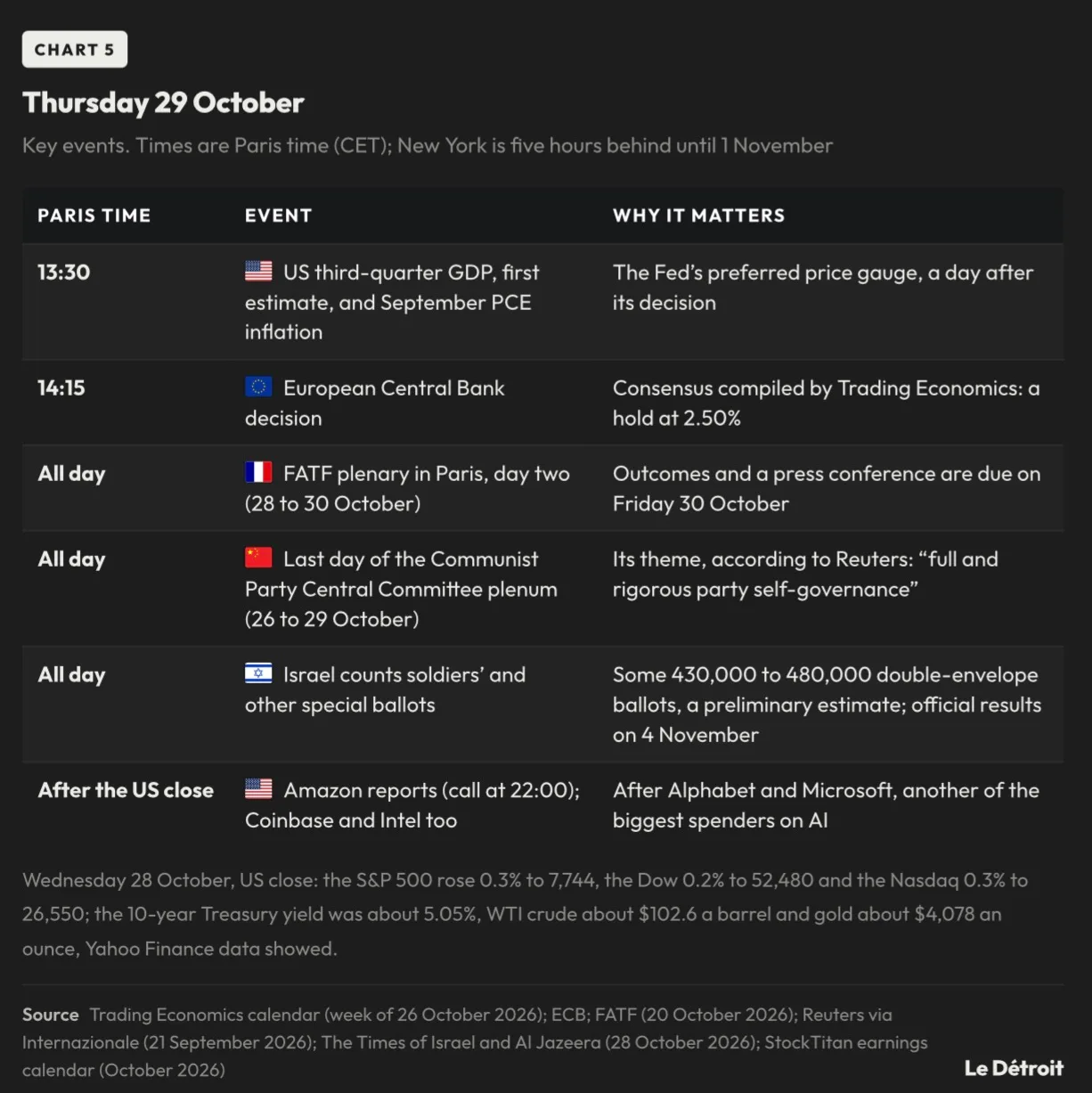
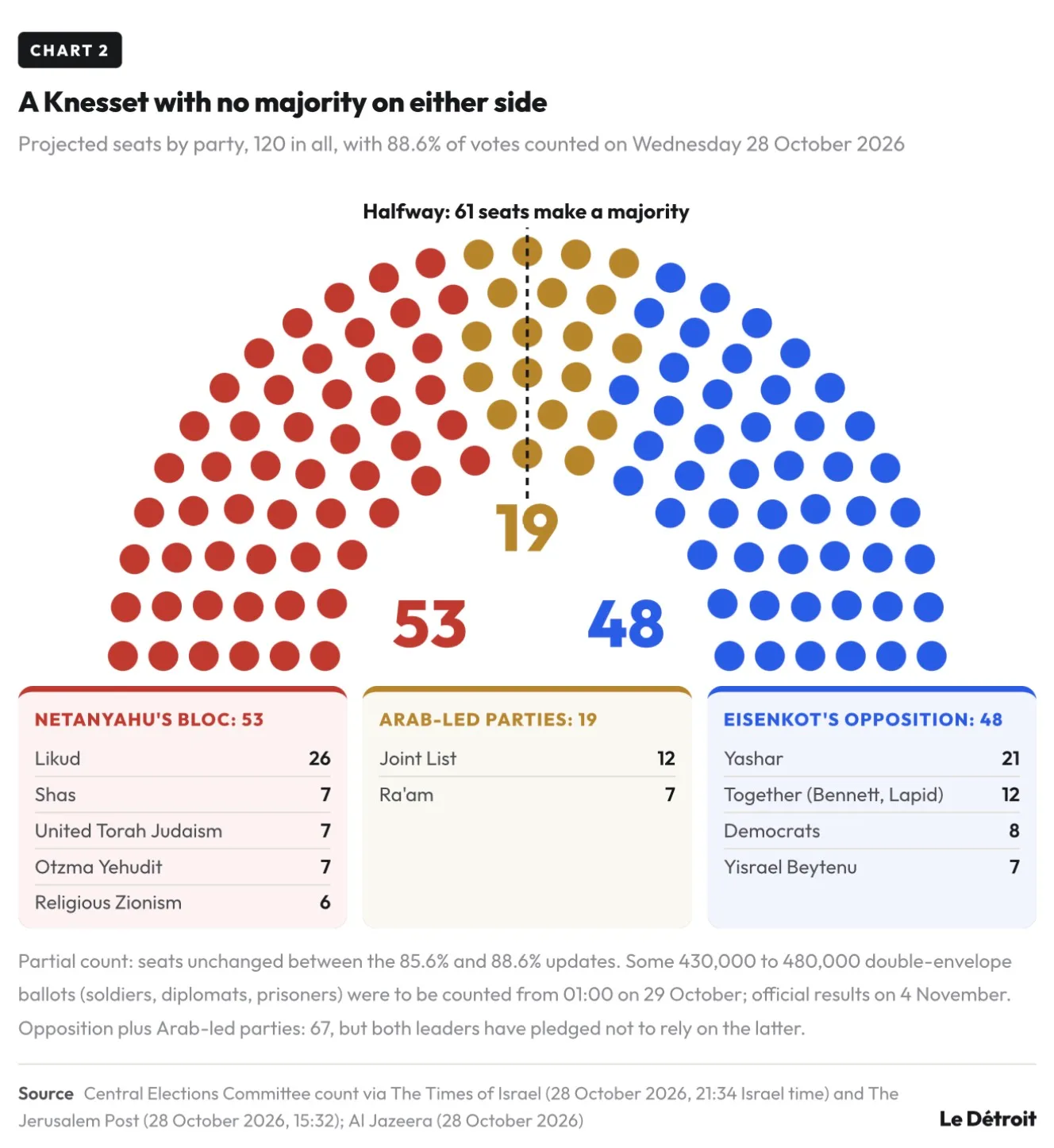
Israel's election has left neither camp with a majority, and the shortest route to one runs through parties both leaders have shunned. With 88.6% of votes counted on Wednesday 28 October, Benjamin Netanyahu's bloc had 53 of the 120 seats and Gadi Eisenkot's opposition alliance 48, according to Central Elections Committee projections; the Arab-led Joint List and Ra'am had 19, a record. Together, the opposition and the Arab-led parties would have 67, but Eisenkot, like Netanyahu, has pledged not to rely on them, though Yair Golan, of the Democrats, now urges a partnership. Turnout was 77.7%, the highest since 1999. Netanyahu, whose Likud remains the largest party, claimed "a decisive majority" for the right; Eisenkot spoke of "a new start". "With the numbers we have now, there is no government," said Ra'am's leader, Mansour Abbas. Soldiers' and other special ballots were to be counted on Thursday; official results follow on 4 November, then President Isaac Herzog consults party leaders.
https://x.com/osint613/status/2115528572375056406?s=61

3. Microsoft doubles its capital spending and offers 60,000 staff a way out
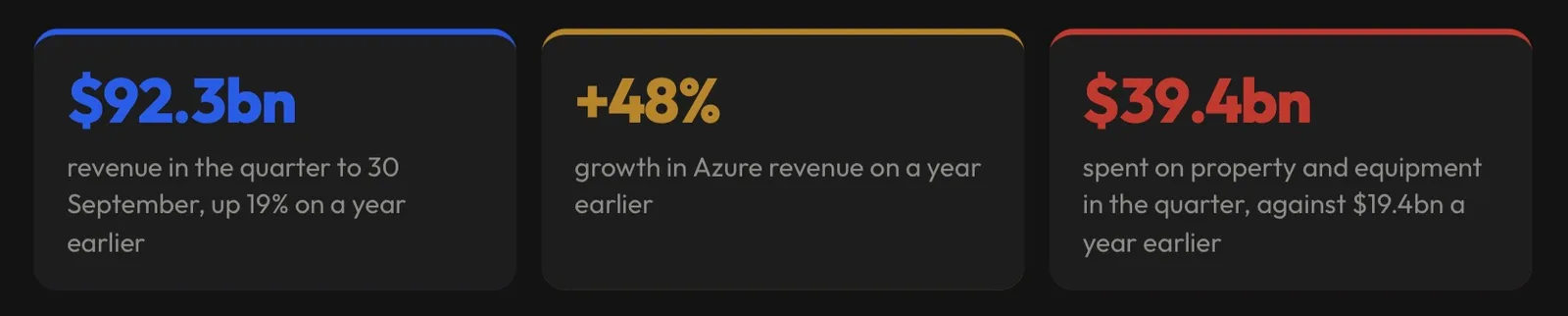
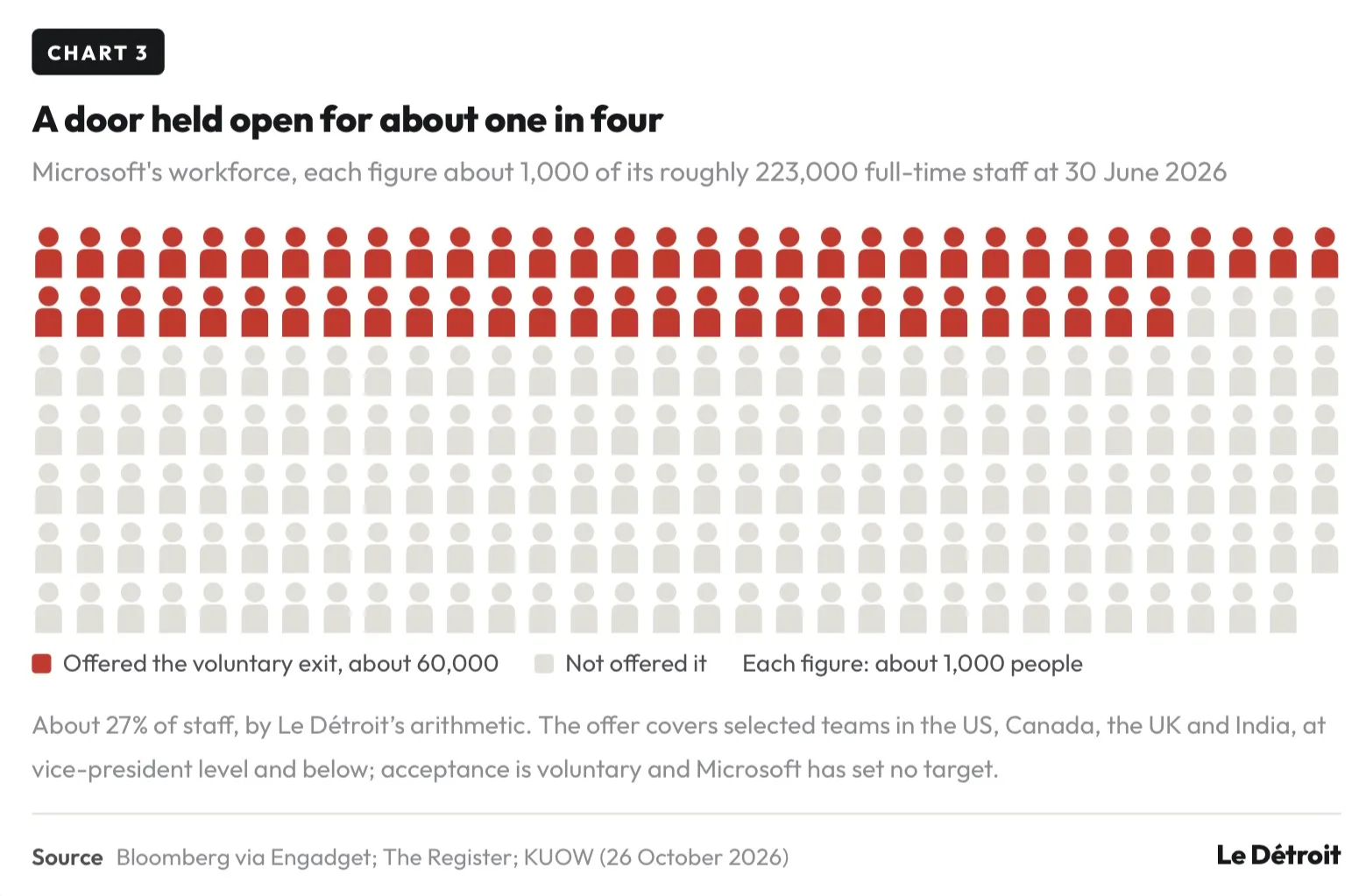
Microsoft is reshaping both sides of its ledger: far more capital spending on the cloud and AI, and possibly fewer people. On Wednesday 28 October, it reported revenue of $92.3bn for the quarter to 30 September, up 19% on a year earlier, with its Azure cloud growing 48%. Results "exceeded expectations across revenue, operating income, and earnings per share," said Amy Hood, the finance chief. Cash spent on property and equipment reached $39.4bn, against $19.4bn a year earlier: double, by Le Détroit's arithmetic. Two days earlier, Microsoft offered a "voluntary exit" to about 60,000 employees, more than a quarter of its roughly 223,000 full-time staff, in selected US, Canadian, British and Indian teams, at vice-president level and below. Terms resemble its standard severance, and the company says AI is not the driver. About 30% of eligible staff took an earlier retirement offer in April, open to some 8,750 long-serving US employees.
4. Washington sanctions Rwanda's defence ministry and a military lender
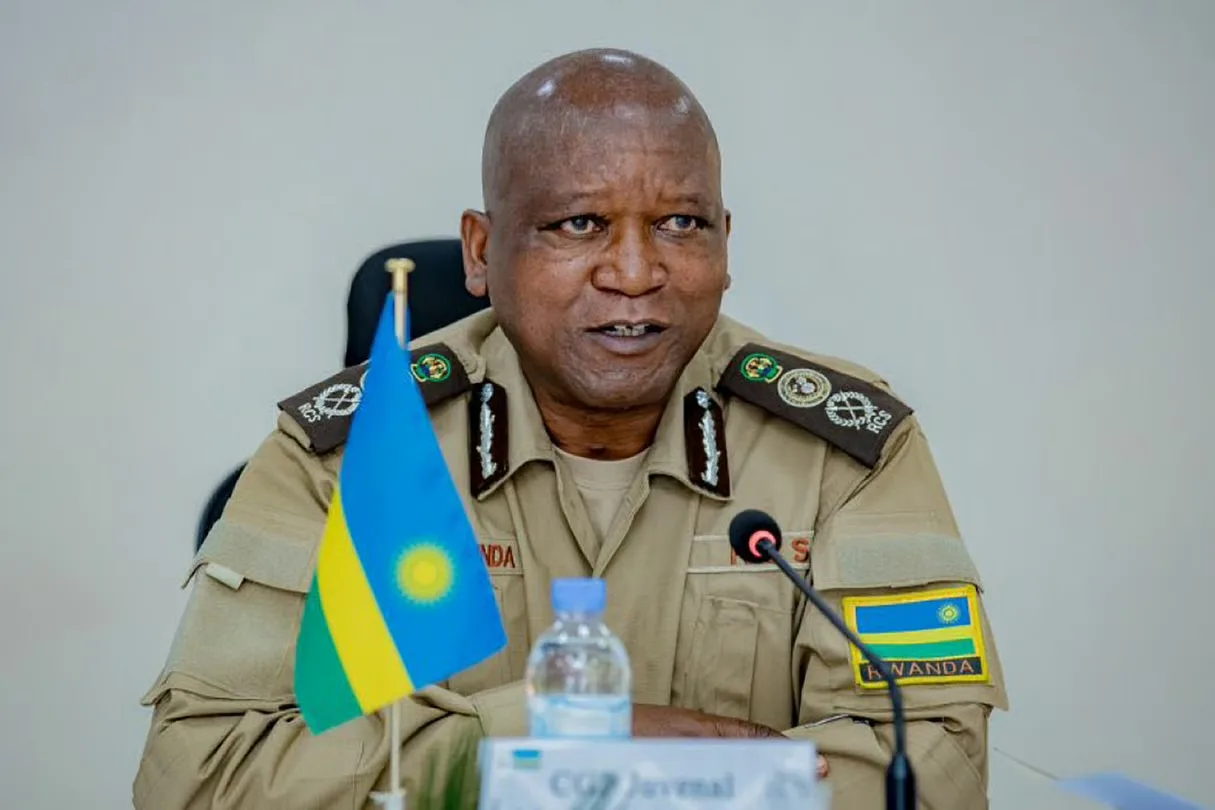
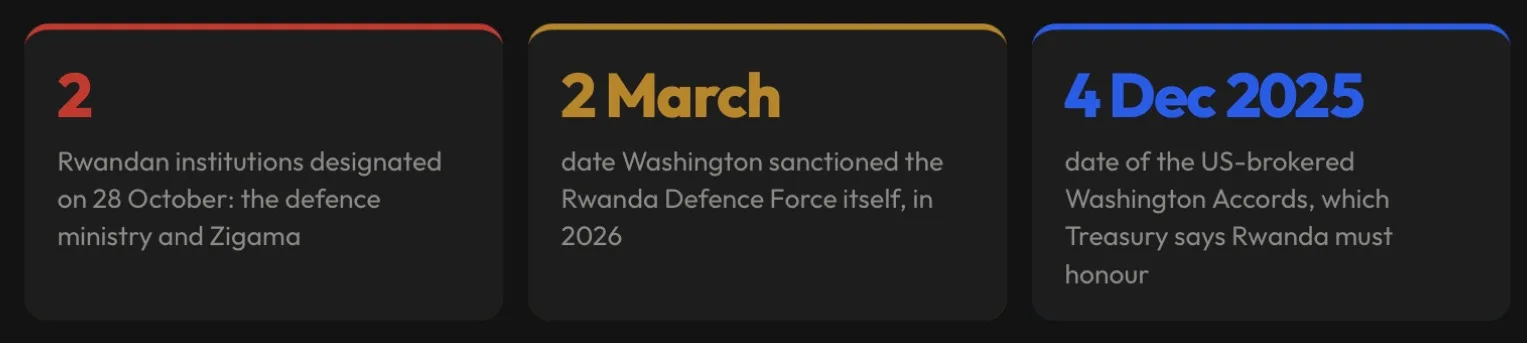
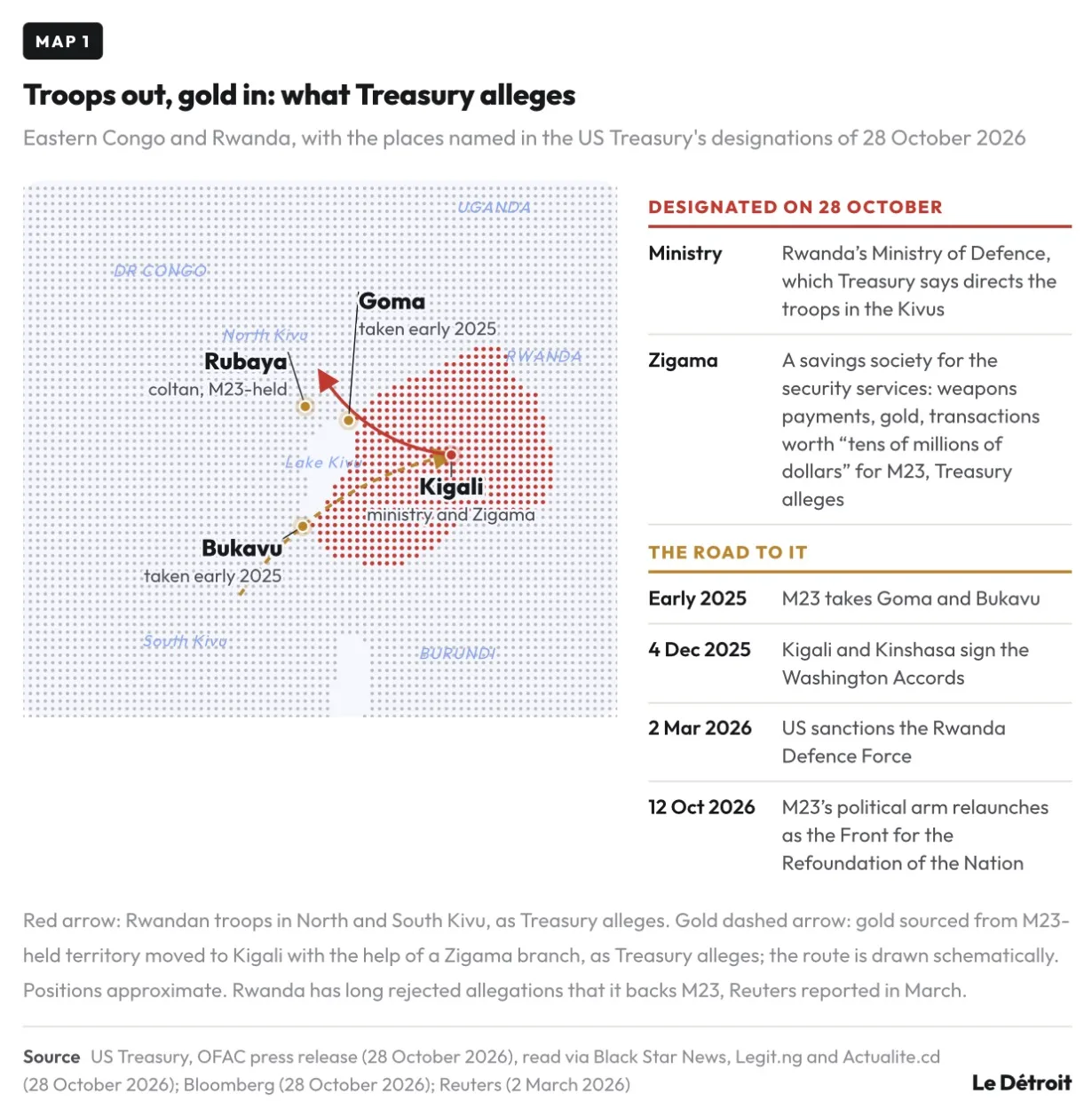
Washington has moved from sanctioning Rwanda's soldiers to the institutions that command and pay them. On Wednesday 28 October, the US Treasury designated Rwanda's Ministry of Defence and Zigama Credit and Savings Society, a lender for the security services, it says, for backing M23 rebels in eastern Congo. Treasury alleges that the ministry sent "thousands" of troops to fight alongside M23 in the Kivus, with surface-to-air missiles and jammers that endanger civil aviation. Zigama, it says, facilitated payments to entities in China for army weapons and transactions worth "tens of millions of dollars" for M23, and helped move gold from M23-held territory to Kigali. "Rwanda must halt its support for M23 and withdraw its troops from eastern DRC," said Scott Bessent, the Treasury secretary, citing the Washington Accords of 4 December 2025. The designations block US-linked assets; they are not criminal charges. Rwanda has long rejected claims that it backs M23, and called March's sanctions on its army a distortion of the facts.
https://x.com/ustreasury/status/2115451594699309192?s=61
5. Brazil's defeated candidate flies to Miami despite a court travel ban
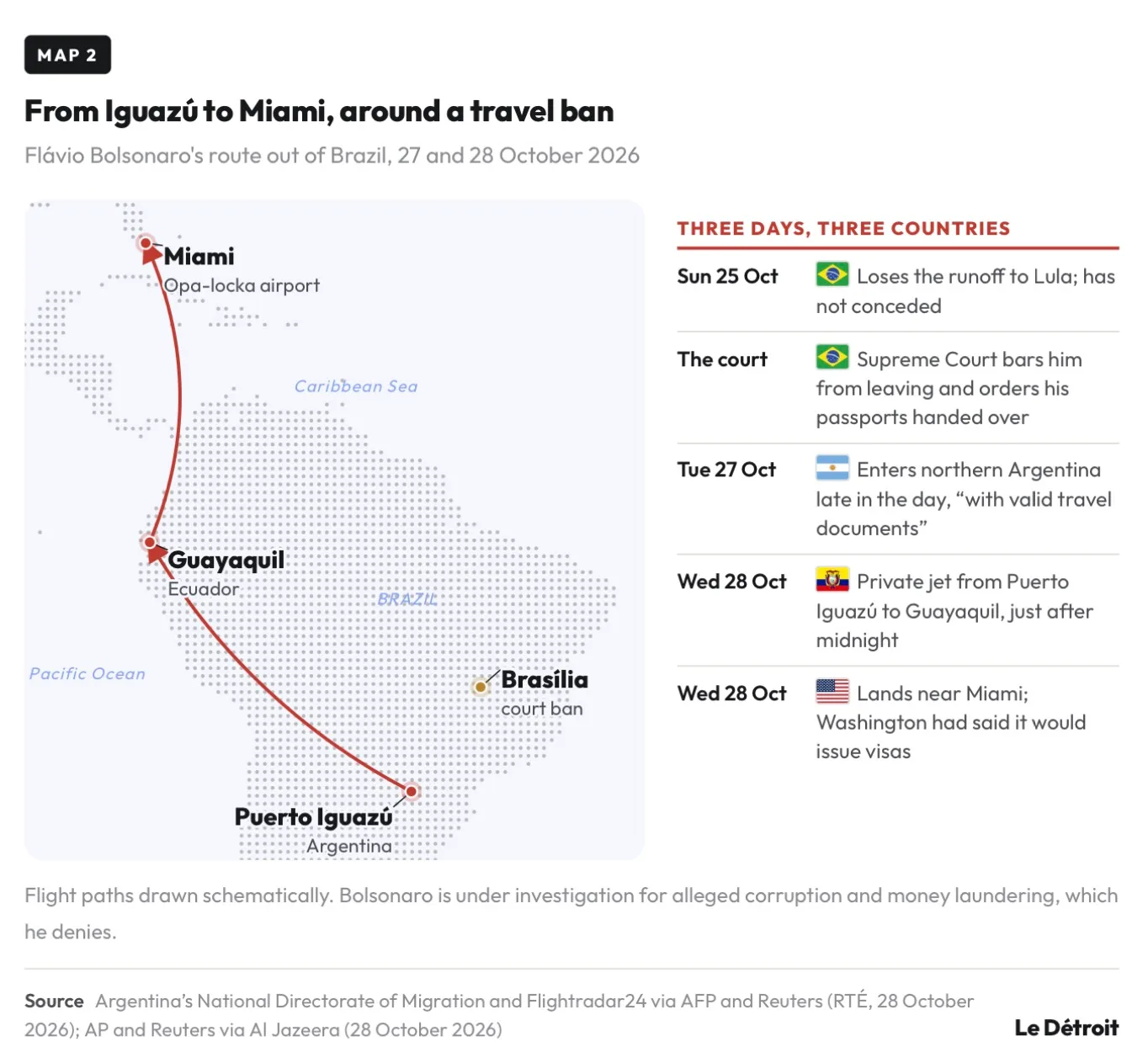
Three days after losing Brazil's presidency, Flávio Bolsonaro has put an investigation, a court order and a border between himself and Brasília, and Washington has let him in. Bolsonaro, who lost the runoff of Sunday 25 October to Luiz Inácio Lula da Silva and has not conceded, landed near Miami on Wednesday 28 October with his wife and two daughters, AP and Reuters reported. Brazil's Supreme Court had barred him from leaving the country and ordered him to surrender his passports, in an investigation into alleged corruption and money laundering that he denies. The family crossed into northern Argentina late on Tuesday 27 October "with valid travel documents and no legal impediment", Argentina's migration directorate said, then flew from Puerto Iguazú to Guayaquil, in Ecuador, and on to Florida. The State Department had said it would issue the family visas. "Well, I would approve," Donald Trump told reporters at Joint Base Andrews, adding: "The election was very strange."

6. The Bank of Canada raises rates for the first time since 2023
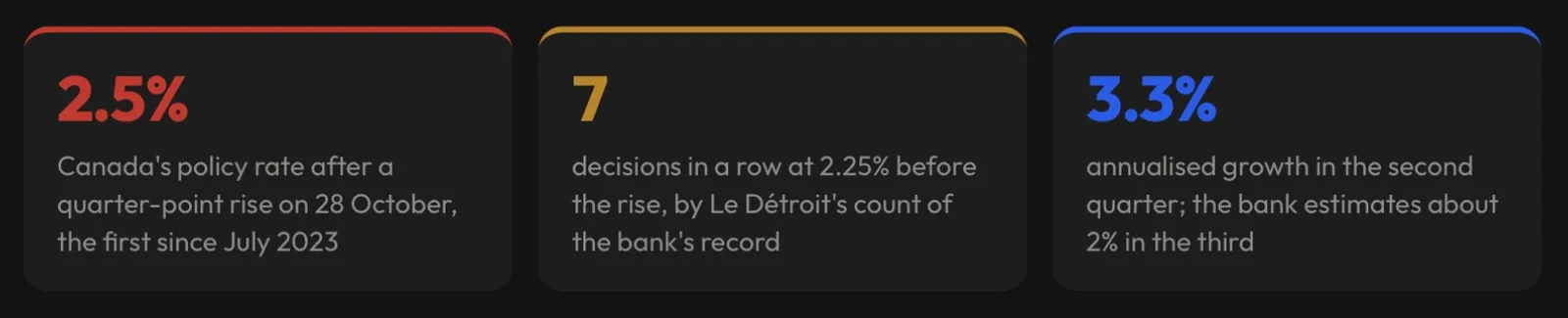
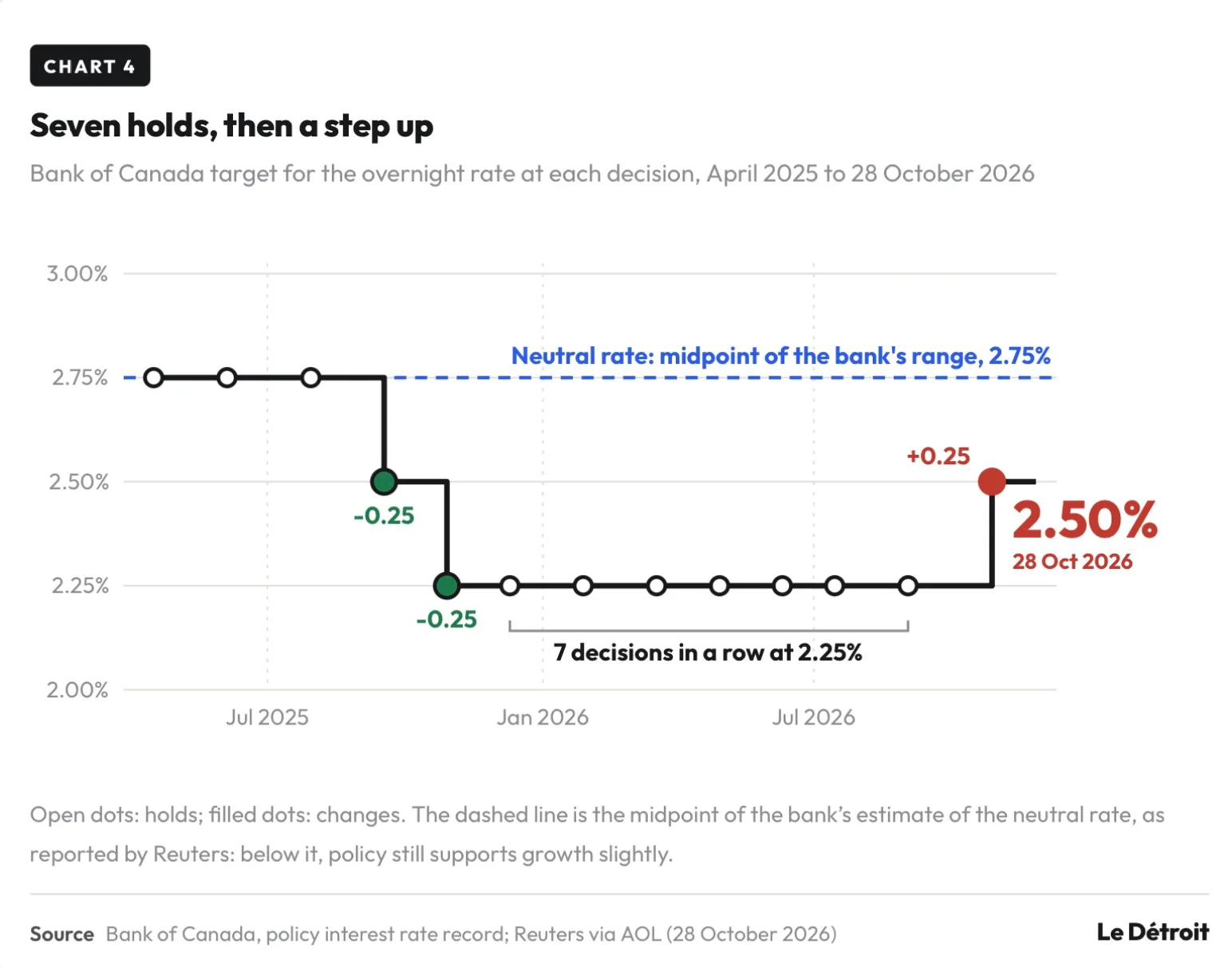
Canada's central bank has concluded that an oil shock born abroad now threatens to become inflation at home. On Wednesday 28 October, the Bank of Canada raised its policy rate by a quarter point to 2.5%, its first increase since July 2023, after 7 decisions in a row at 2.25%, by Le Détroit's count of the bank's own record. Its governor, Tiff Macklem, pointed to energy prices set to stay higher for longer and to growth that has beaten forecasts: the economy expanded at an annualised 3.3% in the second quarter, and the bank estimates about 2% in the third. The bank now expects inflation of around 3.5% at the end of 2026, and a return close to its 2% target only by mid-2028, Reuters reported. Macklem said a further rise could be needed, but that the bank would "proceed carefully". The next decision is due on 9 December.
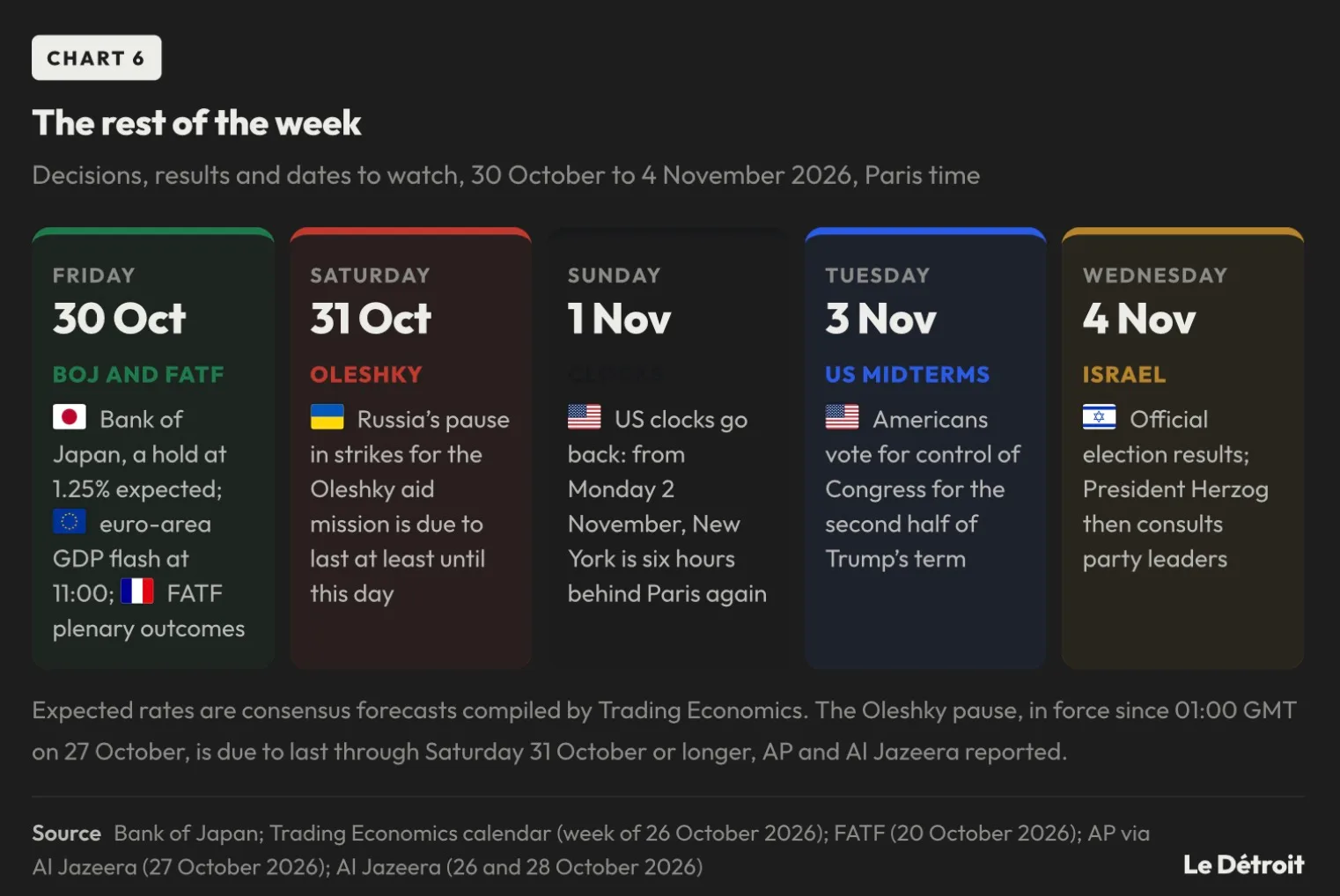
Thursday and the week ahead