1. A treaty for one account, and a test for the whole drive
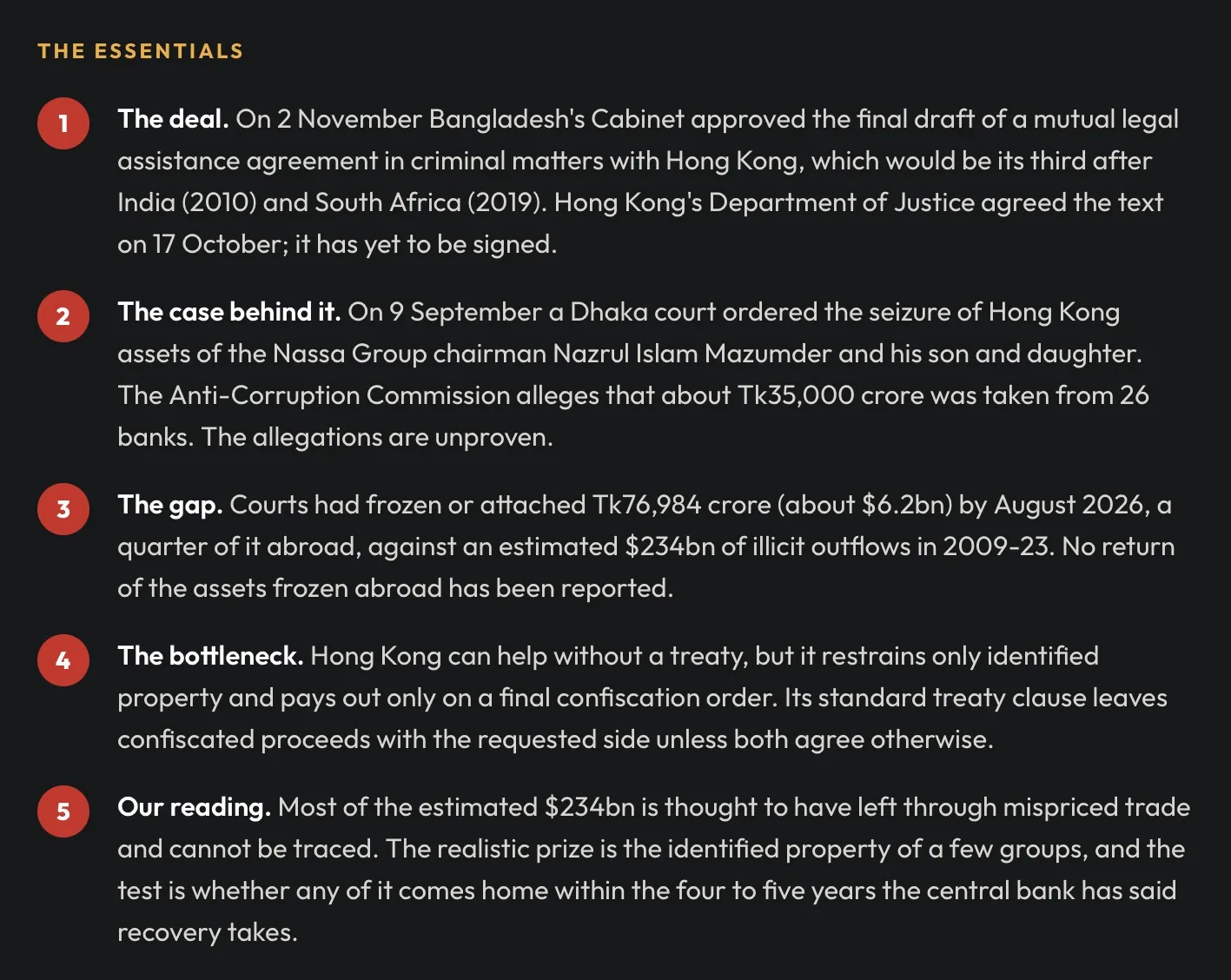
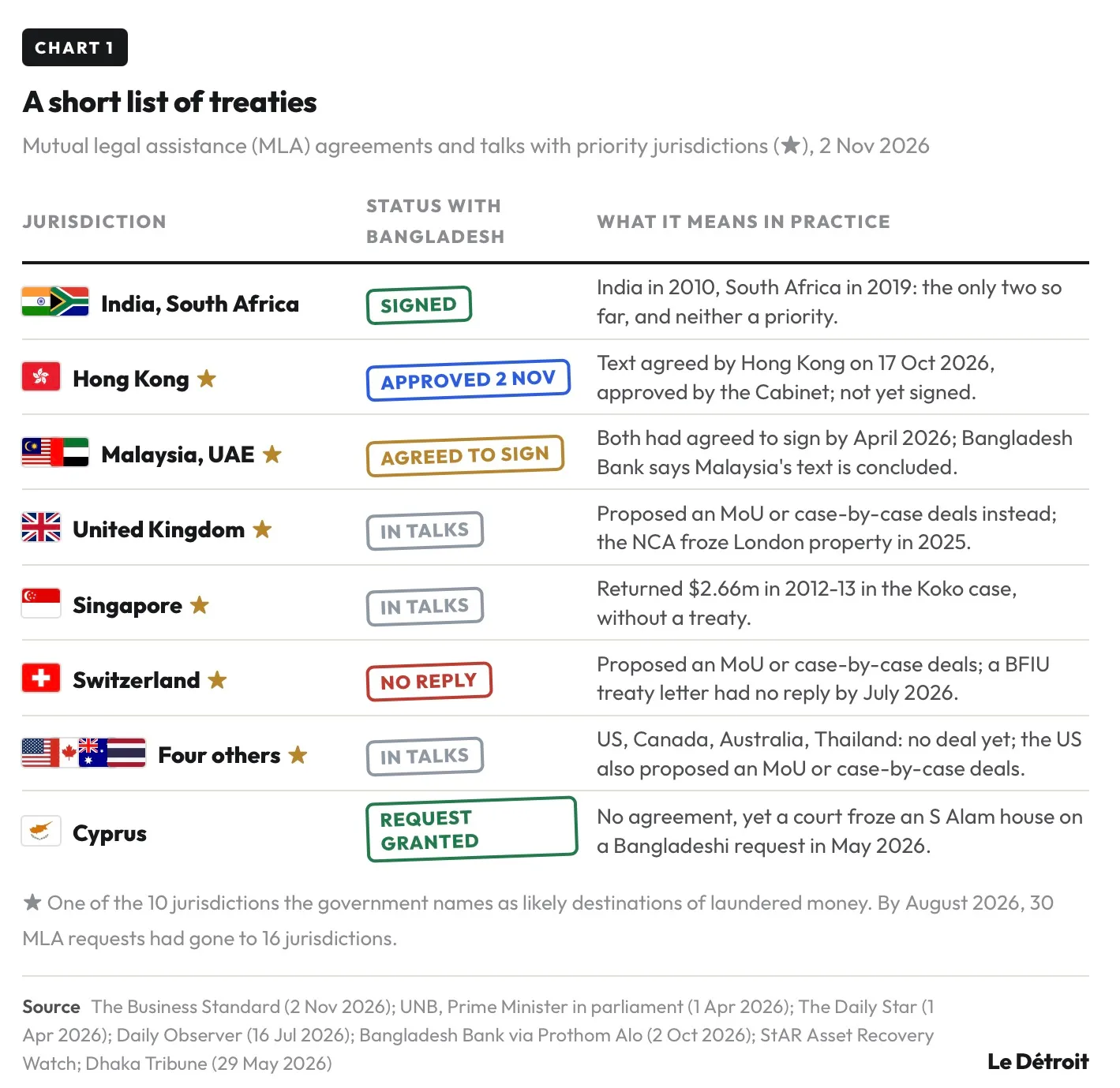
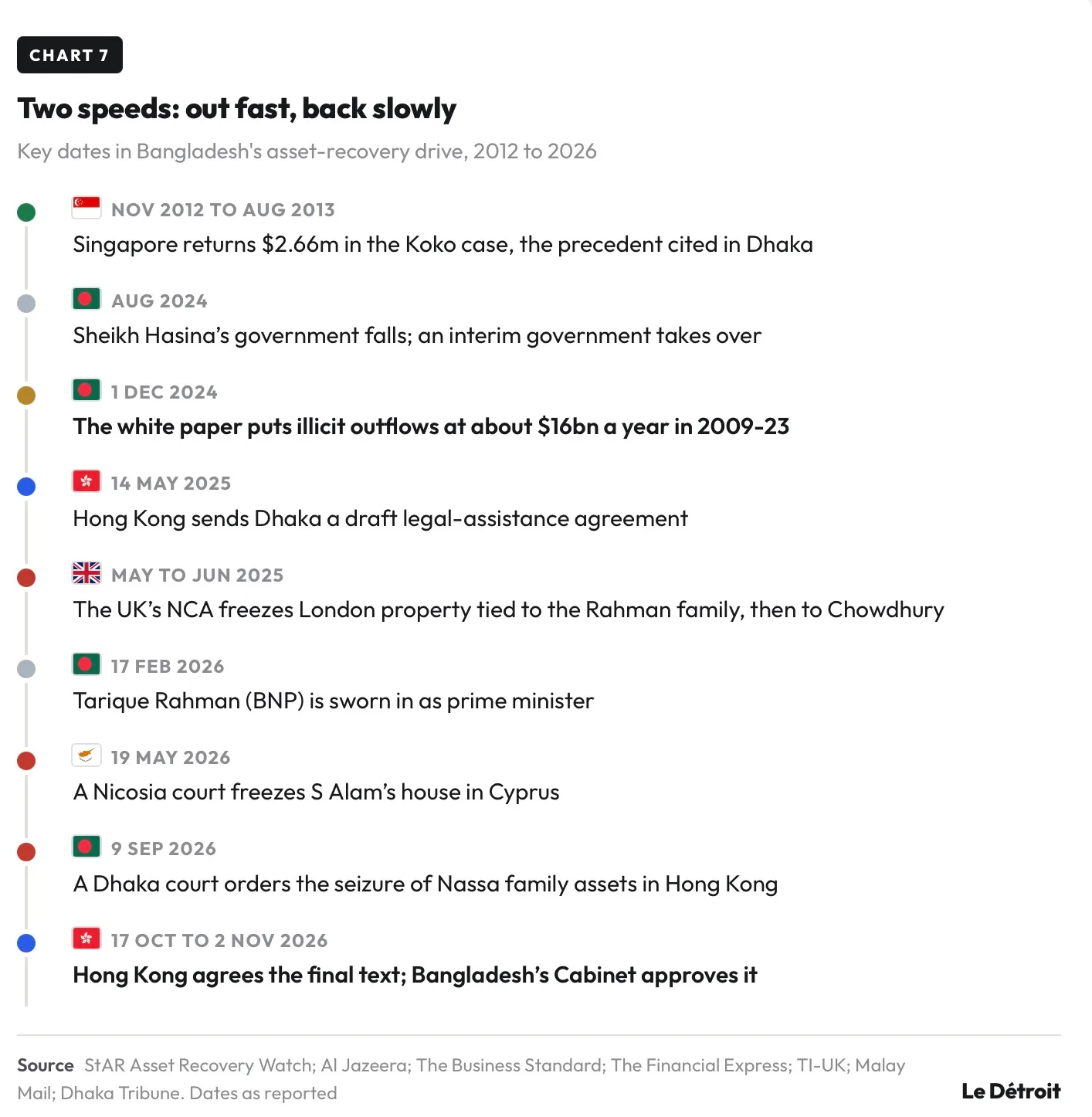
Getting money out of Bangladesh took transfers and invoices; getting it back takes treaties, foreign courts and years. On 2 November the Cabinet, chaired by Prime Minister Tarique Rahman, approved the final draft of a mutual legal assistance agreement in criminal matters with Hong Kong, The Business Standard reported. Once signed, it would let the two sides share evidence and help each other trace and recover illicit assets. Hong Kong sent a first draft on 14 May 2025; its Department of Justice agreed the final text on 17 October 2026.
A case is waiting for it. On 9 September a Dhaka court, at the request of the Anti-Corruption Commission (ACC), ordered the seizure of assets and the freezing of bank accounts in Hong Kong belonging to Nazrul Islam Mazumder, chairman of the Nassa Group and a former chairman of Exim Bank, and his son and daughter. The ACC alleges that about Tk35,000 crore (some $2.8bn) was taken from 26 banks and laundered to the UK, the Isle of Man and Hong Kong, and names the three as beneficial owners of China Supreme Limited, a Hong Kong company with an account at the Bank of East Asia. How much reached Hong Kong has not been disclosed, and we found no public response from the family.
The agreement would be only Bangladesh's third, after India in 2010 and South Africa in 2019, and the first with one of the 10 jurisdictions the government has named as priorities for recovery. Of those ten, only Malaysia, Hong Kong and the UAE had agreed to sign by April; the US, the UK and Switzerland proposed memoranda of understanding or case-by-case agreements instead, The Daily Star reported. On 1 October Bangladesh Bank told MPs that the treaties with Malaysia and Hong Kong had been concluded, Prothom Alo reported, and that 30 requests for legal assistance had gone to 16 jurisdictions.
2. The $234bn is a leak, not a list of assets
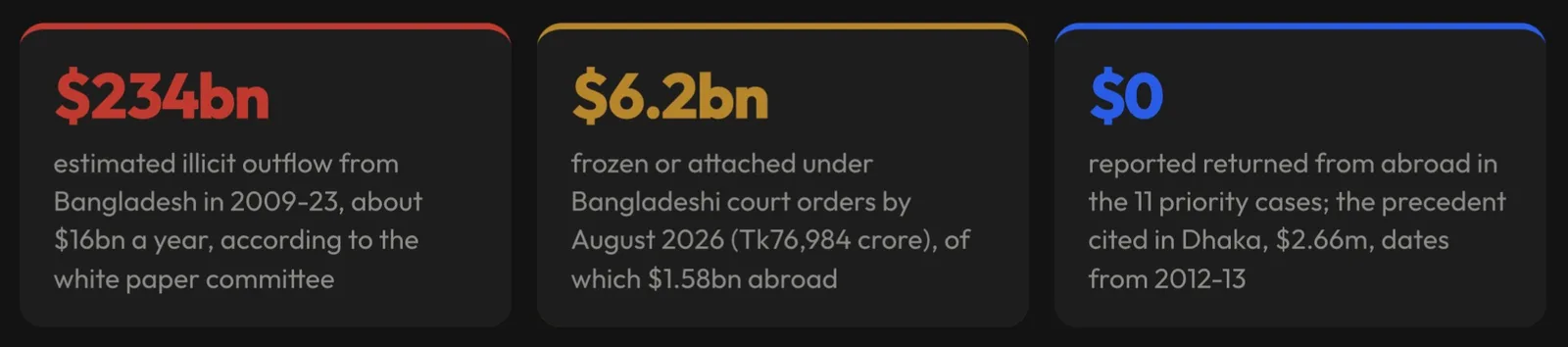
The headline number measures money that left, not money that can be found. It comes from a white paper committee chaired by Debapriya Bhattacharya of the Centre for Policy Dialogue (CPD), which handed its report to the interim leader, Muhammad Yunus, on 1 December 2024. It put illicit outflows under Sheikh Hasina's Awami League governments at about $234bn from 2009 to 2023, an average of $16bn a year and more than twice net foreign aid and foreign direct investment combined. "The problem is deeper than what we have thought," Bhattacharya said.
The method matters for recovery. The estimate builds on Global Financial Integrity's figures for trade mis-invoicing, which averaged $8.27bn a year in 2009-18, extended by the authors to 2023; more than 70% of outflows were judged to run through over- and under-invoiced trade, according to a review in the Dhaka Courier, which called reliance on a single coefficient an oversimplification. GFI's own latest estimate, published in March 2026, is far lower: about $68bn in 2013-22, or $6.8bn a year, The Daily Star reported. A mispriced shipment leaves a hole in the statistics, not a bank account a judge can freeze.
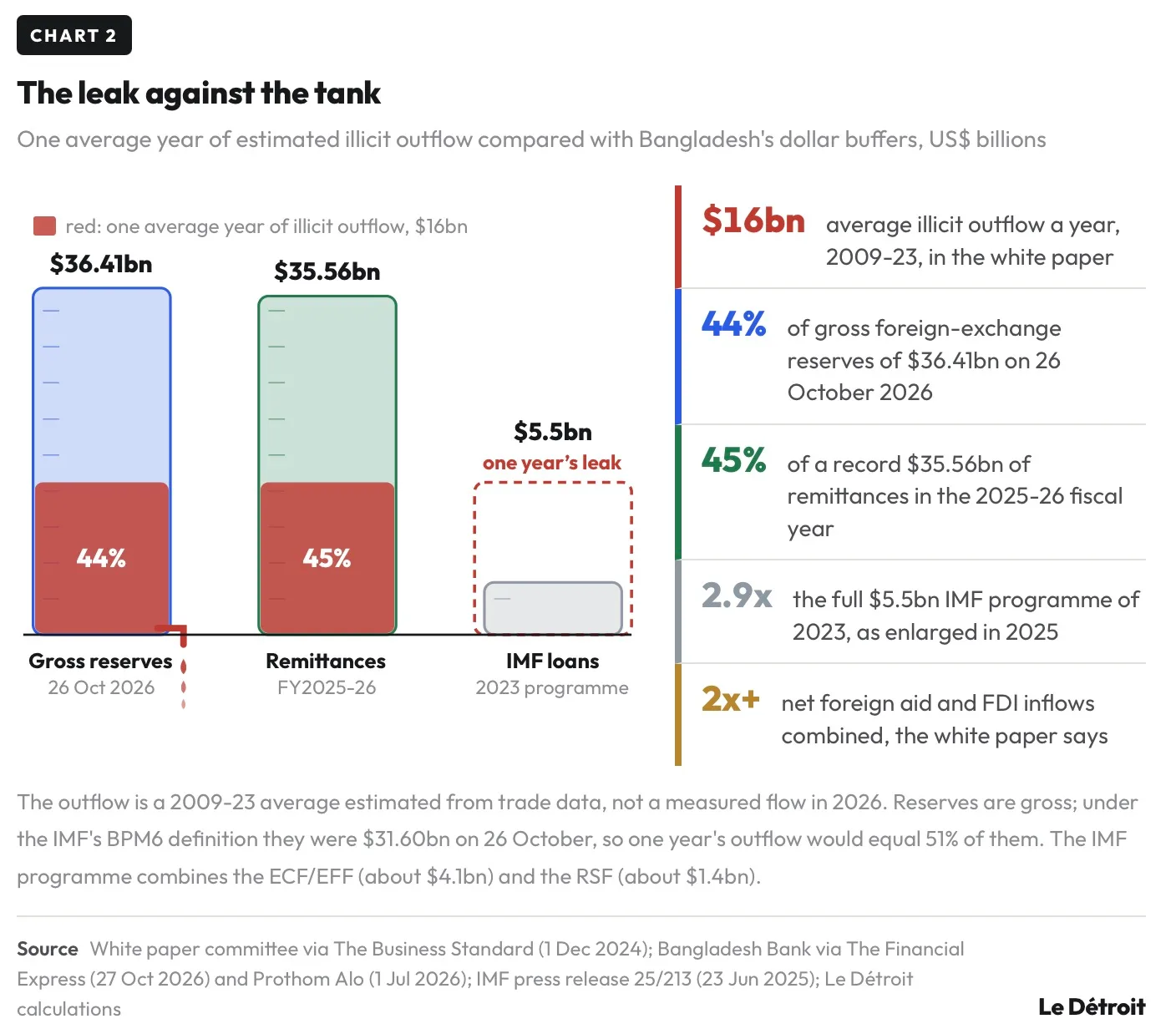
Even as an estimate, the scale explains the urgency. By Le Détroit's calculation, one average year of outflow equals 44% of gross foreign-exchange reserves on 26 October and 45% of a record year of remittances. It is almost three times the IMF programme agreed in 2023 and enlarged in 2025, and on GFI's lower estimate it would still exceed that programme.
3. Freezing at home worked fast, then stalled
Domestic freezing was fast because it needs only a Bangladeshi judge, but the totals have barely moved since May. The interim government built the machinery within months: an inter-agency task force chaired by the central bank governor, and 11 joint investigation teams led by the ACC with police, tax and customs investigators. The Bangladesh Financial Intelligence Unit (BFIU) has since added a Stolen Asset Recovery Division, with technical help from bodies including the US Department of Justice. The 11 priority cases read like a roll-call of the old order: former land minister Saifuzzaman Chowdhury, Sheikh Hasina and her family, HBM Iqbal and the S Alam, Beximco, Sikder, Nassa, Orion, Bashundhara, Nabil and Summit groups, the finance minister told parliament on 24 June.
By August courts had attached or frozen assets worth Tk76,984 crore: Tk57,326 crore in Bangladesh and Tk19,658 crore abroad, according to Bangladesh Bank's report to parliament's Standing Committee on Estimates on 1 October, as described by Prothom Alo. At the central bank's rate of Tk124.30 per dollar on 2 November, that is about $6.2bn, including $1.58bn abroad. By Le Détroit's calculation, the total is 9% above the Tk70,446 crore the prime minister gave for 25 March, and the part abroad has risen by almost half, to a quarter of the whole; but the finance minister had already put the total at Tk76,814 crore in May, so it has grown by just 0.2% since.
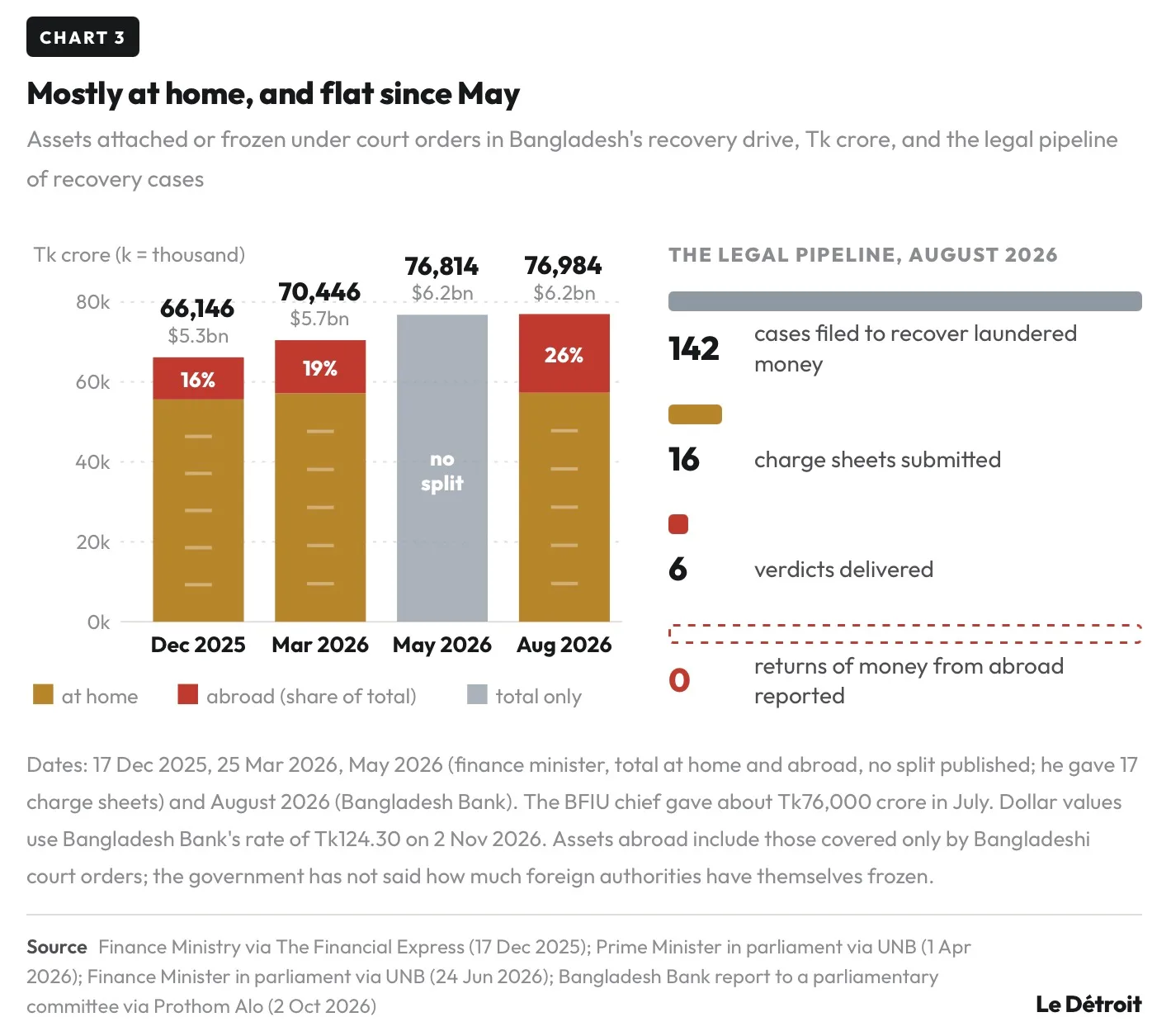
The legal pipeline narrows sharply. Of 142 recovery cases filed by August, 16 had reached a charge sheet and six a verdict, and no return of money from abroad has been reported in these cases. "It normally takes four to five years to repatriate money from abroad; it is not instant," Ahsan H Mansur, then the central bank's governor, said in December 2025. His successor, Md Mostaqur Rahman, told newspaper editors on 8 June that $25m of assets frozen in the UK would soon be repatriated, The Business Standard reported; no such return has been reported since.
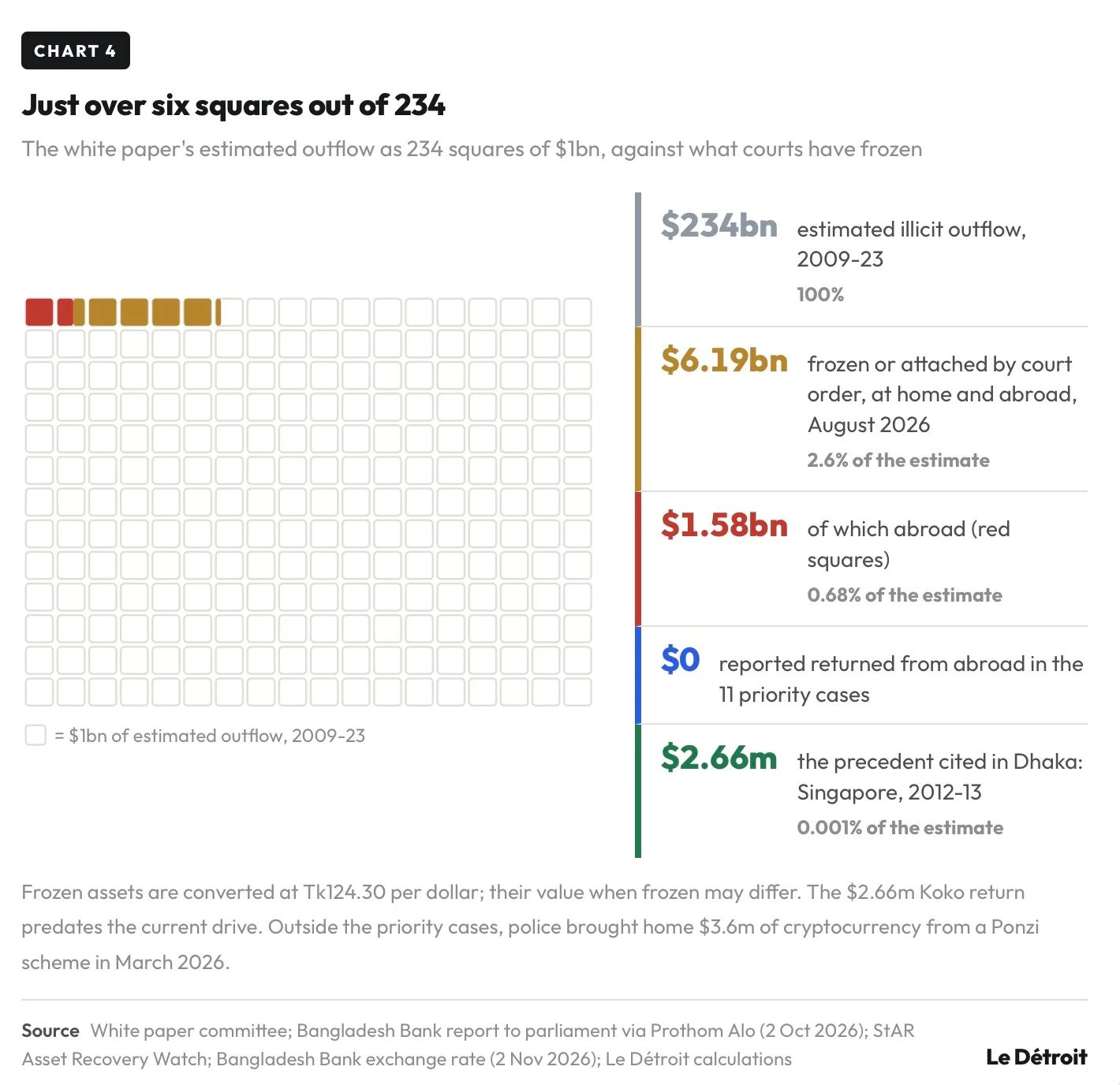
Set against the estimate, the freeze is small. Everything frozen so far equals 2.6% of the $234bn, and the part abroad 0.68%, by Le Détroit's calculation. The sum the ACC alleges was taken in the Nassa case alone equals nearly half of everything frozen.
4. Abroad, a Dhaka order is only a request
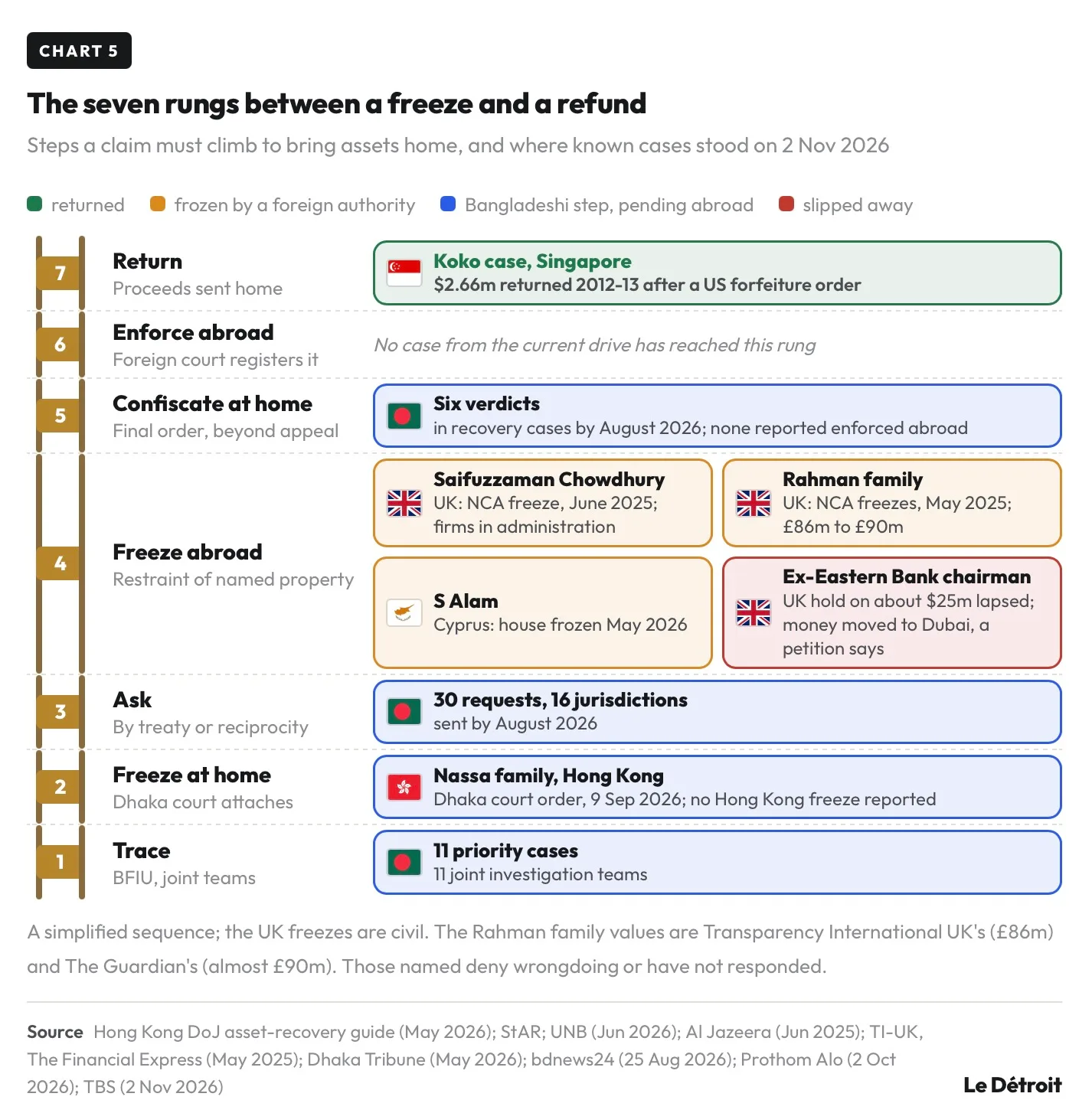
The bottleneck sits in foreign courtrooms, where Bangladesh must in effect win its case twice. A Bangladeshi freezing order has no force in London or Hong Kong. A local court has frozen overseas assets, but the freeze has not been enforced in those jurisdictions, The Financial Express reported in August, describing the response to dozens of requests as "lukewarm". Bhattacharya foresaw this in 2024: "After obtaining a decree from the host country, it must then be presented in the destination country."
Hong Kong's own rules show the hurdles: under its Mutual Legal Assistance in Criminal Matters Ordinance, it can act on a promise of reciprocity without a treaty, its Department of Justice explains in a guide updated in May 2026. But it restrains only identified property, cannot pay funds across until a final confiscation order is obtained abroad, and registers such an order only if it is no longer subject to appeal and those affected had notice and a chance to defend themselves. Nor is sharing automatic: Hong Kong's standard treaty clause leaves confiscated proceeds with the requested side unless both agree otherwise, though Hong Kong also applies the UN Convention against Corruption, which Bangladesh joined in 2007, to share or return assets with its parties. The treaty can settle those terms; recovery still depends on Bangladeshi convictions.
Every month on the ladder gives owners time to move. In July the BFIU chief, Ikhtiar Uddin Mohammad Mamun, said a foreign state had frozen Tk307 crore (about $25m) belonging to a former chairman of Eastern Bank and asked the BFIU to act, but administrative delays let the money leave for another jurisdiction. A High Court petition says Britain's crime agency held the funds for four weeks so that Bangladesh could act, then released them, and that they went to Dubai; on 25 August the court asked why BFIU officials should not face action, and the petition adds that the former chairman has since declared the money and paid tax and penalties on it. "We know that time is of the essence," Mansur told Al Jazeera in March 2025.
5. London froze first, but others may be paid first
Where foreign authorities have acted, the money still has other claimants, and the owners are fighting back. The UK moved earliest. In May 2025 the National Crime Agency (NCA) obtained freezing orders on London property linked to Ahmed Shayan Rahman and Ahmed Shahryar Rahman, the son and a nephew of Salman F Rahman, whose Beximco group is on Dhaka's priority list; the property is worth £86m by Transparency International UK's count and almost £90m by The Guardian's.
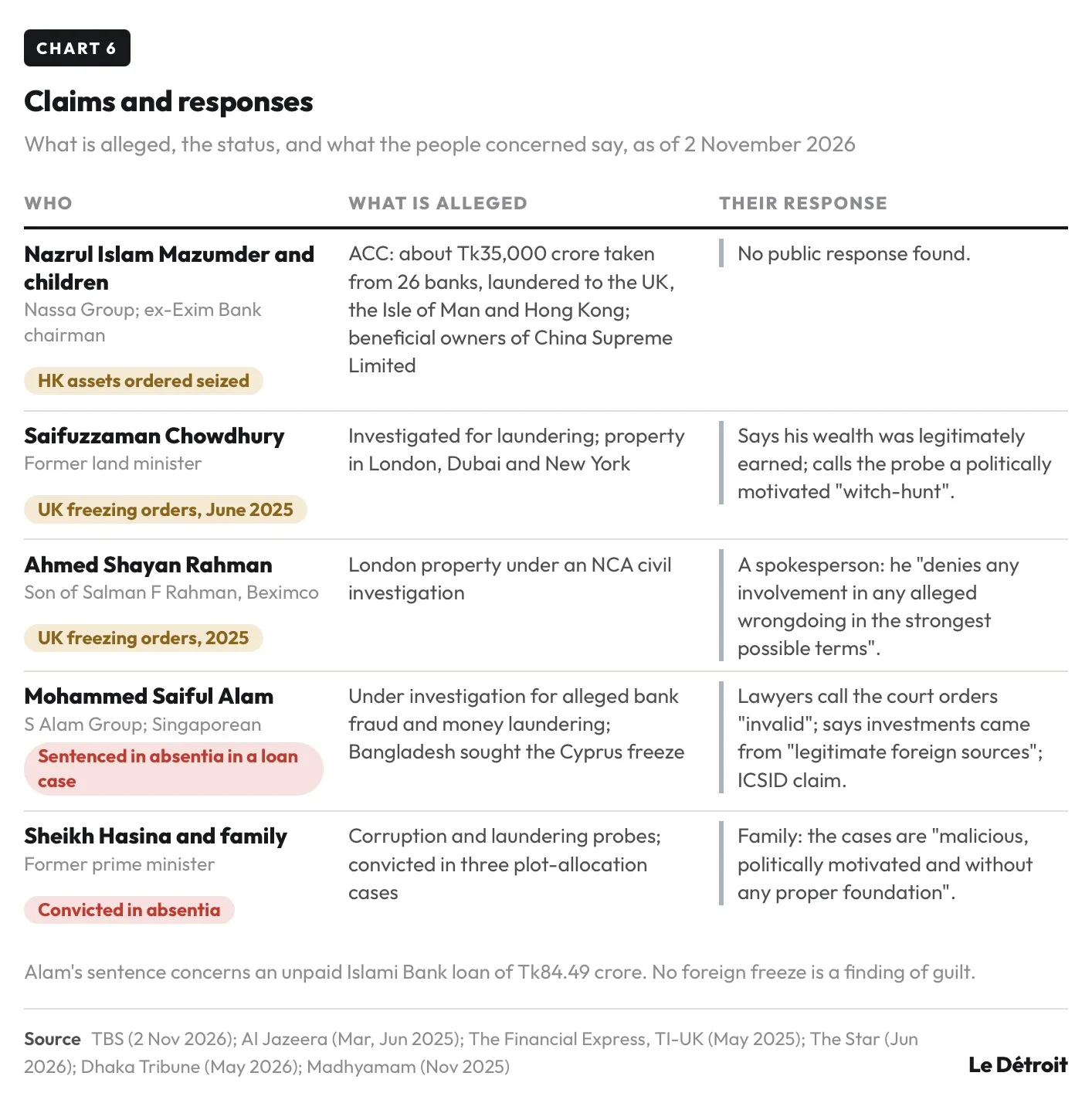
A spokesperson for Ahmed Shayan Rahman said he "denies any involvement in any alleged wrongdoing in the strongest possible terms". In June the NCA froze properties of Saifuzzaman Chowdhury, including a house in St John's Wood bought for £11m; he says his wealth was legitimately earned and calls the investigation a politically motivated "witch-hunt".
A freeze is not a refund. Six companies that held Chowdhury's UK portfolio went into administration, and Grant Thornton was appointed to sell properties to repay lenders including Singapore's DBS and the British Arab Commercial Bank, Prothom Alo reported in August 2025, citing The Daily Telegraph. Grant Thornton has since applied to a UK court for worldwide freezing orders under bankruptcy rules, which Dhaka hopes will serve its own claim, and Mansur said in December that two Bangladeshi banks had filed claims in London.
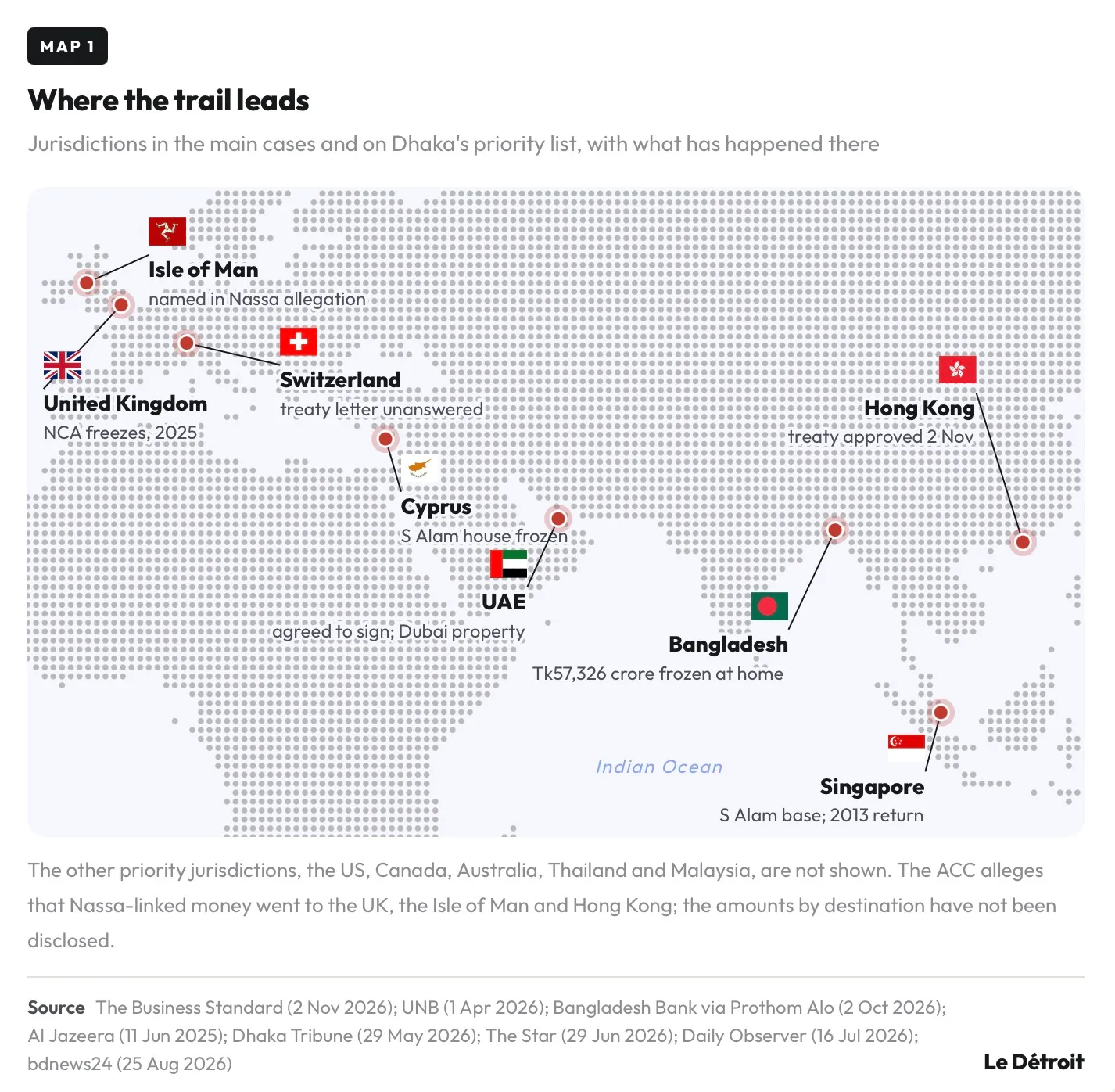
S Alam shows the counter-attack. On 19 May 2026 a court in Nicosia froze a house owned by Mohammed Saiful Alam and his wife, on an application by Cyprus's anti-money-laundering unit acting on a Bangladeshi request, the Dhaka Tribune reported. Alam, a Singaporean, denies wrongdoing, says his investments came from "legitimate foreign sources" and has taken Bangladesh to the World Bank's investment tribunal, ICSID, claiming damages his side estimates in the hundreds of millions. His Singapore lawyers call the court orders behind a five-month sentence passed in absentia in Chattogram in May "invalid".
6. A new government, an old pattern
Recovery has long been entangled with politics in Bangladesh, and foreign judges will look at how cases were won. The Bangladesh Nationalist Party (BNP) won a two-thirds majority in February's election, from which Sheikh Hasina's Awami League was barred, and Tarique Rahman, son of the former prime minister Khaleda Zia, was sworn in on 17 February. "Those who looted or siphoned off the people's money will face punishment as per the existing laws of the country," he told parliament on 1 April, according to UNB.
The accused see a purge. Sheikh Hasina, sentenced in absentia in November 2025 to 21 years in three cases over plot allocations, and her family called the cases "malicious, politically motivated and without any proper foundation". The BFIU's chief says his staff do not consider political affiliation, and that anyone in the interim government involved in laundering would also be exposed.
History cuts both ways: the precedent usually cited in Dhaka is the $2.66m Singapore sent back between November 2012 and August 2013 from accounts linked to Arafat Rahman Koko, Khaleda Zia's younger son and so the prime minister's brother, after a US civil forfeiture action; Koko had been convicted in absentia in 2011. Recovery began in 2008, according to the World Bank and UNODC's StAR database: five years for less than $3m. The only return from abroad we found since 2024 lies outside the priority cases: in March 2026 the police's Criminal Investigation Department brought home about $3.6m in cryptocurrency laundered abroad through MTFE, a Ponzi scheme that collapsed in 2023. "Chasing the stolen assets globally would give a strong signal to the persons involved in money laundering," Mustafizur Rahman of the CPD told The Financial Express.
7. Le Détroit's reading
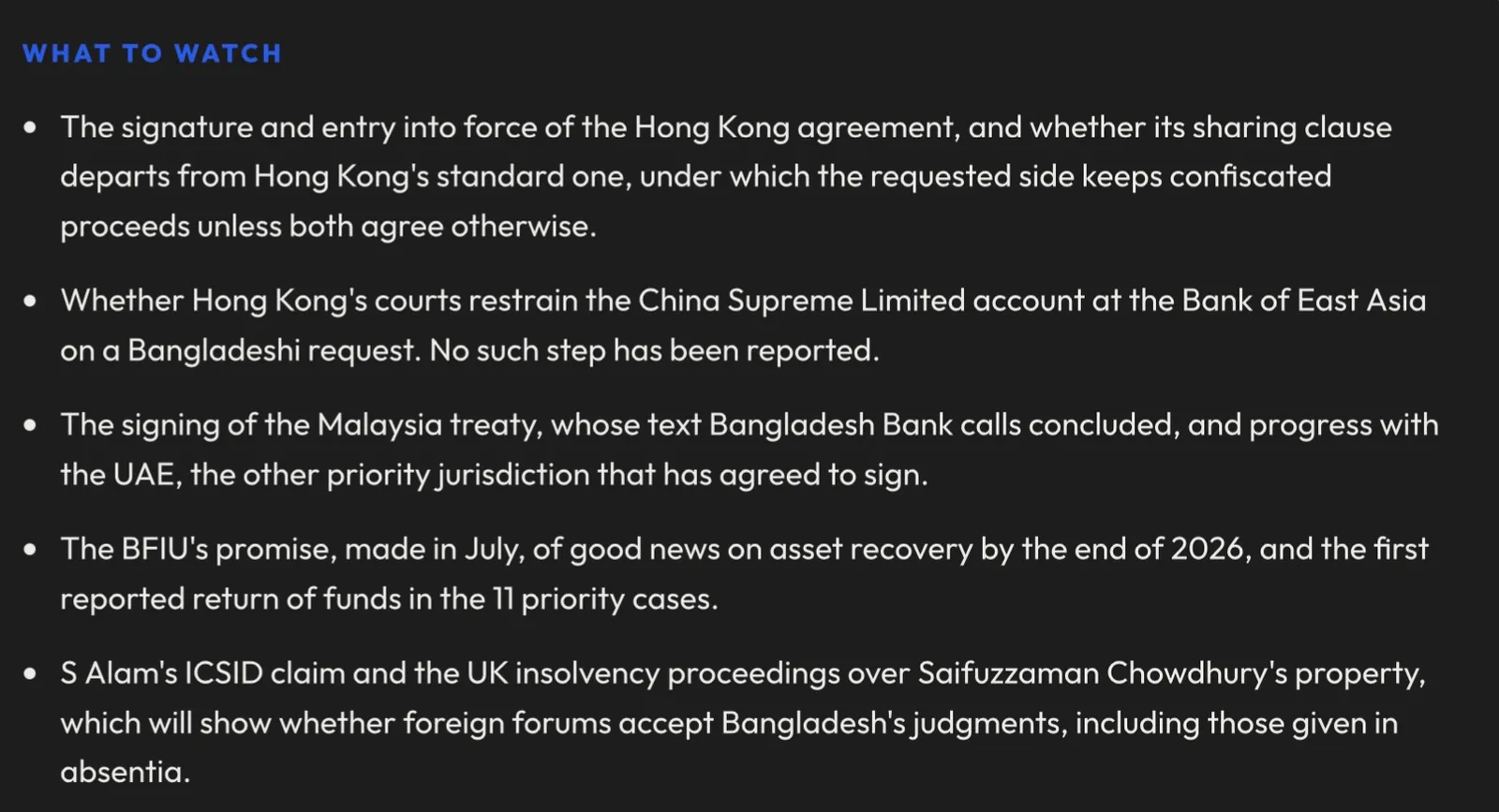
The Hong Kong agreement will not bring back $234bn, nor most of the $6.2bn frozen. Most of the estimated outflow left as mispriced trade and will never be traced. The recoverable part is the identified property of a few families and groups, held where mortgage lenders, insolvency administrators and investment-treaty lawyers stand in the queue ahead of Dhaka. Our reading is that the Tk57,326 crore frozen at home is the only pool Bangladesh fully controls, and that plea bargains or an amnesty, options Mansur floated in 2025, could return more, faster, than foreign courts; the convictions Bangladesh needs abroad must also survive foreign judges' tests of notice and a fair hearing, which in-absentia verdicts and the former ruling party's exclusion from the vote will make harder.
So far the clearest beneficiaries are lawyers, administrators and secured lenders abroad; the losers are Bangladeshi depositors and taxpayers, whose banks were drained and whose reserves the outflow dwarfs. Three signals will show whether the drive is more than a freezing campaign: whether the Hong Kong agreement is signed with a sharing clause that favours return and Hong Kong's authorities seek a restraint order over the China Supreme account; whether the BFIU delivers the first reported return in the priority cases by the end of 2026, the deadline its chief set for "good news"; and whether a foreign forum, starting with S Alam's ICSID claim or the UK insolvency case, accepts a Bangladeshi judgment.