1. A post, two charts and a missing number
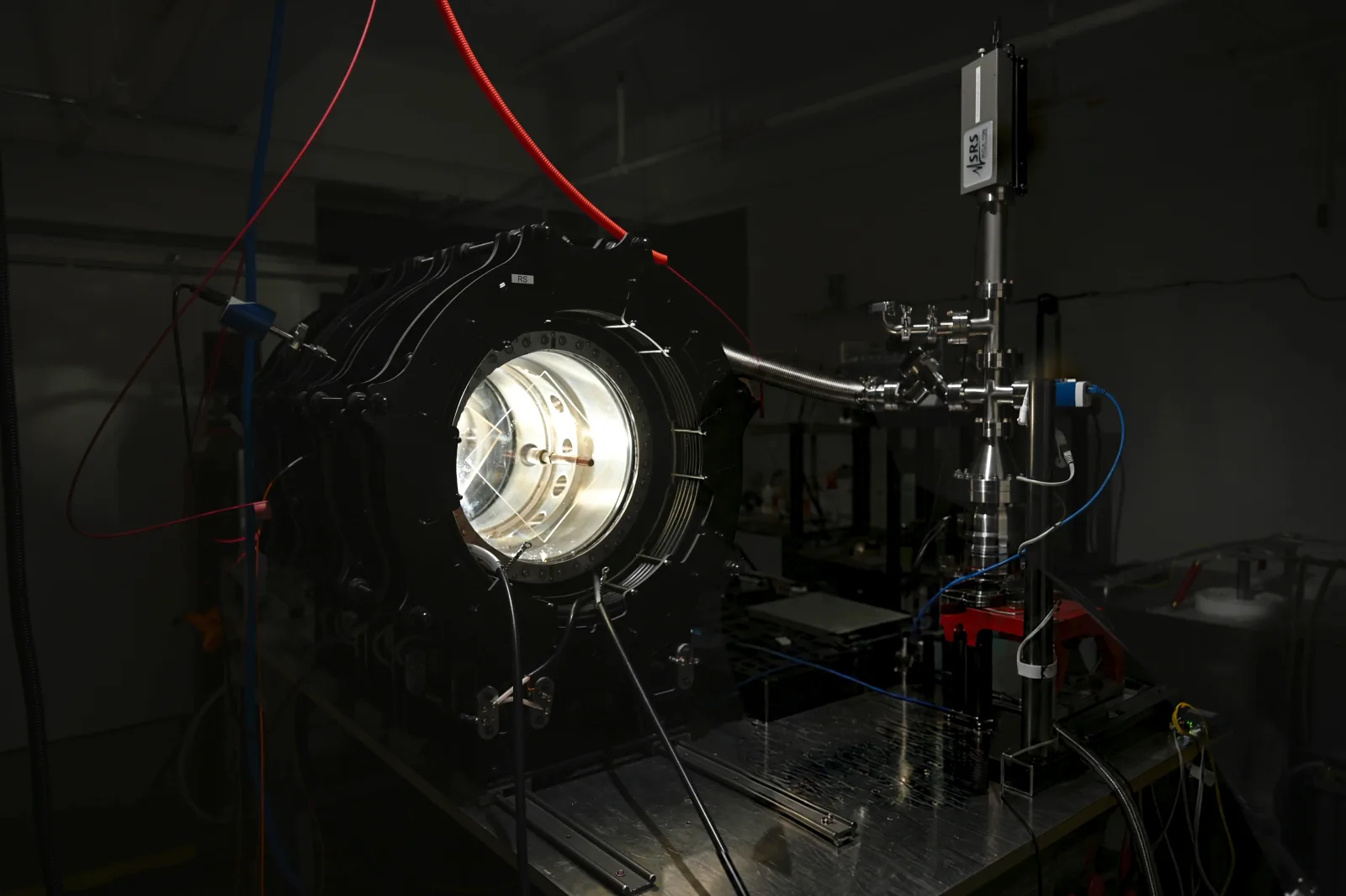
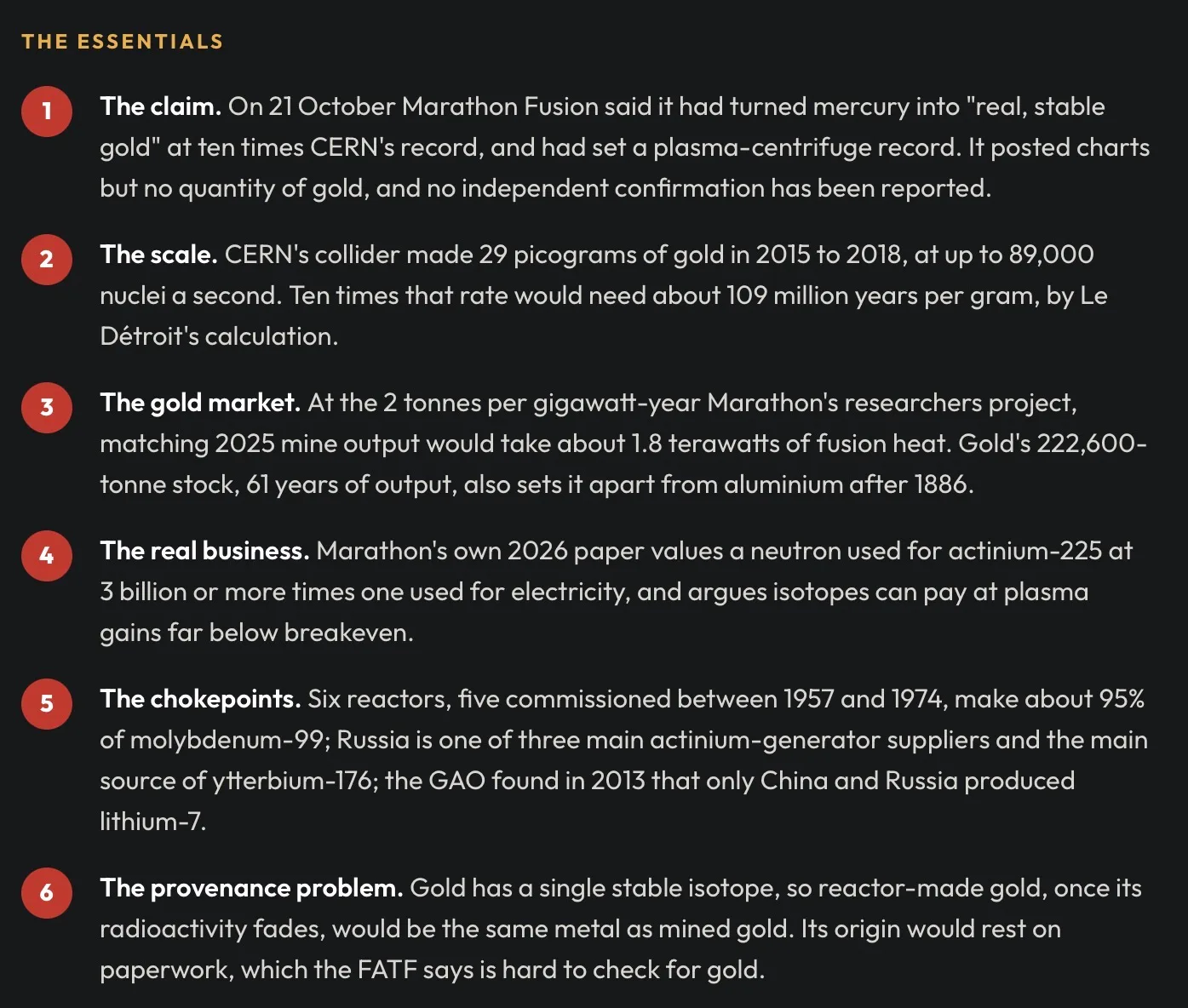
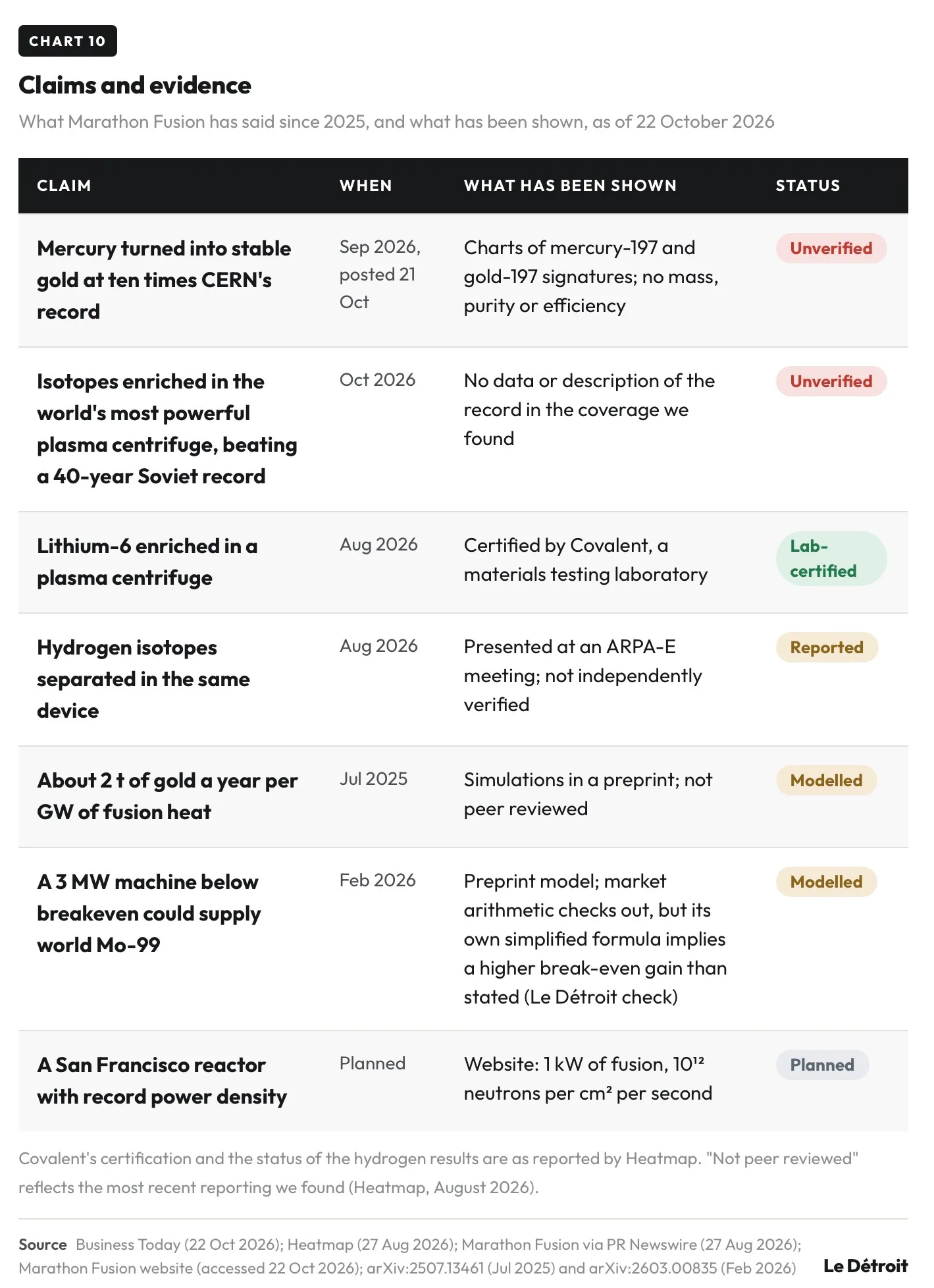
On 21 October Marathon Fusion, a San Francisco start-up, posted on X, as quoted by Business Today: "Last month, we demonstrated high-rate alchemy: turning mercury into real, stable gold, beating CERN's record by a factor of 10." The company added that it had "enriched isotopes in the world's most powerful plasma centrifuge, beating the Soviet record that stood for 40 years", and that it is "building a fusion reactor in San Francisco to achieve record power density".
https://x.com/marathonfusion/status/2113001073019662481?s=61
The thread carried charts that Business Today describes as showing signatures of mercury-197 and gold-197, and of copper isotopes made by irradiating zinc. They do not establish how much gold was made, its purity or the efficiency of the process, and the claim still needs independent validation, Business Today noted.
The company, founded in 2023 and led by its chief executive, Kyle Schiller, has a mixed record of proof. Its lithium-6 enrichment in August was certified by Covalent, a materials testing laboratory, Heatmap reported, but its hydrogen separation results were not independently verified. Its 2025 gold proposal rested on computer simulations that had not been peer reviewed.
The numbers that Marathon's own researchers have published tell a more interesting story than alchemy. They show what a fusion neutron is worth, who controls the isotopes that sell for the most, and why gold made in a reactor would be the same metal as gold dug from the ground.
2. Ten times almost nothing
CERN's record is tiny by nature. On 8 May 2025 its ALICE collaboration reported that lead nuclei grazing each other in the Large Hadron Collider had produced 86 billion gold nuclei during Run 2, from 2015 to 2018: about 29 picograms, at a peak rate of about 89,000 nuclei a second. Each nucleus then broke up against the beam pipe or collimators.
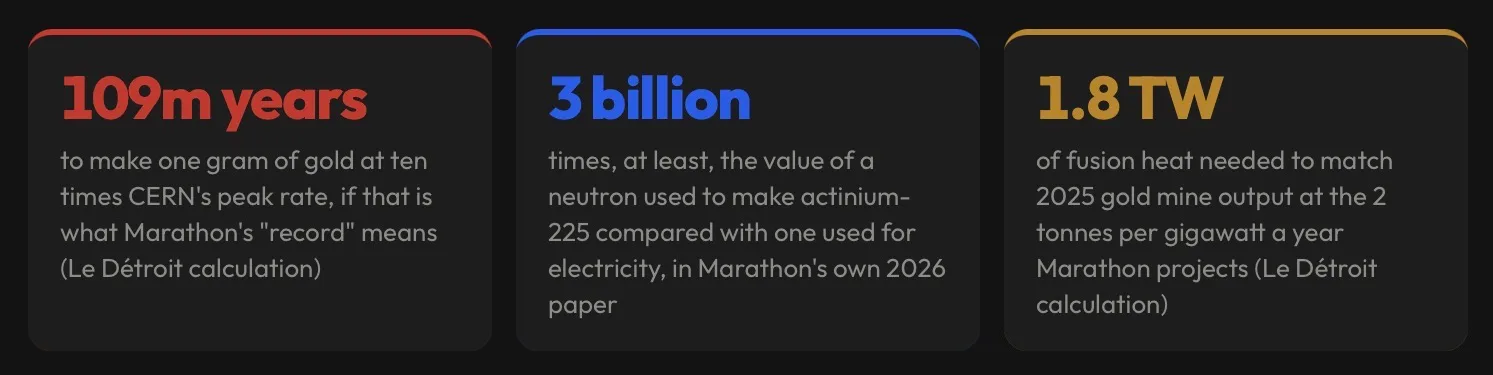
Marathon has not defined its "factor of 10". If it refers to CERN's peak rate, ten times 89,000 nuclei a second comes to about 9 nanograms of gold a year, worth roughly a ten-thousandth of a US cent at about US$4,050 an ounce. At that pace a single gram would take some 109 million years, by Le Détroit's calculation. If the comparison is with CERN's total, the result would be about 290 picograms.
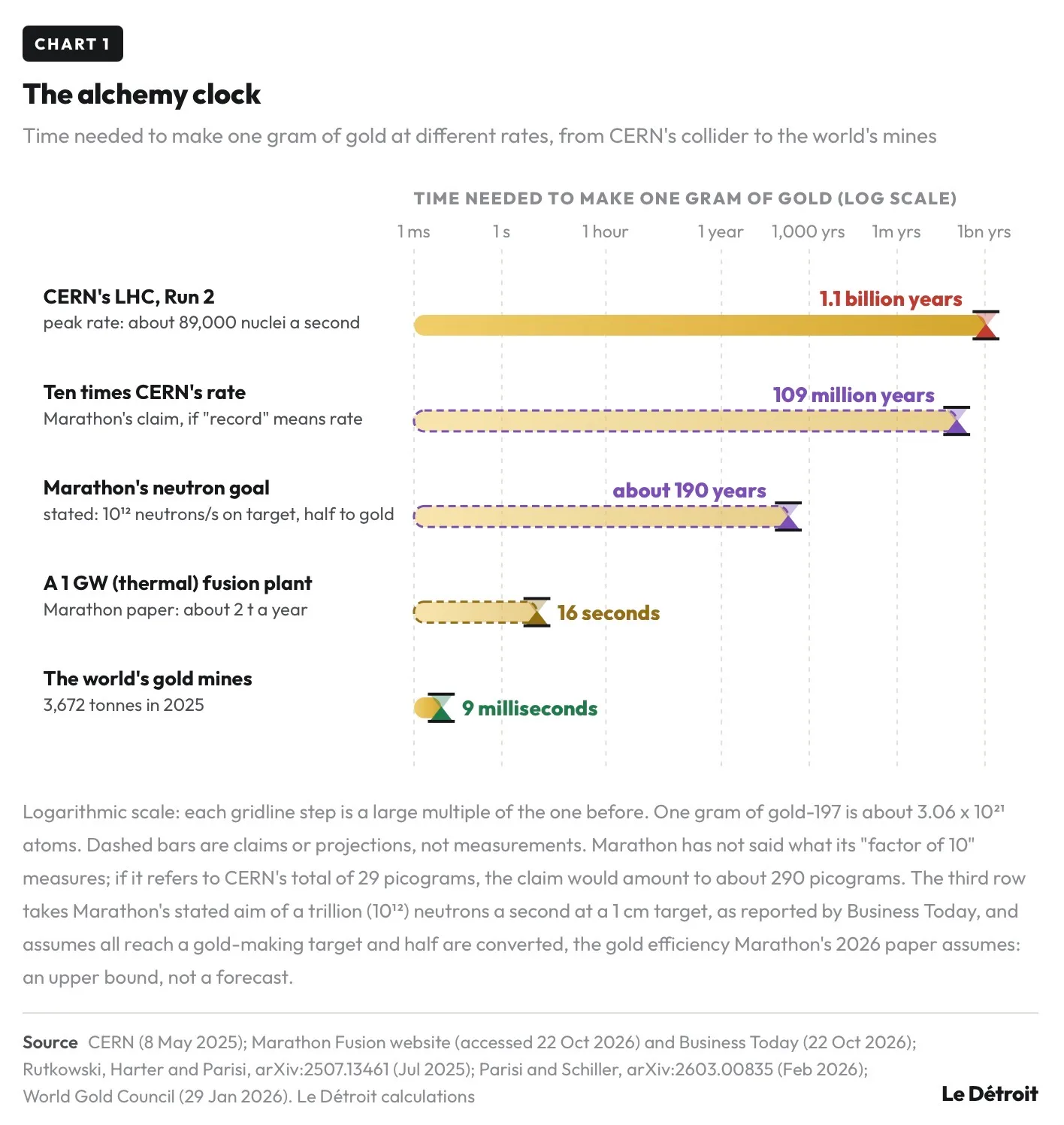
Scale is not the point of a first experiment, and the reaction is not new: the 2025 paper cites earlier laboratory measurements of mercury-198 struck by 13 to 15 MeV neutrons. A confirmed result would show Marathon making gold on its own hardware. The company says it aims to direct a trillion neutrons a second at a 1 cm target, Business Today reported; even if half became gold, a gram would take about two centuries. Marathon's projected gigawatt plant would make one every 16 seconds.
3. What two tonnes per gigawatt would do to gold
That 2025 preprint, by Adam Rutkowski, Jake Harter and Jason Parisi of Marathon, projects about 2 tonnes of gold a year per gigawatt of fusion heat, from a mercury layer in the reactor's blanket, without reducing electricity output and while remaining compatible with breeding the plant's tritium. The authors say this could roughly double a fusion plant's revenue; at about US$4,050 an ounce, 2 tonnes are worth about US$260m.
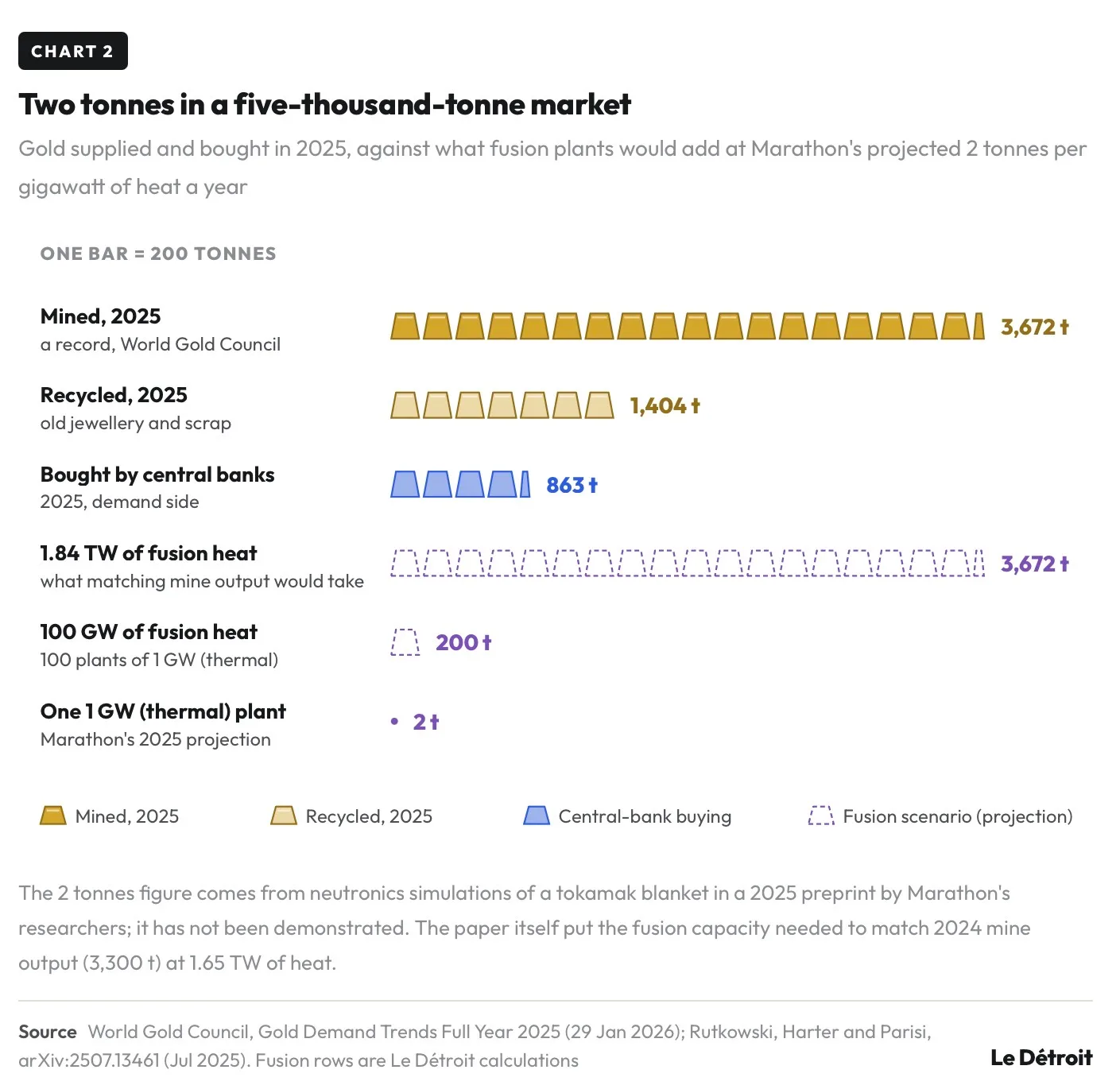
Against the market, it is a rounding error. Mines produced a record 3,672 tonnes in 2025 and recycling 1,404 tonnes, while central banks bought 863 tonnes, the World Gold Council says. Matching mine output would take about 1.8 terawatts of fusion heat, by Le Détroit's arithmetic; the 2026 paper similarly says the gold market, "∼$700 B/yr", "can support ∼2 TW". The paper prices gold at US$160,000 a kilogram, about US$5,000 an ounce; the Council valued 2025 demand at US$555bn, at an average of US$3,431 an ounce.
History offers a precedent for a precious metal undone by a process. Aluminium cost US$12 a pound before improvements in the early 1880s cut it to US$4; the Hall process of 1886 brought it to US$2, and production at Niagara Falls to 75 cents and then 30 cents, according to the Science History Institute.
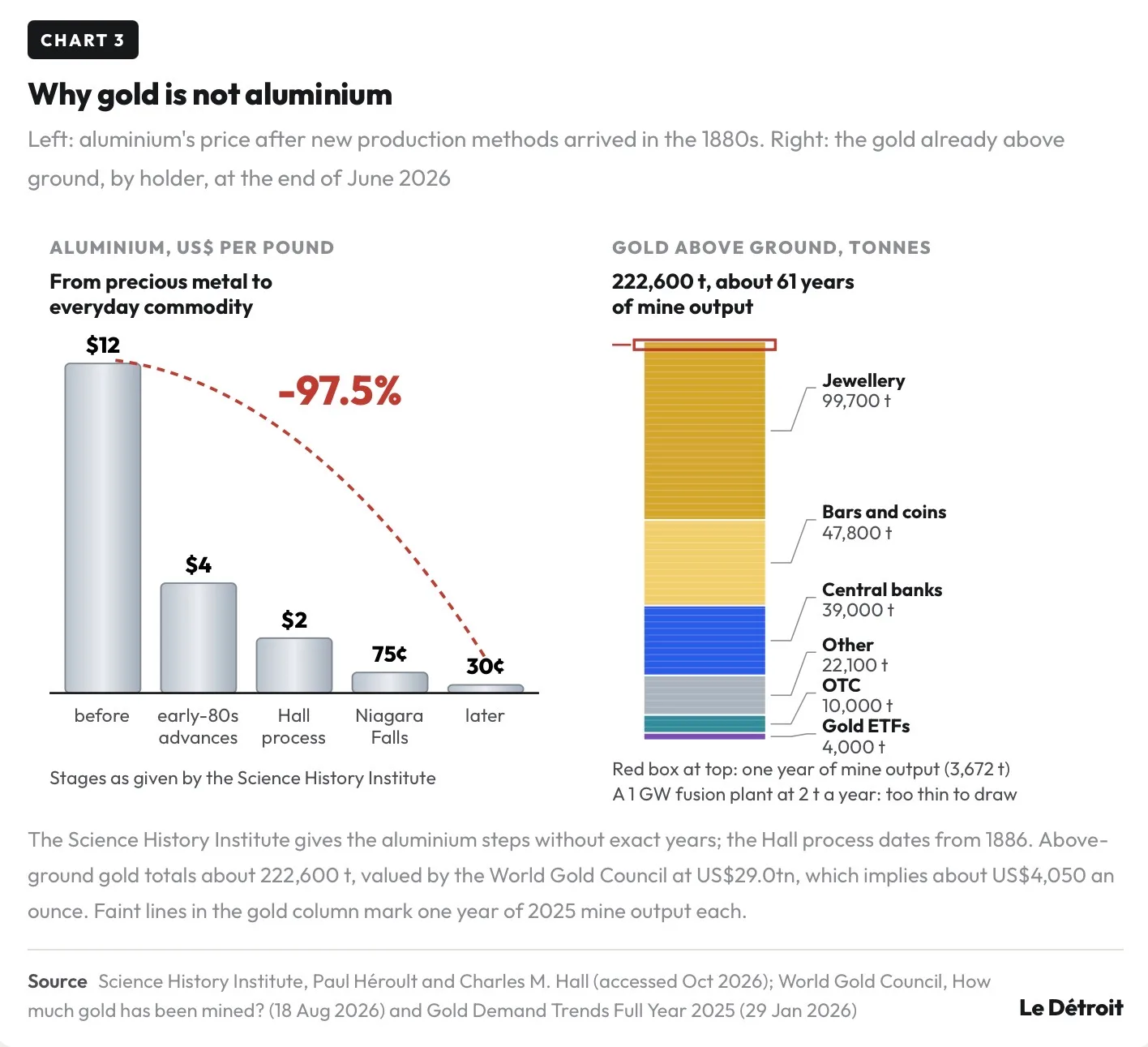
Gold is different. Aluminium's value lay in scarcity that new output quickly swamped; gold's rests on a stock of about 222,600 tonnes, some 61 years of mine output, of which central banks hold 39,000 tonnes. On Marathon's own numbers, fusion would matter for the gold price only at terawatt scale, and the authors concede the risk: the subsidy from gold would continue "but with a lower value if the price of gold decreases as a result of increased supply".
4. The same metal, by design
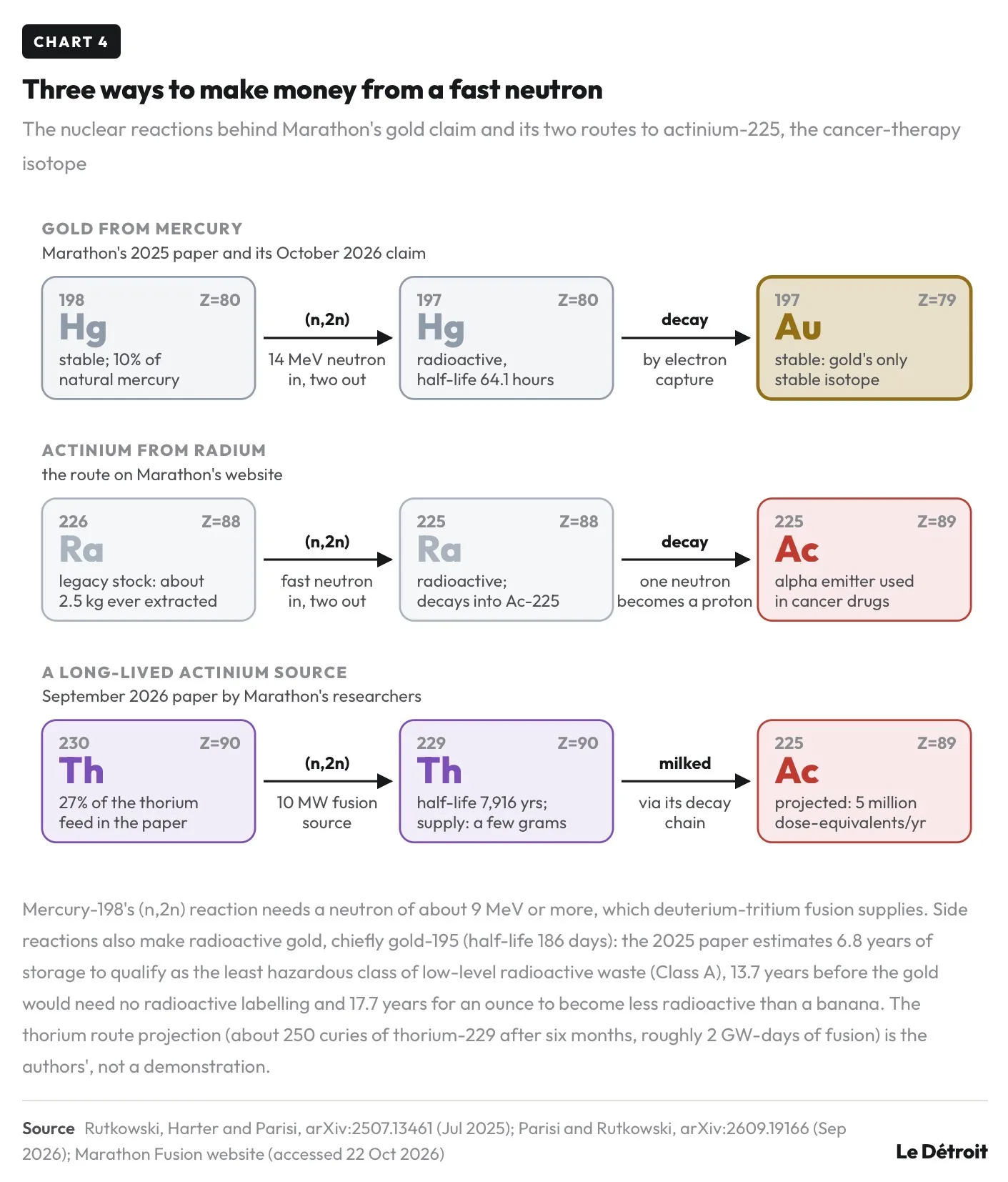
The more unsettling question is provenance. Gold-197 is "the only stable isotope of gold", as the 2025 paper notes. In Marathon's scheme, mercury-198 struck by a fast neutron loses one, becomes mercury-197 and decays, with a half-life of 64 hours, into gold-197.
Side reactions also make radioactive gold. The paper estimates that the metal would need 6.8 years of storage to qualify as the least hazardous class of low-level radioactive waste, 13.7 years before it would need no radioactive labelling, and 17.7 years for an ounce to become less radioactive than a banana.
Diamonds offer the contrast. Laboratory-grown stones can be told apart: GIA's researchers say its techniques "can easily identify and characterize laboratory-grown diamonds". Their wholesale prices have fallen 96% since 2018 on one analyst's index, JCK reports. Anglo American, which co-led Marathon's 2024 seed round, cut the value of its De Beers diamond business to US$2.3bn in February, citing a "prolonged shifting of customer preference between natural diamonds and lab-grown diamonds".
5. The neutron as a commodity
Marathon's February 2026 paper, by Parisi and Schiller, reframes the business. It asks what one 14.1 MeV fusion neutron is worth and finds that "the range spans ten orders of magnitude". Turned into electricity, a neutron earns US$1.5 to 3.0 x 10⁻²⁰; into gold, 2.6 x 10⁻²⁰; into molybdenum-99, the parent of the most used medical imaging isotope, 2.6 x 10⁻¹⁷; into actinium-225, a cancer-therapy isotope, 9.3 x 10⁻¹¹, at least 3 billion times as much as electricity.
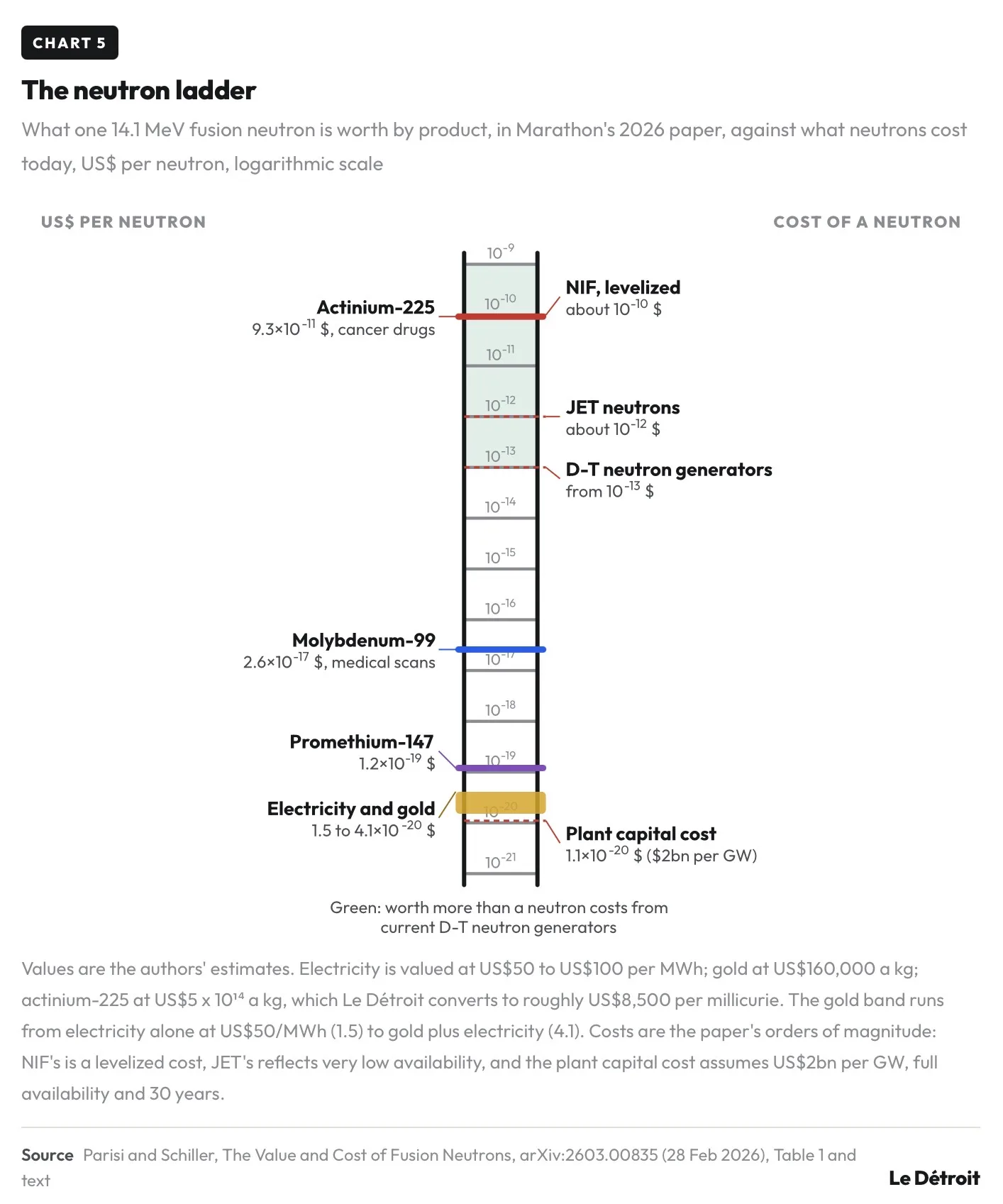
The paper sets those values against the cost of making neutrons. JET, Europe's former flagship experiment, produced them at about US$10-12 each and deuterium-tritium neutron generators at more than US$10-13, it says, concluding that "today's sources are ∼7 orders of magnitude too expensive for commercial fusion electricity generation". Of the products listed, only actinium beats today's cheapest sources.
Hence the "neutron ladder": sell the most valuable isotopes first, then cheaper ones, and electricity last, with "each rung" generating "revenue and operational experience that funds the next". It inverts the usual fusion pitch, in which a plant earns nothing until it makes net power. Marathon's website lists alchemy and radiopharmaceuticals among its solutions, including actinium-225 made from radium-226.
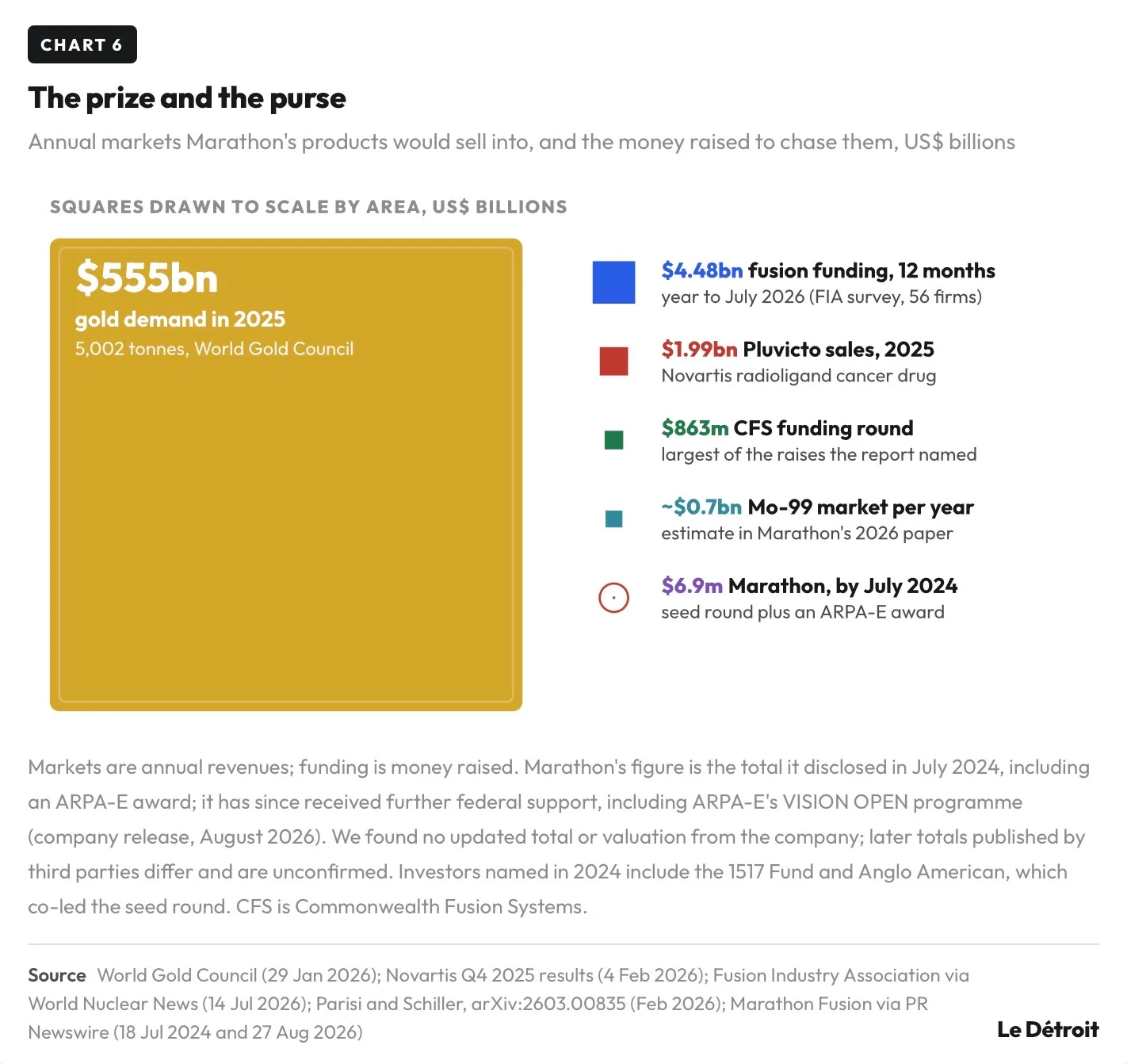
The catch is market size. The paper says the molybdenum-99 market, about US$0.7bn a year, "saturates at only ∼3 MW of fusion power". Radioligand drugs are growing fast: Novartis's Pluvicto sold US$1,994m in 2025, up 42% at constant currencies, and in July Novartis reported Phase I data on Ac225-PSMA-617, an actinium-based radioligand therapy for prostate cancer. But Pluvicto uses lutetium-177, and the actinium market is still being built.
6. Below breakeven, but not small
The paper's second argument concerns plasma gain, Q, the ratio of fusion power to the heating power fed into the plasma. Selling electricity alone needs a Q of about 22 at US$50 a megawatt-hour, or about 10 at US$100; adding gold lowers the hurdle to about 3 at US$50, or about 4 at US$100. For molybdenum-99 it gives two figures: profitable at a Q of about 0.001 in one passage, and value far above cost unless Q falls below about 0.01 in another. Actinium-225 already pays with existing neutron sources, it says, provided radium feedstock is cheap and the neutron flux high enough.
For comparison, the paper gives JET a Q of about 0.33. JET's 59 MJ pulse of December 2021, which lasted five seconds, produced about 11 MW of fusion from 40 MW of heating; its peak record, 0.64 by Physics World's account (EUROfusion gives 0.65), dates from 1997 and lasted about 0.15 seconds. The US National Ignition Facility first exceeded a target gain of 1 on 5 December 2022, when 2.05 MJ of laser light produced 3.15 MJ; its best shot, on 7 April 2025, yielded 8.6 MJ, a gain of 4.13.
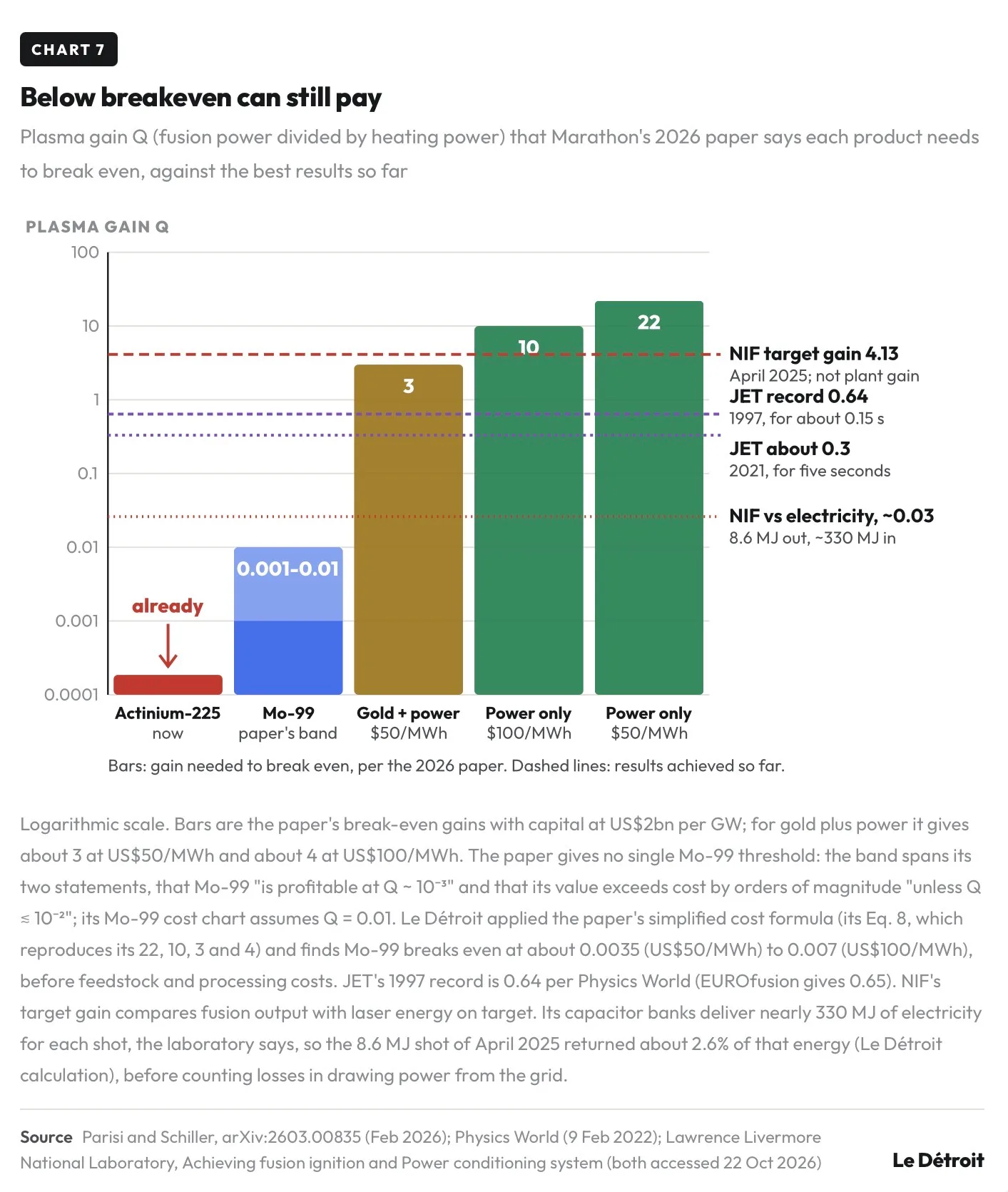
Target gain is not plant gain. NIF's capacitor banks deliver nearly 330 MJ of electricity for each shot, the laboratory says; its best shot, which put 2.08 MJ of laser light on target, returned under 3% of that, by Le Détroit's arithmetic. Electricity is further off: in the Fusion Industry Association's 2026 survey, 71% of companies said they expect a plant delivering power to the grid by the 2030s.
The isotope rungs need far less gain, but not small machines. The paper says "a 3 MW system with Q ≪ 1 could supply global 99Mo demand ($0.7B/yr)"; by Le Détroit's calculation, 3 MW of deuterium-tritium fusion releases about 1018 neutrons a second, worth about US$0.9bn a year as molybdenum-99. But at a gain of 0.01, as in the paper's Mo-99 cost chart, those 3 MW would need 300 MW of heating, and the paper's simplified cost formula, applied by Le Détroit (it reproduces the paper's 22, 10 and 3), puts Mo-99's break-even gain at about 0.0035 to 0.007 before feedstock costs: above the 0.001 the paper calls profitable. Rivals exist: the NEA's October 2025 report expected SHINE's fusion-driven Chrysalis plant to start by 2027, while NorthStar halted Mo-99 production in 2023, citing costs and subsidised competition.
7. The chokepoints fusion wants to unlock
The strongest case for Marathon is strategic. Technetium-99m, made from molybdenum-99, is used in 80 to 85% of nuclear medicine procedures, 30 to 40 million a year, and Mo-99's 66-hour half-life leaves "limited capacity for stockpiling", the OECD Nuclear Energy Agency says. Six research reactors supply about 95% of it; five were commissioned between 1957 and 1974. Outages in late 2022 caused "a near-complete halt in European processing capacity", and the Dutch HFR was shut in October 2024 for an urgent structural repair.
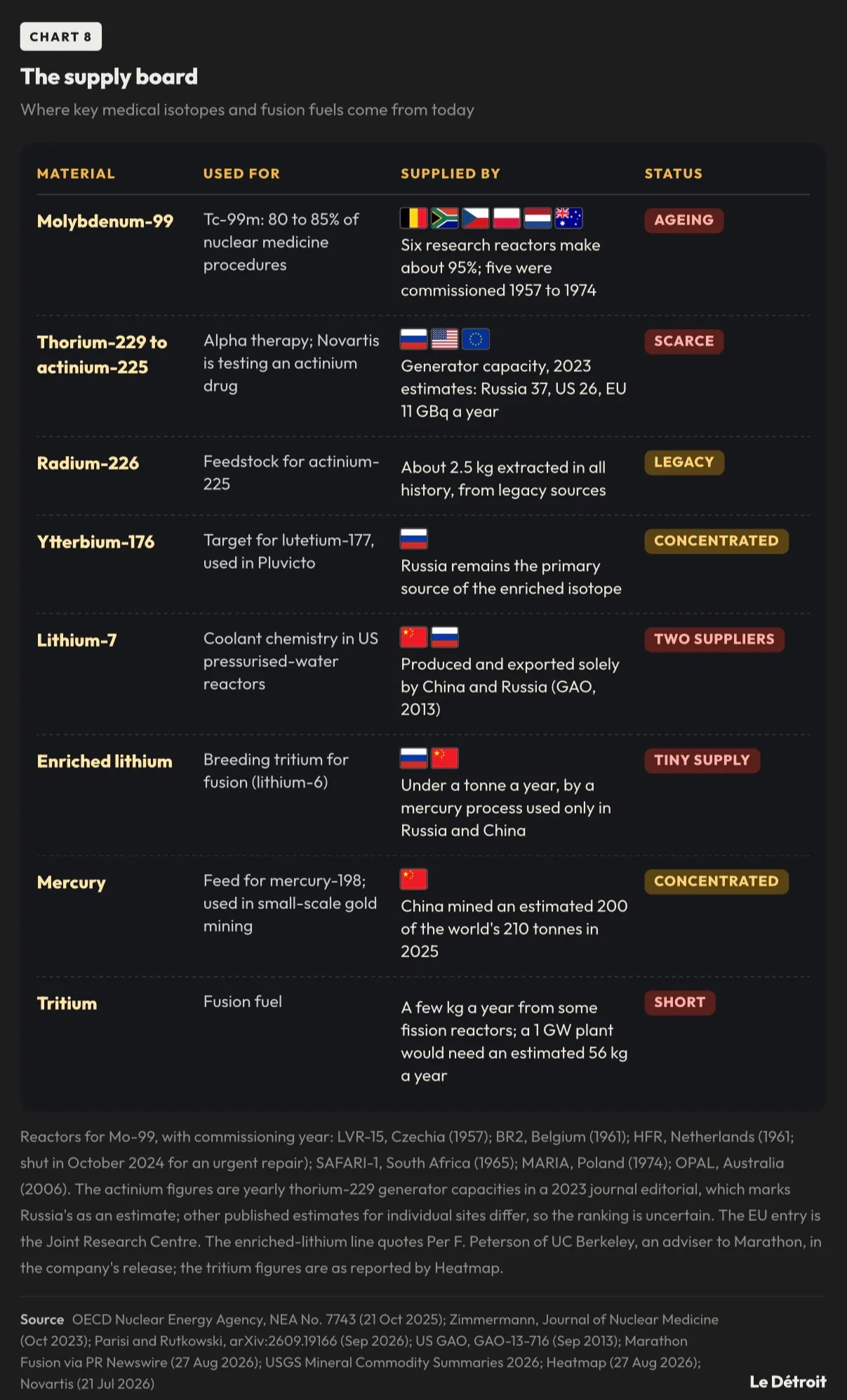
Alpha emitters are scarcer still. The world's supply of thorium-229, the long-lived source that is milked for actinium-225, is "a few grams", Marathon's researchers write, and all the radium-226 ever extracted amounts to about 2.5 kg. A 2023 Journal of Nuclear Medicine editorial estimated that Russia's IPPE in Obninsk could make 37 GBq of actinium a year from thorium-229, against 26 at Oak Ridge and 11 at the EU's Joint Research Centre, and noted that the war in Ukraine "has not (yet) altered" US trial access to Russian actinium. Russia is also "the primary source of enriched Yb-176", used to make lutetium-177, the NEA says.
Fusion's own fuel chain is just as narrow. Lithium-7, used in US pressurised-water reactors, is "produced and exported solely by China and Russia", the GAO found in 2013. The world makes "less than a tonne of enriched lithium each year", with "a mercury-based process now used only in Russia and China", Per Peterson of UC Berkeley, an adviser to Marathon, said in August; the United States ran such a process, COLEX, at Oak Ridge's Y-12 plant from 1955 to 1963, using "literally millions of pounds" of mercury. Tritium comes to a few kilograms a year, while a 1 GW plant would need about 56 kg a year, Heatmap reported. Marathon's papers and products bear on most of these bottlenecks, which makes its pitch a security argument as much as a commercial one, and helps explain the backing of ARPA-E, the energy department's research agency.
8. The mercury irony
Gold from mercury would invert an old relationship. Artisanal and small-scale gold mining, which involves 10 to 15 million miners and produces 12 to 15% of the world's gold, accounts for about 37% of the roughly 2,200 tonnes of mercury released by human activity each year, by UNEP's estimate, making it the largest source. The Minamata Convention bans new primary mercury mining and phases out the remaining mines, as the 2025 paper notes, and the United States has banned exports of elemental mercury since 1 January 2013.
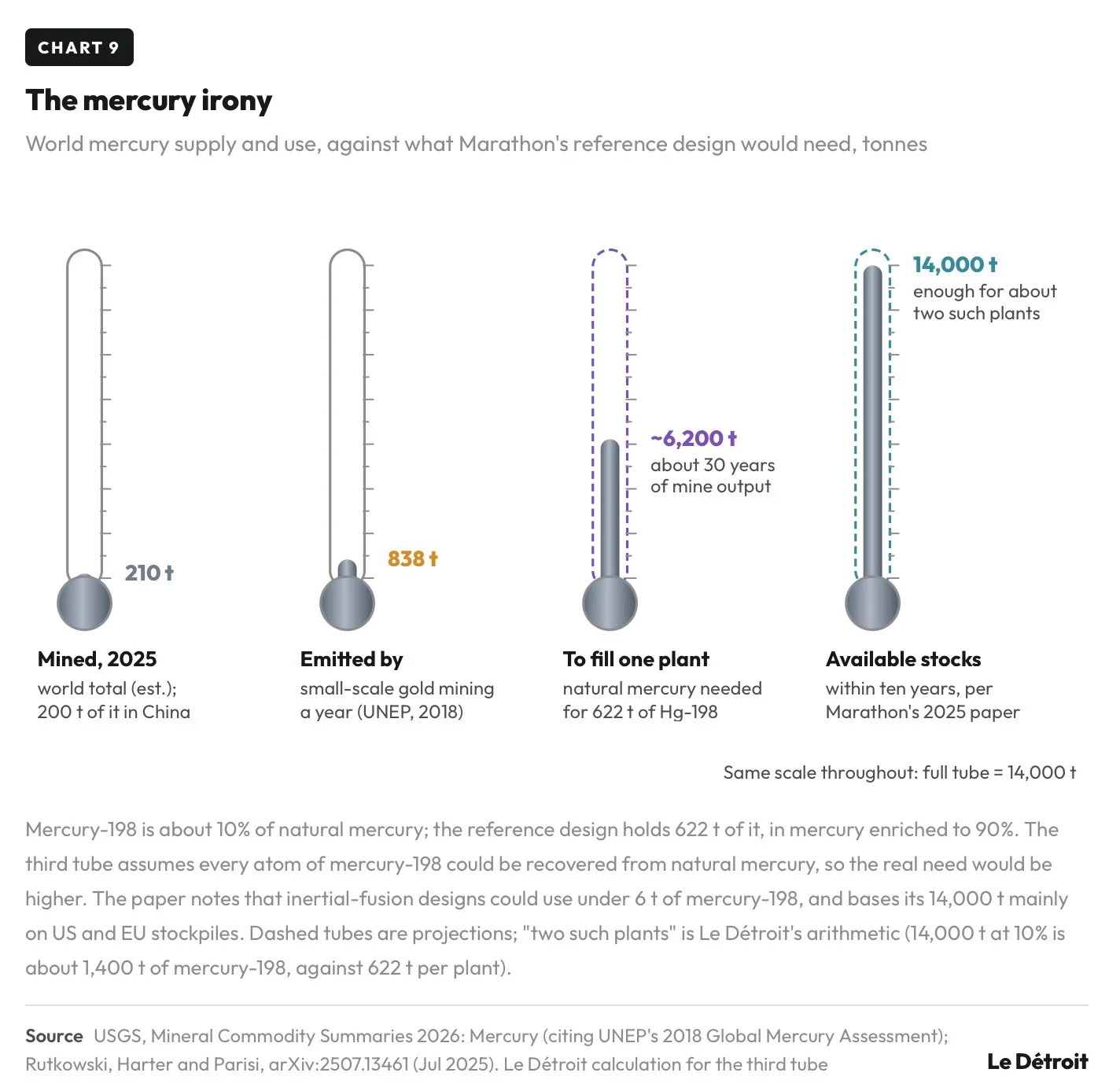
Marathon's design needs mercury in bulk. Its reference blanket holds 622 tonnes of mercury-198 enriched to 90%, and mercury-198 is 10% of natural mercury. Filling it would take at least 6,200 tonnes of natural mercury, by Le Détroit's arithmetic: about 30 years of world mine output, which the USGS estimates at 210 tonnes in 2025, 200 of them in China. The authors estimate that 14,000 tonnes, mainly from stockpiles, could be made available within ten years, note that inertial-fusion designs could use under 6 tonnes, and argue that fusion "appears to be a strong candidate for an acceptable new process" under the convention.
9. Who is paying, and what would settle it
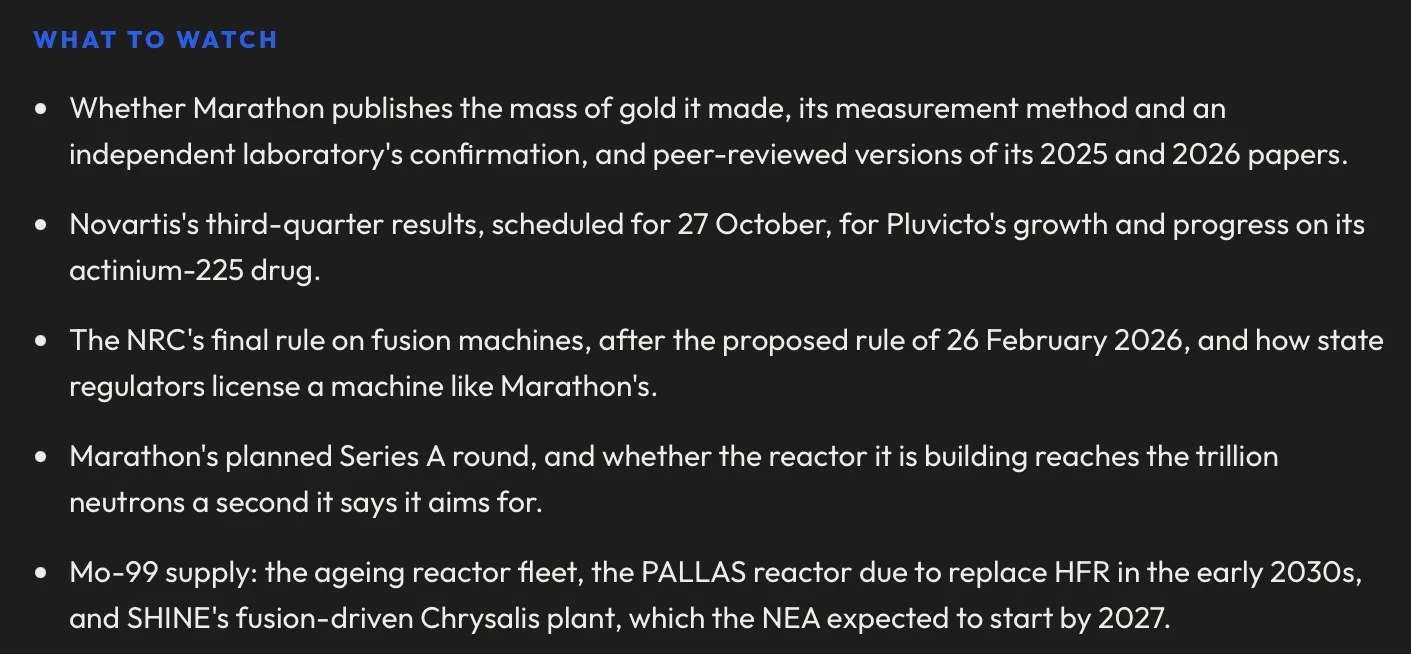
Four things would settle the alchemy claim: a measured mass of gold; the method, confirmed by an independent laboratory as Covalent did for lithium-6; peer-reviewed versions of the papers; and data on the centrifuge record. Until then, the claims rank as follows.
Marathon is small. Its US$5.9m seed round in July 2024, co-led by the 1517 Fund and Anglo American, brought its funding to US$6.9m including an ARPA-E award, the company said; it plans a Series A, Heatmap reported. Fusion companies raised US$4.48bn in the year to July 2026, including US$863m for Commonwealth Fusion Systems, the Fusion Industry Association says. Marathon pitches itself as a supplier to every reactor, an approach Schiller calls "reactor agnostic", and as a claim on isotopes priced by medicine rather than by power markets.
Marathon's reactor also needs a regulator. The NRC published a proposed rule on 26 February 2026 that keeps fusion machines in the byproduct-material framework of 10 CFR Part 30 rather than treating them as reactors, following the ADVANCE Act of 2024; it had not been finalised when K&L Gates reviewed the rulemaking in August. Most such licences would likely come from the 40 Agreement States, which oversee about 90% of the nuclear materials licensed in the United States.