1. Back in Bangkok, in a different world
The last time the IMF and the World Bank held their Annual Meetings in Bangkok, in 1991, globalisation was the only game in town. "Back then, the fax machine represented speed," Thailand's prime minister, Anutin Charnvirakul, reminded delegates last week. Later he added: "Today, geopolitical fragmentation is reshaping trade and investment."
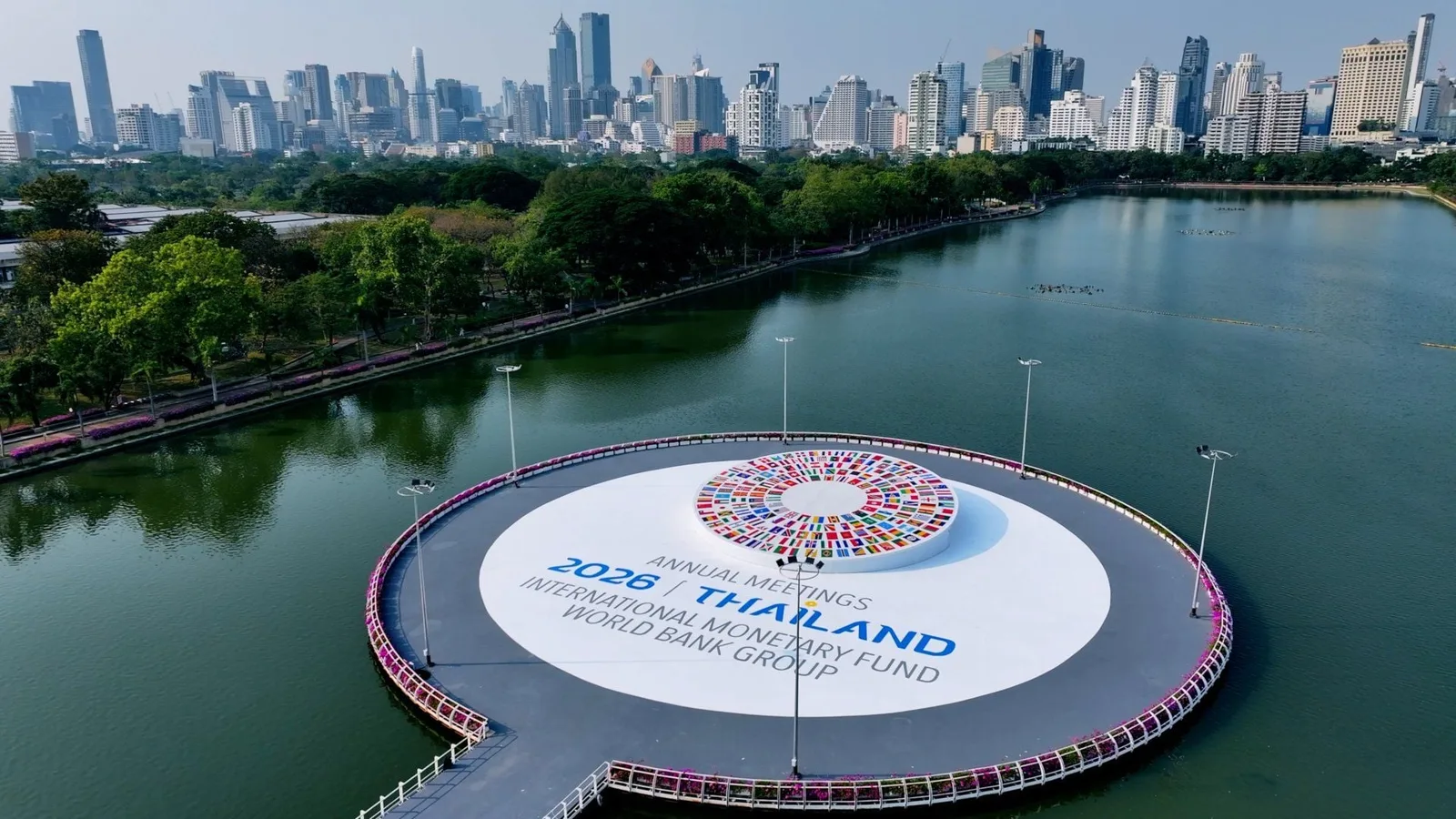
The 2026 meetings, held from 12 to 18 October at the Queen Sirikit National Convention Center, drew more than 18,000 people. They took place in the shadow of a war. The war with Iran, which began with US and Israeli strikes on 28 February according to Britannica, closed the Strait of Hormuz. That closure "resulted in a significant supply shock", the IMF says, in what it calls the war in the Middle East. Oil prices almost doubled in the early months of the conflict, the Fund says.
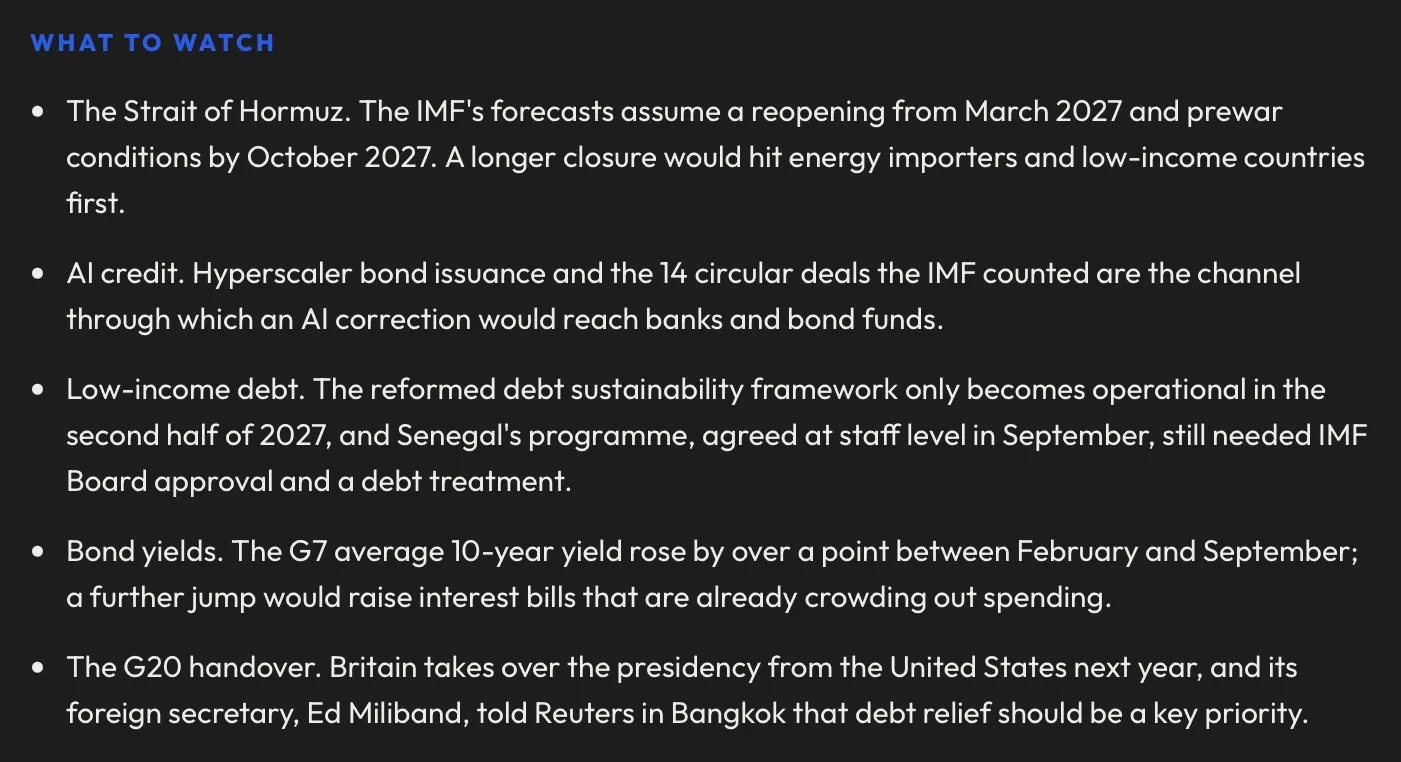
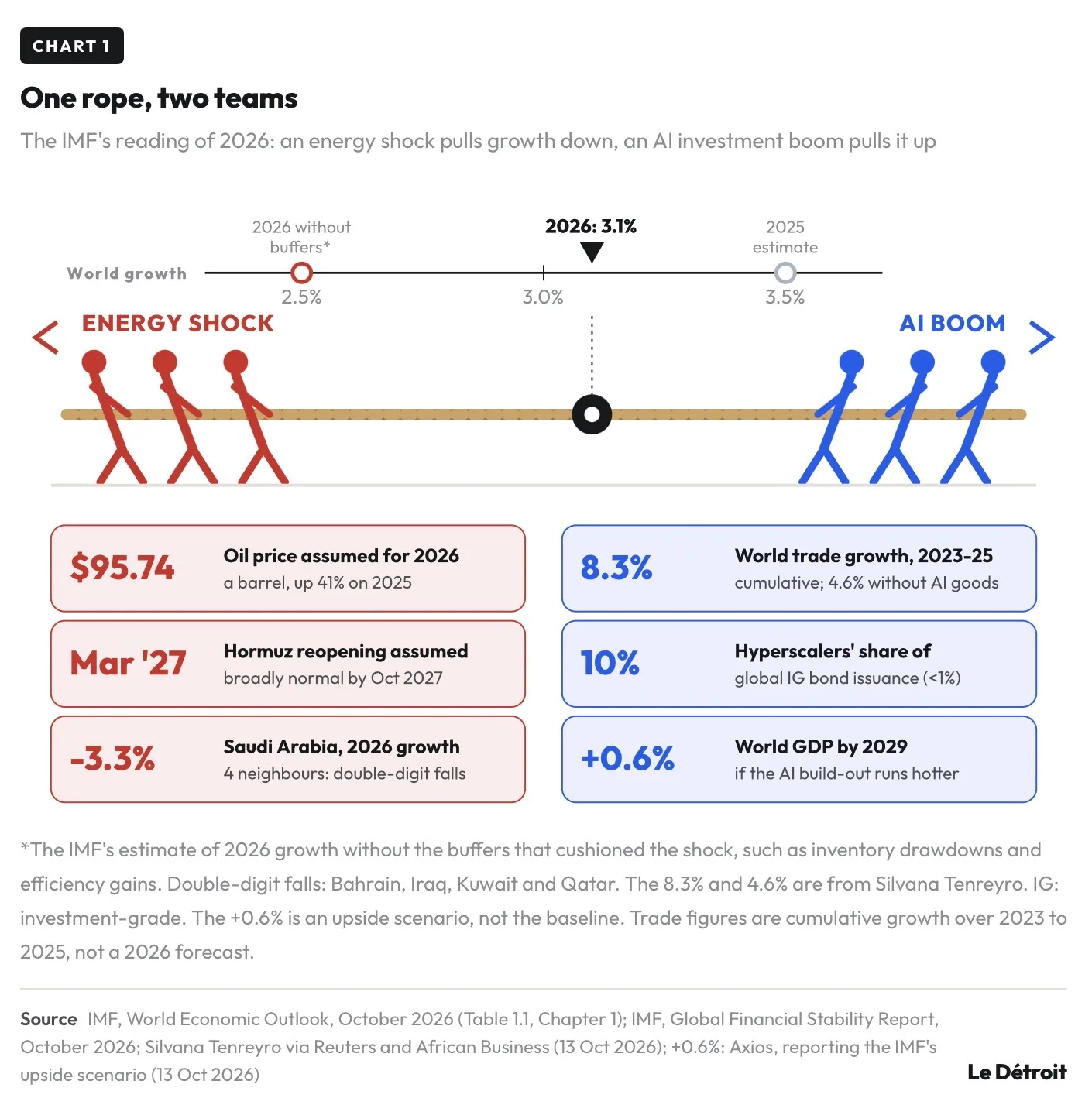
Markets have since run ahead of the Fund's numbers. On 19 October, the day after the meetings closed, December Brent settled at $109.55 a barrel, after two tankers were reported struck in the Gulf and Iran said it had "no choice" but to assert control over the Strait, Rigzone reported. The IMF's $95.74 is a 2026 average across three benchmarks, so the two are not directly comparable, but the direction is not reassuring.
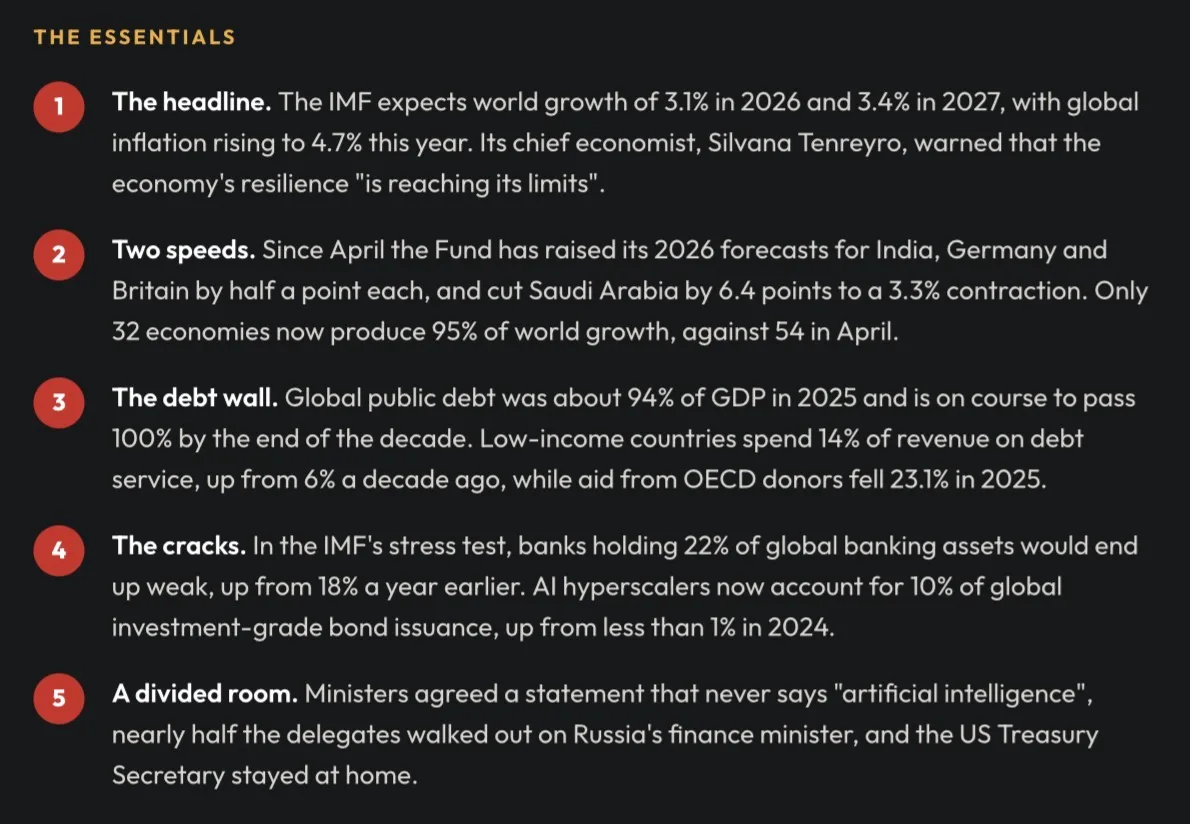
Yet the IMF's headline number barely moved. It expects the world economy to grow 3.1% in 2026, the same as in April, and 3.4% in 2027. Kristalina Georgieva, its managing director, described an economy pulled between "two big opposing forces": a drag from energy supply shocks and a lift from investment in artificial intelligence. "Our boat is being lashed by the waves of technology and geopolitics," she said, according to Xinhua.

The calm average hides the strain. Silvana Tenreyro, the IMF's chief economist, said that without buffers such as inventories and efficiency gains, "this year's global growth would have been 60 basis points lower at 2.5% instead of 3.1%". Her summary was blunt: "The economy has been resilient, but that resilience is reaching its limits."
2. Escalators and trapdoors
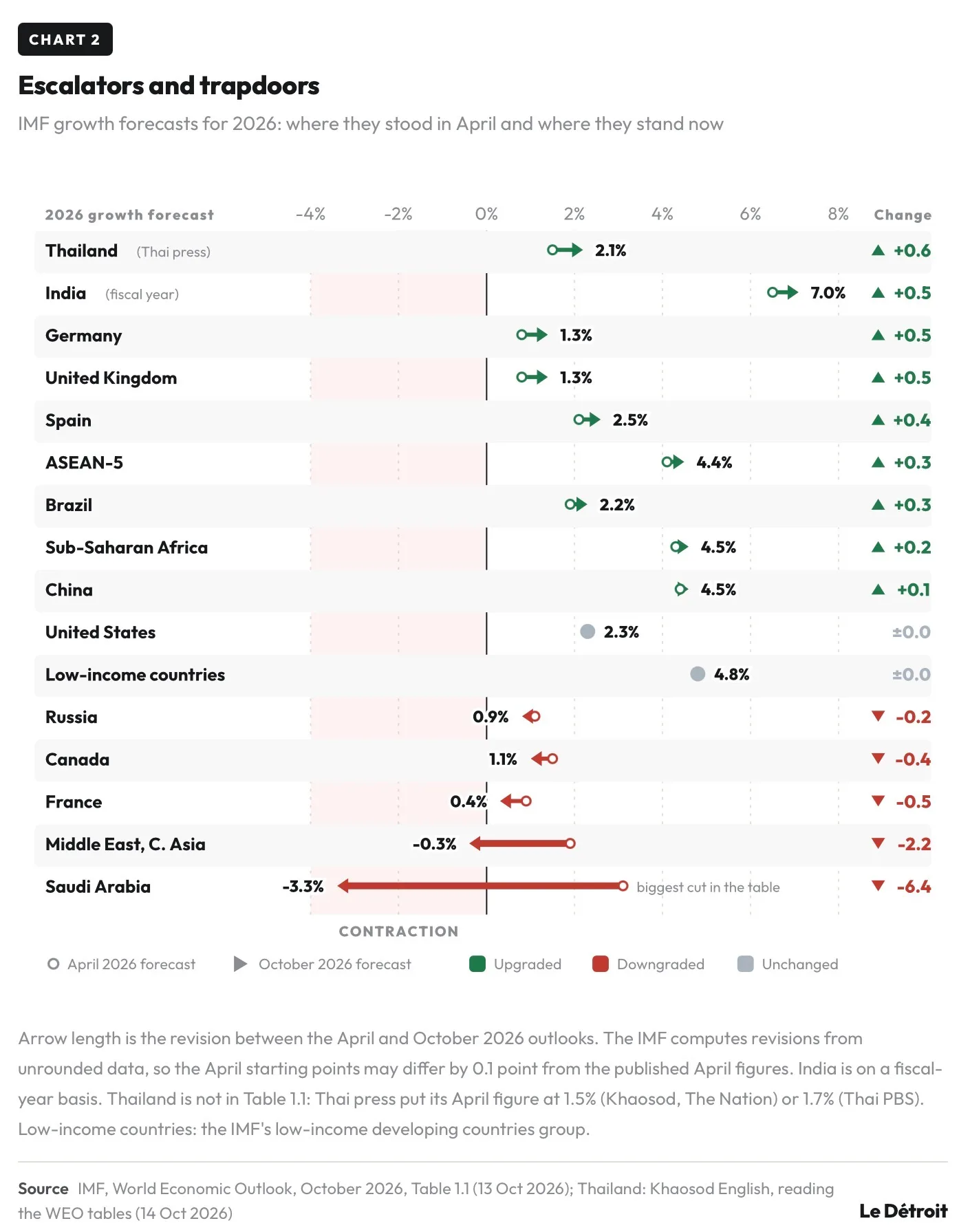
Underneath the global figure, the October World Economic Outlook moves countries in opposite directions. Since April, India's 2026 forecast (fiscal year 2026/27) has been raised by half a point to 7.0%, the fastest among large economies. Germany and Britain also gained half a point each, to 1.3%. The United States is steady at 2.3% for both 2026 and 2027, with next year revised up by 0.2 point.
The trapdoors are in the Gulf. Saudi Arabia is now forecast to shrink by 3.3% in 2026, a cut of 6.4 points since April, before rebounding by 7.9% in 2027. Bahrain, Iraq, Kuwait and Qatar are projected to suffer double-digit contractions this year. The Middle East and Central Asia as a whole goes from expected growth to a 0.3% contraction. In Europe, France was cut by half a point to 0.4%.
The result is a narrower engine. The IMF counts 32 economies that now account for 95% of global growth, compared with 54 in April. Energy importers outside the technology value chain face the hardest outlook, the Fund says.
The host sits in between. Thailand's growth is forecast at 2.1% in 2026, up from 1.5% in April but among the slowest in Southeast Asia, Khaosod English reported from the IMF tables; Vietnam is expected to lead the region at 8.4%. China slows from 5.0% in 2025 to 4.5% this year and 4.0% in 2027.
3. A rising tide of public debt
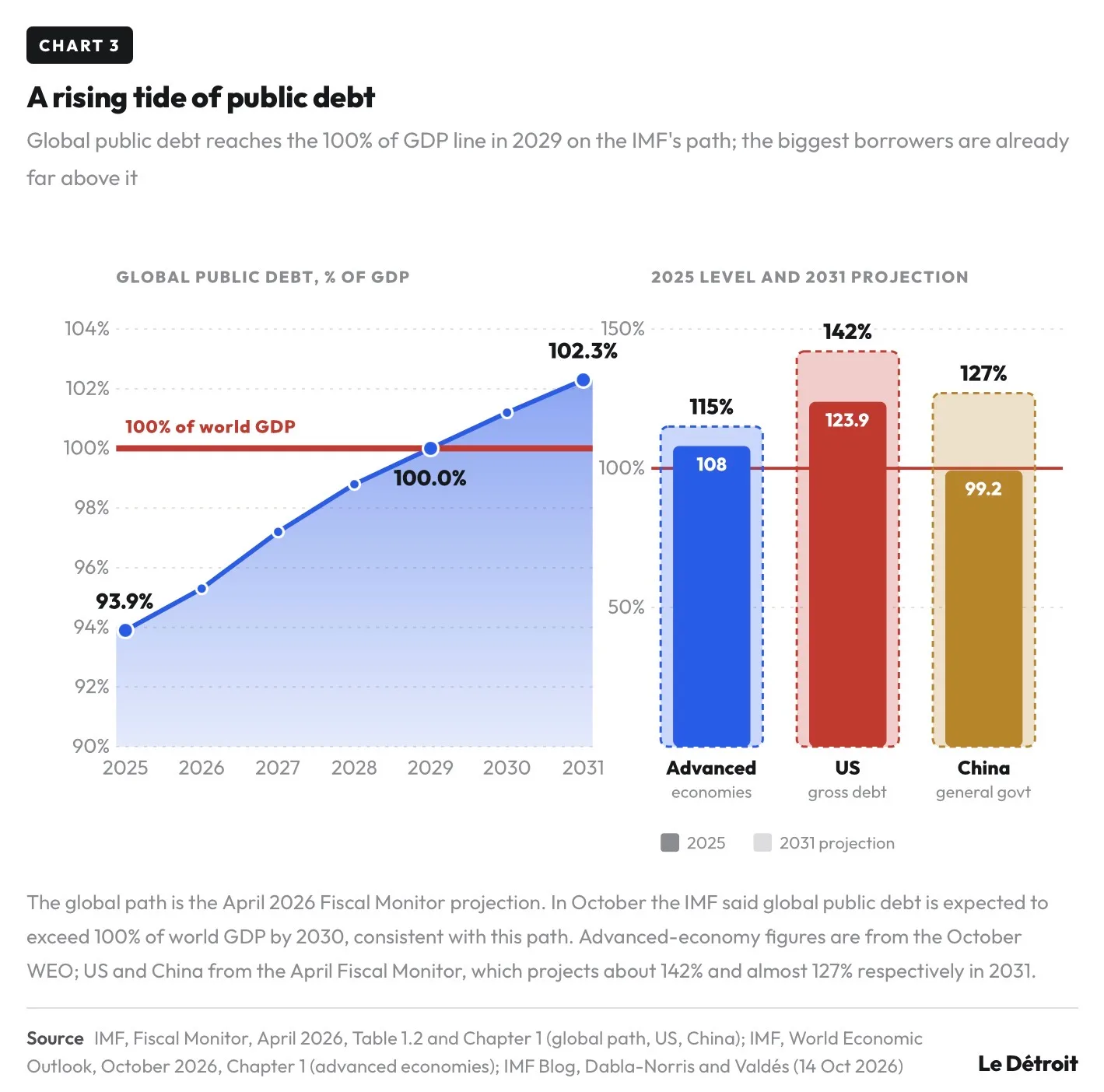
Governments enter this shock with little room. Global public debt reached an estimated 93.9% of GDP in 2025, and on the IMF's April projections it touches 100% in 2029 and keeps rising to 102.3% in 2031. In October, the Fund's fiscal chiefs wrote that global public debt "is expected to exceed 100 percent of global gross domestic product by 2030". In advanced economies alone, debt is projected to climb from 108% of GDP in 2025 to 115% in 2031.
The new element is the price of money. The Group of Seven's average 10-year government bond yield rose by over one percentage point between February and September, according to Era Dabla-Norris and Rodrigo Valdés of the IMF's Fiscal Affairs Department. They project US interest payments to rise from about 2.8% of GDP before the pandemic to 5.7% in 2031.
"Higher borrowing costs are adding to fiscal pressures at a time of high debt, making credible consolidation more urgent," the blog summarises.
The two largest economies are the furthest above the line. The April Fiscal Monitor projected US gross debt rising from 123.9% of GDP in 2025 to about 142% by 2031, and China's from 99.2% to almost 127%. The Fund's advice is to cut deficits and stop paying for broad price caps: its October outlook says price-suppressing measures can require 3 to 22 times more fiscal resources than targeted, temporary transfers.
4. The squeeze at the bottom
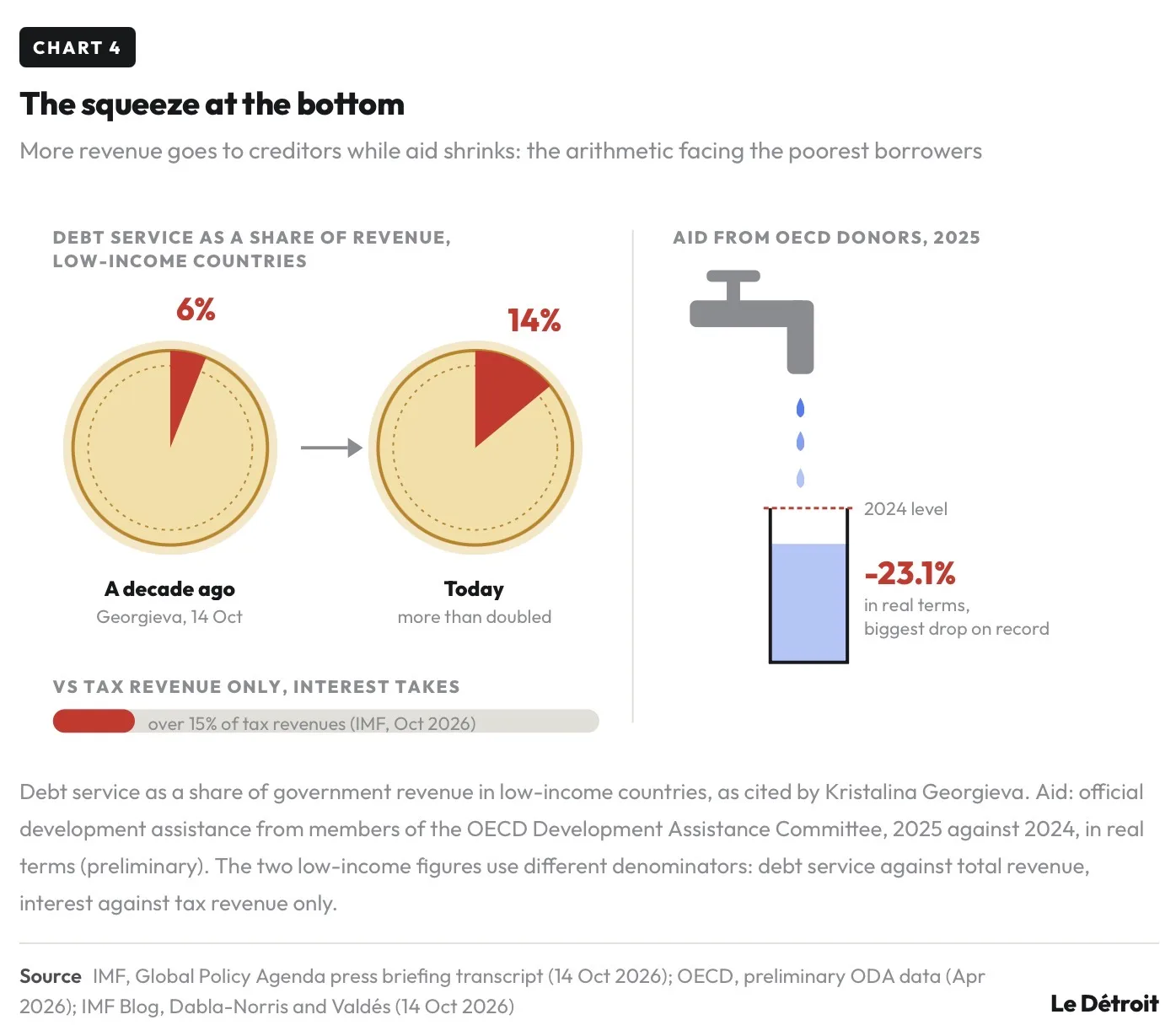
For the poorest countries the debt problem is less about levels than about cash flow. Georgieva said low-income countries' debt service has risen "from 6 percent a decade ago to 14 percent of their revenues today". The IMF's fiscal blog measures it against tax revenue only: interest payments "consume over 15 percent of tax revenues" in low-income countries.
The cushion of aid is thinning at the same time. Official development assistance from OECD donors fell 23.1% in real terms in 2025, the largest annual drop on record. The developing world's external debt reached $12.3 trillion in 2025, according to UN Trade and Development figures cited by Reuters. The IMF also expects food prices to rise by 5% this year and fertilizer by 10%, a direct hit to poor importers.
The official response is slow. A reformed debt sustainability framework for low-income countries, the first review since 2017, was endorsed in September but will only become operational in the second half of 2027. The IMFC called for "enhanced debt transparency from all stakeholders, including private creditors". Senegal, which reached a $2.2 billion staff-level agreement with the IMF after a case of misreported debt, shows what opacity costs, with debt at about 130% of GDP after audits. Georgieva called it "the test case" for creditors, but no Board date had been set. Eric LeCompte of Jubilee USA called the week a disappointment: "There was a lot of information about how challenging problems are, but we saw hardly any action."
5. The 800 million missing jobs
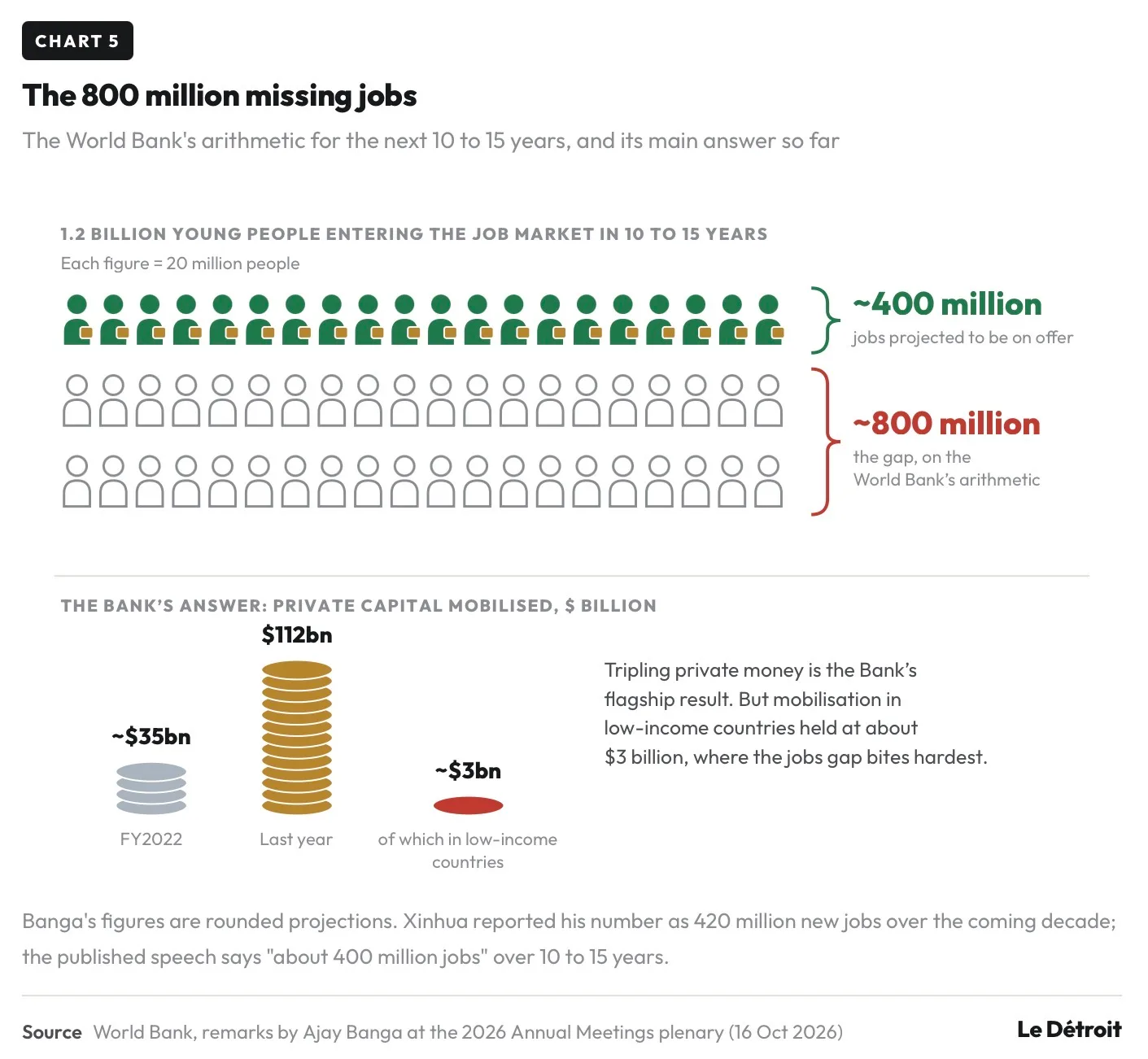
The World Bank brought its own arithmetic. "Over the next 10 to 15 years, 1.2 billion young people will arrive at a job market projected to offer only about 400 million jobs," Ajay Banga told the plenary on 16 October. "Today, the challenge arrives as arithmetic: a gap of roughly 800 million jobs."
The Bank's answer is private money. Banga said it mobilised $112 billion of private capital last year, against roughly $35 billion in fiscal 2022. But in low-income countries, he acknowledged, "mobilization held at roughly $3 billion". Georgieva told reporters that many lower-income countries outside the AI value chain fear falling behind, Reuters reported, which is the jobs problem seen from the other side.
6. Where the cracks could open
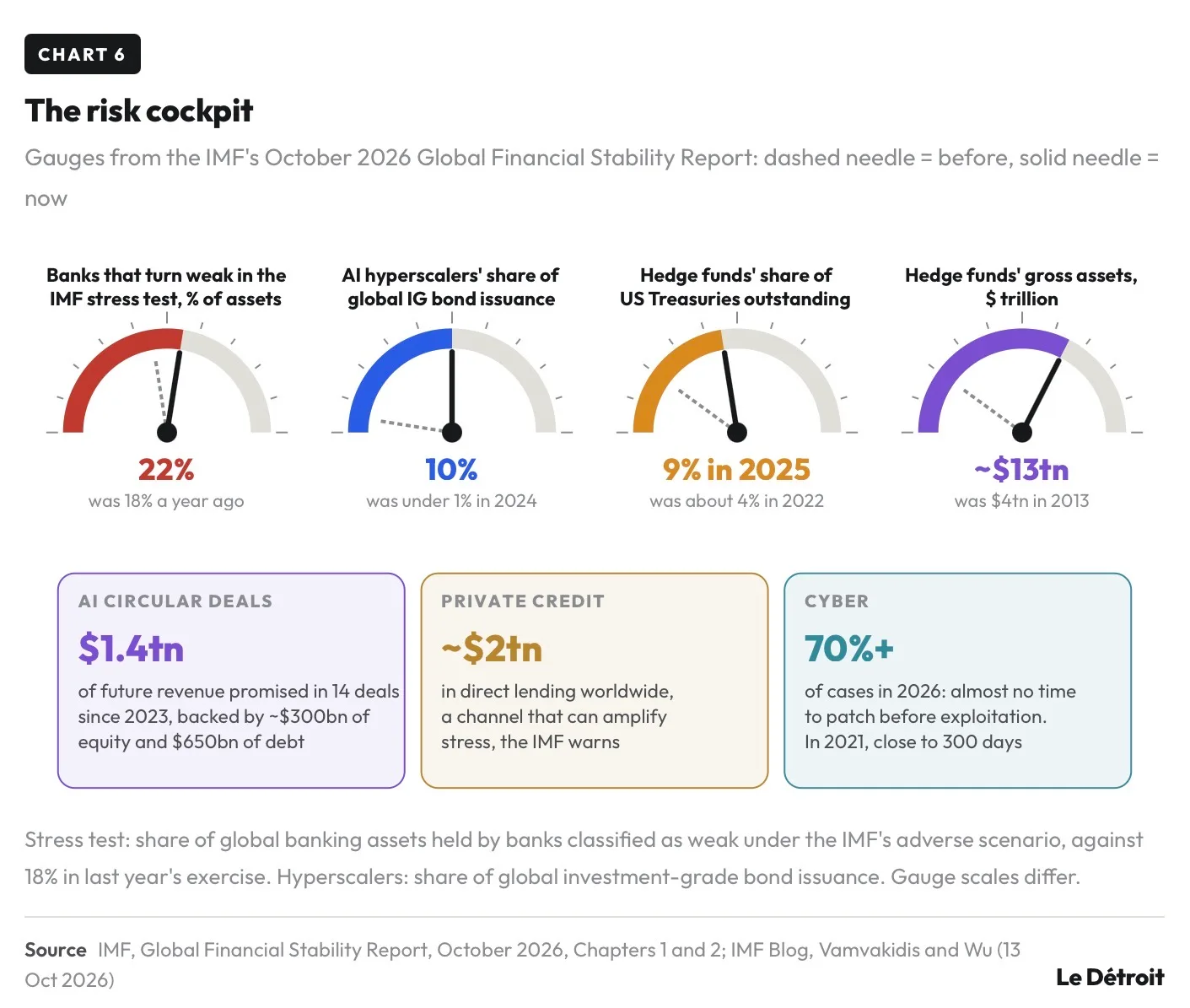
The IMF's Global Financial Stability Report opens with a warning: "Financial markets have been resilient since the April 2026 Global Financial Stability Report, but financial stability risks are elevated." The AI boom is the first risk. Hyperscalers' share of global investment-grade bond issuance has risen to 10% this year from less than 1% in 2024. Fourteen publicly disclosed "circular" deals since 2023 combine about $300 billion of equity and $650 billion of debt in exchange for $1.4 trillion of future revenue commitments.
The shadows are growing too. Hedge funds' gross assets reached about $13 trillion in early 2026, from $4 trillion in 2013, and their share of US Treasuries rose from about 4% in 2022 to 9% in 2025. Direct lending, the core of private credit, now accounts for nearly $2 trillion of loans. Cyber risk is accelerating: in more than 70% of cases this year, software providers had almost no time to patch flaws before they were exploited.
7. New plumbing, old temptations
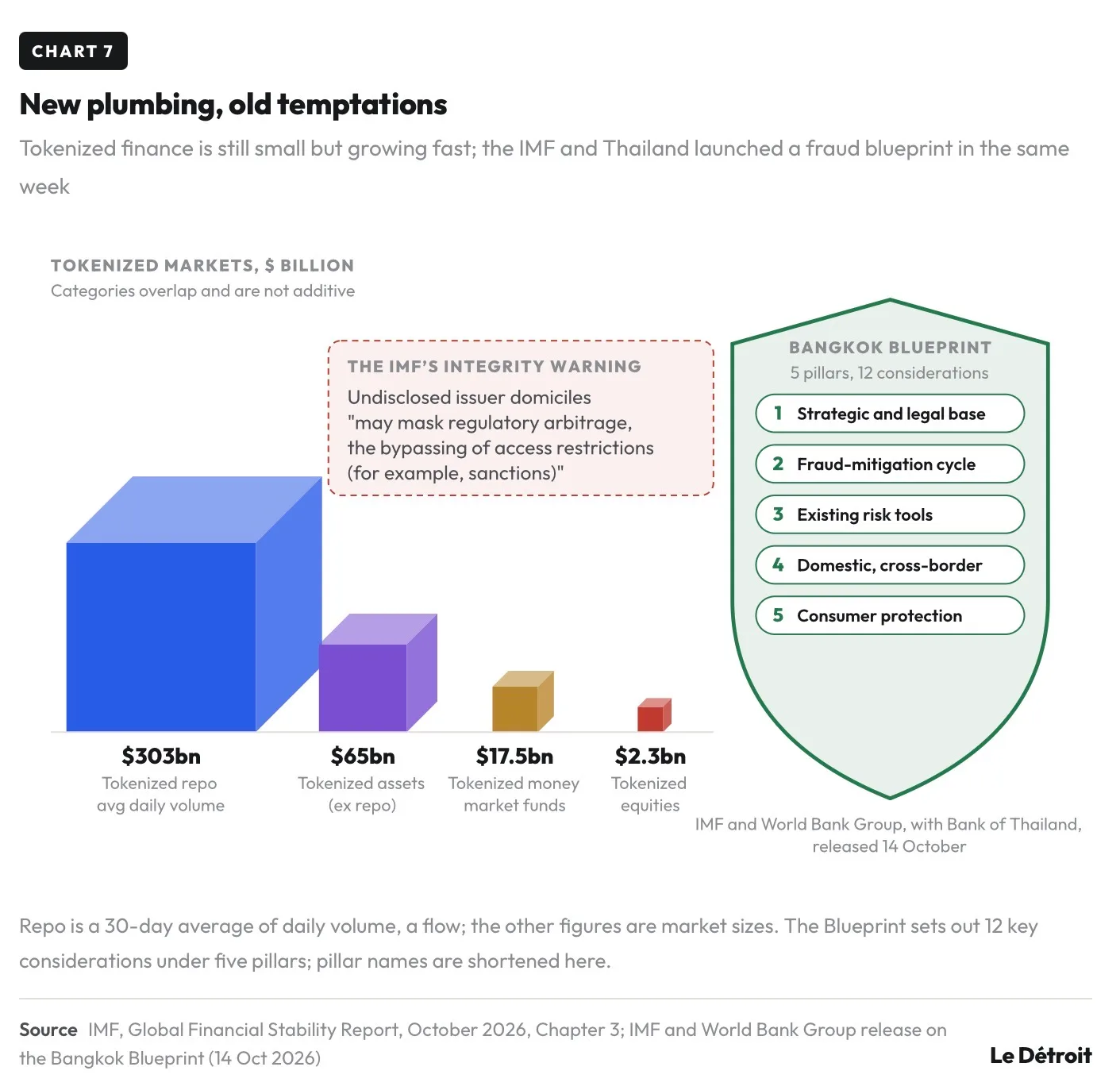
For readers of Le Détroit, the most telling chapter is the one on tokenization. The public market for tokenized real-world assets, excluding repos, has reached about $65 billion, and tokenized money market funds about $17.5 billion. Tokenized repo trades average $303 billion a day. The IMF's verdict on integrity is balanced:
"Tokenization is not inherently a risk for anti-money laundering/combating the financing of terrorism."
The warning sits in the detail. Where issuers do not disclose their domicile, the report says, this "may mask regulatory arbitrage, the bypassing of access restrictions (for example, sanctions)". Registration or servicing of tokenized assets through offshore jurisdictions can increase such vulnerabilities, it adds. The October report gives no estimate of the stablecoin market's size and leaves stablecoins out of its tokenization figures.
The host's own contribution was about crime. The IMF and the World Bank, working with the Bank of Thailand, released a "Bangkok Blueprint" to help countries prevent, detect and address cyber-enabled fraud in digital finance, with 12 key considerations under five pillars. "Cyber-enabled fraud has become a global challenge that no country or institution can tackle alone," said Vitai Ratanakorn, the Bank of Thailand's governor. "Trust is the foundation of every financial system," said Georgieva.
8. A divided room
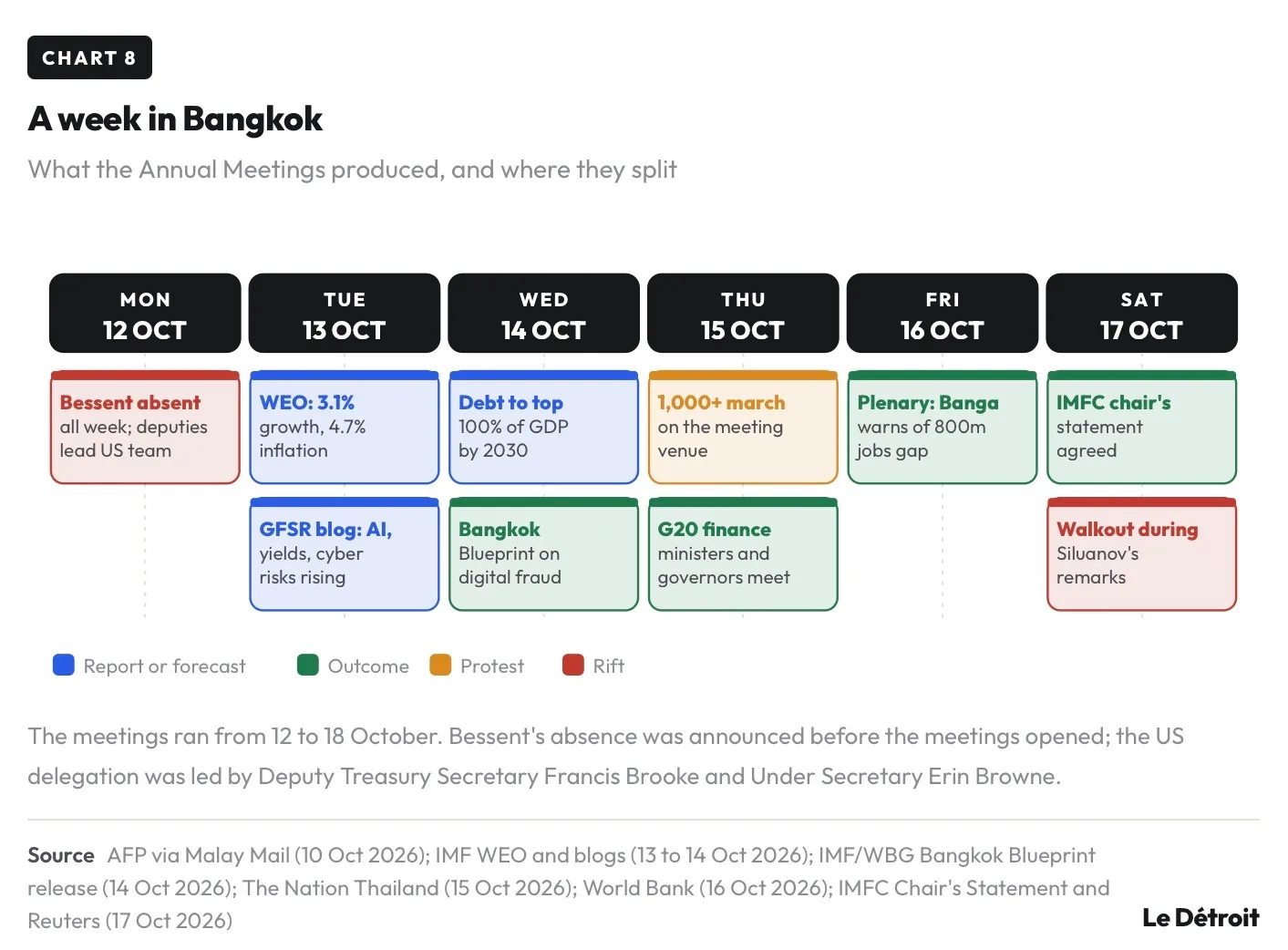
The politics of the week were as fractured as the forecasts. Scott Bessent, the US Treasury Secretary, skipped the meetings; a US official cited "domestic engagements", AFP reported. The International Monetary and Financial Committee, chaired by Saudi Arabia's finance minister Mohammed Al-Jadaan, did agree a chair's statement. "The message from the IMFC members is clear: there is no room for complacency," he told reporters.
The text itself shows the strain. A senior US Treasury official told Reuters that Washington was pressing members to rename artificial intelligence "super intelligence"; the final statement contains no reference to artificial intelligence and speaks instead of "advanced intelligence technologies". When Russia's finance minister, Anton Siluanov, spoke at the IMFC meeting on 17 October, nearly half the delegates walked out, including those of Britain, Germany and France. "I was really proud so many left this plenary," said Joachim Nagel of the Bundesbank. Outside, more than 1,000 protesters marched on the venue on 15 October, accusing the institutions of favouring the rich.
Le Détroit's reading. Bangkok's message is that the world average no longer describes anyone. Countries plugged into the AI build-out, or able to absorb an oil shock, are being upgraded. Energy importers outside the technology chain, the Gulf economies caught in the war, and low-income borrowers paying 14% of revenue to creditors are being left behind. The two forces pulling on the rope are also linked: an AI correction or a longer Hormuz closure would both arrive through the same channel, higher yields on already historically high public debt.