1. A modest sum, aimed at the top of the opposition
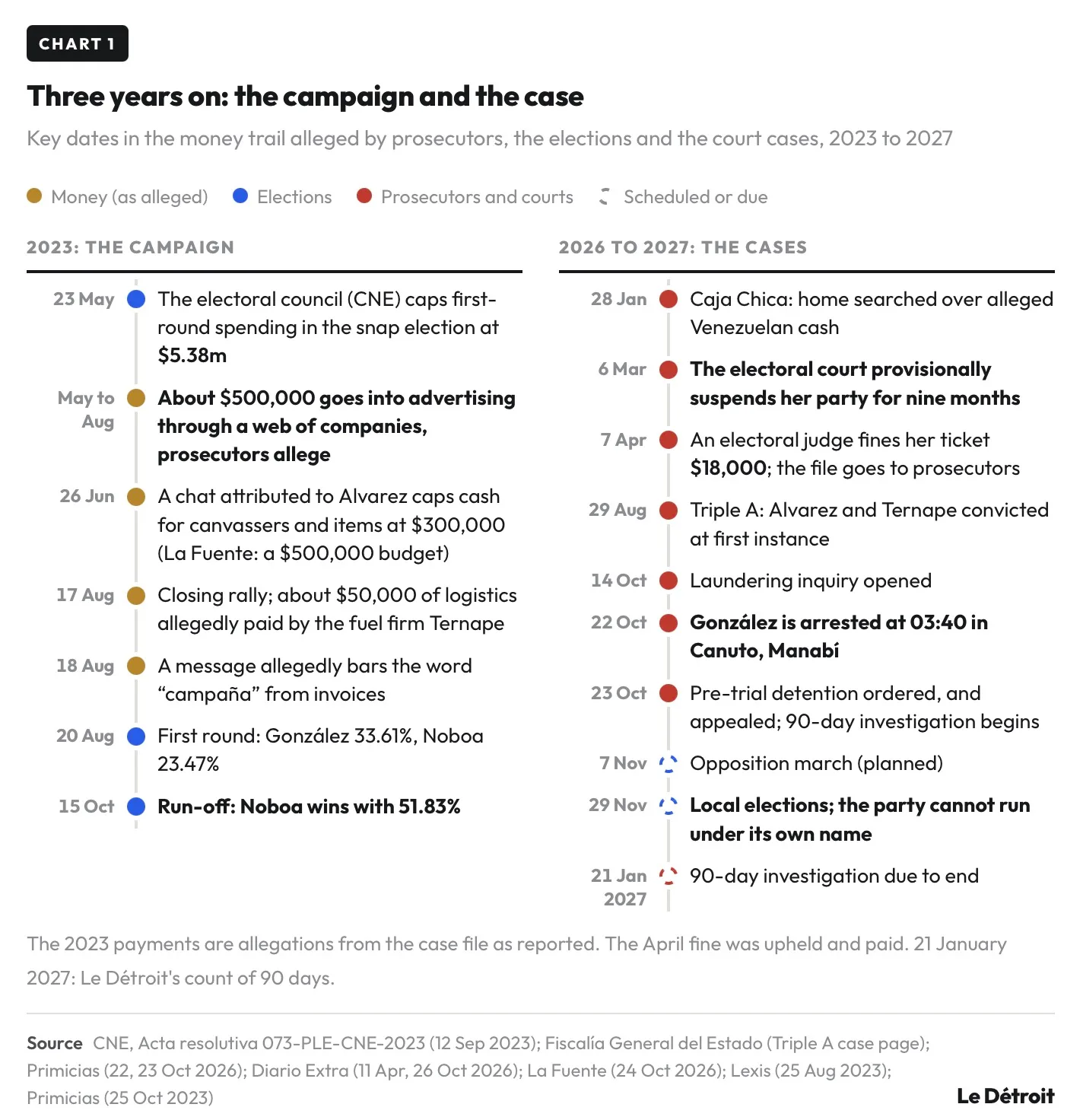
The money is modest; the target is not. Before dawn on 22 October, police and prosecutors detained Luisa González at a property in Canuto, a rural parish in Manabí province, after following the car she was travelling in from Quito for about seven hours the day before, according to police reports cited by Primicias. A judge had issued arrest warrants for six people. Four were found and charged with money laundering in a hearing held behind closed doors.
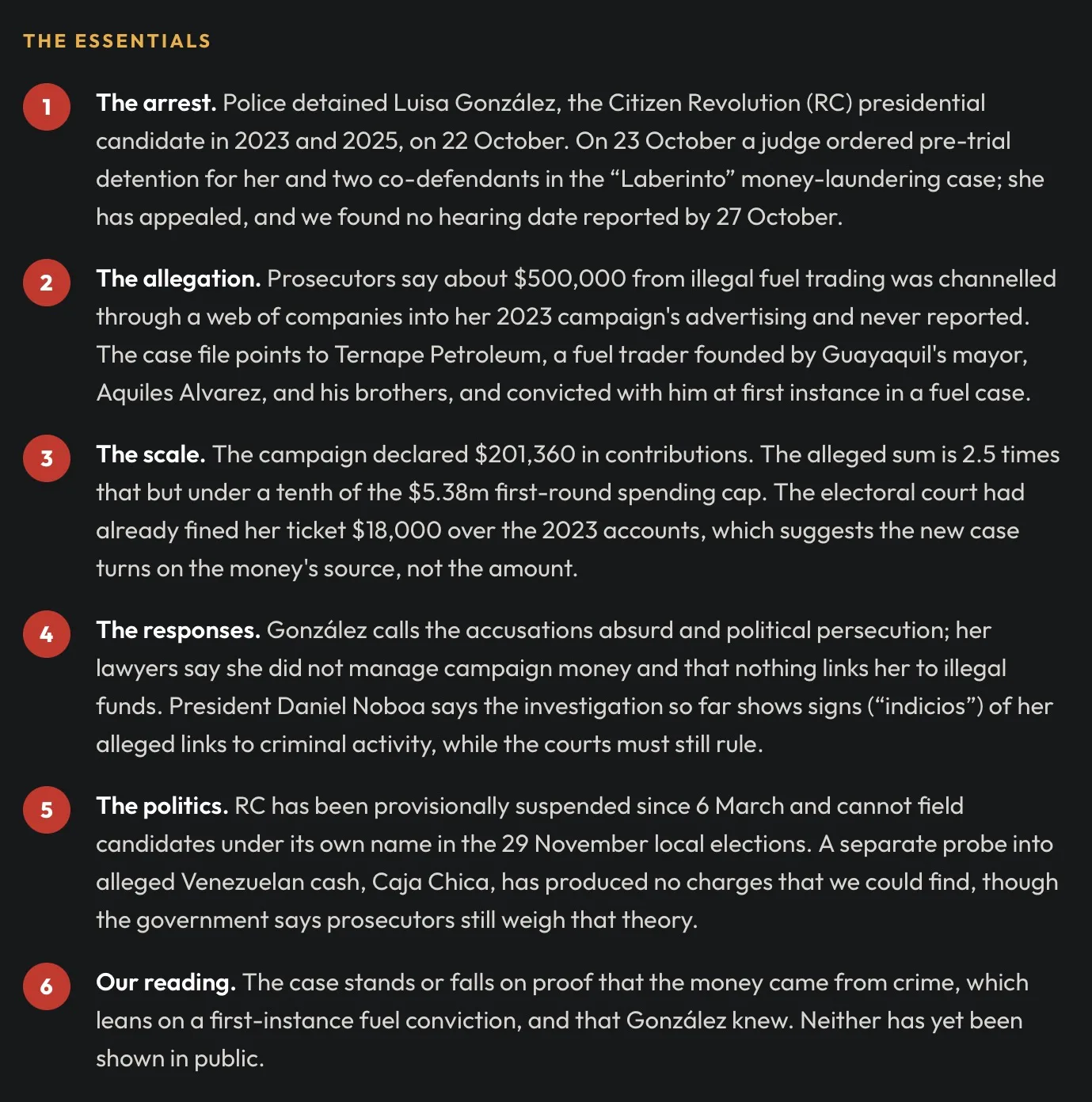
On 23 October judge Harry Navarrete ordered pre-trial detention for González, for Santiago Díaz, a former assembly member already in prison, and for Wendy Onofre, secretary of the RETO movement; Estefanía Molina, who managed the campaign's finances, was given a travel ban, check-ins and an electronic tag. González, 48, was flown to Latacunga and driven to the prison in Riobamba. Her lawyers have appealed against the detention; we found no hearing date reported by 27 October.
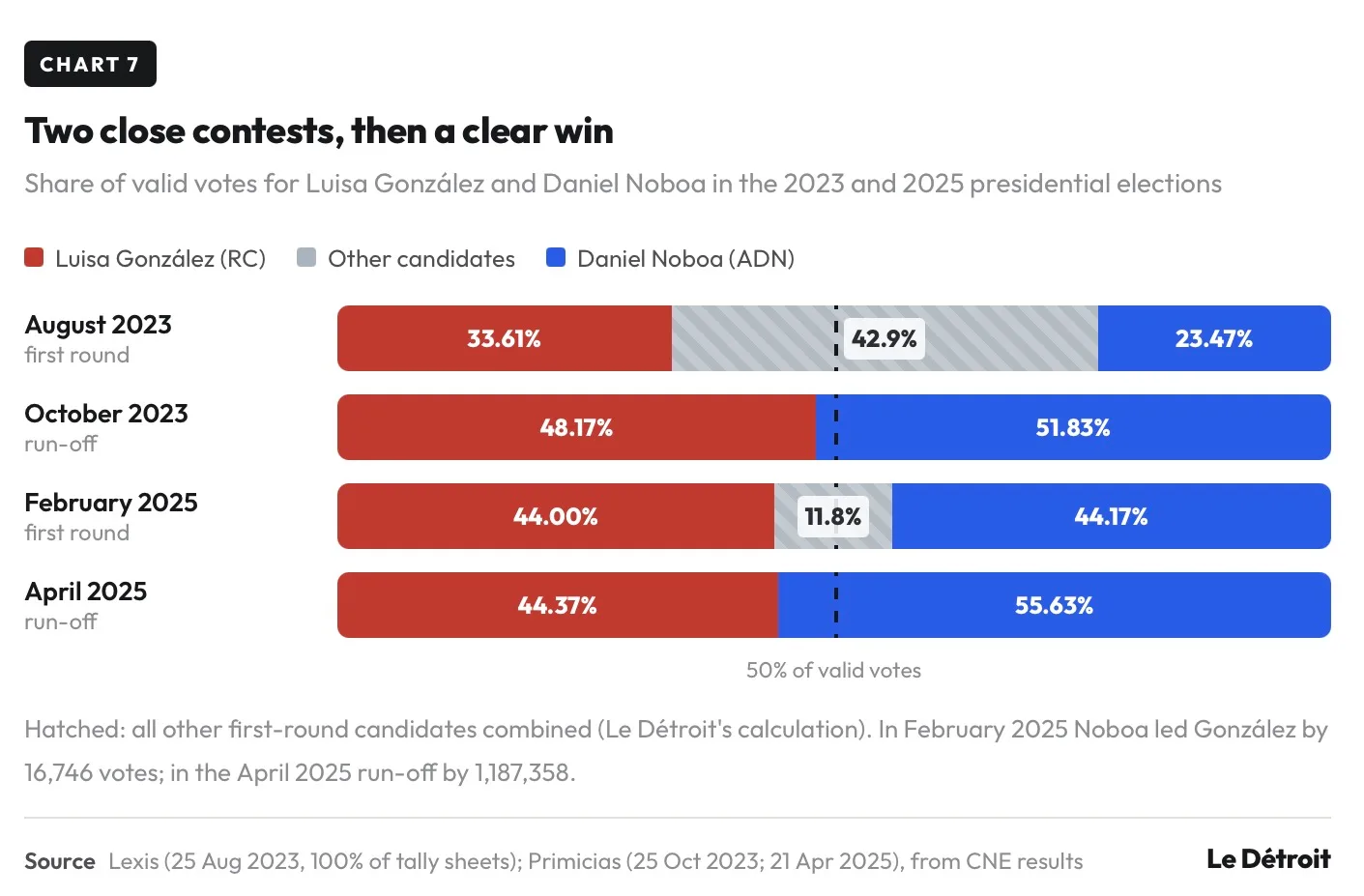
She calls the accusations absurd and the case political persecution. She won the first round in 2023, lost the run-off to Daniel Noboa by 3.7 points, and came within 16,746 votes of him in the first round of 2025. The case lands five weeks before local elections on 29 November, from which her party, Citizen Revolution (RC), is already barred. A small sum and a large target: that is why the evidence matters more than usual.
2. The alleged trail runs through a fuel company, not Caracas
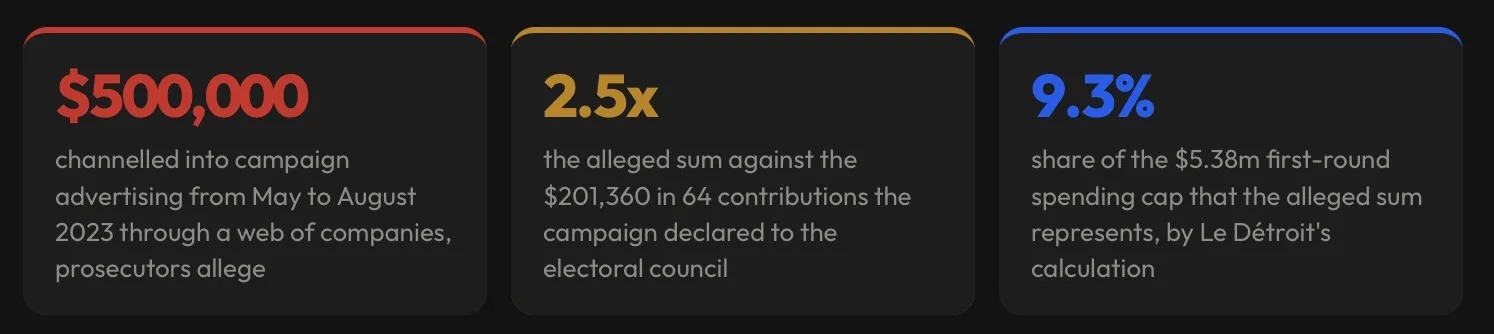
The core of the charges, as presented at the hearing, is not Venezuelan cash, the theory behind this year's earlier raids, but a fuel business in Guayaquil. Prosecutors say they want to “esclarecer el origen de los recursos destinados a financiar publicidad electoral” (establish the origin of the money used for electoral advertising) between May and August 2023: about $500,000, allegedly channelled through “un entramado de personas jurídicas”, a web of companies. At the hearing the prosecutor, María Belén Luna, said the money allegedly came from illegal trade in hydrocarbons, Diario Extra reported.
The case file, as Primicias reports it, points to Ternape Petroleum S.A., a fuel trader set up in 2017 by Aquiles Alvarez, elected mayor of Guayaquil for RC in 2023, and his brothers. In a chat dated 26 June 2023 and attributed to Alvarez, cash spending on canvassers, T-shirts and other items was capped at $300,000, as Primicias and Diario Extra report it; La Fuente says the same chat discussed a global budget of $500,000. An internal control matrix allegedly assigned $725,933 to González's bid: $447,933 for the first round and $278,000 for the run-off. “Todo esto sale de Ternape” (all of this comes out of Ternape), reads a July 2024 chat between two of Alvarez's employees, as Primicias quotes it.
The alleged mechanics are mundane. Printers sent quotes in the party's name but invoiced Ternape; on 18 August 2023, the day after the closing rally, the company's accountant allegedly told staff that invoices must not mention the word “campaña”. In the file as Primicias reports it, Ternape paid about $100,000 to one printer, for 400,000 stickers and 200,000 booklets, and about $50,000 for the rally, and bearer cheques were meant to raise cash for mobilisation through third parties, though banks rejected six of $10,000 each. None of the cash or transfers was reported to the electoral authorities, according to police findings in the file.
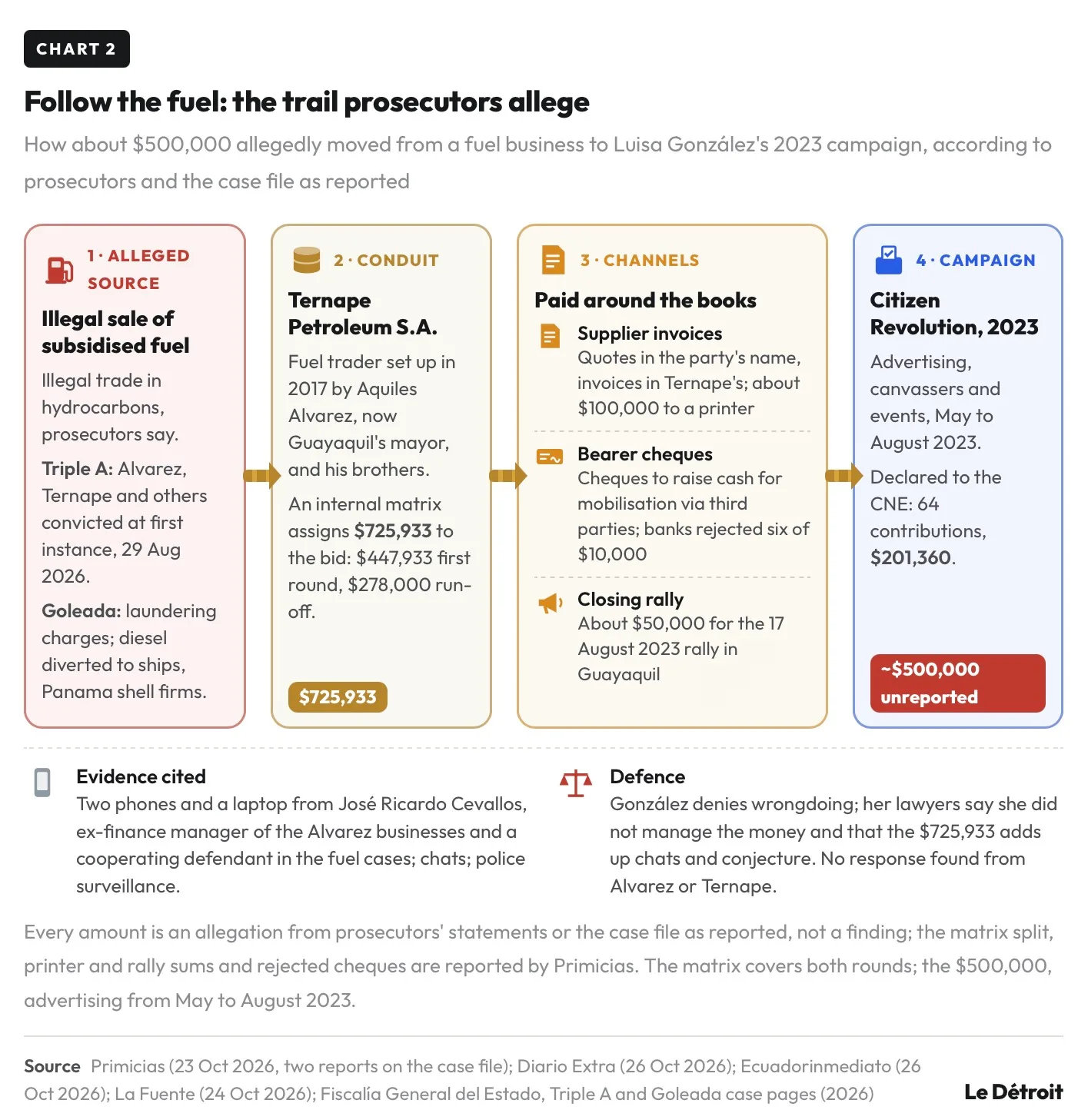
On this account the strongest evidence concerns Ternape, not the candidate. Much of it comes from two phones and a laptop handed over by José Ricardo Cevallos, the former finance manager of the Alvarez family's businesses, a cooperating defendant in the fuel cases; what has been reported shows money moving around González's campaign, but not yet her directing it. Her lawyer, Diego Guarderas, said on 26 October that a prosecution table records her role as the “destinataria política declarada de actividades de campaña” (declared political recipient of campaign activities), and that a cooperator's testimony “no sustituye una prueba técnica” (is no substitute for technical evidence), Ecuadorinmediato reported. Rafael Correa, the former president, argued on Radio Pichincha that a campaign treasurer, not the candidate, handles the money.
3. Why a spending breach becomes a laundering charge
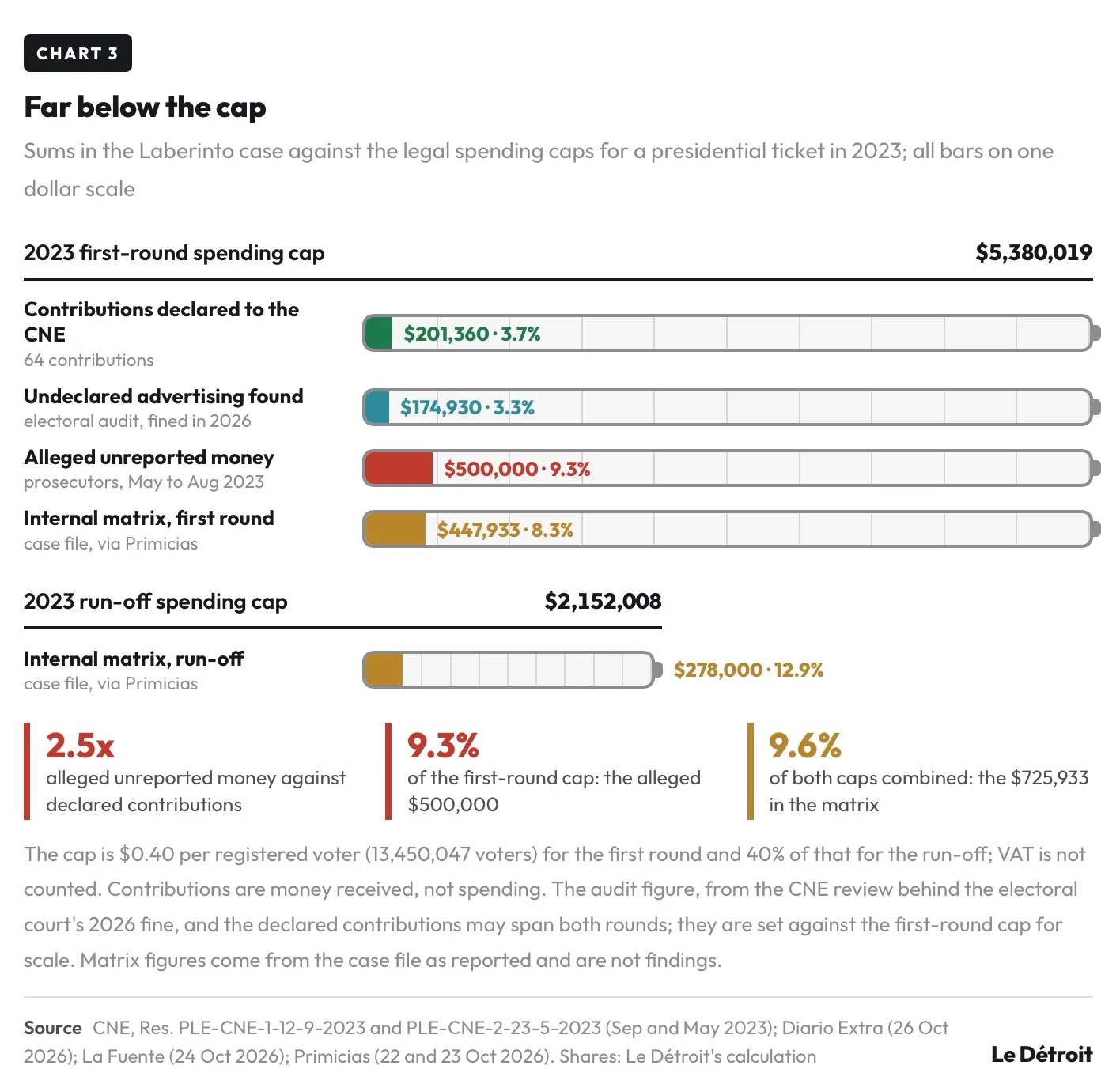
Ecuador does not need a laundering law to punish a campaign that breaks the rules; it needs one when the money itself is said to be dirty. The electoral route has already run its course: on 7 April 2026 a judge of the electoral court, the TCE, fined Estefanía Molina, the campaign's finance manager, $18,000, holding González and her running mate, Andrés Arauz, jointly liable, in a case built on an electoral council audit that found $174,930 of undeclared advertising and $6,400 of unsupported contributions. The court's plenary upheld the fine, which was paid in June, and the judge's referral to prosecutors became Laberinto, opened as a laundering inquiry on 14 October, Primicias reports.
The electoral code, the Código de la Democracia, caps spending at $0.40 per registered voter for a presidential ticket: $5,380,018.80 in the 2023 first round, and 40% of that, $2,152,007.52, in the run-off. By that yardstick the sums are small. The campaign declared 64 contributions from individuals worth $201,360.21 to the electoral council, the CNE, according to Diario Extra and La Fuente. The $500,000 that prosecutors say went unreported is 2.5 times that, but only 9.3% of the first-round cap, by Le Détroit's calculation, and nearly three times the undeclared advertising the audit found; even the $725,933 in the internal matrix is 9.6% of the two caps combined.
A laundering charge needs a crime that produced the money, so Laberinto borrows its predicate from two other cases against Alvarez. In Triple A, a court convicted nine people, including the mayor, and six companies, Ternape among them, on 29 August 2026 over the illegal sale of subsidised fuel. In Goleada, prosecutors have charged a network that allegedly diverted subsidised diesel to international vessels and used Panama-based shell companies to profit from it; Alvarez is one of 17 defendants and Ternape one of nine companies in that case.
4. Cash is the hard part, in a dollarised economy
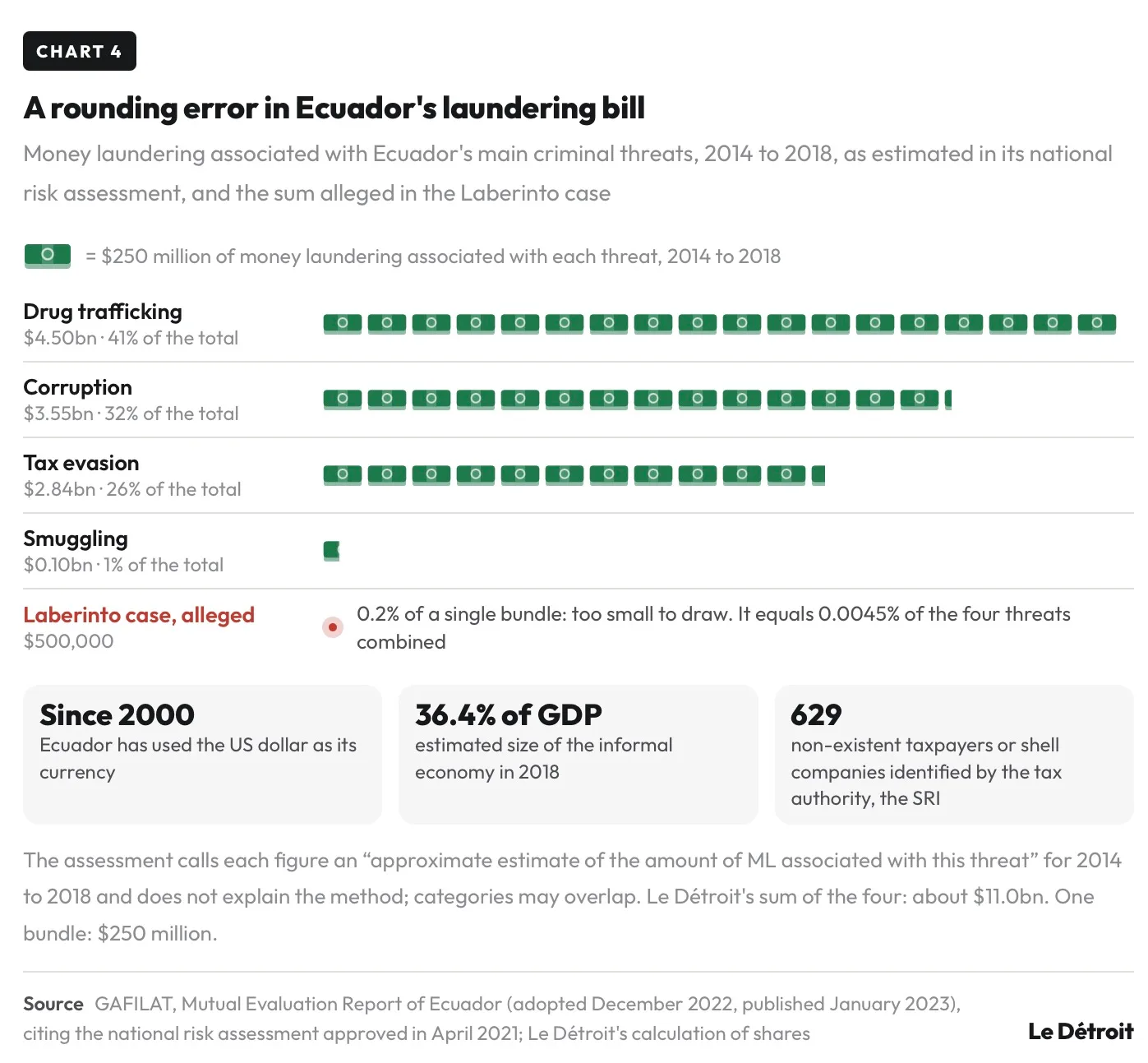
Ecuador's own risk assessment shows why political cash is hard to trace. The country has used the US dollar since 2000, and its informal economy was put at 36.4% of GDP in 2018. The national risk assessment, summarised by the regional watchdog GAFILAT, estimated the money laundering associated with drug trafficking at $4.50bn over 2014 to 2018, with corruption at $3.55bn and tax evasion at $2.84bn: about $11bn in all, by Le Détroit's sum, 41% of it linked to drugs. Against that, Laberinto's sum is a rounding error; the case matters for what it says about where political money comes from, not for its size.
The government's sharpest line is about cash. “¿Quién auspicia una campaña política con cientos de miles de dólares en efectivo?” (who sponsors a political campaign with hundreds of thousands of dollars in cash?), José Julio Neira, the presidency's spokesman, asked on X on 23 October; he also said that one of the prosecutors' hypotheses points to cash from Venezuela, Primicias reported. The same report quoted Ana Paula Patiño, head of the financial intelligence unit, the UAFE, as saying the suspicious operations were carried out by Venezuelan and Colombian third parties, and said, without naming a source, that 80% of income of about $400,000 arrived within two months. It does not say when Patiño spoke or whose income that was; none of it has been tested in court.
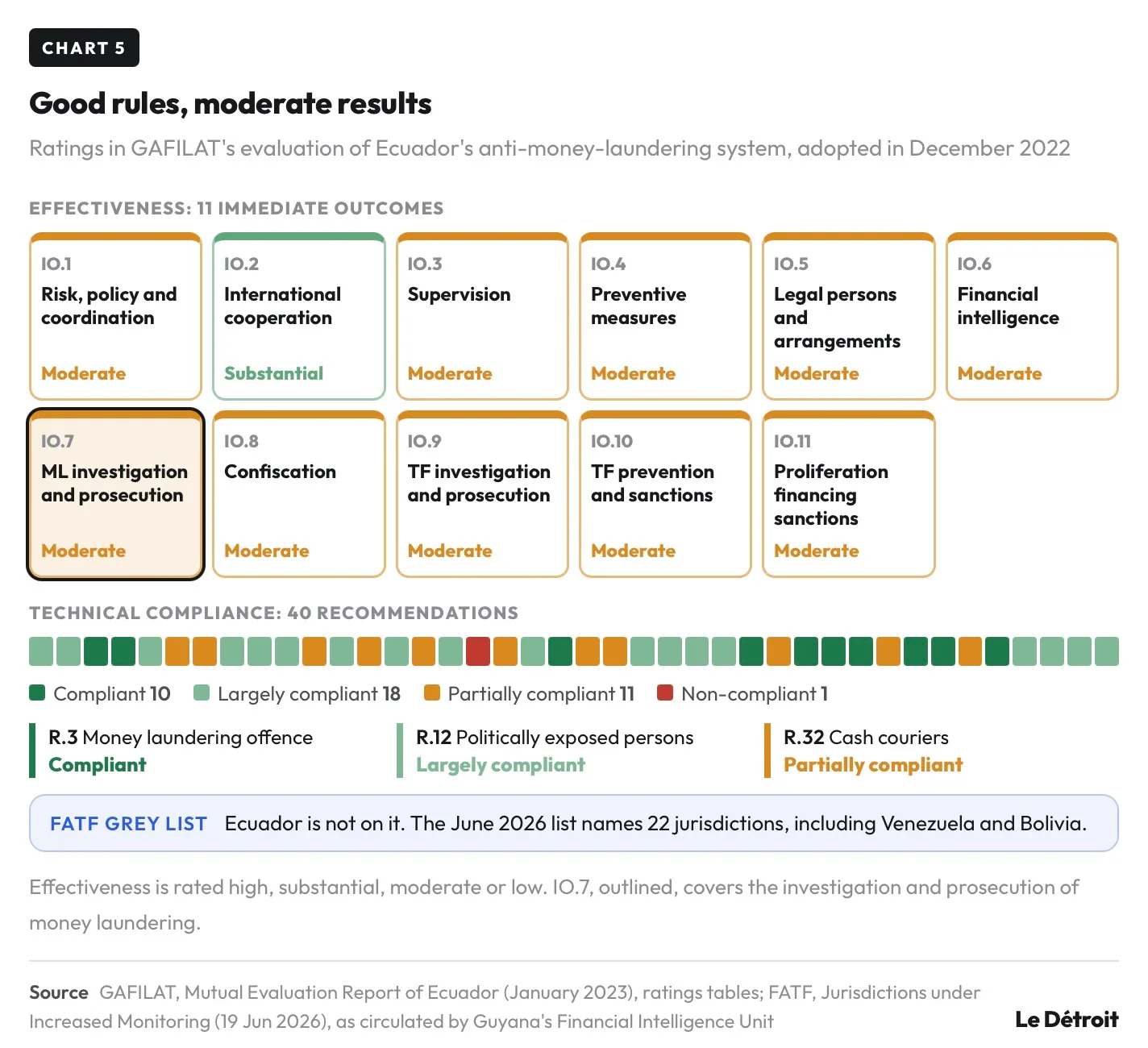
The watchdog's verdict on enforcement is lukewarm. GAFILAT's evaluation, adopted in December 2022, rated Ecuador's effectiveness “moderate” on 10 of 11 outcomes, including the investigation and prosecution of laundering, and found “a lack of consistency between the cases sanctioned and the country's risk profile”. Its rules scored better: 28 of 40 recommendations compliant or largely compliant, though the one on cash couriers was only partly met. Ecuador is not on the FATF's grey list, which in June named 22 jurisdictions, including Venezuela and Bolivia.
5. Two cases, two theories of the money
Prosecutors have two stories about the same campaign, and they rest on very different evidence. The first, Caja Chica, opened the year: on 28 January prosecutors searched González's home, on the theory that cash of illicit origin had come in from Venezuela to fund the 2023 presidential campaign. Eight people are under investigation, including Correa, González and Arauz; the party's Quito headquarters was searched in February. No one has been charged in that case, as far as we could establish.
Its key witness is now a defendant in the other case. Santiago Díaz, a former RC assembly member, said on 30 January: “yo trasladé, por disposición del presidente (Rafael) Correa, dinero desde Venezuela a Ecuador” (on President Correa's orders, I moved money from Venezuela to Ecuador). He gave no public amounts or dates. He has been in prison since 2025, and in May 2026 was sentenced to 29 years and four months for raping a 12-year-old girl, a charge he had denied. González said at the time that he was trading information for prison benefits, and Correa disputes his credibility. Since 23 October he has also been in pre-trial detention in Laberinto.
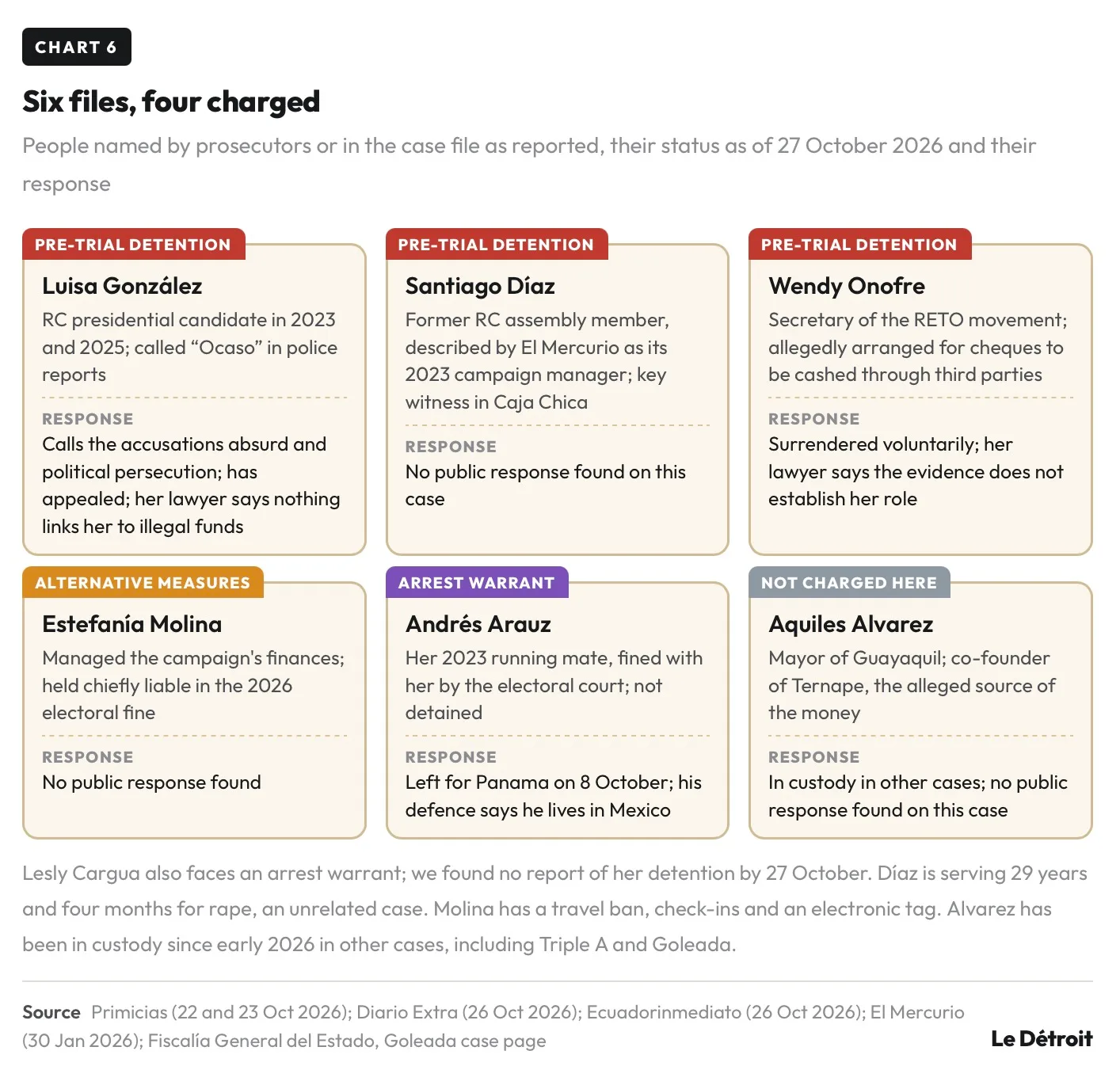
The defence has its own account. González says that in 2023 she was the candidate and that administrative responsibility lay with Marcela Aguiñaga, then the party's president; RC says a UAFE report cleared it of mishandling funds, an argument that did not persuade the electoral court in April. Arauz left for Panama on 8 October, according to migration records cited by Primicias; his defence says he lives in Mexico.
6. The calendar turns a court case into a campaign
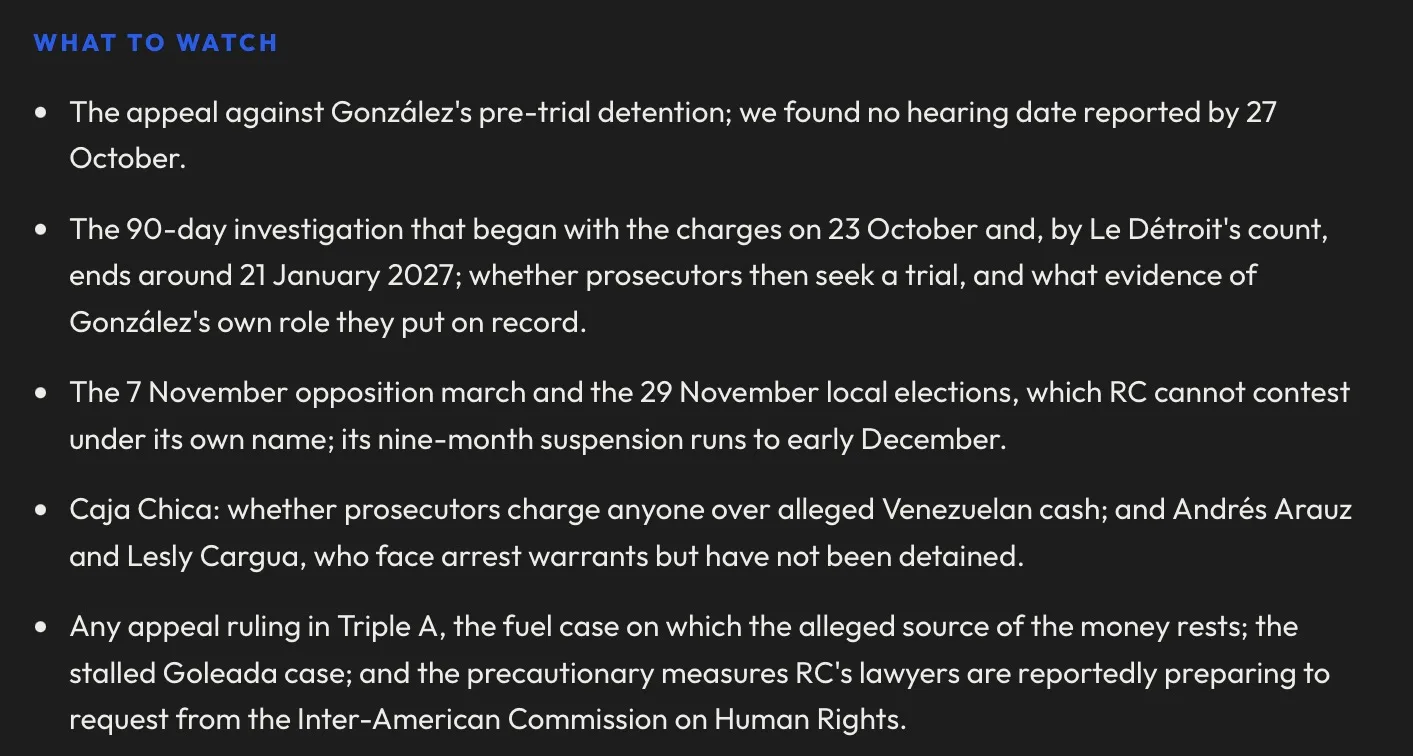
Whatever its merits, the timing guarantees the case will be fought as politics. The electoral council has brought local elections forward to 29 November. On 6 March the electoral court, on a request from the attorney general, Carlos Alarcón, provisionally suspended RC for nine months over the Caja Chica inquiry into alleged Venezuelan money, and it upheld the measure on 11 April. By Le Détroit's count the suspension runs to early December, past polling day, so RC cannot register candidates under its own name.
Noboa, whom Al Jazeera describes as a close ally of Donald Trump, frames the case as part of a wider fight: “Hemos visto casos ya en tres partidos políticos en los que hay un nexo con el narcotráfico” (we have already seen cases in three political parties with a link to drug trafficking), he told Radio Sucre on 26 October; asked about González's alleged links to criminal activity, he said that on the investigation so far “hay indicios de que sí” (there are signs that there are), while the judicial process still had to run its course. Gabriela Rivadeneira, RC's president, said the arrest showed that “Ecuador is living under a dictatorship”. RC, Unidad Popular, the Socialist Party and Pachakutik jointly denounced the case, opposition parties and unions have called a march for 7 November, and RC's lawyers are reportedly preparing a request to the Inter-American Commission on Human Rights.
Both sides can find support in the record. The government can point to a first-instance fuel conviction, a cooperating witness's devices, a trail of invoices and an electoral fine over undeclared spending. The opposition can point to an electoral case already closed with a paid fine, a party suspended at a prosecutor's request, a hearing closed to the public and pre-trial detention for a two-time presidential finalist. Neither settles the case; both will shape how the 29 November results are read.
7. The regional mirror: convictions, annulments, fines
Latin America has prosecuted campaign money before, and the outcomes turned on whether the money could be tied to a crime at its source, under the law of the day. Ecuador's own precedent is Correa. In April 2020 the National Court convicted him of aggravated bribery and sentenced him to eight years over a scheme in which companies made “aportes indebidos” (improper contributions) to his Alianza PAIS movement between 2012 and 2016 in exchange for state contracts. “Bueno, esto era lo que buscaban: manejando la justicia lograr lo que nunca pudieron en las urnas” (this is what they wanted: to use the courts to achieve what they never could at the ballot box), he wrote at the time.
Peru shows how fragile such convictions are. In April 2025 a court sentenced the former president Ollanta Humala and his wife, Nadine Heredia, to 15 years each for aggravated laundering, over about $3m from Odebrecht for his 2011 campaign and illicit contributions from Hugo Chávez; in a ruling published on 30 July 2026 the Constitutional Tribunal voided the whole case against Humala on grounds of legality, and in August an appeals court archived the case against Heredia. The same tribunal had voided the Cócteles case against Keiko Fujimori, over about 17m soles of allegedly illicit contributions, in October 2025, and in June 2026 she was elected president. In Colombia, the electoral council fined officials of Gustavo Petro's 2022 campaign and two parties in November 2025 for overspending by more than 3,500m pesos, about $940,000, and taking money from prohibited sources; Petro said he had run a campaign “sin trampas” (without cheating).
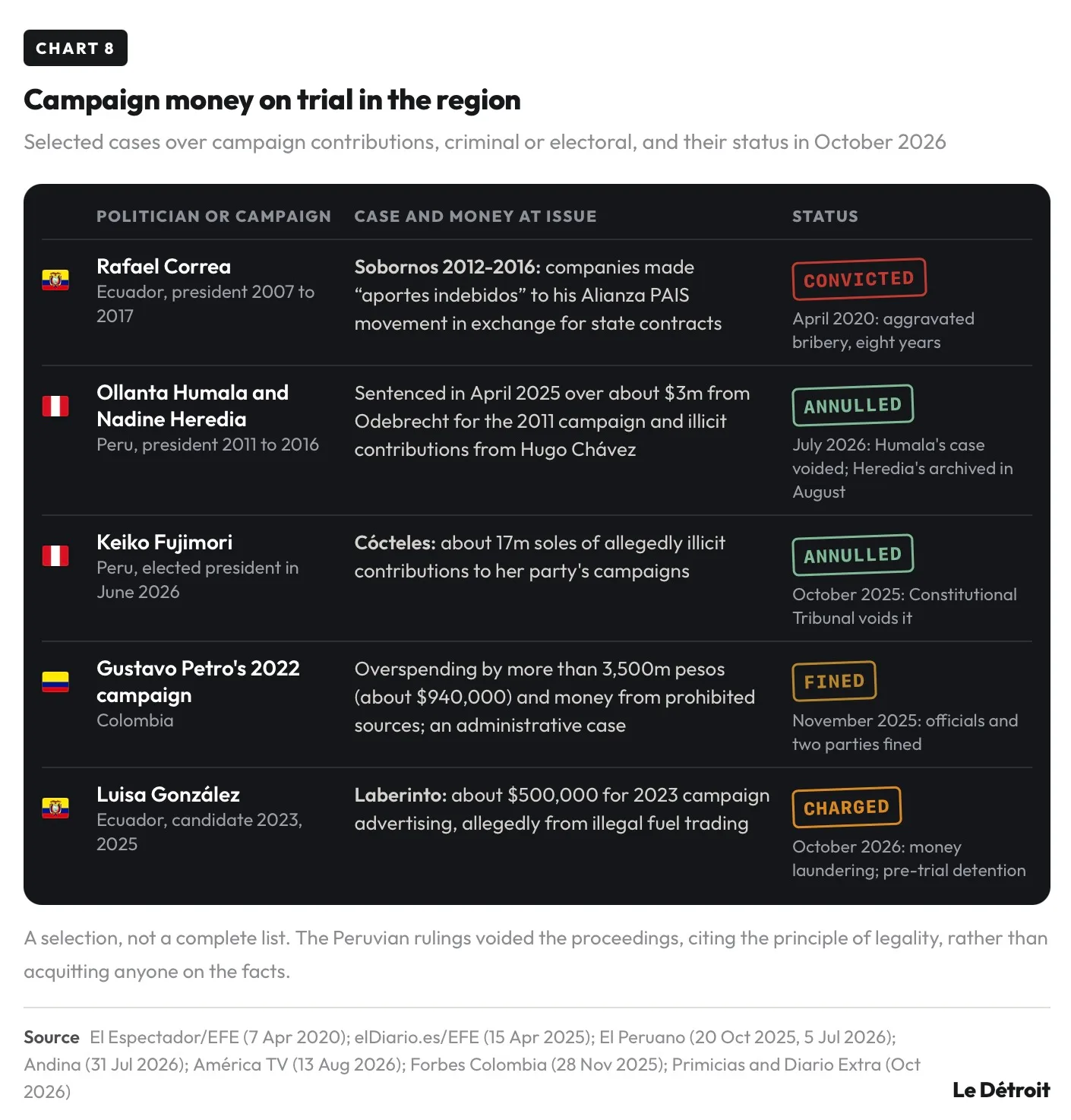
On a small sample, the source decides the charge. Correa was convicted over bribes paid in exchange for contracts, a crime in its own right. Peru's laundering cases over campaign money collapsed at the Constitutional Tribunal, and in Fujimori's case the prosecutor said the ruling meant Odebrecht's contributions did not amount to laundering; Petro's overspending stayed an administrative matter. Laberinto's reliance on a fuel crime at the source suggests that Ecuador's prosecutors have drawn the lesson.
8. Le Détroit's reading
Laberinto can prove less than either side claims. If the file is accurate, it may show that a fuel company tied to Guayaquil's mayor paid a presidential campaign's bills off the books, a serious breach of electoral law in itself. To convict González of laundering, prosecutors must go further and show that the money was the proceeds of crime and that she knew. The Venezuelan-cash theory has so far produced searches, a party suspension and the word of a witness serving 29 years for rape, not charges. In the short run the government gains a story of tough enforcement weeks before the vote, and RC loses its best-known candidate and its brand at once. Ecuador's institutions have most to lose if the case is seen to move with the electoral calendar rather than the evidence.
Three signals will show which way it goes. First, the appeal against detention: whether a higher court upholds it, and on what grounds. Second, what prosecutors put on record before the 90-day investigation ends, around 21 January 2027 by Le Détroit's count: above all, any document showing that González directed or knew of the Ternape payments, and the fate of the Triple A ruling on appeal. Third, the 29 November vote: how candidates backed by correísmo fare under other parties' labels, and whether the Inter-American Commission takes up the party's request.