1. What went live
On 21 September 2026, the Eurosystem launched Pontes, a service that allows wholesale transactions in tokenised assets to be settled in central bank money. The ECB calls it the first initiative in its programme to make central bank money fit for a tokenised future. Christine Lagarde said the Eurosystem is working to enable a more integrated, innovative and resilient European financial market in the digital age. Piero Cipollone, the Executive Board member in charge, said Pontes brings the stability and trust of central bank money to the tokenised ecosystem and will help it scale.
The scope matters. Pontes is for banks and market infrastructures. Households and companies never touch it. It is separate from the digital euro, the retail project for which the ECB plans a twelve-month pilot from the second half of 2027, with a potential first issuance in 2029, provided the EU regulation is adopted in 2026.
The public will never see Pontes. Every bank issuing a tokenised bond in euros will.
2. The second announcement
On the same day, the ECB said it has launched preparatory work to invest a small portion of its own funds in tokenised securities, with purchases settled in central bank money through Pontes. The own-funds portfolio sits outside monetary policy; it generates income that helps cover the ECB's operating costs. Initial investments will focus on euro-denominated securities issued by euro area central and regional governments, agencies and European supranational institutions. The Executive Board will decide the operational details and timing once preparations are complete.
3. How it works, and why it took so long
Tokenisation means issuing or representing an asset as a digital token on a shared ledger, so that issuance, trading, settlement, custody and servicing can be bundled and partly automated through smart contracts. The obstacle has always been the cash side of the trade. A bond that moves instantly on a ledger is of limited use if the money to pay for it moves separately, or moves as a private token whose value depends on its issuer.
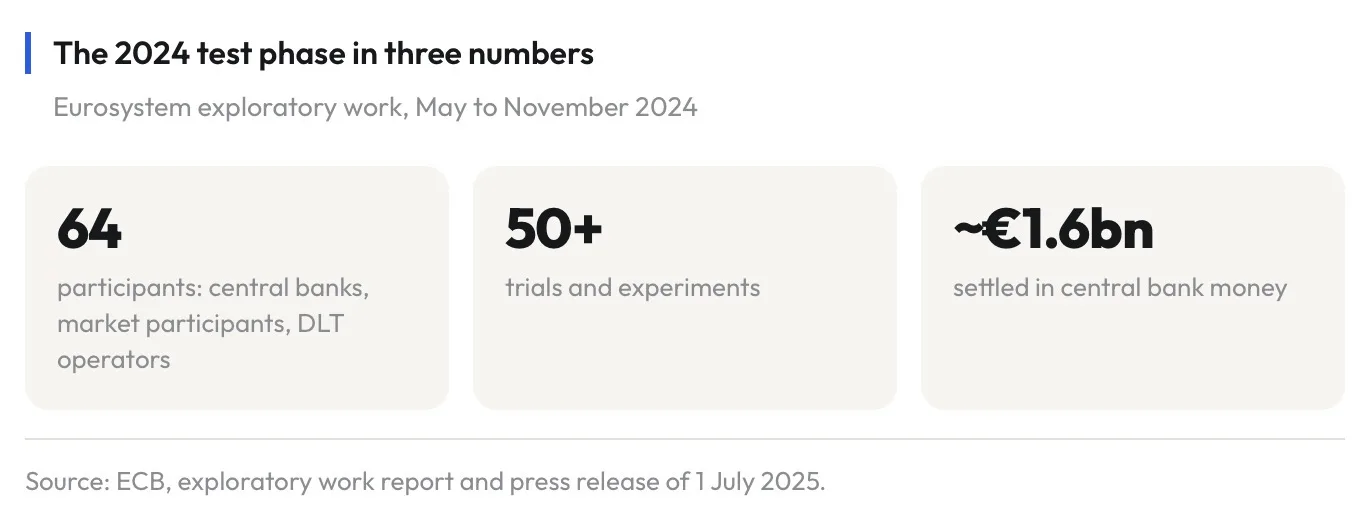
Pontes links the platforms where tokenised assets live to TARGET Services, the Eurosystem's existing settlement infrastructure, so the cash leg settles in central bank money. The ECB says its 2024 tests made the need explicit: participants said access to a risk-free settlement asset was crucial for wider adoption.
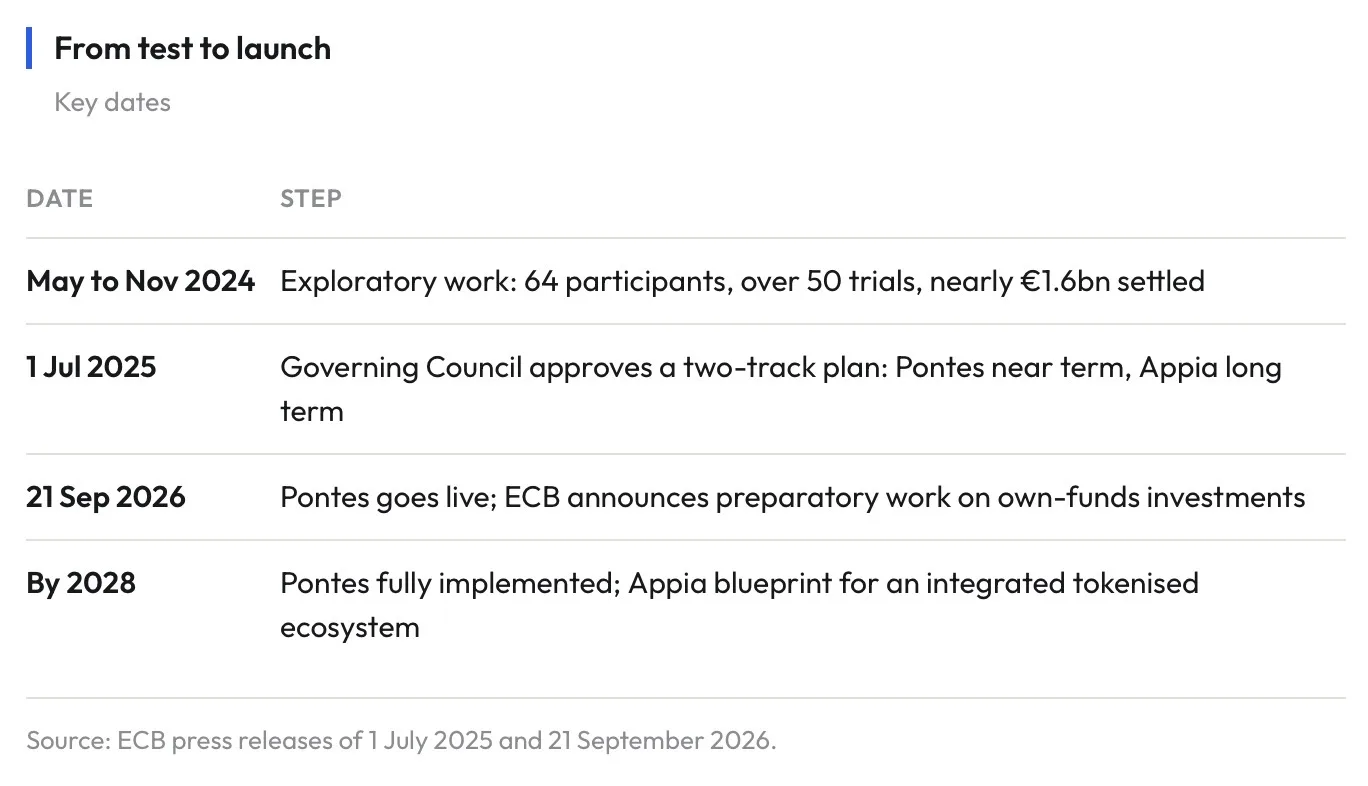
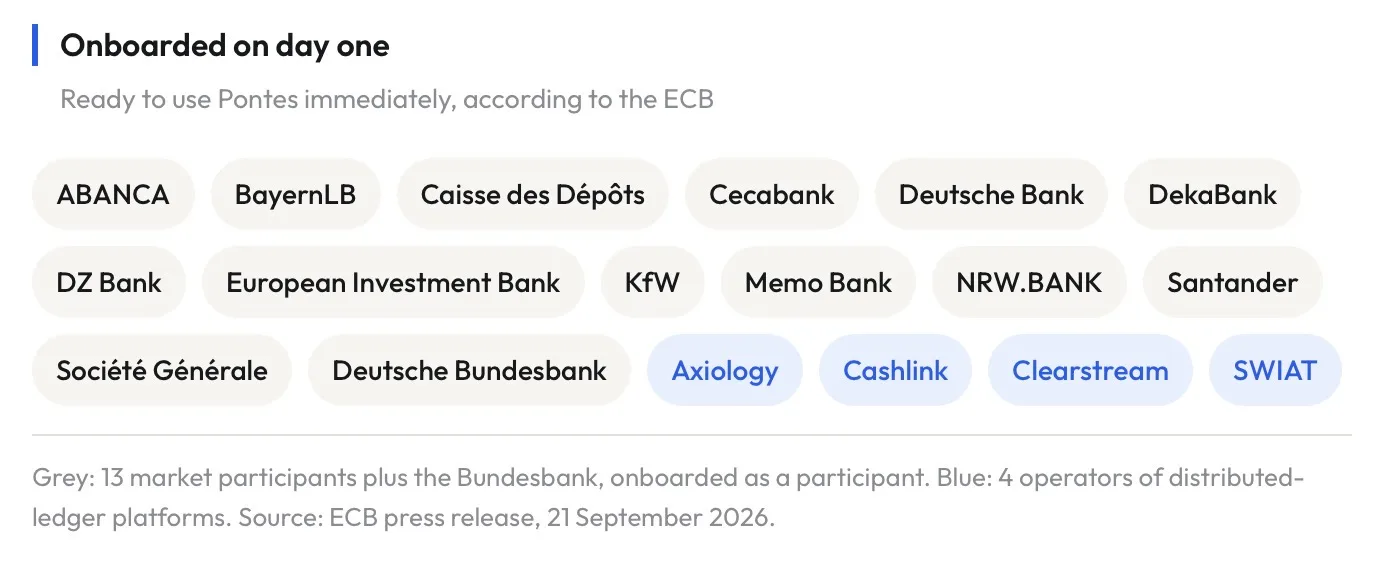
Pontes starts with a core set of services. Enhanced features and longer operating hours will be introduced gradually, with full implementation expected by 2028. Appia, run with Danmarks Nationalbank and market stakeholders, is due to deliver a blueprint for an integrated European tokenised ecosystem by 2028.
4. The dollar problem, in the ECB's own numbers
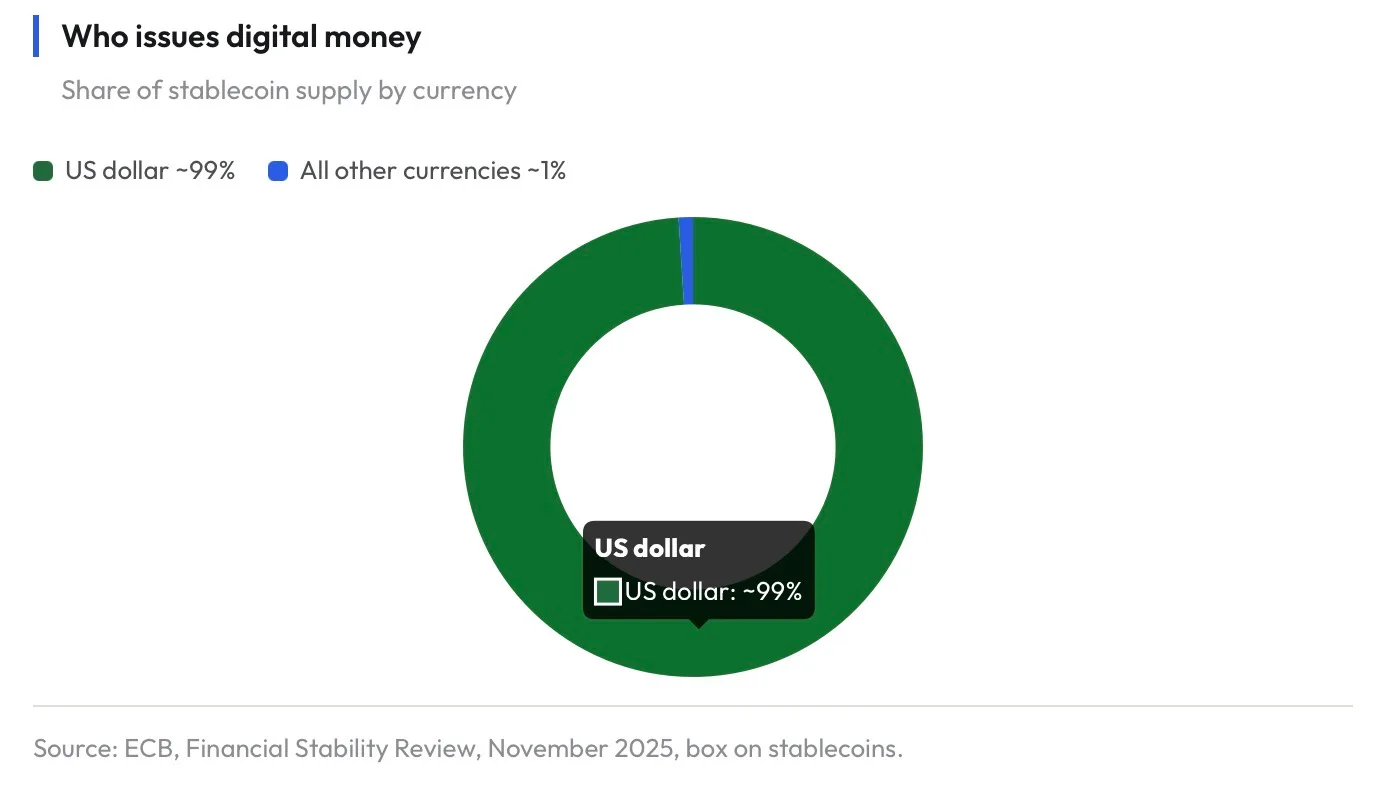
The launch is technical. The motive is not. Over the past year, the ECB has repeatedly set out the same diagnosis: digital money is already dollar money.
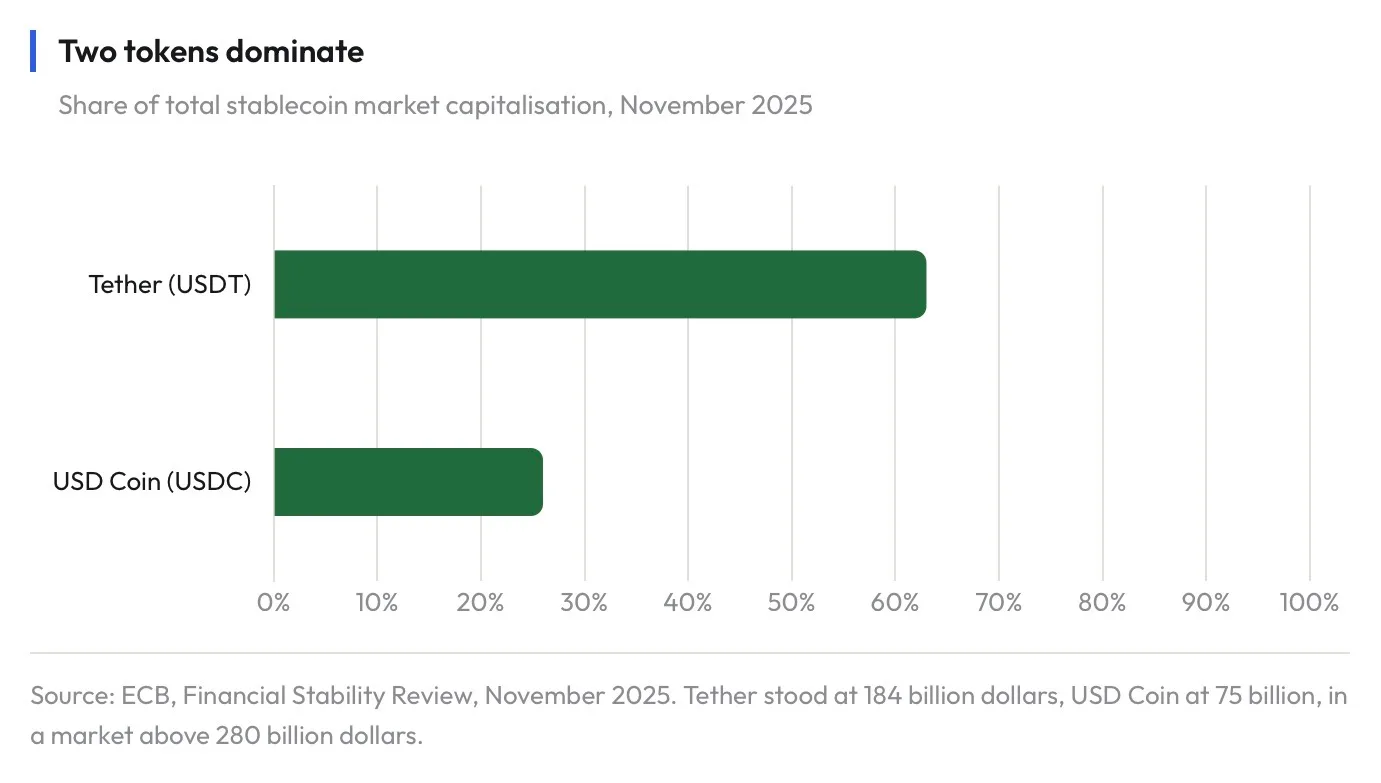
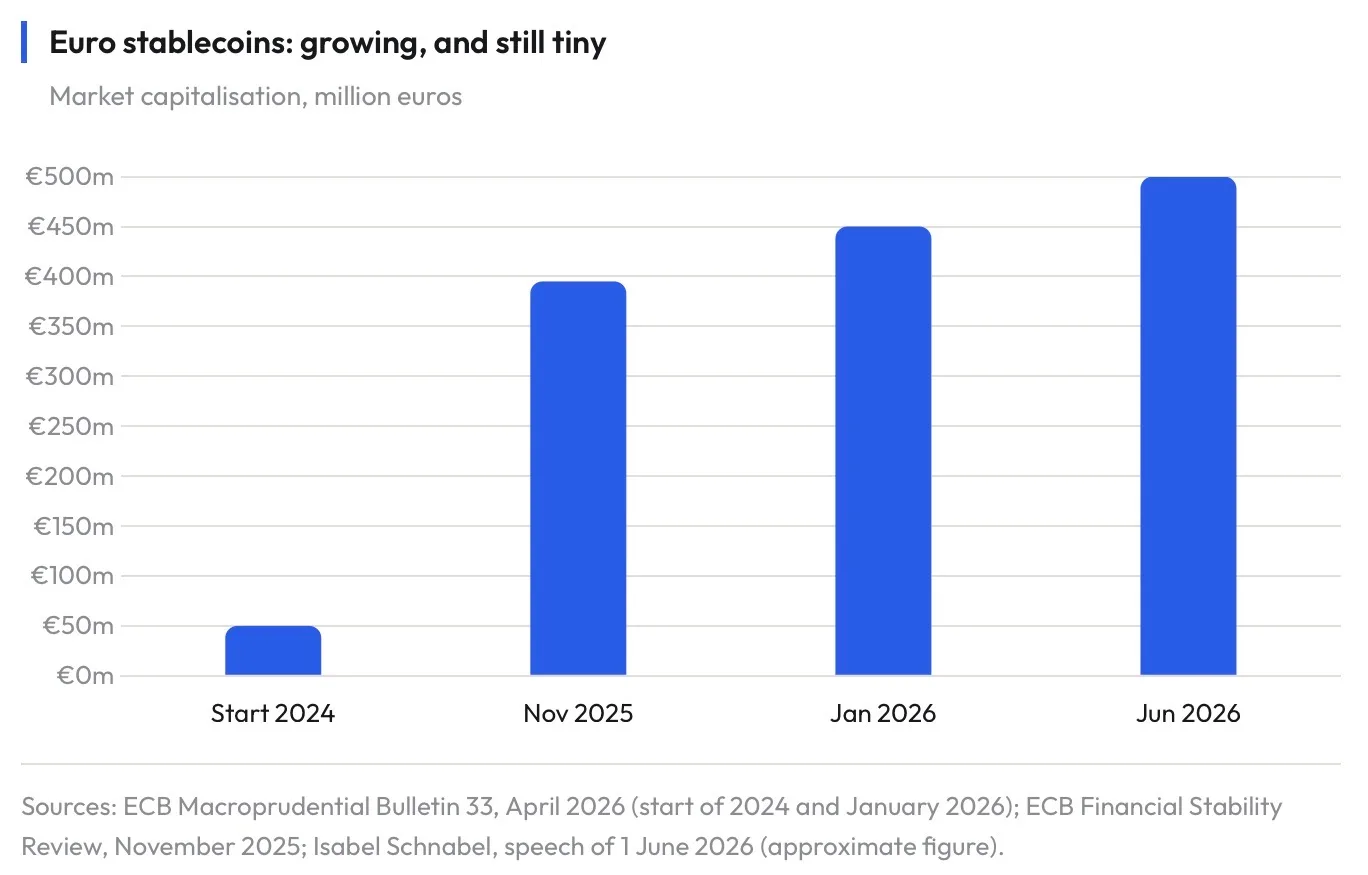
In a speech in Seoul on 1 June 2026, Executive Board member Isabel Schnabel put the global stablecoin market close to 300 billion dollars. The two largest dollar tokens, Tether (USDT) and USD Coin (USDC), account for roughly 90 percent of it. Euro-denominated stablecoins total about 500 million euros. Her summary was blunt: virtually all stablecoins in circulation are denominated in dollars.
The euro side is growing fast from almost nothing. The ECB's Macroprudential Bulletin put euro stablecoins at around 50 million euros at the start of 2024 and around 450 million in January 2026. That is a ninefold increase, and it still leaves the entire euro segment smaller than a rounding error on Tether's balance sheet.
5. The three risks Frankfurt names
Schnabel grouped the ECB's concerns into three areas. They explain why Pontes exists.
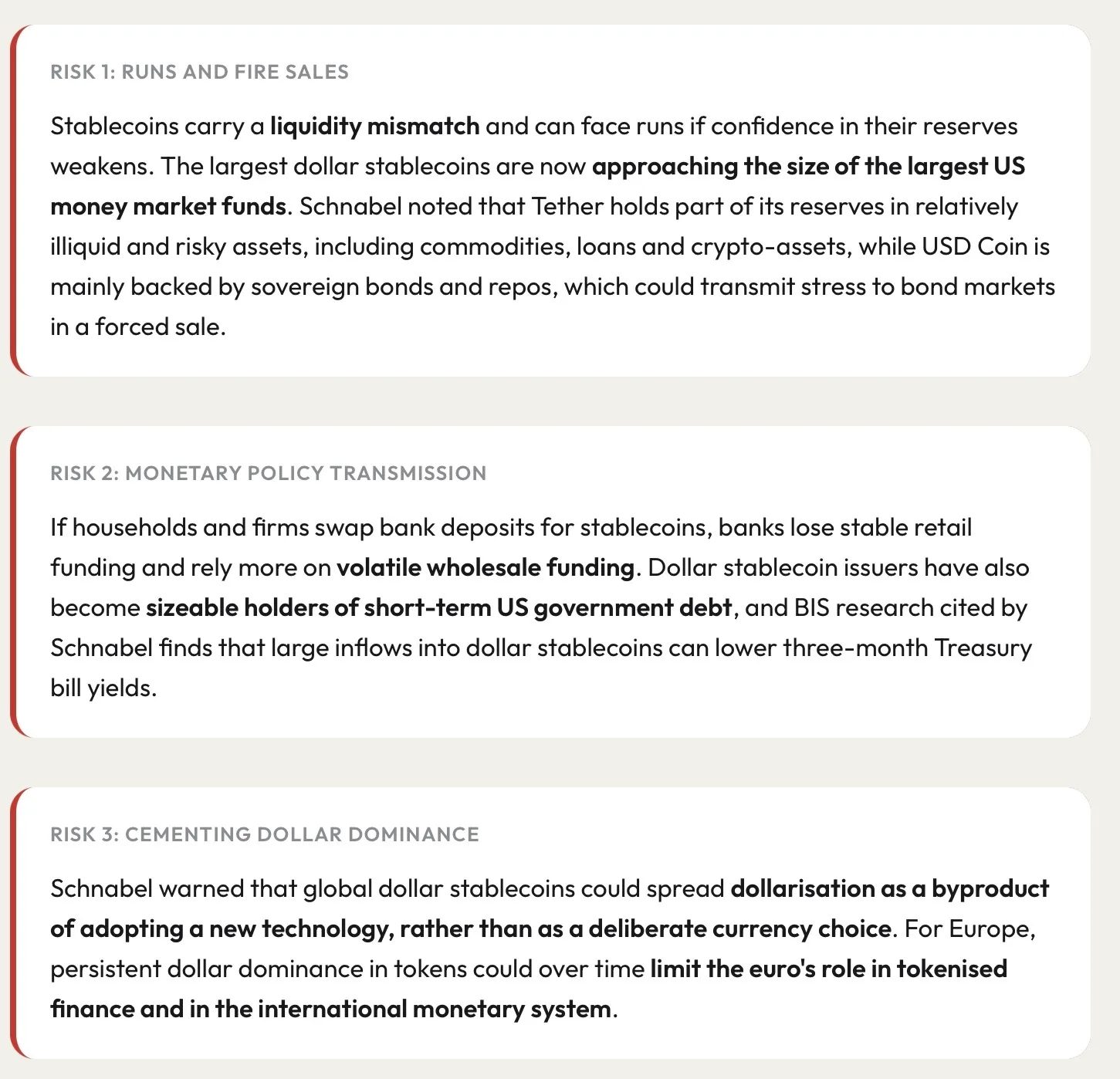
Europe regulates its own issuers tightly. Under MiCAR, the EU's crypto-asset regulation, euro stablecoin issuers must hold at least 30 percent of reserves as bank deposits, rising to 60 percent for significant stablecoins. Schnabel acknowledged the trade-off: this improves liquidity but makes euro stablecoins less profitable to issue, and ties them more closely to the banking sector.
6. Europe's answer, and its limits
The ECB's strategy has two halves: the digital euro for retail payments, and tokenised central bank money for wholesale markets, which is what Pontes and Appia deliver. Schnabel described the goal as providing a public settlement asset that complements and enables private assets like tokenised deposits and stablecoins. Lagarde made the underlying argument in May: many of the advantages of stablecoins come from the technology, not from the instrument itself.
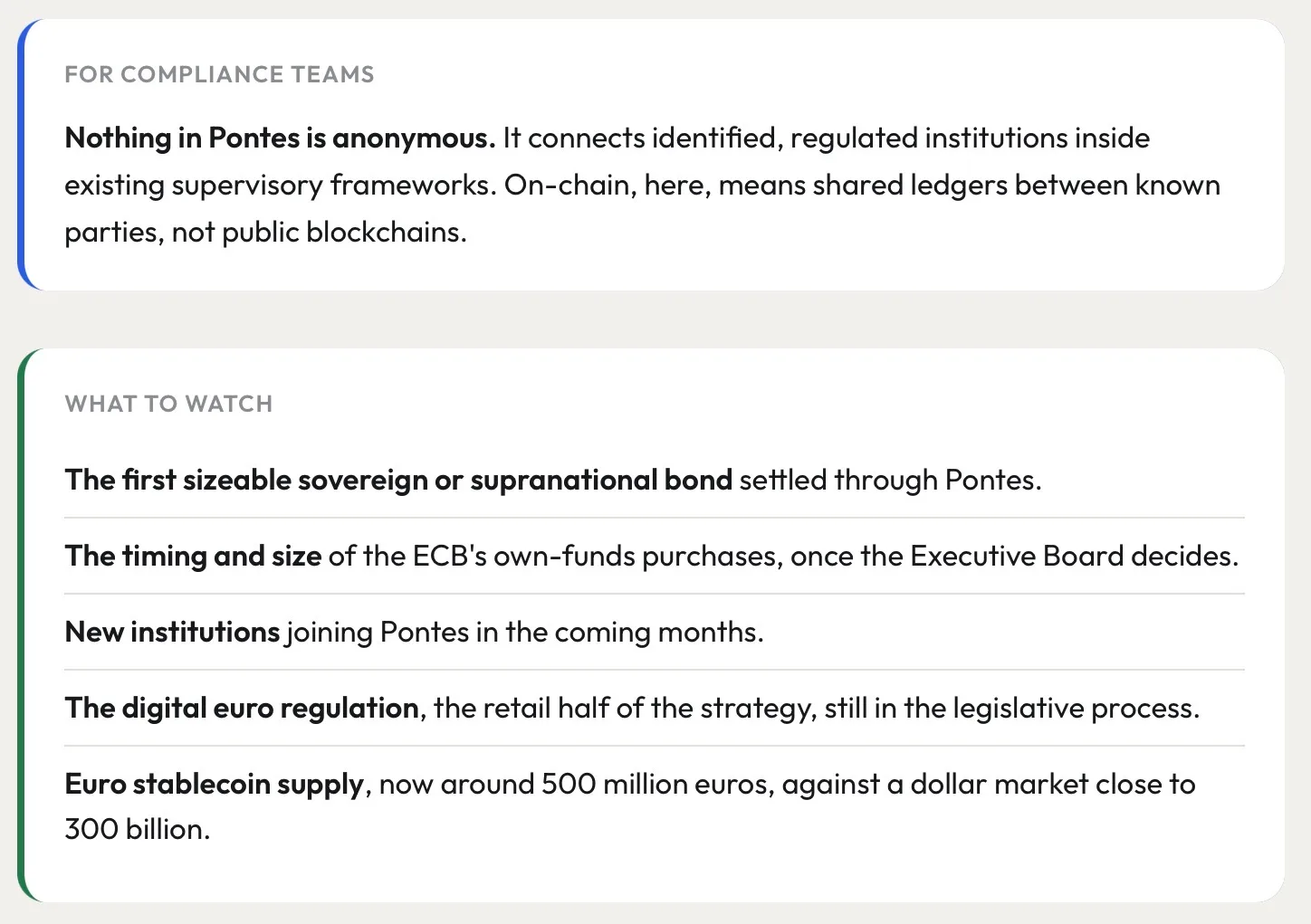
That is the logic of Pontes. It does not ban stablecoins or tokenised deposits. It removes the argument that there is no alternative: the largest regulated institutions now have a settlement asset with no issuer risk, on the same rails.
The limits are just as clear. Pontes is wholesale only; it does nothing for the retail and cross-border payment flows where dollar stablecoins are gaining ground. The digital euro, which would, still depends on legislation not yet adopted. And Schnabel herself pointed to a related weakness: a large and increasing share of card transactions in the euro area is processed by non-European providers.