1. A doctrine nine days before the vote
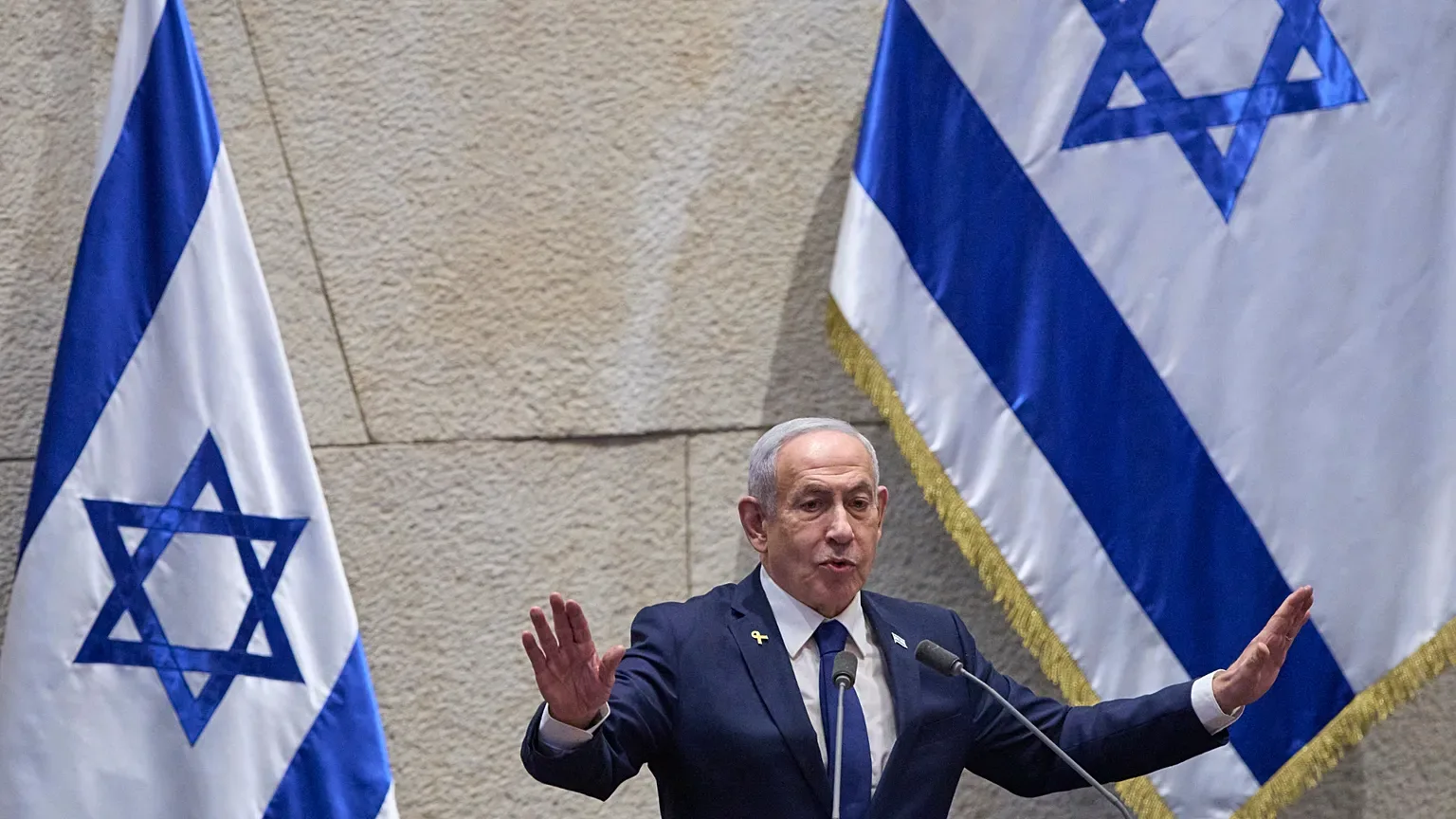
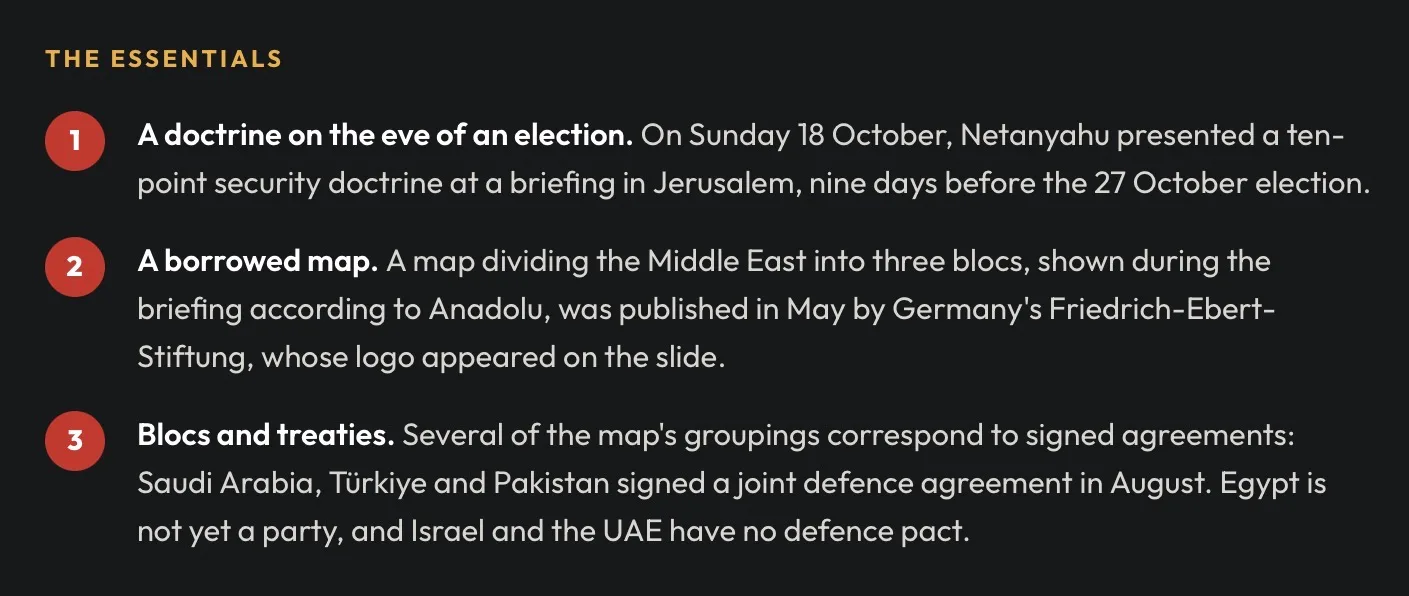
On Sunday 18 October, Prime Minister Benjamin Netanyahu presented Israel's updated security doctrine at a briefing for Israeli reporters in Jerusalem, the Times of Israel reported. The session lasted about two hours, including a presentation of nearly an hour, and several prominent outlets boycotted it. His office also released a written document. Its ten principles, as summarised by Israeli media, favour pre-emption over containment, buffer zones, technological independence and a wider web of alliances.

Netanyahu described the region as threatened by two axes: a Shiite axis led by Iran and what he called a "Muslim Brotherhood axis" led by Türkiye, according to Israeli media. On Iran's nuclear programme, he said, according to Israel National News: "If we need to act alone, we will act alone." He also warned that a president hostile to Israel could take office in two years, and said Israel must diversify its alliances and use the time left: "There is a window of another two years with President Trump." On Türkiye, he said: "I hope we do not reach a head-on confrontation."
2. The map behind him was German
The map shown during the presentation, which splits the Middle East into three rival blocs, is not an Israeli document. It was published on 19 May 2026 by Germany's Friedrich-Ebert-Stiftung, a foundation close to the Social Democratic Party, and drawn by analysts Marc Saxer and Marcus Schneider. According to Anadolu and several regional outlets, a slide in Netanyahu's presentation showed the map with the foundation's logo visible. None of the published accounts quotes Netanyahu commenting on it.
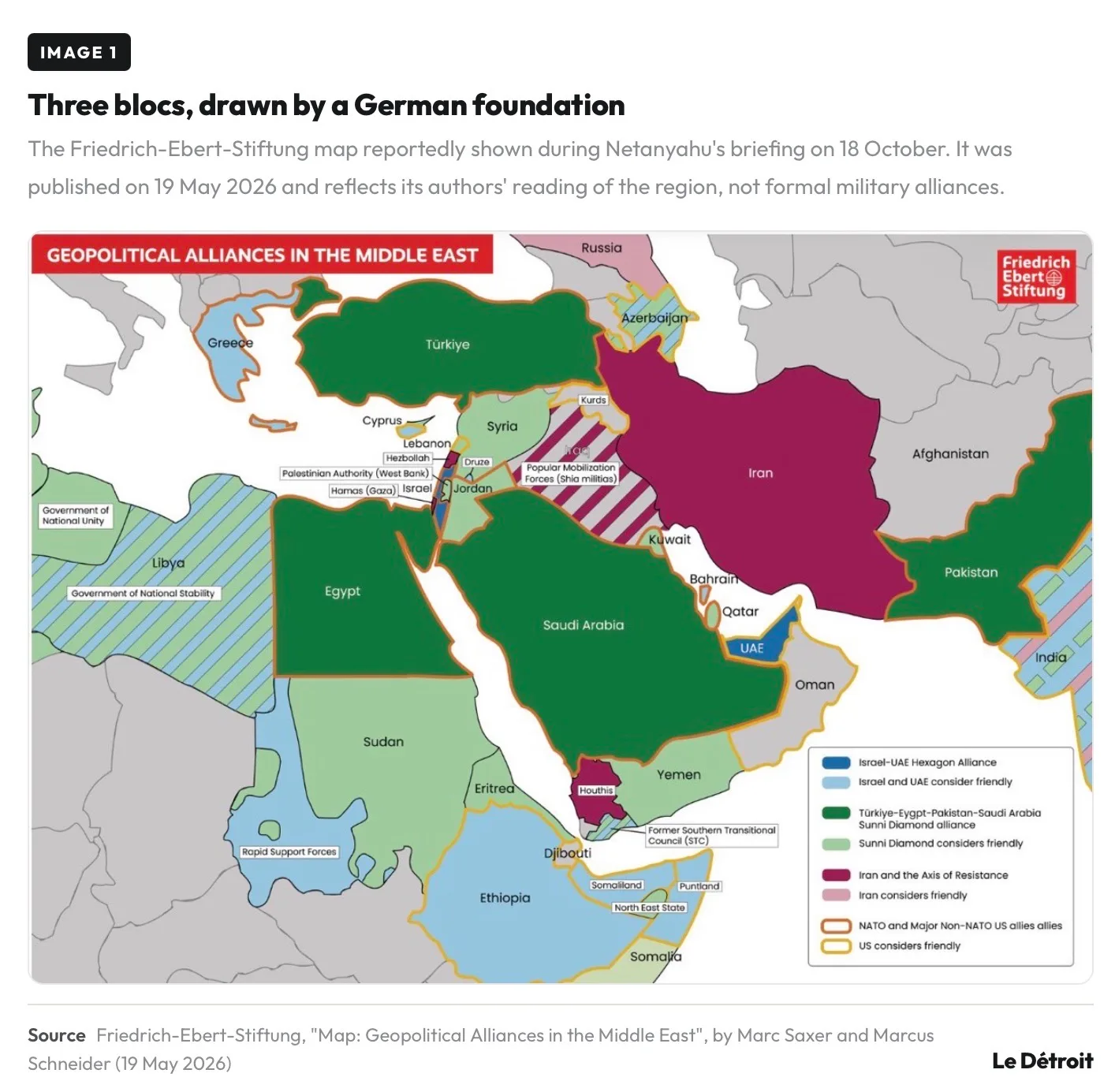
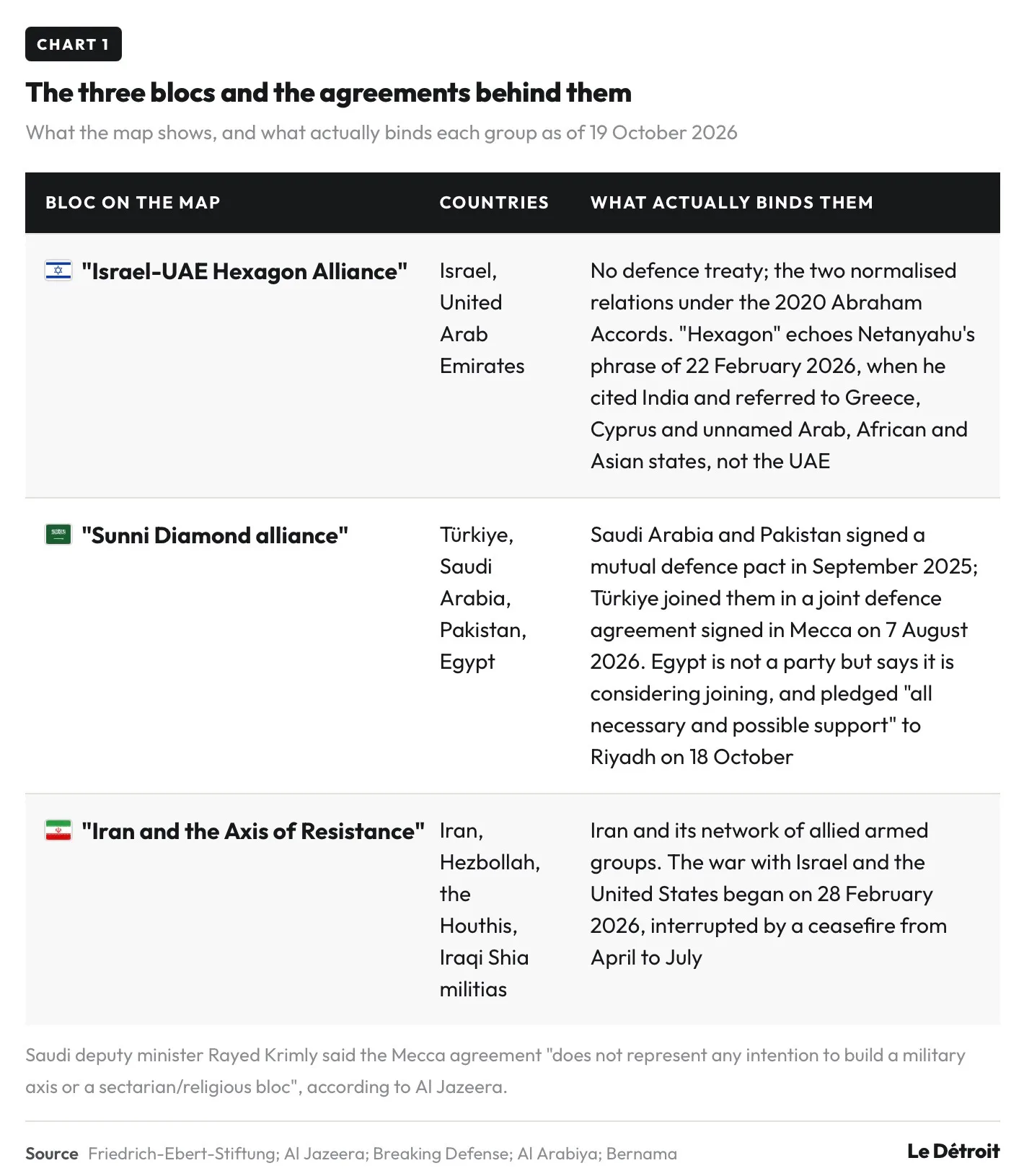
The map's categories are its authors' own. It labels Israel and the United Arab Emirates a "Hexagon Alliance"; groups Türkiye, Saudi Arabia, Egypt and Pakistan as a "Sunni Diamond"; and colours Iran and its allies as the "Axis of Resistance", with a fourth layer for US allies. The foundation's text calls the Israel-UAE relationship a "silent axis" that may become a "Hexagon alliance". The labels are the foundation's, not an Israeli government designation, and Netanyahu did not say publicly whether he endorses them.
3. Which blocs rest on treaties
Several of the map's groupings correspond to signed agreements. Saudi Arabia and nuclear-armed Pakistan signed a mutual defence pact in September 2025, and Türkiye joined them in a joint defence agreement signed in Mecca on 7 August 2026, under which an attack on one is "regarded as an attack against them all". Egypt is not a party, but its foreign minister has said Cairo is seriously considering joining, and its National Defence Council pledged "all necessary and possible support" to Saudi Arabia on 18 October, after a wave of Houthi missile and drone attacks on the kingdom. On the other side, Netanyahu spoke on 22 February of a "hexagon" of alliances, citing India and referring to Greece, Cyprus and unnamed Arab, African and Asian states.

4. Hollow slogans, says the opposition
Israel's opposition dismissed the doctrine as an election document. Gadi Eisenkot called it "hollow" and "filled with slogans that have absolutely nothing to do with a security doctrine", and promised a national security strategy within 150 days if elected. Yair Lapid called it "a collection of inflated slogans devoid of substance". By Monday, Le Détroit had found no official reaction to the doctrine or the map from Ankara, Riyadh, Cairo, Islamabad or Abu Dhabi.
5. Le Détroit's reading
The map tells a story that suits a campaign: Israel as the anchor of a new regional order, facing two hostile axes. The reality is messier. Saudi Arabia, Türkiye and Pakistan are cooperating on defence, though Riyadh denies building a sectarian bloc; Egypt is weighing whether to join; and Israel's "hexagon" remains a set of partnerships rather than an alliance. What the map does capture is the direction of travel: a Middle East where Saudi Arabia, Türkiye and Pakistan now plan their security together, outside any framework that includes Israel.