1. The number
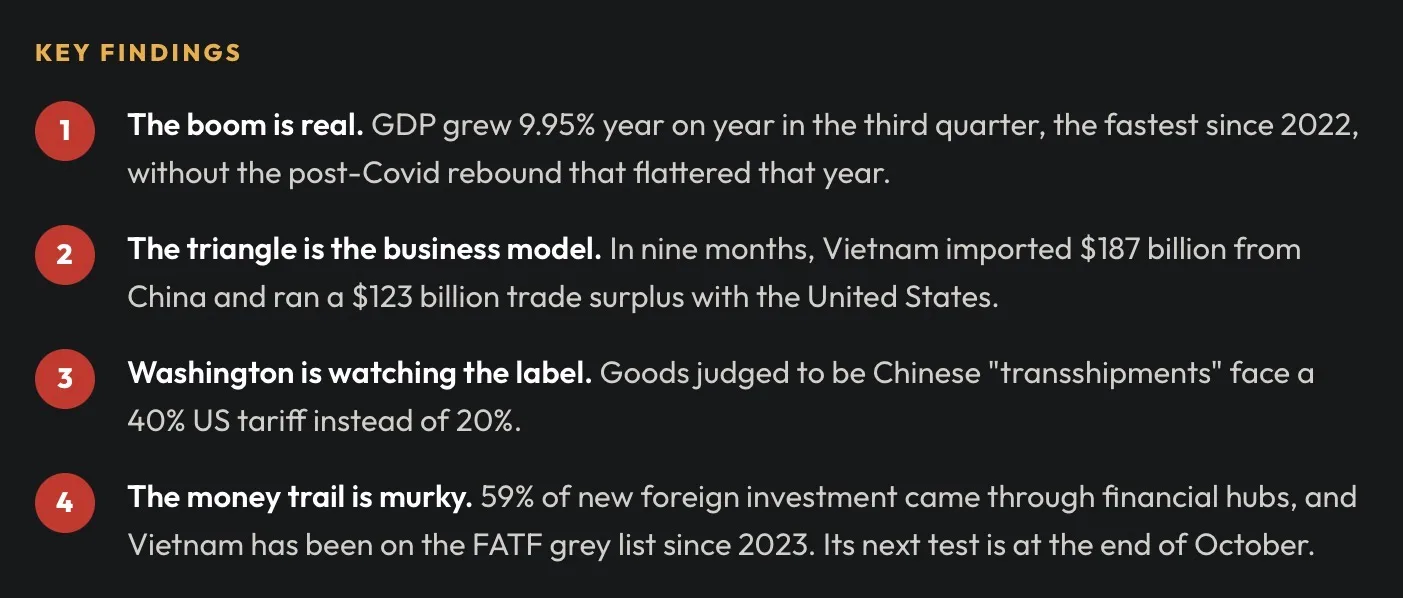
Vietnam's economy grew 9.95% year on year in the third quarter, the National Statistics Office said on 3 October, well above the 8.65% economists expected and up from 8.15% in the first quarter and 8.81% in the second. The first-quarter figure had initially been reported at 7.83% before being revised up. It is the fastest pace since the third quarter of 2022, when growth of 13.7% largely reflected a rebound from Covid lockdowns. This time, there is no such base effect.
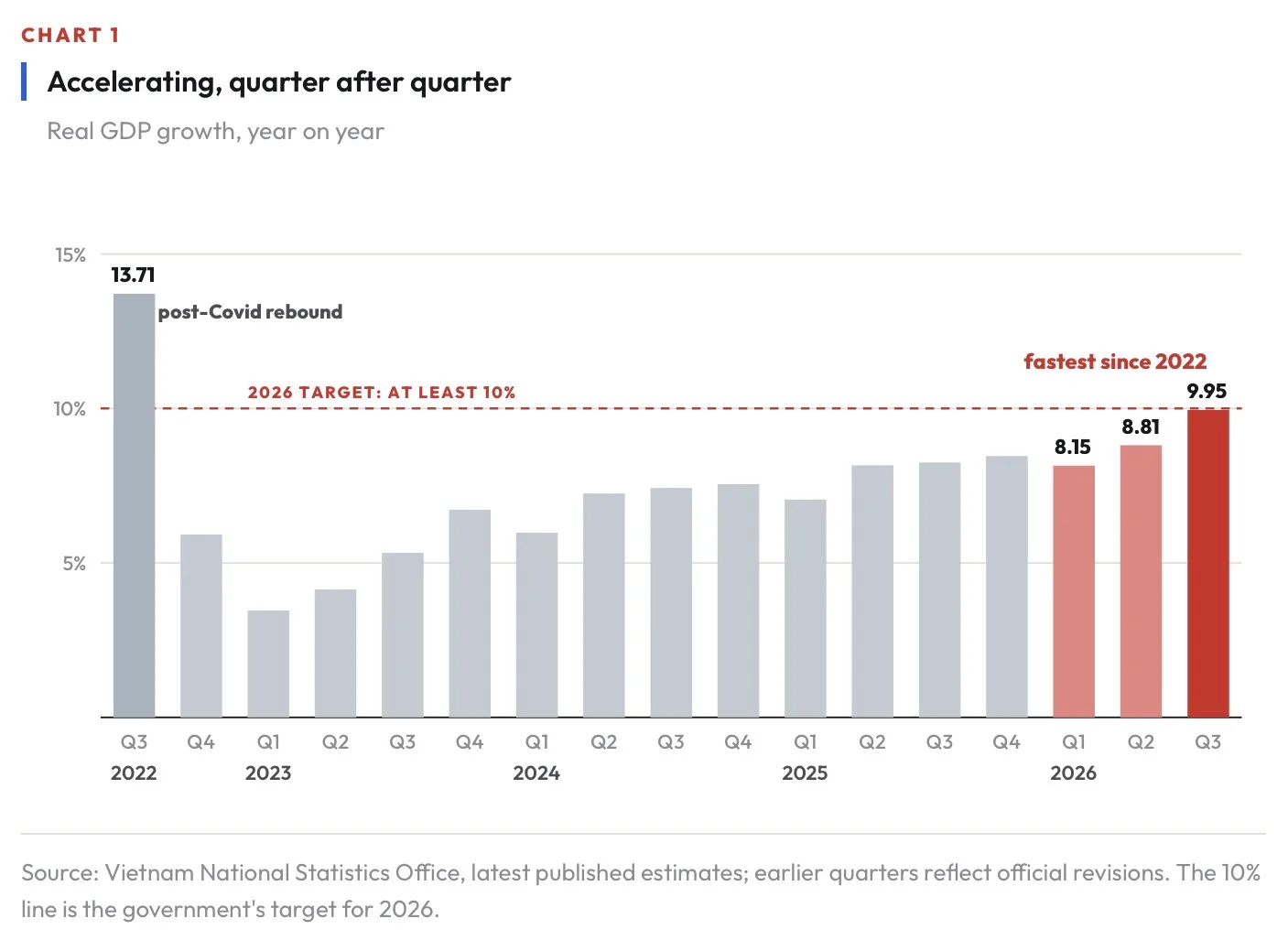
Industry and construction led, up 12.5% in the quarter, and investment surged 21.4%. Growth reached 9.01% over nine months. The government wants at least 10% for the year, which means the fourth quarter has to beat it.
2. The triangle
Behind the boom is a simple geometry. Vietnam buys inputs from China, assembles, and sells to the West.
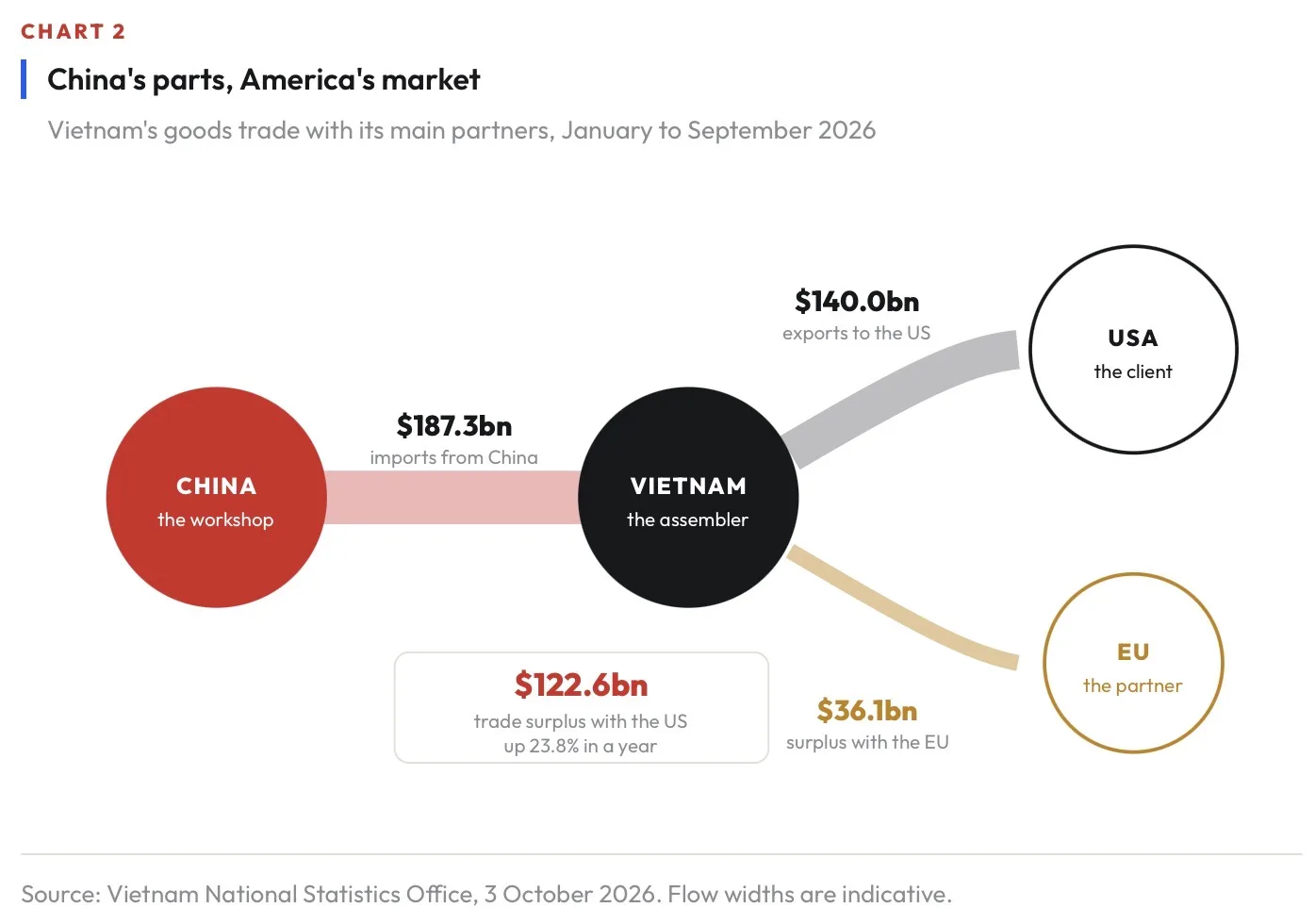
China was Vietnam's largest source of imports in the first nine months, at $187.3 billion, after a record $186 billion in the whole of 2025. The United States was its largest market, buying $140 billion of Vietnamese goods. The surplus with the US rose 23.8% to $122.6 billion; the surplus with the EU, 25.3% to $36.1 billion. Earlier this year, according to US trade data, Vietnam briefly became the largest single source of the US trade deficit.
3. Bamboo diplomacy
Hanoi calls its foreign policy "bamboo diplomacy": firmly rooted, flexible in the wind. In practice, it means signing its highest-level partnership with all sides.
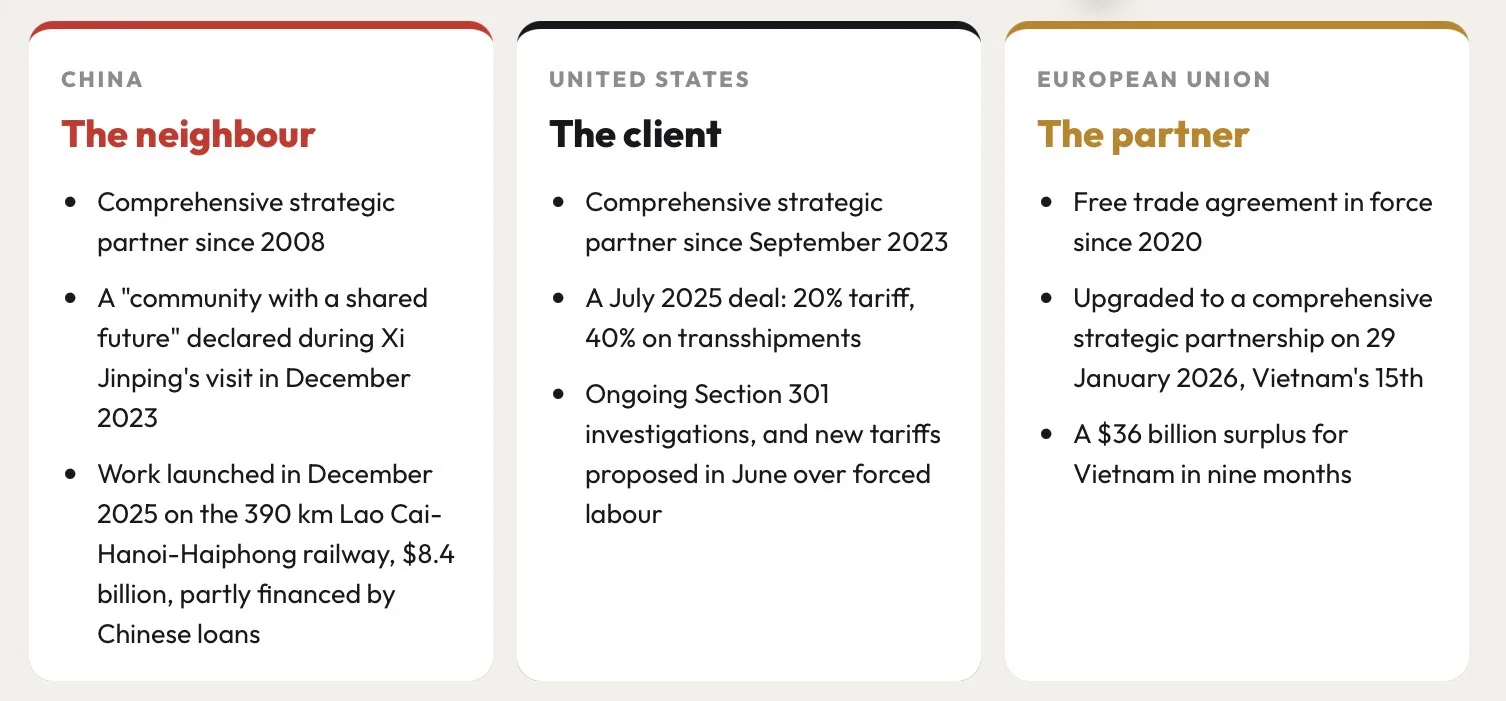
The balancing act has critics. In 2025, Peter Navarro, Donald Trump's trade adviser, called Vietnam "essentially a colony of communist China". Hanoi's answer has been to keep every door open: closer rail links to Yunnan, zero tariffs on American goods, and a new top-tier partnership with Brussels.
4. The financial side of the double game
When "Made in Vietnam" is a financial crime
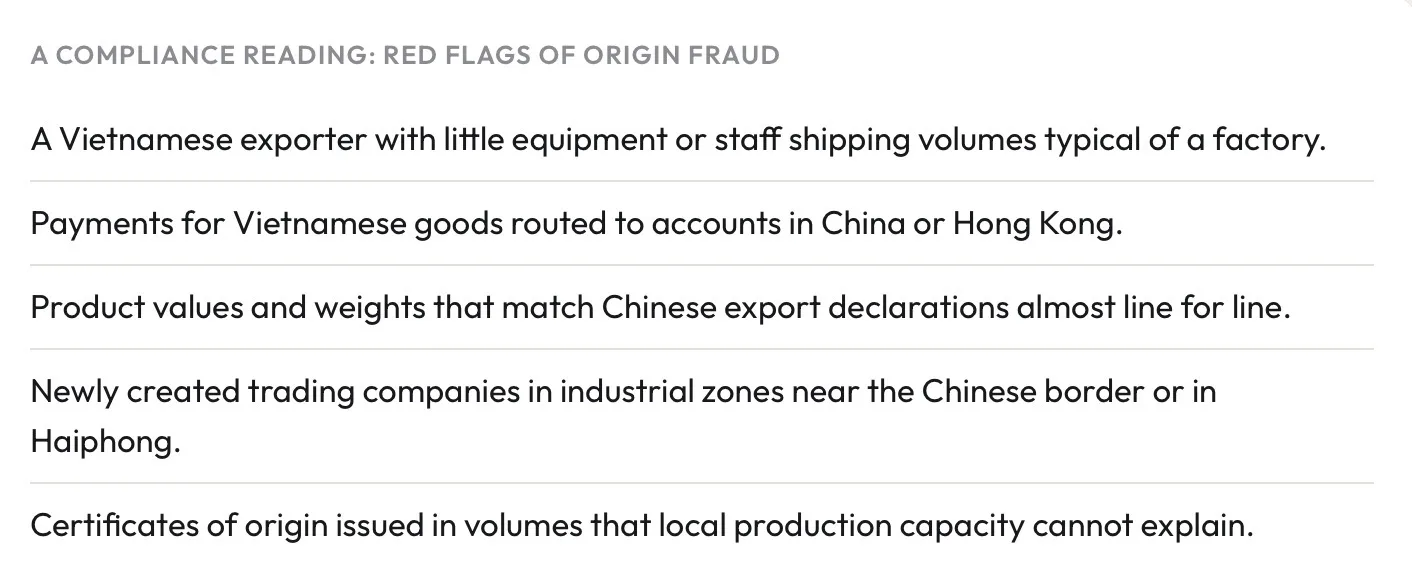
The 40% tariff targets goods that are Chinese in all but label, sometimes after only minimal assembly in Vietnam. Misdeclaring the origin of goods is customs fraud, and it often travels with the techniques of trade-based money laundering: false invoices, shell trading companies and forged certificates of origin. Washington has never clearly defined what counts as "transshipment", which leaves banks and importers to draw the line themselves.
Whose capital?
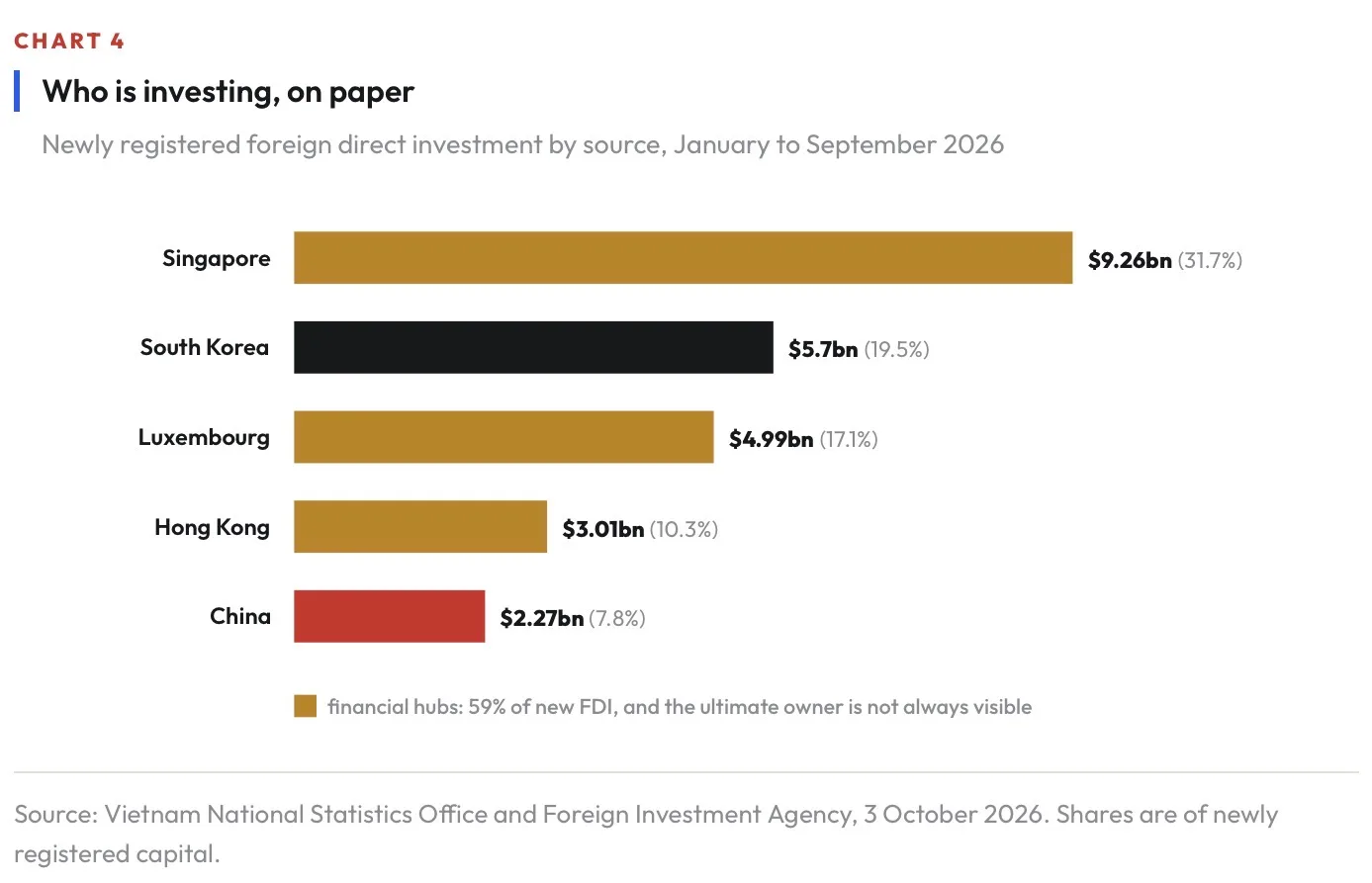
Registered foreign investment reached a record $50.4 billion in nine months, up 76%. But look at where new projects came from: Singapore, Luxembourg and Hong Kong together accounted for 59%. Investment statistics record the jurisdiction the money arrives from, not necessarily its ultimate owner, and financial hubs are where those owners can sit out of view.
The grey list
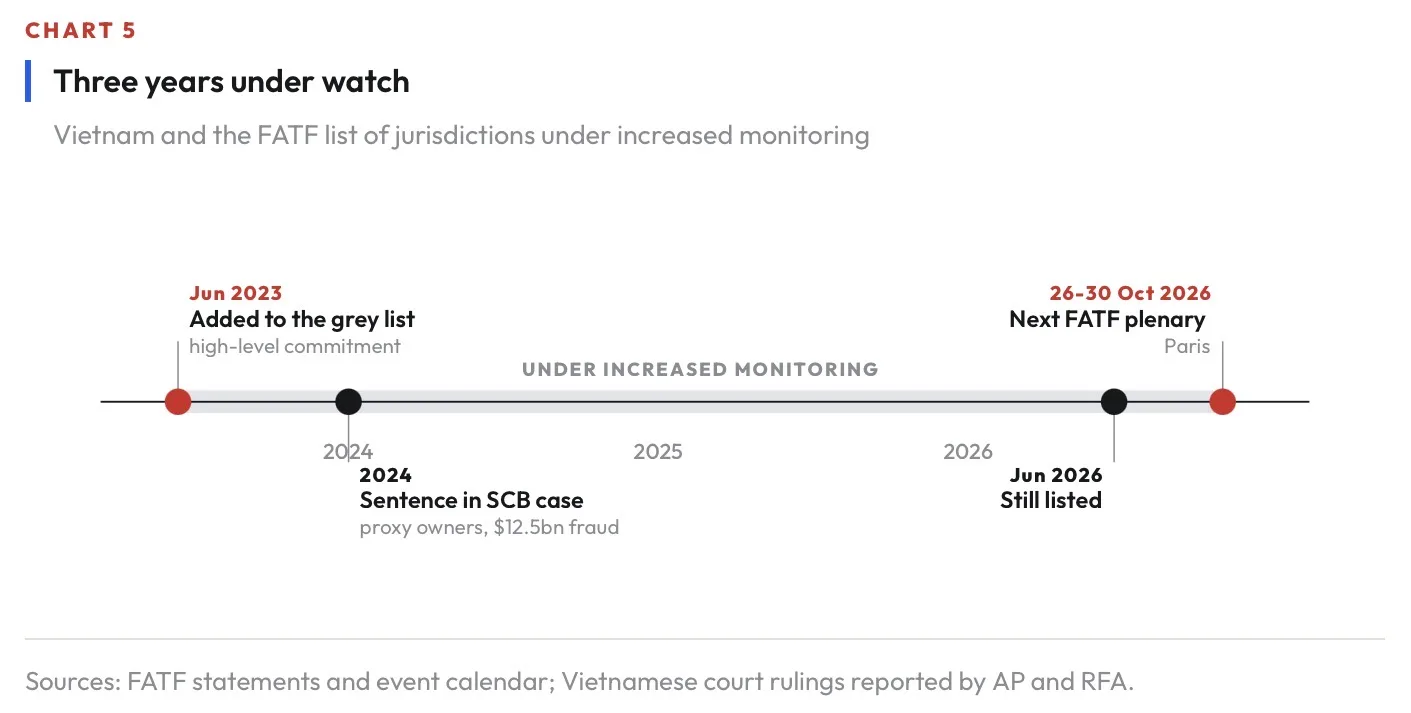
That opacity matters because beneficial ownership is one of Vietnam's known weak spots. The Financial Action Task Force placed the country under increased monitoring in June 2023, and it was still on the grey list after the June 2026 plenary. The country's biggest financial scandal shows why. Real estate tycoon Truong My Lan officially owned about 5% of Saigon Commercial Bank, yet controlled more than 90% of it through relatives and associates, according to the courts. She was sentenced to death in April 2024 for embezzling $12.5 billion, and in a second trial to 12 years for laundering more than $18 billion.
5. What could break the machine
A stricter US definition of transshipment, which could push much more trade into the 40% bracket.
New US tariffs linked to forced labour or the Section 301 investigations.
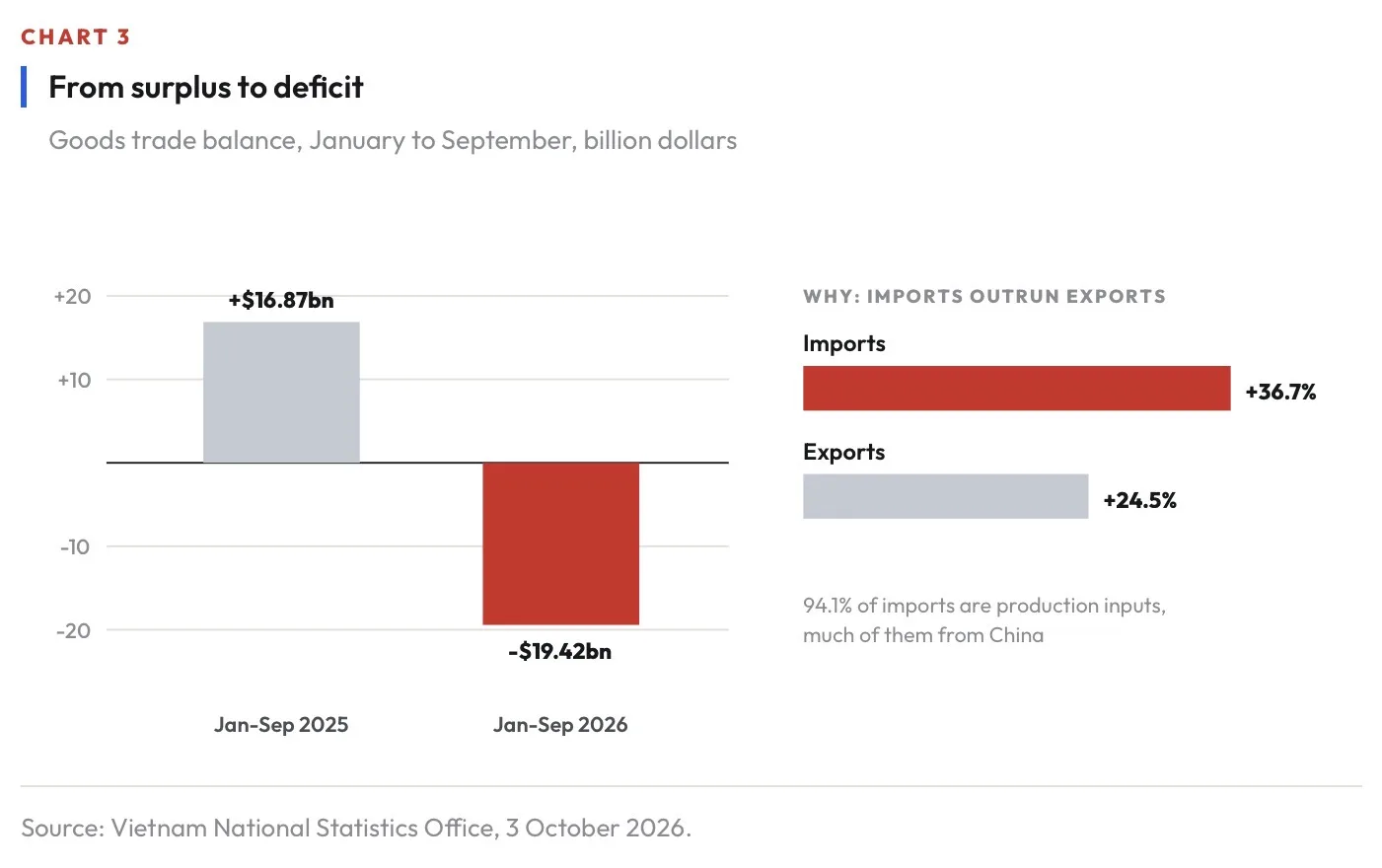
Inflation, at 5.08% in September, with transport and construction costs pushed up by the war with Iran.
Dependence on Chinese inputs: 94% of imports are production materials, and China supplies the largest share.