1. A record within reach
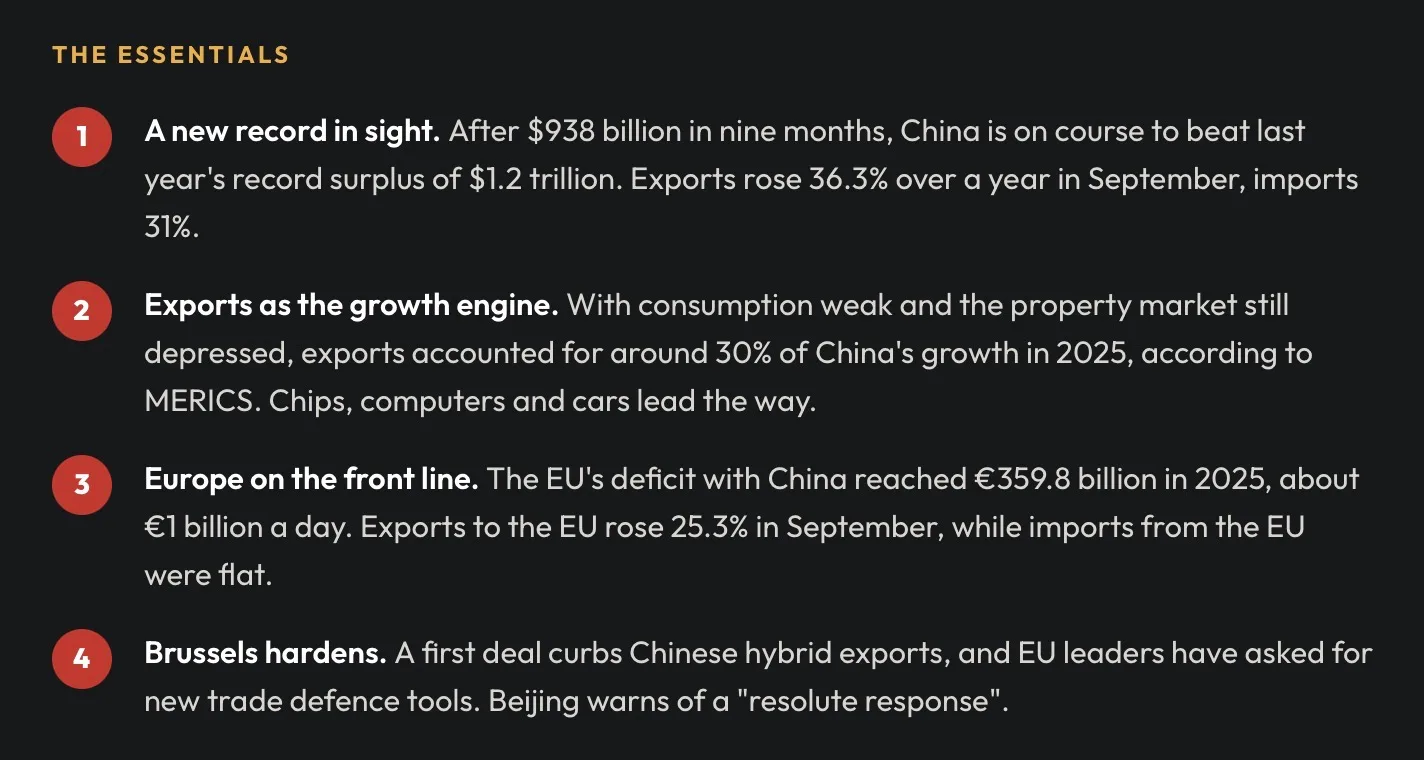
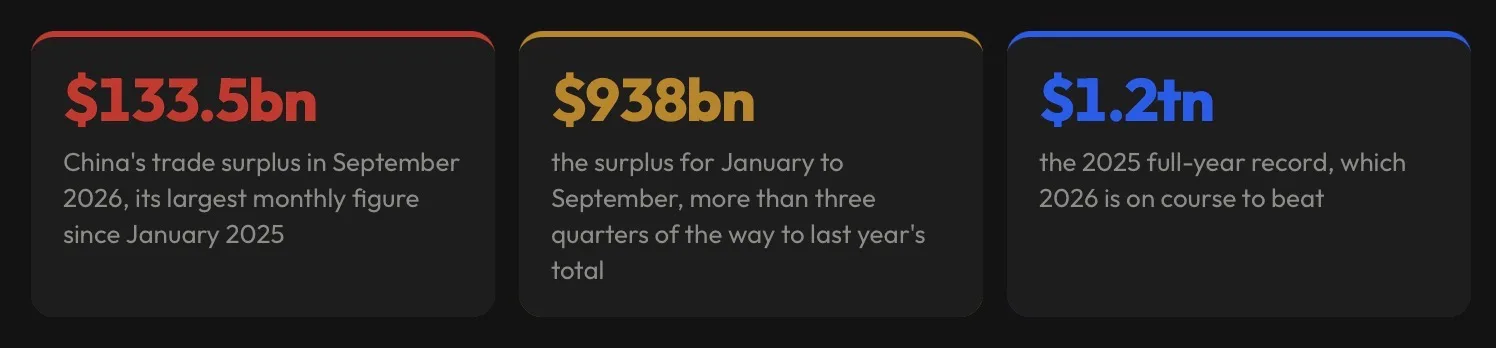
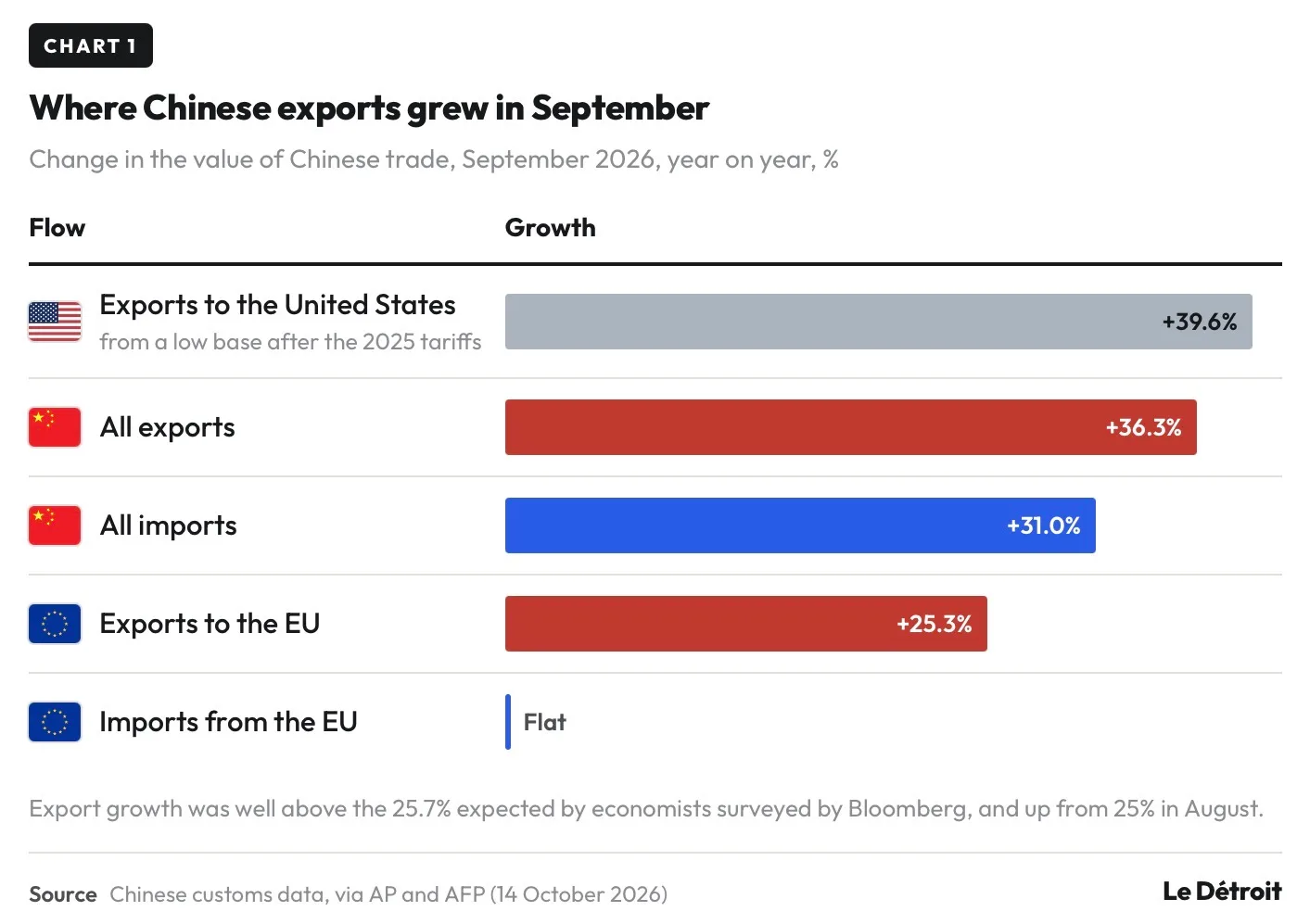
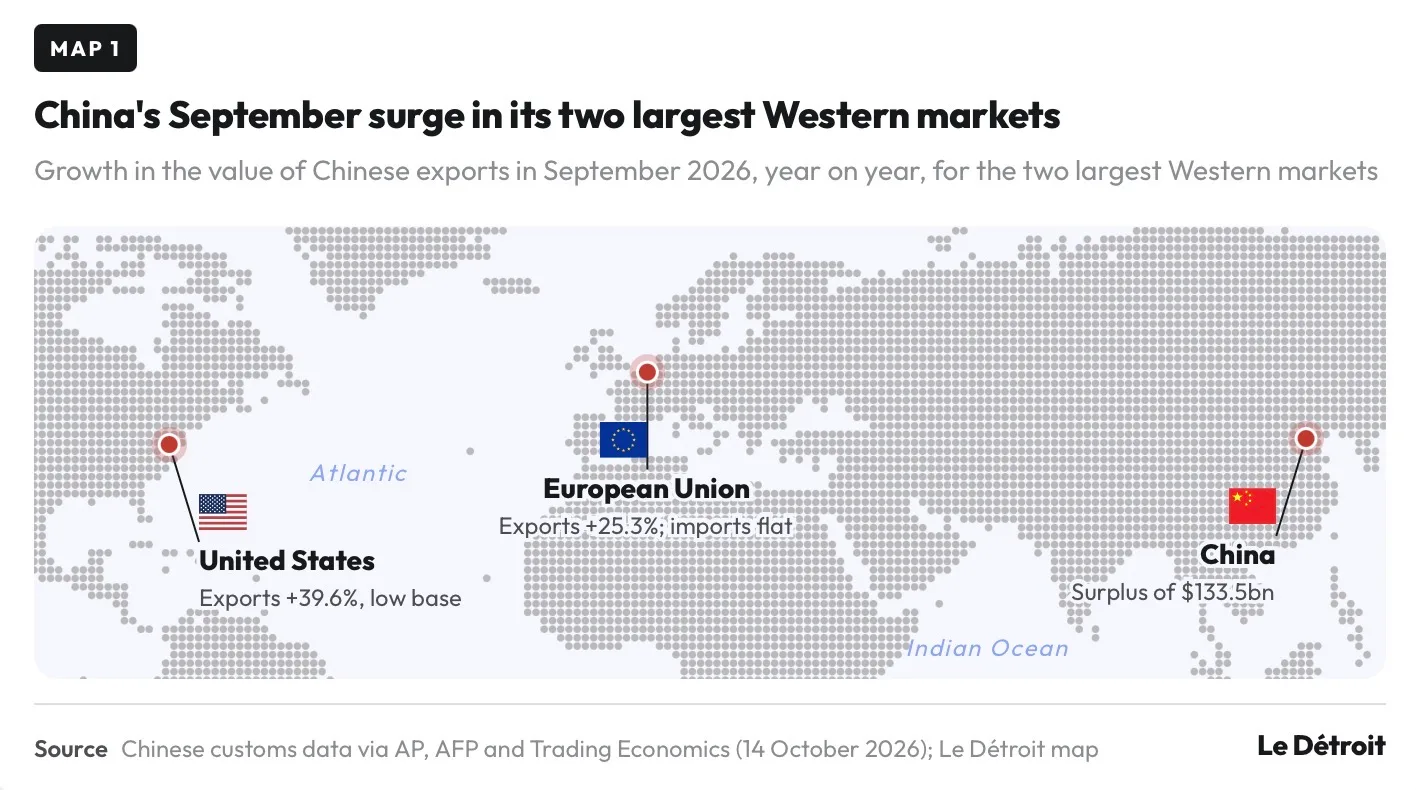
China sold the world far more than it bought in September. Its exports rose 36.3% over a year, their fastest pace since February and well above the 25.7% economists expected, while imports grew 31%, customs data showed on 14 October. Exports reached $447.2 billion and imports $313.7 billion, according to customs figures compiled by Trading Economics. The monthly trade surplus widened to $133.5 billion, from $119.1 billion in August and $88.7 billion a year earlier, the second largest on record after January 2025. Over the first nine months of the year, it reached $938 billion, putting China on course to beat the record of $1.2 trillion it set in 2025.
The surge is broad. Exports to the United States rose 39.6%, but from a low base after the tariff shock of 2025. Exports to the European Union rose 25.3%, while Chinese imports from the EU were flat.
2. Why China exports so much
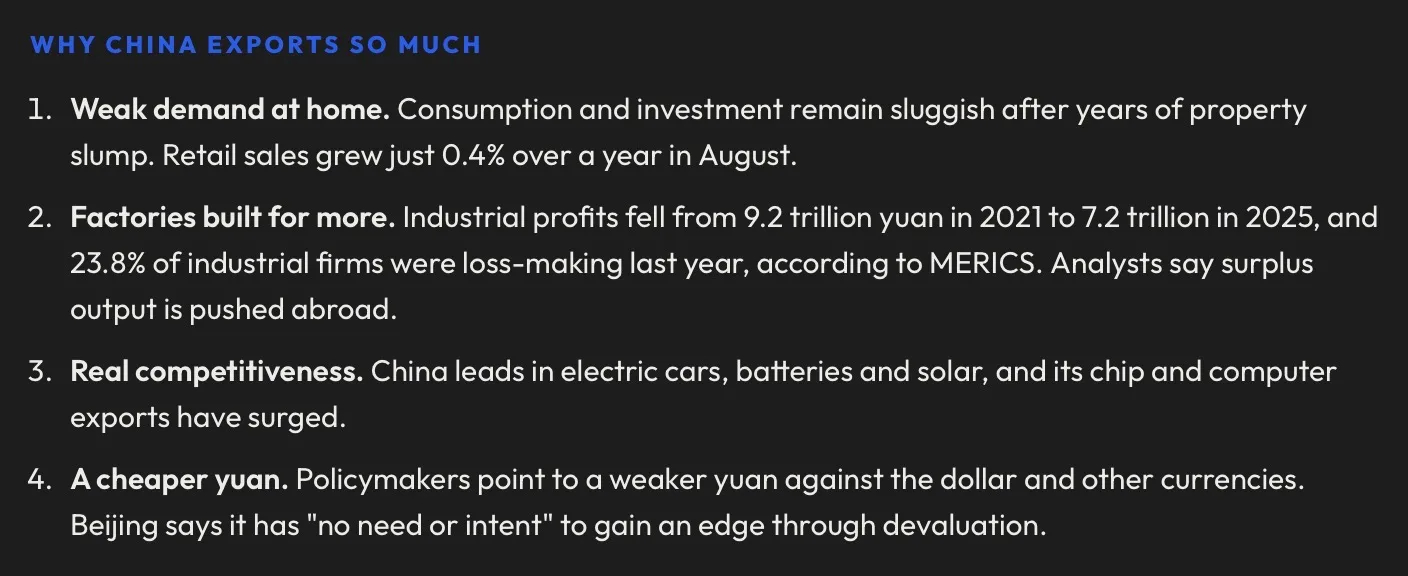
Analysts point first to weakness at home. Chinese households are still reluctant to spend after years of falling property prices, and investment is sluggish. Exports have filled the gap: they accounted for around 30% of China's economic growth in 2025, according to the Mercator Institute for China Studies (MERICS). Beijing's growth target for 2026 is 4.5% to 5%, and the IMF has just lowered its forecast for China to 4.5%.
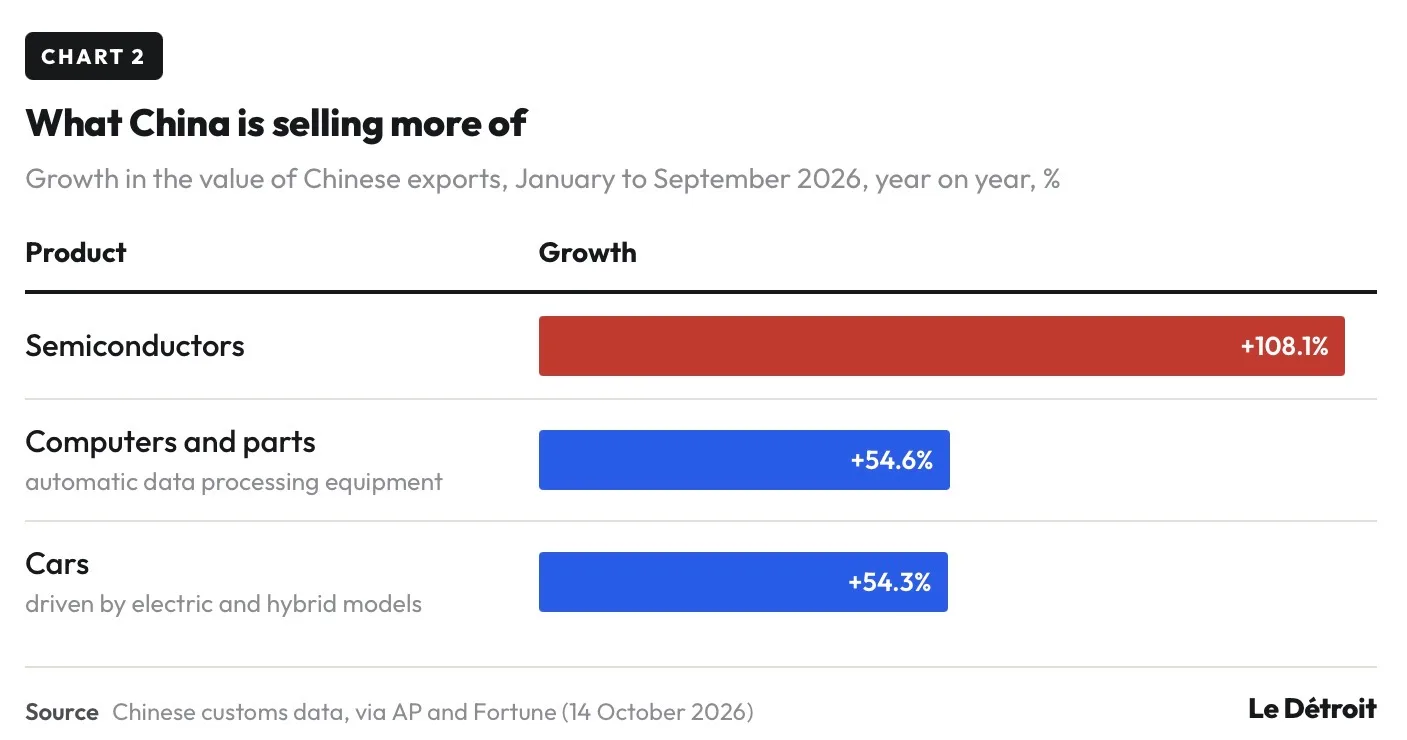
Industrial strength also plays a part. Chinese firms now lead in electric vehicles, batteries and solar panels, and their exports are increasingly high-tech. Over nine months, semiconductor exports more than doubled in value, computers and parts rose 54.6% and cars 54.3%, driven by global demand for Chinese electric and hybrid models.
3. Beijing's plan: make more, and make it better
The 15th Five-Year Plan, approved by the National People's Congress on 12 March 2026and covering 2026 to 2030, puts technology and industry first. The Communist Party's Central Committee called for maintaining "a reasonable proportion of manufacturing" in the economy, and the plan targets average growth in research and development spending of 7.1% a year, and aims to raise core digital economy industries to 12.5% of GDP by 2030. Promoting "new productive forces", meaning high-tech industries, "has become the leadership's central response to slowing growth and rising debt", MERICS writes.
The plan does acknowledge the problem: according to MERICS, its strategy includes "reducing overcapacity in certain industrial sectors". But MERICS expects measures to support consumption to remain secondary. MERICS describes a "strongly supply-oriented approach", in which provisions on income growth and social benefits "take a back seat". The squeeze is visible in company accounts: industrial profits fell from 9.2 trillion yuan in 2021 to 7.2 trillion yuan in 2025, and nearly one in four industrial firms lost money last year.
4. Why Europe is the most exposed
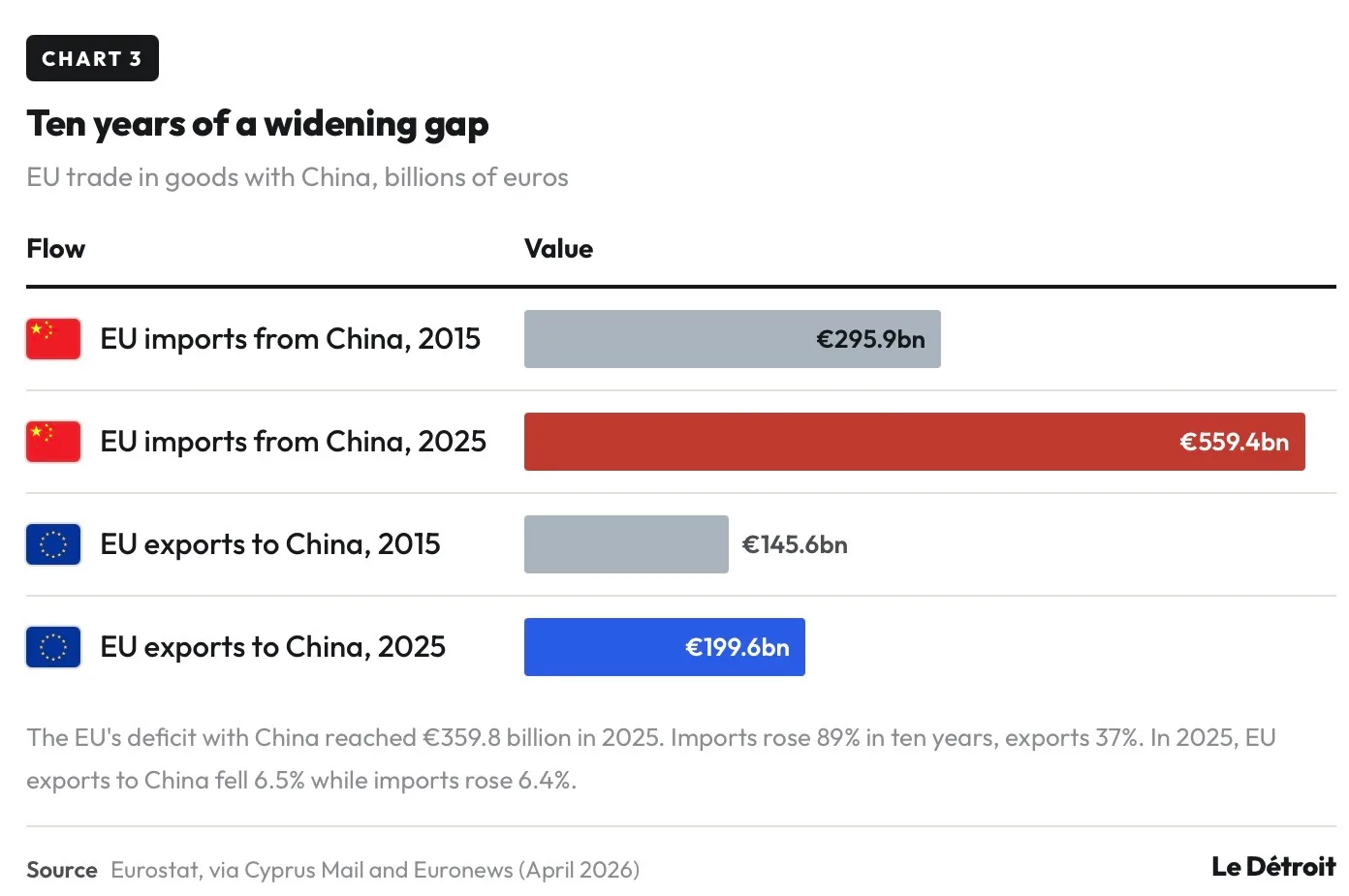
The European Union has become a key outlet: China's surplus with the bloc was its largest with any partner from January to April, ahead of ASEAN and the United States, according to Eunews. The EU's deficit with China reached €359.8 billion in 2025, according to Eurostat: imports from China rose 6.4% to €559.4 billion, while EU exports to China fell 6.5% to €199.6 billion. That is roughly €1 billion a day, a threshold Al Jazeera and the Irish Times report has now been crossed.
Chinese data tell the same story from the other side. China's surplus with the EU reached $113 billion in the first four months of 2026, up about 24% on a year earlier, according to an analysis of Chinese customs data by Eunews, and hit a record $32.9 billion in June alone, Bloomberg reported, a high surpassed again in September, according to AFP. In June, China's surplus with Germany more than doubled over a year. Goldman Sachs estimated in July that the measures Brussels is preparing could affect roughly 27% of China's exports to the bloc, mainly steel, machinery and basic chemicals.
Europe's top imports from China are electrical equipment and machinery, nearly half of the total, and machinery is also the EU's first export to China. "If this unbalanced trend continues, it could ultimately lead to the deindustrialisation of the EU," the Polish Institute of International Affairs (PISM) warned in July.
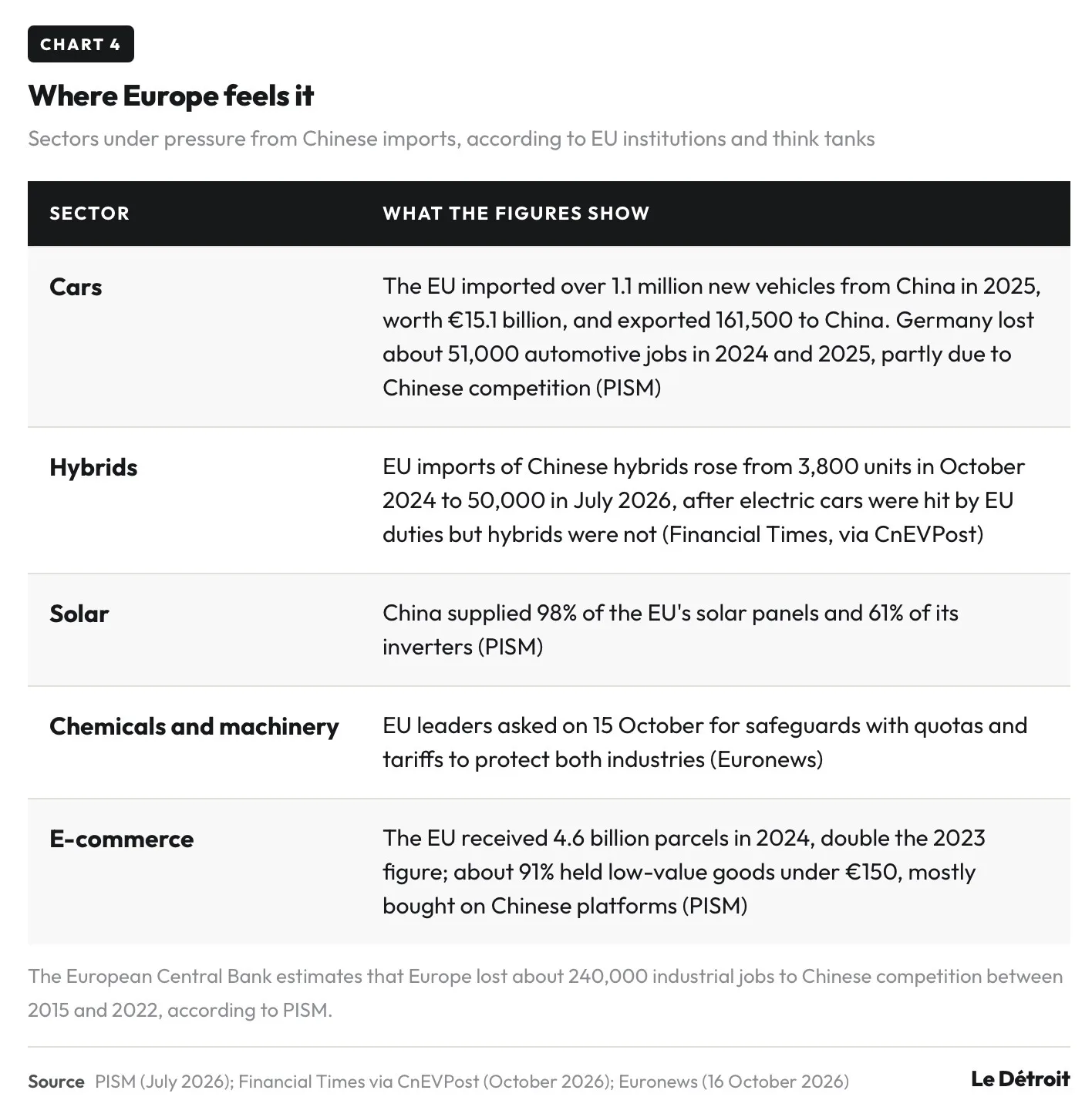
Cars show how fast things can move. When Brussels imposed duties of up to 35.3% on Chinese electric cars in 2024, hybrids were left out. Chinese makers adapted: EU imports of Chinese hybrids rose from 3,800 units in October 2024 to 50,000 in July 2026, according to Financial Times figures.

5. Brussels hardens its tone
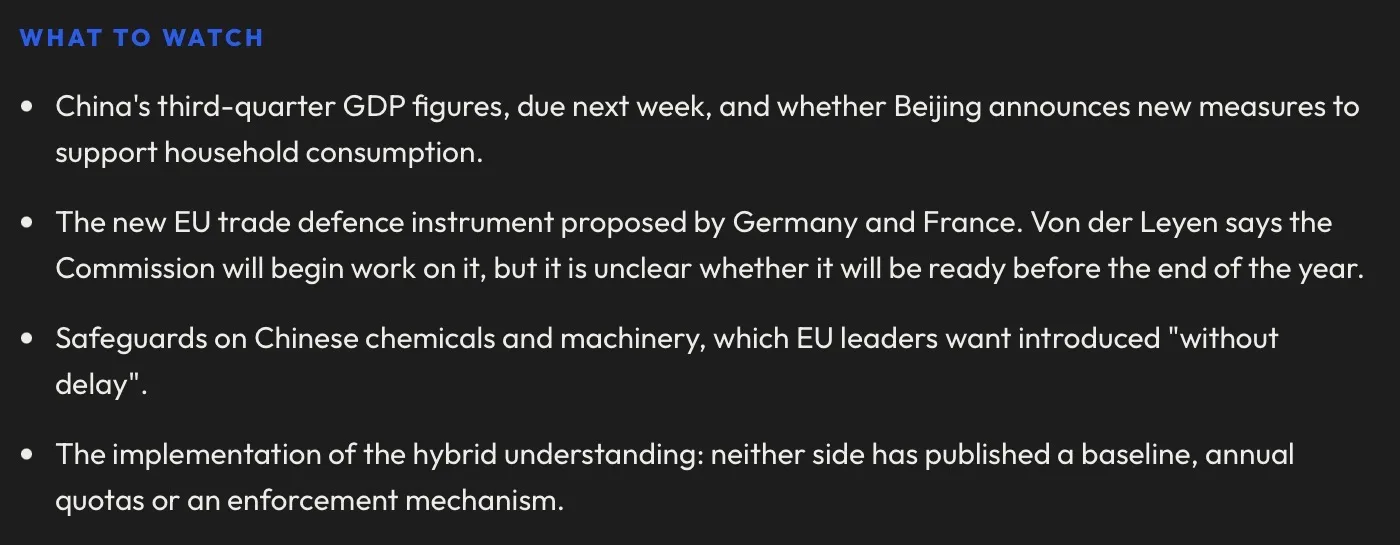
Ursula von der Leyen told the European Parliament in September that the imbalance had reached a "tipping point". Trade commissioner Maroš Šefčovič gave Beijing until October to deliver "very concrete results". Talks in Beijing on 8 and 9 October with commerce minister Wang Wentao produced what Šefčovič called a "first step": an understanding to moderate Chinese hybrid exports to the EU, which he says could cut projected exports by more than half over four years, a faster "green channel" for rare earth export licences, and an "exploration" of lower Chinese tariffs on products such as car parts, olive oil and footwear. China confirmed the understanding but gave no figures.
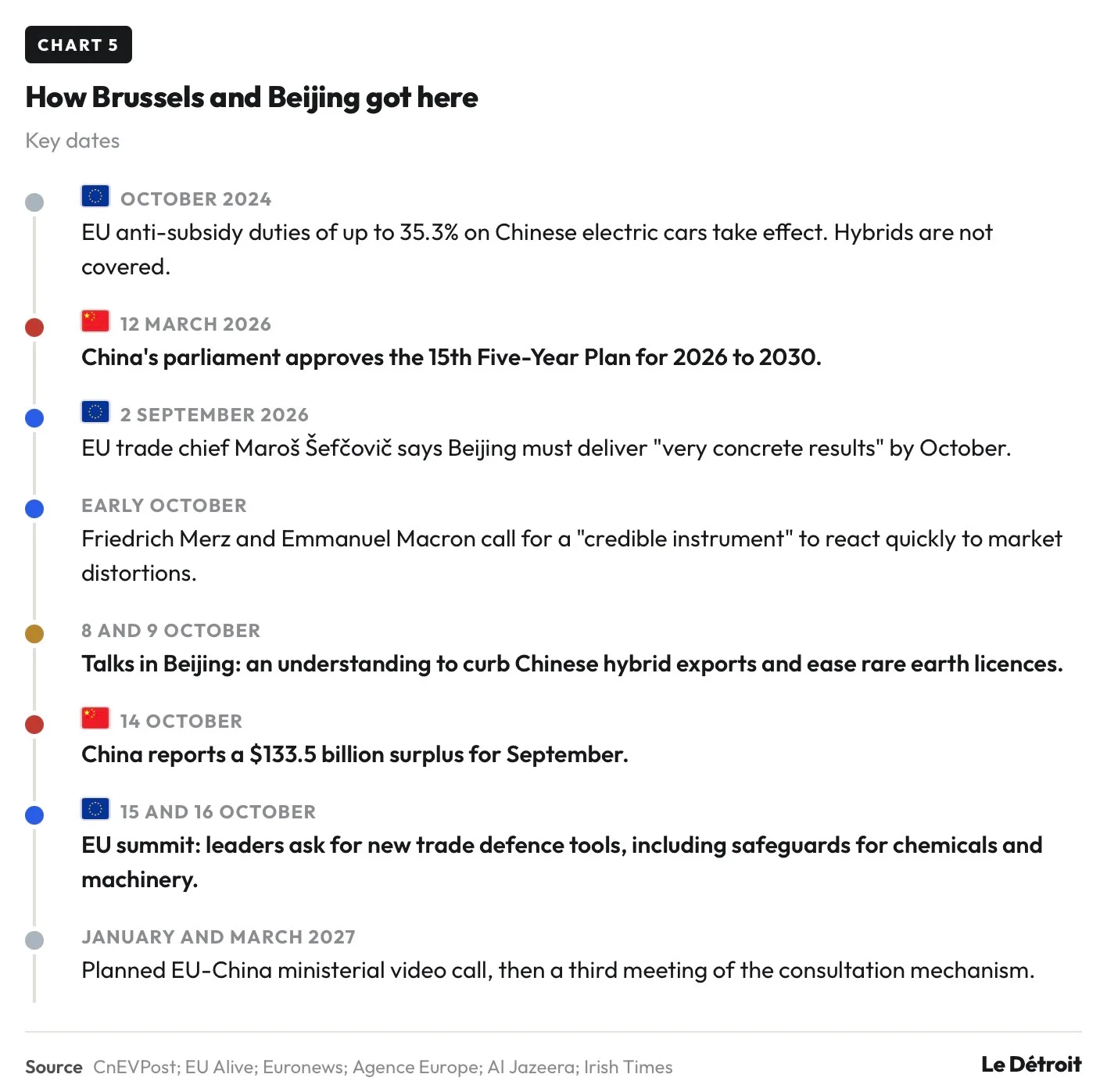
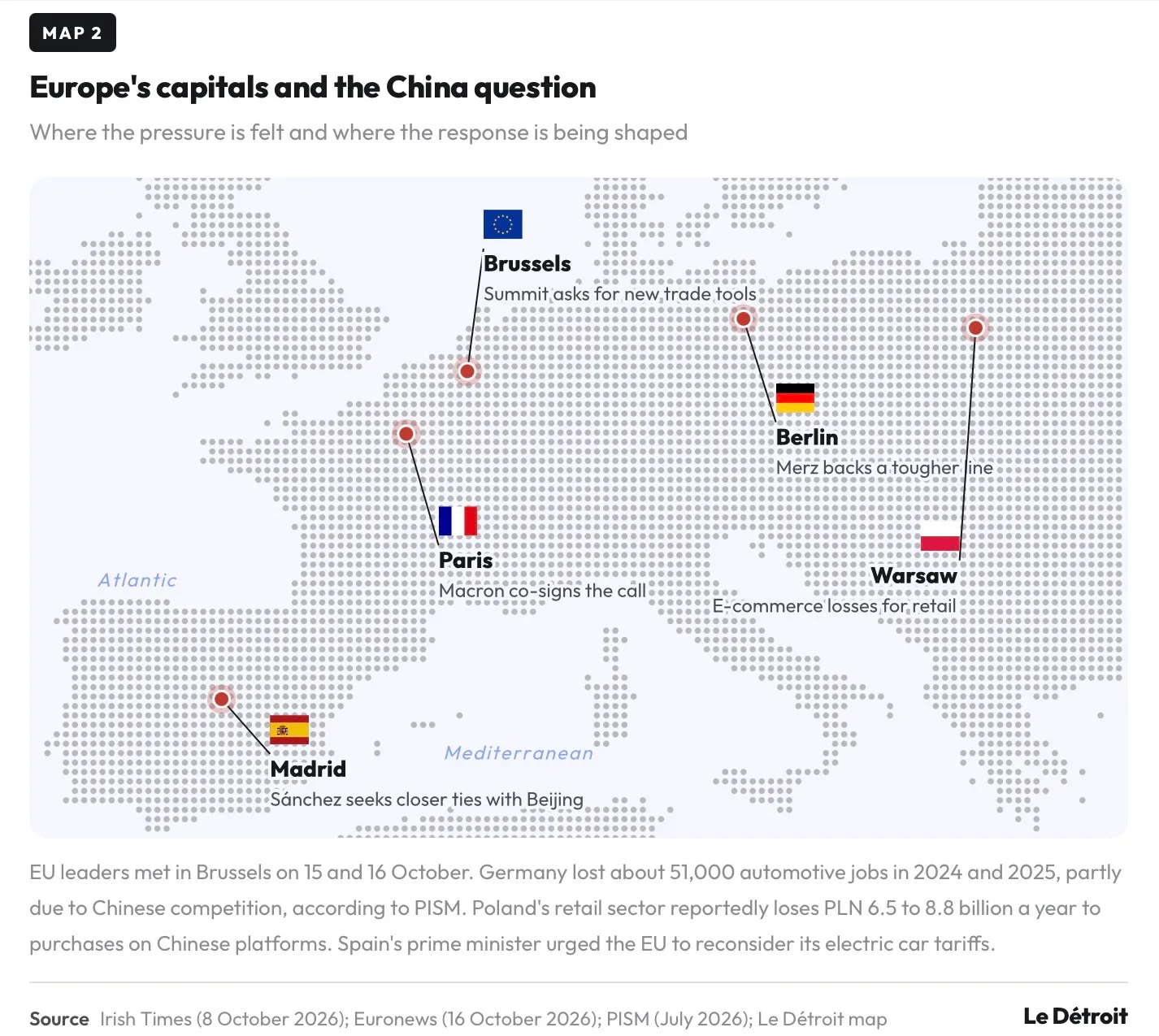
Many in Europe want more. In early October, Chancellor Friedrich Merz and President Emmanuel Macron called for a "credible instrument" allowing the Commission a "decisive and systemic reaction" to market distortions, without naming a country. At their summit on 15 and 16 October, EU leaders asked the Commission to prepare new trade defence tools, including safeguards with quotas and tariffs for the chemicals and machinery industries, introduced "without delay", according to Euronews. The conclusions avoided naming China, referring instead to "macroeconomic imbalances".

Beijing rejects the diagnosis. China says its trade growth reflects industrial competitiveness, calls accusations of overcapacity protectionism, and has vowed a "resolute response" if the EU restricts its goods. The commerce ministry described the hybrid understanding as "reciprocal and mutually beneficial", while a Fudan University scholar quoted by the state-run Global Times warned that the EU "may face countermeasures from China in the future" if it keeps up pressure based on what he called a misperception. China holds a near-monopoly on rare earths and permanent magnets, which Beijing has implicitly threatened to use as leverage, the Irish Times reported.
6. Le Détroit's reading
The September surplus is not an accident but the result of a model. As long as Chinese households save rather than spend, and as long as Beijing directs credit to factories rather than to consumers, China will produce more than it can absorb, and the excess will flow to whichever large market stays open. The United States has partly closed its door. Europe, which depends on China for rare earths and runs on export-oriented industries of its own, is now where the adjustment lands.
The hybrid deal shows both the reach and the limits of negotiation: it addresses one product among thousands, with no published figures. The real test is whether the EU can agree on a fast, general instrument without triggering retaliation on the rare earths its own industry needs.