1. What Africa launched
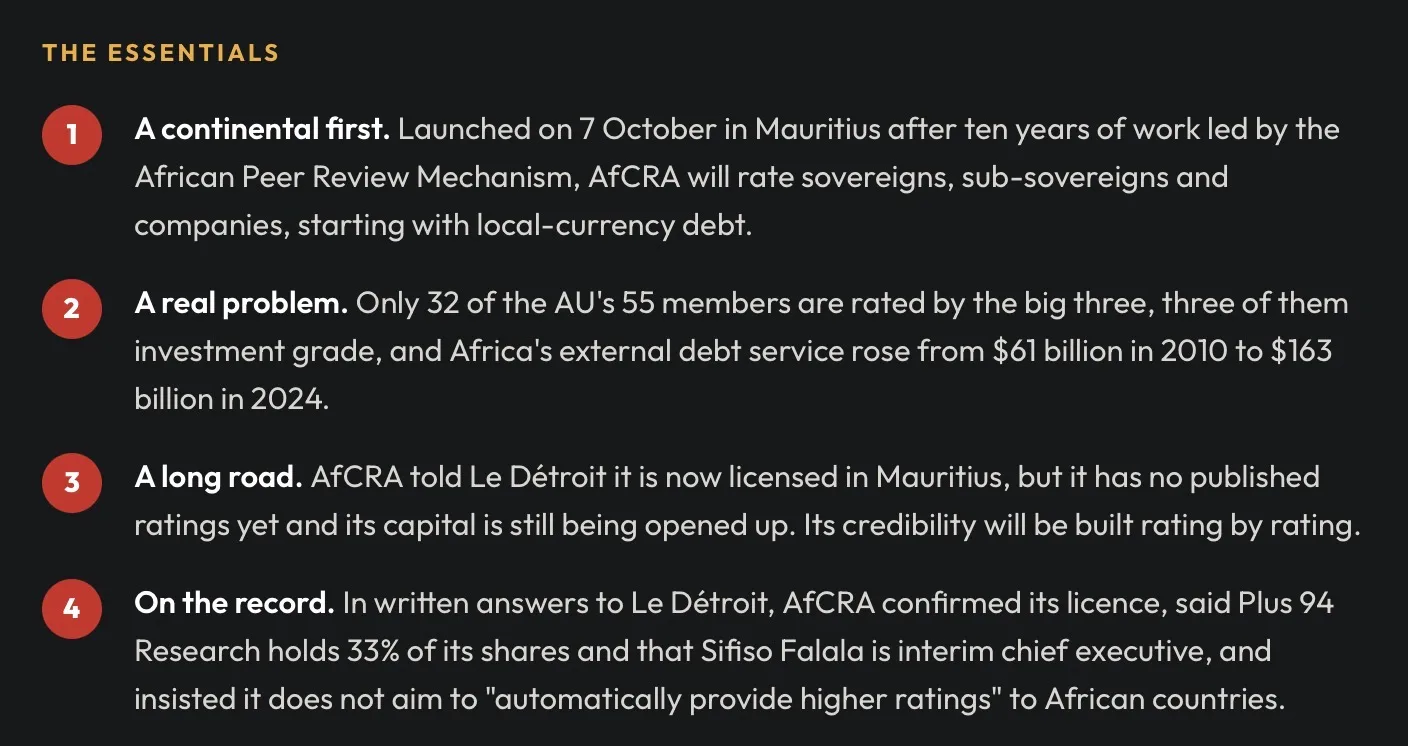
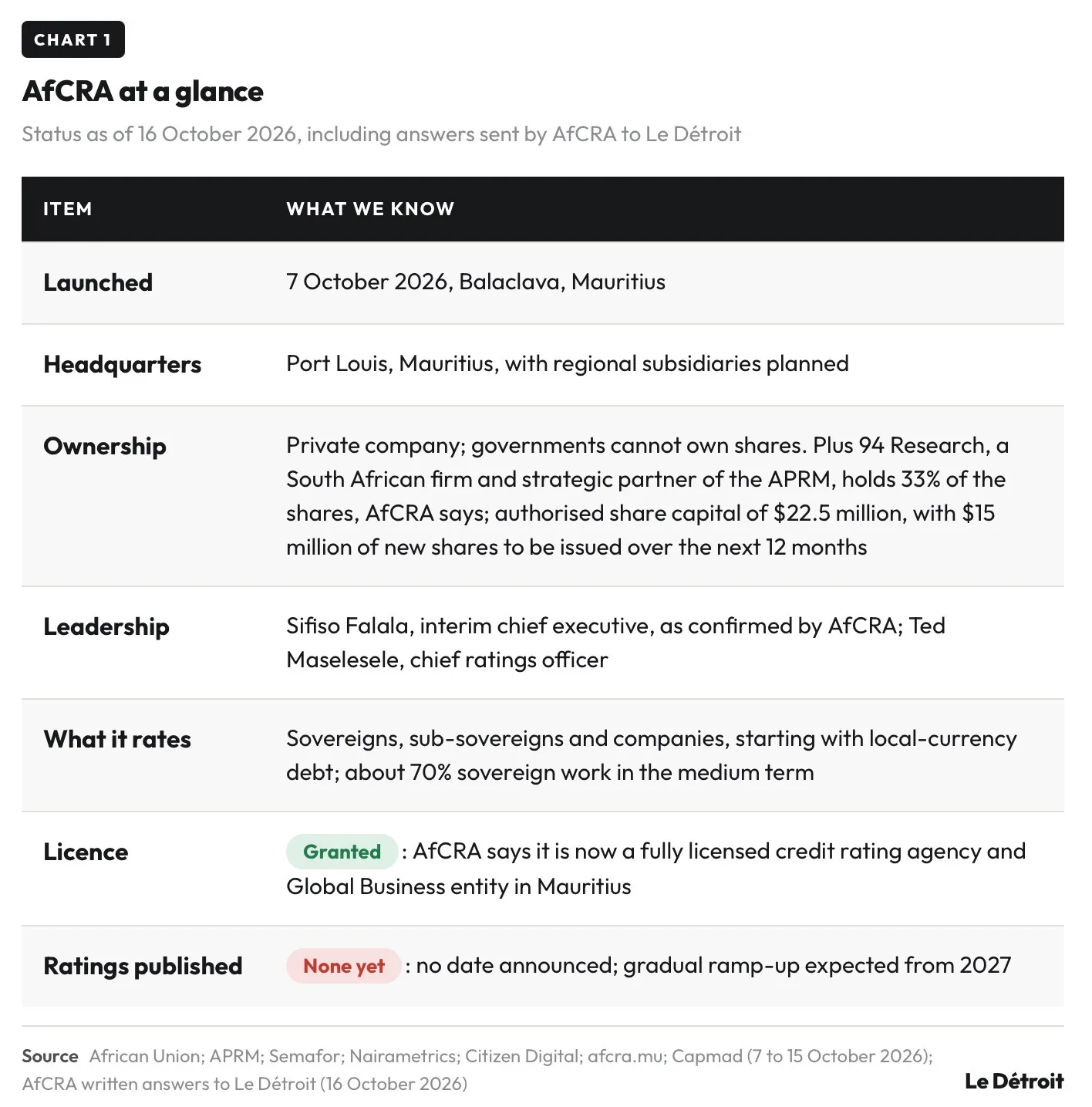
On 7 October 2026, in Balaclava, just north of Port Louis, the African Union officially launched the Africa Credit Rating Agency (AfCRA), the first credit rating agency created at the initiative of the continent's own institutions. The ceremony, attended by the chair of the AU Commission, Mahmoud Ali Youssouf, followed the 2nd Annual Conference on Credit Ratings, held over the two previous days and organised by the African Peer Review Mechanism (APRM) and Mauritius, with the support of the UN Economic Commission for Africa.
AfCRA is designed as a private, self-funded and independent company, headquartered in Port Louis, with regional subsidiaries planned. Governments are barred from owning shares, "ensuring freedom from political influence", the AU says. The APRM oversaw its creation, but the agency now operates on its own, and neither the AU nor the APRM determines its ratings. It will rate sovereigns, sub-sovereigns, companies and public institutions, with an initial emphasis on local-currency debt.

2. Why the continent wanted its own voice
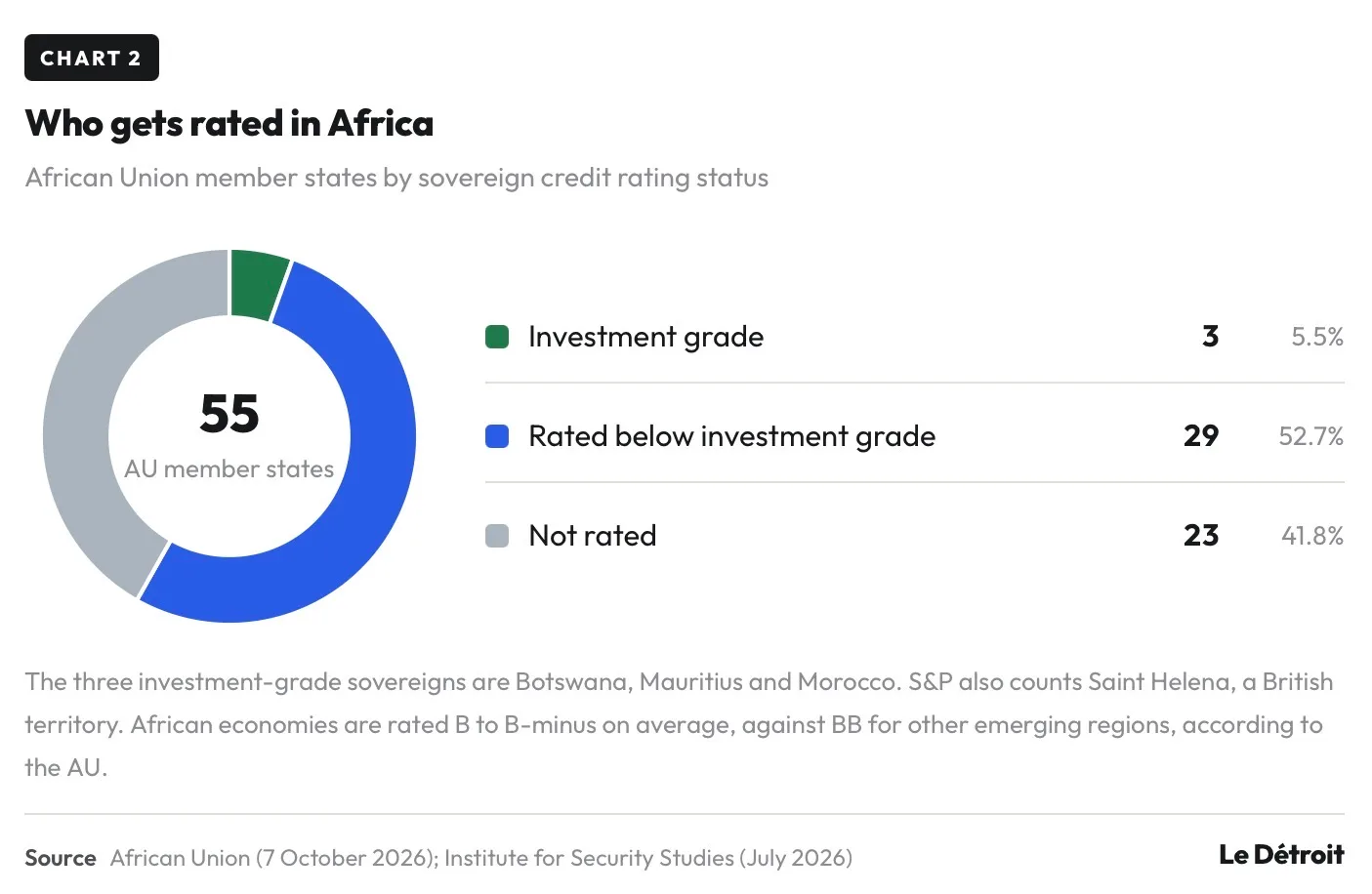
Credit ratings decide how much a country pays to borrow, and whether it can borrow at all. In Africa, the picture is stark. Only 32 of the AU's 55 member states have a sovereign rating from Moody's, S&P or Fitch, and only three, Botswana, Mauritius and Morocco, are rated investment grade. African economies are rated B to B-minus on average, against BB for other emerging regions, according to the AU.

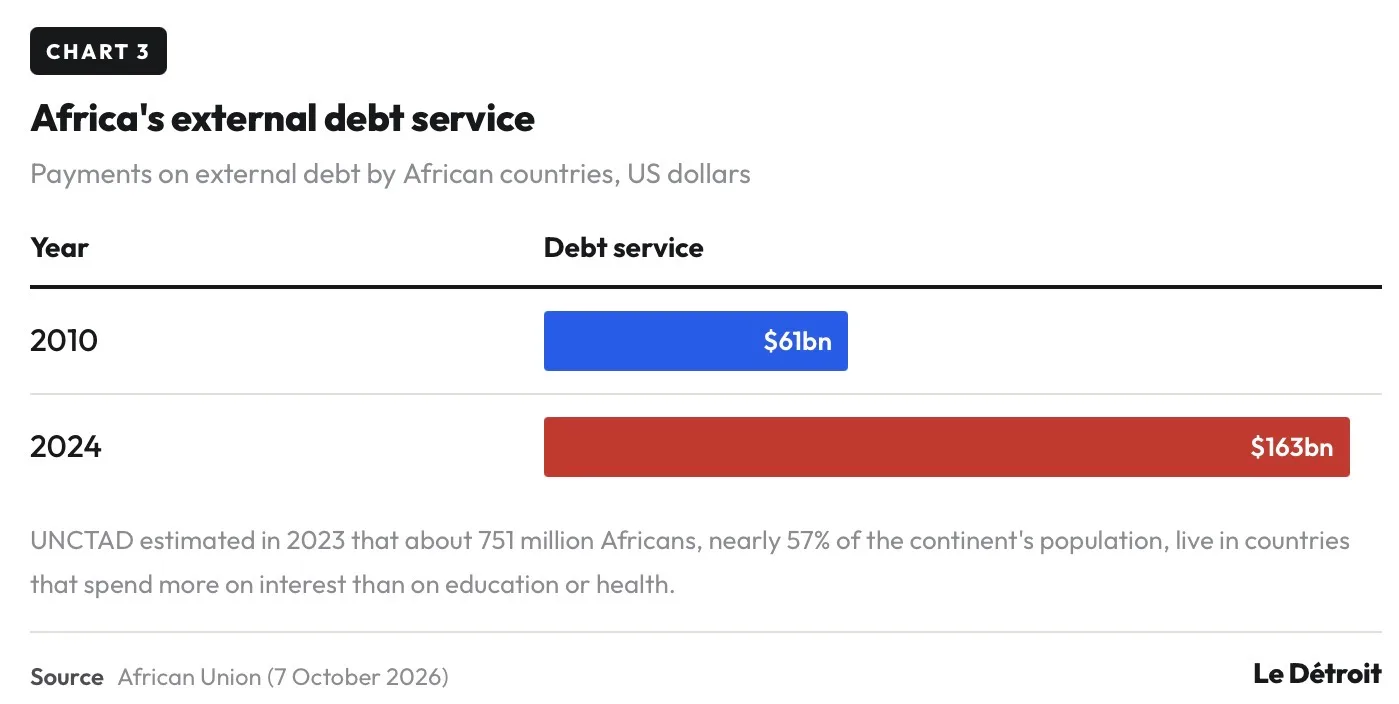
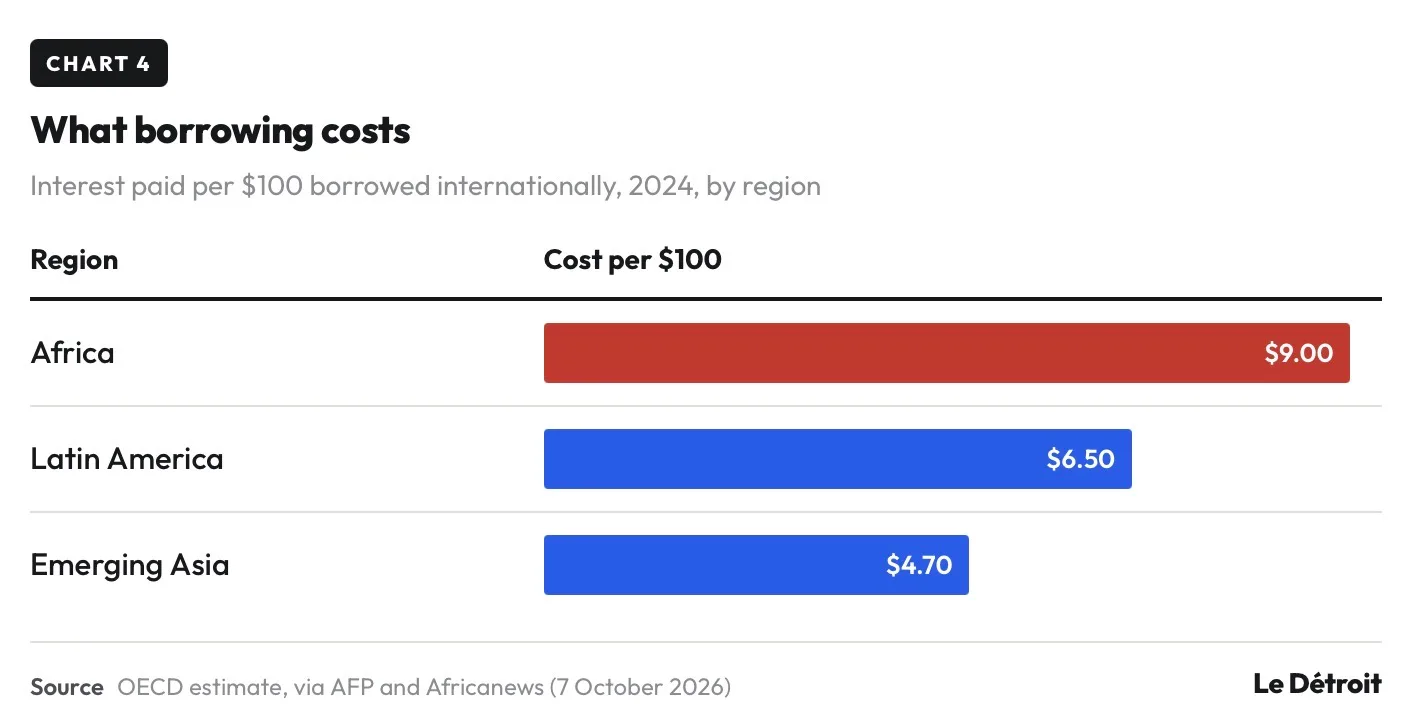
The stakes have grown with the debt burden. Africa's external debt service rose from $61 billion in 2010 to $163 billion in 2024, the AU says. According to OECD estimates cited by AFP, Africa paid about $9 for every $100 borrowed internationally in 2024, against $6.50 for Latin America and $4.70 for emerging Asia.
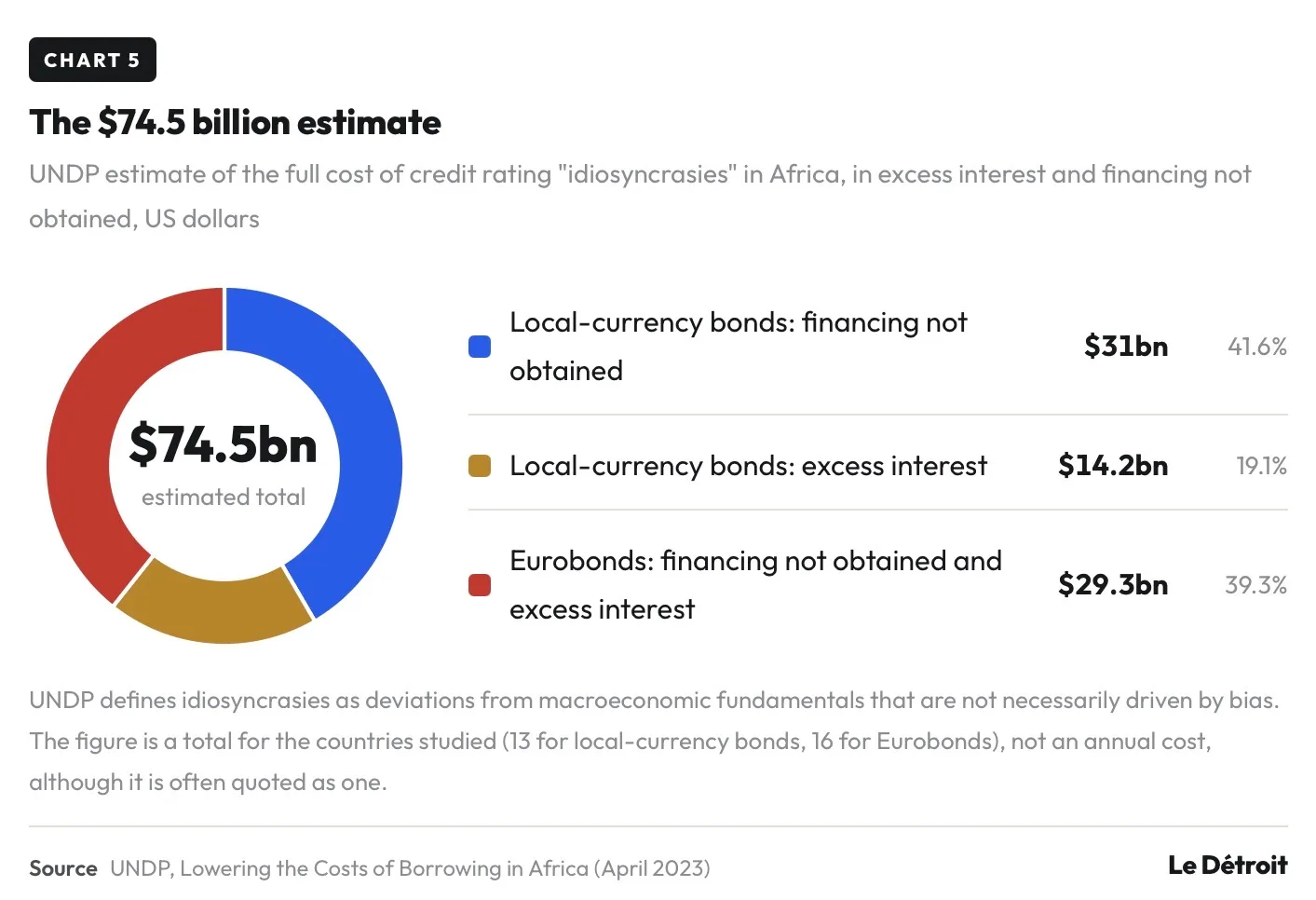
African governments also remember the pandemic. Between 2020 and the first half of 2021, up to 62.5% of rated African countries were downgraded by the big three, against a global average of 31.8%, according to a 2023 UNDP report. That report estimated the full cost of rating "idiosyncrasies", deviations from macroeconomic fundamentals, at $74.5 billion in excess interest and financing not obtained, a total for the countries studied, often quoted as an annual figure.
3. Bias or risk? An honest debate
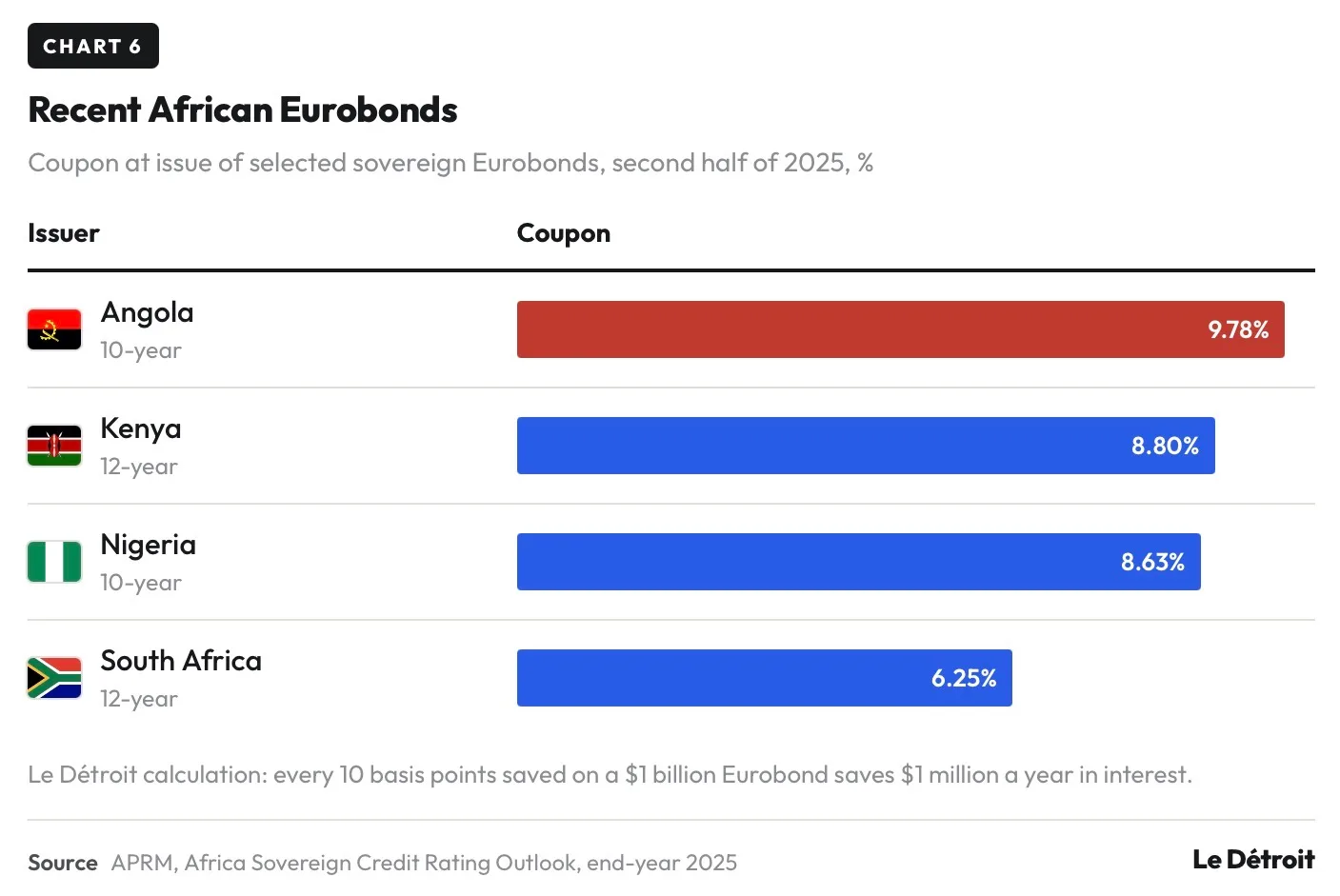
Whether the big three are biased against Africa is contested, and AfCRA's founders know it. A 2023 IMF working paper found that the apparent premium on sub-Saharan Eurobonds vanishes once structural factors such as financial depth and budget transparency are accounted for; a 2025 IMF paper found a modest extra premium in normal times but only "limited evidence" of rating agency bias. A Moody's executive, citing 40 years of default data, says African defaults line up with those of similarly rated borrowers elsewhere. On the other side, a KAS-Leibniz report cited by the Institute for Security Studies finds African governments underrated by half a notch to a full notch on average.
What both sides agree on is that information matters. Many African economies are thinly covered, with few local analysts and limited data, and a rating built from far away can miss reforms, natural wealth or local savings. That is the gap AfCRA wants to fill. Mauritius's foreign minister, Dhananjay Ramful, said a better methodology could cut borrowing costs by 50 to 100 basis points, saving up to $5 billion a year across the continent. The head of the AU Commission was more cautious.

4. Ten years in the making
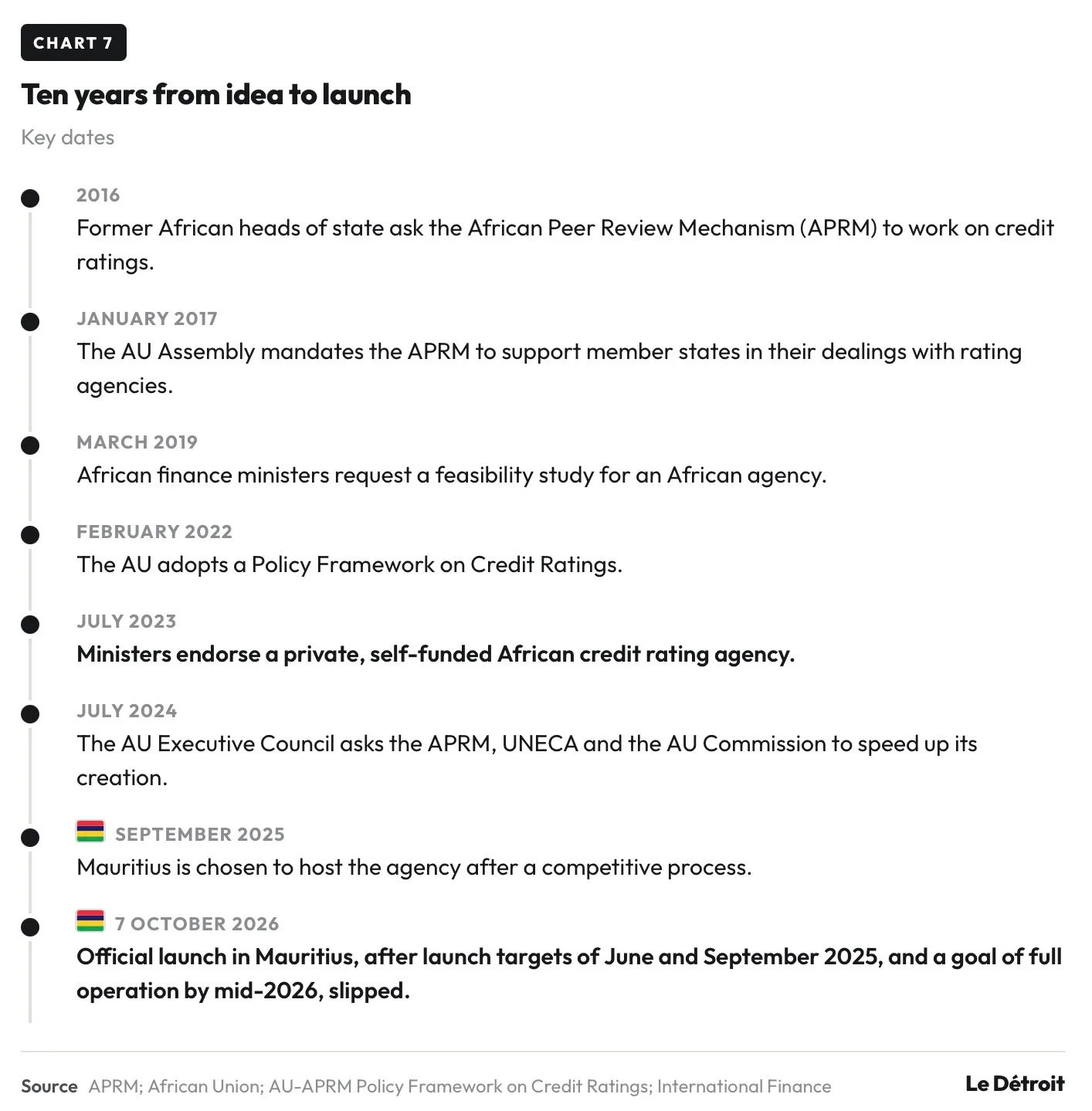
AfCRA is the product of a patient institutional effort. The APRM, the AU's governance peer-review body, has supported African states in their dealings with rating agencies since 2017, and publishes a twice-yearly review of African sovereign ratings. The idea of a continental agency moved from feasibility study to ministerial endorsement in 2023, and Mauritius won the right to host it in 2025, after a process run by the APRM's transaction adviser, MCB Financial Advisors, appointed in February 2025.
5. How AfCRA says it will rate
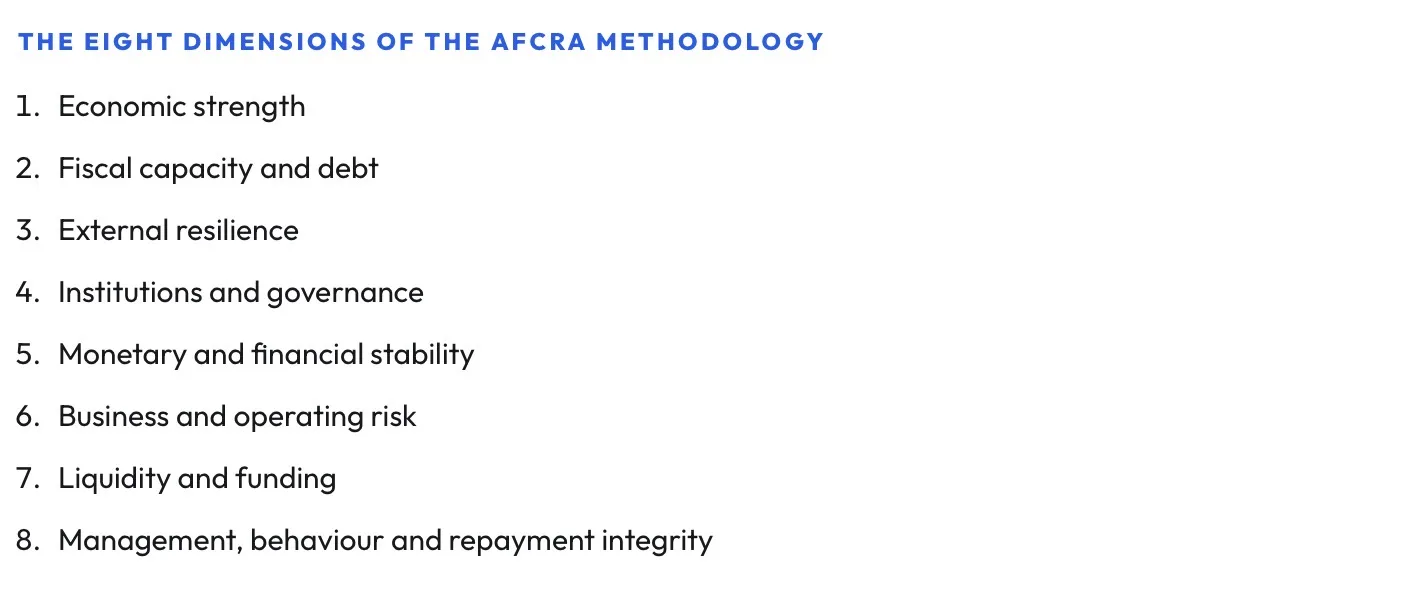
The agency's methodology rests on eight composite dimensions, built from evidence and validated indicators, drawing on data from the World Bank, the IMF, central banks and finance ministries, and from field research. Its team argues that some current approaches treat natural resources as a credit weakness rather than a neutral factor. Governments will be able to submit data through an AfCRA portal. In the medium term, the agency expects about 70% of its work to be sovereign ratings and 30% commercial ratings.
Its interim chief executive, Sifiso Falala, a South African researcher who previously founded Sovereign Africa Ratings, insists the agency "is not here to give favourable ratings" and does not ask investors to drop the agencies they already use. The aim, as the APRM's lead expert on ratings, Misheck Mutize, has framed it, is above all to steer Africa's roughly $4 trillion of savings towards African assets.
6. What will make it credible
A rating agency's value rests on one thing: whether investors believe it. On that front, the APRM's chief executive set the bar herself.

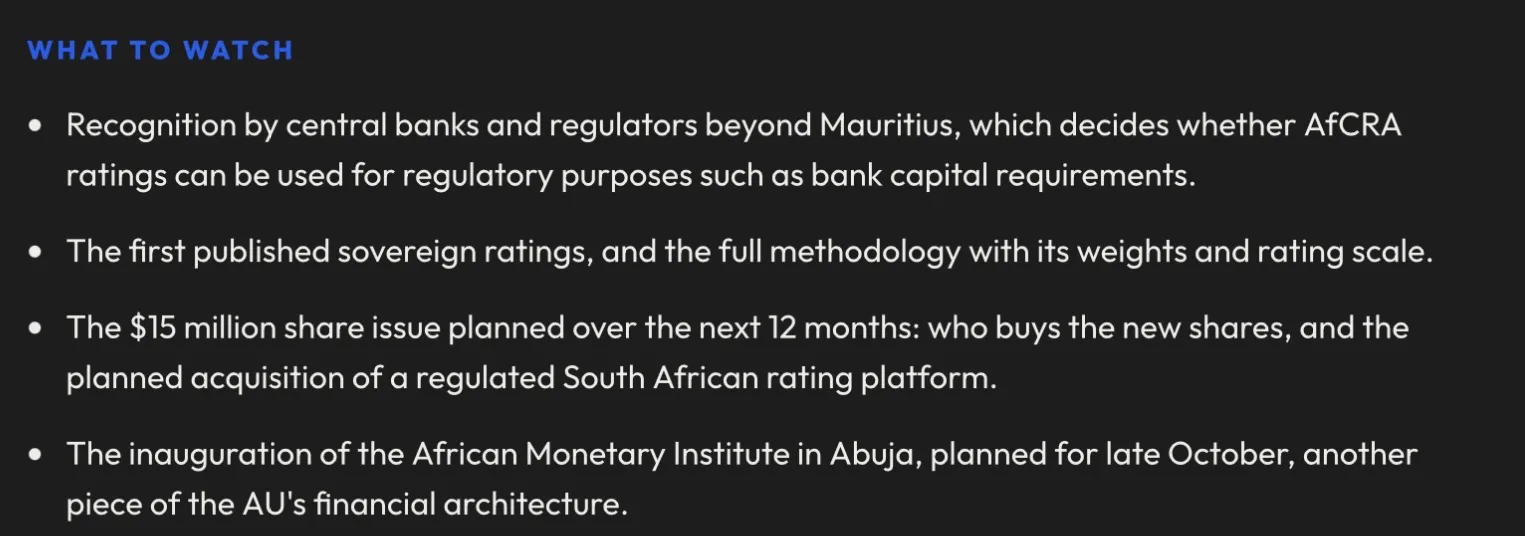
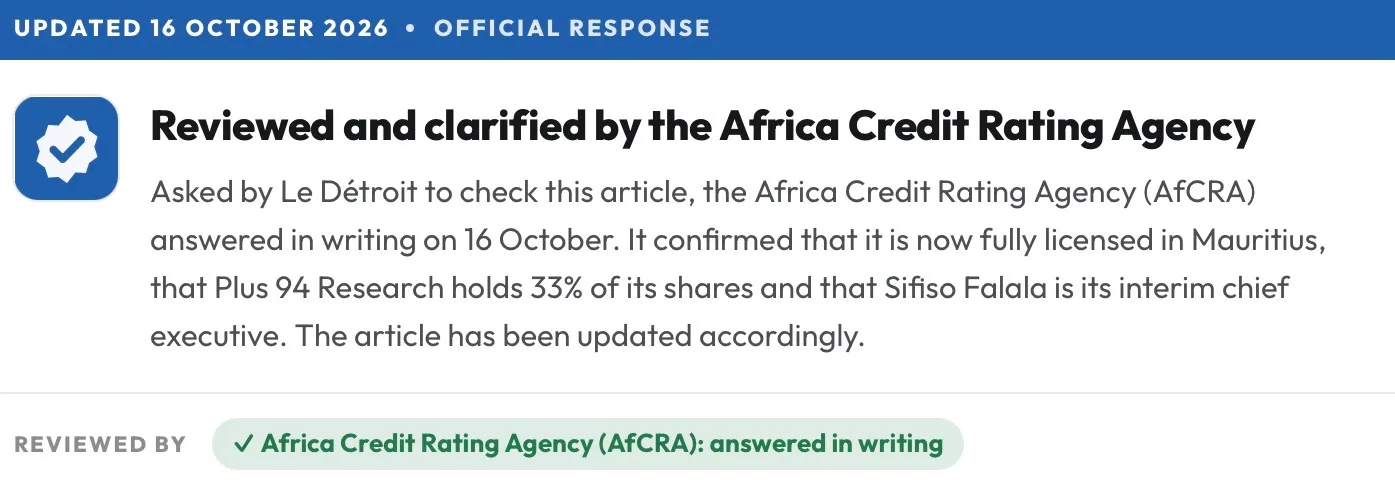
Le Détroit submitted this article to AfCRA for a factual review. In written answers sent on 16 October, the agency said it is now "a fully licensed Credit Rating Agency and Global Business entity", with its primary registration in Mauritius. The next step is recognition by central banks and regulators elsewhere, without which its ratings cannot be used to set capital requirements. Its ratings library is still empty, and the weights and rating scale of its methodology have not been published: AfCRA told us that it is "engaging with several African countries regarding sovereign rating mandates" and that the timelines for its first ratings, full methodology and rating scale "will be communicated once officially confirmed".
Its ownership is also taking shape. Plus 94 Research, a South African firm co-founded by Falala and the strategic partner of the APRM responsible for establishing and capitalising the agency, holds 33% of AfCRA's shares, the agency told Le Détroit. AfCRA has an authorised share capital of $22.5 million and has announced the issuance of $15 million in new shares over the next 12 months; a preliminary prospectus reported by Nairametrics put the offer at 2,000 new shares.
Analysts welcome the ambition but point to the test ahead. "Credibility in credit rating is accumulated rather than declared," says Daniel Cash, a UK-based law professor who has advised the APRM. "A new rating agency begins with a promise while investors ultimately require a track record," says Dennis Shen, a former analyst at the European agency Scope, which, after more than a decade, still holds less than 1% of the global market. "Independence is demonstrated at the point of disagreement," Cash adds. For the Lagos research firm SBM Intelligence, the decisive test "will come when an African government deserves a downgrade".
7. On the record: what AfCRA told Le Détroit
After publication, Le Détroit sent AfCRA five questions and asked the agency to point out anything inaccurate or out of date. The AfCRA team answered in writing on 16 October 2026. Its answers are reproduced below, lightly abridged where marked, alongside a summary of our questions. The agency has also designated its business development manager, Allegria Ntumba, for a follow-up interview with Le Détroit.
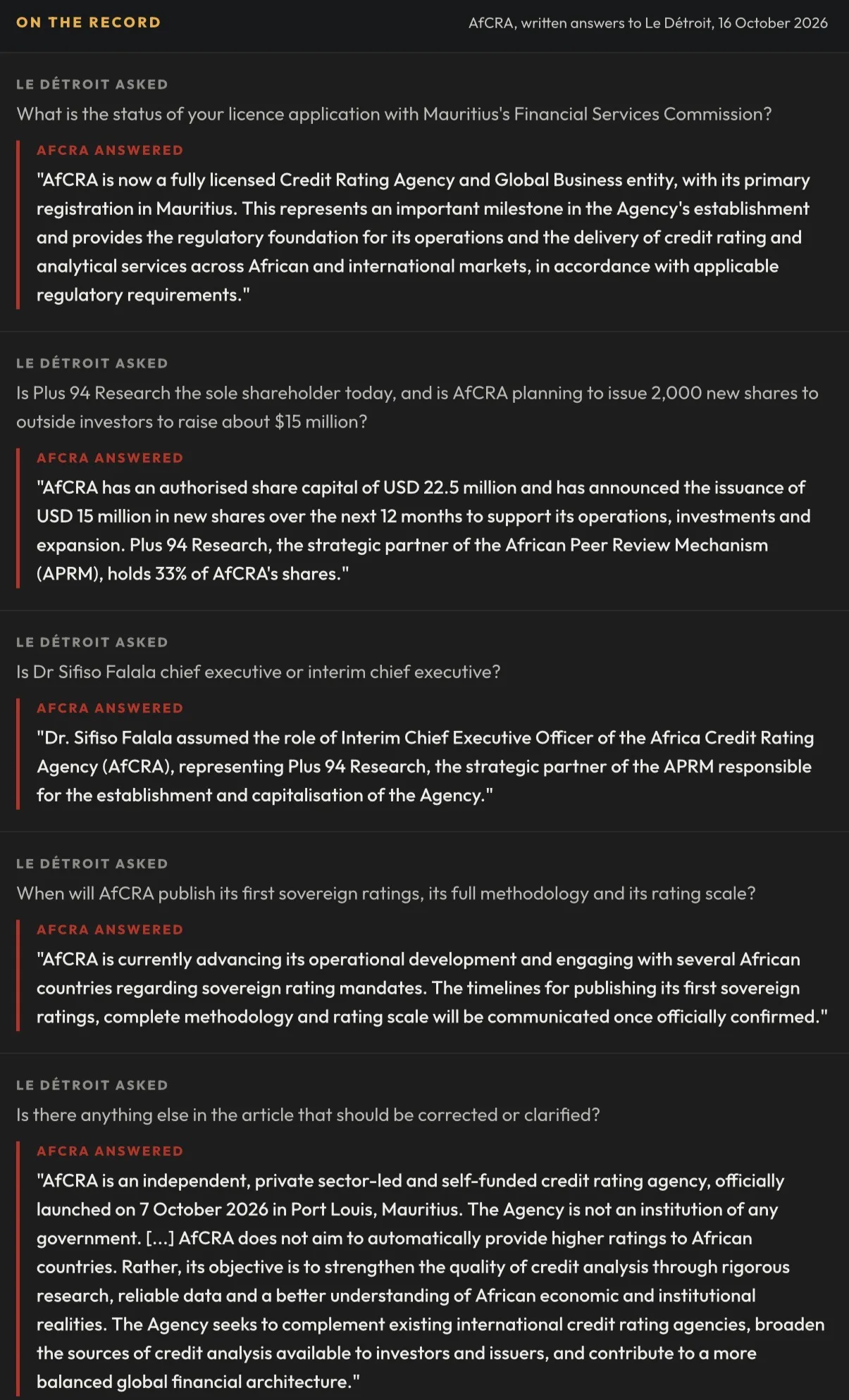
Le Détroit's verdict on these answers: they confirm the agency's licence and its interim leadership and correct our earlier description of its ownership, which we have updated. They leave open the questions that matter most for its credibility: who will buy the new shares, which governments will be rated first, and when the full methodology will be public.
8. The bigger picture
AfCRA is one piece of a wider African financial architecture: an African Monetary Instituteis due to be inaugurated in Abuja in late October, according to an AU adviser. It also arrives as the world reconsiders how ratings work. South Africa's G20 presidency commissioned an Africa Expert Panel, chaired by Trevor Manuel, whose November 2025 report called for "stronger oversight of credit rating agencies", according to Ecofin. The Sevilla Commitment, adopted at the UN Financing for Development conference in Seville in June 2025, set up new ECOSOC meetings with rating agencies; ECOSOC held a special meeting on credit ratings under that mandate on 30 March 2026.

9. Le Détroit's reading
AfCRA's real promise is less about changing what Moody's or S&P think of Africa than about giving African investors, regulators and governments a serious, transparent and local reading of African risk. Local-currency debt, domestic pension funds and regional capital markets are where an African agency can make the biggest difference first, because that is where foreign agencies look least.
The launch is a statement of intent, and the AU has been careful not to oversell it. The next steps will matter more than the ceremony: recognition by regulators, published methods, a diversified shareholder base, and ratings that stand up when markets are under stress. If AfCRA can show that knowing Africa better means rating it more accurately, upwards or downwards, it will have done something no declaration could: made African credit easier to understand, and therefore cheaper to finance.