
1. Two tonnes through the workshops
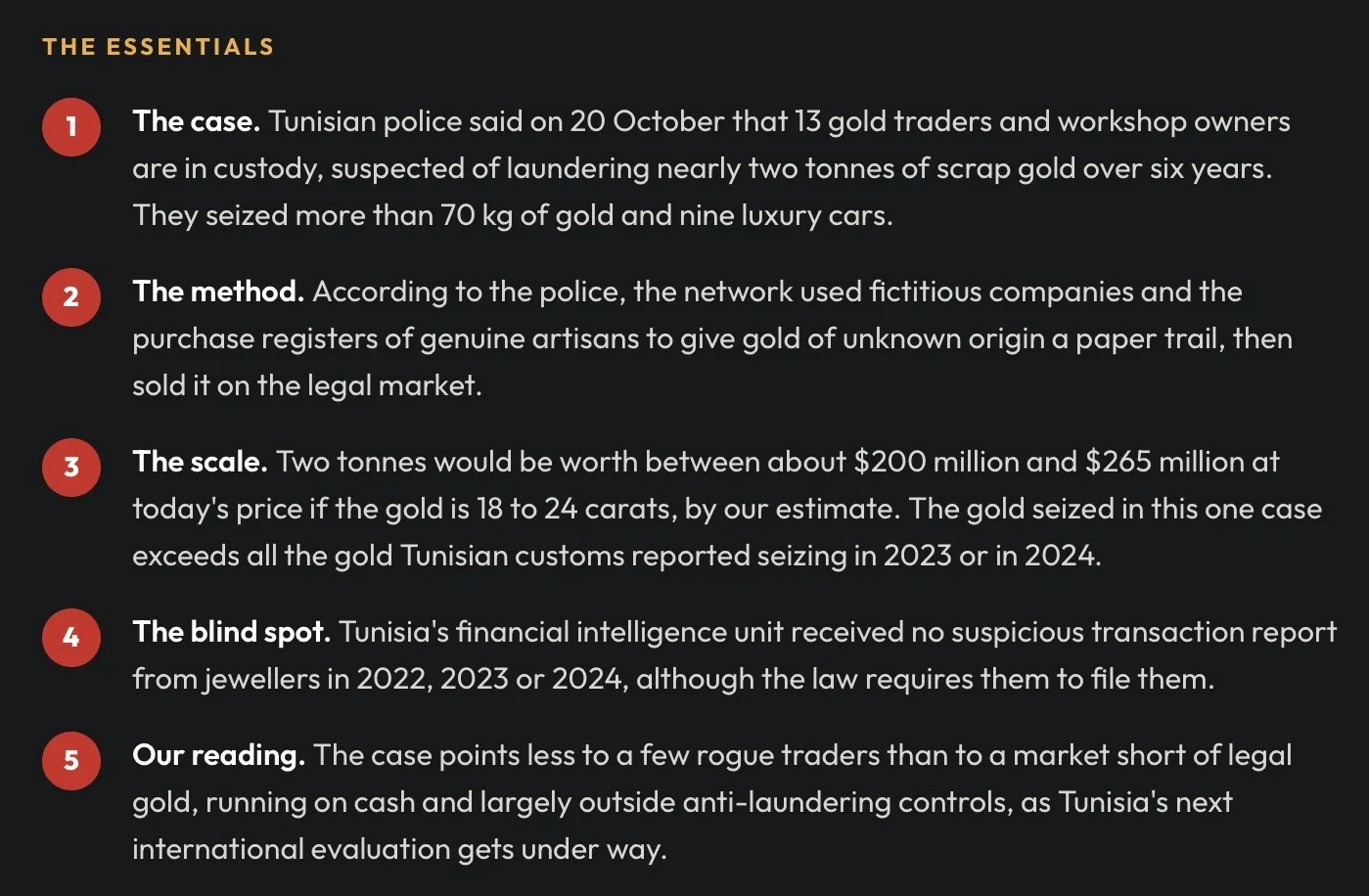
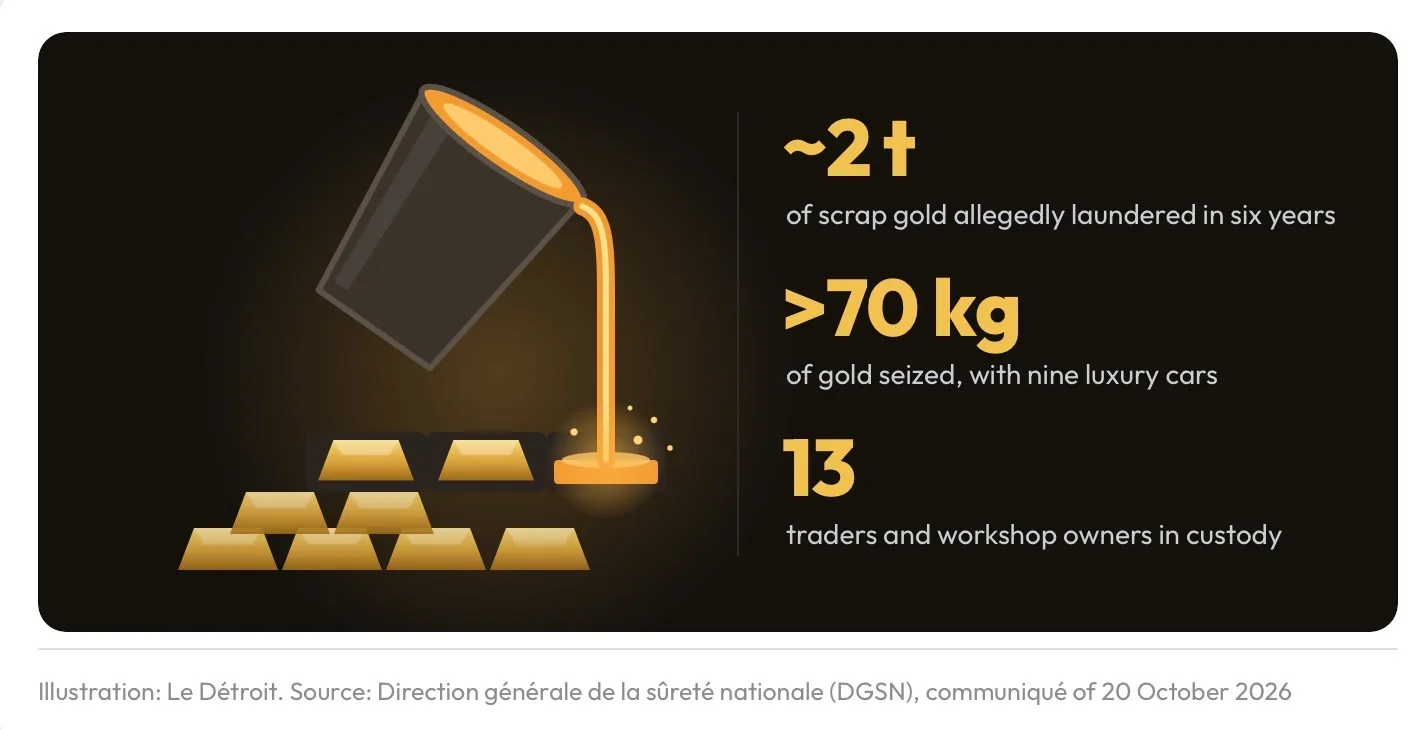
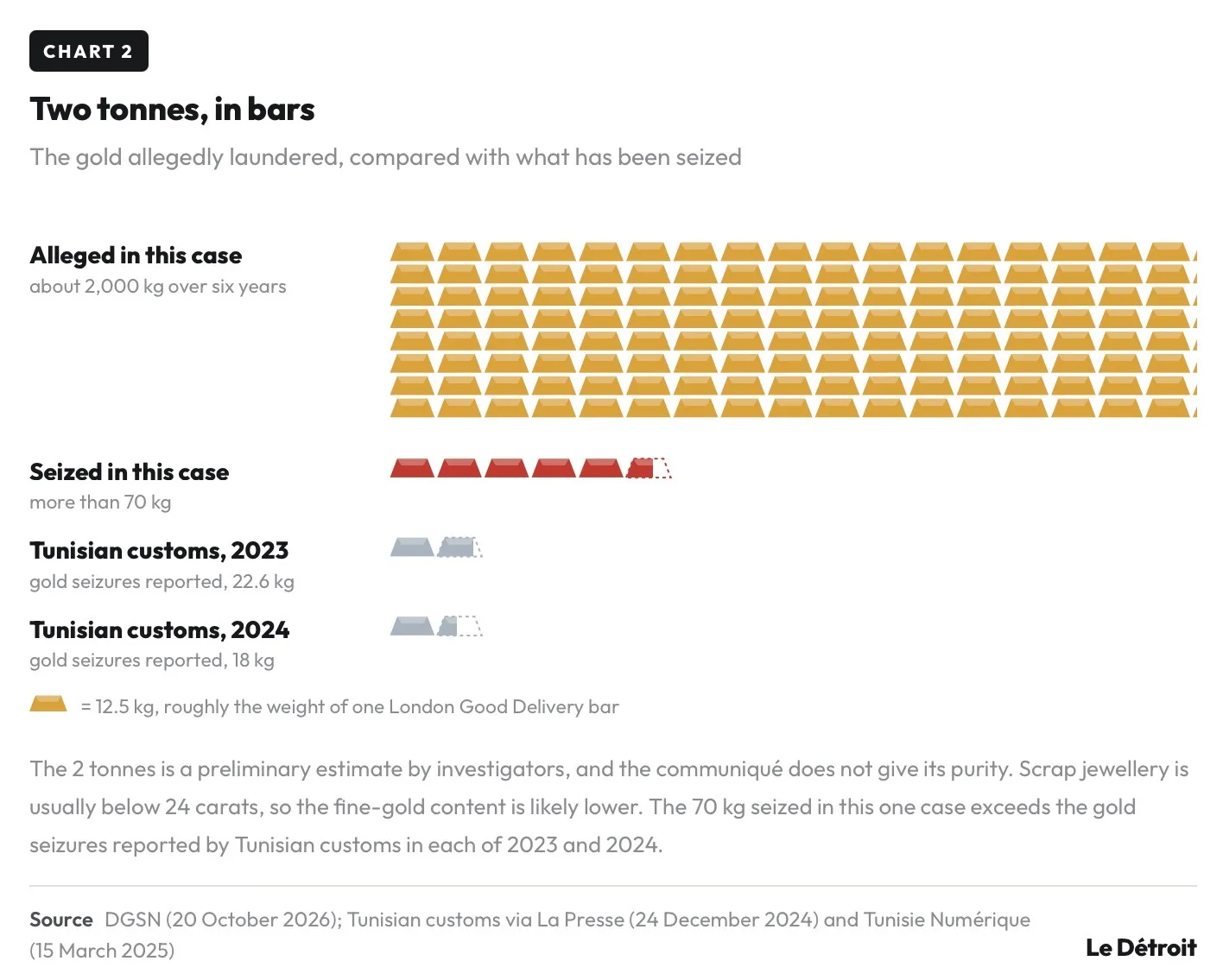
On Tuesday 20 October, Tunisia's national security directorate, the DGSN, announced that police had uncovered a network suspected of laundering "nearly two tonnes" of gold over the past six years. Investigators from the economic and financial crimes unit of the judicial police at El Gorjani, in Tunis, are holding 13 people: traders and owners of gold workshops. They seized more than 70 kg of gold and 4.5 kg of silver, both of unknown origin, more than 120,000 dinars in cash and nine luxury cars, which La Presse and Webdo report are valued at nearly 25 million dinars.
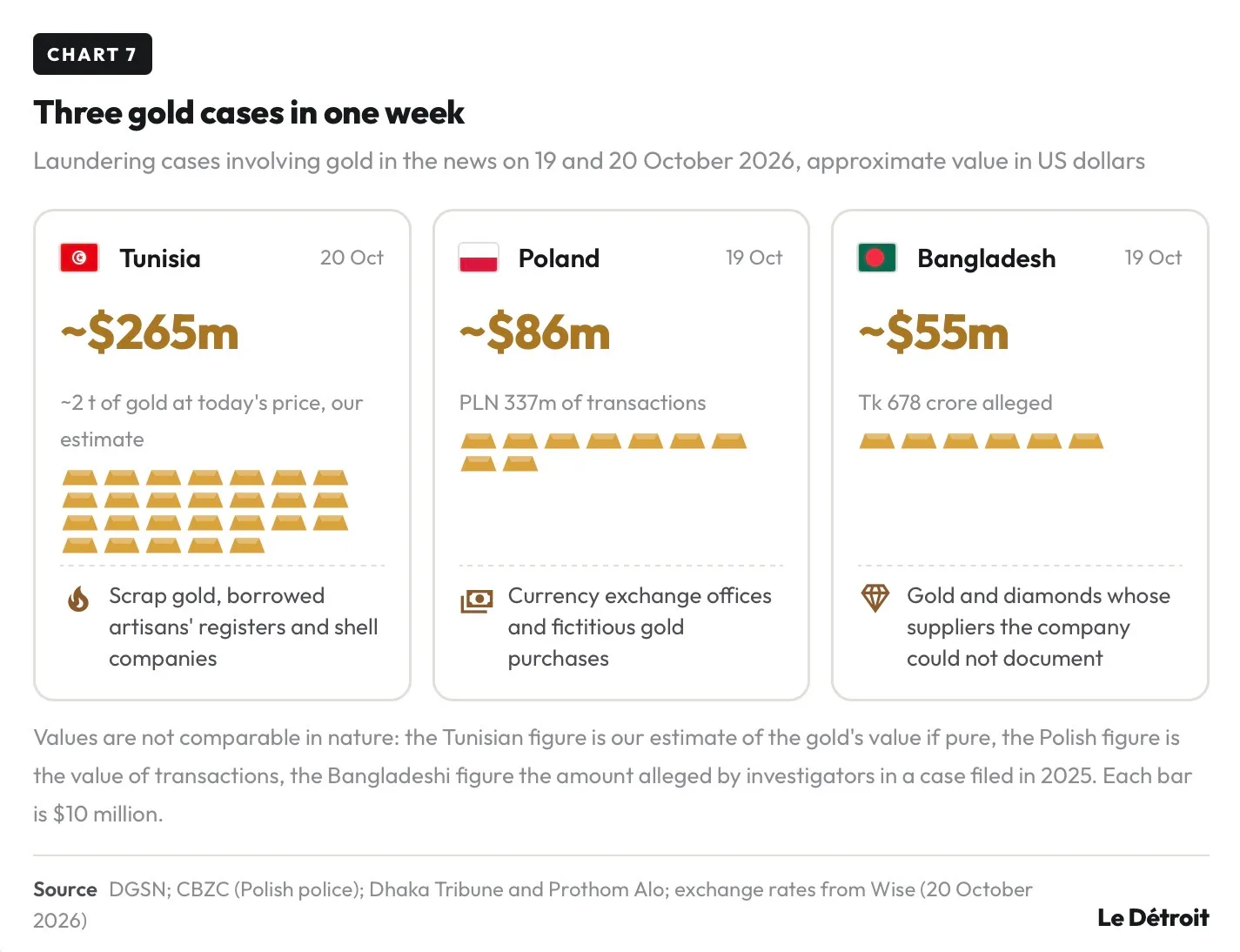
The suspected offences include criminal conspiracy, forgery and use of forged documents, and habitual money laundering by an organised group abusing its professional position. The two tonnes is a preliminary finding of the investigation. At about $4,120 an ounce, it would be worth between roughly $200 million and $265 million if the gold is 18 to 24 carats, or about 600 to 795 million dinars, by our estimate.
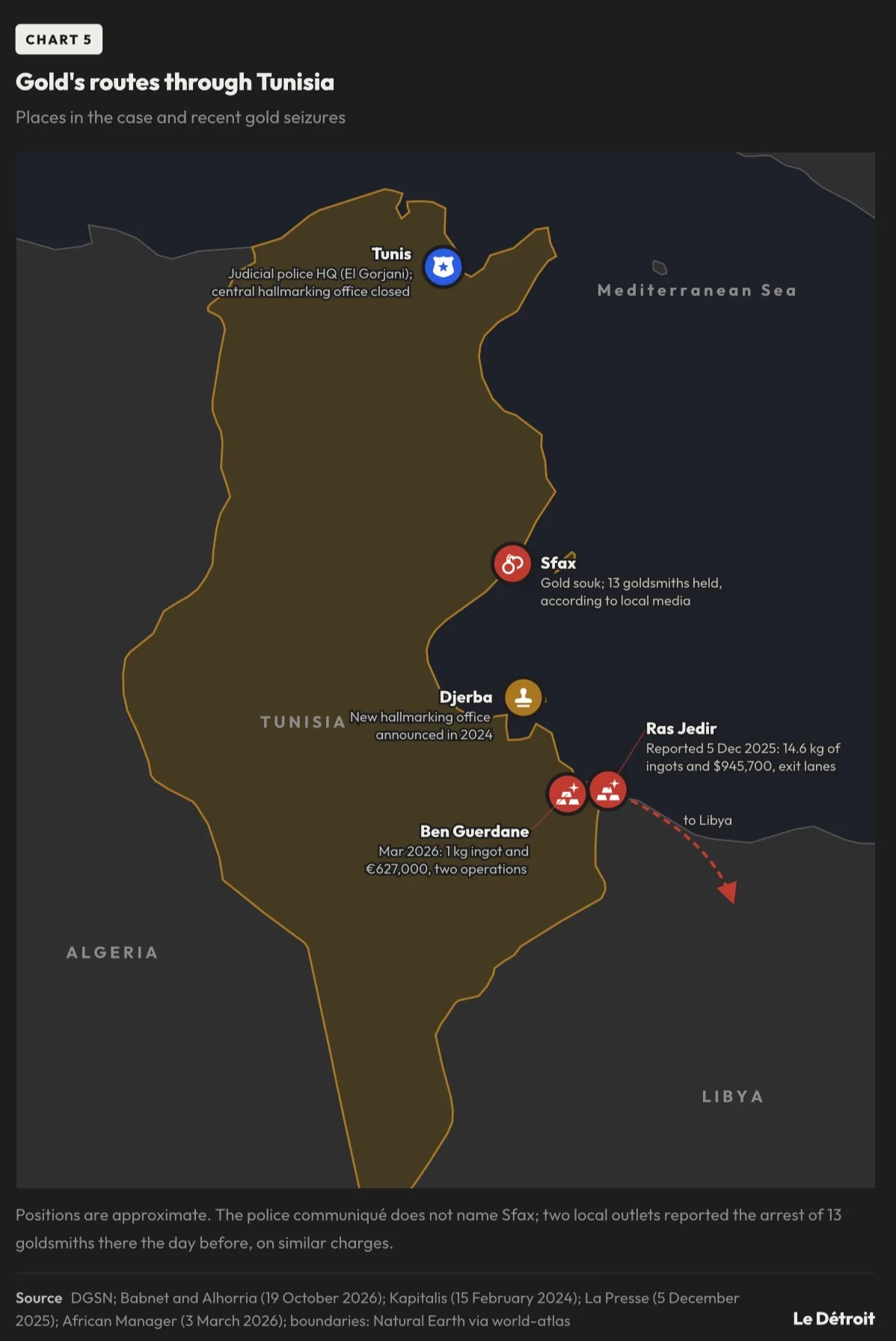
The communiqué does not say where the network operated. But the day before, Babnet and Alhorria reported that custody had been extended for 13 goldsmiths and jewellery craftsmen in Sfax, home to one of the country's main gold souks and one of its three State hallmarking offices, held by the same police unit on similar charges, with tens of kilograms of gold and luxury cars seized. Alhorria added that the head of the hallmarking office at the Sfax gold souk had also been detained; we could not confirm this.
2. How scrap becomes clean gold
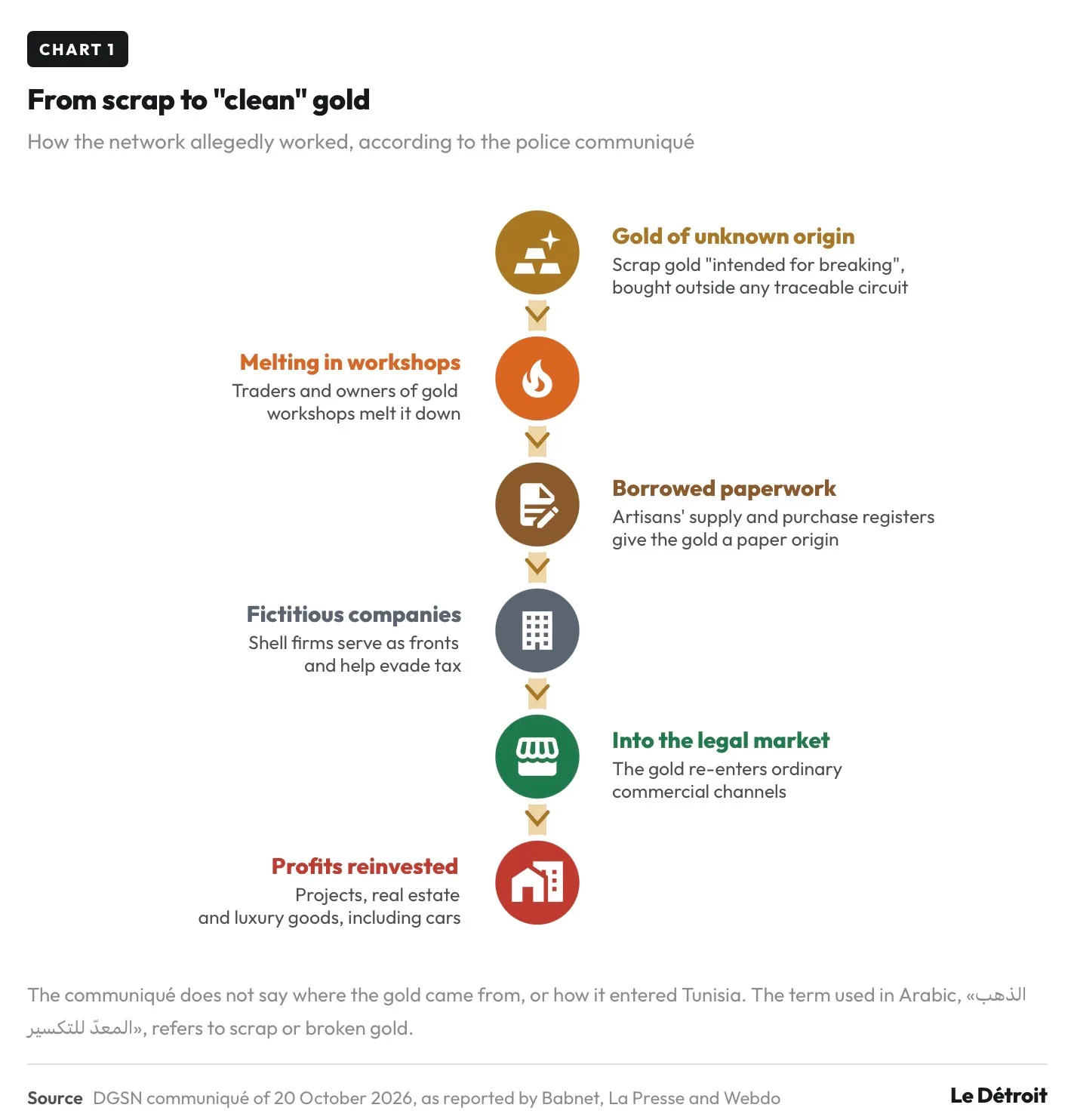
The scheme, as the police describe it, turned on paperwork. The gold was scrap, "intended for breaking" in the Arabic of the communiqué: old or broken jewellery that is melted down and recast. The network allegedly used fictitious companies and the supply and purchase registers of several artisans to make this gold of unknown origin look as if it had been bought legally, evaded tax, and then sold it through ordinary commercial channels. The profits, the police say, went into projects, real estate and luxury goods.
Scrap is a natural cover. Part of Tunisia's trade in "or cassé" is legal: families sell old jewellery, and Tunisians abroad, Algerian and Libyan visitors and pilgrims bring gold in. Hatem Ben Youssef, president of the national chamber of jewellery traders, describes a market in three tiers: hallmarked gold, unhallmarked scrap, and smuggled gold, which he calls the most serious problem. Once scrap is melted, its origin is gone, and only the registers remain to vouch for it.
3. A market short of legal gold
Tunisia produces no gold. Under the 1976 exchange code, gold cannot be imported or exported without the joint authorisation of the central bank and the economy ministry, and the central bank is the main legal supplier of raw gold to craftsmen. They received about 720 kg from it in 2024, according to La Presse, and complained that year that the monthly allocation of 100 grams was not enough. Every piece must carry three hallmarks under a 2005 law, the last applied by a State hallmarking office. But the central hallmarking office has been shut since at least May 2024, when jewellers were already demanding its reopening, a closure Ben Youssef called "a catastrophe" in August 2026, saying it feeds illegal, uncontrolled circuits.
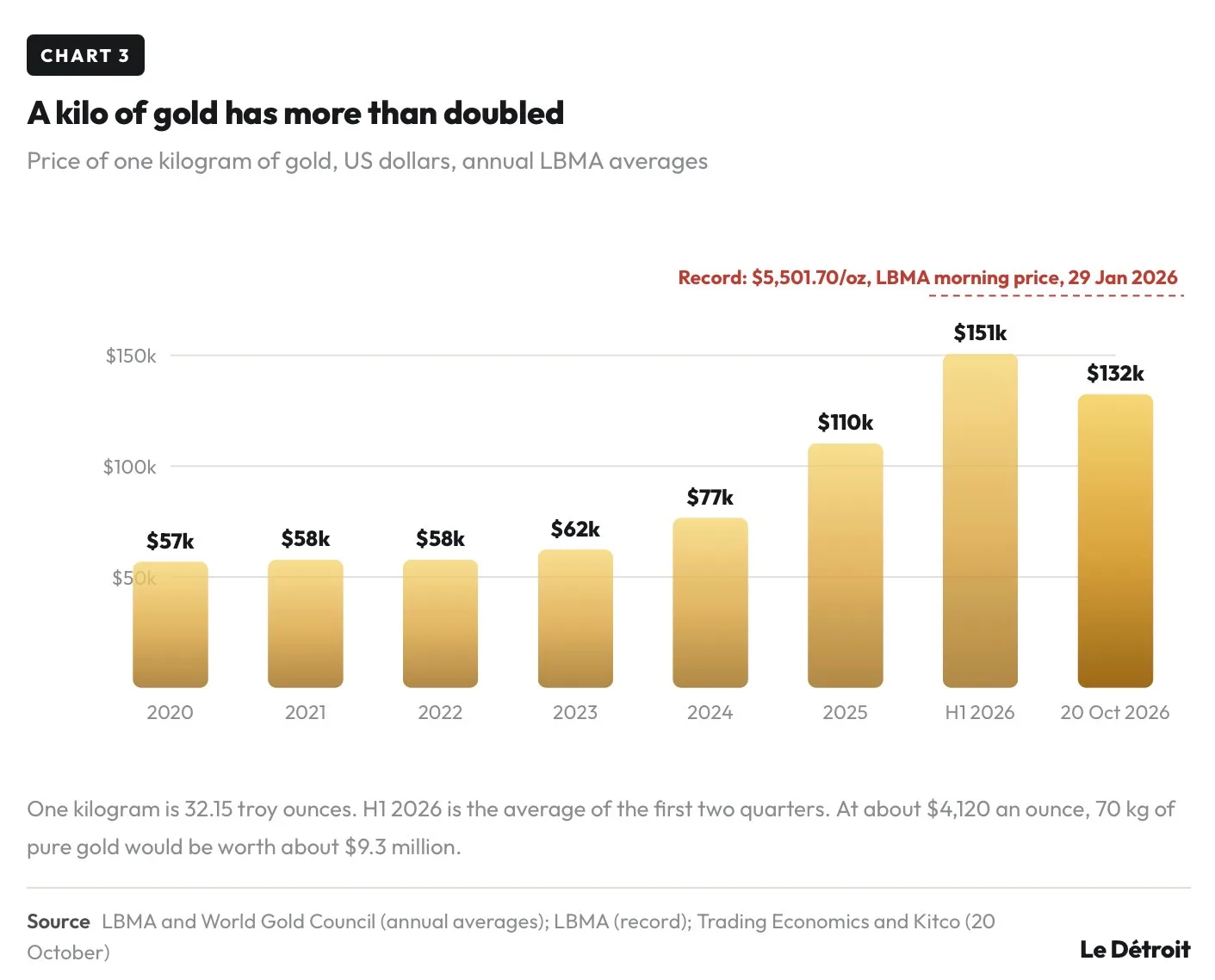
Meanwhile, the value of what passes through a workshop has soared. A kilogram of gold, worth about $57,000 in 2020, is worth about $132,000 today, after a record in January 2026. The more gold is worth, the more there is to gain from a register that makes it look legal.
4. Cash, borders and Libya
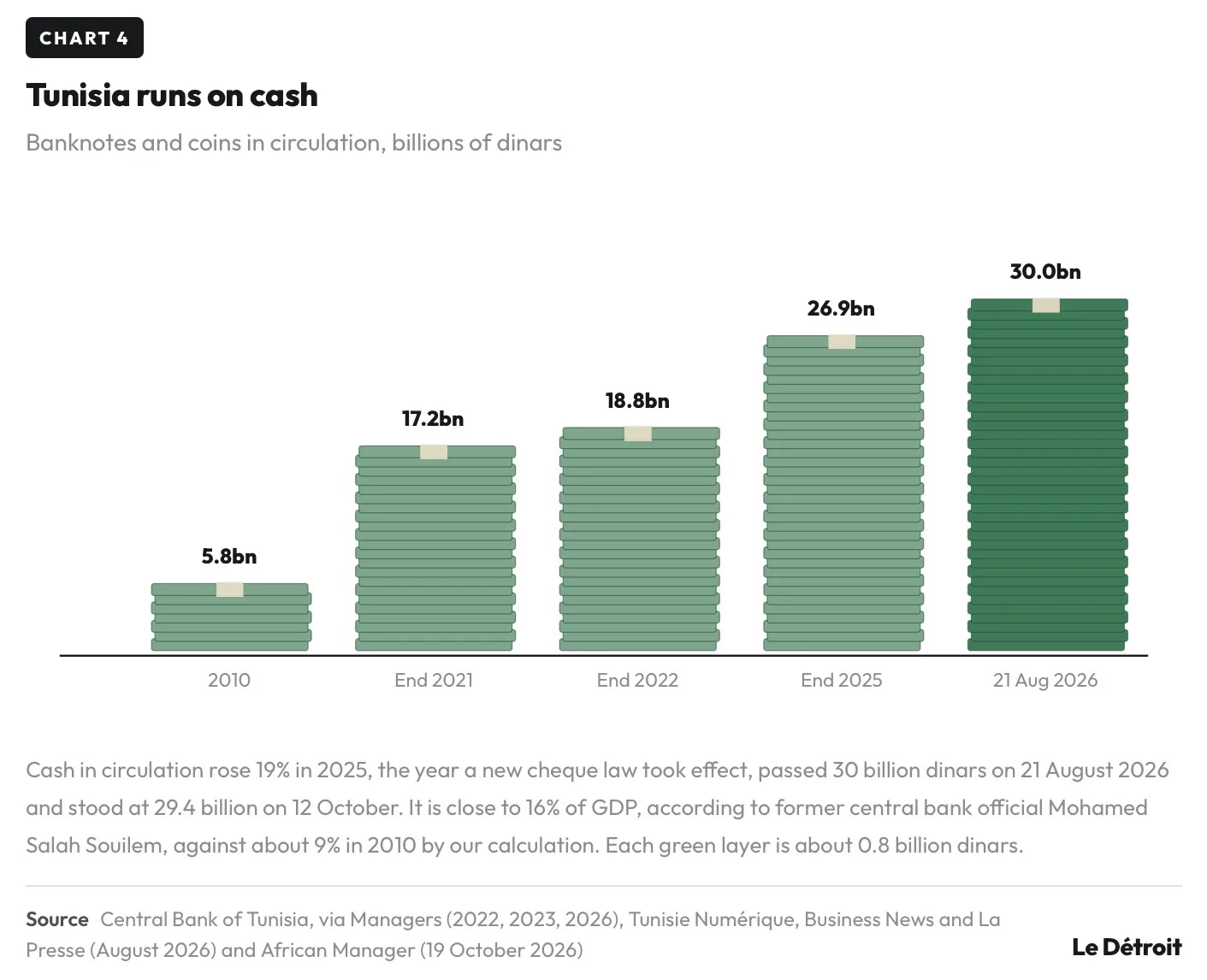
The case also sits in an economy that runs on cash. Banknotes and coins in circulation passed 30 billion dinars for the first time in August 2026, more than five times the level of 2010, after a 19% jump in 2025. Gold is one obvious place to store and move that cash.
The borders show gold moving in both directions. In July 2024, customs found 6.4 kg of gold jewellery hidden in a car entering Tunisia at Ras Jedir, the main crossing from Libya. Seizures reported by Tunisian customs in the area since 2025 have involved ingots and foreign currency, including 14.6 kg of gold bars and $945,700 found in the exit lanes at Ras Jedir (reported in December 2025) and, in two operations at Ben Guerdane reported in March 2026, a one-kilogram ingot and €627,000. In September 2026, Libyan customs seized about 25 kg of gold bars at the same crossing. Libya, where the ENACT Organised Crime Index estimates gold smuggling flows at 50 to 55 tonnes in recent years, is a transit point for illicit gold, mainly from Chad, according to the same index. Tunisia's 2017 national risk assessment already described the gold sector as high risk and estimated that 19.4 tonnes of gold transited the country illegally in 2012 to 2014.
5. Jewellers who never report
Under the 2015 anti-money-laundering law and a rulebook approved by an order of 19 April 2018, jewellers and dealers in precious metals must report suspicious transactions to the CTAF, Tunisia's financial intelligence unit, and apply due diligence to transactions of 15,000 dinars or more. In 2024, the CTAF received 1,236 reports, up 45% on 2023 and the highest in at least five years. Three came from non-financial professions, all of them accountants. None came from a jeweller, as in 2022 and 2023.
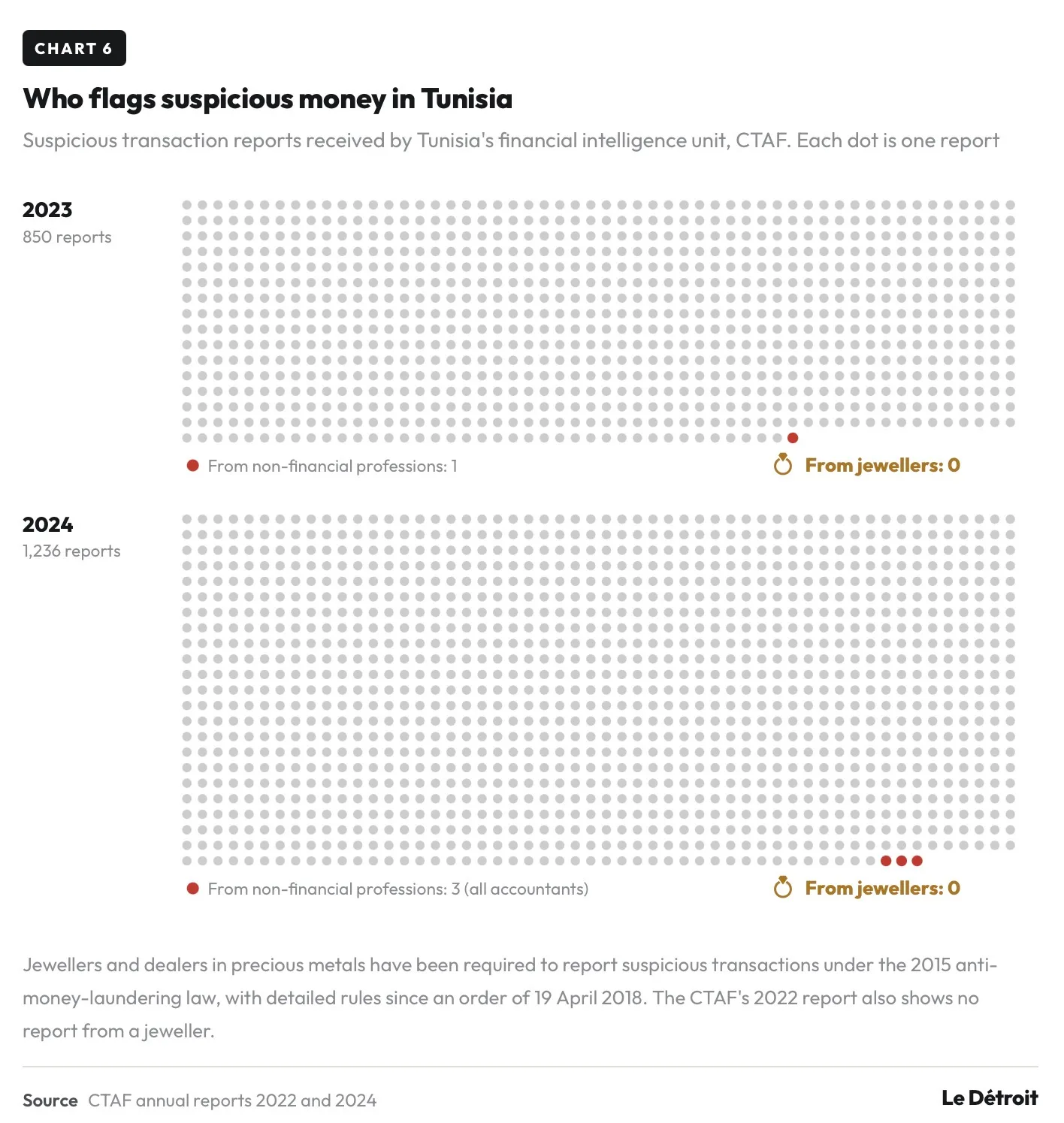
That gap will matter soon. Tunisia left the FATF's grey list in October 2019 and the European Union's list of high-risk countries in 2020. Its next evaluation by MENAFATF, the regional body that applies the FATF's standards, is under way and due to be discussed in November 2026, according to a MENAFATF timetable. Its 2016 evaluation rated the effectiveness of supervision as low and the rules for jewellers and other non-financial businesses as only partially compliant; Tunisia won upgrades on paper in 2019 for due diligence and supervision of these businesses, though not for their reporting duties, and the effectiveness rating has not been revisited since.
6. Not only Tunisia
Gold, the FATF warned in 2015, gives criminals "a stable, anonymous, transformable and easily exchangeable asset". The same week, two other cases made the point. In Poland, police said on 19 October they had detained nine suspects, eight Ukrainians and a Belarusian, accused of laundering the proceeds of investment and cryptocurrency scams through currency exchange offices and fictitious gold purchases, in transactions worth more than 337 million zlotys. In Bangladesh, police arrested the managing director of the jeweller Diamond World in a case, filed in 2025, in which investigators accuse him of laundering 678 crore taka through purchases of gold and diamonds whose suppliers the company could not document.
7. Le Détroit's reading
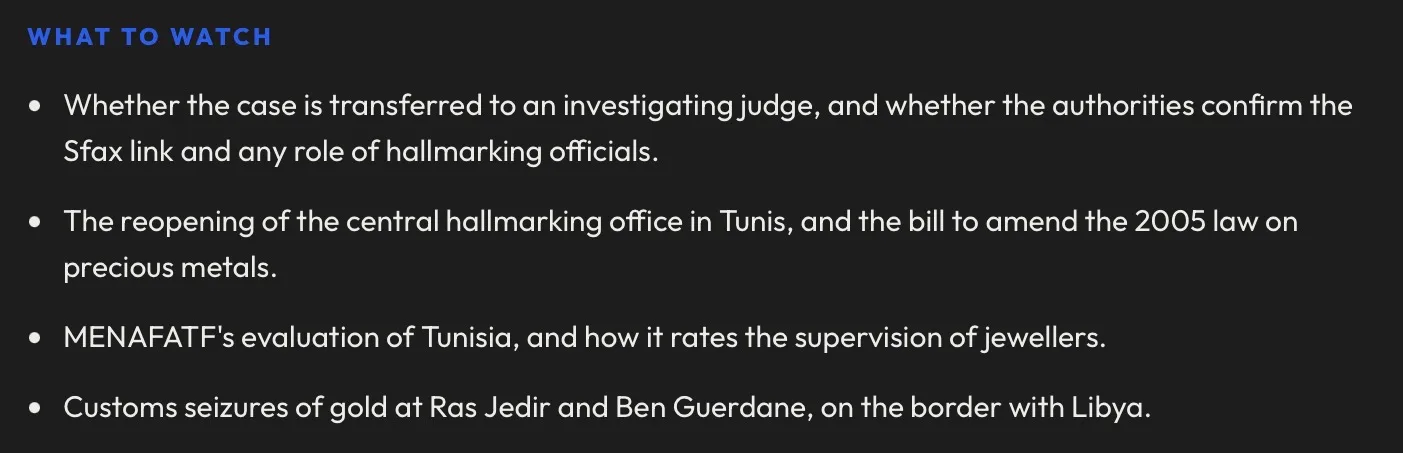
Thirteen arrests will not fix a market built this way. Jewellers say legal supplies of raw gold fall short, the central hallmarking office has been shut since at least May 2024, cash keeps piling up and jewellers filed no suspicious transaction reports in 2022, 2023 or 2024. In that setting, an artisan's purchase register can be worth as much as the gold it records, because it is what turns metal of unknown origin into stock that can be sold. The question for the investigation is whether anyone inside the hallmarking system helped the network, as one local outlet has suggested. The question for Tunisia is whether it reopens and modernises that system before its evaluators ask.