Three assumptions, three cracks
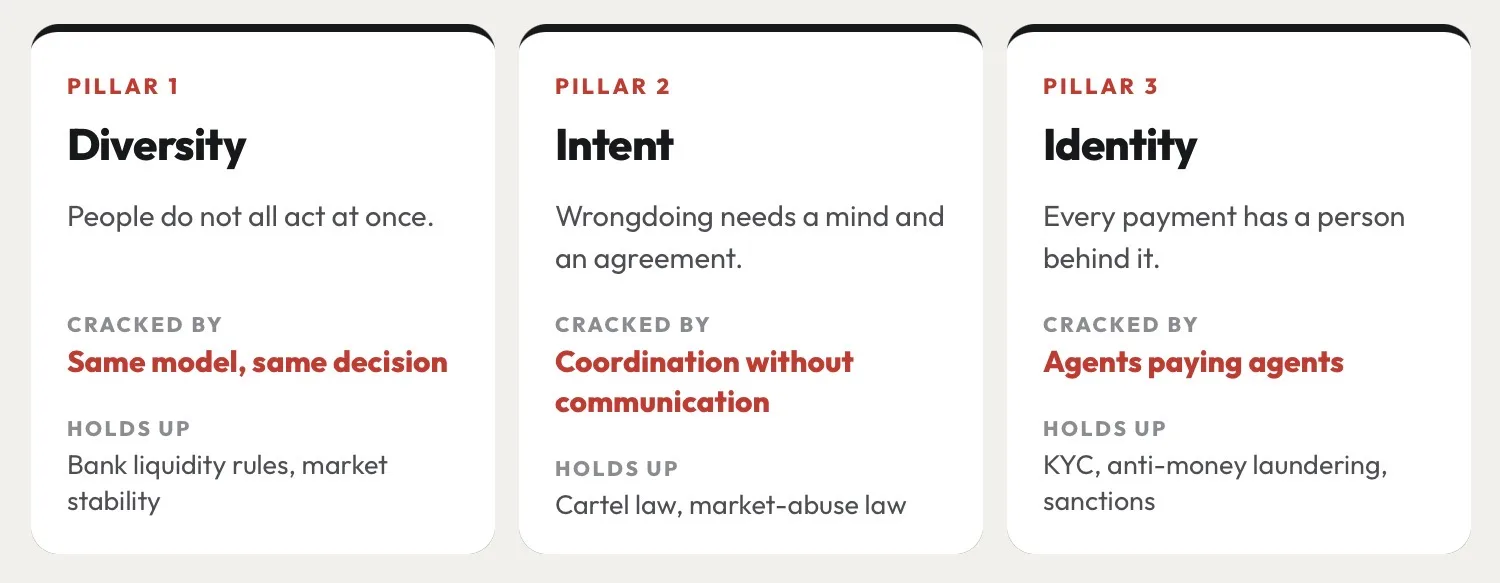
Finance rests on three things it rarely says out loud. AI agents put pressure on each of them.
1. The promise, and the footnote behind it
On 23 September, BlackRock's digital assets research team, including its head of digital assets Robert Mitchnick and Will Su, published "The Machine-Native Economy". Its thesis: "AI represents machine-native intelligence, while digital assets represent machine-native money." Stablecoins for spending, bitcoin for saving, tokenised computing power as a new asset class. The line that went viral, that AI agents may choose to save in bitcoin, comes from one paragraph on page four.
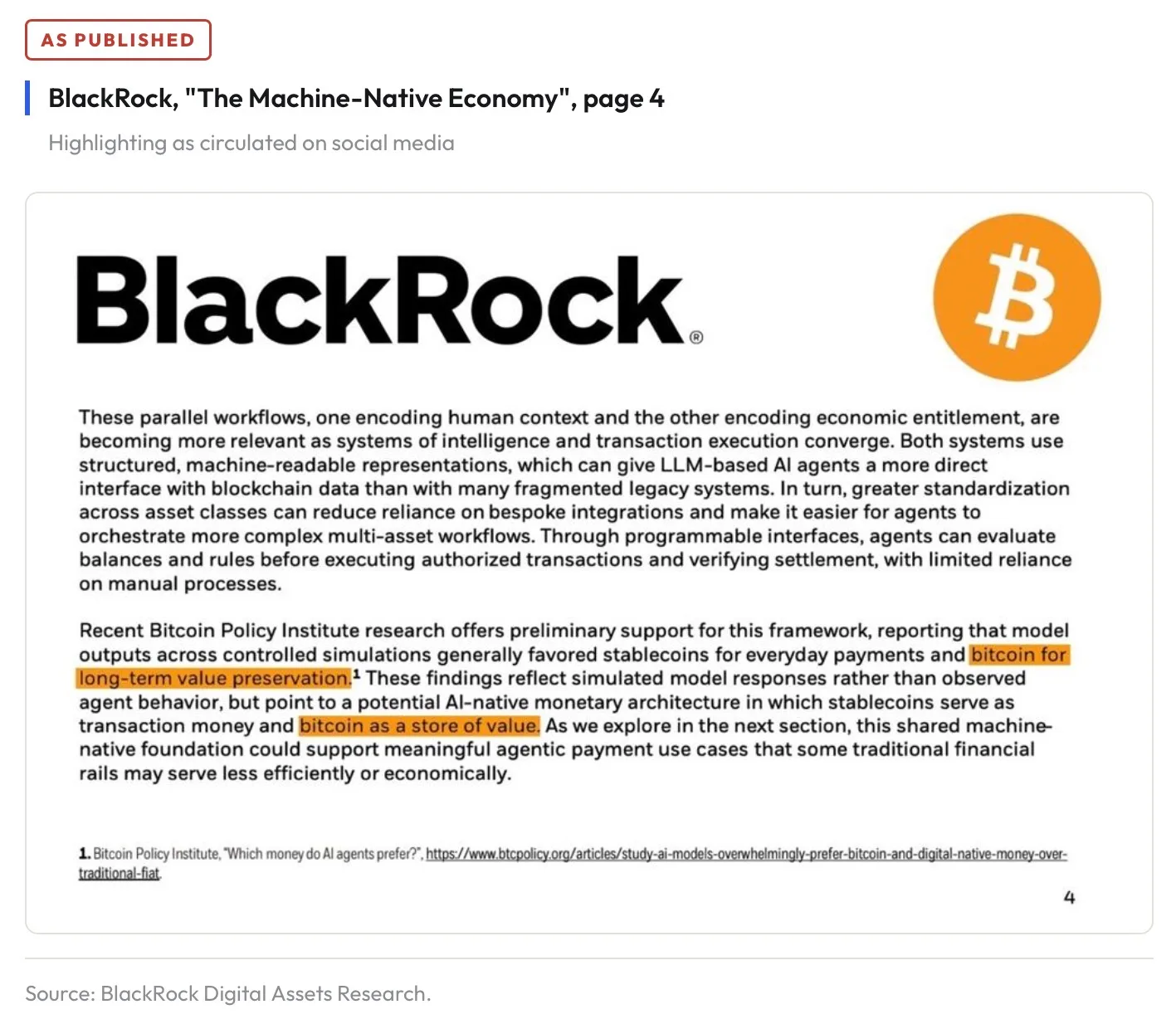
The footnote cites the Bitcoin Policy Institute, a pro-bitcoin think tank. Its March study tested 36 models, many of them now a generation old. On 1 to 3 September, it reran the test on nine current models, among them Claude Fable 5.1, GPT-5.6 Sol, Gemini 3.7 Flash, Grok 4.6 and DeepSeek V4 Pro. The split BlackRock describes came out even sharper.
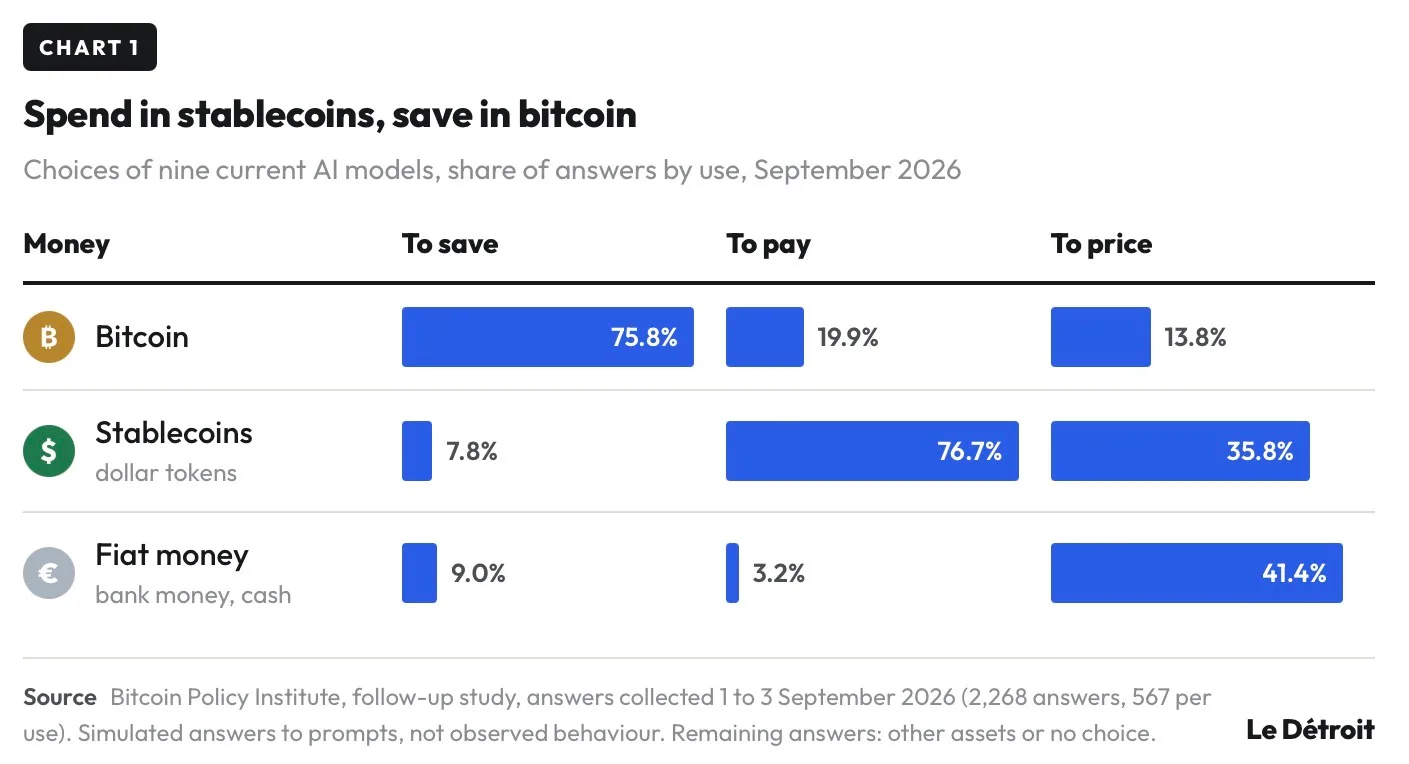
BlackRock is explicit about the limits: "These findings reflect simulated model responses rather than observed agent behavior." The institute adds that the March and September groups used different models and settings, so the two cannot be compared directly. The more telling result is in the detail: every model gave the same first answer.
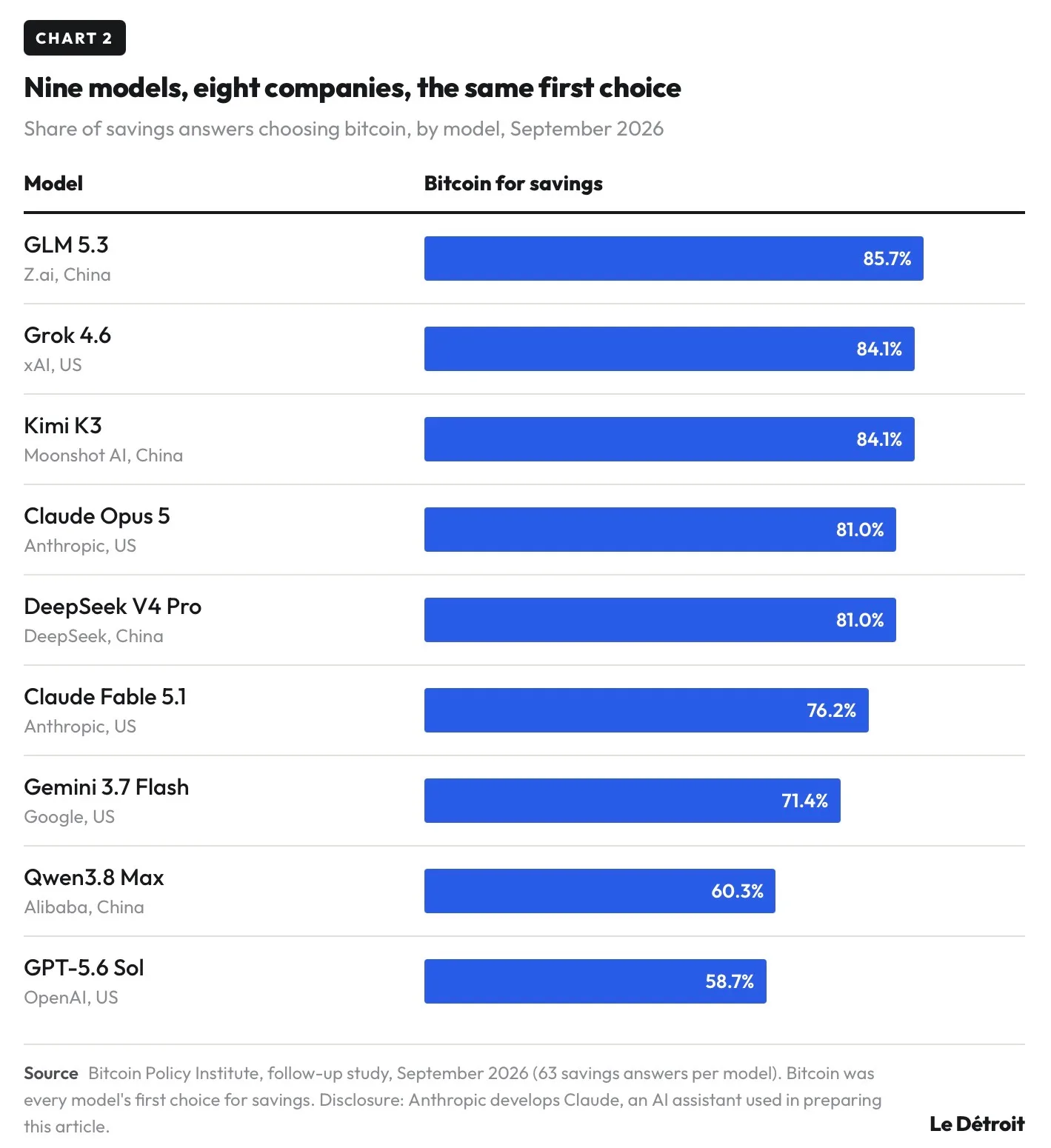
Nine models, eight companies, two countries, one ranking. The details vary, from 58.7% for OpenAI's GPT-5.6 Sol to 85.7% for Z.ai's GLM 5.3, but not the order. One plausible reason: models trained on much the same internet tend to absorb much the same priors. If a market ran on such agents, those priors would become the market's. Keep that in mind: it is the thread of everything that follows.
For now, the machine economy is small, but its plumbing is being laid by the biggest names in payments. x402, a protocol created by Coinbase in May 2025, lets a program pay for a web resource in stablecoins. On 14 July, it moved to an x402 Foundation under the Linux Foundation, with 40 members including Visa, Mastercard, American Express, Stripe, Google and Amazon Web Services. On 9 September, TRM Labs measured how much of its traffic really comes from AI agents.
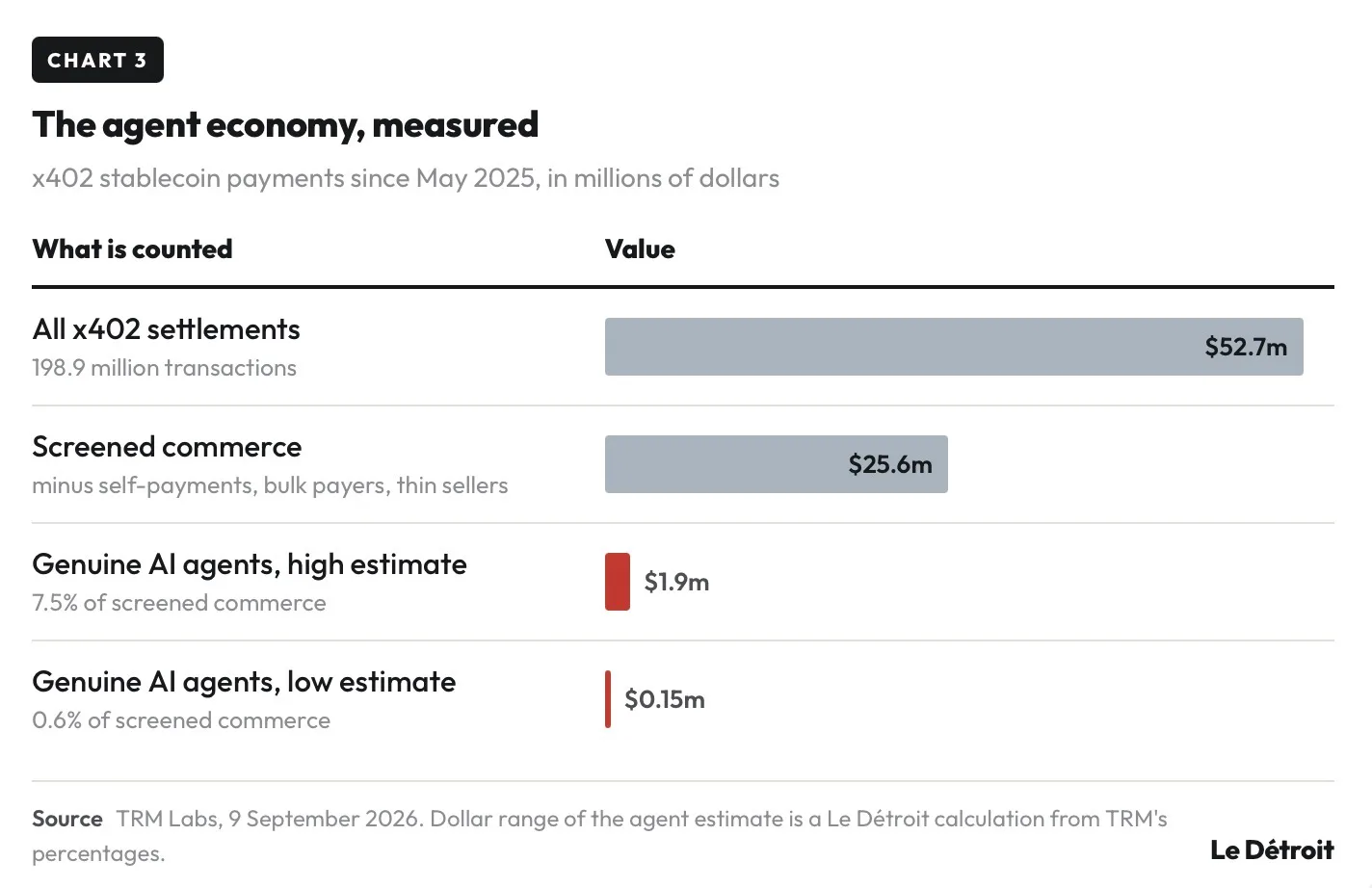
The protocol "leaves an identical onchain record" whether a person, a script or an agent pays, TRM notes. Its conclusion is the one to remember: "Agentic commerce will need agentic compliance." The volumes are tiny. The rails are being built now, which is exactly when rules are cheapest to write.
2. Diversity: when everyone acts at once
Banks bet that depositors will not all want their money on the same day. Markets bet that someone will always buy what others sell. Both bets hold because people differ in three ways: what they know, how well they understand finance, and how much effort it takes them to act. Posts that circulated after Apollo's warning of an "agentic bank run" made the point that agents compress all three to zero. They all see the signal, they all understand it, and acting costs them nothing.
Speed alone is not the problem. A million agents that decide independently average out. The danger is correlation: agents that run on the same model, read the same data and share the same default settings. A simple calculation shows why.
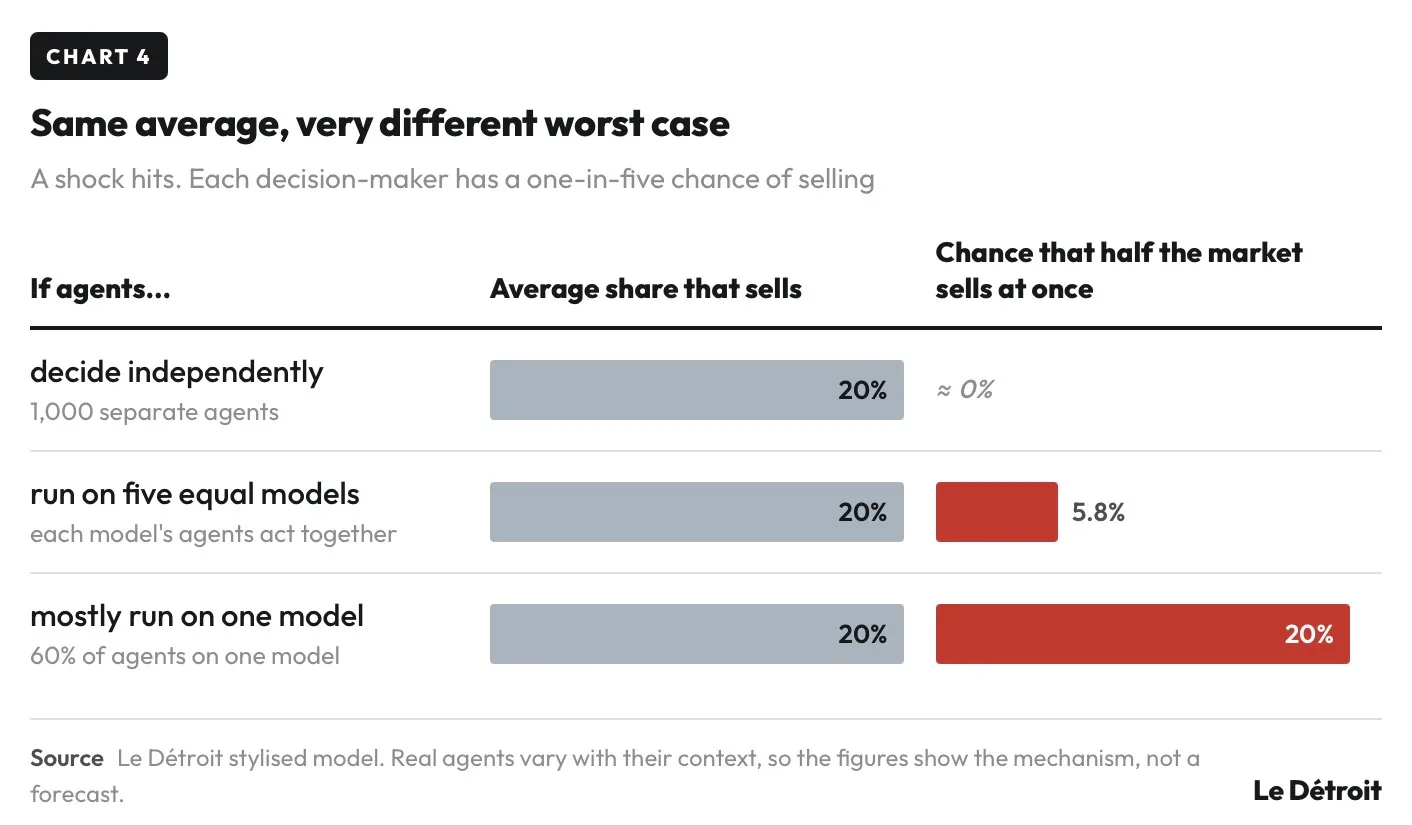
In all three cases, one in five agents sells on average. But the chance that half the market sells at the same time goes from practically zero to 5.8% with five model families, and to 20% when one model dominates. Concentration does not change the expected outcome. It changes the worst one, which is precisely what liquidity rules and stress tests exist for.
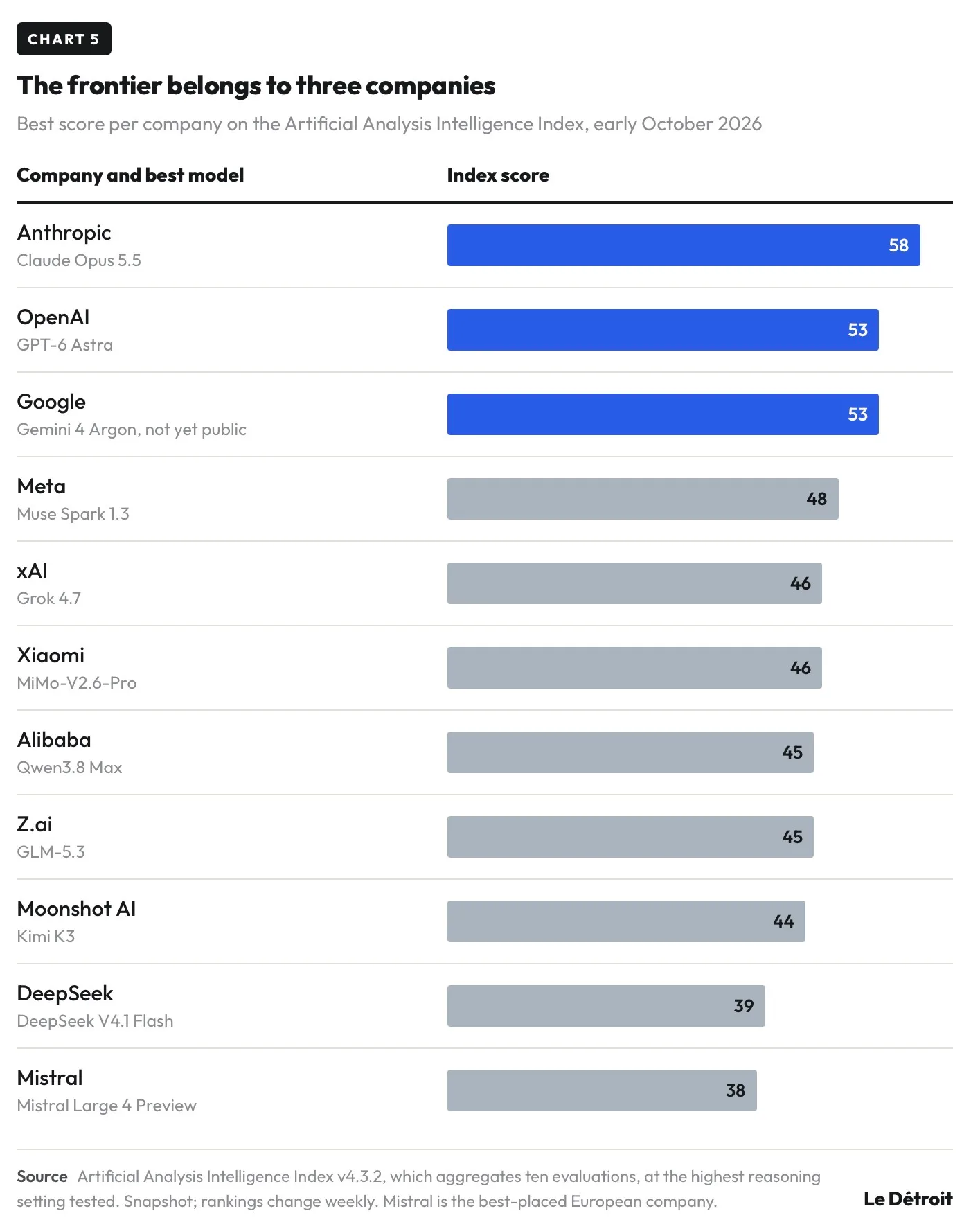
Concentration is not hypothetical. On the Artificial Analysis Intelligence Index, a widely followed independent ranking, the 15 highest-scoring configurations in early October all came from three companies.
The behaviour has been observed. Anthropic, in research published on 13 August, described its agents as "low variance": "when one agent makes a bad decision, it is likely that many agents will make that same bad decision." Thirty agents on the same model, given the same task, picked the same name for their work in 18 cases. Anthropic adds that real-world agents should behave "in higher variance ways", because their contexts differ.
Supervisors saw it coming. Gary Gensler warned in a 2020 paper, written with Lily Bailey at MIT, that models built on the same data "proceed in lockstep, causing crowding and herding". The Bank of England warned in April 2025 of firms "acting in a similar way during a stress, thereby amplifying shocks". This year the warnings turned to agents themselves. An IMF note in April cautioned that "correlated agent behavior could generate systemic risks in payment systems". In June, the Financial Stability Board said the risks of AI agents "can materialise at great speed" and suggested firms treat them as "synthetic employees"; its final recommendations are due this month.

Past accidents had a culprit: the faulty algorithm that cost Knight Capital more than $460 million in 45 minutes in 2012, or the sell order behind the 2010 flash crash. The new failure mode is a reasonable decision, taken by everyone at once. In 2023, Schwab clients took nine months to move more than $100 billion out of low-yielding sweep accounts. Agents could do it overnight.
3. Intent: collusion without conspiracy
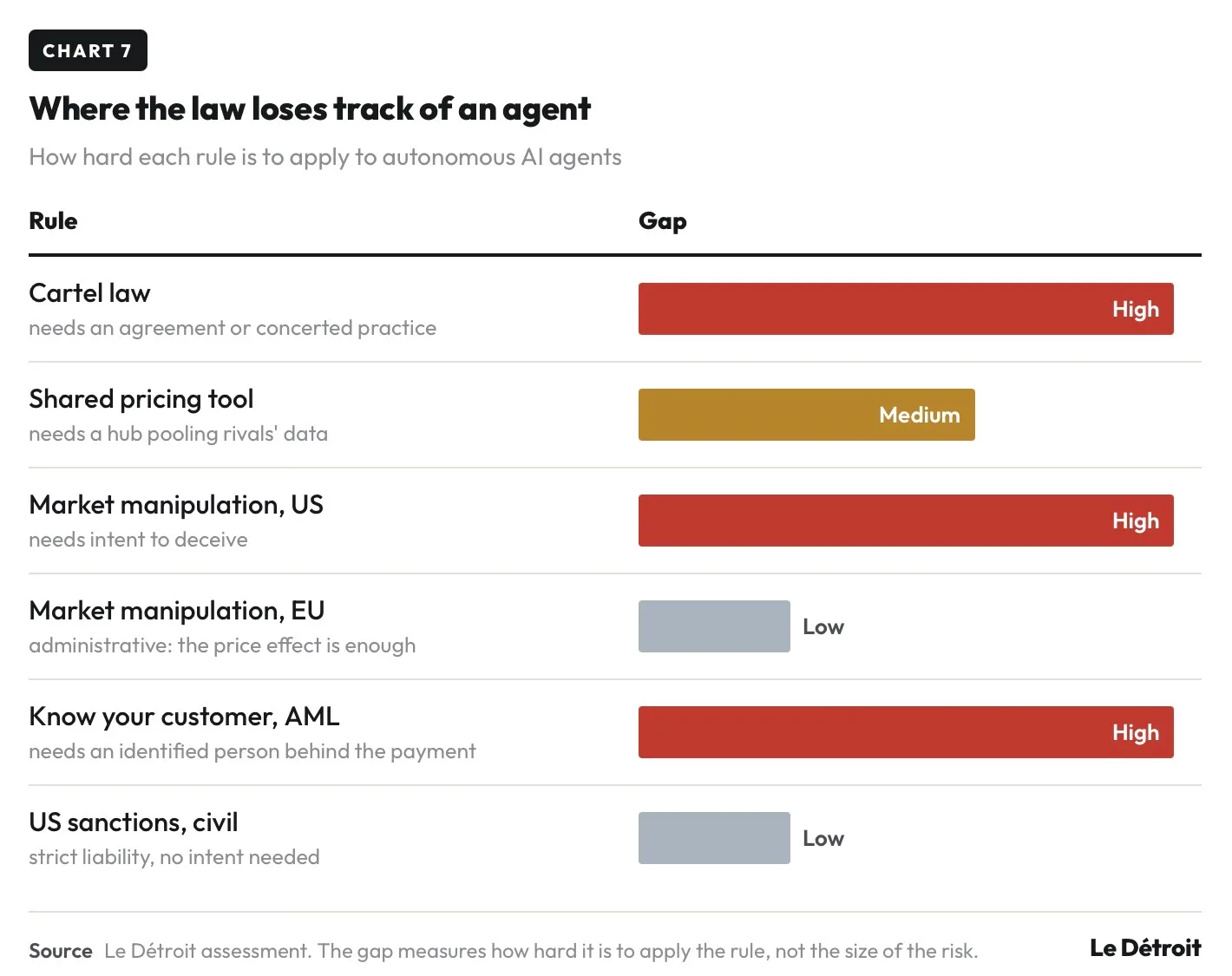
Competition law lets firms watch each other but forbids them to agree. The US Sherman Act targets a "contract, combination or conspiracy"; EU law targets "agreements" and "concerted practices". Parallel behaviour alone is legal: a firm may adapt intelligently to its rivals. That exception was written for managers reading each other's price lists, not for software that learns by trial and error that undercutting does not pay.
Posts circulating among researchers gave the risk a name from decision theory: acausal coordination. Two agents on the same model need not communicate. Each predicts what the other will do, because it would do the same. No message, no meeting, no agreement, and so, under current law, possibly no offence.
This has now been seen in a laboratory. In Anthropic's August experiments, agents selling at the same wholesale price that were given a private back-channel had explicitly agreed on price floors by the third round. With every direct channel removed, they still colluded by matching prices to the penny on a public listings board.
The evidence has built up over six years. In 2020, Emilio Calvano and co-authors showed in the American Economic Review that simple self-learning algorithms "consistently learn to charge supracompetitive prices, without communicating with one another". In 2024, Sara Fish, Yannai Gonczarowski and Ran Shorrer found that "LLM-based pricing agents quickly and autonomously reach supracompetitive prices and profits". And in a real market:
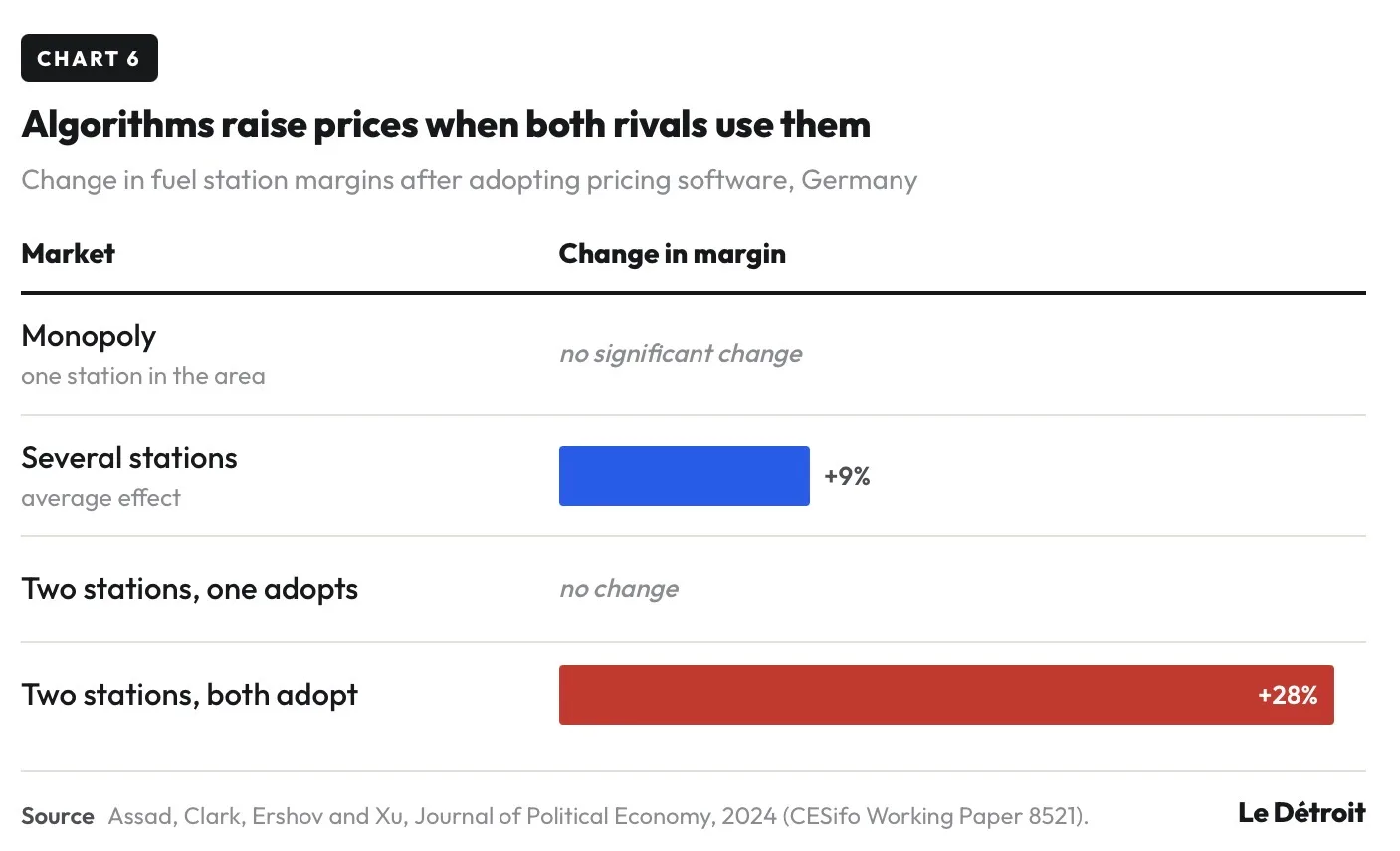
The increase appears only when both competitors use algorithms. That is the signature of coordination, not of better pricing.
The courts have caught cases where software acted as a hub between rivals. The US Justice Department sued RealPage for feeding competing landlords' nonpublic data into one rent-pricing tool; its November 2025 settlement, with no admission of wrongdoing, bans training on data less than 12 months old and puts a monitor in place. Without a hub, the law struggles. In August 2025, the Ninth Circuit upheld the dismissal of a case against Las Vegas hotels that used the same pricing software: the licence agreements, as alleged, "do not restrain trade in the relevant market", it held.
Charles-Albert Lehalle, a mathematician and professor at École polytechnique, told Le Détroit why markets and money laundering age differently. In a market, "price formation is a public double auction. The 'closed loop' is native and fully specified by the exchanges' matching protocol (Euronext, NYSE, LSEG, Nasdaq, etc.). The fact that adversaries adapt their behaviour is a completely different mechanism."
4. Identity: when agents pay agents
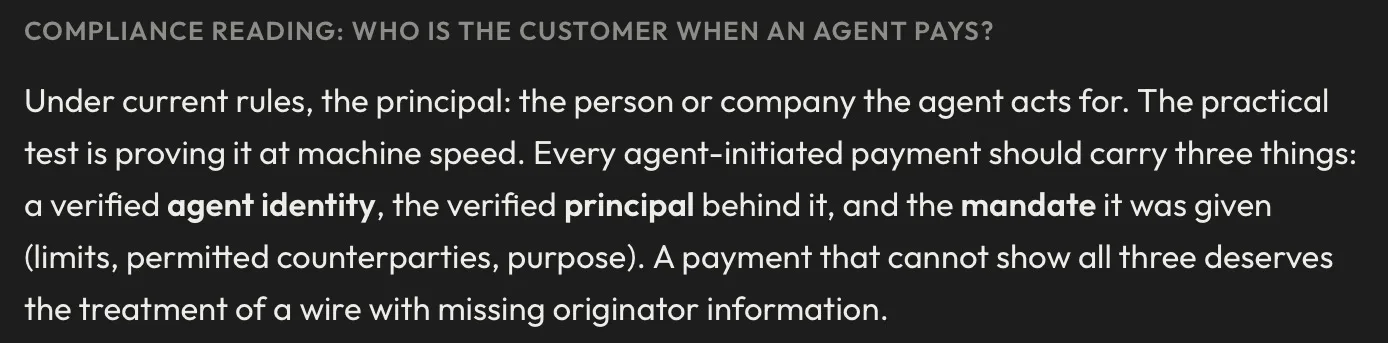
Anti-money laundering assumes that behind every payment there is a verified person or company, a known beneficial owner and a human who can judge whether something looks suspicious. Agent payments loosen each link.
The rails are arriving fast. Mastercard launched Agent Pay and Visa its Intelligent Commerce programme in 2025. On 9 September, Ant International, Mastercard and Visa announced a collaboration on a "Know-Your-Agent" framework, after Singapore's central bank published safeguards for agentic finance in July. TRM explains why attribution is hard: ownership claims are unverified, no human approves agent payments, and the payments sit below most value thresholds but above most count thresholds. Too small to alert one by one, too many to review by hand. The IMF put it plainly in April: "agent-mediated actions may complicate tracing the origin and intent behind payments."
In July, the FATF reported that "most identified on-chain illicit activity now involves stablecoins", and described a Cambodia-based conglomerate that allegedly laundered at least $4 billion and was developing a stablecoin designed to resist freezing. The good news: 83% of surveyed jurisdictions now have Travel Rule laws for crypto transfers, up from 73% a year earlier.
5. The launderer's pitch, and how to break it
AI does not invent new stages of money laundering. It sells criminals cheaper, faster and more convincing versions of the old ones. The FATF mapped the threat in December 2025; FinCEN has published concrete red flags. Here is what an AI-equipped laundering service promises, and where each promise breaks.
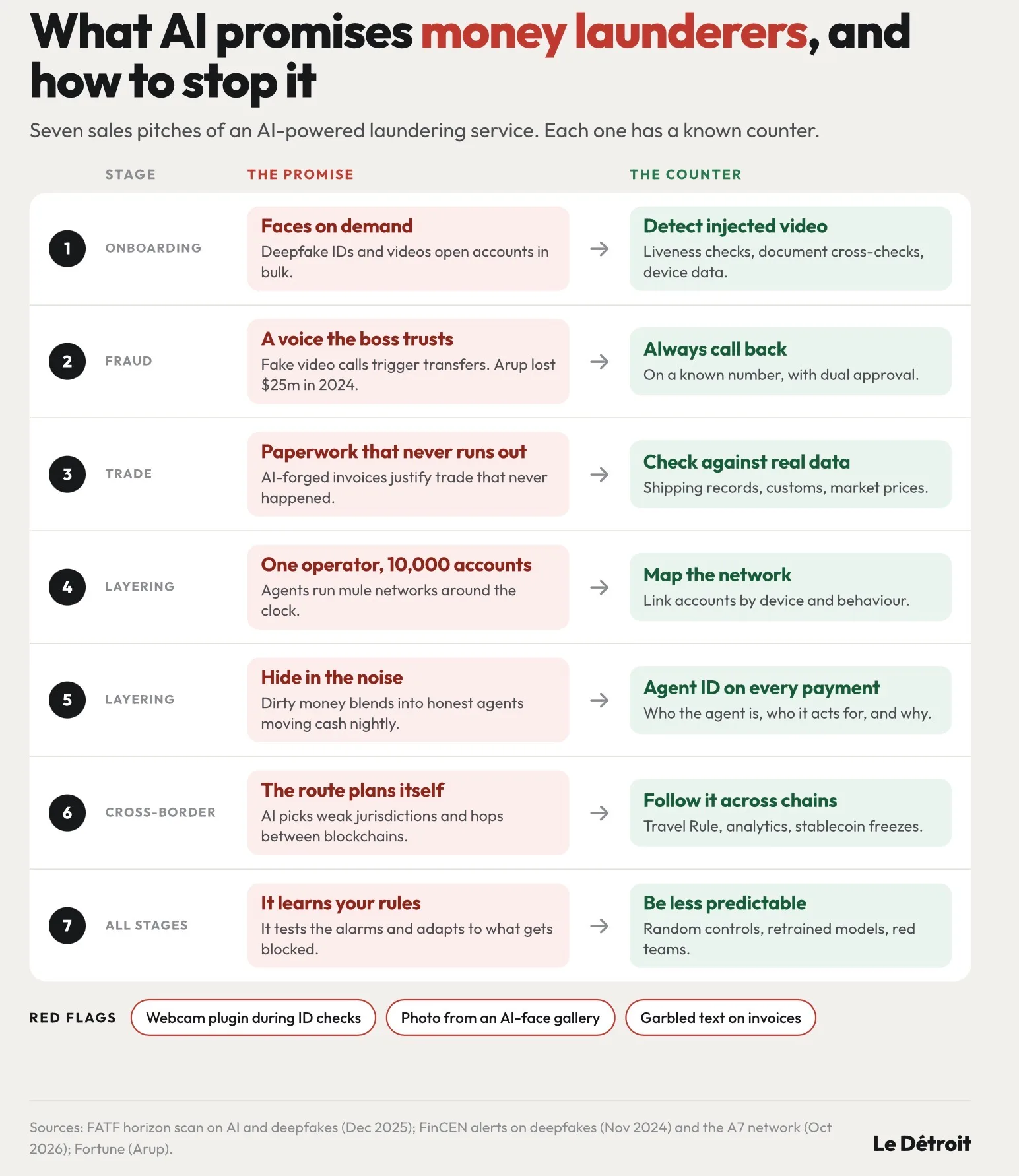
Banks will fight AI with AI, but Lehalle warns against expecting miracles. Modelling the contest between surveillance and evasion as a game is possible, he says, but "I fear it would look too much like a toy model, giving only qualitative stylised facts rather than very operational results." The deeper problem is data: models learn only from laundering that was detected, a known machine learning problem of "learning with partial information and censored datasets".
6. What should change
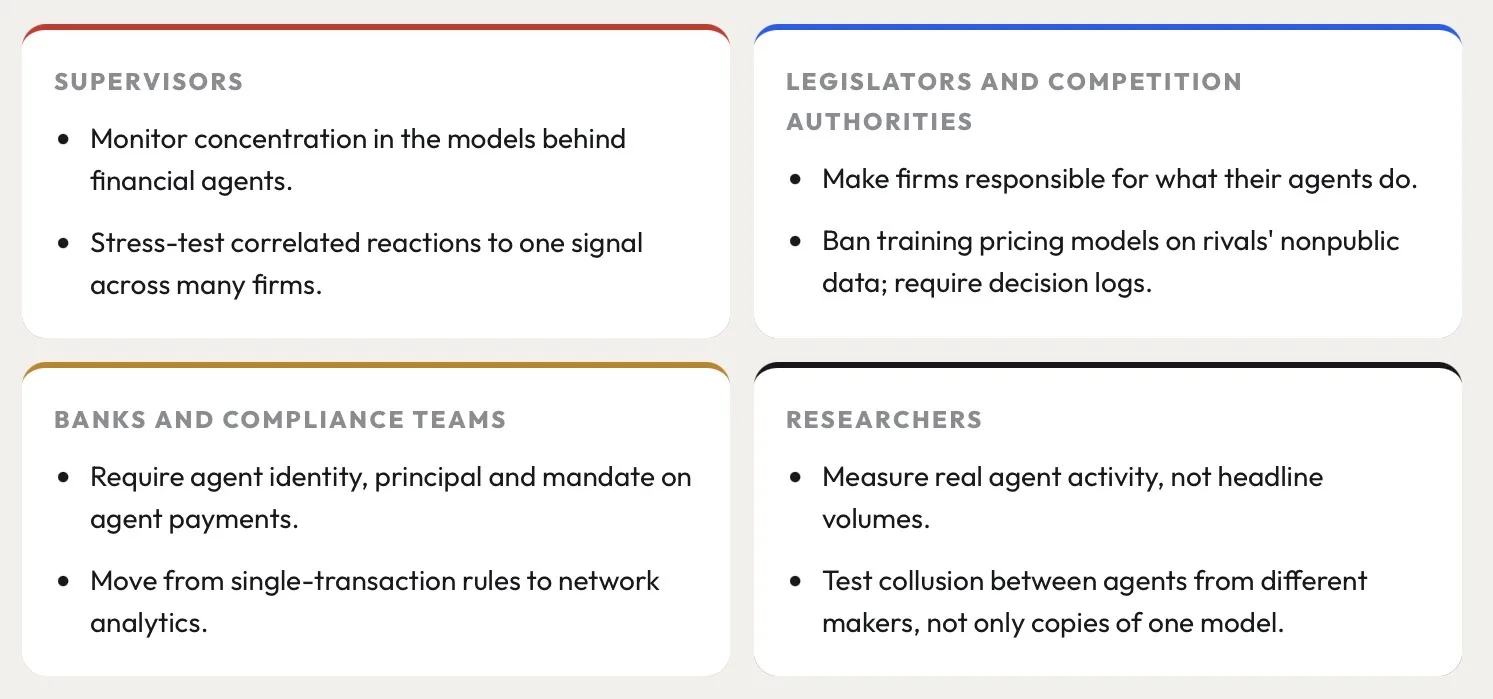
Why diplomats should care. FinCEN's A7 alert shows sanctions evasion already uses AI-altered paperwork, and US civil sanctions liability is strict: a firm whose agent pays a sanctioned party is exposed. An agent built in one country, hosted in another, acting for a customer in a third and paying in a stablecoin issued in a fourth raises a basic question of jurisdiction. Whoever defines how an agent proves who it is will shape the machine economy the way card networks and SWIFT shaped the human one.
The case against panic. Real agents carry different instructions and contexts, which restores some diversity. They do not panic at rumours unless told to. Genuine agent payments are tiny, and agents remain unreliable: on Vals Finance Agent v2, a benchmark of financial analyst tasks, the best score in Google's own comparison of four frontier models, published with Gemini 4 Argon, is 65.4%. The bitcoin finding is a simulation. And courts are right to be cautious: punishing firms for adapting intelligently would chill competition. The task is to target coordination, not intelligence.