1. The banker at the airport
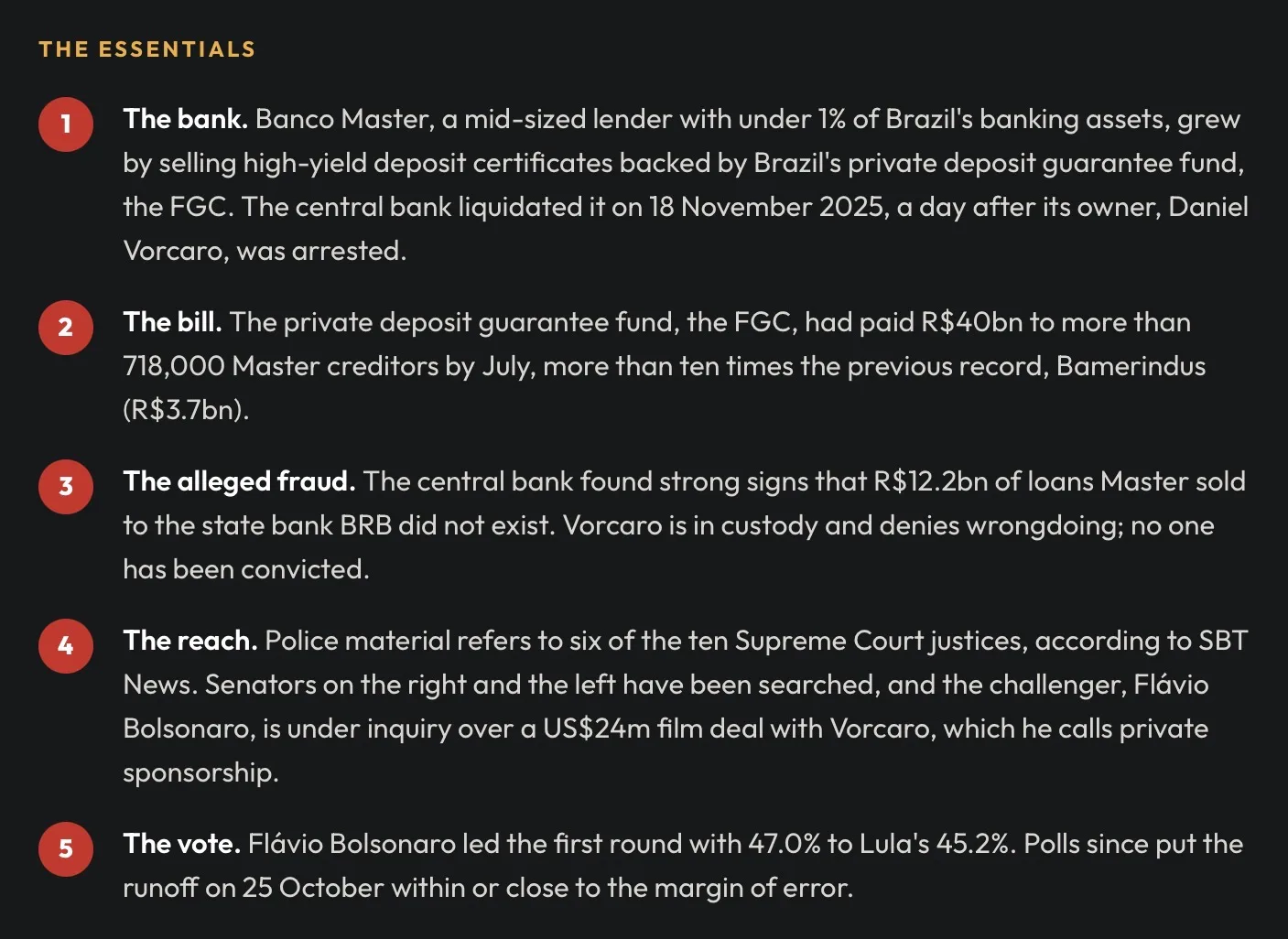
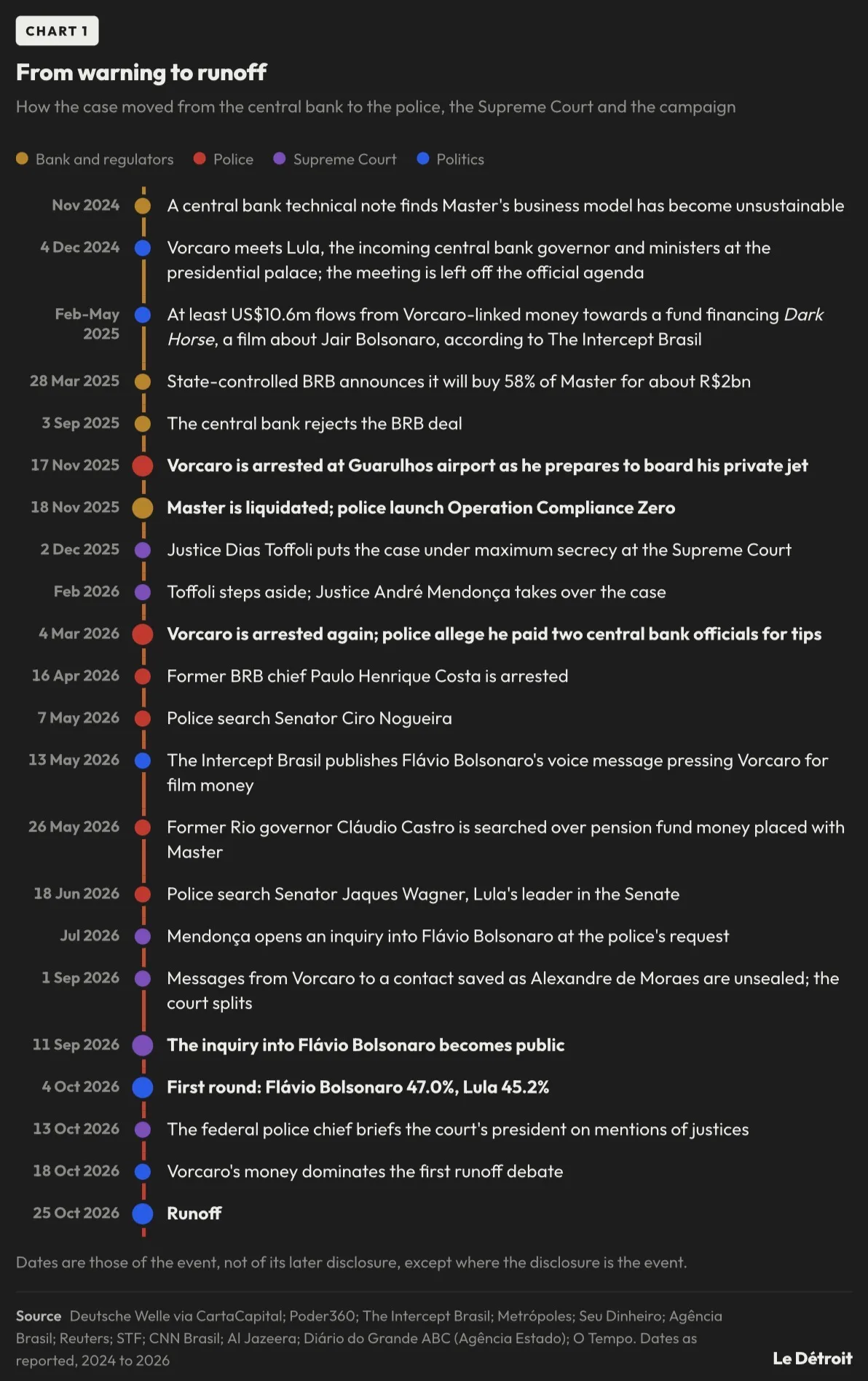
On the evening of 17 November 2025, federal police stopped Daniel Vorcaro at Guarulhos airport in São Paulo as he prepared to board his private jet. His lawyers denied he was fleeing. The next morning Brazil's central bank put his Banco Master into liquidation, citing a "grave crise de liquidez" (a severe liquidity crisis) and "graves violações" of banking rules, and the police launched Operation Compliance Zero.
Released 12 days after his first arrest and re-arrested in March 2026, the banker is now in custody and his bank has become the most politically toxic subject in Brazil. Master held only 0.57% of the banking system's assets when it failed. Yet the investigation has reached the Supreme Court, the central bank, the Senate, a state pension fund and the family of the man who may be president by Sunday night.
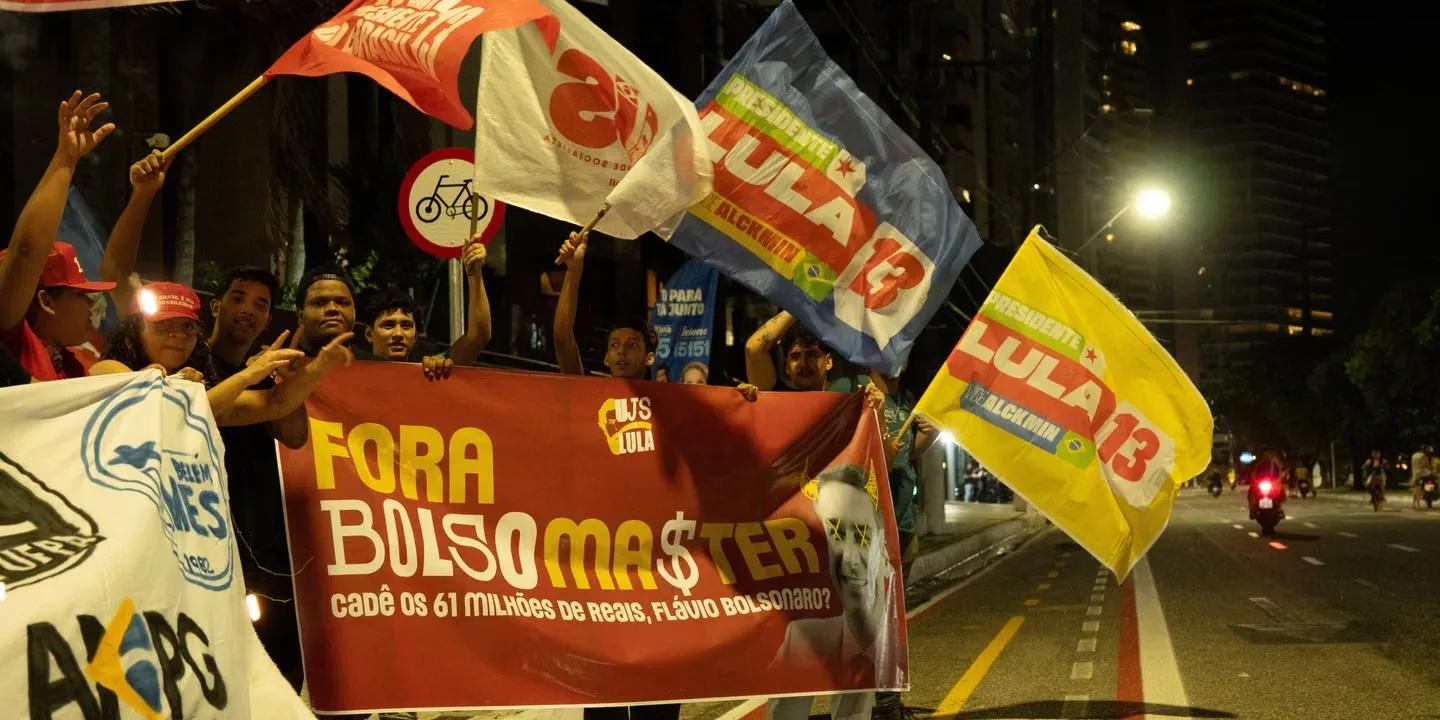
On 18 October, in the first debate of the runoff, Lula asked Flávio Bolsonaro to explain "os R$ 134 milhões do Vorcaro", the sum the senator negotiated for a film about his father. Flávio replied with accusations of his own, including a police investigation into Lula's son Fábio Luís for alleged influence peddling, a probe unrelated to the Master case. Reuters now calls the affair Brazil's largest-ever banking fraud. Whoever wins on 25 October will govern in its shadow.
2. A bank built on the guarantee
Master began as Banco Máxima, a lender that Vorcaro took over in the late 2010s. Reuters reports it was already on the central bank's confidential watchlist; the change of control was approved in 2019, under then-governor Roberto Campos Neto, and the bank took its new name in 2021. What followed was a funding machine. Total deposits rose from R$8.5bn in December 2021 to R$59.7bn three years later, according to DIEESE, a research body that analysed central bank data, and almost all of it was time deposits.
The product was the CDB, a certificate of deposit. Master paid up to 140% of the CDI, the interbank benchmark, when many banks paid around 100%. Big investment platforms, among them XP, BTG Pactual and Nubank, put the certificates in front of retail savers, according to Correio Braziliense. The selling point was that the FGC, Brazil's private deposit guarantee fund, covers up to R$250,000 per investor per bank. In effect, savers were lending to Master on the credit of the fund.
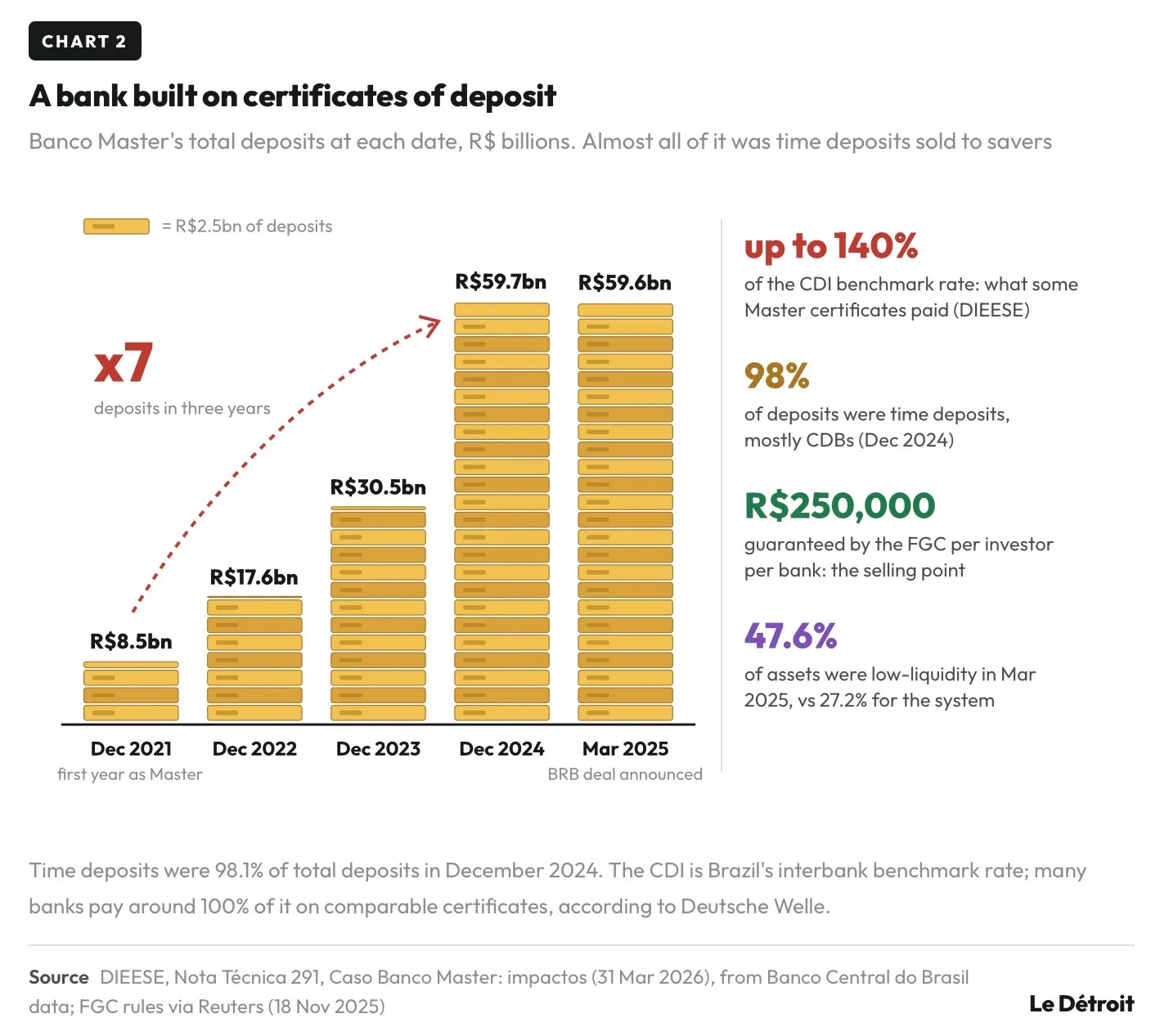
The assets told another story. By March 2025, 47.6% of Master's assets were hard to sell, against 27.2% for the banking system, DIEESE found, including about R$8.7bn of precatórios at end-2024, court-ordered government debts, and other receivables. A central bank technical note from November 2024 concluded that the model had become unsustainable, Deutsche Welle reported: the bank could no longer earn enough to pay its savers. Police suspect new certificates were being sold to pay earlier ones.
3. Phantom borrowers
The escape route was Brasília. On 28 March 2025 BRB, the bank controlled by the Federal District government, announced it would buy 58% of Master for about R$2bn. Before and after that, money moved between the two banks on a vast scale: R$16.7bn from July 2024 to October 2025, according to a court ruling cited by Reuters. Much of it paid for portfolios of payroll loans that Master sold to BRB.
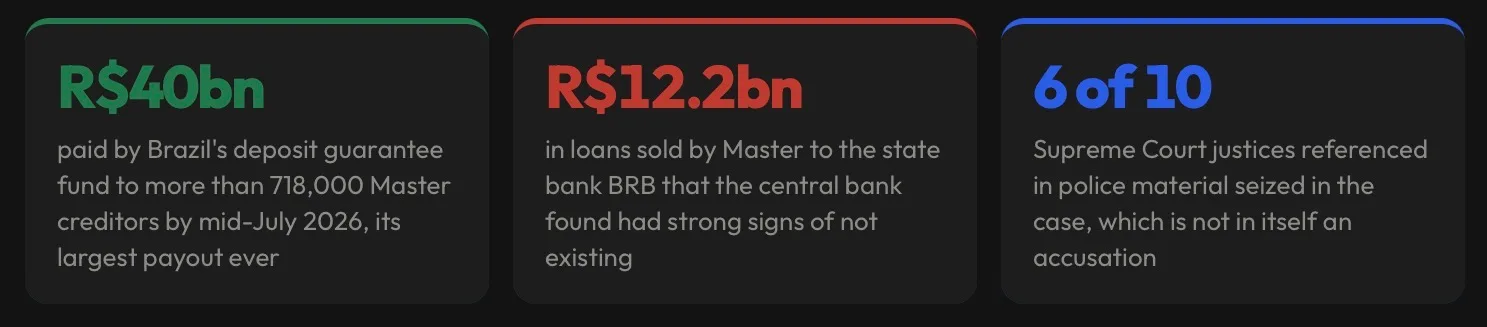
On 3 September 2025 the central bank rejected the takeover. Its documents, later unsealed at the Supreme Court, show what examiners found in their review. They found "fortes indícios" (strong signs) that R$12.2bn of credits sold to BRB did not exist, Jovem Pan reported. The review was simple: it picked 30 supposed borrowers and, for none of them, could link the loans to a payment to the borrower.
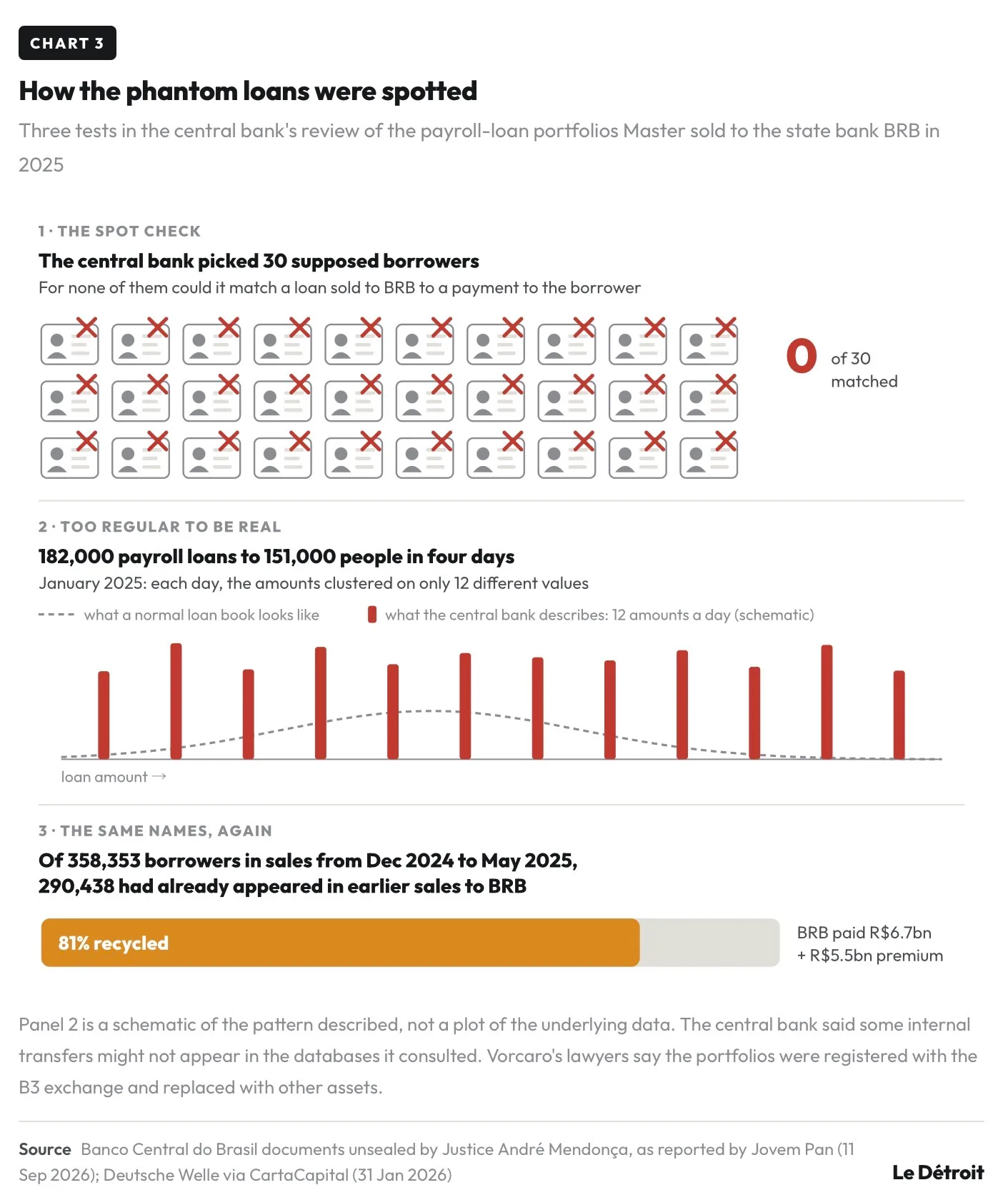
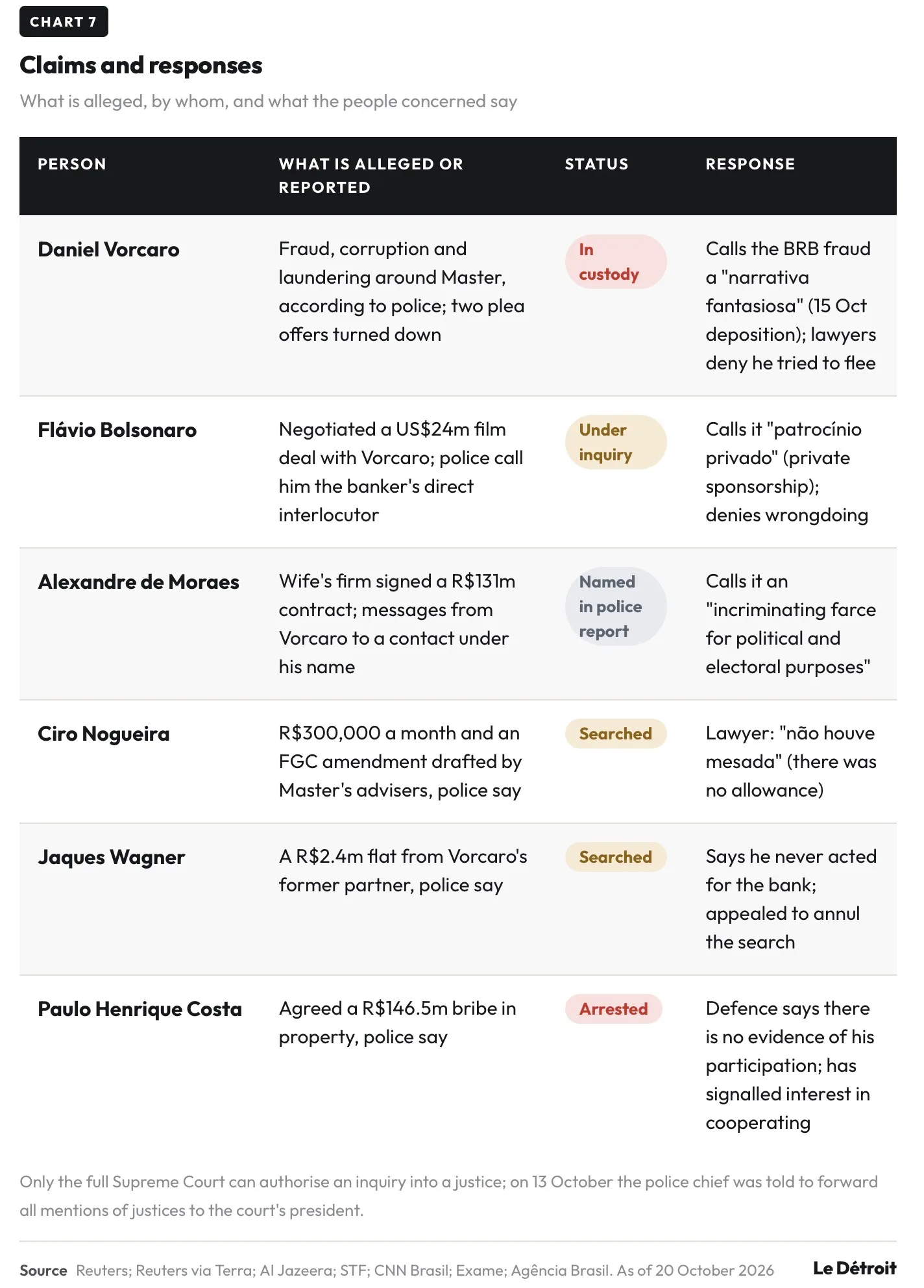
Other patterns were just as telling. In four days of January 2025, 182,000 loans to 151,000 people were clustered on only 12 different amounts a day, which investigators judged incompatible with real payroll lending. Vorcaro's lawyers say the portfolios were registered with the B3 exchange and replaced with other assets; in an October deposition Vorcaro called the fraud allegation a "narrativa fantasiosa", a fanciful story. BRB may need to set aside more than R$5bn, the central bank's head of supervision, Ailton Aquino, told investigators, according to Reuters. Its former president, Paulo Henrique Costa, was arrested on 16 April 2026; police allege he agreed to take R$146.5m in property from Vorcaro. A police report unsealed on 9 October attributes a "direct" role in BRB's bid to Ibaneis Rocha (MDB), then governor of the Federal District, whose government controls BRB, citing a meeting with Vorcaro and Costa in Zurich on 23 January 2025; his lawyer says the report shows he did not interfere.
4. The biggest bill in the fund's history
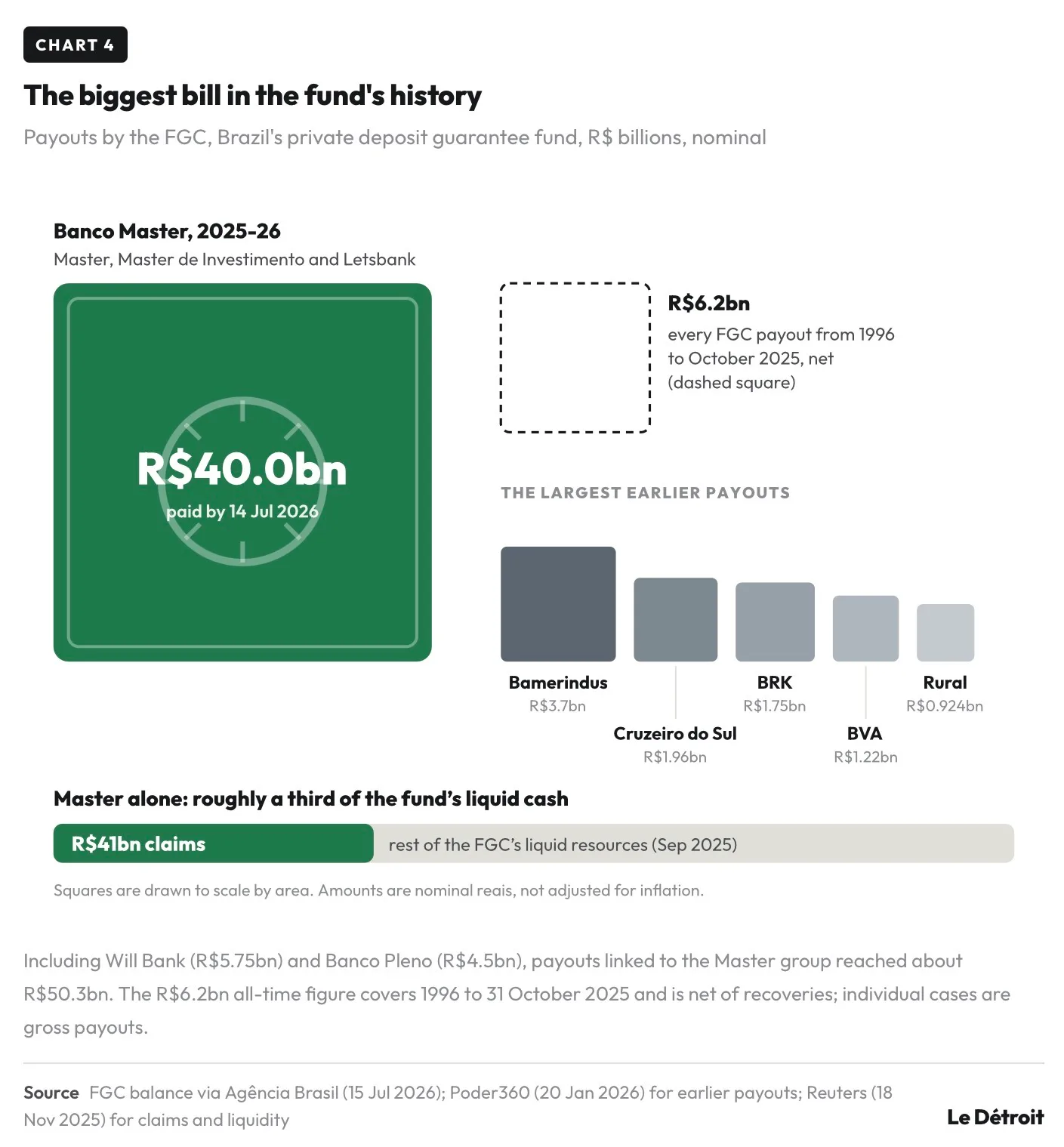
When Master failed, about 1.6 million creditors held some R$41bn of claims eligible for the guarantee, roughly a third of the FGC's liquid cash, Reuters reported at the time. By 14 July 2026 the fund had paid R$40bn to more than 718,000 Master creditors, about 94% of expected creditors (98.5% of the expected amount), and some R$50.3bn across the group including Will Bank and Banco Pleno. The FGC's figures imply about 766,000 eligible creditors, roughly half the 1.6 million Reuters reported at liquidation; Al Jazeera cites about 800,000. We could not establish why the counts differ.
The scale is new for Brazil. From 1996 to October 2025 the FGC paid out R$6.2bn in total, net of recoveries, Poder360 calculated; the largest single case, Bamerindus in the 1990s, cost R$3.7bn. The central bank let up to an estimated R$30bn of reserve requirements be redirected to the fund this year, according to Reuters. Some losses fall outside the guarantee: the Rio de Janeiro pension fund, Rioprevidência, held about R$960m in Master financial bills that the FGC does not cover.
5. From the vault to the Court
In December 2025 the case moved to the Supreme Court, where Justice Dias Toffoli placed it under maximum secrecy. He stepped aside in February after police reported links between his family and funds tied to the bank, and Justice André Mendonça took over. In a report published by piauí in September, police raised the hypothesis that Toffoli could be the ultimate owner of a fund, Arleen, that received at least R$35m from Vorcaro, while stating that the evidence did not yet allow definitive conclusions. Toffoli denies wrongdoing.
The bigger blow fell on Justice Alexandre de Moraes. His wife's law firm signed a R$131m, three-year contract with Master, and file metadata indicate the draft was edited by a user named "Ministro Alexandre de Moraes", CNN Brasil reported, citing Estadão. Her firm says the minister checked the draft and saw no obstacle. On 1 September Mendonça unsealed messages from Vorcaro to a contact saved under Moraes's name; police recovered no replies. "I am grateful to you for my life," one read, AP reported. Moraes denies the exchanges and calls the affair an "incriminating farce for political and electoral purposes".
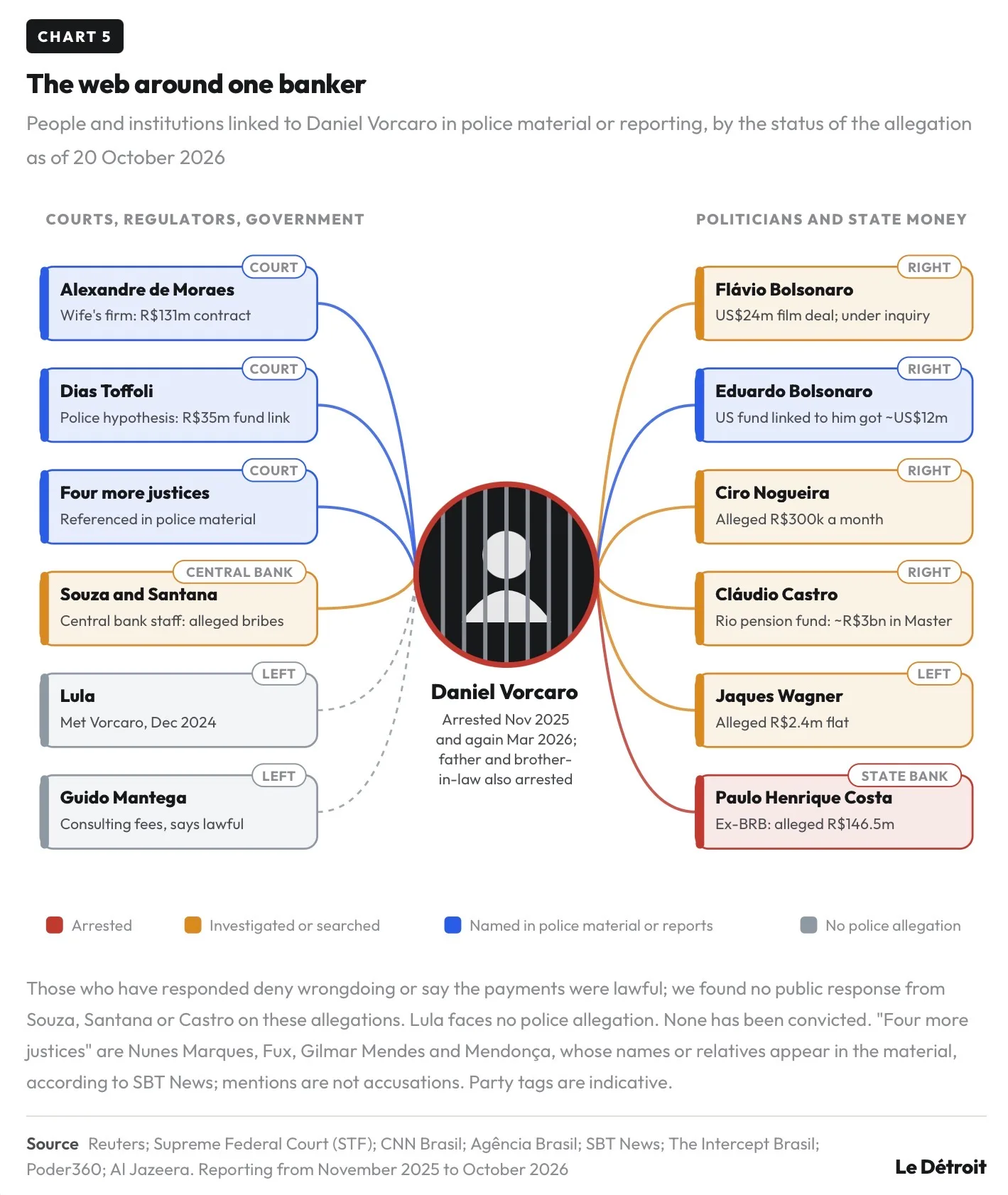
The court then turned on itself. Moraes and Mendonça asked for sanctions against each other, AP reported; Mendonça confirmed he had met Vorcaro in March 2025 to discuss precatórios. On 13 October the police chief briefed the court's president, Edson Fachin, after SBT News reported that seized material referred to six of the court's ten justices. Fachin told him to forward every mention "sem exceção", without exception, while noting that the full court will decide on any inquiry into a justice. On 19 October the prosecutor-general's office told Fachin it saw no grounds for Moraes's abuse-of-authority accusation against Mendonça, saying the report behind it "não pode ser considerado prova", cannot be considered evidence.
The central bank has not been spared. Police allege that Vorcaro bribed two central bank employees who had held senior supervision posts, Paulo Sérgio Neves de Souza, a former director of supervision, and Belline Santana, for tips, including reviews of his filings before he submitted them, according to Reuters. Both left those posts in January and were suspended by court order in March; Reuters could not reach them. A police source told Reuters the findings point to corrupt individuals rather than an institutional failure, but critics say the bank was slow to rein Master in.
6. Follow the money
The political trail runs through payments of very different kinds. Senator Ciro Nogueira, a former minister under Jair Bolsonaro, allegedly received R$300,000 a month, later R$500,000, and filed an amendment to raise the FGC limit to R$1m per depositor that police say was drafted by Master's advisers, according to the Supreme Court's own summary. His lawyer says "não houve mesada", there was no allowance. Police searched former Rio governor Cláudio Castro over about R$3bn that Rioprevidência placed in Master's bills and funds.
On the left, police searched Jaques Wagner, Lula's leader in the Senate, over a R$2.4m flat in Salvador allegedly given by Vorcaro's former partner. Wagner says he never acted for the bank. Reuters found Master paid fees in 2025 to firms of the former president Michel Temer, the former finance minister Guido Mantega and Fabio Wajngarten, Jair Bolsonaro's former communications chief, among others; all say the work was lawful, and Reuters found no evidence linking the payments to regulatory decisions.
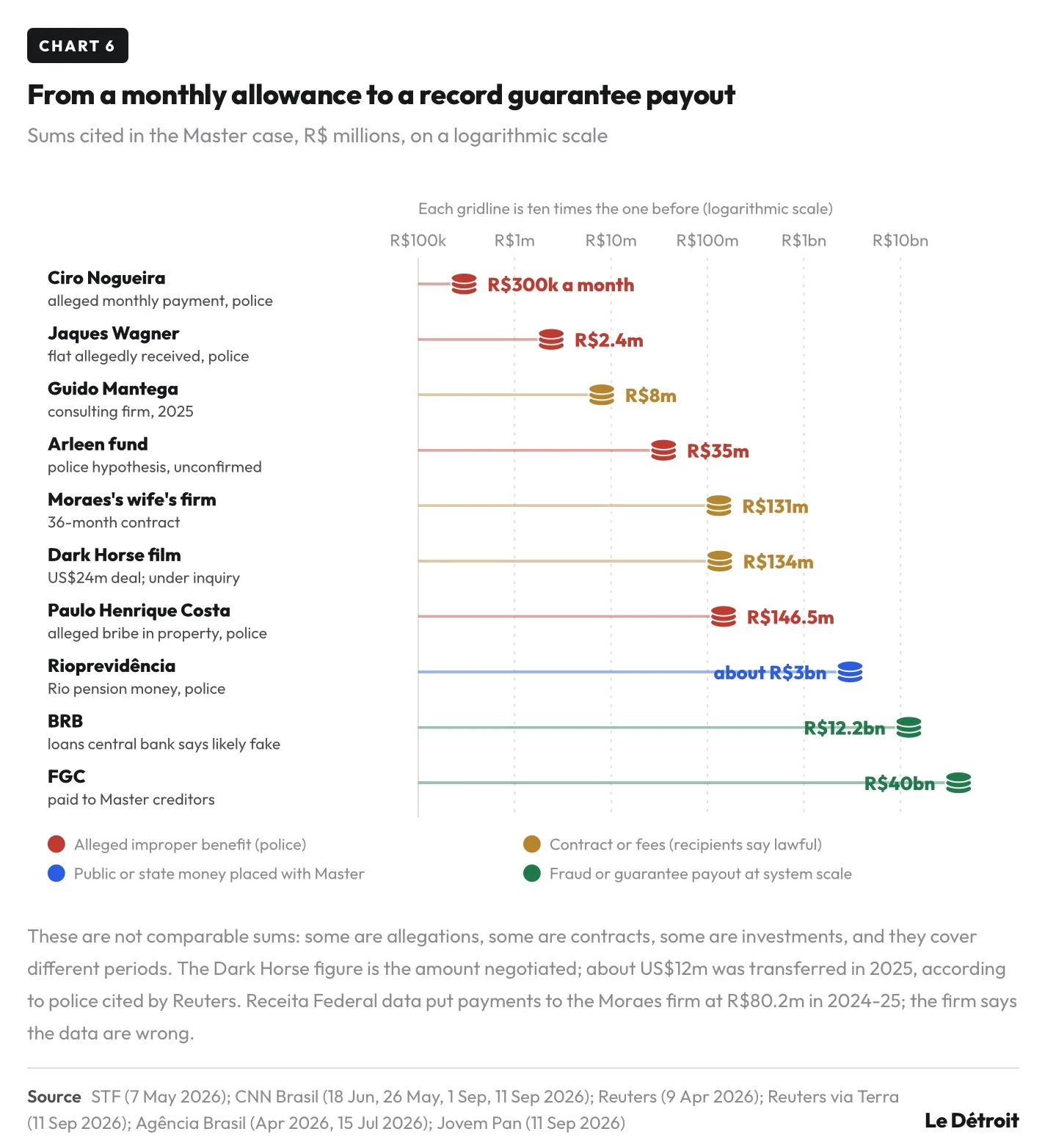
Then there is the film. The Intercept Brasil published a voice message from 8 September 2025 in which Flávio Bolsonaro pressed Vorcaro for overdue instalments for Dark Horse, a biopic of his father, warning that otherwise "a gente perde tudo", we lose everything. The deal was worth US$24m, about R$134m; about US$12m was transferred in 2025 to a US fund linked to his brother Eduardo, according to police data cited by Reuters. In July Mendonça opened an inquiry into Flávio for alleged corruption, money laundering and illegal currency transfers; police describe him as Vorcaro's direct interlocutor on the film.
Flávio says the money was a "patrocínio privado", private sponsorship, for a private film, and denies wrongdoing. "They want to frame this as bribe money, which it isn't," Eduardo told Reuters, saying the funds were kept abroad to shield them from Moraes.
7. Both camps, one banker
Neither side is clean of contact. On 4 December 2024 Lula received Vorcaro at the presidential palace with Gabriel Galípolo, then about to take over the central bank, and several ministers, a meeting left off the official agenda, Poder360 reported. Lula told Galípolo to treat Vorcaro's complaints by technical criteria, according to the same report; he is not accused of wrongdoing. "Let the Supreme Court investigate everything, disclose everything, whoever it hurts," he said on 10 September.
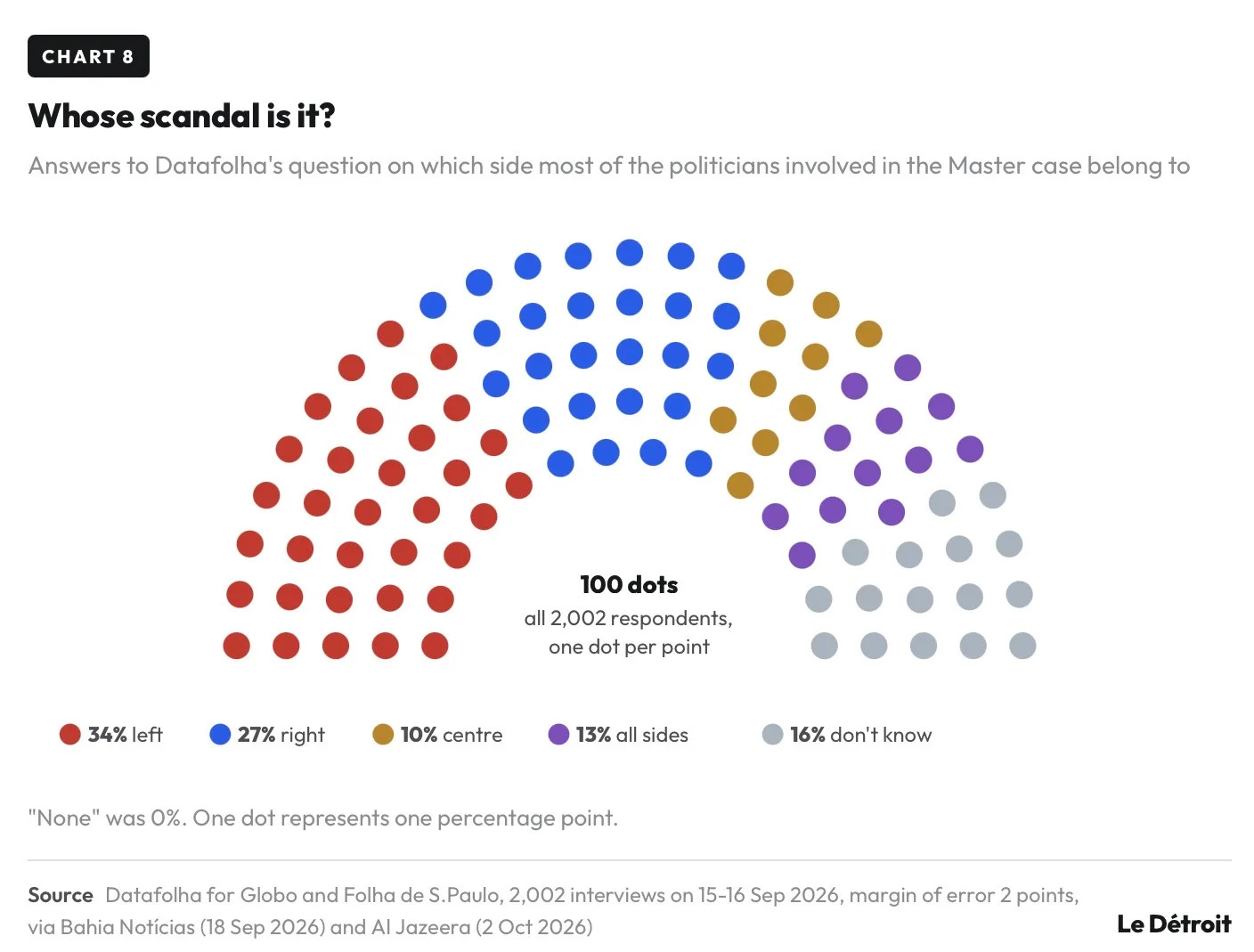
Voters are confused about who owns the scandal. In a Datafolha poll in mid-September, 34% said most of the politicians involved were on the left and 27% on the right. One analyst disagrees with the voters. "Make no mistake, this is a corruption scandal that predominantly involves the right," Leonardo Paz of the Fundação Getulio Vargas told Al Jazeera. Flávio has instead tied Lula to the most exposed justice: "Anyone voting for Lula is voting for Alexandre de Moraes."
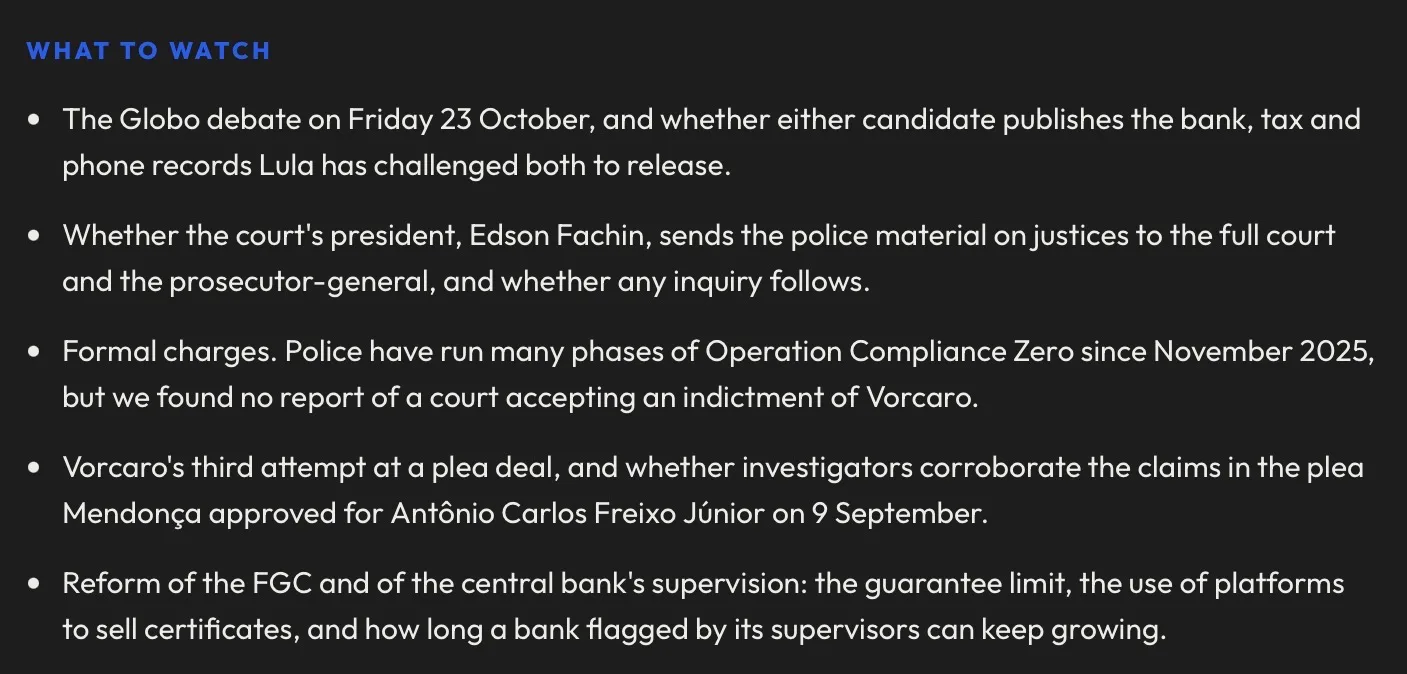
The debate on 18 October showed both strategies. Lula said he had told Vorcaro: "the last government made you a banker, mine will make you a prisoner". Flávio accused Lula of having taken money from Vorcaro through the Instituto Lula, citing a Veja report that Vorcaro, in a rejected plea proposal, claimed to have paid R$30m in cash for a Lula documentary; police and prosecutors told CNN Brasil the claim lacked minimum supporting evidence, and Lula's campaign calls it a farce. He also asked what he had promised the banker in their closed-door meeting. On 20 October Lula filed a pledge with the electoral court to publish his bank, tax and phone records if Flávio does the same. "I want to see whether he (Bolsonaro) has the courage to disclose his bank and phone records," he said, according to Reuters. Flávio's allies told SBT News he will not take up the challenge, calling it an electoral trap.
8. A coin toss, and what comes after
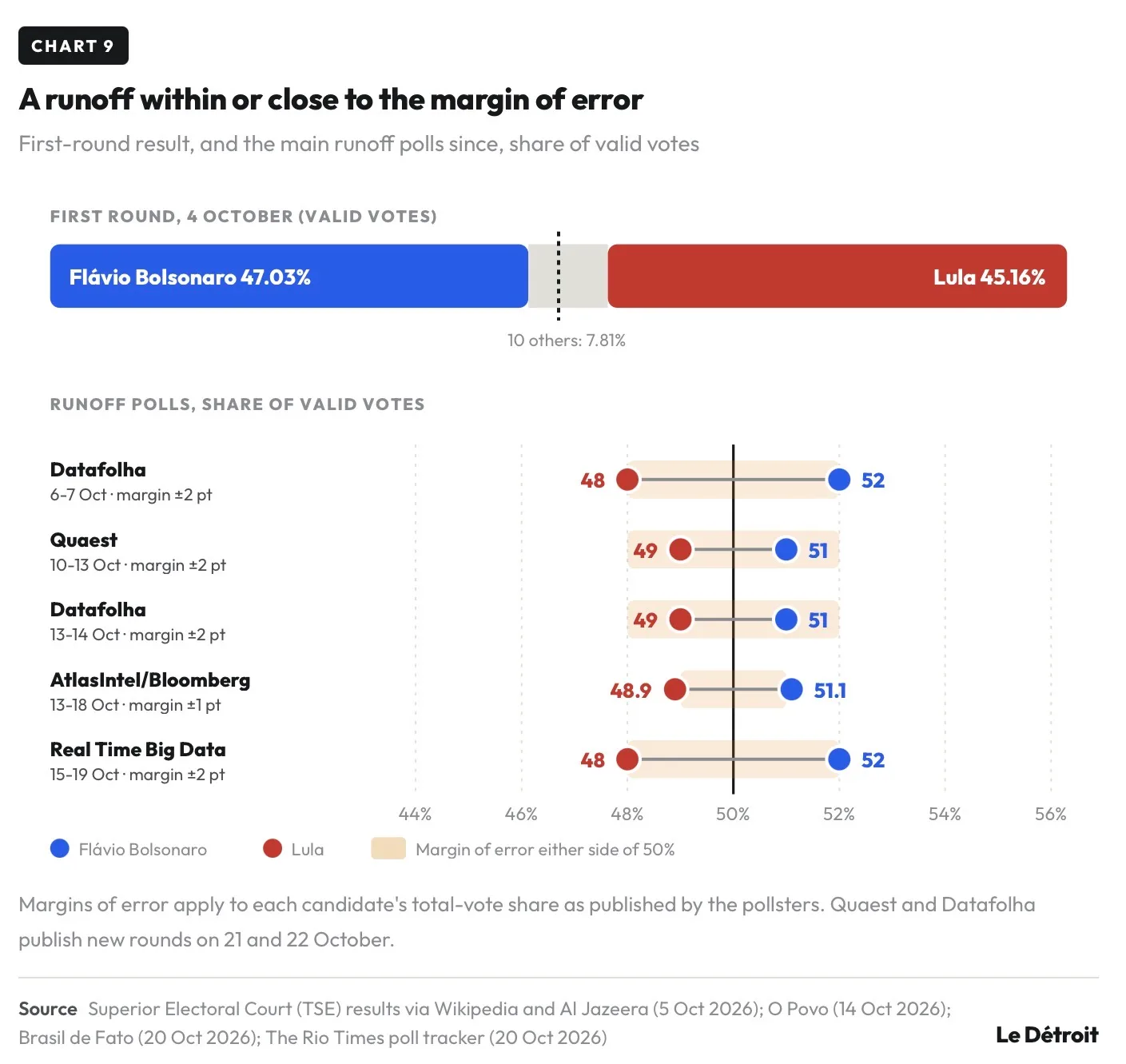
Flávio Bolsonaro won 47.0% of valid votes on 4 October, against 45.2% for Lula. The main polls, including Datafolha, Quaest and AtlasIntel, give him 51% or 52% of valid votes, a lead within or at the edge of their margins of error; others show a near tie (PoderData 47-47), and Vox Brasil has twice had Lula narrowly ahead. Rejection is high for both: in mid-October, 54% said they would never vote for Flávio and 53% for Lula (Quaest, 10-13 October).
The case will outlive the vote. Vorcaro has twice seen plea offers rejected by police for lacking new facts, and his new lawyers are trying again. On 9 September Mendonça approved the plea deal of Antônio Carlos Freixo Júnior, a businessman who says he delivered cash to people Vorcaro designated and moved money for the film, Jornal Opção reported; his claims still have to be checked. The material on justices sits with the court's president, and only the full court can open an inquiry into one of its members.
That is where the runoff matters. By law the president appoints the head of the Federal Police. One Supreme Court seat has been empty since Luís Roberto Barroso retired a year ago, and the Senate rejected Lula's nominee, Jorge Messias; and the winner will probably fill at least three seats during the term, CNN Brasil reported. Flávio has also said he would pardon his father, who is serving a sentence of more than 27 years for a coup plot, under house arrest on health grounds.