1. A wave bigger than the railways
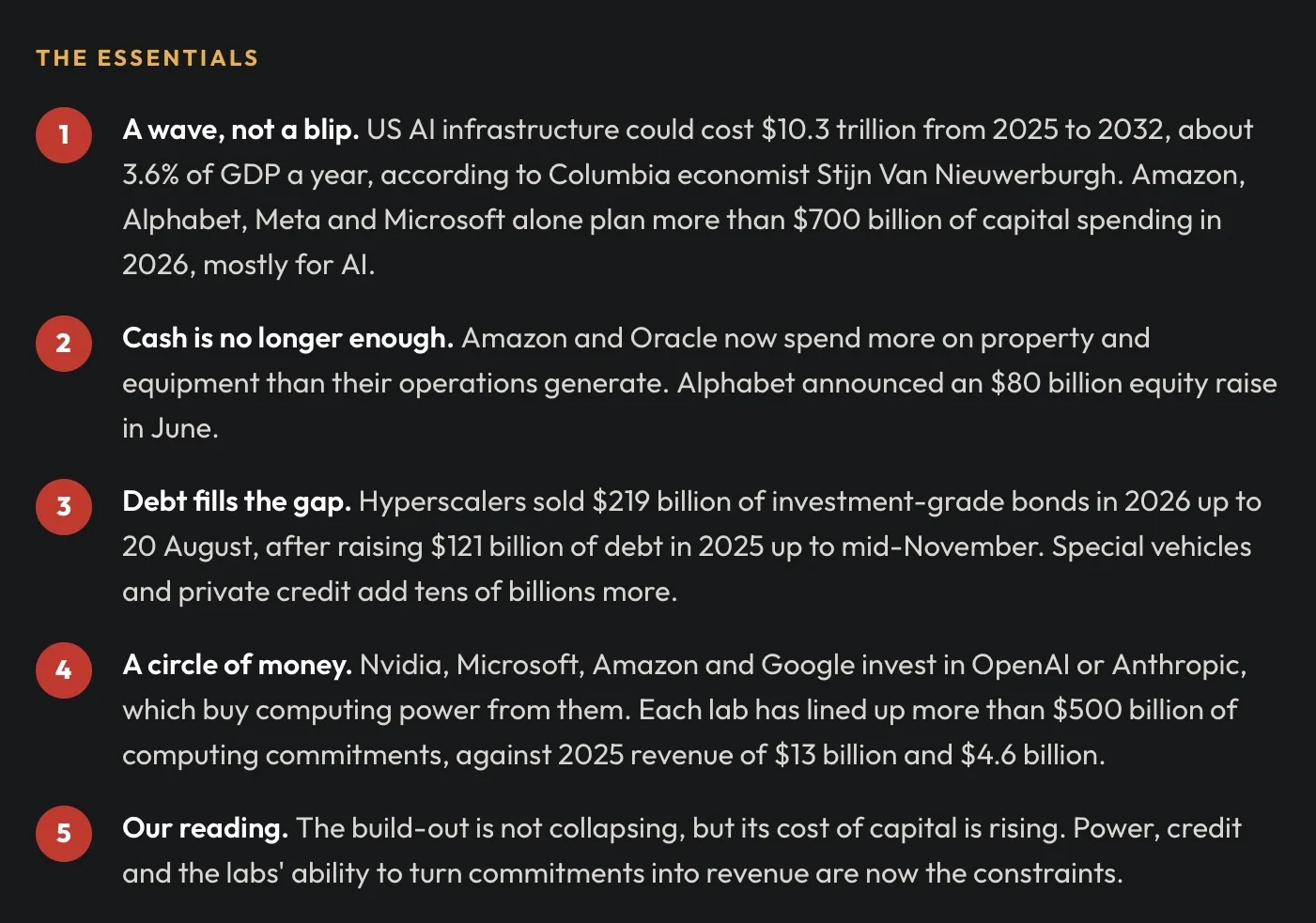
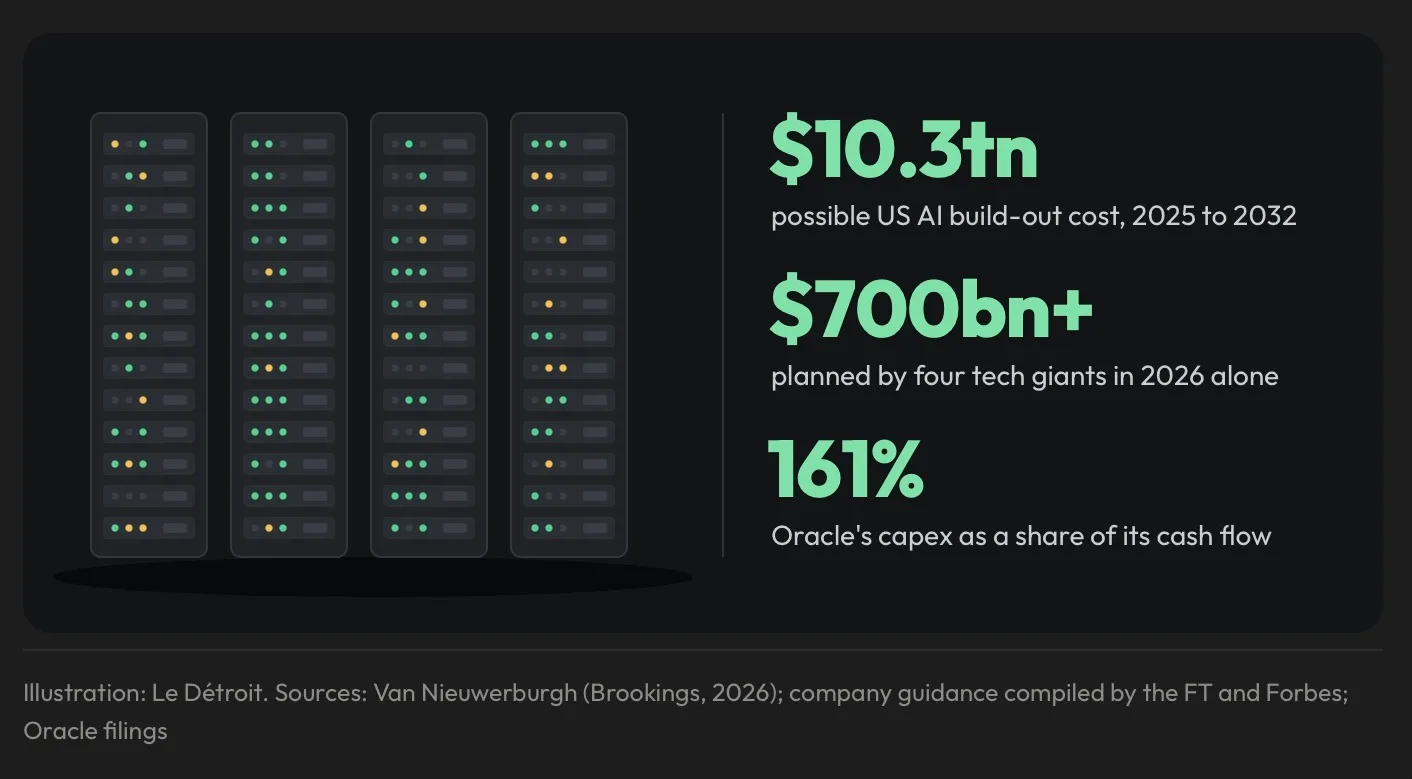
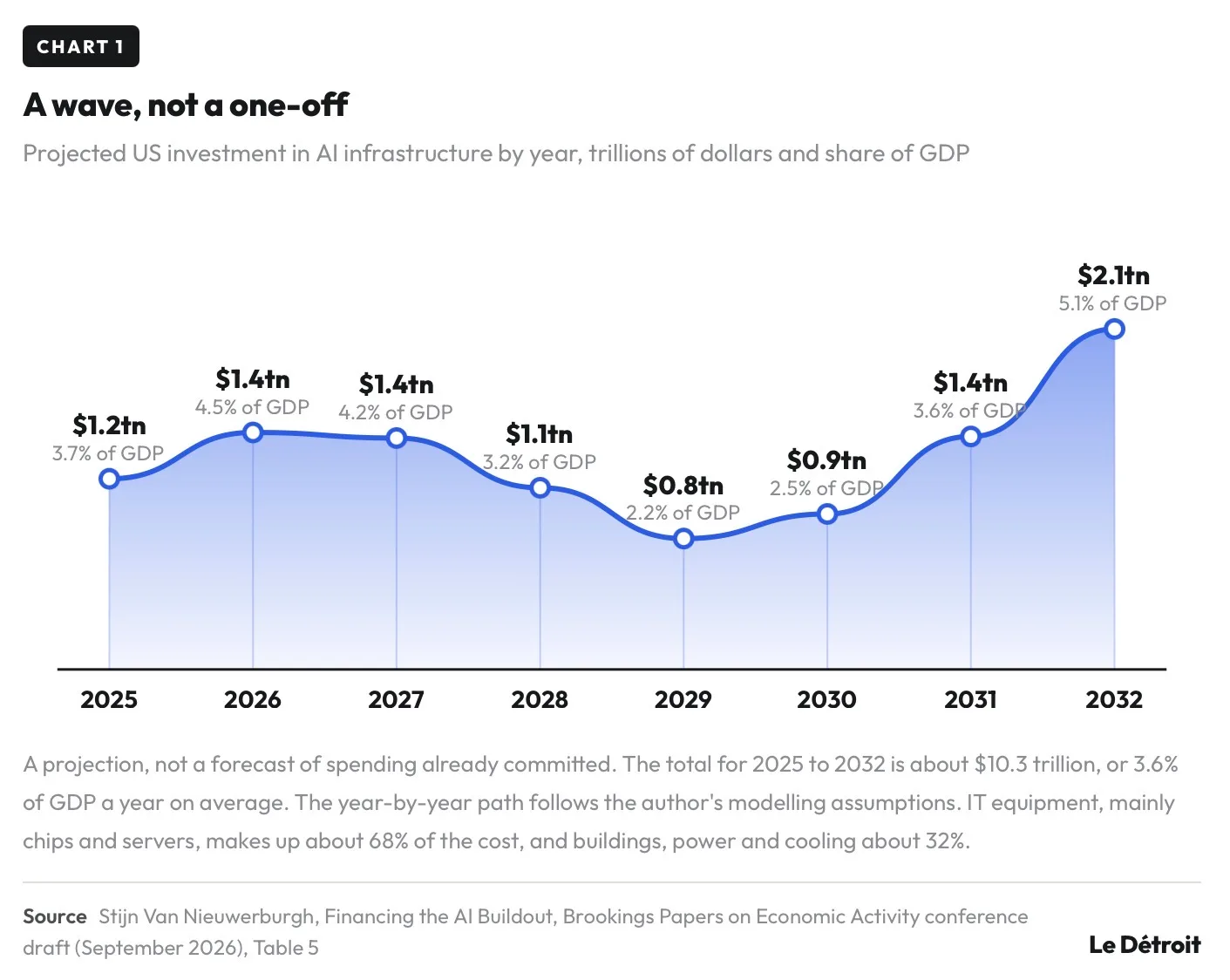
Building the infrastructure for artificial intelligence, from data centres to chips, power and cooling, could cost the United States about $10.3 trillion between 2025 and 2032, according to Columbia Business School economist Stijn Van Nieuwerburgh. That is about 3.6% of GDP a year, more than the railway boom of 1870 to 1890. His projection is not a smooth line: it reaches about $1.4 trillion a year in 2026 and 2027, dips to $0.8 trillion in 2029, then climbs to $2.1 trillion in 2032.
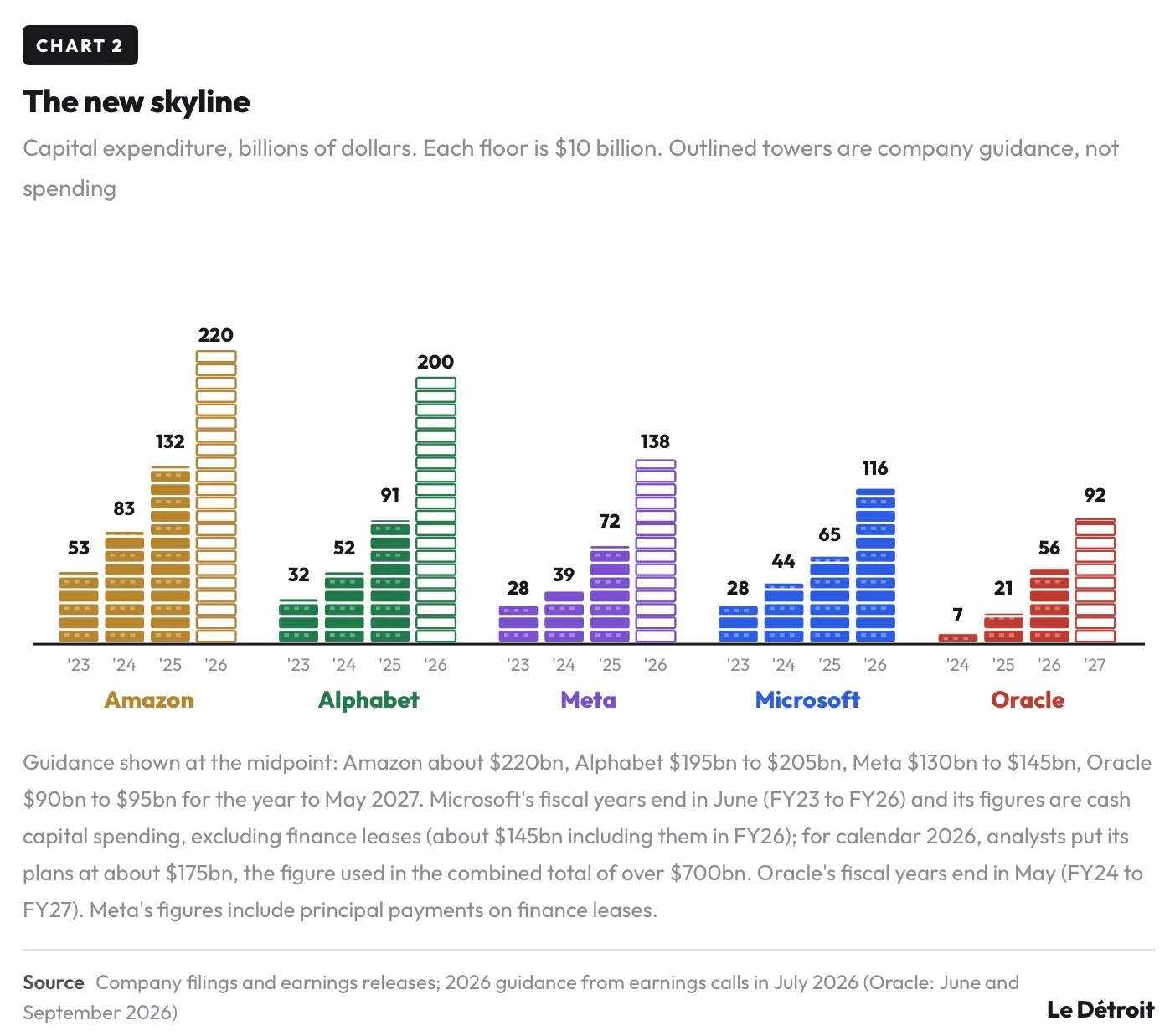
The spending is already visible in company accounts. Amazon expects about $220 billion of capital expenditure this year, Alphabet $195 billion to $205 billion and Meta $130 billion to $145 billion. Microsoft spent $115.9 billion in cash in the year to June, or about $145 billion including finance leases. Oracle, a latecomer, plans $90 billion to $95 billion in the year to May 2027, against $6.9 billion three years earlier. Together, Amazon, Alphabet, Meta and Microsoft plan to spend over $700 billion in 2026, according to figures compiled by the Financial Times and Forbes.
2. The cash test
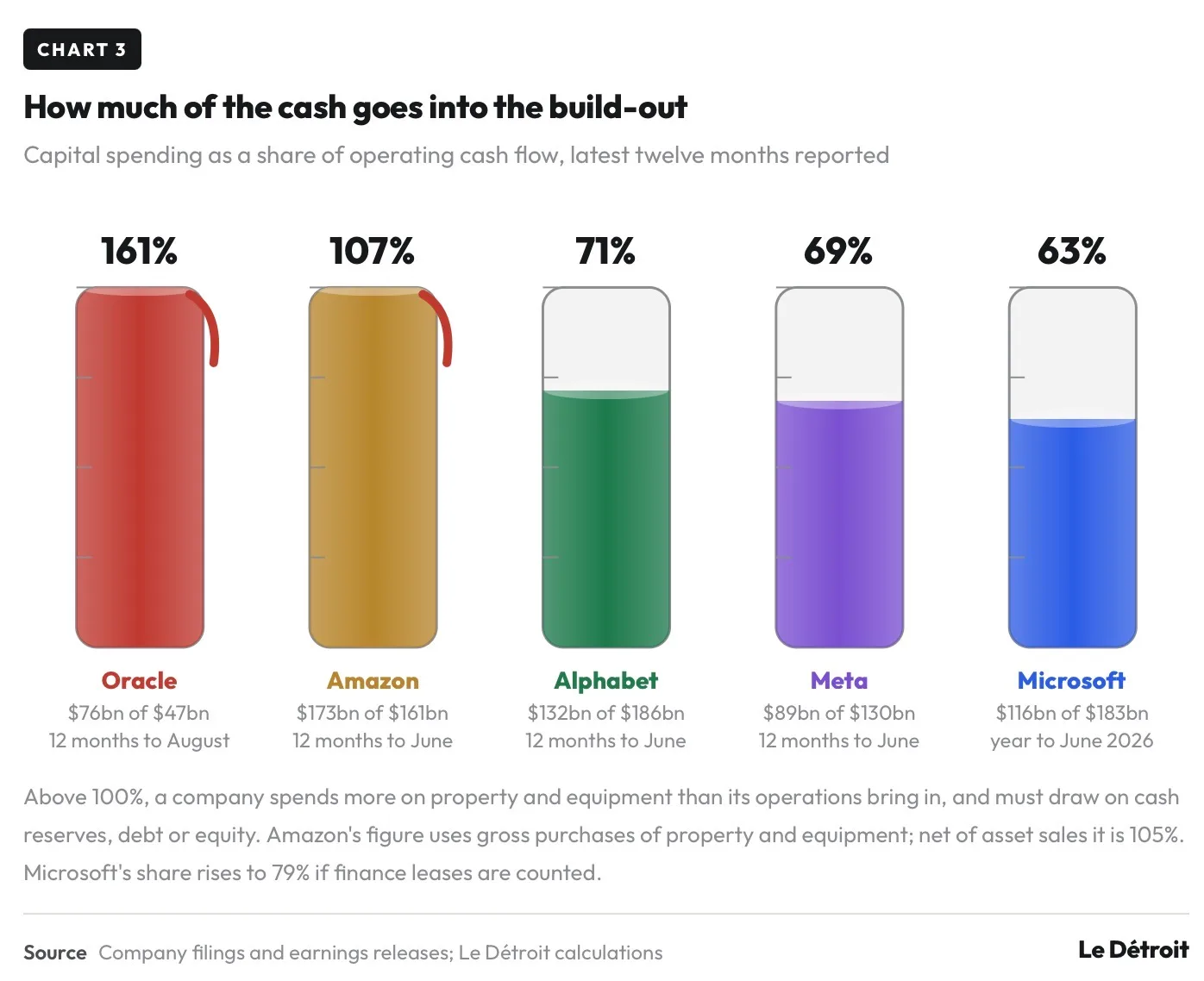
For years the largest tech groups paid for their data centres out of their own pockets. That is changing. Over the latest twelve months reported, Amazon spent 107% of its operating cash flow on property and equipment, and its free cash flow turned negative, at minus $7.6 billion on the company's own measure. Oracle spent 161%, with negative free cash flow of $28.7 billion. Alphabet, Meta and Microsoft still pay their way, but capital spending absorbs between 63% and 71% of their operating cash.
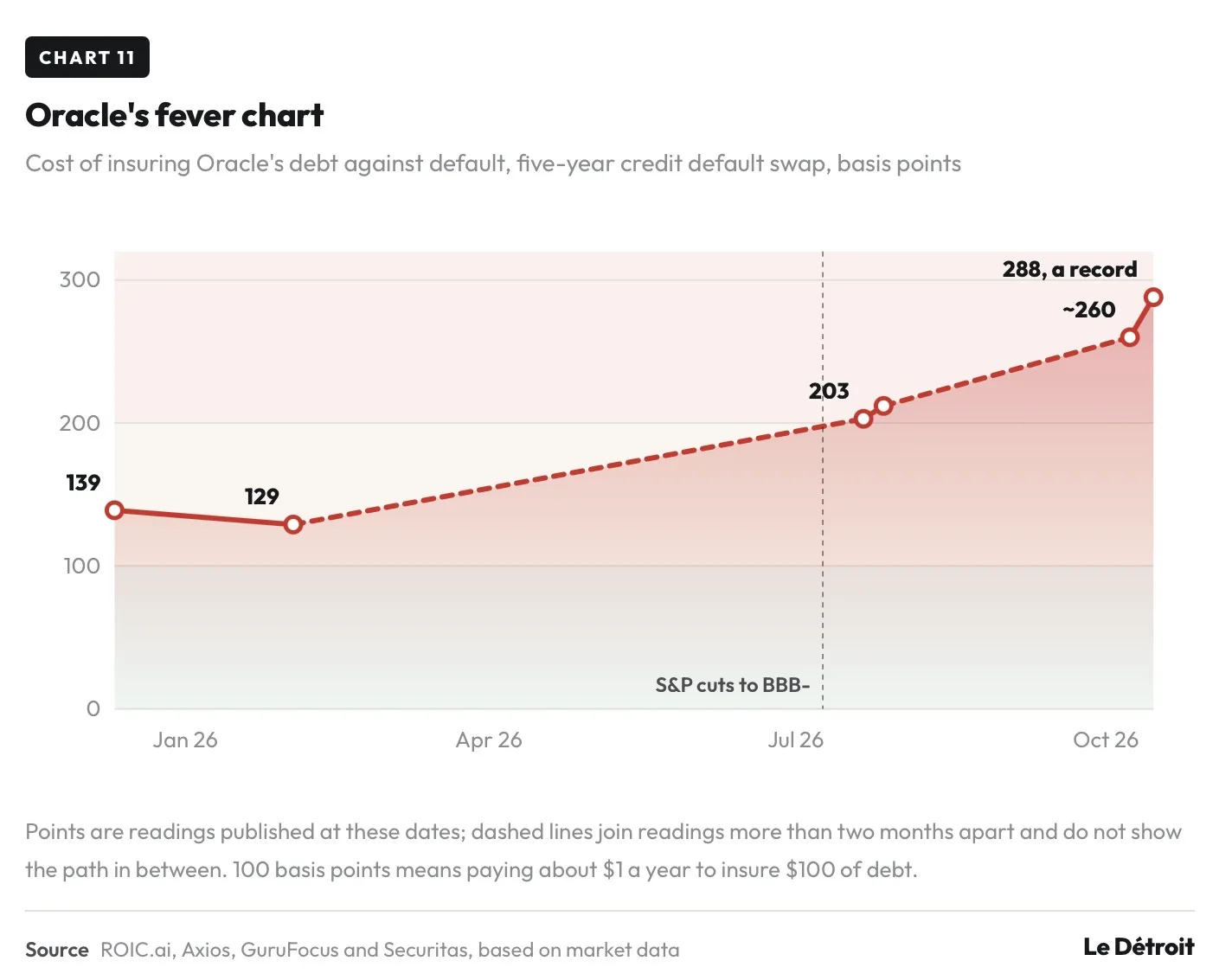
Even the richest are raising money. Alphabet announced an $80 billion equity raise on 1 June, including $10 billion from Berkshire Hathaway, on top of large bond sales. S&P cut Oracle's rating to BBB-, one notch above junk, on 9 July, and expects a free operating cash flow deficit of about $42 billion in its next fiscal year. Microsoft says its spending plans are unchanged, but a new classification of some leases means analysts now put its 2026 capital spending at about $175 billion rather than $190 billion.
3. The bond market picks up the bill
In July 2025 Morgan Stanley estimated that $2.9 trillion of data centre spending between 2025 and 2028 would require about $1.5 trillion of outside financing, with private credit expected to provide the largest share. Reality has run ahead of the plan on one front: big tech's bond sales.
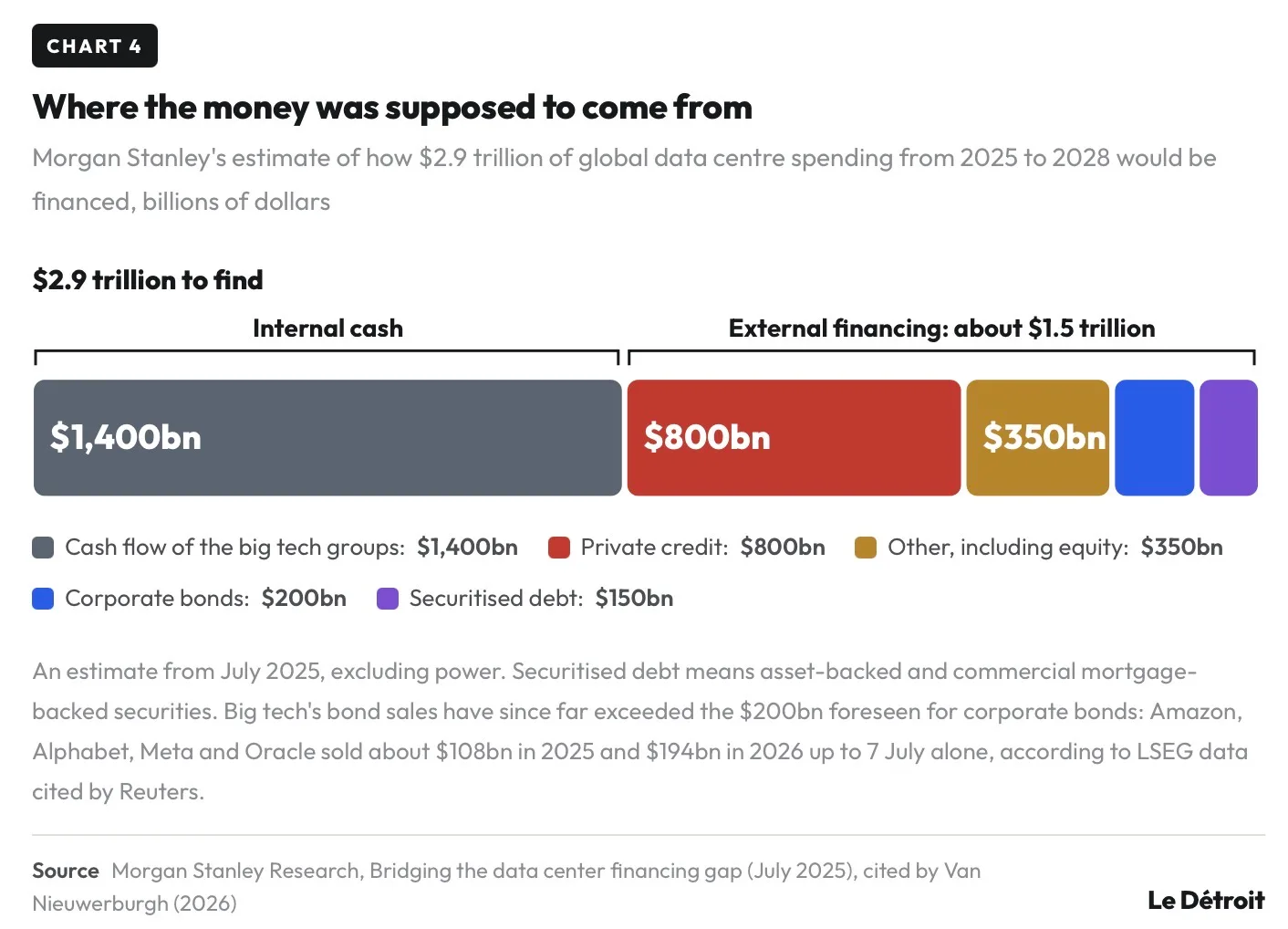
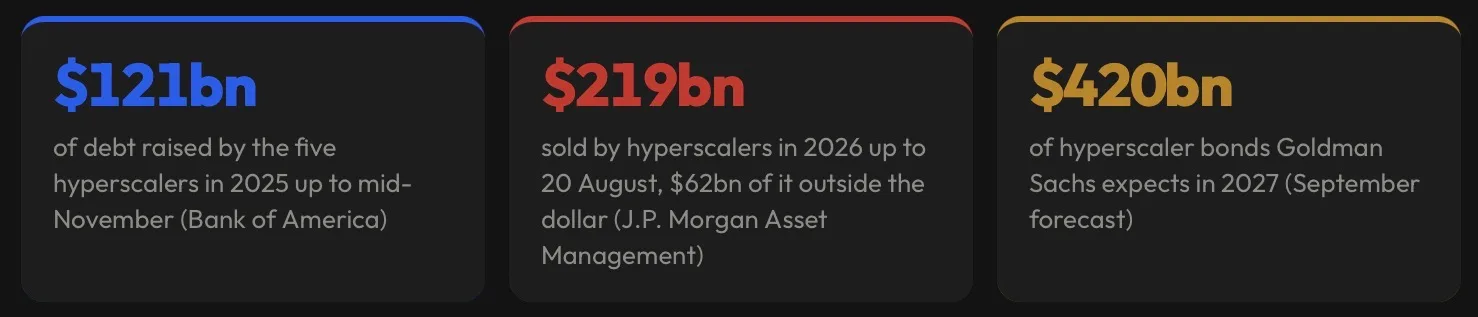
The five hyperscalers raised $121 billion of debt in 2025 up to mid-November, according to Bank of America, and sold $219 billion of investment-grade bonds in 2026 up to 20 August, according to J.P. Morgan Asset Management. Amazon's $53.8 billion deal in March, in dollars and euros, was the largest corporate bond sale on record, according to IFR. Goldman Sachs expects hyperscaler bond issuance of about $420 billion in 2027.
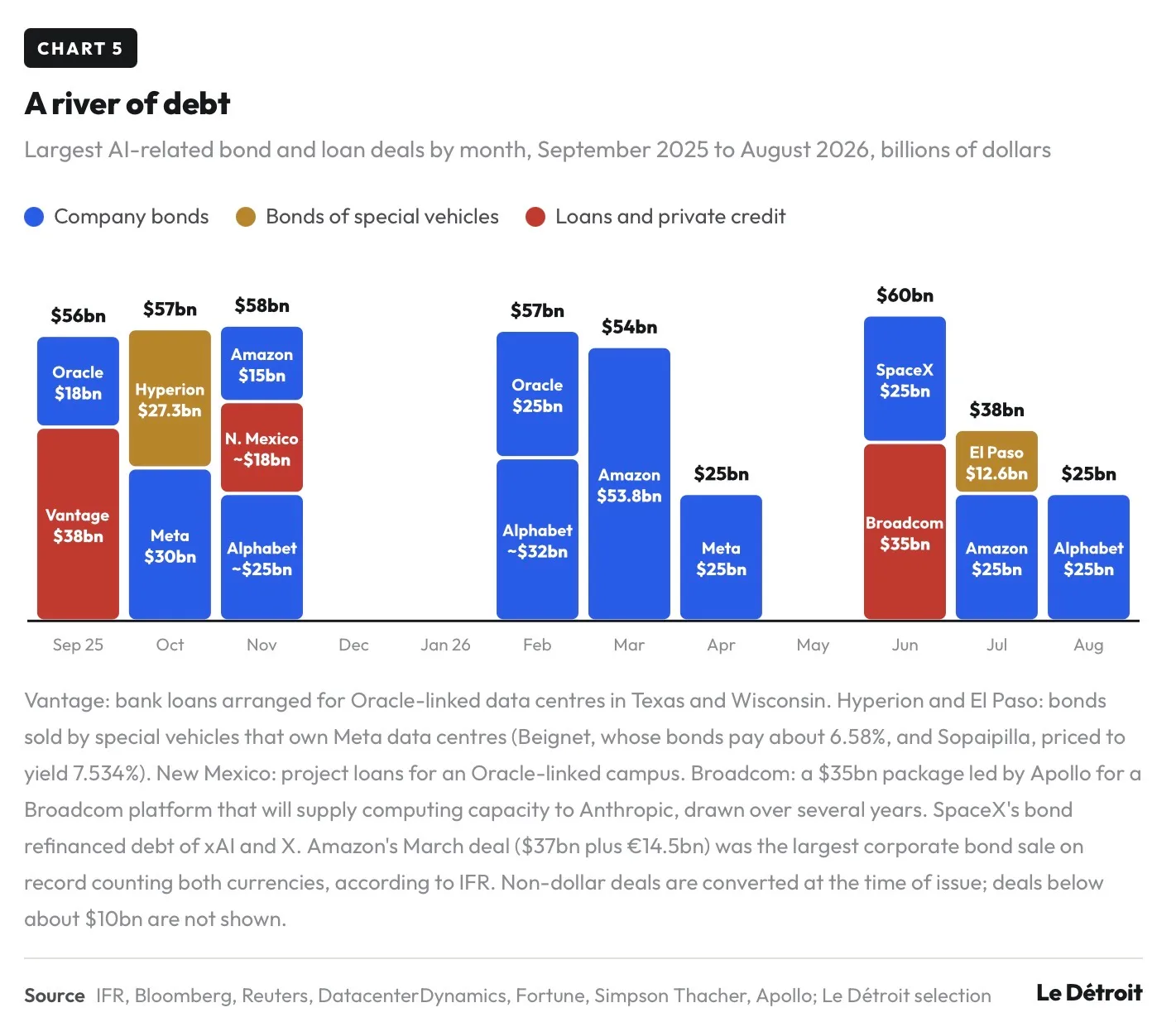
A growing share sits off balance sheets. Meta's Hyperion campus in Louisiana is owned 80% by funds managed by Blue Owl, through a vehicle called Beignet that sold $27.3 billion of bonds. A second vehicle, Sopaipilla, backed by BlackRock and linked to Meta's El Paso site, had to offer a yield of 7.534% in July, a yield closer to junk bonds than to Meta's own debt. Moody's counts about $970 billion of lease commitments at the hyperscalers, $660 billion of which has not yet reached their balance sheets, Van Nieuwerburgh notes. Investors are charging more: median spreads on the bonds of Amazon, Alphabet, Meta and Oracle maturing in five to seven years widened from about 50 to about 60 basis points between 2025 and 2026, according to LSEG data cited by Reuters.
4. A circle of money
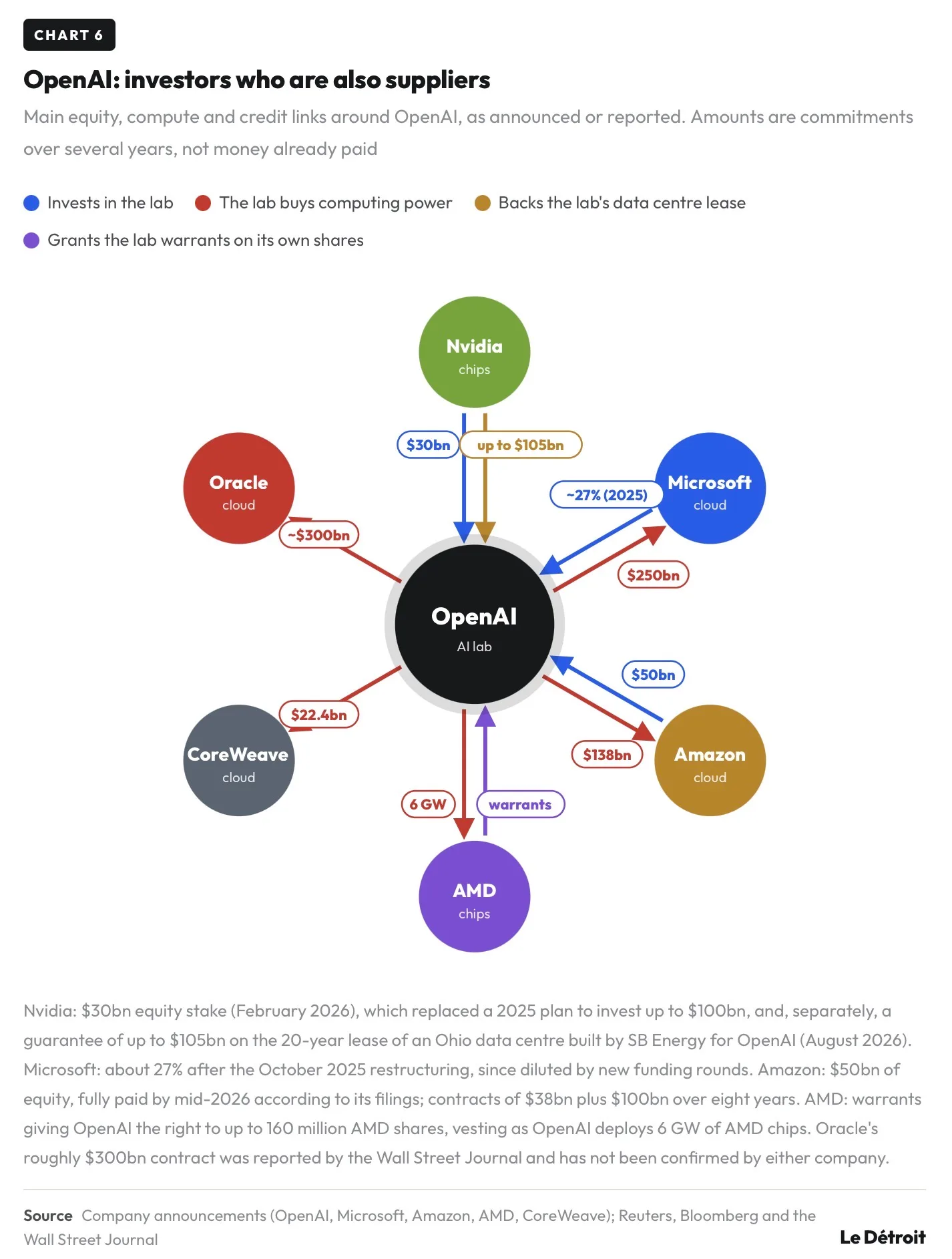
The AI labs at the centre of the boom are both customers and investees of their suppliers. OpenAI received a $30 billion equity investment from Nvidia in February and $50 billion from Amazon, fully paid by mid-2026, while committing $250 billion to Microsoft's cloud and about $138 billion to Amazon's. The Nvidia stake replaced a 2025 plan to invest up to $100 billion. Separately, in August, Nvidia agreed to guarantee up to $105 billion of the lease on an Ohio data centre built for OpenAI by SoftBank's SB Energy.
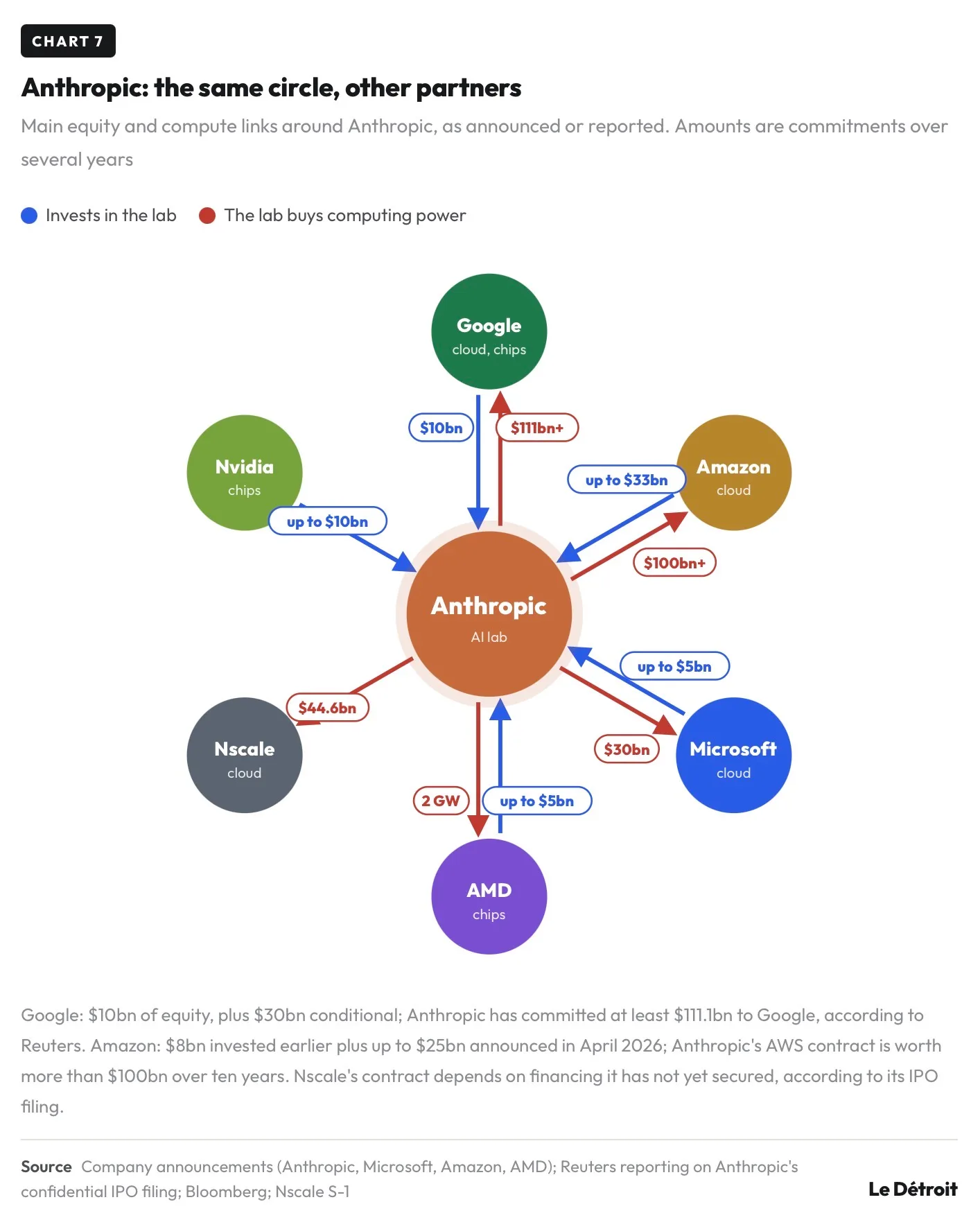
Anthropic shows the same pattern with other partners. Google has committed $10 billion of equity, with $30 billion more conditional, while Anthropic has committed at least $111 billion to Google, according to Reuters. Amazon and Microsoft are both investors and cloud suppliers, and AMD plans to invest up to $5 billion in Anthropic, which will deploy its chips.
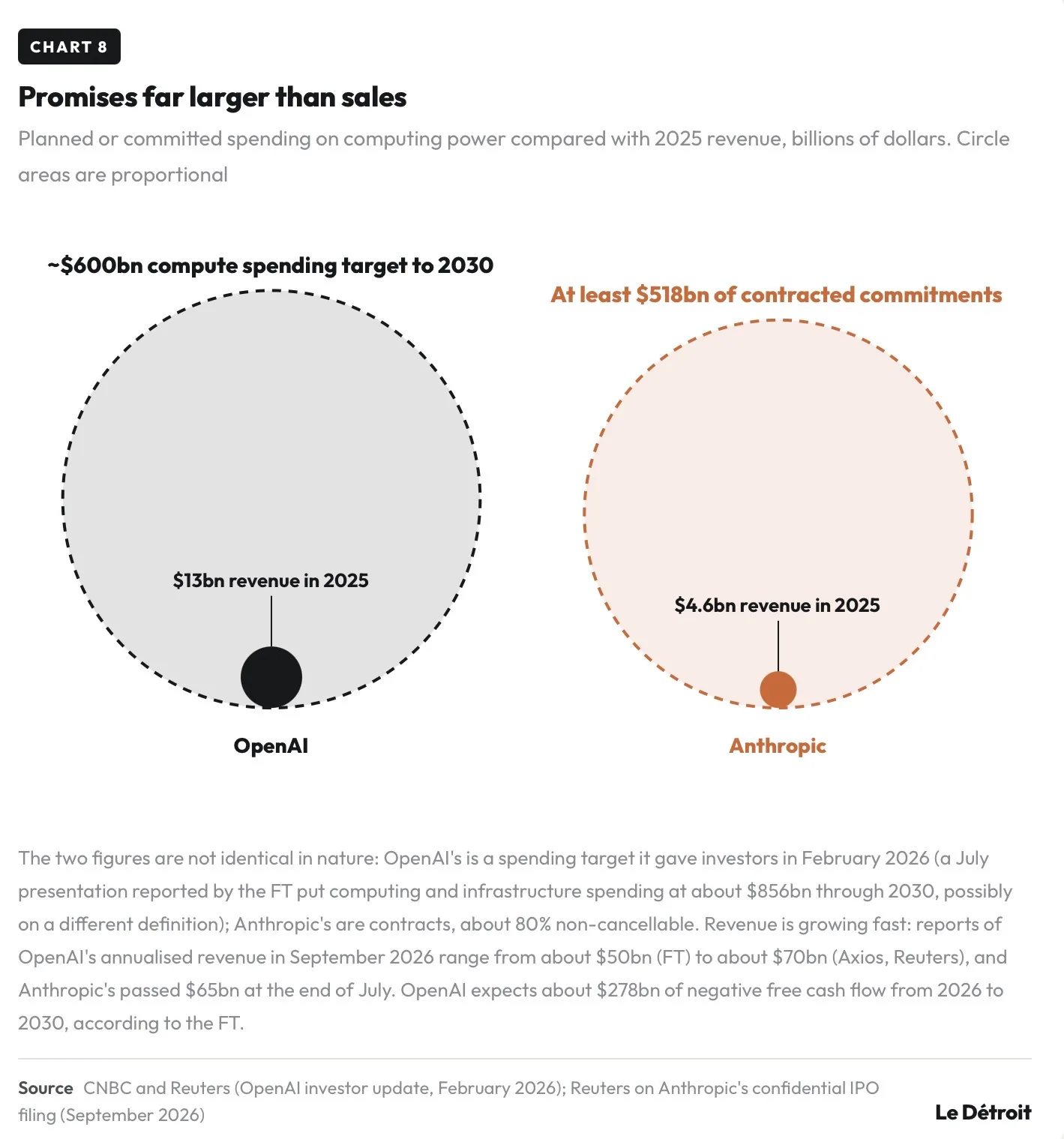
The question is whether revenue can catch up with the promises. OpenAI told investors in February it expected to spend about $600 billion on computing power by 2030, after revenue of about $13 billion in 2025; a July presentation reported by the FT put the figure at about $856 billion, possibly on a different definition. Anthropic has at least $518 billionof compute commitments, about 80% of them non-cancellable, after $4.6 billion of revenue in 2025, according to Reuters reporting on its confidential IPO filing. Both are growing fast: Anthropic's annualised revenue passed $65 billion at the end of July.
5. The power bill
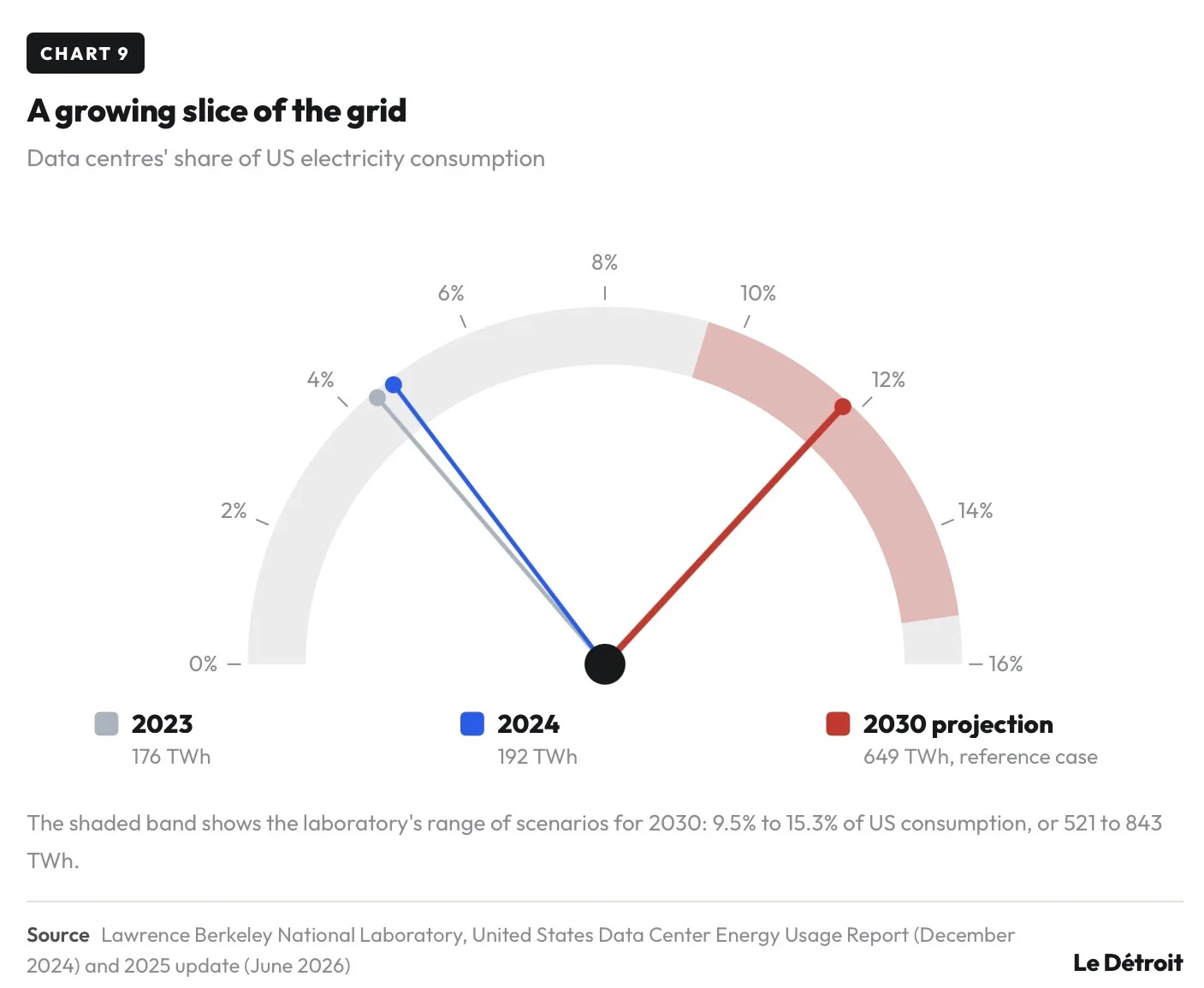
Data centres used 4.7% of US electricity in 2024, according to the Lawrence Berkeley National Laboratory. In its central scenario, the share reaches 11.8% by 2030, and up to 15.3% in its high case.
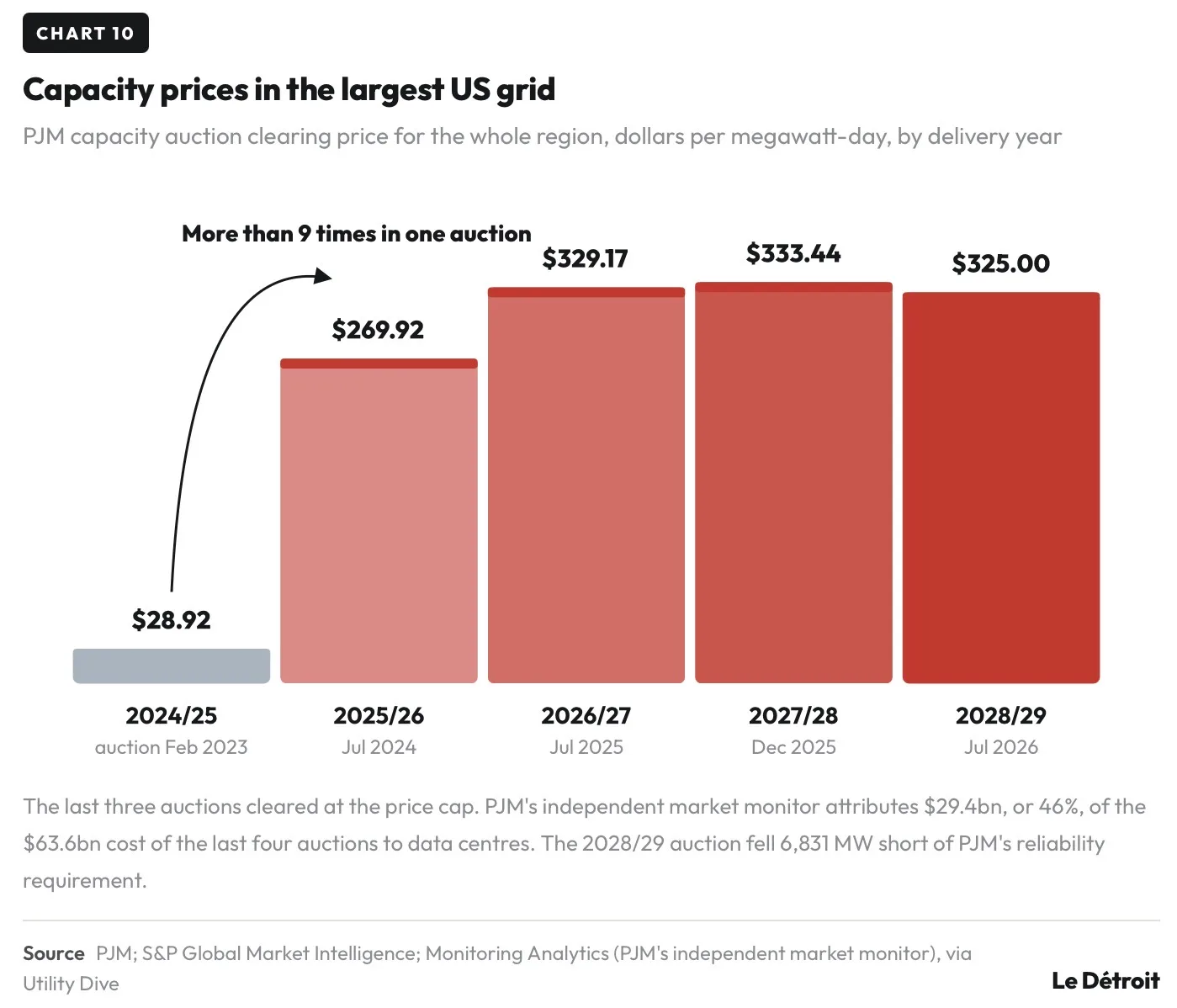
Households are already paying part of the bill. In PJM, the grid that serves 13 states from Illinois to New Jersey plus Washington DC, the price of capacity, which pays power plants to be available at peak times, jumped from $28.92 per megawatt-day to $269.92 in one auction, then hit the regulated cap three times in a row. PJM's independent market monitor attributes $29.4 billion of the $63.6 billion cost of the last four auctions to data centres.
6. The first cracks
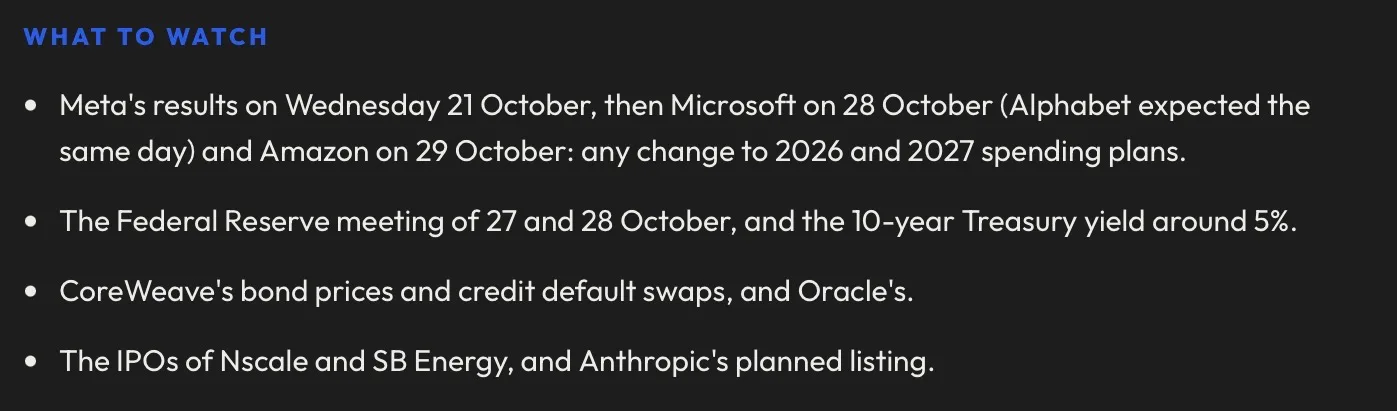
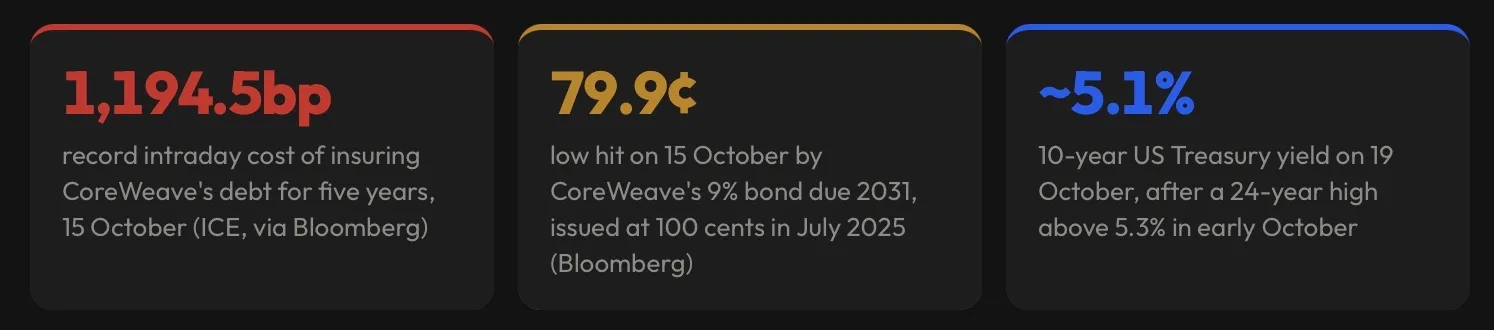
The stress shows first where balance sheets are weakest. The cost of insuring Oracle's debt for five years doubled in ten months, from 139 basis points in December to a record 288 on 15 October. CoreWeave, which rents out Nvidia chips and owes about $35 billion of debt, or about $52 billion including leases, saw its shares fall about a quarter last week and one of its 2031 bonds trade as low as 79.9 cents on the dollar. Meanwhile the 10-year Treasury yield, the anchor for all this borrowing, touched a 24-year high above 5.3% in early October.
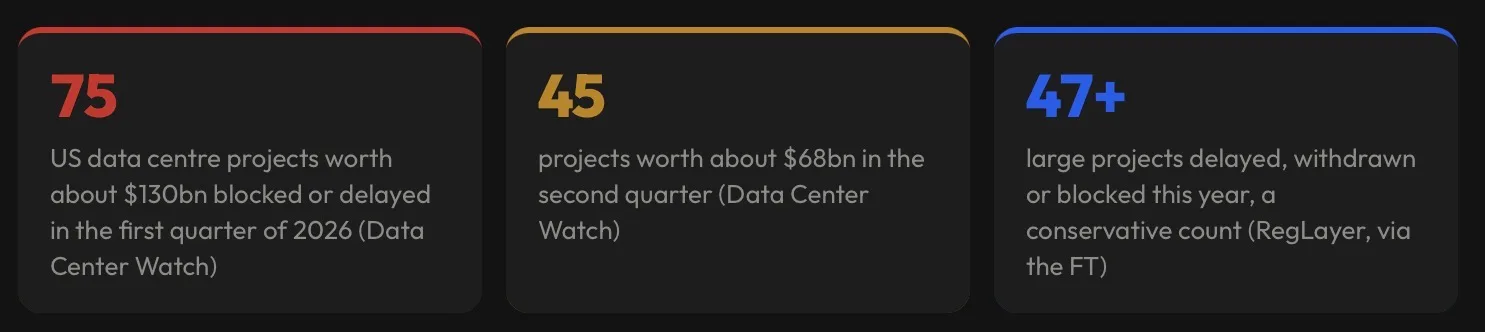
On the ground, local resistance is slowing projects. Data Center Watch counted at least 75 US projects worth about $130 billion blocked or delayed in the first quarter of 2026, and 45 worth about $68 billion in the second; some appear in both counts. RegLayer counts at least 47 large projects delayed, withdrawn or blocked this year, according to the Financial Times.
7. Le Détroit's reading
The AI build-out is not collapsing. Demand for computing power is real, and Alphabet, Meta and Microsoft can still fund most of their plans from cash. But the financing has changed in nature in less than two years: from cash to bonds, from balance sheets to special vehicles and, in our view, from arm's-length sales towards deals in which suppliers help finance their own customers.
That structure works while money is cheap and revenue keeps growing. Three things could break it: long-term rates staying above 5%, power and local permits slowing projects, and AI labs failing to turn commitments into revenue fast enough. The weakest links, Oracle, CoreWeave and the special vehicles, are already being priced as risks. For the giants, the next test comes in the coming days, when Meta, Microsoft, Alphabet and Amazon report results and update their spending plans.