1. Four at the gate
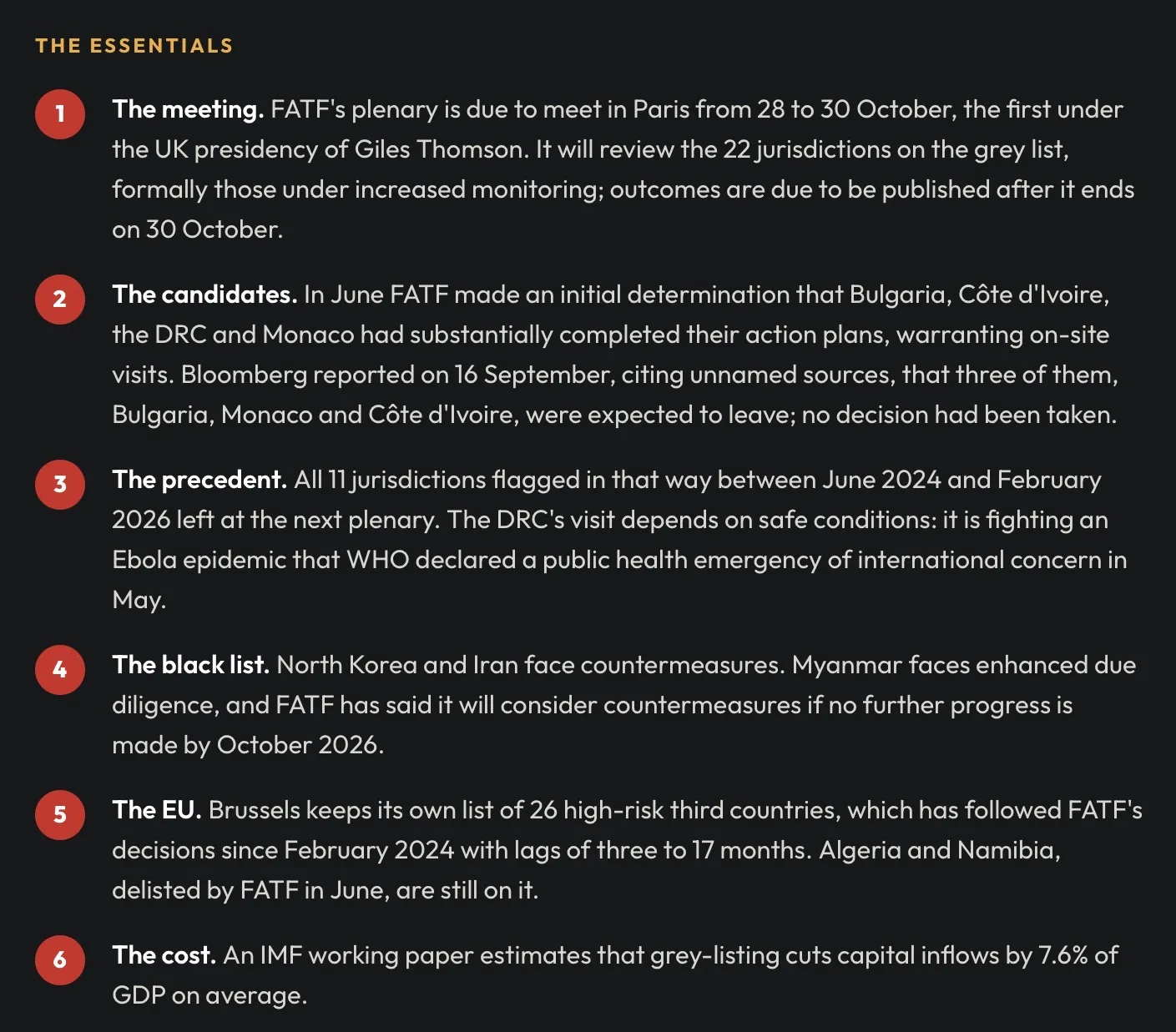
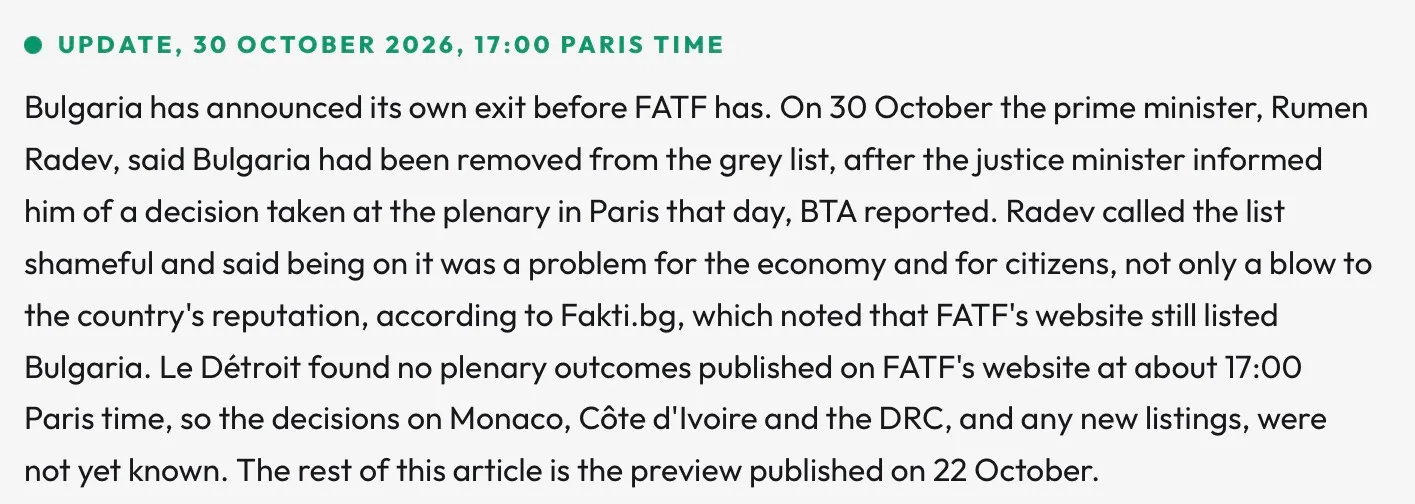
FATF Week opens in Paris on 26 October, and the plenary that closes it, scheduled for 28 to 30 October, is the first under the UK presidency of Giles Thomson. Delegates from FATF's global network of more than 200 jurisdictions and observer organisations will review the 22 jurisdictions under increased monitoring, the list usually called the grey list. Outcomes are due to be published after the meeting ends on 30 October, and FATF has scheduled a virtual press conference for 17:00 that day; its notice gives the time as CEST, although European summer time ends on 25 October.
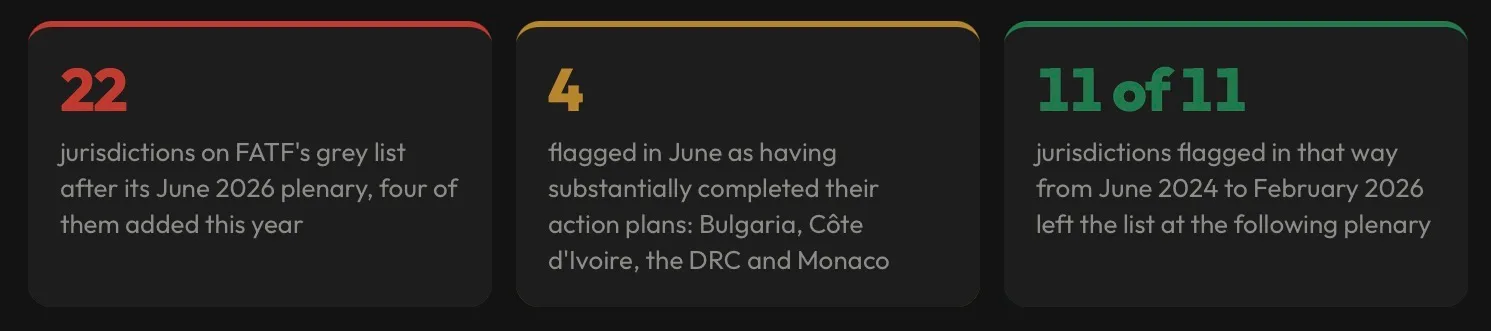
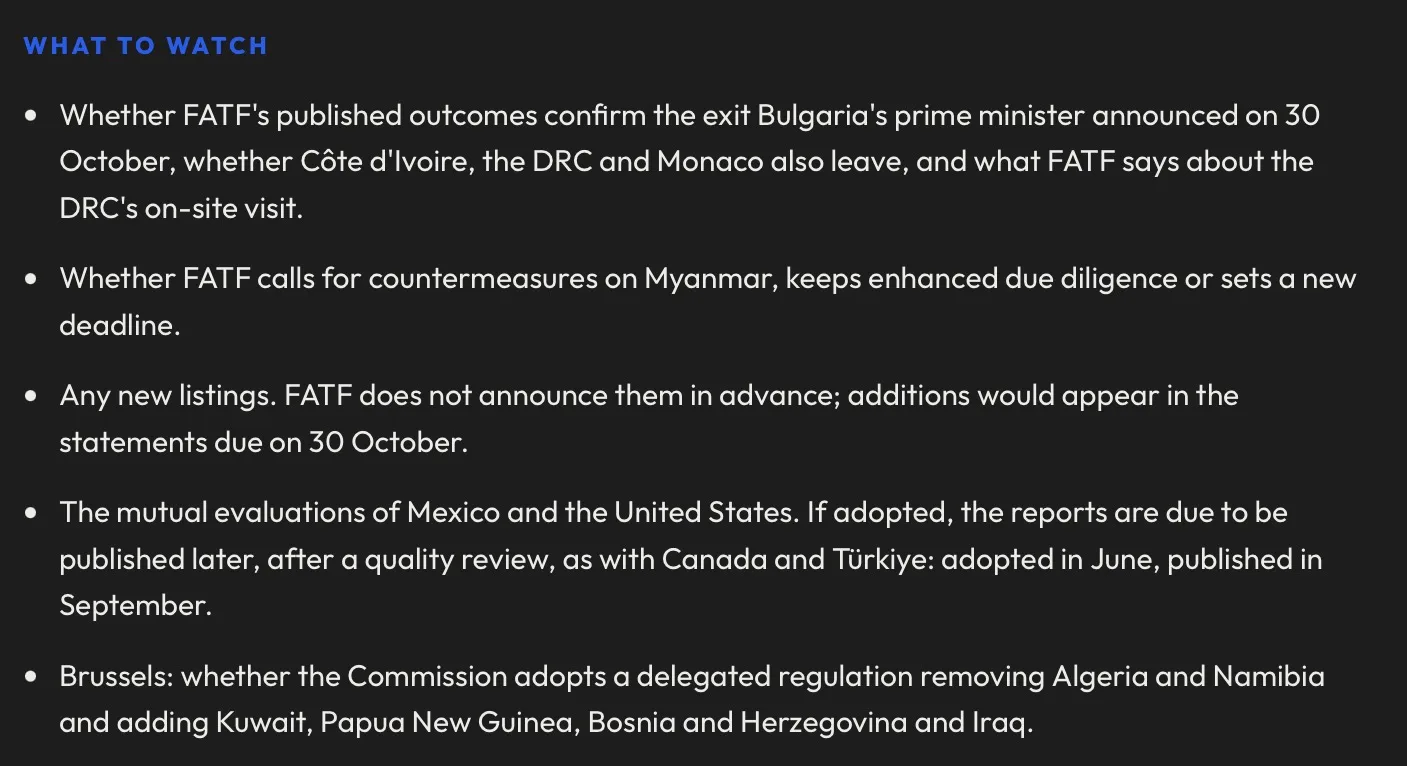
Four of the 22 arrive with FATF's strongest signal. In June it made "the initial determination" that Bulgaria, Côte d'Ivoire, the Democratic Republic of the Congo and Monaco had each substantially completed its action plan and warranted an on-site assessment "to verify that the implementation of AML/CFT reforms has begun and is being sustained". On 16 September Bloomberg reported, citing sources familiar with the discussions, that Monaco, Bulgaria and Côte d'Ivoire were expected to leave, according to BTA, Bulgaria's national news agency, which noted that no decision had been reached. A FATF spokesperson declined to comment, according to an unsigned report on the same story carried by The Edge Malaysia that day.
The black list, formally the high-risk jurisdictions subject to a call for action, faces a harder test. It still names North Korea, Iran and Myanmar. Myanmar is subject only to enhanced due diligence, but in June FATF warned: "If no further progress is made by October 2026, the FATF will consider countermeasures." Those are the strongest measures it has, so far reserved for the other two.
2. How a jurisdiction gets off the list
A jurisdiction usually reaches the grey list through a mutual evaluation that finds strategic deficiencies in its defences against money laundering, terrorist financing and the financing of weapons proliferation. It then has a one-year observation period to work with FATF or its regional body, a process overseen by FATF's International Co-operation Review Group (ICRG). If gaps remain, it agrees an action plan, makes a "high-level political commitment" to complete it, and is publicly listed.
Leaving takes three steps. FATF says a jurisdiction "must address all or nearly all the components of its action plan". FATF then organises an on-site visit to confirm that implementation is under way, and decides on removal "at the next FATF plenary". After that the jurisdiction keeps working with its regional body, as FATF has told Algeria and Namibia to do with MENAFATF and ESAAMLG.
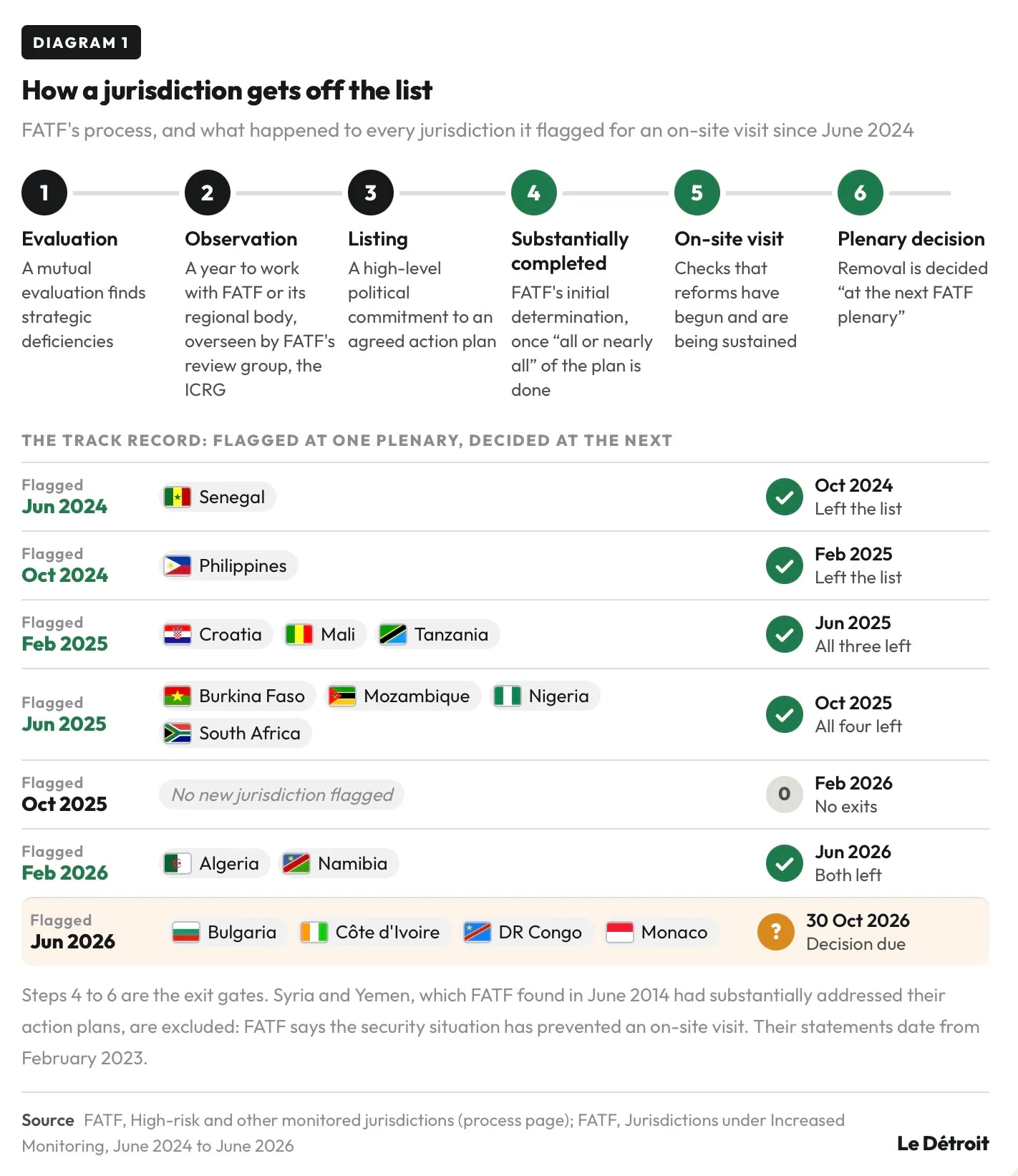
The recent record is unbroken. FATF flagged 11 jurisdictions for an on-site visit at its plenaries from June 2024 to February 2026, and all 11 left at the following plenary; when it flagged none, in October 2025, no one left in February 2026. The exceptions show where the mechanism can jam: FATF determined in June 2014 that Syria and Yemen, both listed since February 2010, had substantially addressed their action plans, but it has been "unable to conduct an on-site visit" because of the security situation.
3. The four candidates
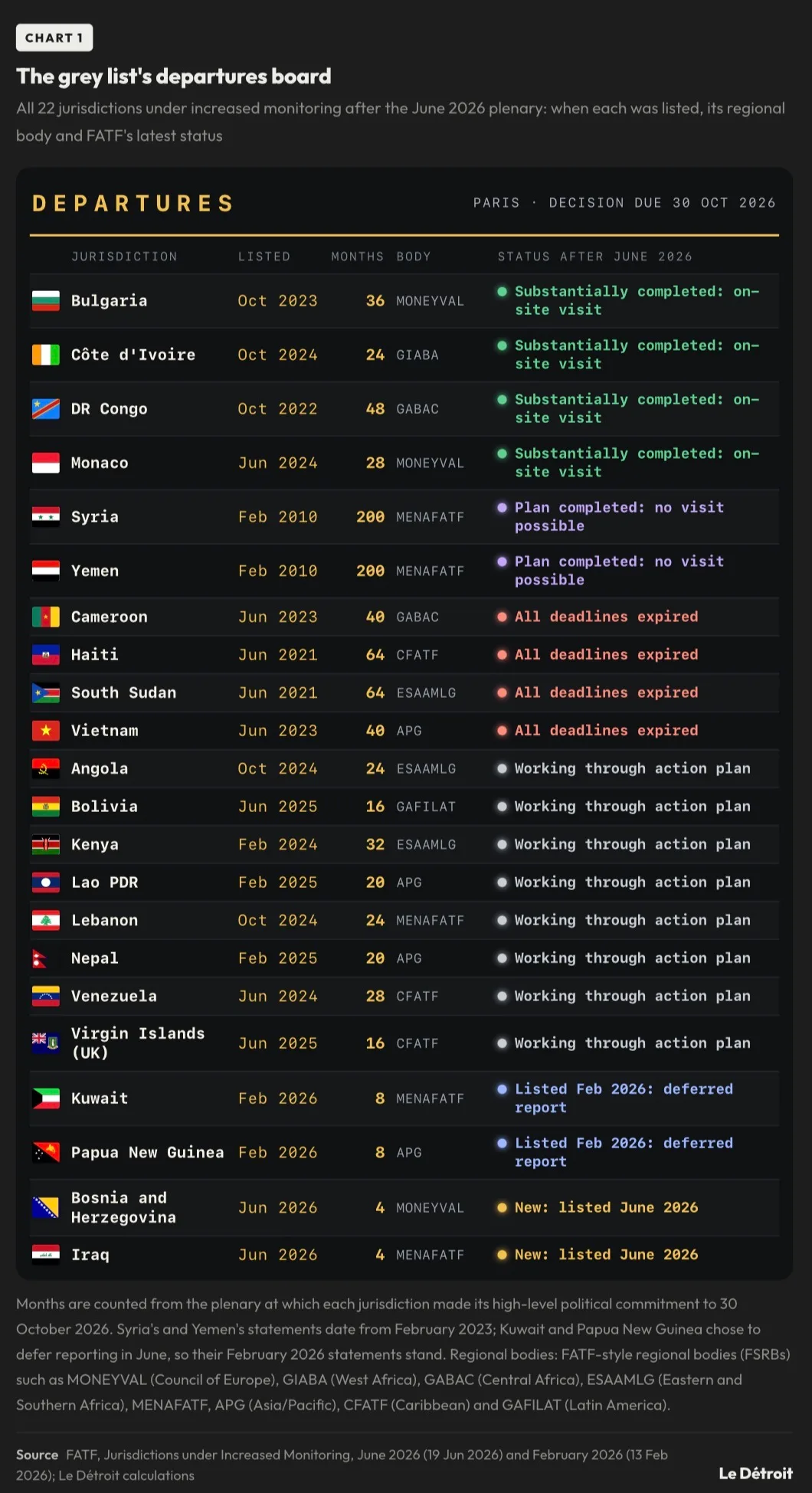
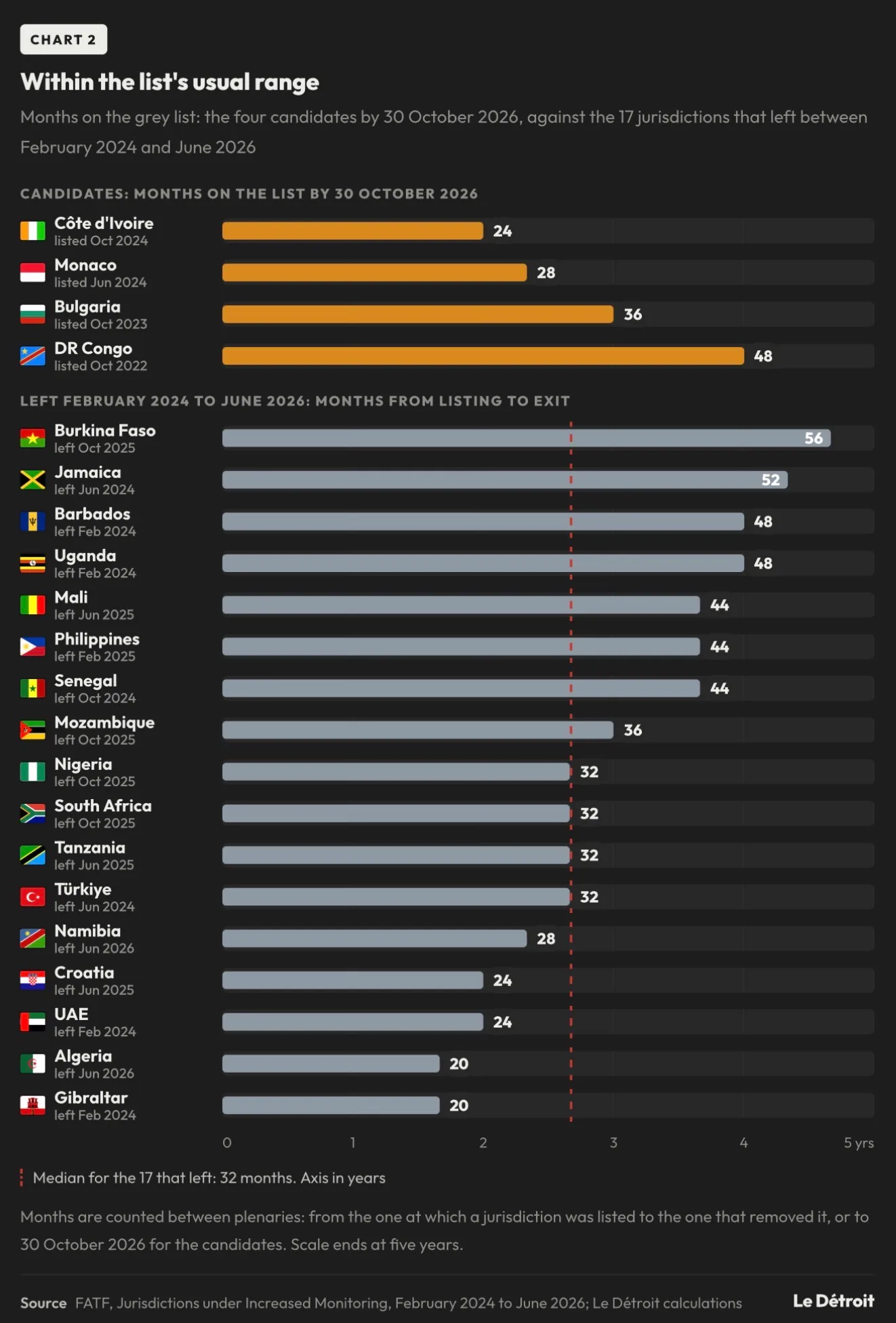
None of the four would set a record for speed or slowness. The 17 jurisdictions that left between February 2024 and June 2026 spent a median of 32 months on the list, from 20 months for Gibraltar and Algeria to 56 for Burkina Faso. By 30 October Côte d'Ivoire will have been listed for 24 months, Monaco for 28, Bulgaria for 36 and the DRC for 48.
Bulgaria, listed in October 2023, is the only EU member state on the list. MONEYVAL, the Council of Europe's evaluation body, said on 17 June that Bulgaria now rates as compliant with 13 of FATF's 40 Recommendations and largely compliant with the other 27, BTA reported. The justice ministry said in June that "one final on-site assessment remained to confirm that the reforms implemented were irreversible". On 4 September BTA reported that the prime minister, Rumen Radev, had met representatives of a joint group of FATF and MONEYVAL to discuss the country's progress.
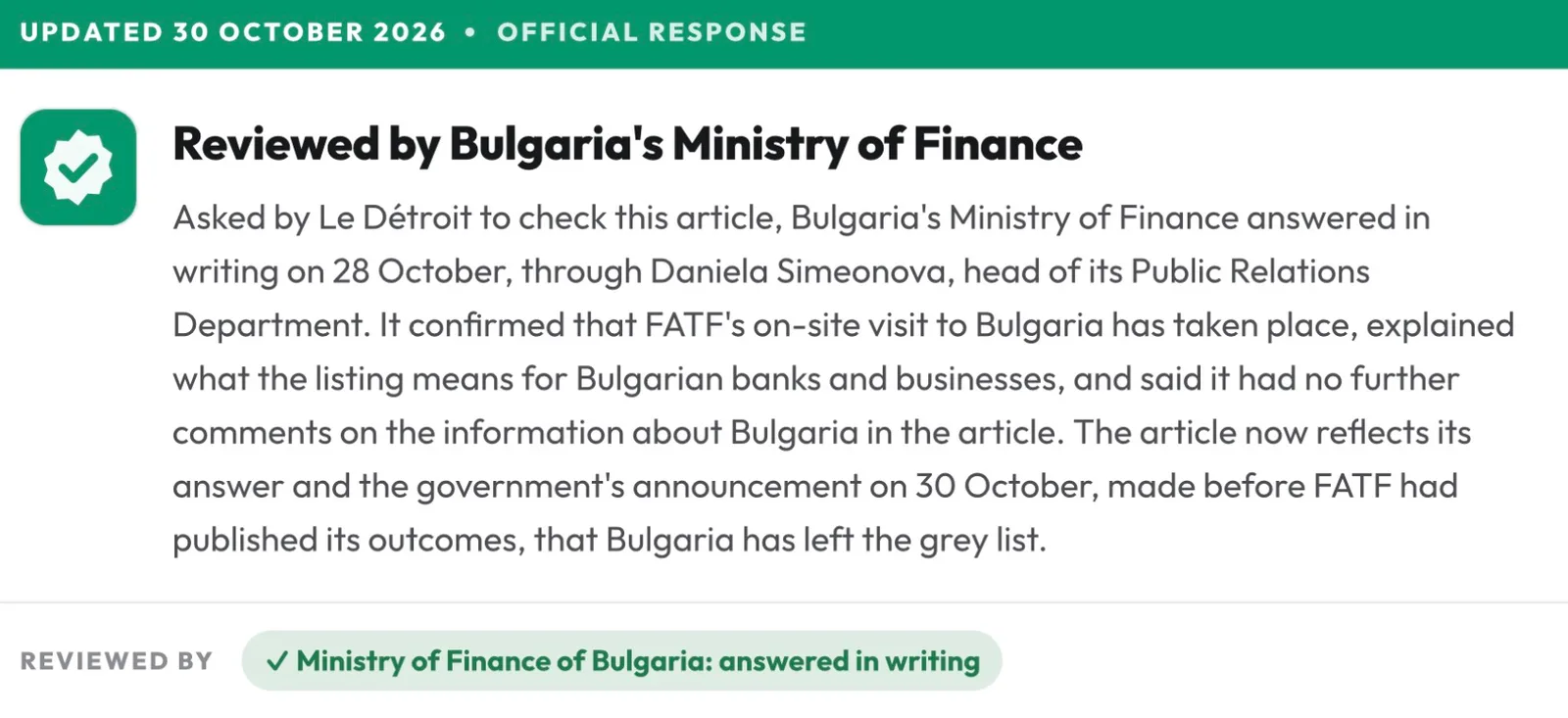
That assessment has now taken place. "Yes, the FATF on-site visit to the Republic of Bulgaria has taken place," Daniela Simeonova, head of the Public Relations Department at Bulgaria's Ministry of Finance, wrote on 28 October; the ministry gave no dates, saying FATF had not announced them, and said the results would be reviewed at the October plenary. More revealing is what it sees as the next task: much of the action plan changed laws and institutions, and initial practical implementation has been shown for a number of measures, so the focus will be on "deepening practical implementation and achieving measurable results". In the ministry's own framing, an exit would close the phase of writing laws and open the test of whether they work.
Monaco, listed in June 2024, was credited with six reforms, from a better understanding of the risks of money laundering and income tax fraud committed abroad to more seizures of property suspected of criminal origin. FATF also noted that it had completed a resourcing programme for its financial intelligence unit. A Monaco government spokesperson declined to comment on Bloomberg's report, according to The Edge Malaysia's version of the story.
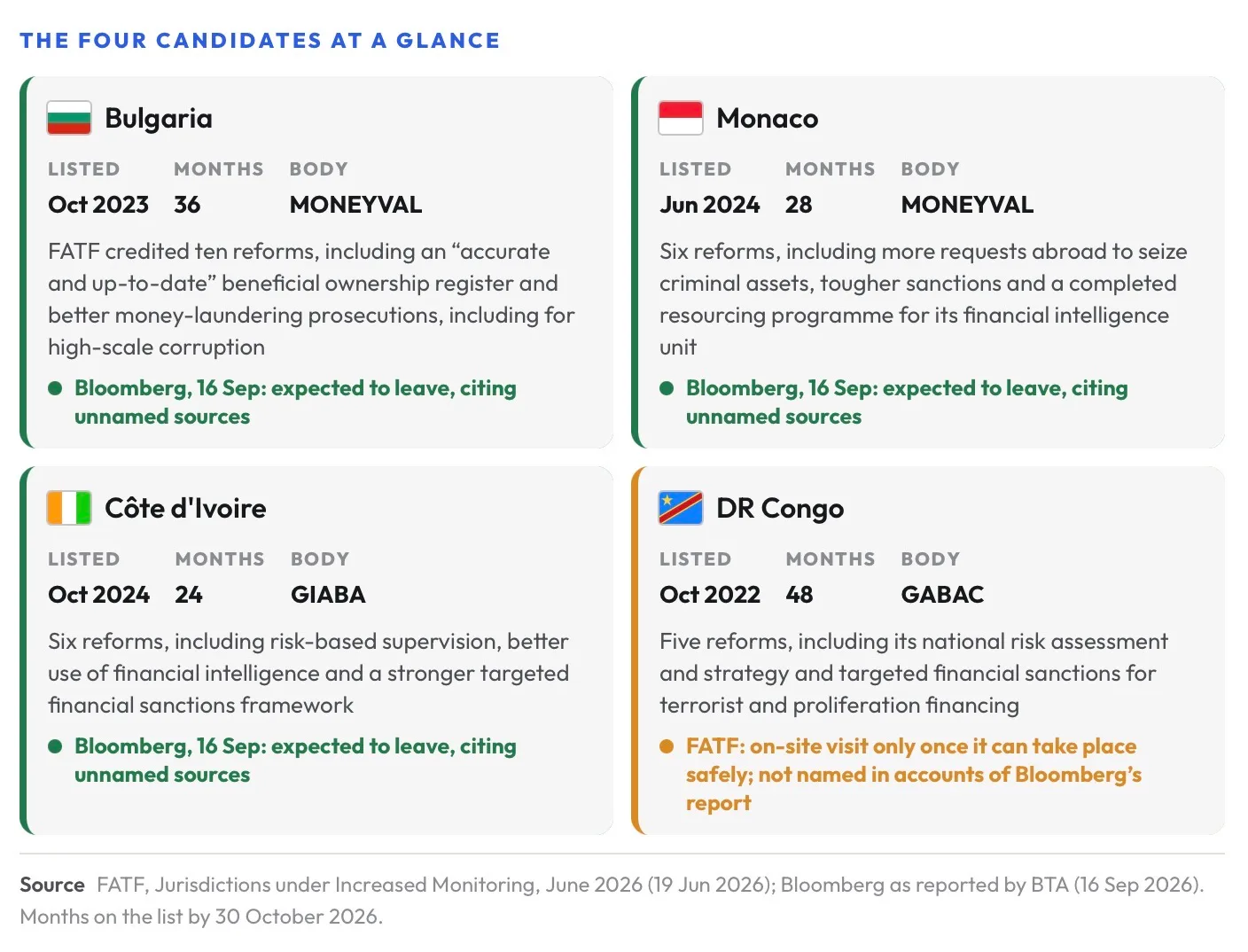
Côte d'Ivoire, listed in October 2024 and reviewed with GIABA, the West African body, was credited with more international co-operation in investigations, better access to beneficial ownership information and a sustained rise in money-laundering investigations and prosecutions. The government sounds confident: Amadou Coulibaly, the communication minister and government spokesman, said it was highly likely that the country had met all the conditions but that it was awaiting the final assessments, according to the report carried by The Edge Malaysia on 16 September. We found no second account of his remarks. An Ivorian commentator, Aboubacar Touré, had urged caution in Connection Ivoirienne on 29 June, writing that talk of an exit was premature and that the outcome depended on the on-site assessment.
The DRC, listed in October 2022, is the hardest case: FATF credited it with a national risk assessment and strategy, supervisors for all non-financial businesses and professions, and a properly resourced financial intelligence unit, but added: "Given the current public health situation in the DRC, the FATF will monitor developments to ensure any on-site assessment can take place under safe conditions." It did not name the problem, but an Ebola epidemic caused by the Bundibugyo virus has been spreading since it was first detected in May, with Ituri province as its epicentre, and on 17 May WHO's director-general declared it a public health emergency of international concern. By 6 October WHO had recorded 8,728 confirmed cases and 4,205 confirmed deaths in seven provinces, and said transmission remained intense. The accounts of Bloomberg's report on likely exits that we could read do not mention the DRC.
4. Who stays, and who has just arrived
For four jurisdictions FATF has signalled impatience: it says all deadlines have expired for Cameroon, Haiti and South Sudan, and that Vietnam's "expired in May 2025". Haiti and South Sudan have been listed since June 2021. Syria is trying to rebuild correspondent banking relationships, Enab Baladi reported, and is preparing for a mutual evaluation with MENAFATF, according to a Syrian banking expert it quoted; its finance minister and central bank governor discussed support for its financial and banking reforms with US Treasury officials on 14 October.
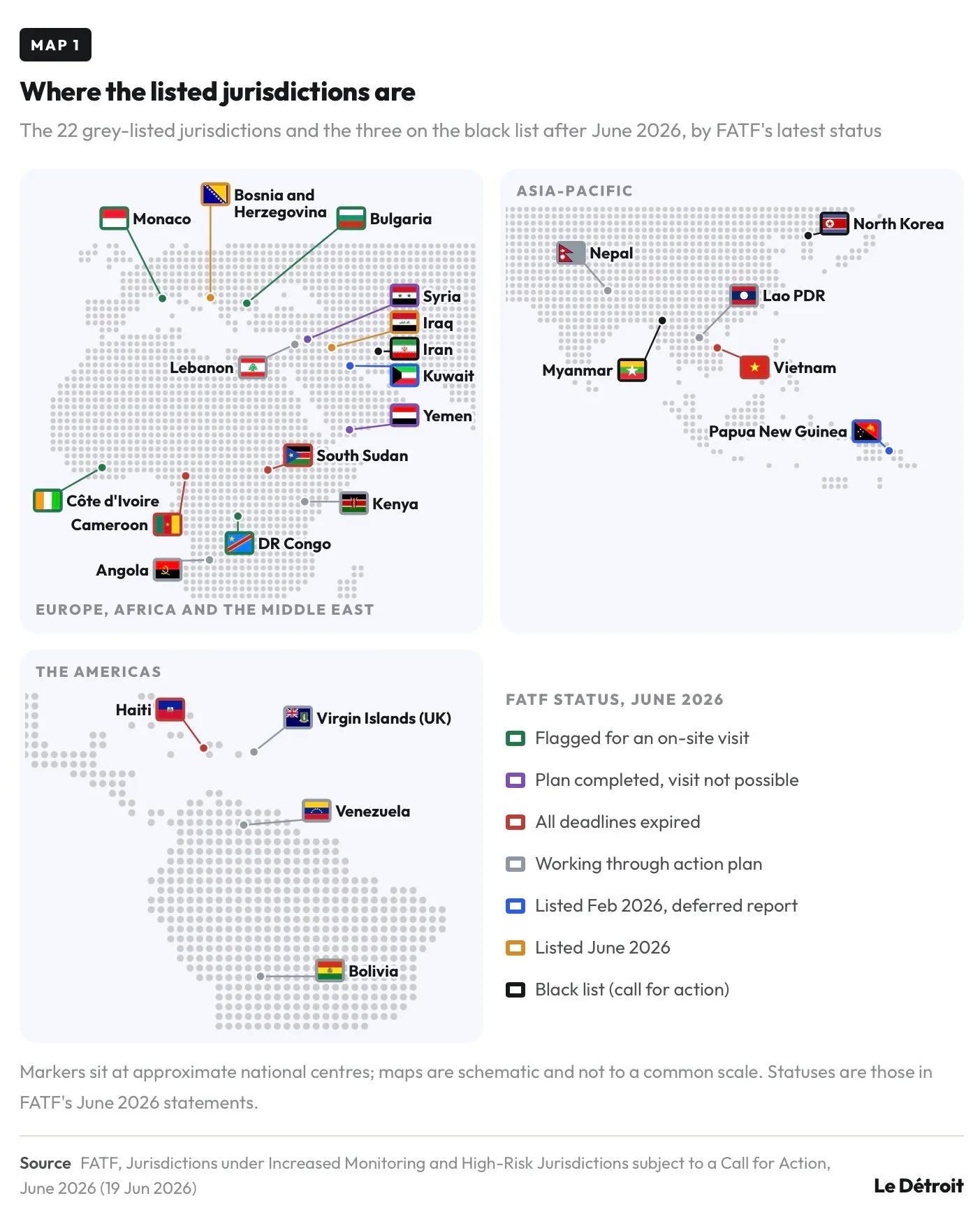
Eight more are working through their plans: Angola, Bolivia, Kenya, Lao PDR, Lebanon, Nepal, Venezuela and the British Virgin Islands. FATF has not said that any of them is close to completion.
The newcomers widen the list's map. Kuwait, a Gulf state, and Papua New Guinea were added in February, and both chose to defer reporting in June. Kuwait's action plan has three items, including the accuracy of its beneficial ownership registry; Papua New Guinea's has seven. Bosnia and Herzegovina and Iraq were added in June with nine items each, following mutual evaluation reports adopted in December 2024 and November 2024.
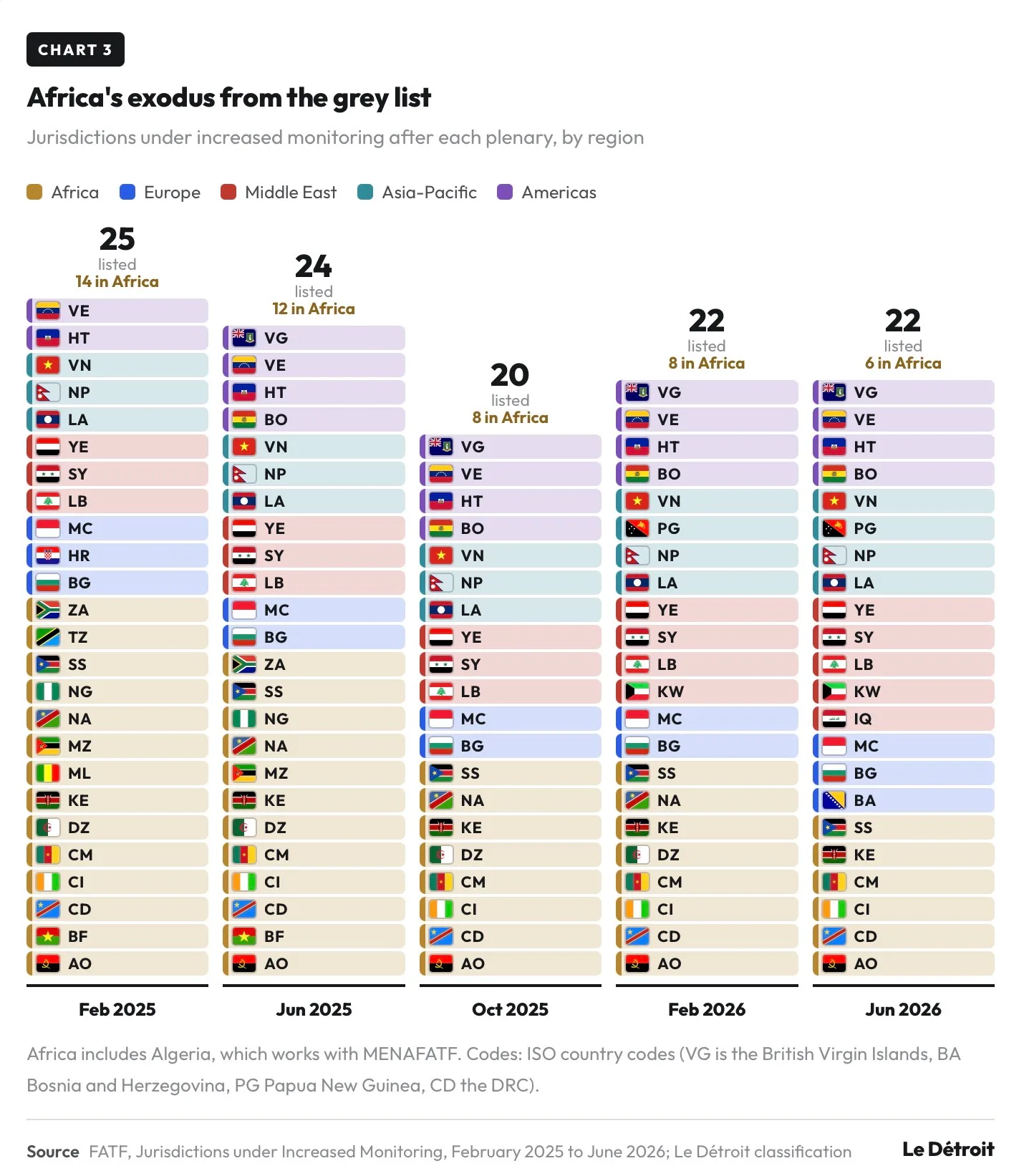
The list's centre of gravity has moved. In February 2025, 14 of the 25 jurisdictions listed were African; after June 2026, six of 22 are. If Côte d'Ivoire and the DRC were removed in October, the African count would fall to four. The Middle East now has five entries, Europe three, Asia-Pacific four and the Americas four.
5. The black list and Myanmar's deadline
Since 2011 FATF has repeatedly called for countermeasures against North Korea, and since February 2020 against Iran, "given Iran's failure to fully address its action plan". It says Iran "has failed to address the majority of its action plan since 2016". Iran updated FATF in January 2026 on ratifying the Palermo and terrorist-financing conventions, but FATF judges its reservations "overly broad". Should Iran ratify and implement them in line with FATF standards, FATF says it will decide on next steps, including whether to suspend countermeasures.
Myanmar sits on the rung below. FATF has called for enhanced due diligence since October 2022, after an action plan agreed in February 2020 expired in September 2021. In June it noted progress, including more use of financial intelligence and more freezing and confiscation of criminal proceeds, but said that "fraud and cyber scam activities in Myanmar remain extensive and present significant illicit finance risks".
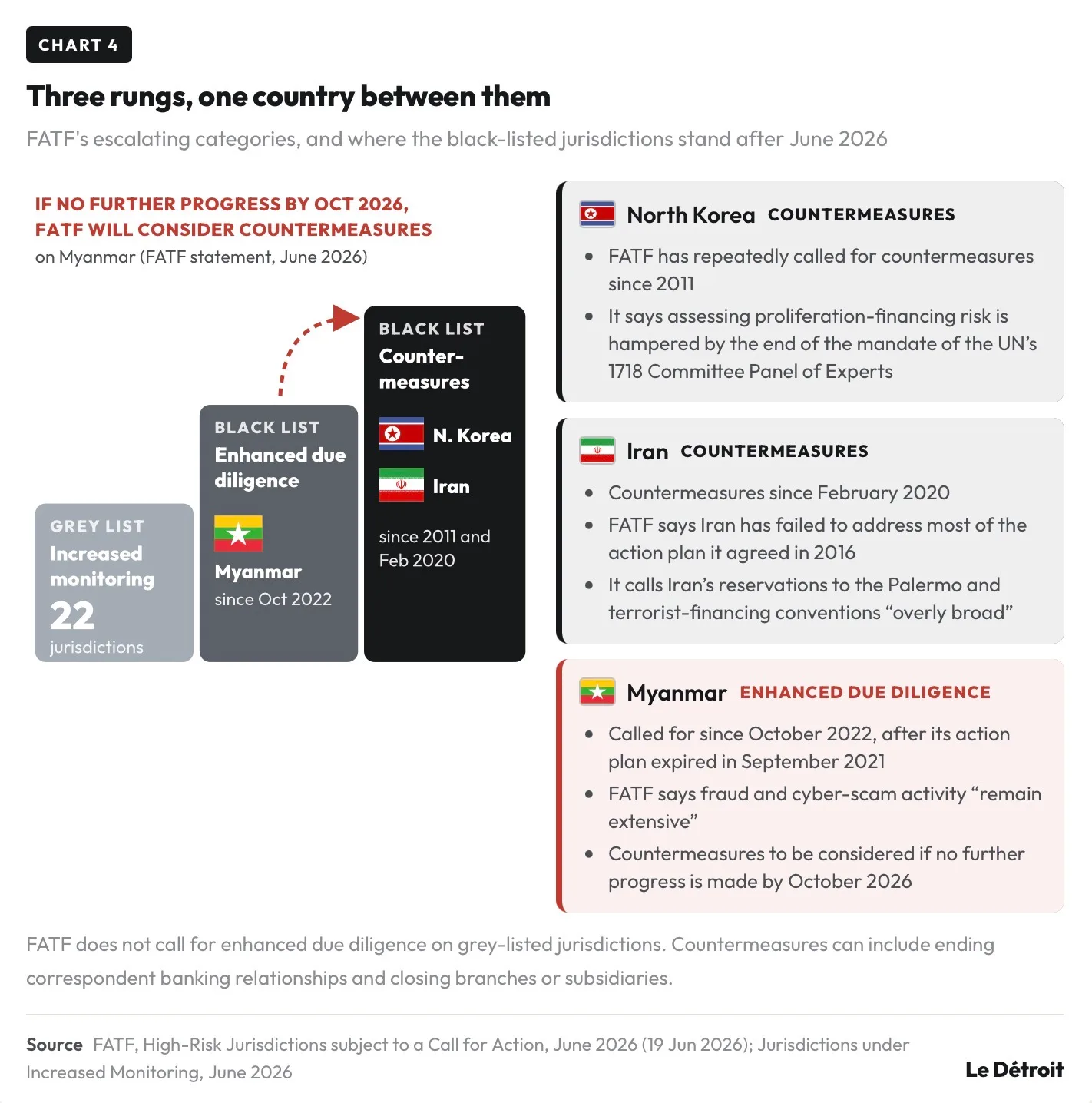
For North Korea, the countermeasures FATF lists include ending correspondent relationships with its banks and closing their subsidiaries and branches. An economist quoted anonymously by Myanmar Now in June said of possible countermeasures on Myanmar: "There will be major impacts on imports, trade and financial transactions." FATF has also asked that flows for humanitarian aid, legitimate non-profit work and remittances "are neither disrupted nor discouraged", citing earthquake relief in particular.
6. Brussels keeps its own list
For banks in the European Union, the list with legal force is the Commission's. Under the fifth anti-money-laundering directive, banks and other gatekeepers must apply enhanced checks to business involving the countries on it. The Commission says its listing "takes into account the recommendations provided by FATF", but it also lists countries on the basis of its own assessment, and it changes the list by delegated regulation.
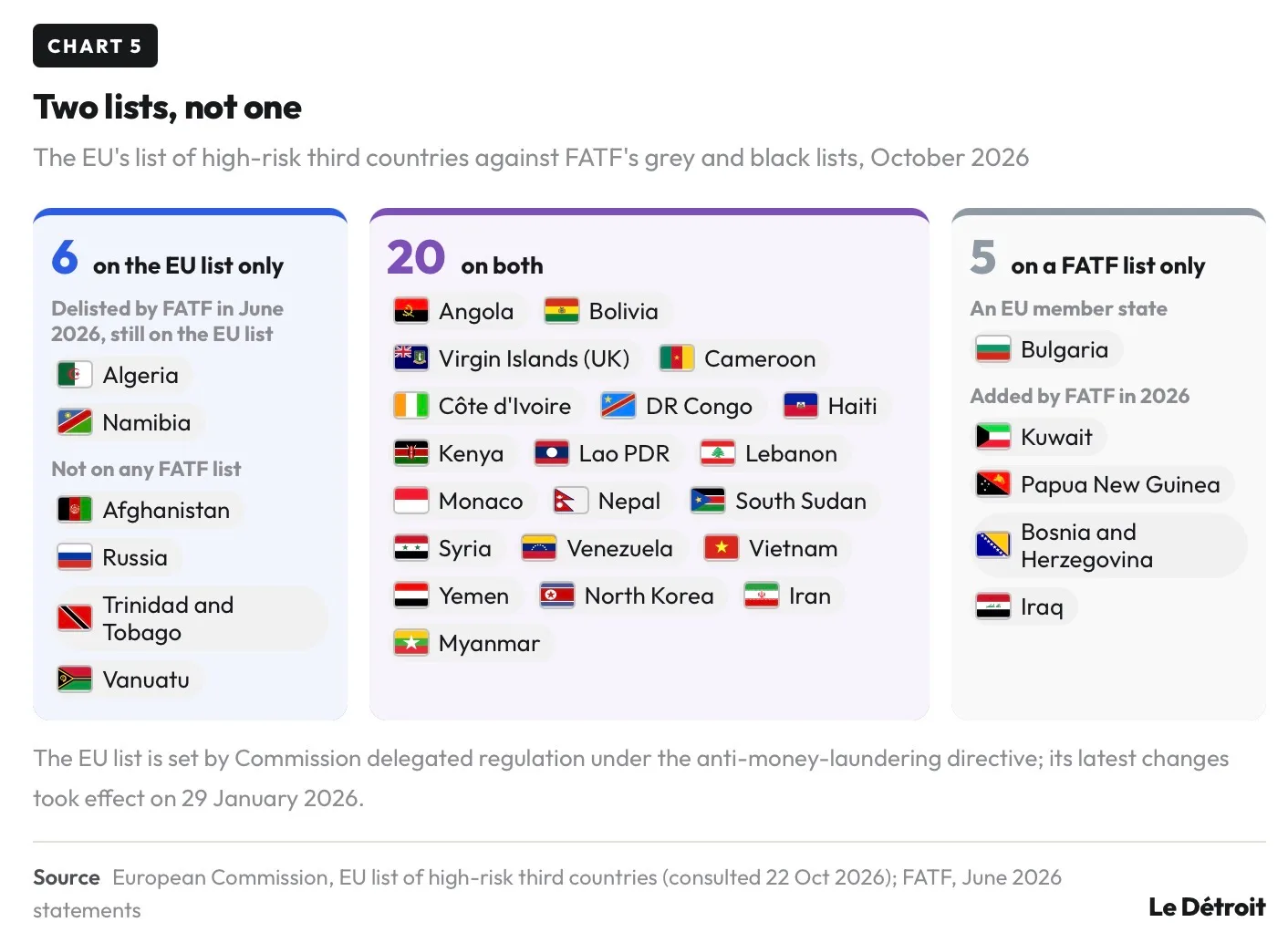
The two lists overlap but do not match. Of the EU's 26 entries, 20 are also on a FATF list. Four are on neither FATF list: Afghanistan, Trinidad and Tobago, Vanuatu and Russia, which Brussels added from 29 January 2026 and whose FATF membership is suspended. Algeria and Namibia, delisted by FATF in June, are still on the EU's list, while Bulgaria, an EU member state, and FATF's four additions of 2026 are not.
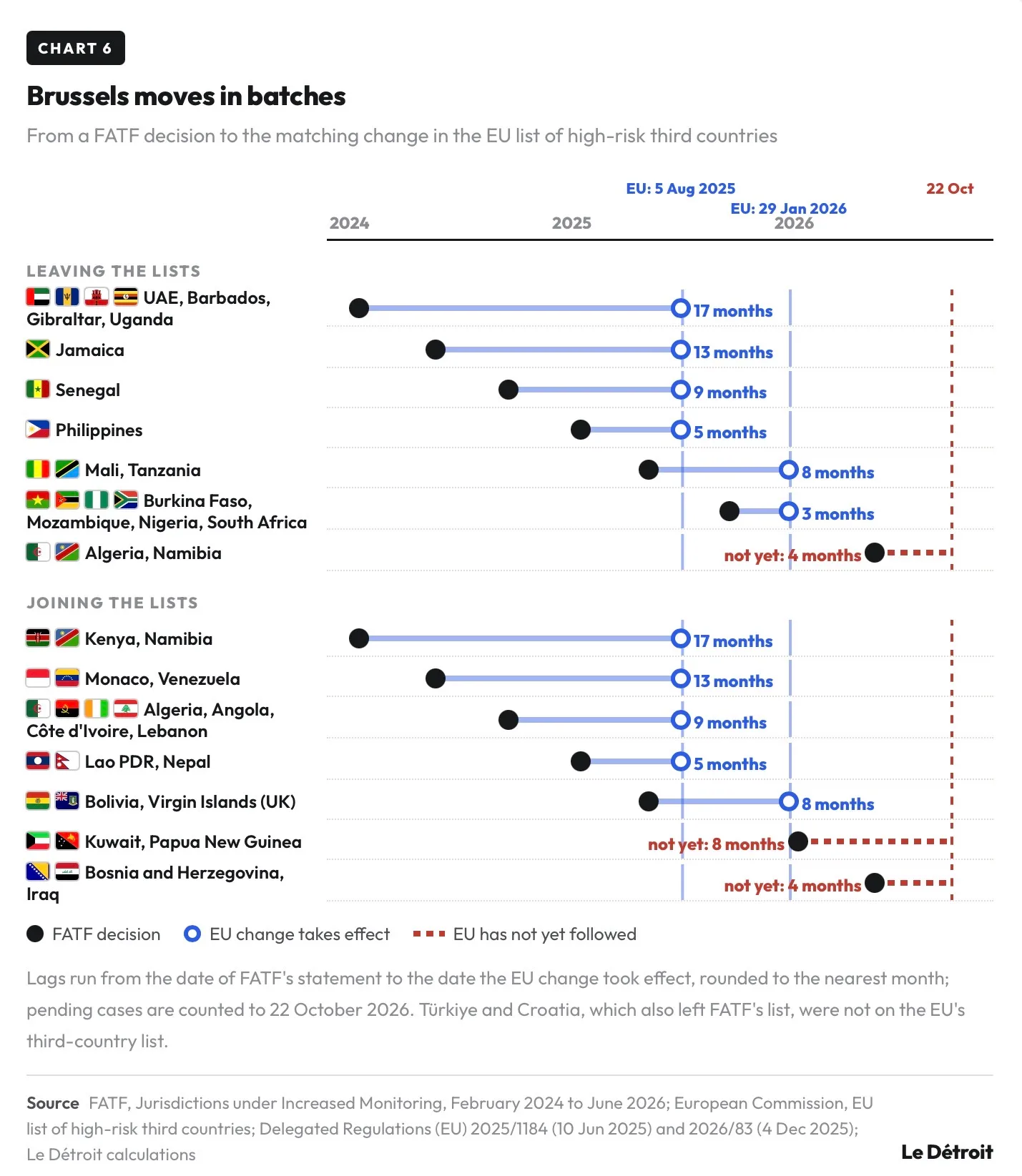
Brussels also moves in batches, which builds in a lag. The four African countries FATF removed on 24 October 2025 came off the EU list on 29 January 2026, about three months later; the UAE, removed by FATF on 23 February 2024, stayed on it until 5 August 2025, about 17 months. Additions lag too, so for a jurisdiction that trades with Europe a FATF exit is only half the journey.
7. What a listing costs
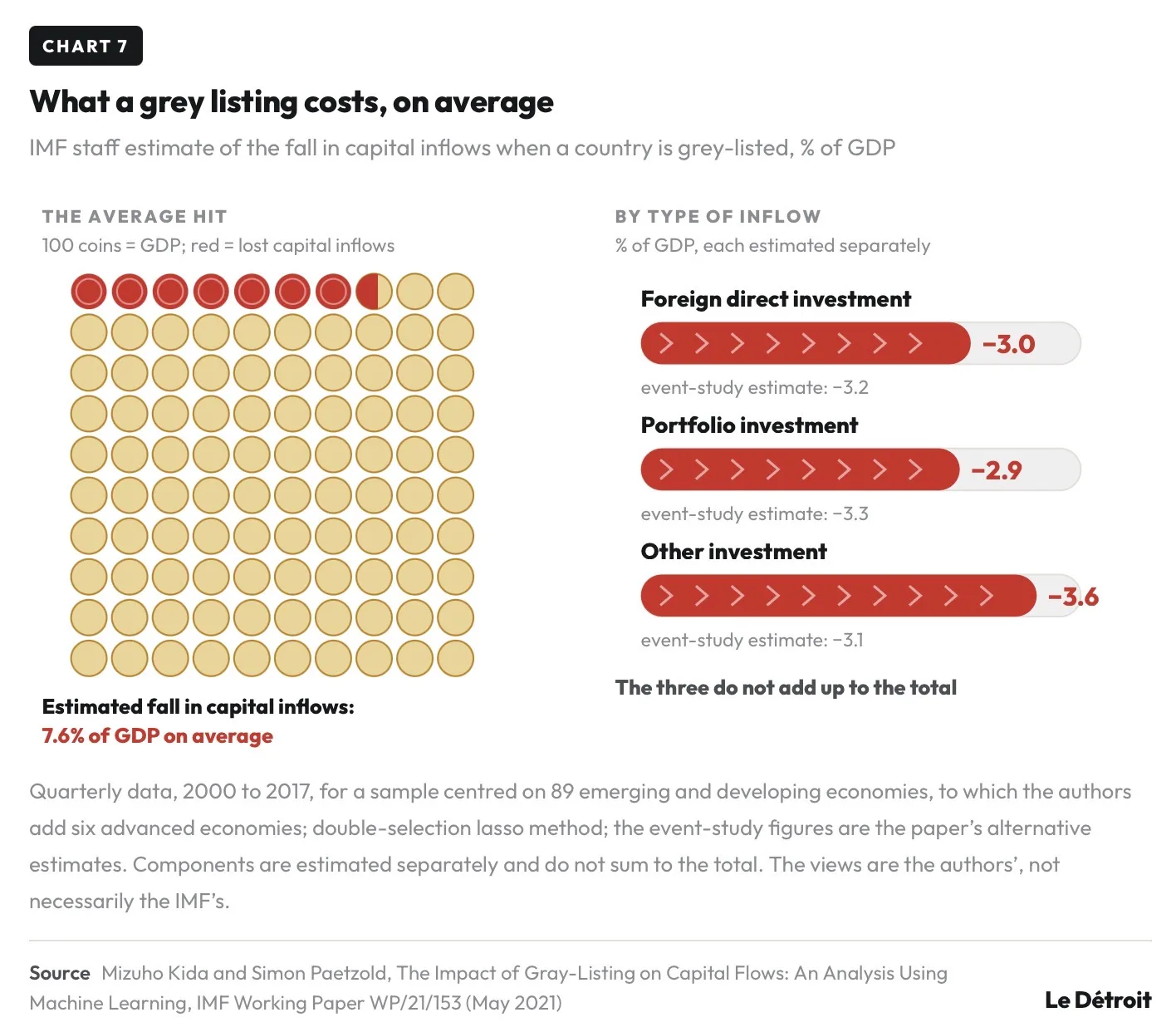
The most cited estimate comes from an IMF working paper by Mizuho Kida and Simon Paetzold, published in May 2021. Using a machine-learning method on quarterly data from 2000 to 2017 for a sample centred on 89 emerging and developing economies, it found that grey-listing "results in a large and statistically significant reduction in capital inflows", of 7.6% of GDP on average. The authors note that the views are their own, not necessarily the IMF's.
That is an average across many listings, and a single exit need not move markets much. The reaction to South Africa's was modest: in early trade on 27 October 2025, the first trading day after it, the rand firmed about 0.2% and the yield on the 2035 government bond fell two basis points to 8.865%, Reuters reported.
Officials describe the cost in terms of friction. "This is not just a bureaucratic achievement or a diplomatic win," Doris Uzoka-Anite, Nigeria's minister of state for finance, said after its exit, according to ThisDay; she said banks abroad had hesitated to process Nigerian transactions. South Africa's Treasury called its exit "an important milestone" but noted that FATF expects "measurable outcomes, including successful investigations, prosecutions, and sanctions".
"The grey list is not a financial sanction," Mahmoud Abdul Karim, a Syrian banking expert, told Enab Baladi in October; he described its effect as "raising the cost of trust". The extra checks foreign banks run can lengthen transfers and raise the cost of letters of credit, Enab Baladi noted. FATF itself "does not call for the application of enhanced due diligence measures" to grey-listed jurisdictions, and says its standards "do not envisage derisking, or cutting-off entire classes of customers".
Bulgaria's Ministry of Finance described the same gap from the inside. Foreign institutions and counterparties typically weigh a listing when assessing risk, it told Le Détroit, and in practice this "often leads to the application of enhanced due diligence measures, which may take the form of additional information and documentation requirements, longer processing times for transactions, and higher costs", particularly with counterparties outside the European Union; removal "would eliminate this basis for enhanced measures". The price of a listing, in other words, is set less by FATF than by the risk models of the banks on the other side of each transaction.
8. The rest of the agenda
The plenary is also expected to discuss mutual evaluation reports on Mexico and the United States under FATF's new round of mutual evaluations, which assesses countries' measures against money laundering, terrorist financing and proliferation financing. The reports on Canada and Türkiye, adopted in June, were published after a quality review: FATF released Türkiye's on 23 September and Canada's on 29 September.
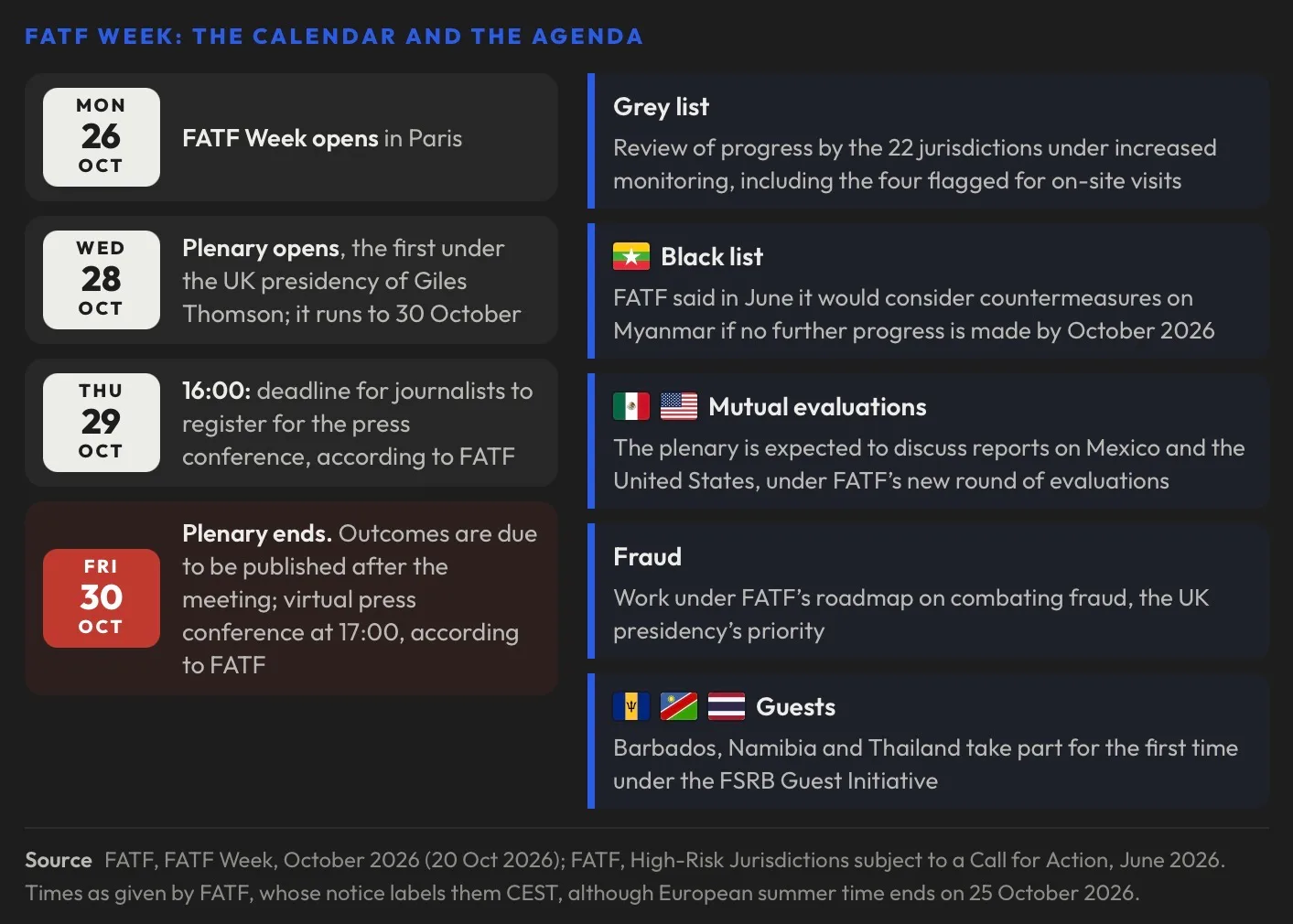
Fraud is the presidency's theme, and delegates will advance work under FATF's roadmap on combating it. In June FATF also updated Recommendation 6 to incorporate humanitarian exemptions from UN sanctions, and approved a public consultation on guidance for its revised payment-transparency standard, Recommendation 16. The October notice does not mention asset recovery or beneficial ownership.
Namibia, delisted in June, will attend with Barbados and Thailand as first-time guests under the FSRB Guest Initiative. An exit is not the end of scrutiny, though: South Africa's Treasury expects its next mutual evaluation to conclude in October 2027, and Türkiye, which left the list in June 2024, was placed in enhanced follow-up by the report FATF published on 23 September. This year's four newcomers show that the list keeps moving in both directions.
Being on a FATF list reflects FATF's assessment of a jurisdiction's systems against money laundering, terrorist financing and proliferation financing; it is not an allegation against any person or company. Outcomes described as expected or likely are not decisions: FATF publishes its decisions after the plenary ends on 30 October. Time on the list is counted in months between plenaries. Quotes first published in other languages are as translated by the outlets cited. After publication, Le Détroit asked Bulgaria's Ministry of Finance to review the article; it answered in writing on 28 October 2026.