1. A warehouse in Amherst
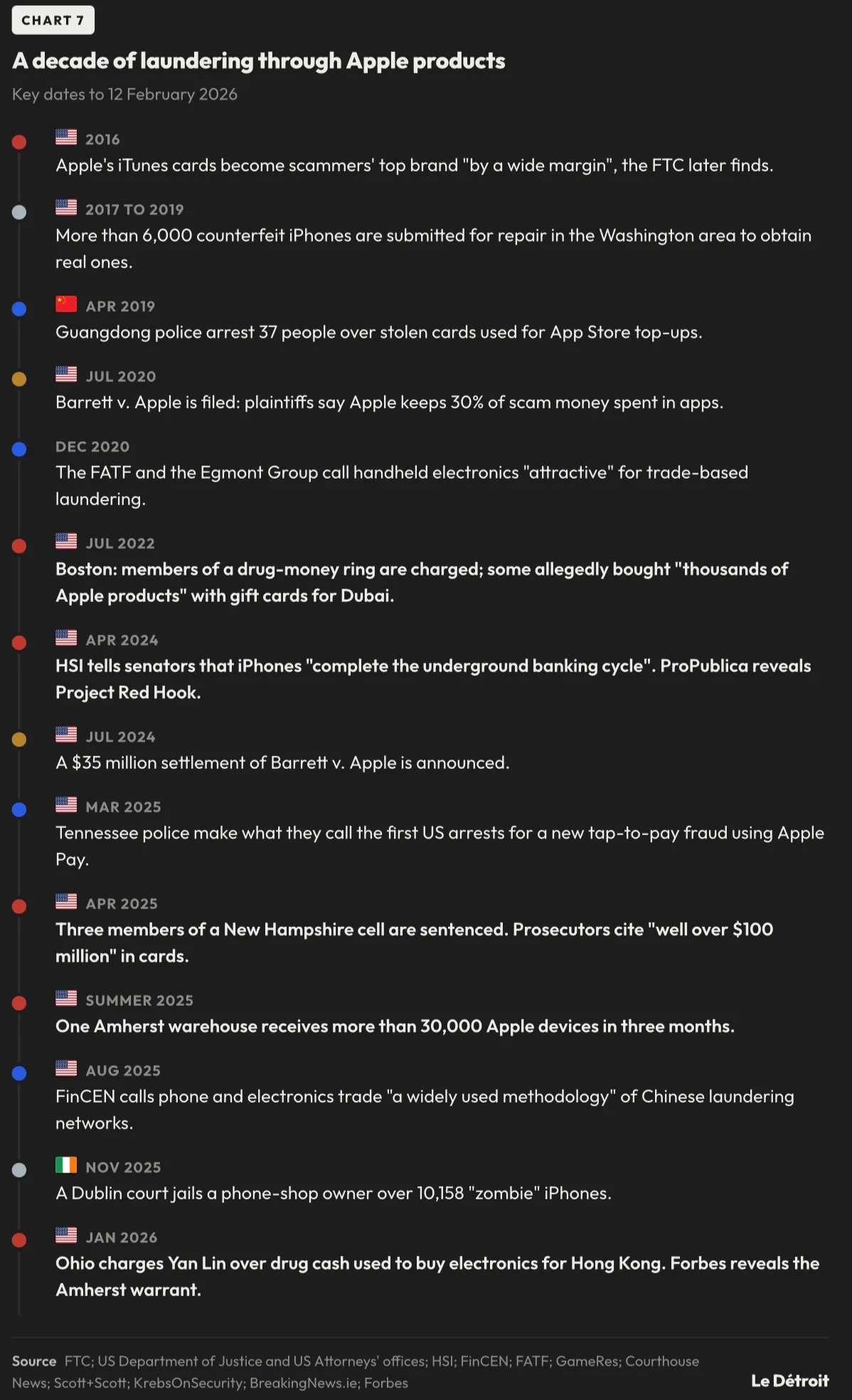
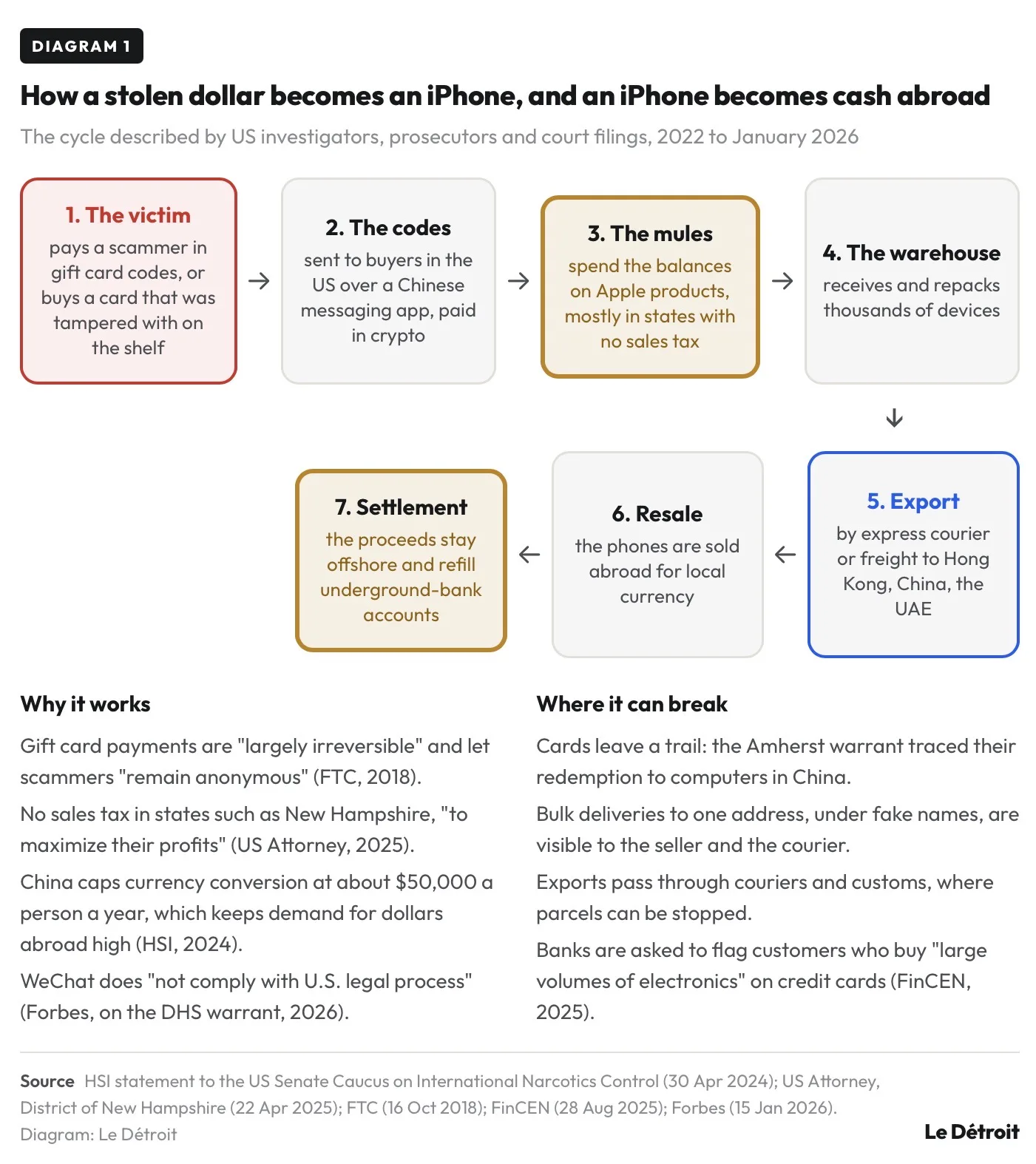
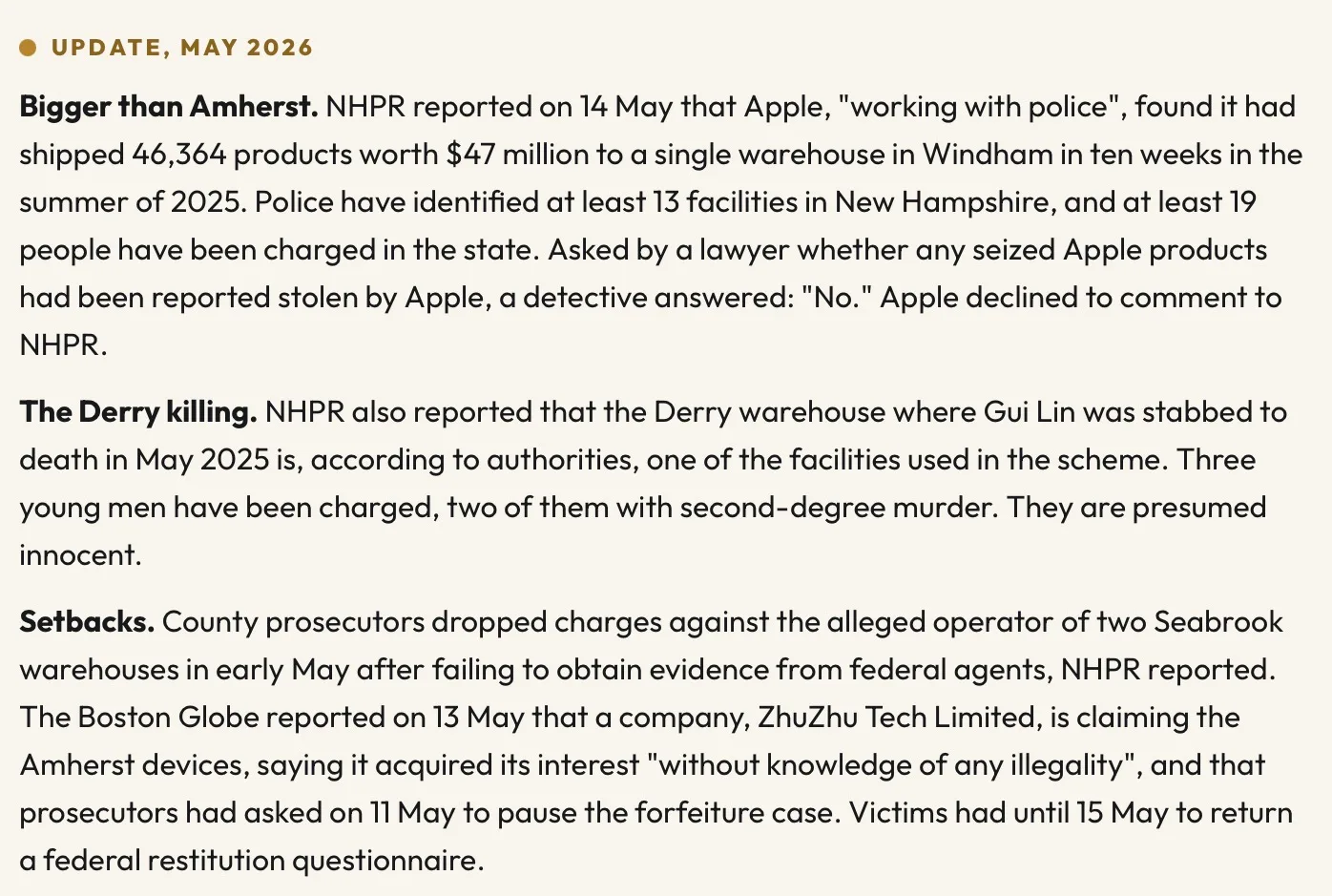
In a small industrial park in Amherst, New Hampshire, one warehouse received more than 30,000 Apple devices over three months in the summer of 2025. Their value was about $35 million. That is what a Department of Homeland Security seizure warrant describes, according to Forbes, which reported it on 15 January 2026. The devices had been paid for with gift cards obtained through romance scams, account hacks and sextortion. The cards were redeemed almost entirely from computers in China, under fake names and billing addresses, and the devices were destined for China or the United Arab Emirates.
The warrant belongs to Project Red Hook, an initiative of Homeland Security Investigations (HSI). In the agency's words, it brings together police forces and businesses "to raise awareness of how Chinese organized crime groups are exploiting gift cards to launder money." Forbes reported that Apple had been giving information to investigators. The company did not respond to its requests for comment.

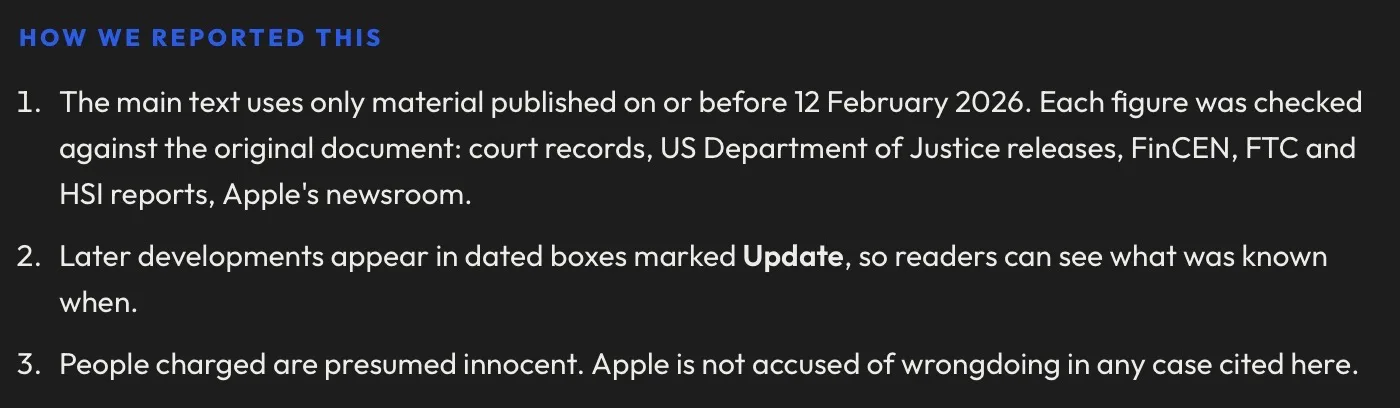
This dossier sets out how that cycle works, step by step, from the victim who reads out a code over the phone to the reseller in Hong Kong. It draws on court records, regulators' reports and investigations published up to 12 February 2026.
2. Why an iPhone works like cash
For a launderer, a new iPhone has most of the qualities of cash. It is standardised: a sealed phone of a given model and capacity is worth roughly the same everywhere, and buyers in Hong Kong or Dubai know its price. It holds its value. It is in demand around the world. It is small enough to ship by the thousand in courier parcels. And a box of phones crossing a border does not pass through a payment system the way a wire transfer does.
That makes phones a natural vehicle for trade-based money laundering, which moves value by trading goods instead of sending money. The FATF, the global anti-money laundering standard setter, and the Egmont Group of financial intelligence units flagged the risk in December 2020: "Portable or handheld electronics are also attractive in TBML schemes as they can be deliberately misrepresented and incorrectly valued, increasing the opportunity to move significant criminal proceeds."
The demand comes from China. Chinese rules cap the yuan a citizen may convert into other currencies at "approximately $50,000 (USD equivalent) each year", HSI told the Senate, and limit transfers abroad to the same amount. That leaves wealthy people in China who want money outside the country, and criminal groups in the United States sitting on dollars they cannot easily bank. Underground banks connect the two. Goods bought with the dollars and sold abroad are one way to settle the account. In HSI's description, "funds generated from these goods remain offshore where they are used to replenish overseas bank accounts used to facilitate Chinese underground banking activities."
3. The fuel: scams and drained cards
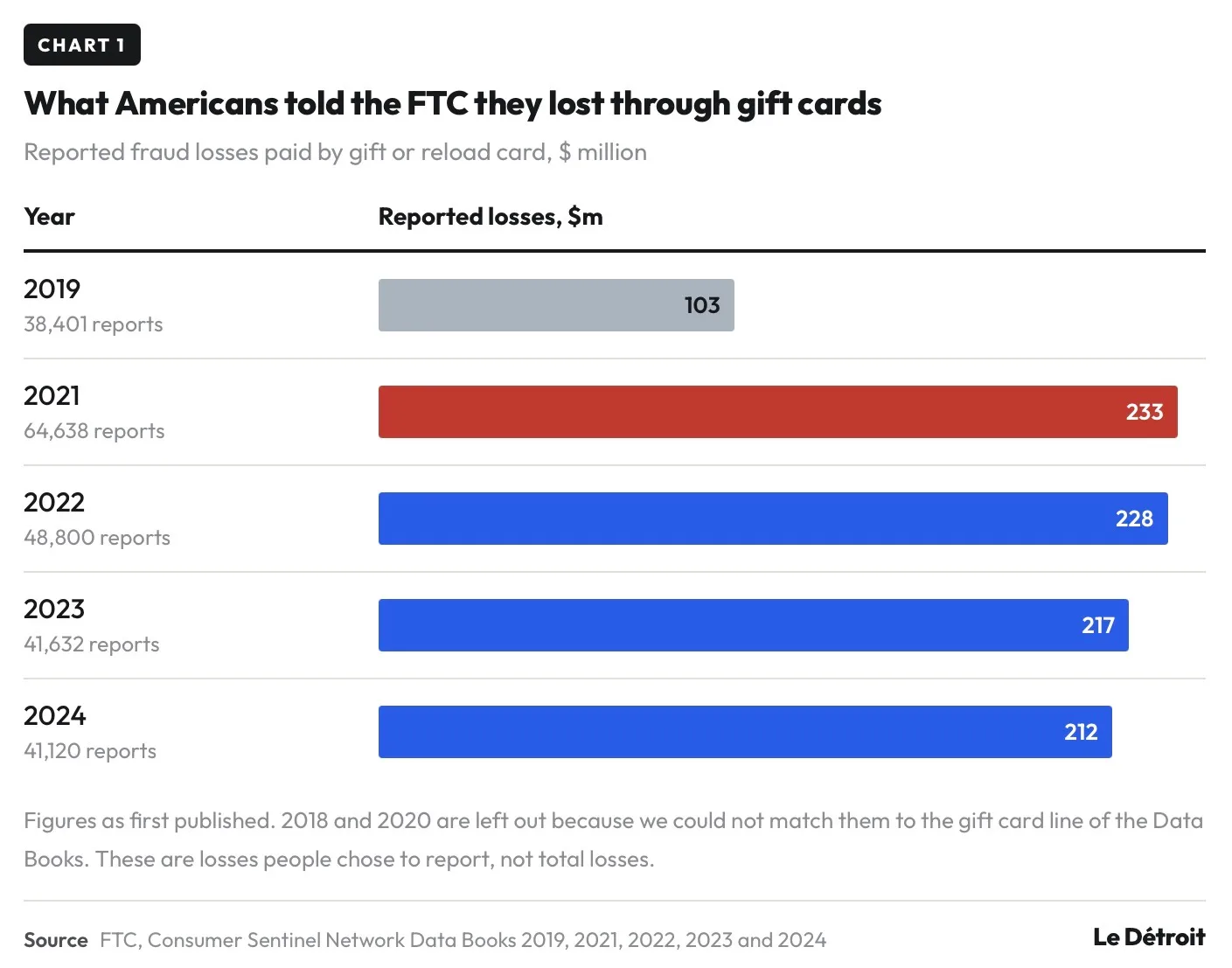
The cycle needs a steady supply of gift card value, and most of it comes from victims. In the classic version, a scammer posing as a tax official, a technical support agent or a romantic partner tells the victim to buy gift cards and read out the codes. For years, Apple's were the favourite. "iTunes cards have been the top card brand by a wide margin since 2016," the Federal Trade Commission wrote in October 2018. From January to September 2018, gift and reload cards were the payment method in 26% of the fraud reports that named one, up from 7% in 2015. The FTC gave three reasons: scammers "can get quick cash", "the transaction is largely irreversible" and "they can remain anonymous."
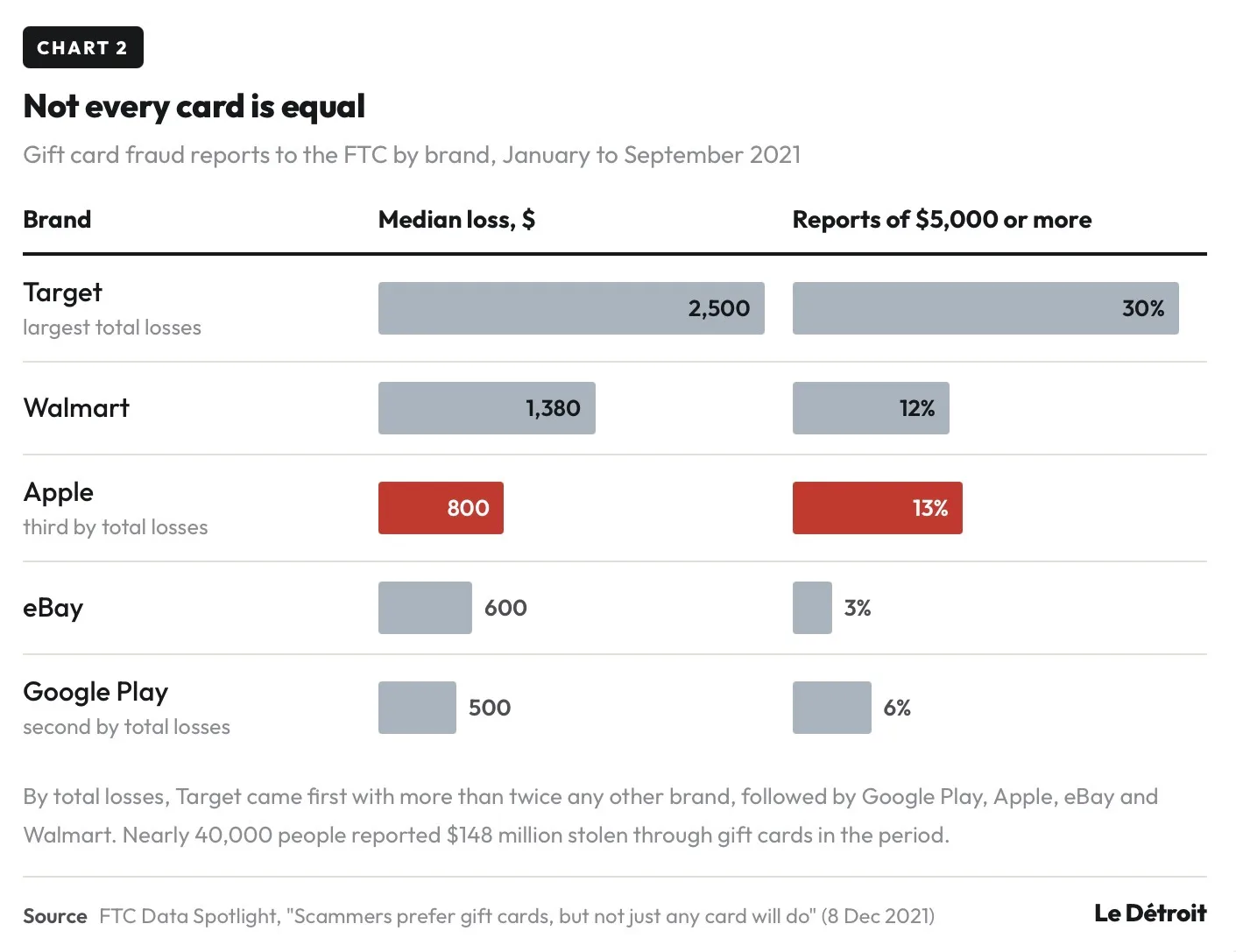
By 2021 the picture had shifted. From January to September that year, Target cards accounted for the largest losses reported to the FTC, more than twice any other brand, followed by Google Play, Apple, eBay and Walmart. Apple cards still stood out in one respect: 13% of the reports involving them were for losses of $5,000 or more, second only to Target.
The second source of value needs no conversation with the victim at all. In "card draining", gangs take cards from store racks, record their numbers, reseal the packaging and put them back. When a shopper loads money onto the card, the balance is spent before the gift reaches anyone. HSI described the next step to the Senate: "When an unwitting customer loads funds onto the altered gift card, the CMLO converts those funds to hard goods, often iPhones, through retail purchases made by CMLO mules throughout the United States." (CMLO: Chinese money laundering organisation.)
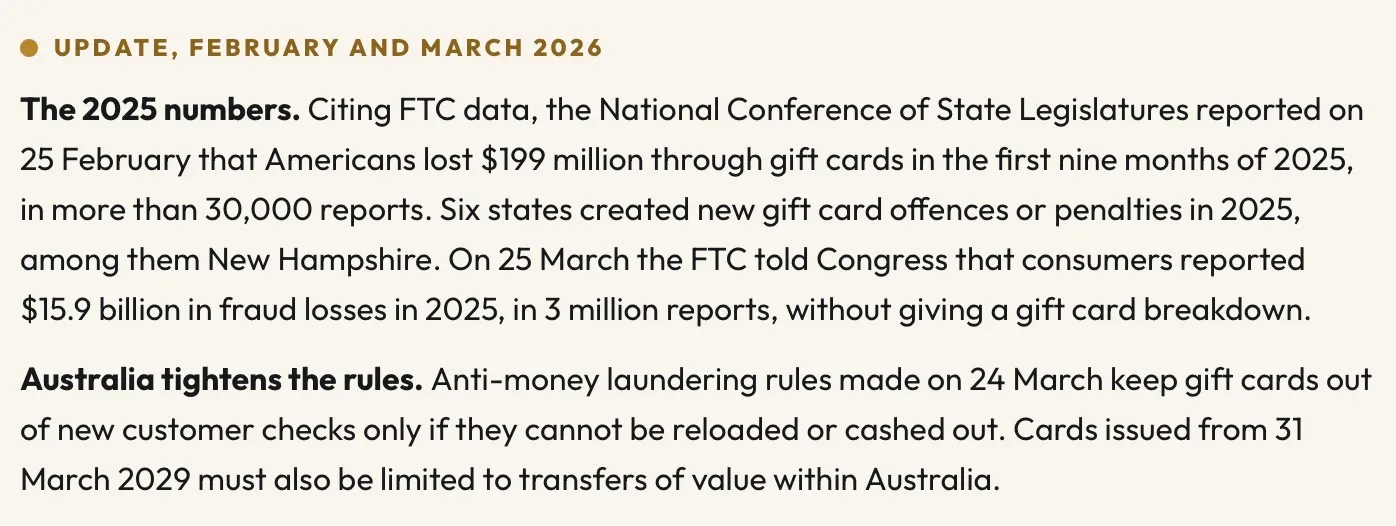
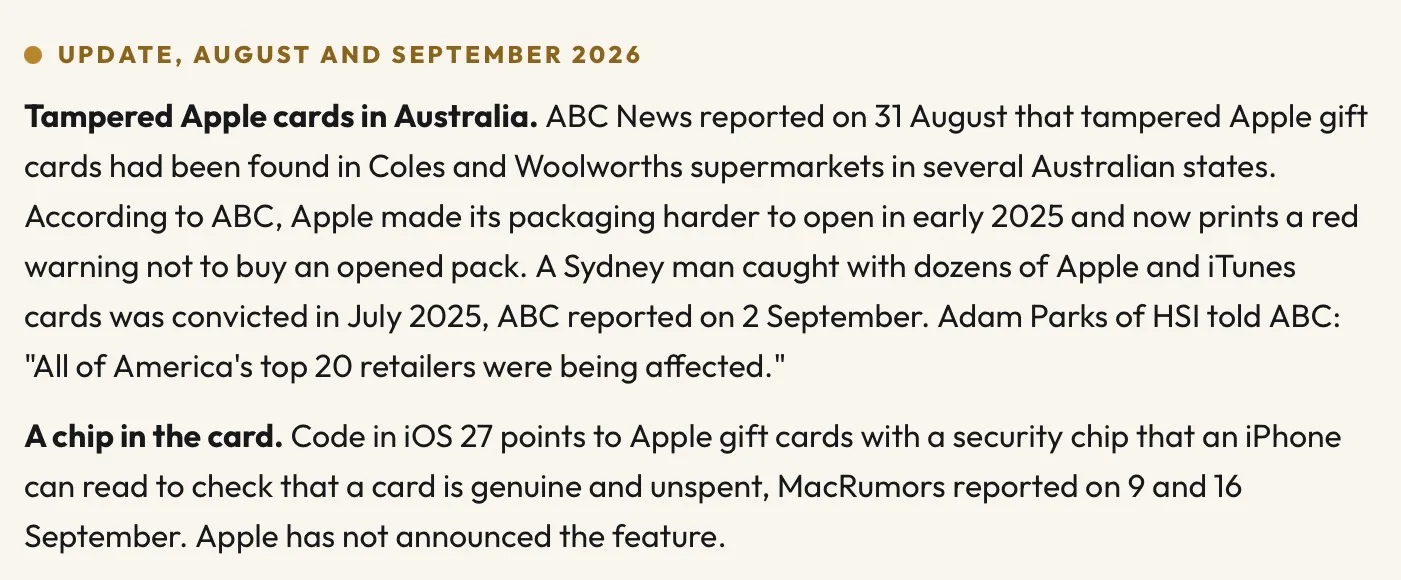
The scale is hard to pin down. ProPublica reported in April 2024 that about 100 people had been arrested for card draining across the United States in the previous 18 months, and quoted Adam Parks, an HSI assistant special agent in charge: "We're talking hundreds of millions of dollars, potentially billions of dollars." NBC Bay Area counted at least 30 arrests and more than 45,000 cards seized across 12 states by May 2024. In Florida, a man stopped in October 2023 had 6,032 gift cards in his vehicle; he admitted possessing more than 6,100 unauthorised cards and was sentenced to 33 months in April 2025. In an AARP survey of American adults planning holiday shopping, published in November 2024, 30% said they had given or received a gift card with no balance, up from 21% in 2021.
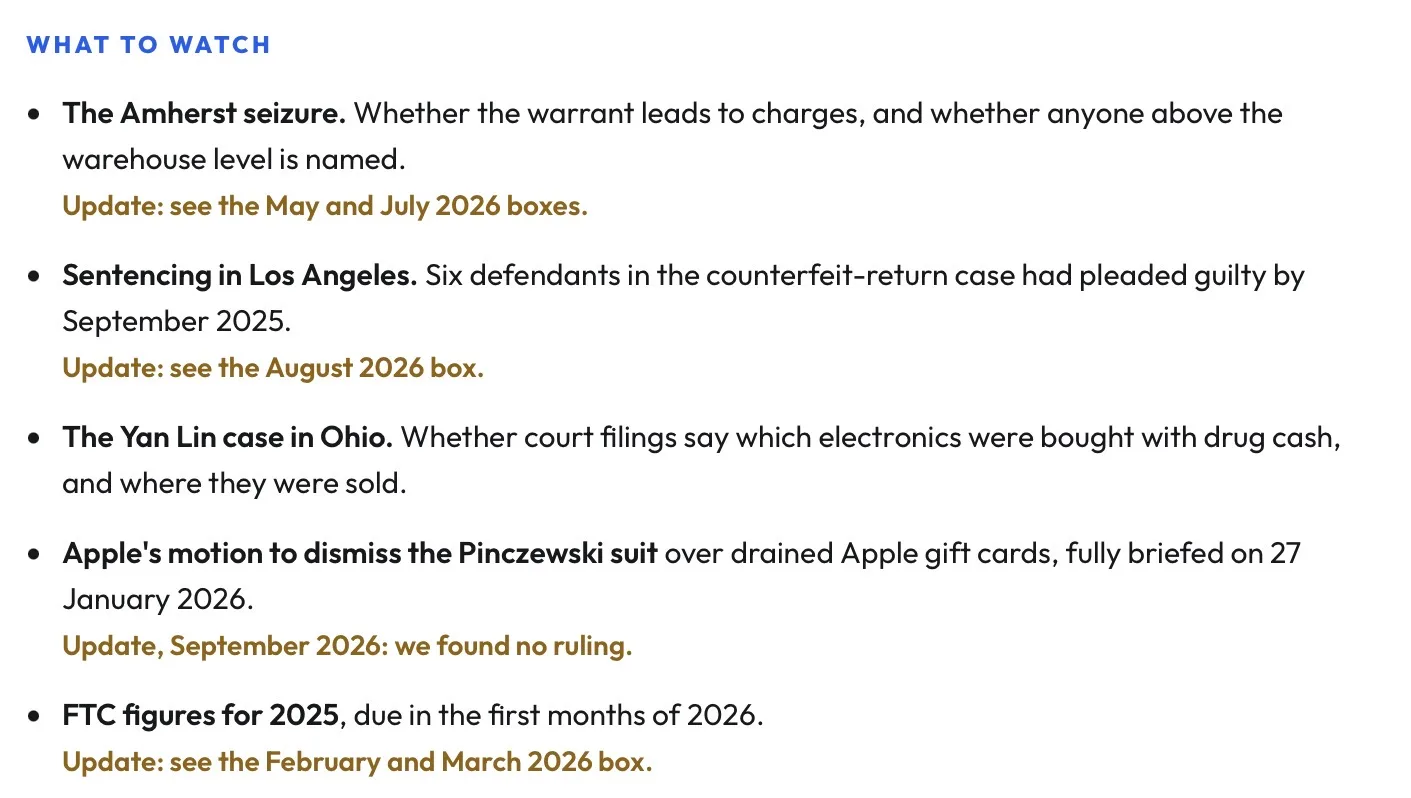
Apple has faced civil claims over drained cards. In Shay v. Apple, it agreed to a $1.8 million settlement, reported in November 2023, for buyers whose cards "were redeemed by an unknown third party" before they could use them. It did not admit wrongdoing. In September 2025 a new proposed class action, Pinczewski v. Apple, accused the company of selling "unsecured and defective Apple Gift Cards". Apple asked the court to dismiss it, and the motion was fully briefed on 27 January 2026. The problem can also hit innocent buyers: in December 2025, TidBITS reported that Apple had locked a developer's account after he redeemed a $500 card bought from a major retailer, which turned out to be compromised. Access was restored after he escalated the case.
4. New Hampshire, the tax-free hub
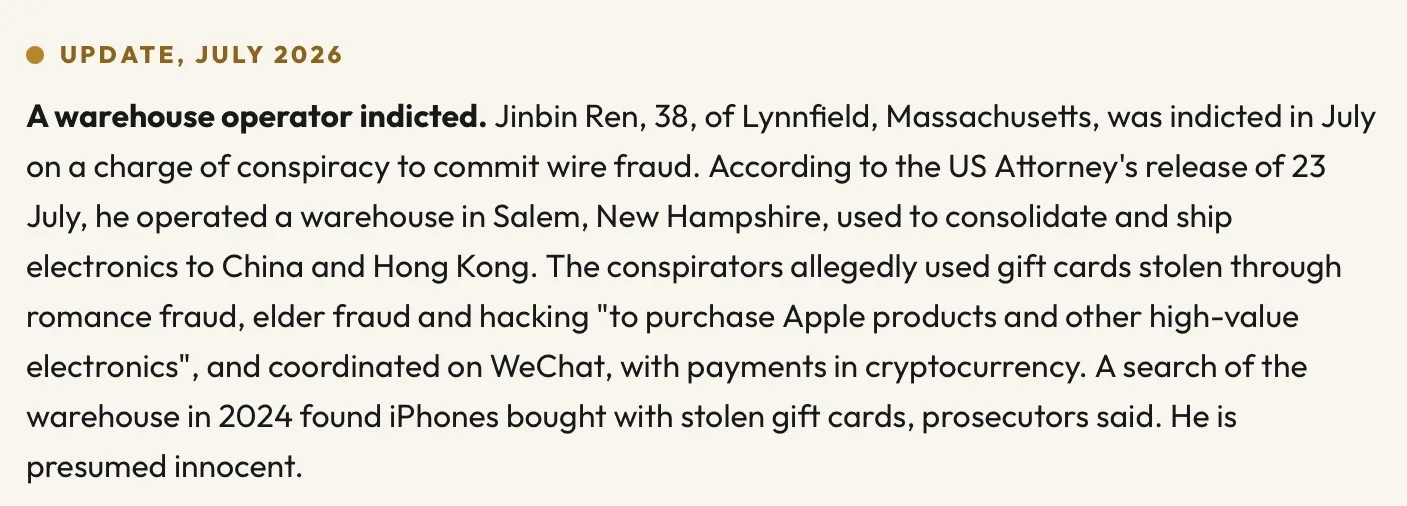
Why New Hampshire? Because it has no sales tax. "The cells primarily operate in states with no sales tax, such as New Hampshire, to maximize their profits," the US Attorney's Office for the state said in April 2025. Goods were consolidated "in warehouses for shipment to China, Hong Kong, or countries in Southeast Asia."
That month, three Chinese nationals were sentenced in federal court for their part in the scheme. Mengying Jiang, 34, of Nashua, received 60 months for handling $3 million in fraudulent gift cards. Naxin Wu, 26, also of Nashua, received 33 months for $1.4 million. Mingdong Chen, 28, of Brooklyn, received 24 months for $400,000. All three had pleaded guilty to conspiracy to commit wire fraud. Prosecutors said the card data reached them "through a Chinese-based messaging platform in exchange for cryptocurrency", and that two of them bought the cards "at a discount from their face value." The discount is the margin of the trade: the cell pays less than the card is worth, then turns the full balance into phones.
Prosecutors also gave a sense of the whole: "organized criminal elements in China acquired well over $100 million in gift cards through multiple fraudulent means." The three defendants accounted for a small part of it.
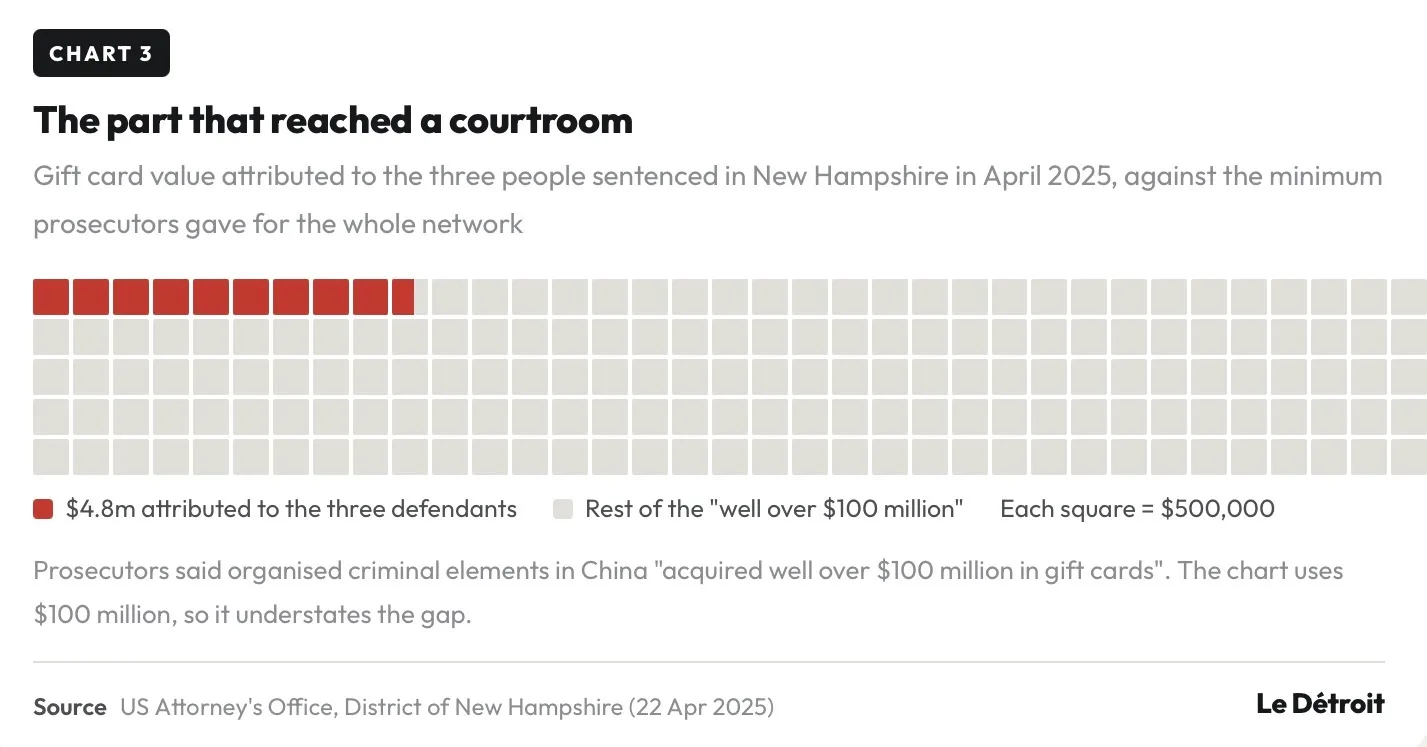
The investigation, run by HSI, IRS Criminal Investigation, the Postal Inspection Service and Concord police, began in December 2023. In March 2025, prosecutors asked for victims whose Apple, Walmart, Target or Best Buy cards had been stolen or misused between 1 October 2023 and 11 January 2024 to come forward. Their notice described criminal organisations in China using New Hampshire as a base because of its tax-free retail, and electronics repackaged and shipped abroad. The Amherst warrant shows the trade went on after the first sentences, on a larger scale: more than 30,000 devices in three months, against $4.8 million for the three defendants.
5. Cartel cash and the "mirror"
Gift cards are only one input. The same channel serves drug money. Mexican cartels earn dollars in cash on American streets. Chinese money laundering networks take those dollars in the United States and arrange for the cartels to be paid in Mexico, often through what investigators call mirror transactions: in HSI's words, "unlicensed cross-border currency swaps where funds are credited and debited without physical money movement." The networks are then left with dollars in the United States that must be moved or used. Buying goods for export is one answer.
FinCEN, the US Treasury's financial intelligence unit, set this out in an advisory on 28 August 2025: "CMLNs may use money mules and other recruits to purchase U.S. electronics and other luxury goods (e.g., cell phones, automobiles, clothing, designer handbags, etc.) at various stores, some of whom are complicit, across the United States." The purchases "may be made using the drug proceeds or with credit cards that are subsequently paid off by the CMLN or by the complicit business owner." The goods may then go "to counterparties in Mexico, China, Hong Kong, and the United Arab Emirates, who resell these goods in their respective countries." Among its red flags for banks: "A customer, especially a Chinese national, regularly uses a credit card to purchase large volumes of electronics or other luxury goods."
FinCEN's trend analysis, published the same day, reviewed five years of Bank Secrecy Act reports and concluded: "TBML involving cell phones and electronics is a widely used methodology by CMLNs to launder funds and profit on the resale of high-demand goods outside the United States."
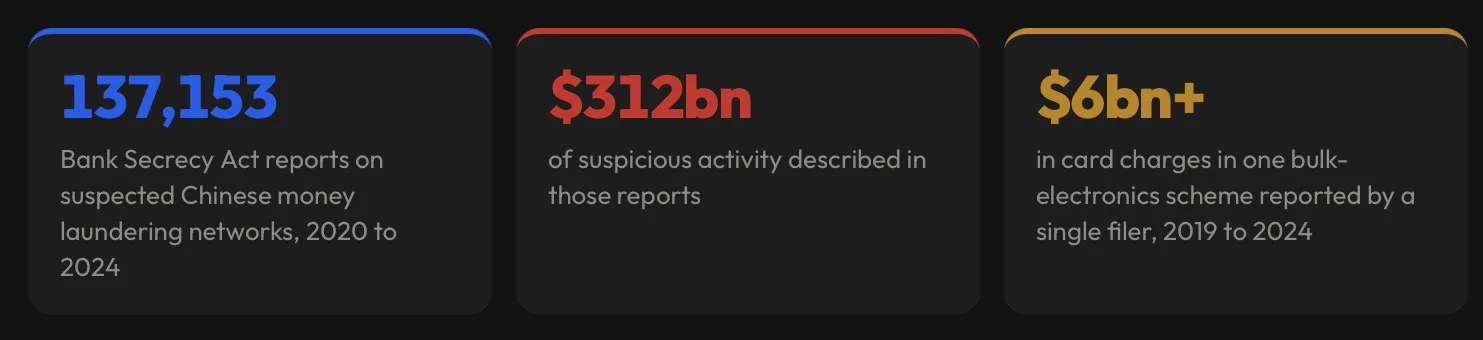
The $6 billion figure comes from a single filer, which identified "a suspected CMLN that included U.S.-based electronics companies and thousands of Chinese nationals who purchased bulk electronics and gift cards in a massive TBML scheme." The method, as FinCEN describes it, is simple: cardholders bought the goods, the companies shipped them, then paid the cardholders back "in the form of cash, checks, and transfers", with "a service fee for the purchaser". FinCEN does not name a brand.
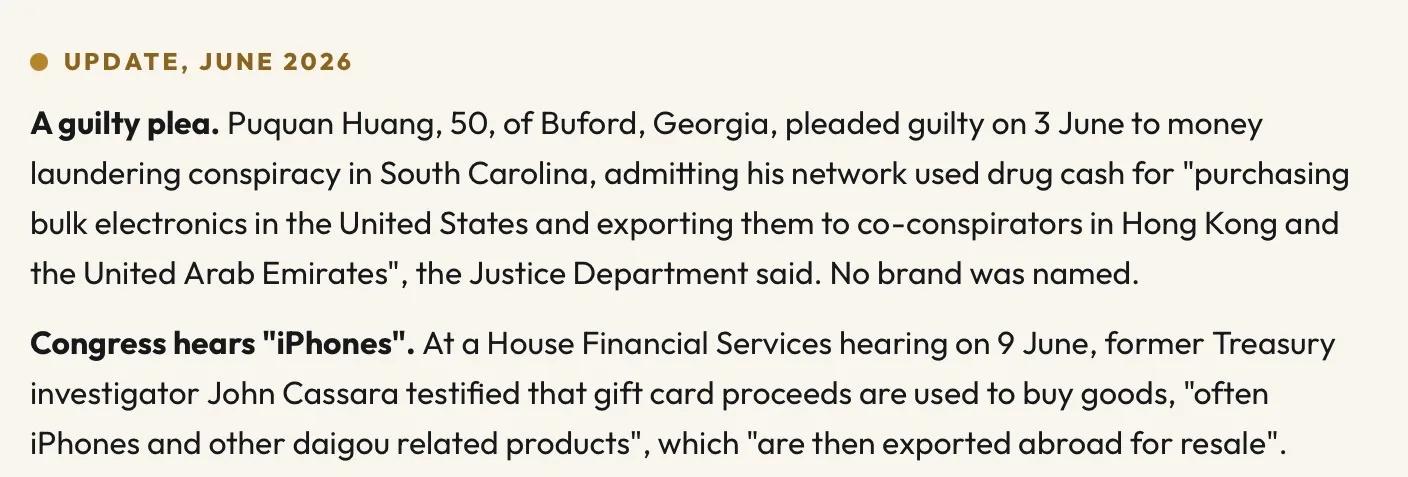
Some cases bring the threads together. In July 2022, prosecutors in Boston charged eight people in "Operation Good Fortune", a ring accused of exchanging drug cash for Chinese renminbi through a restaurant in Chinatown. Some defendants were also accused of using "stolen and/or fraudulent gift cards to purchase thousands of Apple products", shipped "internationally to locations, including Dubai", in exchange for wire transfers, and of conspiring to evade US reporting rules "as well as China's capital flight limits." On 8 January 2026, the Justice Department announced charges in Ohio against Yan Lin, 41, of California, accused of laundering drug proceeds for a Chinese network. According to the department, "Lin arranged for his co-conspirators to deliver bulk cash to others who bought electronics that were shipped to co-conspirators in Hong Kong, China, and elsewhere." One ledger recording only part of his 2024 business totalled about $27.4 million in cash. He is presumed innocent.
Two caveats. Official documents usually say "cell phones" or "electronics", not iPhones, and we found no US criminal case, before February 2026, in which prosecutors say drug cash bought iPhones by name. HSI's 2024 statement is the clearest official text naming Apple products in the drug-money cycle. And the pattern is not only American: the FATF described in 2020 a case of students buying "smart phones and tablets" on credit cards that were then settled "via electronic funds from companies suspected of laundering the proceeds of drug trafficking", with the devices bound for "grey markets in Asia and the Middle East."
6. Apple Pay: phones loaded with stolen cards
A third channel uses Apple's payment system rather than its gift cards. Phishing gangs send text messages posing as postal services or toll operators. Victims enter their card details, then the one-time code their bank sends when the gang adds the card to Apple Pay or Google Wallet on a phone it controls. KrebsOnSecurity reported in February 2025 that phones loaded with several stolen wallets are sold in bulk; one image shared on Telegram showed ten phones, each loaded with four to six cards from UK banks. In April 2025 it described gangs that "load multiple stolen cards to digital wallets on a single Apple or Android device" and "sell those phones in bulk to scammers who use them for fraudulent e-commerce and tap-to-pay transactions."
The cards can also be used remotely. The security firm ThreatFabric described in November 2024 a technique it called Ghost Tap, in which the card's signal is relayed to accomplices standing at shop terminals, who buy goods, gift cards for example, for resale. The loop then closes on itself. In March 2025, KrebsOnSecurity reported that police in Knox County, Tennessee, had arrested 11 Chinese nationals in what were considered the first arrests in the United States for this new type of tap-to-pay fraud. The fraud, said Bernie Lyon of the county sheriff's office, "involves a group utilizing Android phones to conduct Apple Pay transactions". The suspects had been "traveling nationwide, using stolen credit card information to purchase gift cards and launder funds", and police recovered gift cards worth more than $23,000.
The method is not new. In 2019, a federal court in Florida sentenced a man to five years in a conspiracy that linked at least 477 stolen card accounts to Apple Pay on iPhones and made more than $1.5 million in fraudulent purchases. What changed was the scale. In November 2025 Google sued the alleged operators of "Lighthouse", a phishing service whose templates impersonated more than 400 organisations, Apple and the US Postal Service among them; Google alleges it reached more than a million potential victims in 121 countries in 20 days.
7. Inside the App Store
The fourth channel never leaves Apple's own systems. In a class action filed in July 2020, Barrett v. Apple, plaintiffs alleged that scammers spend the codes they collect by making in-app purchases in apps they control, or sell them on grey markets. Apple, they said, keeps its 30% commission and pays the rest to the developer, in this case the fraudster; Reuters summarised the claim as Apple depositing "only 70% of the stolen funds into fraudsters' bank accounts". The complaint also said Apple holds gift card revenue for about 45 days before paying developers, a window in which it could stop payouts. If the allegations are right, a scam victim's gift card balance spent in an app comes out the other side as a developer payment from Apple, a source few banks would question.
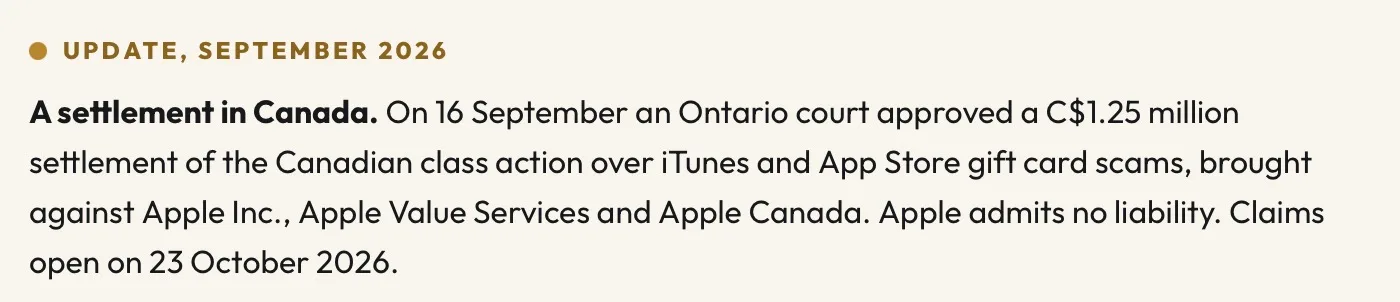
In June 2022, Judge Edward Davila dismissed part of the case but let the plaintiffs proceed, finding they had plausibly alleged that Apple received some of the proceeds. "Apple stands to benefit from proliferation of the scam," he wrote, Courthouse News reported. The ruling was not a finding of liability. Apple agreed to settle, and in July 2024 class counsel announced a $35 million settlement, which received final approval, Mealey's reported in January 2025. We found no US prosecution of a scheme cashing out gift cards through a laundering app.
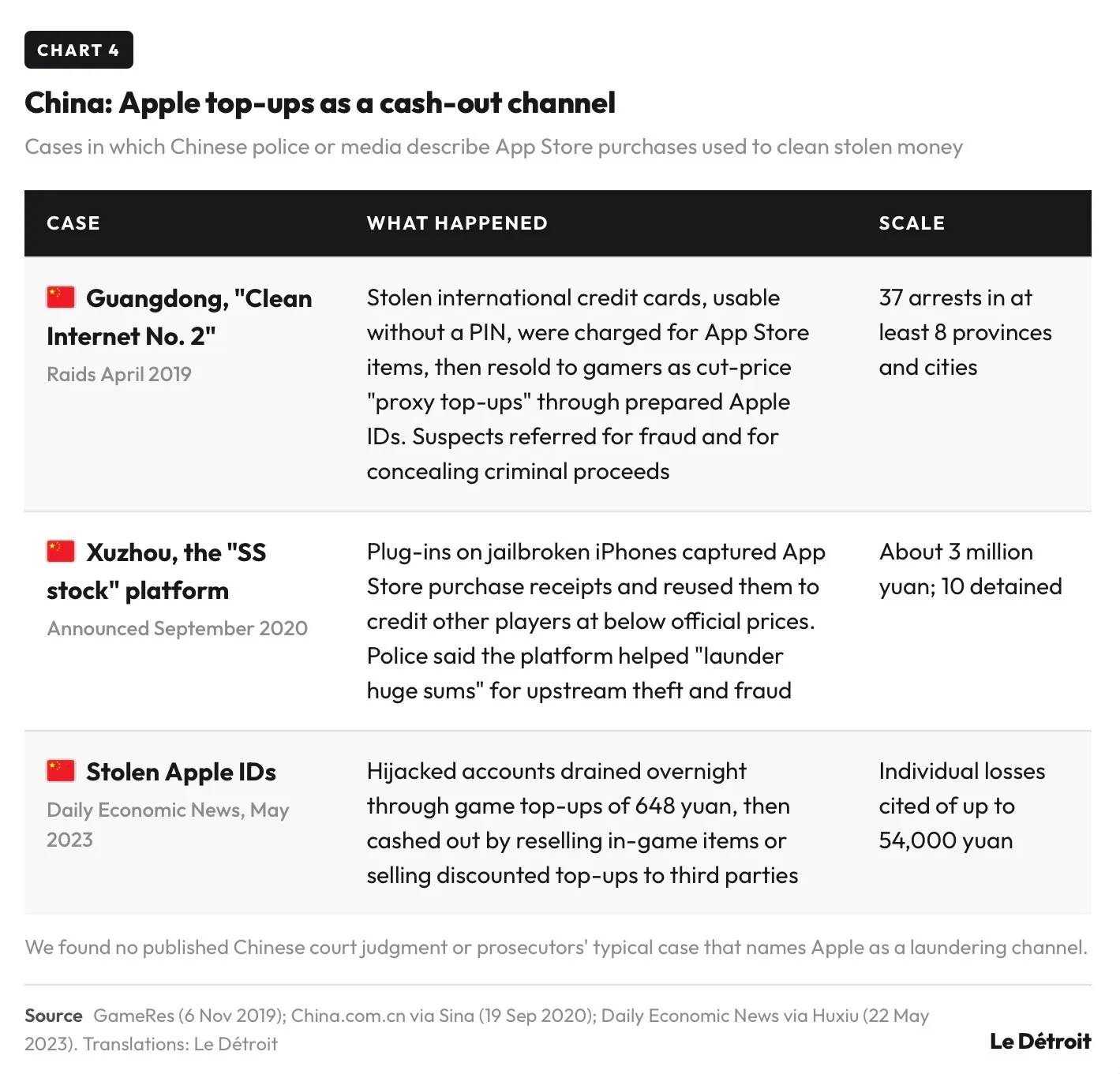
In China, the same logic runs through Apple ID top-ups. Police cases from 2019 and 2020 describe stolen credit cards charged for App Store purchases, resold to gamers at a discount, and a platform that, in the police's words, served to "launder huge sums" for upstream theft and fraud.
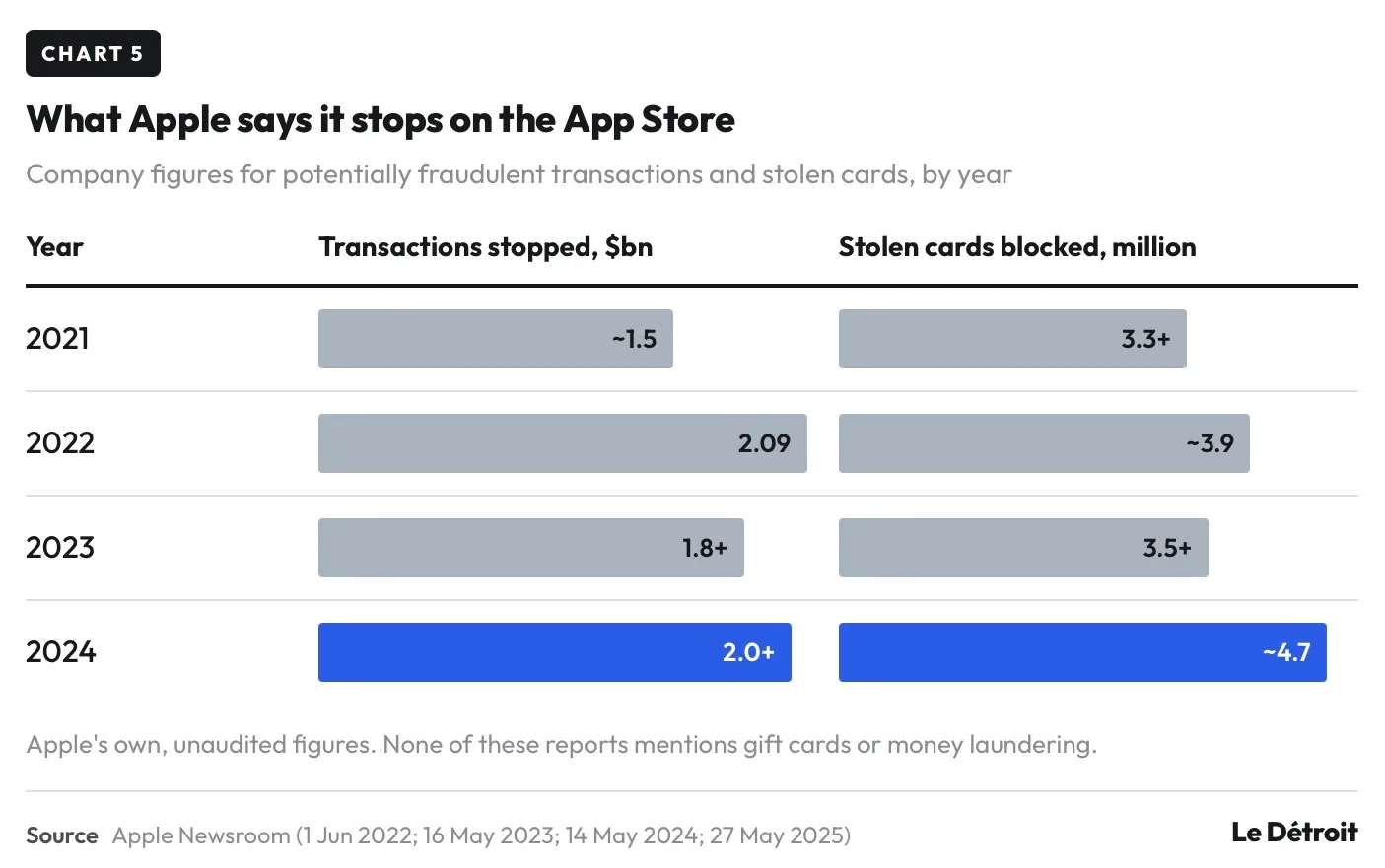
Apple publishes yearly figures on the fraud it says it blocks. For 2024 it reported stopping more than $2 billion in fraudulent transactions, identifying nearly 4.7 million stolen credit cards and banning more than 1.6 million accounts from transacting again. The reports describe fraud in general and never mention gift cards or laundering.

8. Fake phones in, real phones out
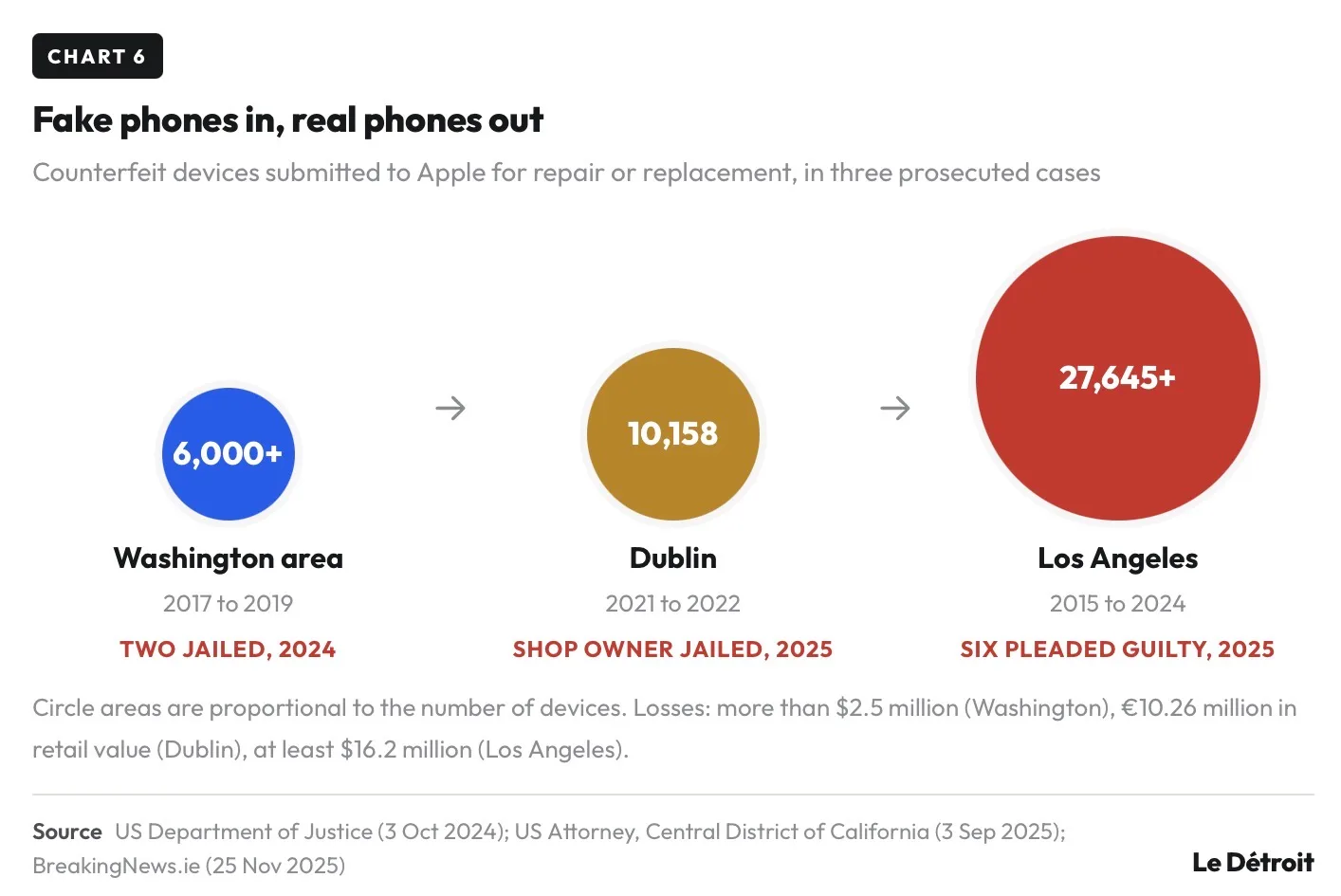
Another route converts counterfeit phones into genuine ones through Apple's own repair and return system. Between 2017 and 2019, two Chinese citizens living in Maryland submitted more than 6,000 counterfeit iPhones to Apple stores and authorised service providers for repair or replacement. The fakes were shipped from Hong Kong to mailboxes around Washington. Apple's loss was more than $2.5 million. Haotian Sun and Pengfei Xue were sentenced in October 2024 to 57 and 54 months.
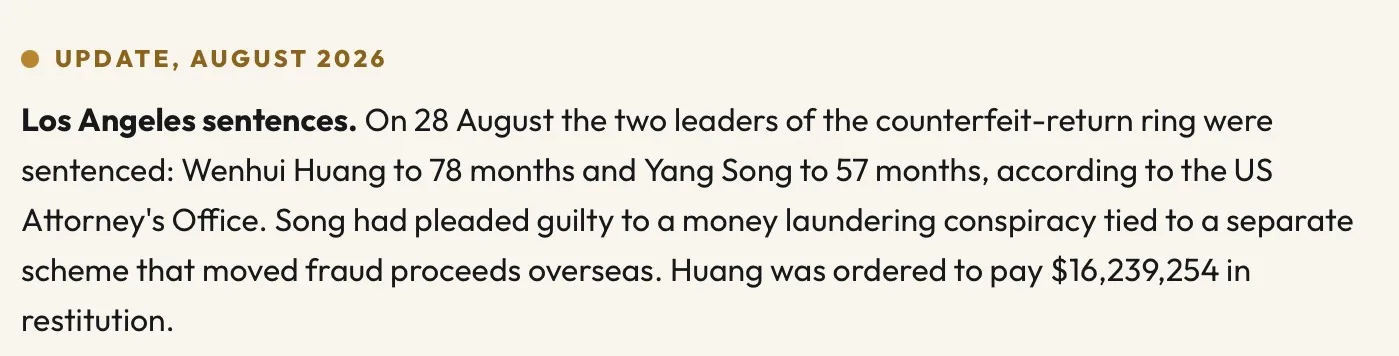
In Los Angeles, prosecutors charged a ring in May 2024 with returning more than 16,000 counterfeit Apple devices between December 2015 and March 2024 and sending the genuine replacements abroad, mainly to China, where, prosecutors said, they "were resold at a substantial profit." By September 2025, six defendants had pleaded guilty, the count had risen to more than 27,645 devices, and the loss to at least $16,239,254. One of them pleaded guilty to a money laundering conspiracy involving more than $1 million from elder fraud schemes.
In Dublin, the owner of the Murray Mobile phone shops, Chengwen Guo, was sentenced in November 2025 to seven years and nine months for theft and money laundering offences, BreakingNews.ie reported. Counterfeit "zombie" phones carrying the identification numbers of real iPhones were passed through a repair firm, declared beyond repair and replaced by Apple under warranty. The replacements went mostly to Hong Kong, and some were sold on the Russian market. BreakingNews.ie described him as the "Irish representative of a transnational crime organisation". At the sentencing of an employee of the repair firm a month earlier, Judge Martin Nolan summed it up: "Apple lost considerably and others gained considerably."
9. Where the phones end up
The records name the same destinations again and again. New Hampshire's cells shipped to China, Hong Kong and Southeast Asia. The Amherst devices were bound for China or the UAE. HSI said networks exported iPhones and other Apple products "to Hong Kong, the United Arab Emirates, and elsewhere", in "thousands of parcels" sent by express courier. FinCEN adds Mexico to the list.
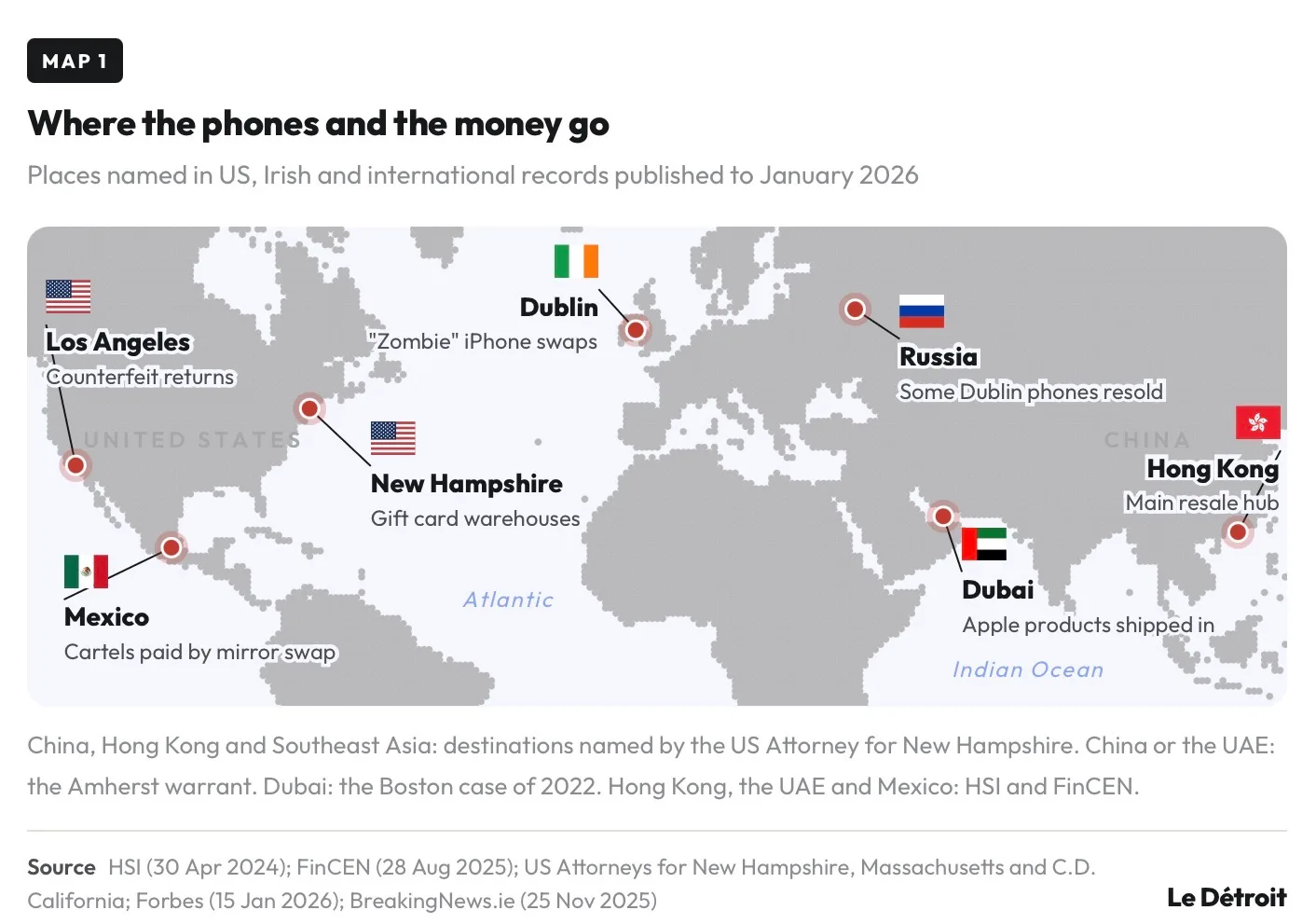
Hong Kong matters because it is the gateway to mainland China. We found no official document describing phones smuggled from Hong Kong as a settlement tool for underground banks, but the smuggling itself is well documented: in November 2022, Hong Kong customs seized about 10,000 suspected smuggled smartphones being loaded onto a speedboat at Tai O, worth about HK$11 million. The seizure notice does not say which brands, and smuggling is not proof of laundering. Dubai and Hong Kong are also hubs for iPhones re-exported to Russia, where Apple stopped selling in 2022. That is a separate grey trade, but the Dublin case shows it can absorb laundered stock.
10. What Apple says, and what nobody knows
Apple sits on several sides of this story. It is the victim of the counterfeit-return schemes. It is the seller of the devices and cards that launderers use. Through the App Store it was, according to plaintiffs it settled with, a recipient of part of the proceeds, a claim never tested at trial. And it is a source of evidence: Forbes reported that it had been giving information to investigators. It has not explained its approach publicly, and its yearly fraud reports do not mention gift cards.
The gaps are large. There is no official estimate of how much money is laundered through Apple products. FinCEN's data do not break down electronics by brand. WeChat, used to coordinate the trade, does "not comply with U.S. legal process", according to Forbes's reporting on the warrant. And the incentive remains: as long as China limits how much money its citizens can move abroad, and criminal groups hold dollars they cannot bank, a phone that can be bought in New Hampshire and sold in Hong Kong will be worth more than the price on the box.