1. Four leave the money-laundering grey list, and Vietnam is warned
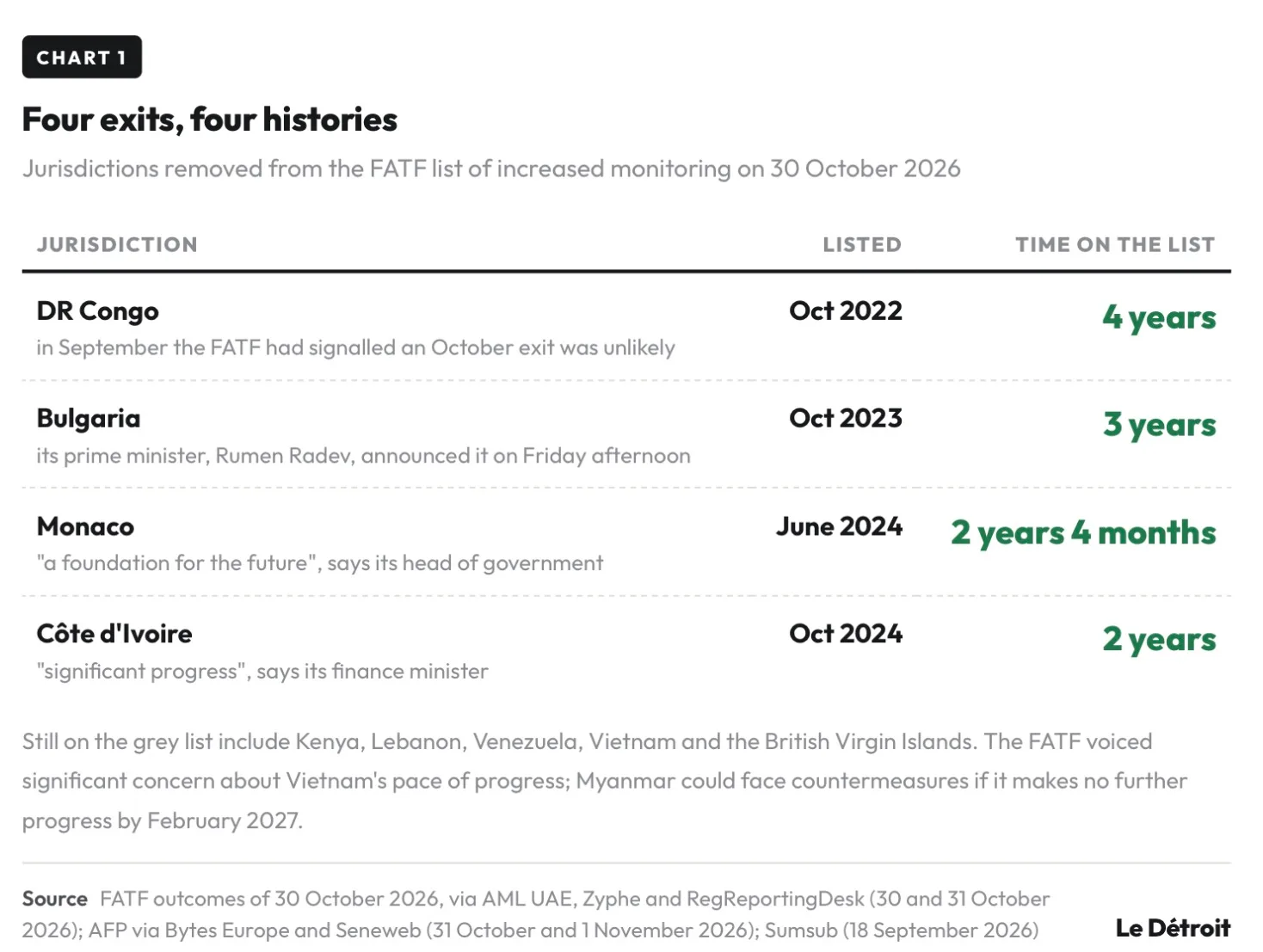
Friday's announcement from Sofia is now official, and it has company. At the close of its plenary in Paris on Friday 30 October, the Financial Action Task Force took Bulgaria, Monaco, Côte d'Ivoire and the Democratic Republic of Congo off its list of jurisdictions under increased monitoring, saying they had completed their action plans. The "grey list" shrinks from 22 names to 18, and none was added. The Congo is the surprise: in September, the FATF itself had signalled that a delisting in October was unlikely, because of the public-health situation there. Monaco's head of government, Christophe Mirmand, called the reforms "not a final destination" but "a foundation for the future". At its first plenary under a new British president, Giles Thomson, the watchdog turned up the pressure elsewhere: it voiced significant concern about Vietnam's slow progress, kept Iran and North Korea under countermeasures, and said Myanmar could face them if it makes no further progress by February 2027.
https://x.com/rumenradevpm/status/2116206767906468185?a=vRXbFxhLw9pRmHPEW70&s=61

2. The FBI blames North Korea for the Binance theft, and withdrawals reopen
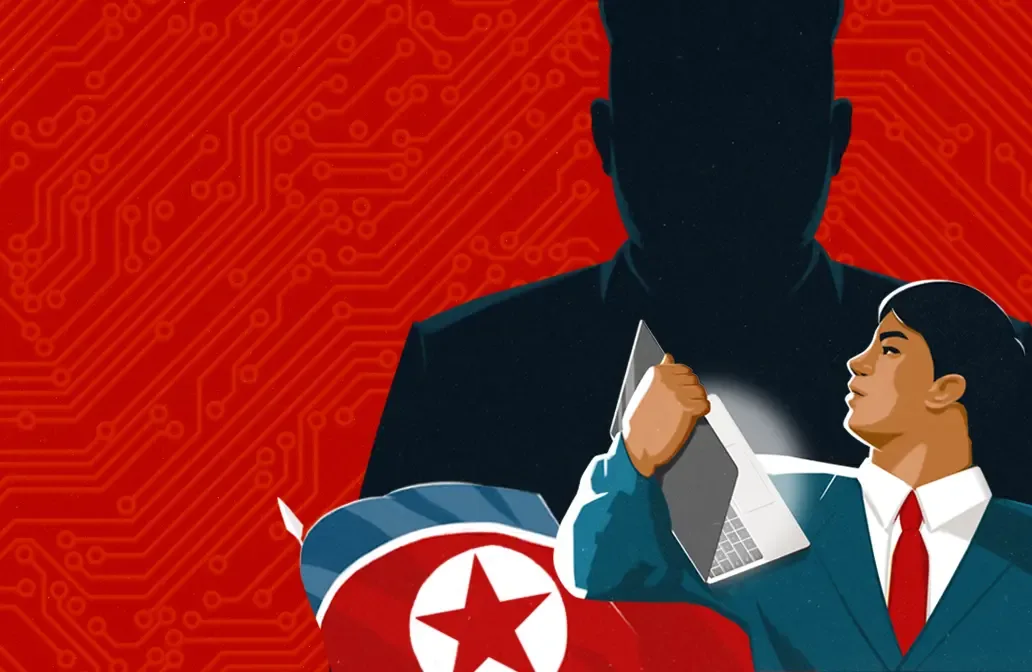
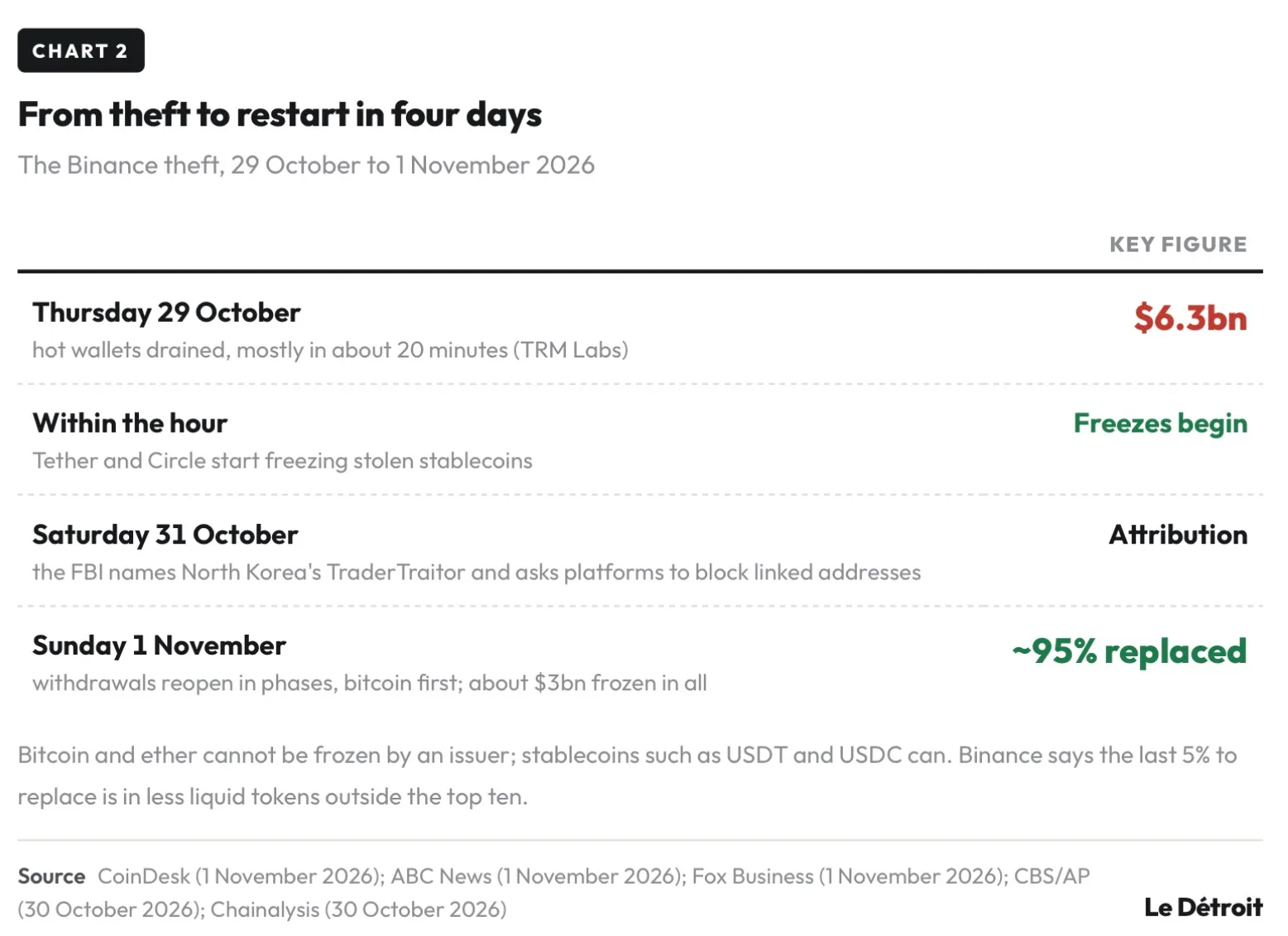
Washington has put a name on the biggest theft in crypto history. On Saturday 31 October, the FBI, working with the Secret Service and IRS Criminal Investigation, said TraderTraitor, a North Korean state-backed unit, was behind the theft of more than $6 billion from Binance on Thursday. The group is converting the loot mainly into ether, and the bureau expects it to be laundered further through decentralised-finance platforms and instant swap services; it asked exchanges and analytics firms to block linked addresses. President Donald Trump sounded less sure: "We don't know if it's North Korea, but if it is, we'll talk to them about it." On Sunday, Binance reopened withdrawals in phases, starting with bitcoin, and said it had replaced about 95% of the affected assets with company funds, up from 90% a day earlier. About $3 billion of the loot is frozen, mostly in stablecoins that their issuers can block.

3. Intel has its worst day since 1974, and drags Wall Street down
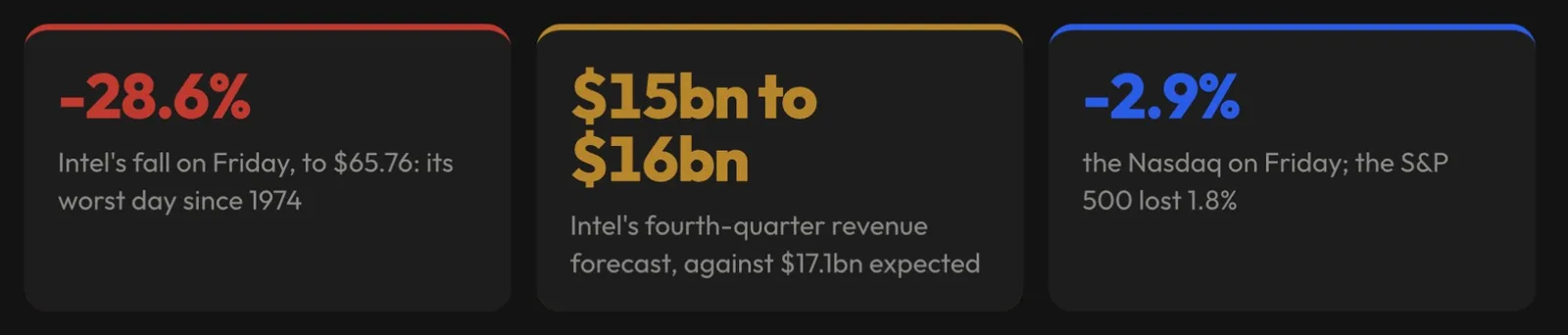
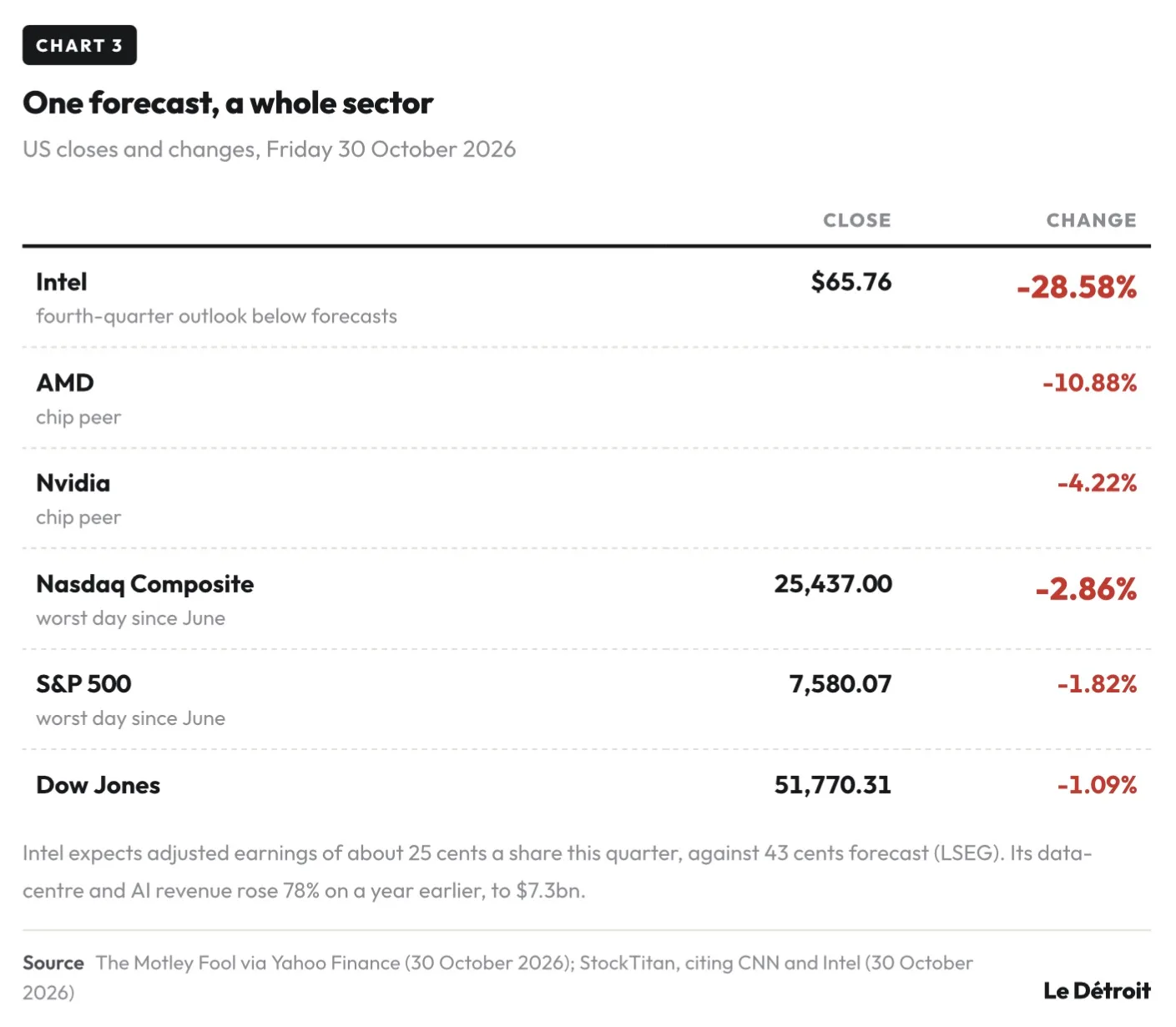
One chipmaker's forecast was enough to send Wall Street into the weekend in the red. Intelshares fell 28.6% on Friday 30 October, to $65.76, their worst day since 1974, CNN reported. Its quarterly earnings beat forecasts; the outlook did not. Intel forecast fourth-quarter revenue of $15bn to $16bn, a midpoint about 9% below the $17.1bn analysts expected, and adjusted earnings of about 25 cents a share against 43 cents. "Looking ahead, we see the PC slowdown continuing at least through the first half of next year," said David Zinsner, its finance chief. Data-centre and AI sales rose 78%, to $7.3bn, but could not carry the rest. The pain spread across the sector: AMD lost 10.9% and Nvidia 4.2%. The S&P 500 fell 1.8% and the Nasdaq 2.9%, both their worst days since June, and the Nasdaq ended October with its worst month since March 2025.
https://x.com/kobeissiletter/status/2116166412024868892?a=paP1RWUVLj6KUGmktfg&s=61
4. The euro area slows to 0.4%, and France shrinks
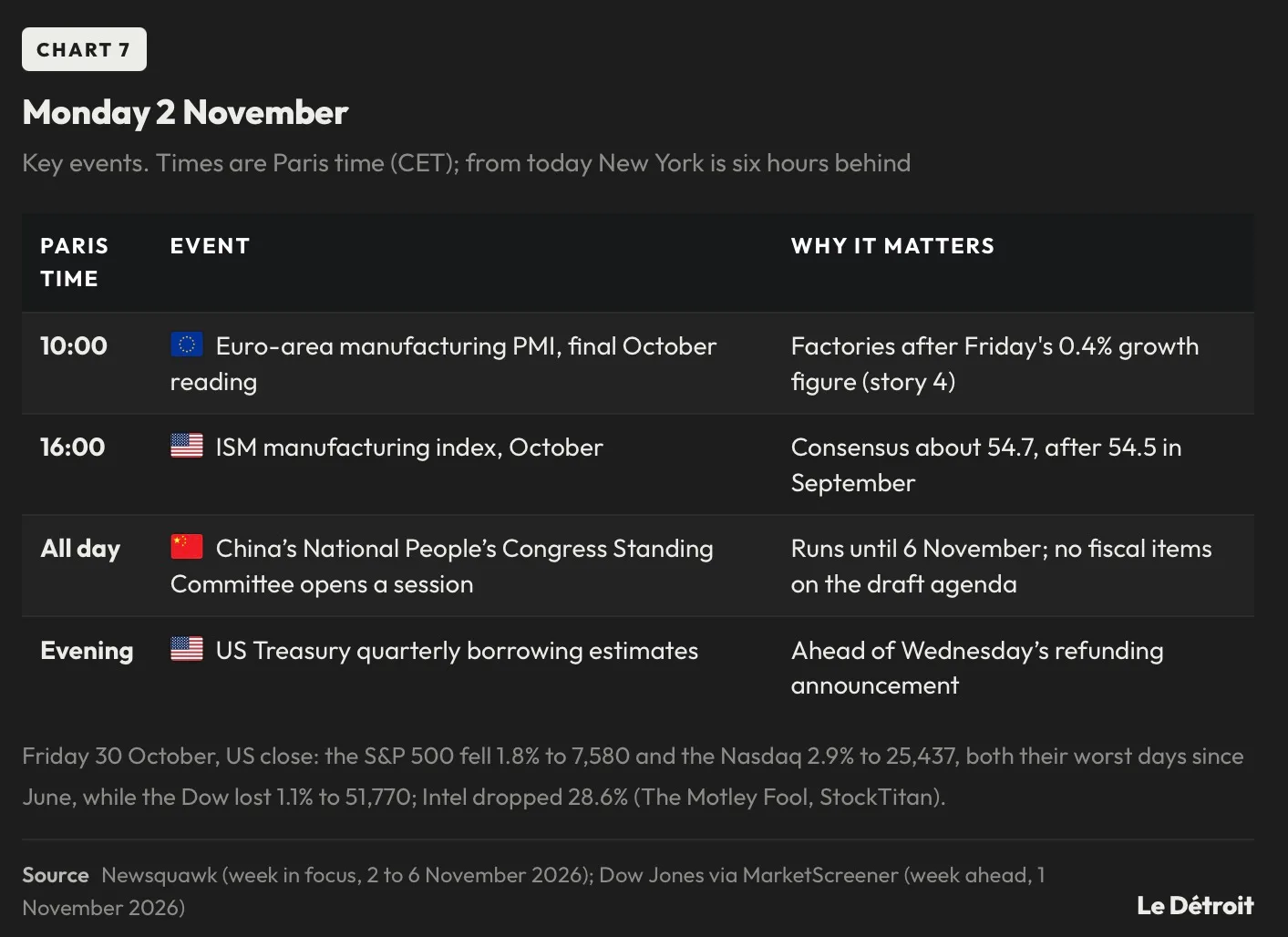
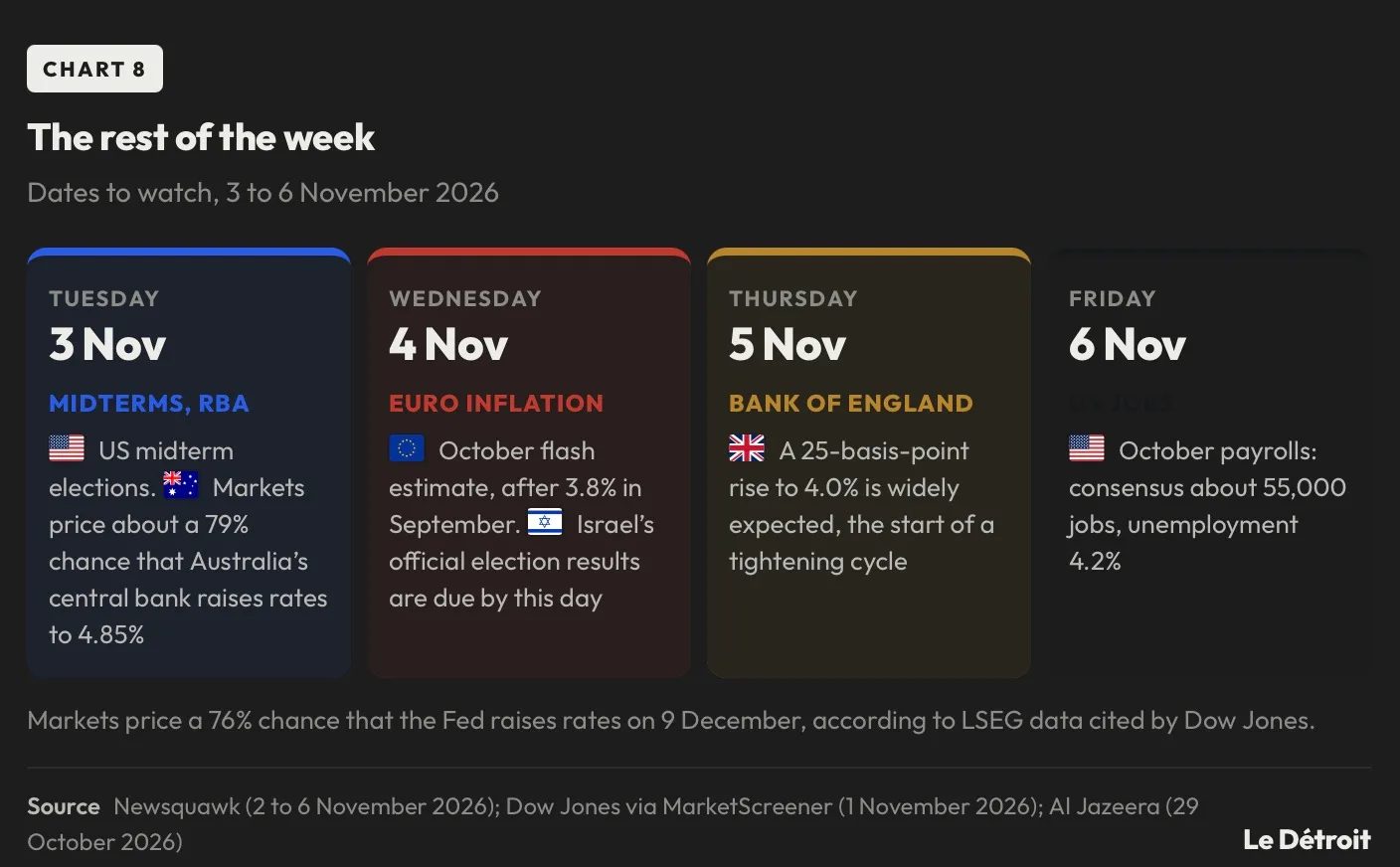
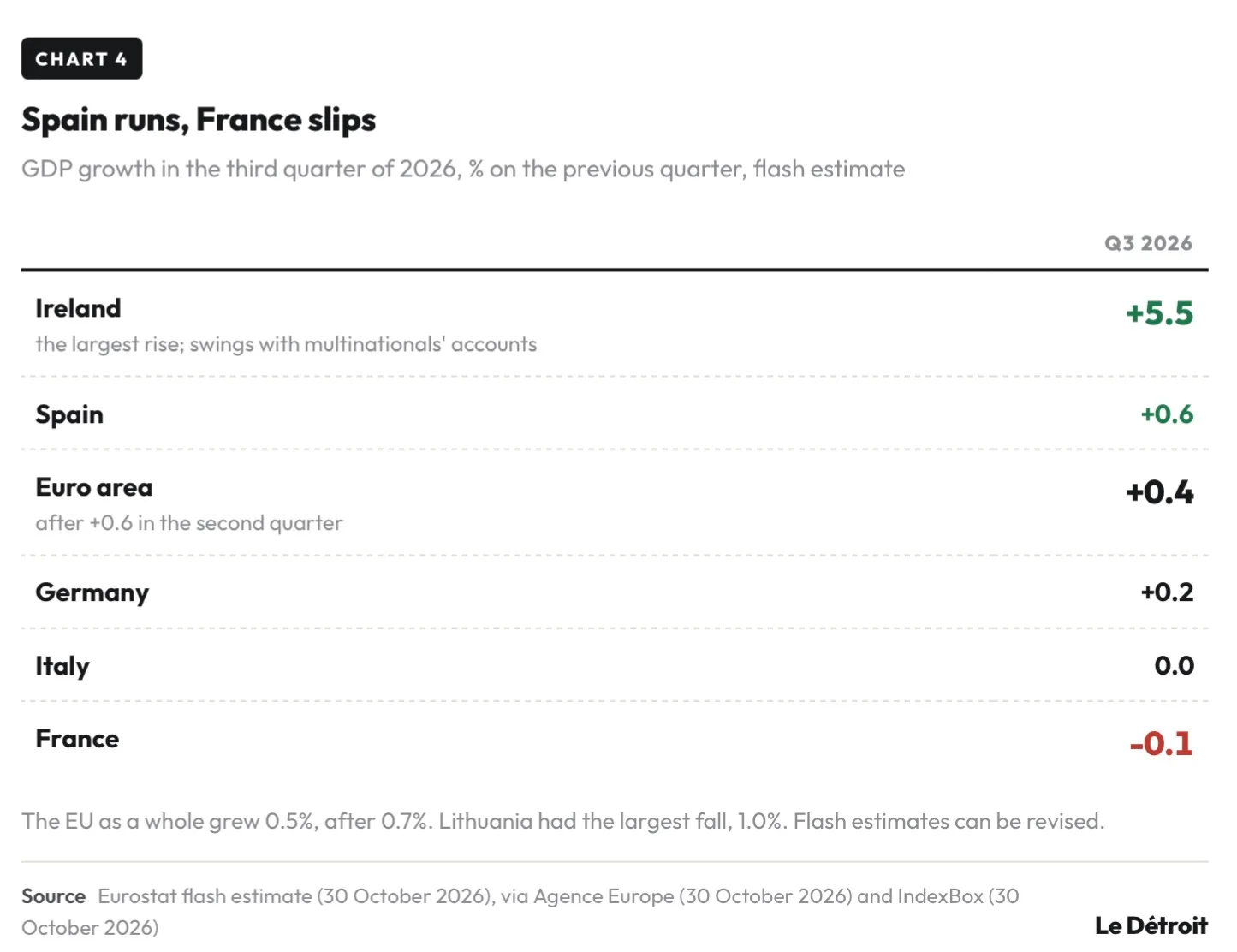
Europe's economy kept growing through the energy shock, but more slowly and very unevenly. Euro-area GDP rose 0.4% in the third quarter, after 0.6% in the second, Eurostat's flash estimate showed on Friday 30 October; output was 1.3% higher than a year earlier. The big economies did the slowing. France shrank by 0.1%, Italy stood still and Germany grew 0.2%, while Spain grew 0.6%, barely slower than its 0.7% in the second quarter. Ireland, whose figures swing with the accounts of multinationals, jumped 5.5% and flattered the total. For the European Central Bank, which held its deposit rate at 2.50% on Thursday with inflation at 3.8% in September, this is the awkward mix: slower growth and high prices. Wednesday's October inflation estimate will sharpen the dilemma; Investec expects 3.9% and LBBW 4%.

5. Iran says four tankers hit mines and burned in the Strait of Hormuz
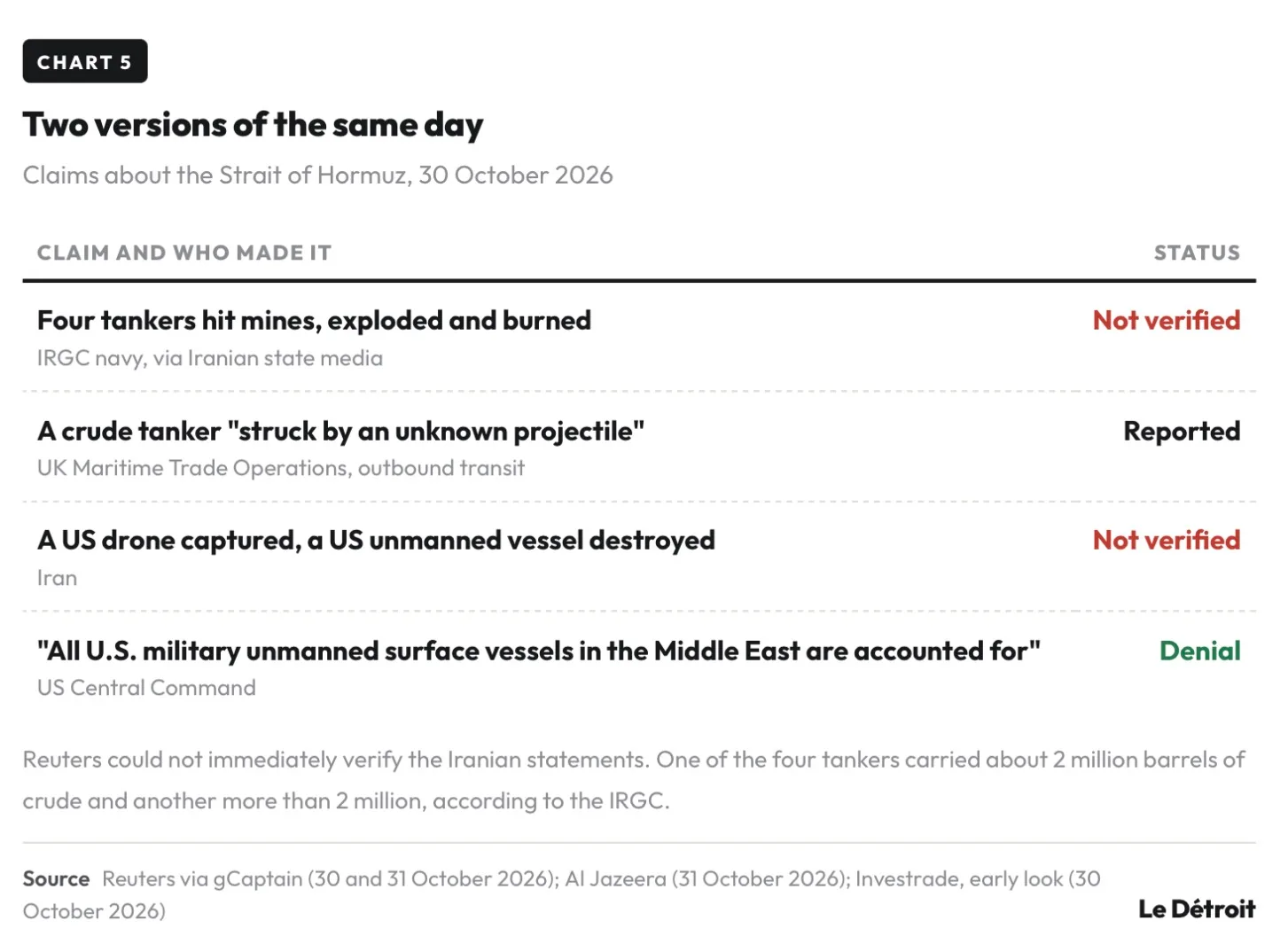
The world's most important oil chokepoint is burning again, by Tehran's account. Iran's Revolutionary Guards navy said on Friday 30 October that four oil tankers caught fire and exploded after trying to use "unauthorised routes"; one was carrying about 2 million barrels of crude and another more than 2 million, Iranian state media reported. Reuters could not verify the claim, and the details differ: the UK Maritime Trade Operations centre said a crude tanker sailing out of the Gulf had been "struck by an unknown projectile"; it was not clear whether it was one of the four. Iran also claimed to have captured a US drone and destroyed an unmanned US vessel; US Central Command called the vessel claim false. The strait, which carries around a fifth of the world's oil, has been contested since the American and Israeli strikes on Iran at the end of February. Brent crude traded at about $113.5 a barrel early on Friday.

6. America votes on Tuesday, with Democrats ahead in the polls
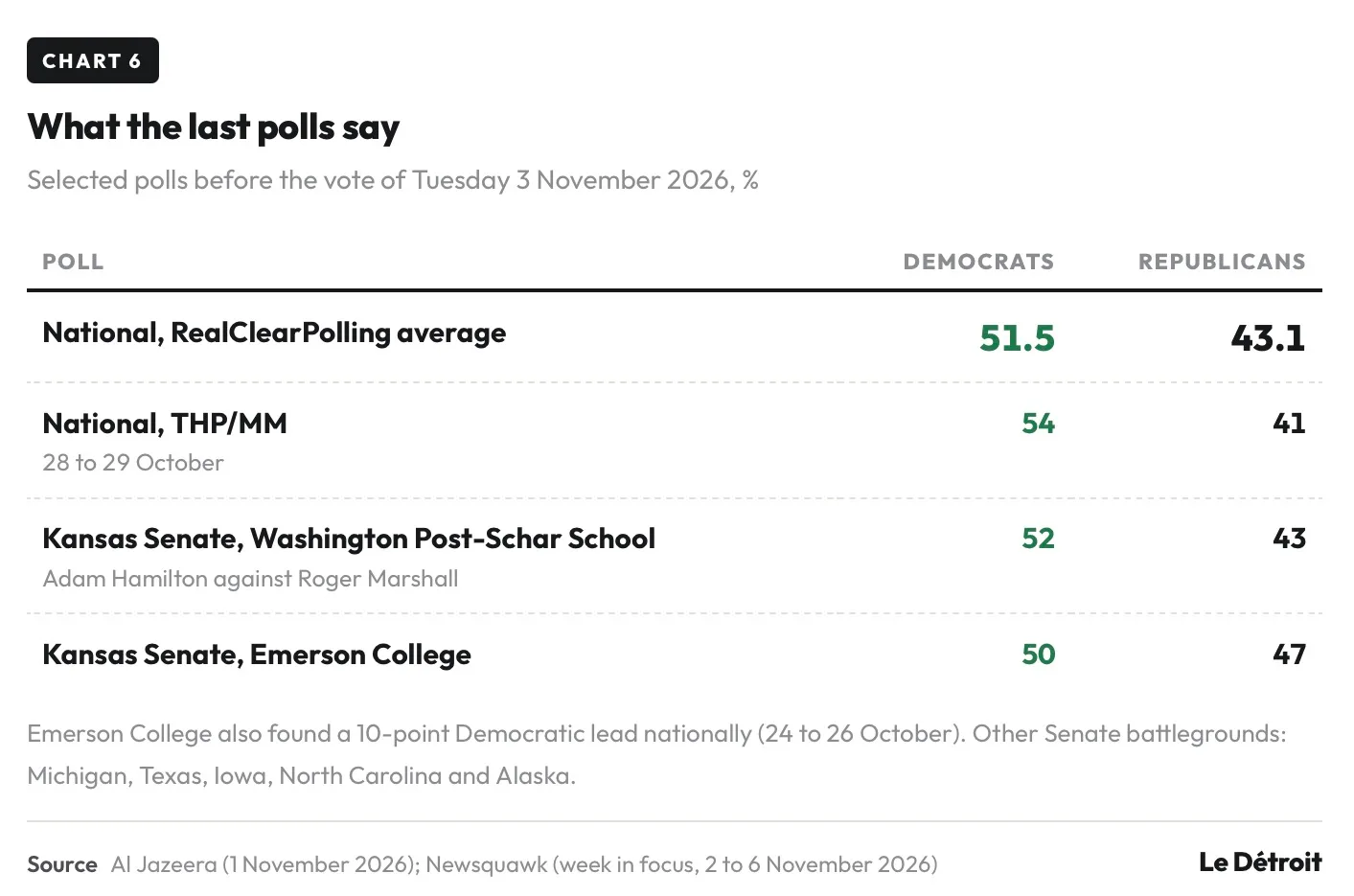
The biggest political test of Donald Trump's second term is a day away. On Tuesday 3 November, Americans elect all 435 members of the House of Representatives, 35 senators and 36 governors. Democrats need a net gain of three House seats and four Senate seats to control both chambers. The polls favour them: the RealClearPolling average gives Democrats 51.5% against 43.1%, and Emerson College found a ten-point lead last week. More than 51 million Americans had already voted, according to reports, though early ballots say nothing about how they voted. The House looks the likelier prize; the Senate turns on Michigan, Texas, Kansas, Iowa, North Carolina and Alaska. In Kansas, where no Democrat has won this Senate seat since 1932, a Washington Post-Schar School poll put Adam Hamilton ahead of Roger Marshall, 52% to 43%. "We can be fairly confident that Democrats will win the House majority, but the Senate picture is unclear," one analyst told Al Jazeera.

Monday and the week ahead