1. Saudi Arabia calls off its Davos in the Desert
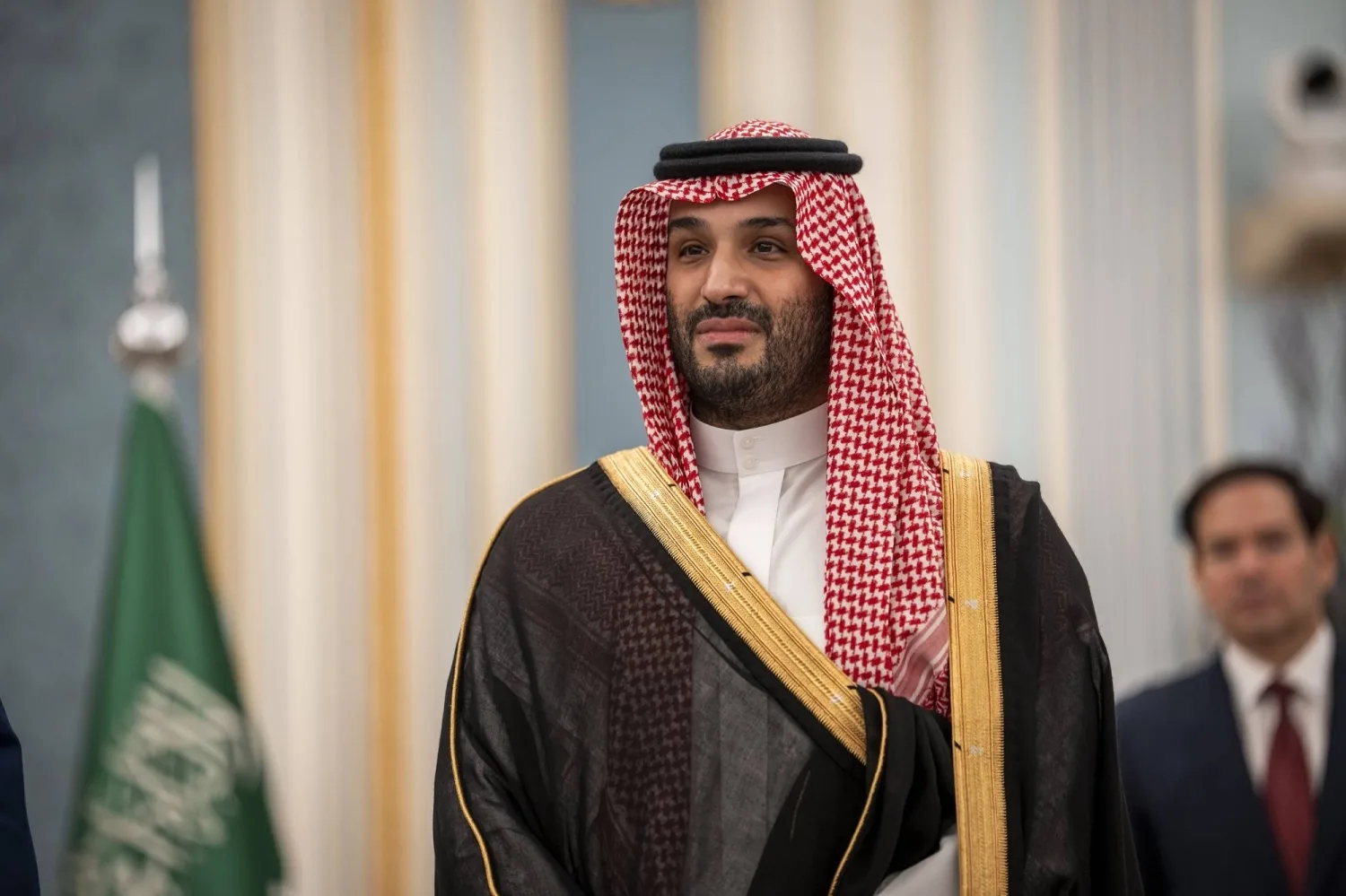
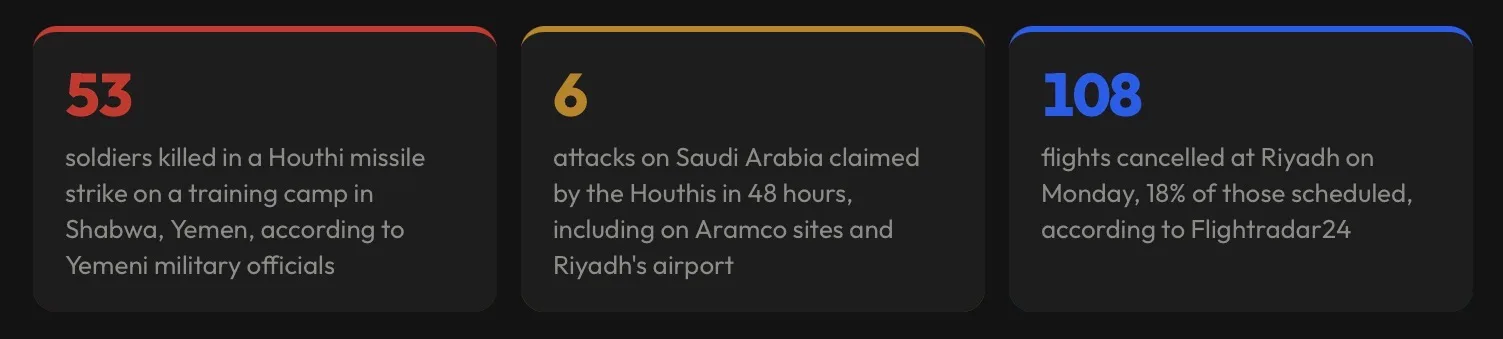
Saudi Arabia on Monday postponed to 2027 its Future Investment Initiative, the "Davos in the Desert" that was due to open in Riyadh on 26 October with guests such as BlackRock's Larry Fink and JPMorgan's Jamie Dimon, after weeks of escalating Houthi attacks on the kingdom. Yemen's Houthis claimed six attacks on Saudi Arabia in 48 hours, on an Aramcosite in Yanbu, the Shaybah oilfield, the airports of Riyadh and Abha and military targets; Riyadh did not immediately confirm them, and Reuters could not verify them. In Yemen, a Houthi missile strike on a government training camp in Shabwa killed at least 53 soldiers, Yemeni military officials said, and wounded about 200 recruits, according to the provincial government. Rashad al-Alimi, who heads Yemen's Saudi-backed Presidential Leadership Council, promised a "firm response". In Cairo, parliament postponed to 26 October a debate on President Sisi's request to authorise military support for Saudi Arabia. US crude settled up 2.2% at $103.66 a barrel. The organisers said the delay would let the tenth edition deliver "the full scale, extraordinary quality, and unforgettable impact that our community has come to expect".
https://x.com/saudi_gazette/status/2112240903502901395?s=61
2. Lavrov flies to Tehran
Russian Foreign Minister Sergei Lavrov arrived in Tehran on Monday, his first visit since the United States and Israel launched strikes on Iran on 28 February. Moscow's efforts are "aimed at preventing the return of a large-scale war", he said, as talks between Washington and Tehran have stalled. At a joint press conference, Iranian Foreign Minister Abbas Araghchi said the war imposed by the United States and Israel, combined with the economic blockade, was "the principal source of insecurity in our region". In an interview with Tasnim on Sunday, he said Washington could meet Iran's conditions for reopening the Strait of Hormuz "within a few days". Vladimir Putin told President Masoud Pezeshkian in early October that Russia was ready to help mediate. On Monday, Benjamin Netanyahu released a video of a call with Donald Trump in which he said of Iran: "Donald, we have a job to finish."
3. China beats forecasts, but not at home
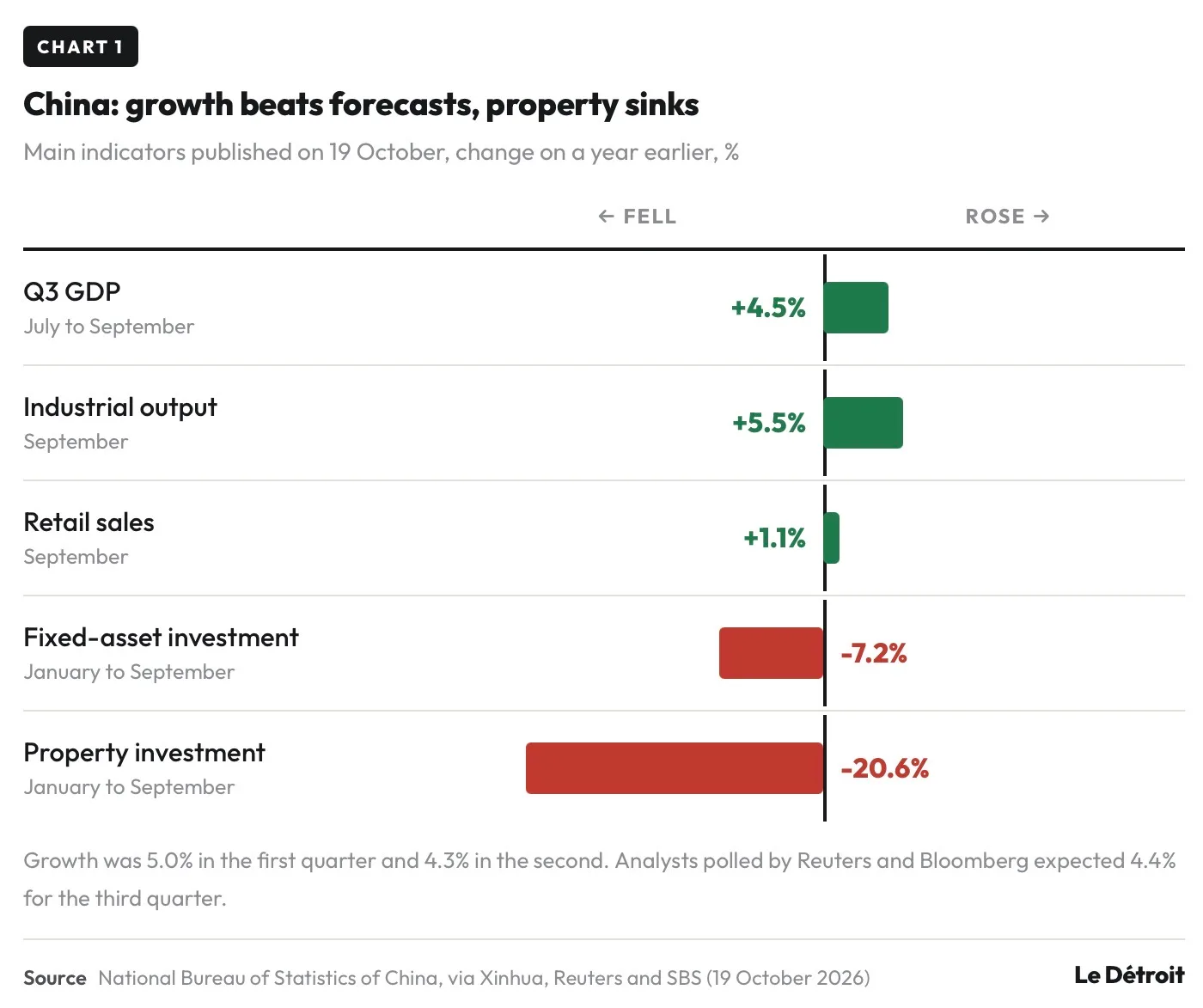
China's economy grew 4.5% on a year earlier in the third quarter, up from 4.3% in the second and above the 4.4% expected by analysts polled by Reuters and Bloomberg, the National Bureau of Statistics said on Monday. Growth over the first nine months reached 4.6%, within the government's target of 4.5% to 5% for the year. Exports carried the economy, while domestic demand stayed weak: retail sales rose just 1.1% in September, fixed-asset investment fell 7.2% over nine months, and investment in property development dropped 20.6%. The bureau itself said the problem of "insufficient domestic demand remains prominent". "Growth has stabilised, but it has not yet entered a self-sustaining recovery," said Raymond Yeung, who leads ANZ's Greater China economics team. Urban unemployment eased to 5.2%.
4. France imposes curfews, including in Lyon
Prime Minister Sébastien Lecornu asked prefects on Monday to impose local, partial curfews after the weekend's riots. In Paris, Place de la République and the streets around Les Halles are under curfew from 11pm to 6am, and protests are banned in several parts of the city from 8pm. Nice and Coulaines imposed curfews for minors, and Lille, Douai, Denain and Wattignies imposed curfews from 8pm to 6am on Monday and Tuesday nights. In Lyon, the prefect of the Rhône, Étienne Guyot, imposed a curfew on part of the Presqu'île from 9pm to 6am, after 160 people were taken into custody on 17 October and about 40 more were arrested since, and more than 100 police officers and gendarmes were injured. Interior Minister Laurent Nuñez, who said police had "lost control", offered to resign; Emmanuel Macron refused, to preserve the chain of command. Justice Minister Gérald Darmanin said more than 2,330 people were taken into custody over the weekend, 70% of them adults. "It is out of the question to put all of Paris under curfew," Lecornu said.
https://x.com/afpfr/status/2112244284535591413?s=61
5. $270 million of suspected student aid fraud
The US Treasury said on Monday that its financial intelligence unit, FinCEN, had identified about $270 million of suspicious activity possibly linked to fraud against federal student aid, across more than 20,000 transactions since February. Banks filed nearly 100 suspicious activity reports after a FinCEN alert in July, and the findings have been referred to federal investigators. The schemes include "ghost students", enrolled with stolen identities; "straw students", paid to lend their names while rings pocket the aid refunds; and synthetic identities mixing real and invented data. The figures cover only activity reported by banks and "do not represent the full scope" of the fraud, Fox Business reported. Education Secretary Linda McMahon pointed to a new FAFSA fraud detection tool and said the department's anti-fraud work with a White House task force was "already saving American taxpayers more than $2 billion in less than 2 years".
6. Mali's army accused of killing civilians from the air
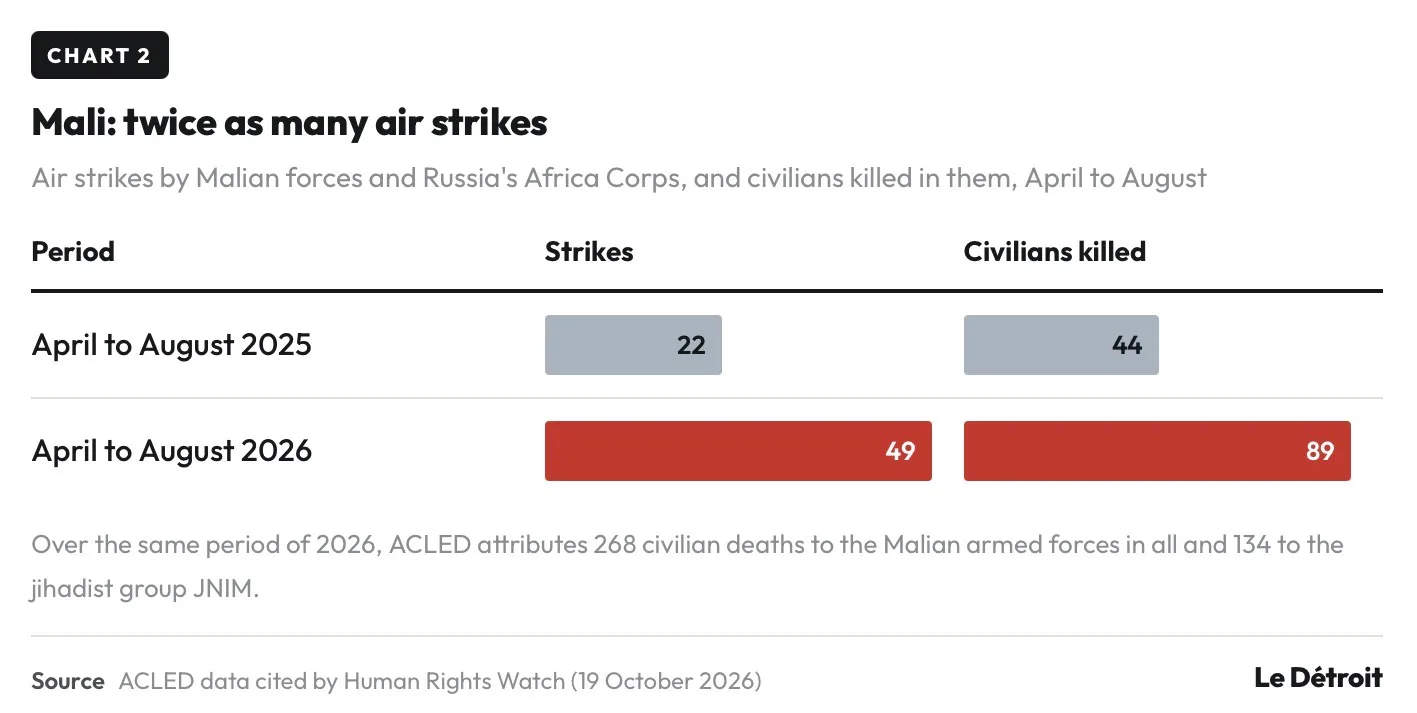
Human Rights Watch accused Mali's army of killing civilians in apparently indiscriminate drone strikes, and its Russian allies of joining in abusive operations, in a report published on Monday. Citing data from the conflict monitor ACLED, it counts 49 air strikes by Malian forces and Russia's Africa Corps, the successor to Wagner, between April and August, killing 89 civilians, against 22 strikes and 44 deaths a year earlier. HRW documents a drone strike that killed six civilians in Tombonkore on 19 August, and soldiers shooting five girls aged 10 to 13 in Niono on 12 July. It also blames the jihadist group JNIM and Tuareg-led FLA rebels for the execution of at least 19 soldiers taken prisoner at Tabrichat on 18 July, after their attack on a military convoy. "The Malian military, armed groups, and insurgent forces are committing grave laws-of-war violations," said Ilaria Allegrozzi, HRW's senior Sahel researcher.