1. A missile hits Aramco's headquarters
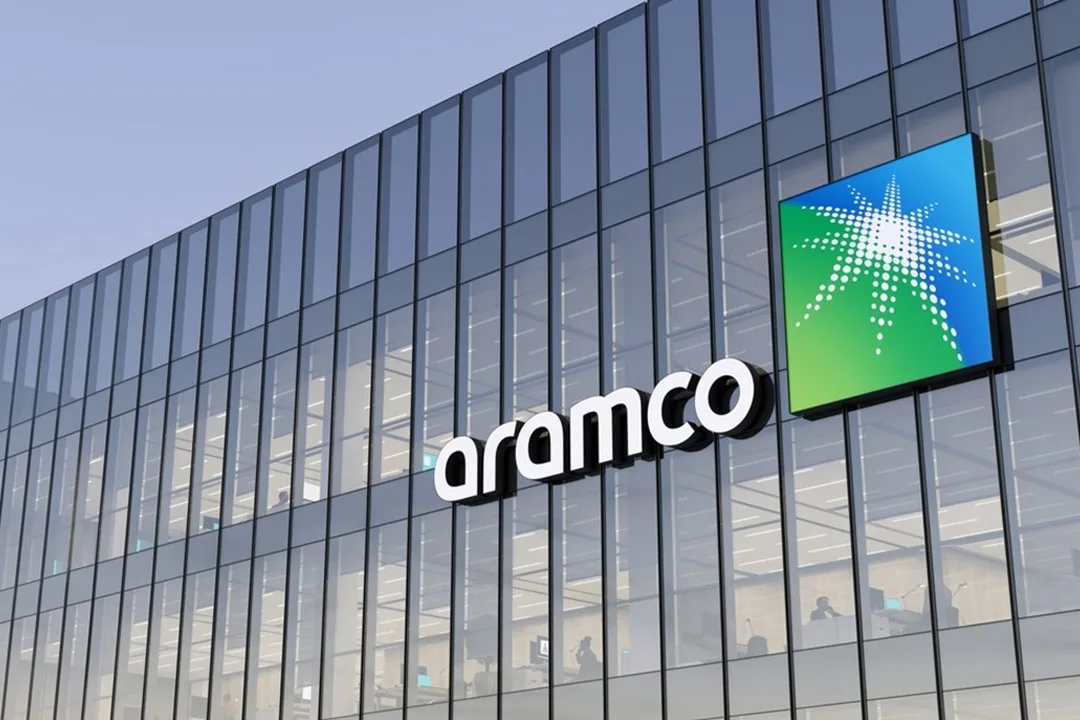
The Saudi-Houthi war reached the heart of the kingdom's oil industry on Tuesday night. An attack hit an administrative building of Aramco in Dhahran, in the Eastern Province, causing a "limited fire" and no injuries, Saudi Arabia's Energy Ministry said. The coalition said it had intercepted Houthi ballistic missiles aimed at the province, with debris falling on a residential area of Dhahran. A company source told Reuters that a ballistic missile struck the headquarters complex, damaging the top three floors of an office tower. Hours earlier, the Saudi-led coalition had ordered civilians to leave the al-Sabaha central station, a fuel depot outside Sanaa, then said it attacked the station and other sites to neutralise the Houthis' capabilities. In Riyadh, debris from two intercepted missiles injured four peopleand damaged 15 homes, according to Saudi Civil Defense. Riyadh's airport has now been hit four times, including on Saturday, when 13 people were killed. Washington now requires US government staff to obtain special authorisation to use any Saudi airport.
https://x.com/spa_eng/status/2110122621232652427?s=61
2. Bank of America pays $1.2 billion for laundering failures
The US Treasury hit Bank of America with a $1.2 billion penalty on Tuesday, the third-largest in the department's history. FinCEN said the bank failed to "mitigate and report priority national security risks", including Chinese money laundering networks and illicit finance along the southwest border, and that it admitted willfully violating the Bank Secrecy Act. According to the Treasury, the bank failed to report more than $5 billion in suspicious transactions and effectively outsourced parts of its detection to law enforcement and other banks. The OCC added a $750 million penalty, its largest ever, which will be credited against FinCEN's, and OFAC settled more than 475 apparent sanctions violations for $11.6 million. "Even the biggest financial institutions are not above the law," said Treasury Secretary Scott Bessent. The bank said it is "responsible for getting it right". Its shares fell more than 2%.
3. The IMF sees a resilient but lopsided world
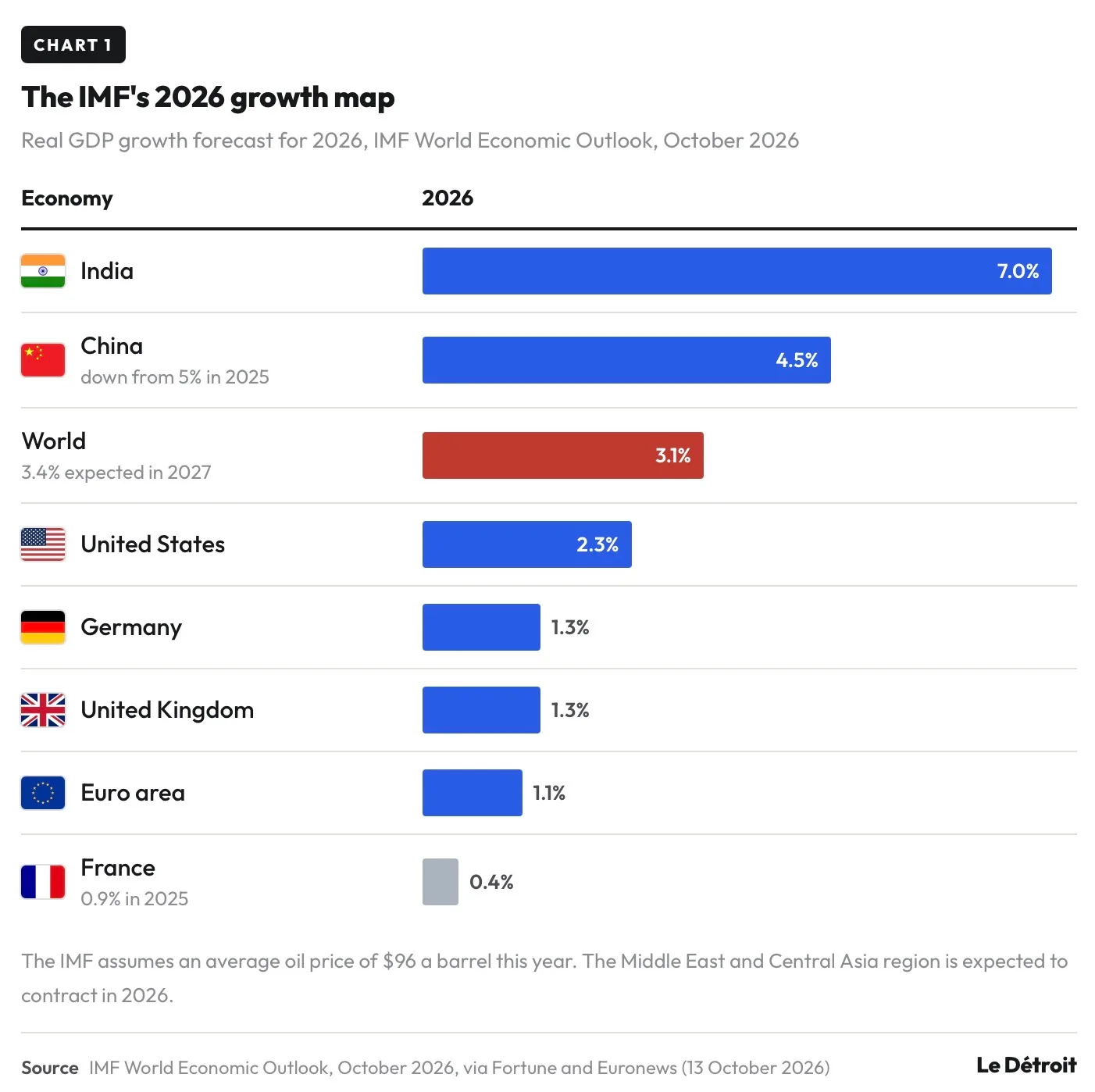
The International Monetary Fund raised its forecast for global growth in 2026 to 3.1%, from 3.0% in July, in its World Economic Outlook presented on Tuesday at its annual meetings in Bangkok, before a pick-up to 3.4% in 2027. The United States should grow 2.3%, China 4.5%, down from 5% last year, and the euro area just 1.1%. France stands out with 0.4%, and unemployment rising to 8.4%. Growth is concentrated: 32 countries account for 95% of world growth, against 54 in April, and the US and China absorb more than three quarters of net imports of chips and AI equipment. "The outlook is highly uneven," said Silvana Tenreyro, the IMF's director of research. The Fund warns of energy prices, low European gas stocks and a technology tailwind that "could stop abruptly".
4. A London court complicates the fight for 61,000 bitcoins
Victims of Zhimin Qian, the Chinese fraudster jailed in London for 11 years and 8 months in November 2025, suffered a setback in their battle for some 61,000 bitcoins seized by British police, worth about £3.8 billion according to the Financial Times. In a judgment dated 12 October, Mr Justice Turner of the High Court ruled that their claims must be assessed under Chinese law, not English law, because the contracts, payments and bitcoin purchases all took place in China. Under English law, the claimants could have claimed the bitcoins themselves and their rise in value, rather than just their original stake plus interest. The ruling does not decide who will get the bitcoins, but it strengthens the British state's position. About 16,000 Chinese victims are pursuing claims, according to Caixin.
5. Goldman's trading desk carries Wall Street
The big US banks opened the earnings season on Tuesday, led by a blowout quarter at Goldman Sachs: earnings of $17.01 per share in the third quarter, well above analysts' forecasts, on revenue of $18.68 billion. Its equities traders brought in $6.44 billion, up 72%in a year, and advisory fees hit a record $1.65 billion. JPMorgan's net income rose 6% to $15.3 billion, or $5.57 per share, below the $5.90 expected, according to TheStreet, weighed down by $658 million of losses on investment securities. "The U.S. economy continued to be fueled by strong business investment and ongoing consumer spending," said Jamie Dimon. Wells Fargo fell 3% after disappointing revenue. The S&P 500 closed almost flat, while memory chip stocks fell.
6. Argentina's inflation ticks up to 1.9%
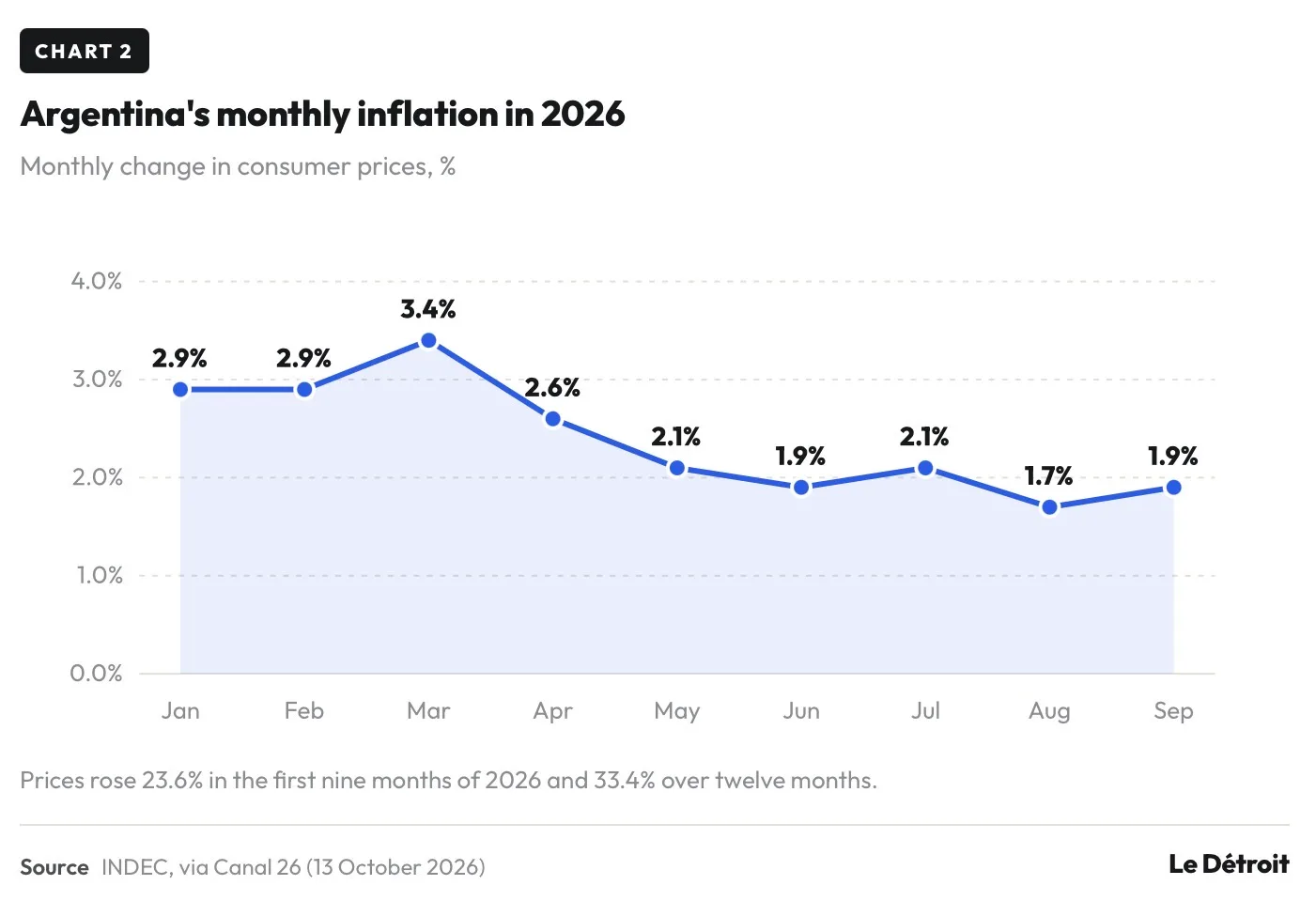
Consumer prices in Argentina rose 1.9% in September, after 1.7% in August, the statistics institute INDEC said on Tuesday, in line with the central bank's survey of forecasters. Over nine months, inflation reached 23.6%, and 33.4% over twelve months. The monthly rate has fallen from a peak of 3.4% in March, but has been hovering around 2% since May. The same day, the IMF cut its 2026 growth forecast for Argentina to 2.1%, and its managing director, Kristalina Georgieva, praised the government's "fiscal discipline" in a meeting with Economy Minister Luis Caputo, Infobae reports.