
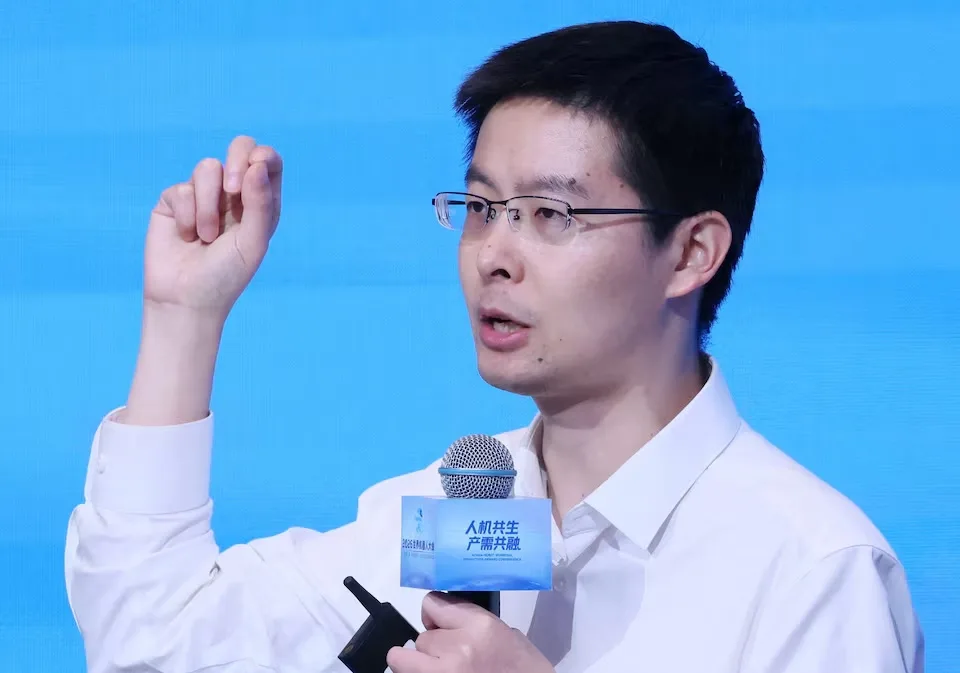
From a 200-Yuan Robot to the STAR Market
Wang Xingxing was born in March 1990 in Yuyao, a city administered by Ningbo in Zhejiang province. He was not a star pupil. A teacher reportedly told his mother that her son was a little slow. He enrolled at Zhejiang Sci-Tech University in 2009 to study mechatronics, and as a first-year student built a small bipedal robot from roughly 200 yuan of parts and hand-made components, before writing his undergraduate thesis on a brushless DC motor controller.
That motor obsession became the company. He went on to Shanghai University for a master's in mechanical engineering, and in his second graduate year won second prize at an intelligent-robotics competition with a quadruped he had built called XDog. The prototype cost him around 20,000 yuan, and the 80,000 yuan prize was, in his telling, his first pot of gold. The insight that made him was economic as much as technical: where Boston Dynamics used expensive hydraulic actuators, Wang used cheap brushless electric motors. He has said he was deeply inspired by Boston Dynamics and has called its founder Marc Raibert his idol, while taking the opposite engineering path.
He graduated in 2016 and joined the drone maker DJI. XDog went viral in domestic and international media at almost the same moment, buyers appeared and an investor offered money. He left DJI that August at 26, and registered Hangzhou Unitree Technology on 26 August 2016 in a 50-square-metre office in the city's Binjiang district. Its first public product, the Laikago quadruped, followed in September 2017.
Ten years later, that company listed in Shanghai !
The Numbers Behind the Legend
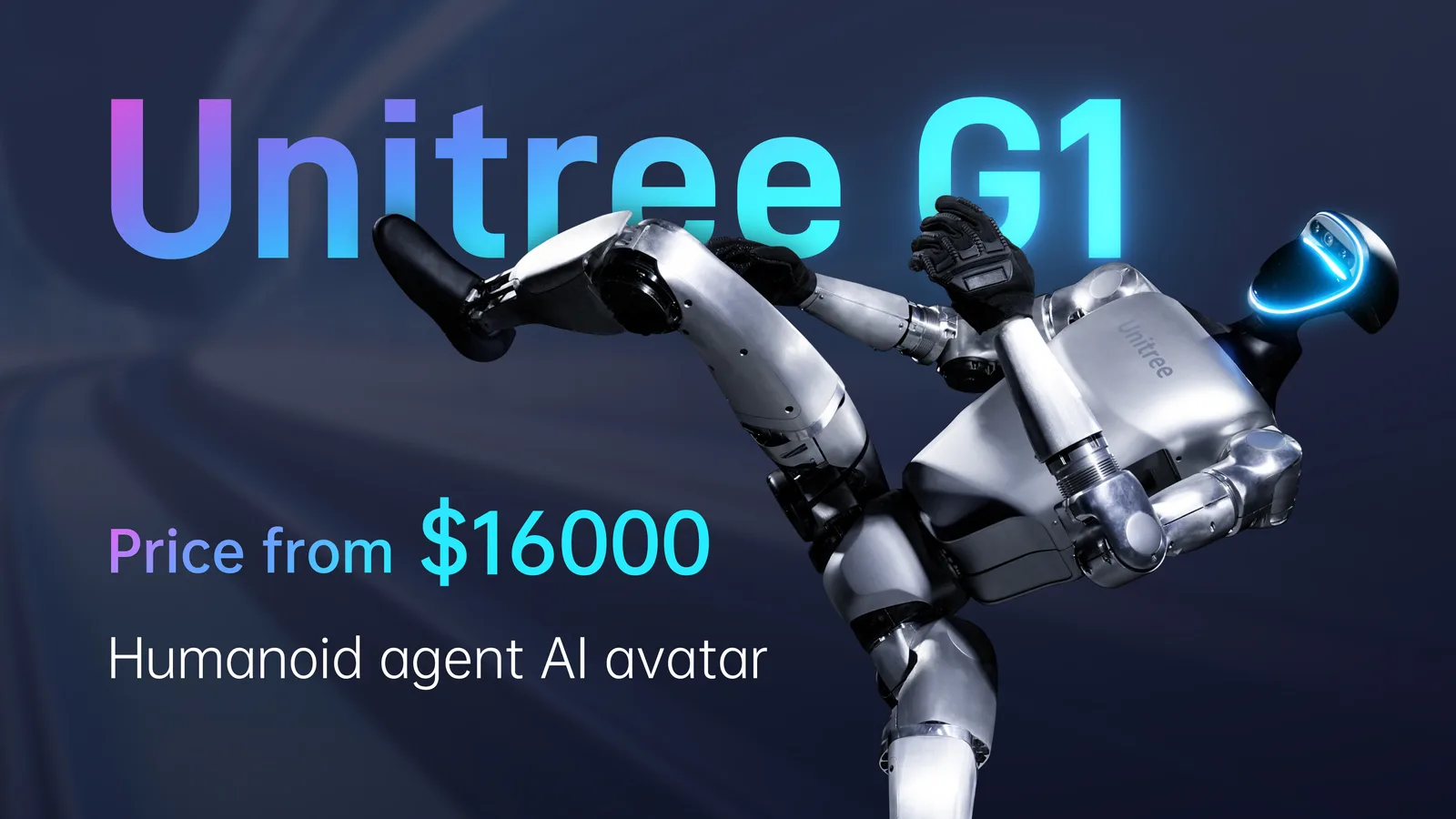
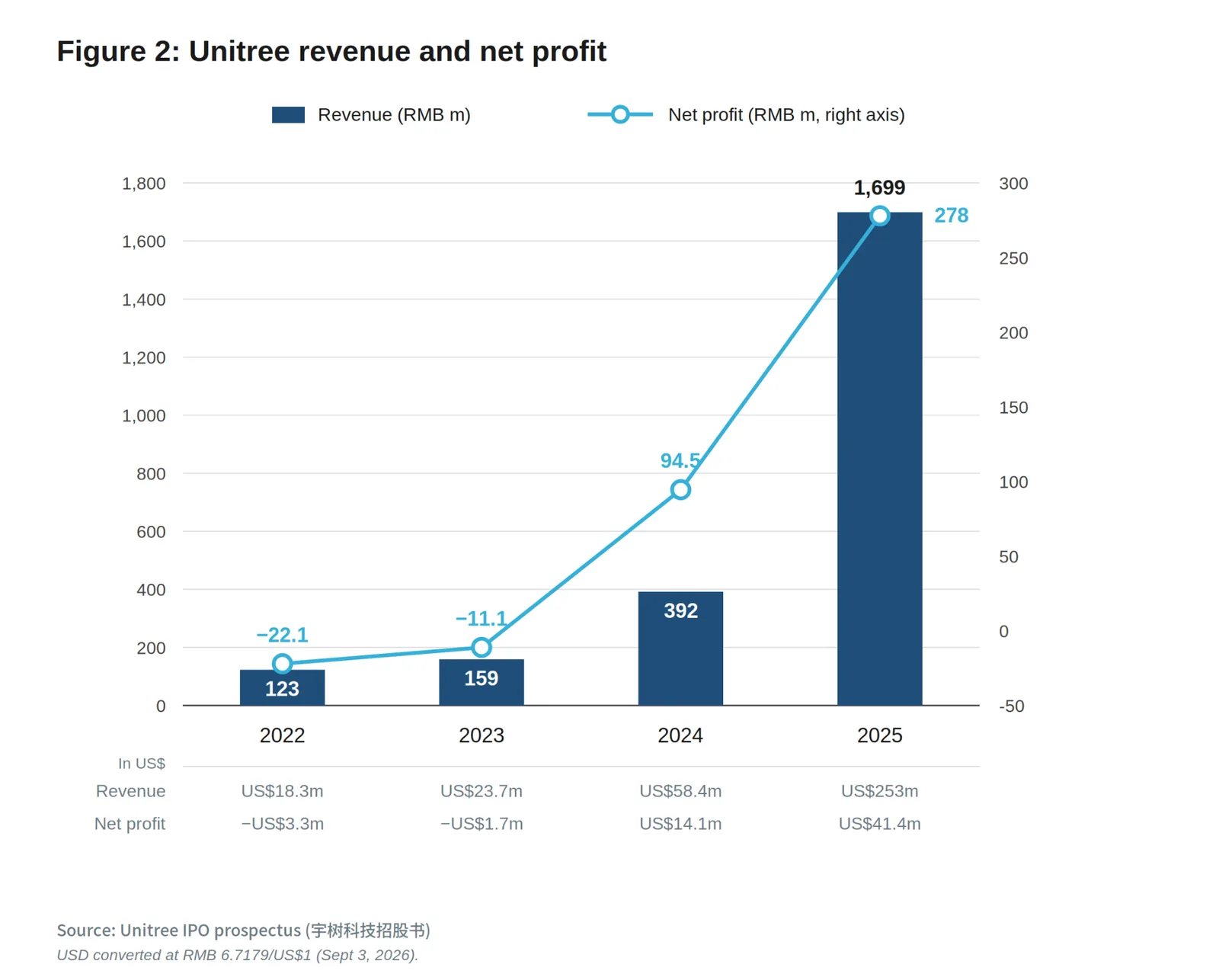
Unitree is unusual among robotics firms in that it makes money. Revenue went from 159 million yuan in 2023 to 392 million in 2024 and about 1.7 billion in 2025, growth of more than 330%, with a gross margin above 60% and operating cash flow tripling to 672 million yuan. It shipped more than 5,500 humanoid robots in 2025, counting pure humanoids and excluding wheeled dual-arm machines. Humanoids overtook quadrupeds along the way, rising from 1.9% of revenue in 2023 to 27.6% in 2024 and 51.5% in the first nine months of 2025. The product line now runs from the Go, A and B series quadrupeds to the H, G and R series humanoids, plus dexterous hands, collaborative arms and lidar.
The pricing is the strategy. The humanoid range runs from 4,900 dollars for the R1 Air to 29,900 dollars for the H2 and 90,000 dollars for the H1, at a moment when Boston Dynamics does not sell Atlas at any price and Tesla has no retail plan for Optimus before the end of 2027.
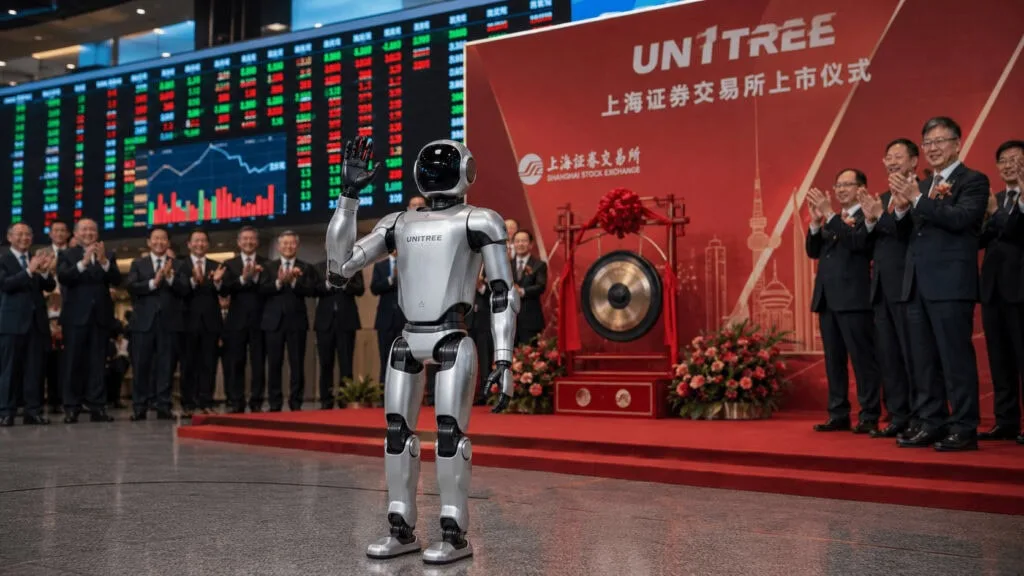
The listing on 19 August 2026 was one of the wildest debuts in Chinese market history. Shares opened at 1,100 yuan against an IPO price of 150.80 yuan, a 629% jump, with an allotment rate of 0.018%, the lowest ever recorded on the STAR Market. The stock closed at 845 yuan, up 460%, valuing the company near 342 billion yuan and Wang's roughly 121.4 million shares at about 103 billion yuan. That day he became the wealthiest member of China's post-1990 generation. The offering raised about 6.1 billion yuan against a 4.2 billion target.
Control matters more than the money. In May 2025 Unitree converted 44.07 million of Wang's shares into Class A stock carrying ten votes each against one for everyone else, lifting his 23.82% direct holding to 63.55% of votes, and the employee platform Shanghai Yuyi took him to 68.78% before the IPO. After the offering he and his platform hold 31.29% of the equity and 65.31% of the votes. Behind him sits a cap table assembled through the June 2025 round: Alibaba, Tencent, Ant Group, China Mobile Capital and Geely Capital, alongside earlier backers HongShan, Matrix Partners China, Shunwei, Meituan, the China Internet Investment Fund and Shenzhen Capital Group. Private venture money and state capital sit on the same line.
The strategic placement said the rest. Nine investors took 8.09 million shares, a fifth of the deal. DeepSeek was allotted 933,399 shares for about 141 million yuan with a 36-month lock-up, three times longer than the others, while the National Social Security Fund took the largest single allocation and PetroChina's Kunlun Capital, China Southern Power Grid, China Telecom's Tianyi Capital and Tencent's Shanghai Qishan each took 903,290 shares. The filing explained the logic: bringing in a leading large-model company to work on AI models and embodied intelligence, improving robots' ability to understand and generalise across complex scenes. A separate employee vehicle let 171 staff subscribe roughly 271 million yuan of stock.
The Party Question
Wang holds no Party post, and no public record identifies him as a Communist Party member. His official Chinese biography, which for any cadre would open with the date he joined the Party, does not mention it. What he has instead is a place inside the system's circle of favour.
In February 2025 he was seated in the front row at Xi Jinping's symposium with private entrepreneurs, the youngest in a group that included Ren Zhengfei, Jack Ma and Pony Ma, and one of six founders who addressed the meeting directly, alongside BYD's Wang Chuanfu and Xiaomi's Lei Jun. The honours followed: nomination for the Zhejiang Youth May Fourth Medal in March 2025, the national China Youth May Fourth Medal in April, and appointment in June 2025 to Hong Kong Chief Executive John Lee's advisory panel. In November 2025 the Ministry of Industry and Information Technology published the membership of its humanoid robot standardisation technical committee, naming him a deputy chair alongside AgiBot's Peng Zhihui and the Beijing humanoid innovation centre's Xiong Youjun. That body drafts the industry standards for safety, components, whole machines and applications from factories to eldercare. He is also chief scientist of Hangzhou's embodied intelligence pilot base.
The state has been a shareholder in his success from early on. According to a government document reviewed by the risk research firm Kharon, Unitree received emergency funding that brought it back from possible collapse in 2017, and Hangzhou subsidises it through its Sci-Tech Fund and through its designation as one of the city's "six little dragons", a group that also includes DeepSeek.
Washington draws a harder conclusion. On 8 June 2026 the Pentagon added 65 entities to its Section 1260H list of Chinese military companies, including Alibaba, Baidu, BYD, Unitree and RoboSense, taking the list to 188 firms it says support military-civil fusion. China's foreign ministry called it another case of the United States overstretching national security to target Chinese business, and listed companies have consistently disputed their designation. The awkward detail is public: Chinese state television reported troops operating a Unitree B1 quadruped during the China-Cambodia Golden Dragon 2024 exercise, with a serviceman describing reconnaissance and assault roles for it.
Then came the harder blow. On 28 July 2026 the Federal Communications Commission banned imports of new foreign-made humanoid robots, quadrupeds and power inverters on cybersecurity and supply-chain grounds, applying the rules only to models not yet authorised for sale in the United States. The American market accounted for about 13% of Unitree's roughly 250 million dollars of 2025 revenue, and overseas sales as a whole exceeded 35% throughout the reporting period. Wang's company was shut out of its largest single foreign market three weeks before it went public, and the stock still opened up 629%.
Why Robots Are a State Project
None of this is a story about one entrepreneur. It is a national wager.
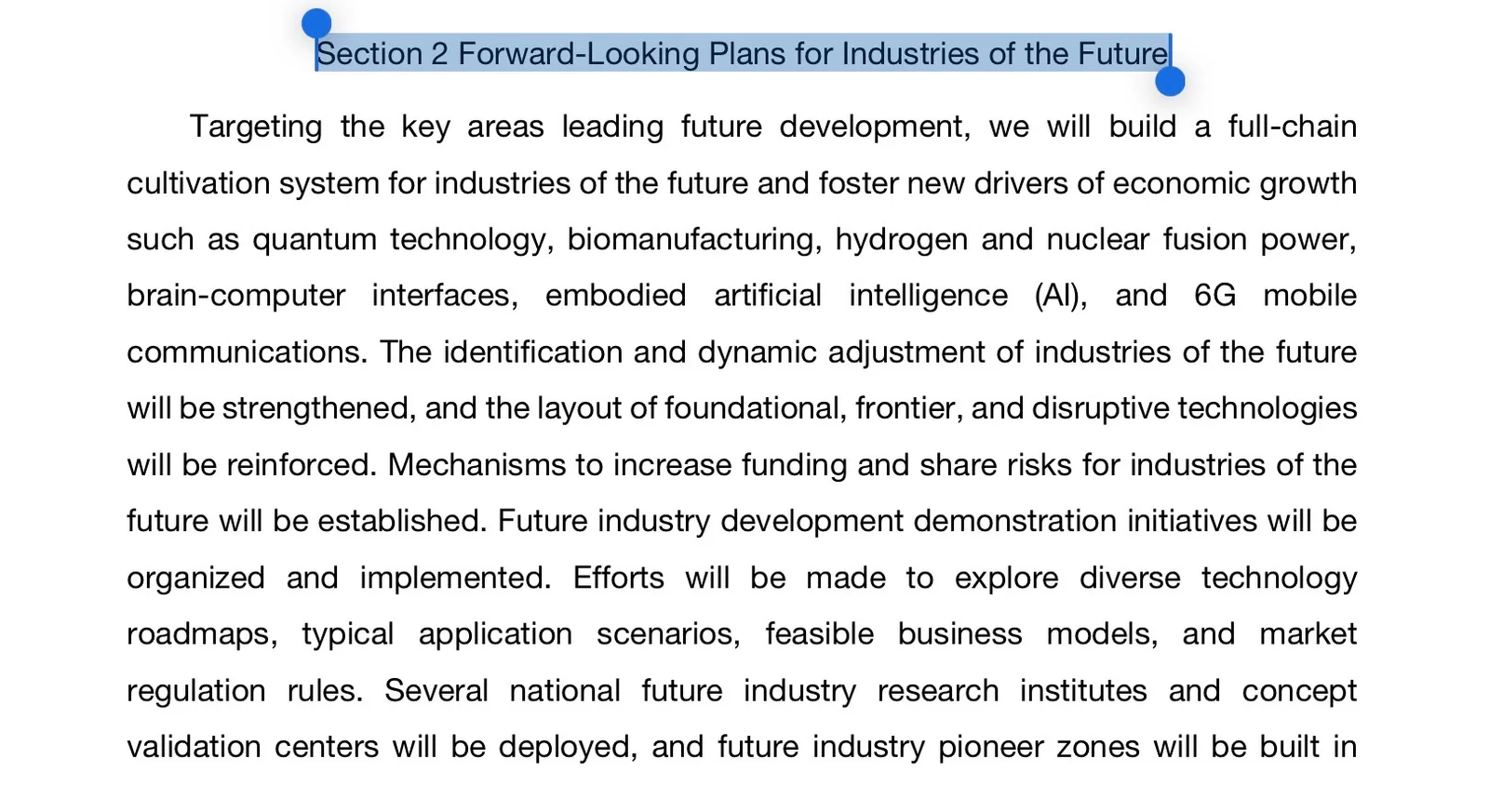
China's 15th Five-Year Plan, approved in March 2026, moved robotics and embodied intelligence from a niche subsidy target into the core of its modernisation strategy, giving embodied intelligence its own inset box among the plan's top ten new industry tracks alongside integrated circuits, biomanufacturing and commercial space. Humanoid robots now sit in the same strategic tier as quantum technology, brain-computer interfaces, 6G and nuclear fusion, with new mechanisms for application-demonstration programmes, national AI testing bases and explicit investment risk-sharing. Shanghai alone targets 100,000 humanoid robots deployed in factories by 2030.
The logic is demographic before it is geopolitical. China's over-60 population is projected to reach 28% by 2040, and embodied AI is expected to lift productivity and offset ageing-driven labour shortages, though roughly 70 million Chinese jobs, about 9.6% of the total, are estimated to be at high risk of AI-driven displacement.
The lead is real and measurable. Counterpoint Research counted more than 22,000 humanoid robots shipped globally in the first half of 2026, up almost 300% year on year, with all five leading vendors Chinese, and China's statistics bureau puts the country's share of global humanoid shipments at 97%.
What Comes Next for Unitree
The bull case and the bear case share a single fact: the hardware works, the brain does not yet.
Unitree open-sourced its UnifoLM-WMA-0 world model in September 2025 and its UnifoLM-VLA-0 vision-language-action model in January 2026, but the prospectus concedes that its general-purpose embodied models have not been deployed at scale in its products, and warns plainly that large-scale deployment of general-purpose robots is uncertain if the brain does not advance. Hence the spending plan: of the 4.2 billion yuan originally targeted, 2.02 billion was earmarked for the robot AI model project alone, close to half the total, with the rest going to hardware, new product lines and a manufacturing base designed for annual output of 190,000 machines.
The growth curve is already bending. Revenue grew 332.64% in 2025, then 68.49% in the first quarter of 2026, then 48.54% in the first half, to 1.152 billion yuan, with the company attributing the slowdown to a much larger base, cooler industry sentiment and intensifying competition. Attributable net profit of 274 million yuan looked like a swing from a 32.02 million yuan loss a year earlier, but that loss was an artefact of 349 million yuan in share-based payment charges. Stripping out one-offs, profit fell 19.34% to 244 million yuan as R&D spending rose by 82 million and marketing costs climbed, including promotion around the 2026 CCTV Spring Festival gala. Operating cash flow fell 32.53%.
The competition moved faster. In the first half of 2026 AgiBot shipped 8,400 units for a 44% global share and took first place, while Unitree shipped about 5,900, up 170%, for 31% and second. Domestic embodied-intelligence startups raised more than 93.5 billion yuan in the same six months, five times the year-earlier figure.
Then the market changed its mind about the price. The stock fell 18.7% on day two, and while it dropped Wang appeared at the World Robot Conference main forum and spoke about technical bottlenecks and industry timelines without mentioning the share price once. The IPO price alone implied 219 times trailing adjusted earnings, and Wang had already stretched his commercialisation timeline from one to two years at best and three to five at worst, to two to three years at best and five to ten at worst. He told the pre-listing investor session that he wanted shareholders who buy because they believe in the company's value rather than to speculate, and that pressure brings motivation. By 2 September the stock had halved from its opening print, with employee complaints about the internal regime circulating on Chinese social media, including claims that expense claims above 100 yuan needed Wang's personal approval, which the company told Yicai was largely untrue. It hit 469.80 yuan on 15 September, 57.3% below the day-one high.
On 17 September it rebounded 5.82% to 501.88 yuan on the Counterpoint shipment data, back above 200 billion yuan of market value. Wang's personal stake is worth roughly 61 billion yuan at that price, down about 40% from the debut and still one of the largest fortunes in Chinese technology.