1. Reading the question
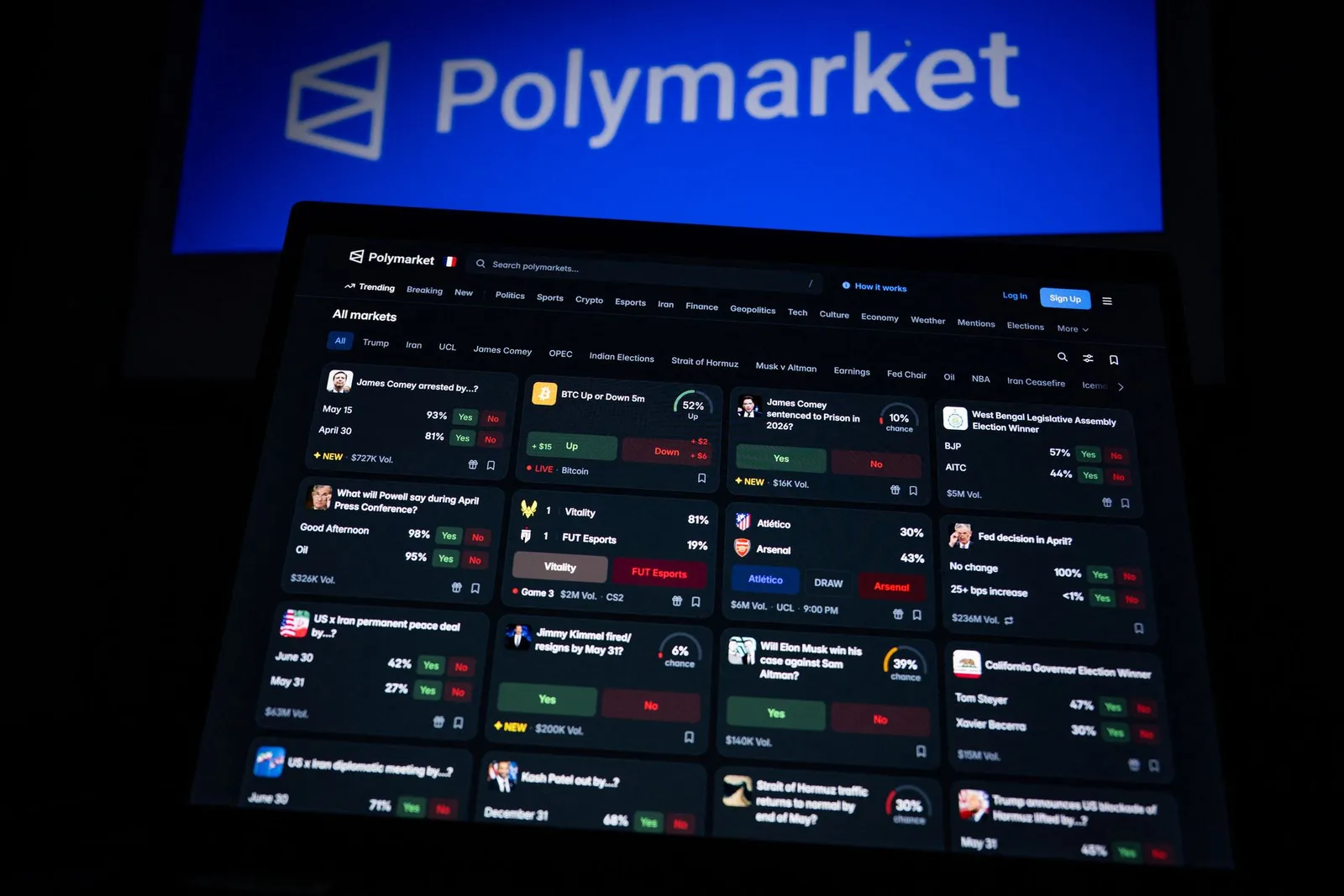
"Polymarket blanchiment", Polymarket laundering, is the question behind this piece. On the public record as of 9 august 2026, no regulator or prosecutor has accused Polymarket, the company, of laundering money. What the record does contain is narrower and more useful.
It includes two US criminal cases against users, one of which carries a money-laundering charge; a string of well-timed trades around military operations; research on fake volume and informed trading; and reporting that the company's new US exchange dropped an anti-money-laundering (AML) control during a stolen-card attack.
This piece separates those strands. We treat as established what courts, regulators or the company's own documents state; as alleged what prosecutors or reporters claim; and we label Le Détroit's analysis as such.
The stakes are rising with the company's size. In September 2026 The Block, summarising The Wall Street Journal, reported that Polymarket was seeking about $1bn at a valuation of roughly $21bn, with Donald Trump Jr.'s investment firm, 1789 Capital, contributing about $300m on top of roughly $200m invested earlier, and that Coplan had met 1789 Capital's co-founder, Omeed Malik, to discuss preparing the company for a possible listing in 2027.
2. Two Polymarkets, two rulebooks
Polymarket's first brush with US regulators came in a CFTC order of 3 January 2022. Blockratize Inc., trading as Polymarket, paid a $1.4m penalty for offering more than 900 event markets without registering as an exchange, and was ordered to wind down the markets that did not comply.
In November 2024 FBI agents seized the electronic devices of its chief executive, Shayne Coplan, in a raid. The New York Times later reported that the Justice Department had opened a criminal probe and that the CFTC had been examining whether Polymarket was illegally serving US customers. In July 2025 Polymarket announced that both agencies had dropped their investigations; according to the Times, the CFTC closed its inquiry over strong objections from its enforcement attorneys. Fortune reported at the same time that Polymarket was buying QCX, a CFTC-licensed exchange, and QC Clearing for $112m.
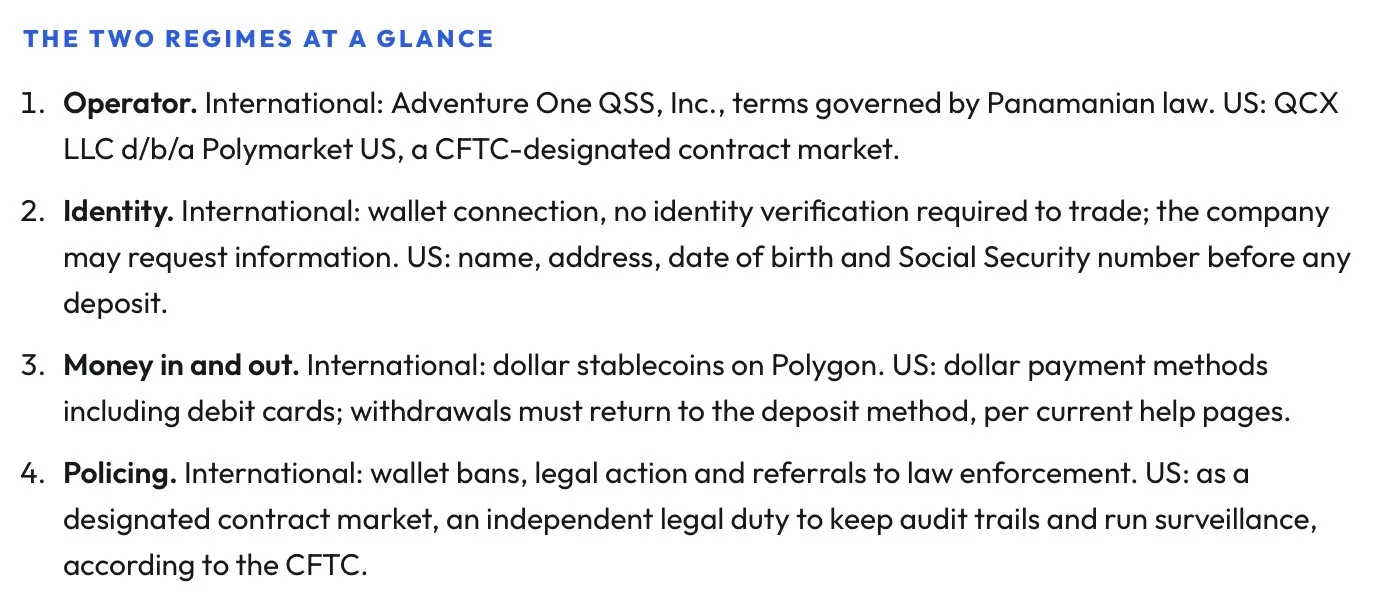
The result is two venues under one name. Polymarket US is run by QCX LLC, which describes itself as "a CFTC-regulated Designated Contract Market". Its help pages require legal name, residential address, date of birth, phone number and Social Security number before a customer can deposit or trade, with an ID upload and selfie if extra checks are needed. Customers fund accounts with dollars, including by debit card.
The international site, polymarket.com, works differently. Its terms of use, effective 11 August 2026, are a contract with Adventure One QSS, Inc., governed by Panamanian law. Users connect crypto wallets. The terms bar restricted persons and anyone on the US Treasury's sanctions list, and forbid using "VPN software or any other privacy or anonymization tools" to get around restrictions. The company "may, from time to time, request additional information", but identity checks are not a condition of trading.
Polymarket has defended that design. When The Information reported in May 2026 that the company wanted traders to identify themselves, its vice-president of engineering, Josh Stevens, wrote on X: "No KYC is being added to any part of existing polymarket.com with this launch."
3. Why stablecoin settlement matters
The international exchange settles in dollar stablecoins on the Polygon blockchain. In a February 2026 announcement with Circle, the issuer of USDC, the two firms said Polymarket "uses Bridged USDC (USDC.e) on Polygon as collateral for all trading activity" and would switch to native USDC, issued by Circle's regulated affiliates, "in the coming months".
For financial crime this cuts two ways. Money never has to pass through a bank on the way in or out: a wallet can be funded from anywhere and winnings sent on to another wallet or to an exchange abroad. The platform sees addresses, not names. At the same time every trade is public, which is how researchers and reporters have reconstructed suspicious activity, and why Polymarket argues that "bad actors leave footprints".
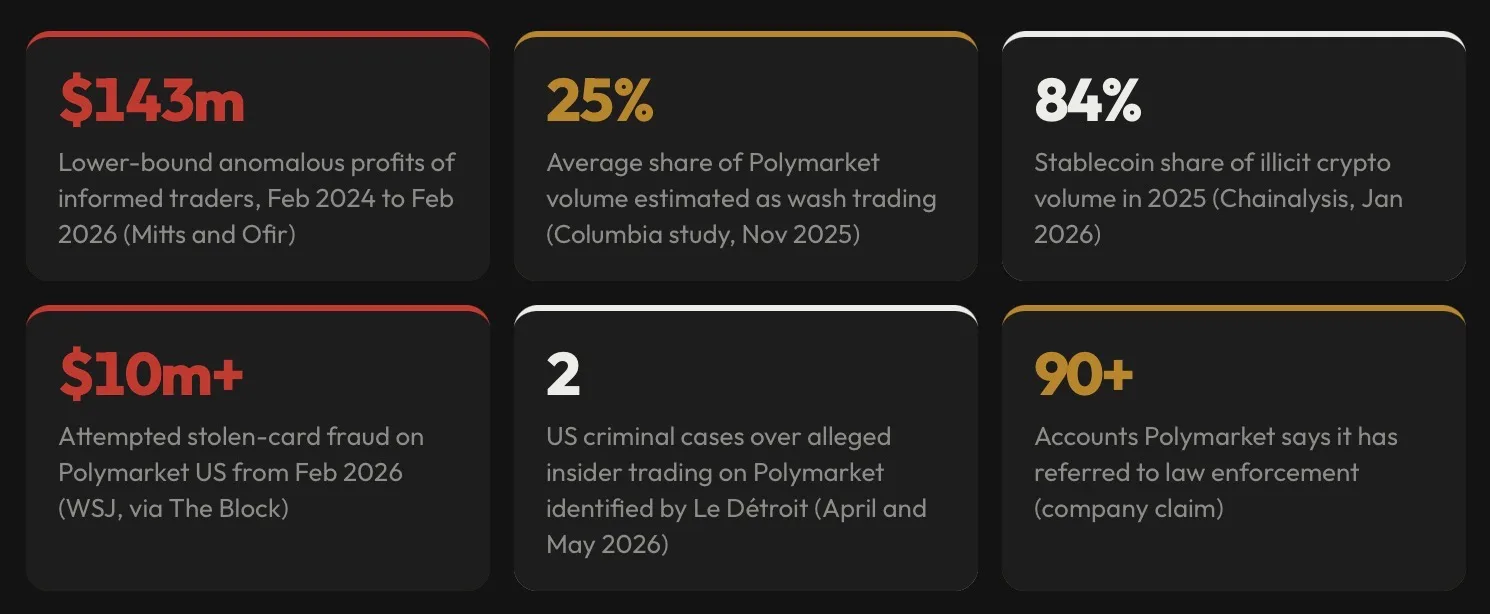
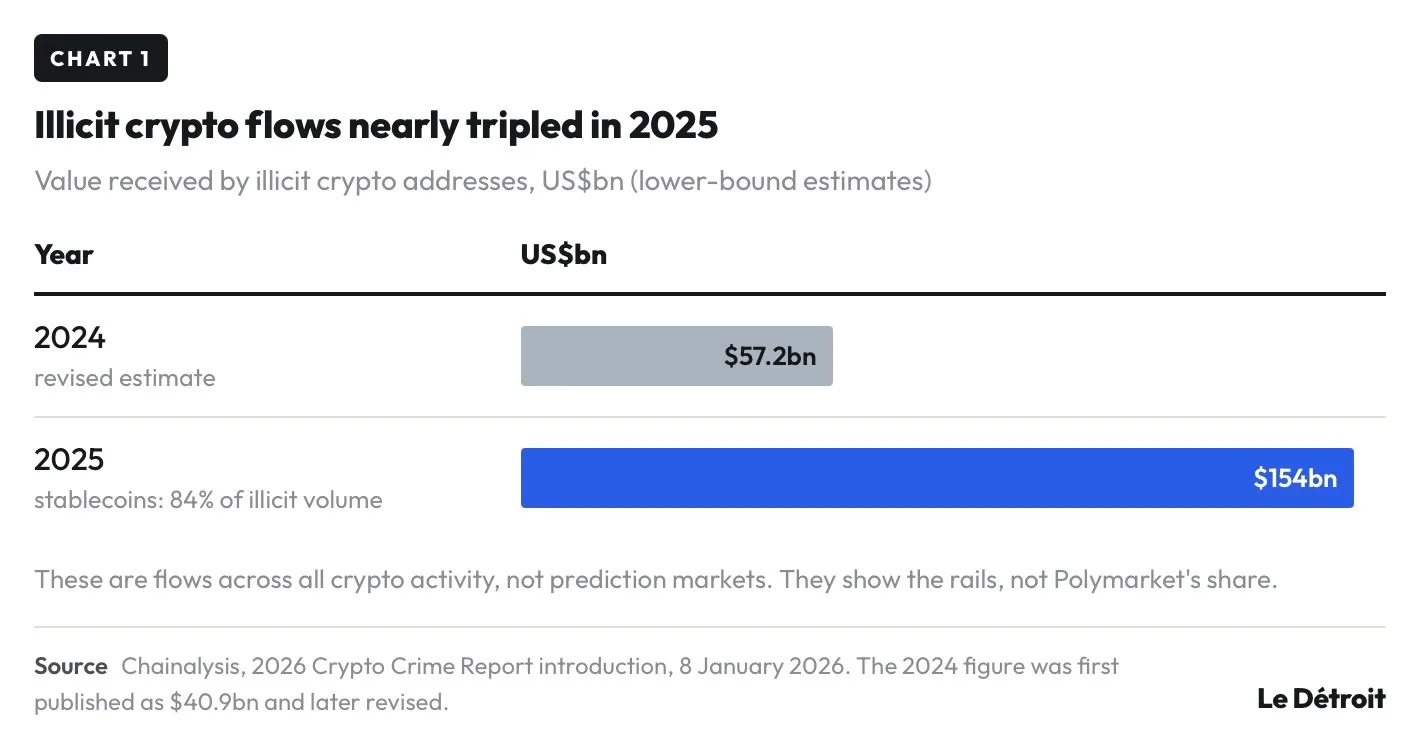
The wider data explain supervisors' concern. Chainalysis said in January 2026 that illicit crypto addresses received at least $154bn in 2025, up from a revised $57.2bn in 2024, driven by a 694% rise in funds received by sanctioned entities. It added that stablecoins "now account for 84% of all illicit transaction volume". In July 2026 the FATF, in its annual update on virtual assets, listed "the misuse of stablecoins, risks arising from P2P transactions through unhosted wallets" and offshore providers "operating outside effective regulatory and supervisory oversight" among emerging and increasing risks.
4. Insider trading: the cases that reached court
The clearest evidence of criminal money on Polymarket comes from insider-trading cases. Profits from misused secrets are proceeds of crime, and moving them can be charged as laundering.
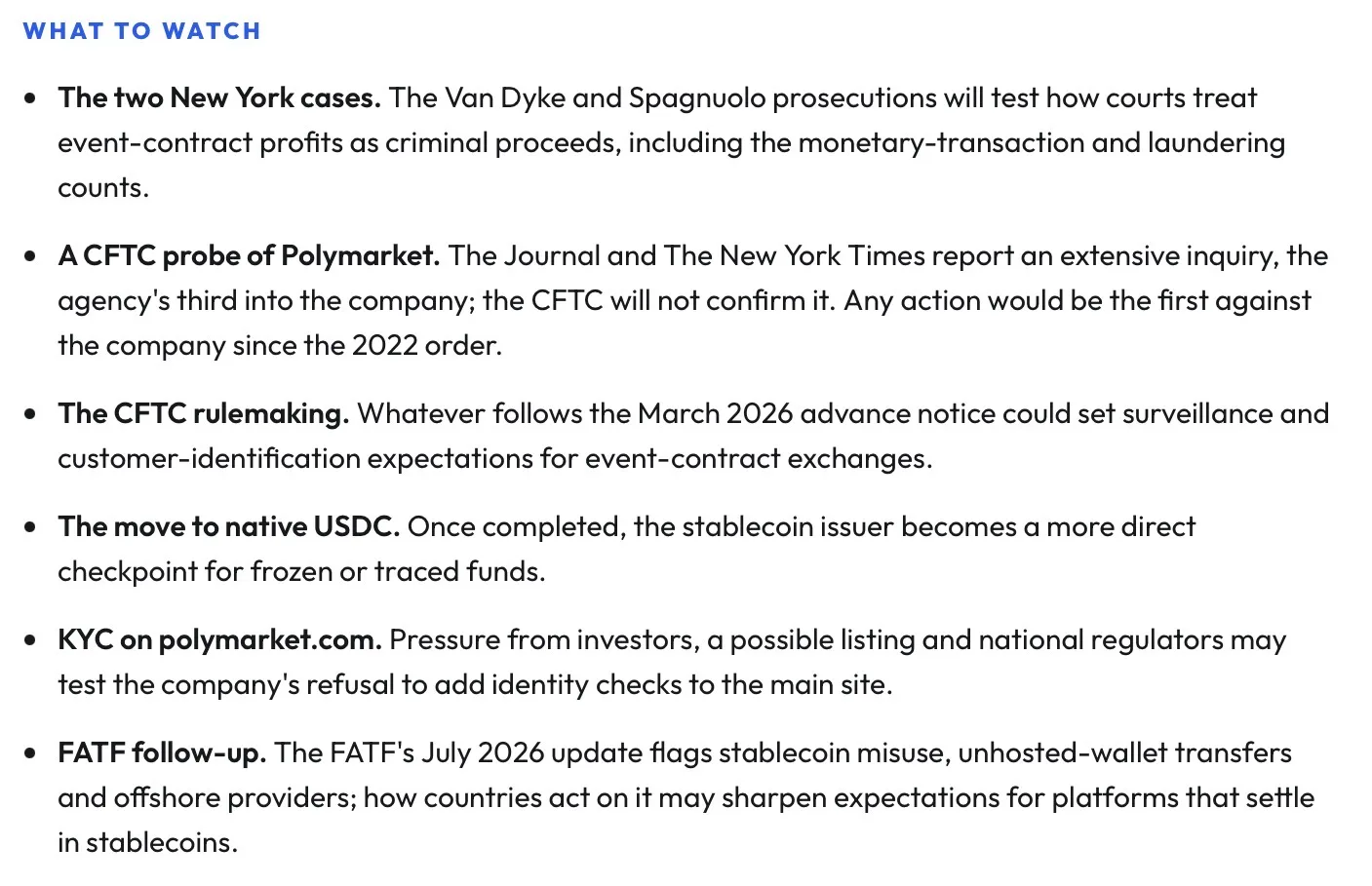
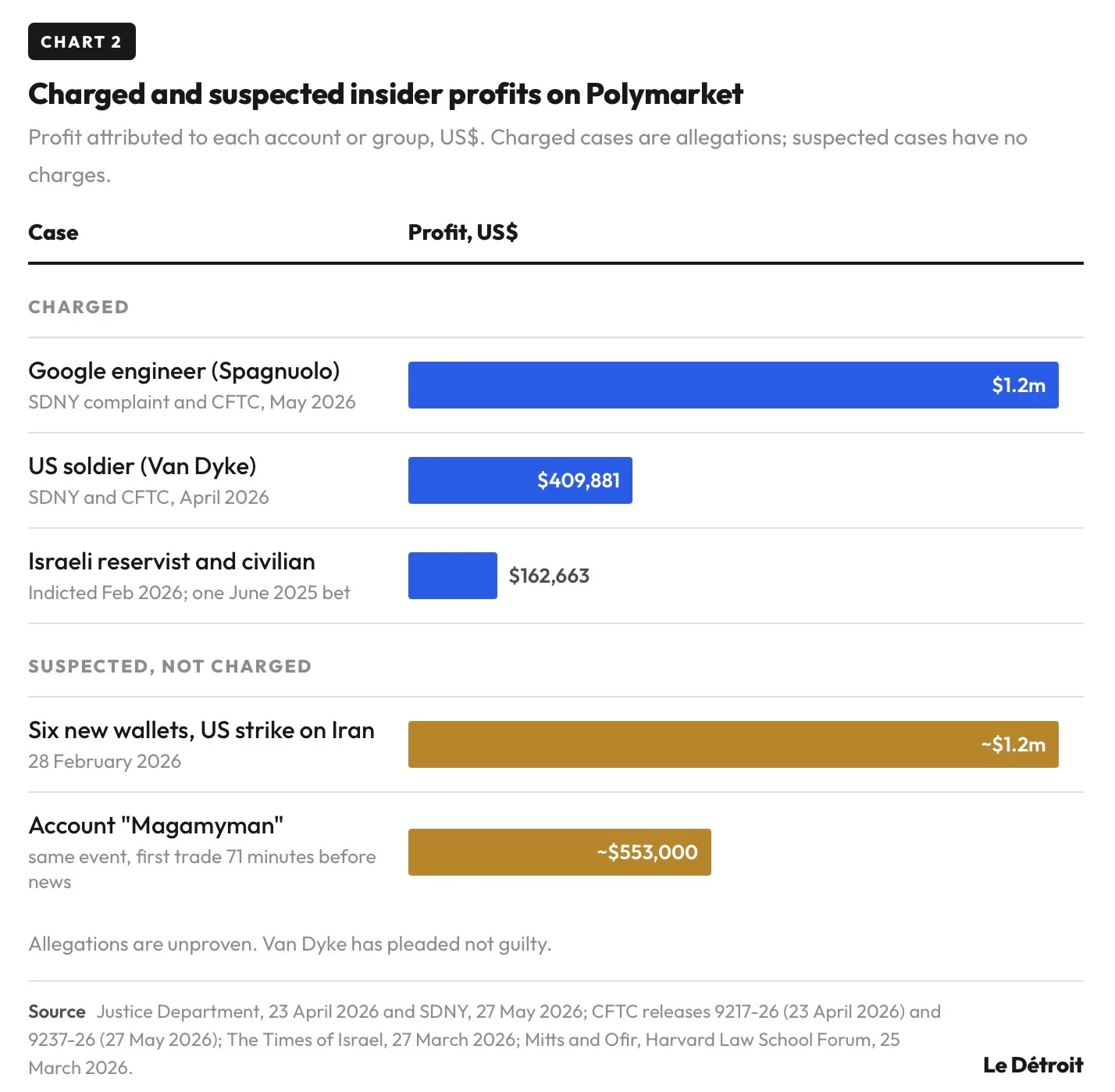
On 23 April 2026 the Justice Department unsealed an indictment in Manhattan against Gannon Ken Van Dyke, an active-duty US Army soldier stationed at Fort Bragg. Prosecutors allege he took part in planning and carrying out Operation Absolute Resolve, the January 2026 operation to capture Nicolás Maduro, and used that knowledge to bet that Maduro would fall. According to the indictment, he opened a Polymarket account around 26 December 2025, staked about $33,034 on roughly 13 bets and made about $409,881.
Prosecutors say he withdrew most of the money on the day of the operation, moved it to a foreign cryptocurrency vault and then to a newly opened brokerage account. They also allege he asked Polymarket to delete his account, claiming falsely to have lost access to his email, and switched the email on his crypto-exchange account to one not in his name. The charges include Commodity Exchange Act violations, wire fraud and an unlawful monetary transaction. Van Dyke has pleaded not guilty.
The CFTC filed a parallel civil complaint. Its enforcement director, David Miller, said the case "marks the first time the CFTC has charged insider trading involving event contracts". The CFTC puts Van Dyke's profit at more than $404,000 on trades between 30 December and 2 January; researchers Joshua Mitts and Moran Ofir put the account's gain at about $485,000 on $38,500. We use the indictment's figures and note the gap.

On 27 May 2026 federal prosecutors in Manhattan unsealed a complaint charging Michele Spagnuolo, a Google software engineer living in Switzerland, with one count each of violating the Commodity Exchange Act, wire fraud and money laundering. According to the Justice Department, he risked about $2.75m on markets tied to Google's internal information between October and December 2025. The CFTC alleges he used confidential Year in Search data to trade at least 23 Polymarket contracts under the handle "AlphaRaccoon", making about $1.2m. CBS reported that days after Google published its rankings, his account moved millions of dollars in crypto to a wallet. Polymarket described itself as "the only prediction platform to date whose cooperation has led to insider trading charges in the United States", a claim CBS did not independently verify.
Israel has acted on the national-security side. In February 2026 prosecutors indicted an air force reservist who had served as a major, and a civilian, in the Tel Aviv District Court for serious security offences, bribery and obstruction over Polymarket bets on military operations. The army called it "a severe ethical failure and a clear crossing of a red line". When the details were cleared for publication in March, The Times of Israel reported that the pair allegedly made $162,663 on a bet on the timing of Israel's opening strikes in the June 2025 war, and that the defendants' names remained under wraps.
5. Suspicious trades that have not become cases
Several episodes remain unproven. On 28 February 2026, six newly created wallets earned about $1.2m by betting on a US strike on Iran, some buying at 10 cents a share, according to Mitts, of Columbia Law School, and Ofir, of the University of Haifa. One account, "Magamyman", first traded 71 minutes before the news and made about $553,000.
Before the US-Iran ceasefire announced on 7 April 2026, a group of newly created accounts bet on a ceasefire in the hours leading up to the announcement, according to Representative Ritchie Torres. He asked the CFTC chairman, Michael Selig, to obtain account ownership, wallet links and transaction histories. He wrote that blockchain markets' features, "including anonymity, rapid account creation, and cross-border activity", "cannot serve as a shield for potential market abuse."
Mitts and Ofir screened more than 93,000 Polymarket markets and nearly 50,000 wallets from February 2024 to February 2026. They flagged 210,718 wallet-market pairs with a 69.9% win rate and estimate about $143m in anomalous profits, which they call "a conservative lower-bound estimate". A statistical screen is not proof of a crime, and the authors say it misses traders who keep their bets small.
6. Wash trading: fake volume, hidden transfers
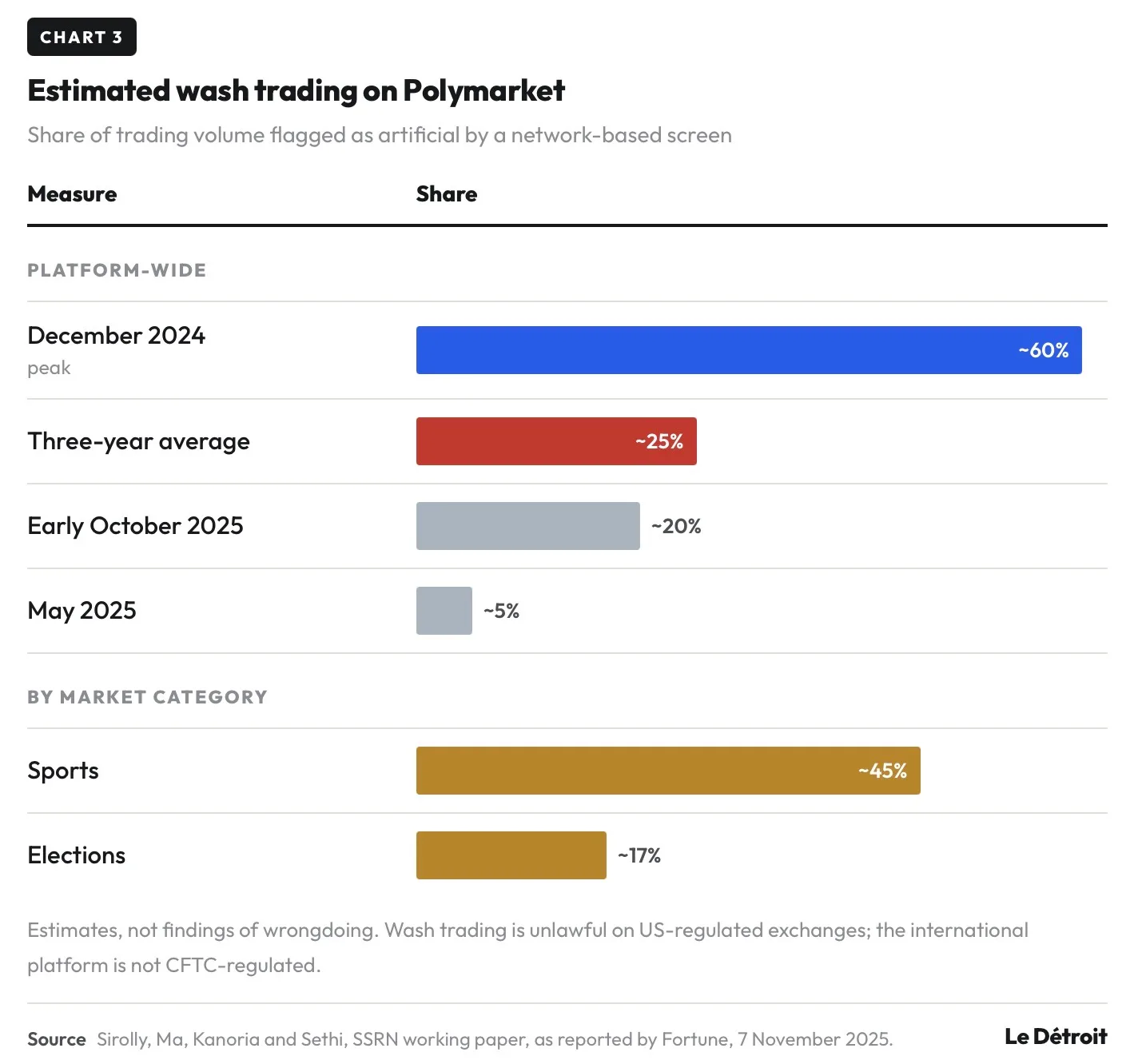
In November 2025 four researchers from Columbia University and Barnard College, Allen Sirolly, Hongyao Ma, Yash Kanoria and Rajiv Sethi, posted a study, not yet peer reviewed, estimating that artificial trading averaged about 25% of Polymarket buying and selling over three years. Fortune reported that the share peaked near 60% in December 2024, fell to about 5% in May 2025 and was around 20% in early October 2025. About 14% of 1.26m wallets were flagged.
Wash trading is chiefly a market-integrity problem: it inflates the volume figures that attract users and investors. But the pattern of accounts that trade mostly with each other is also what AML analysts watch for when value is being passed between parties. The FATF's September 2026 report on gaming and gambling lists as red flags "consistent losses to other player(s) in peer-to-peer (P2P) settings" and players who "appear to play frequently together, with one always winning".
7. The US exchange's first AML test
The US exchange was meant to be the compliant face of the brand. On 19 September 2026 The Wall Street Journal reported, as summarised by The Block, that from February fraudsters used stolen debit cards to fund accounts, place bets and try to withdraw to cards or accounts they controlled. The attempted fraud totalled at least $10m; about seven users accounted for most of it. Checkout.com, the payment processor, at one point rejected more than 80% of US deposits as fraudulent, against an industry norm of about 1%.
According to the report, leadership dropped the rule that withdrawals must return to the original funding source, although employees warned that this could increase money-laundering risk. Coplan reportedly told staff to focus on growth and deal with fines later. The chief compliance officer, Andrew Clifford, resigned in April after giving executives a report on the fraud; US chief executive Justin Hertzberg was fired; the heads of US regulation and AML also left. A Sullivan & Cromwell review reportedly found the company compliant. The Block, summarising the Journal, added that fraud rates were back to industry norms by May, after measures that included limiting how many debit cards users could link to their accounts.
The CFTC is also investigating Polymarket. The Journal first reported the inquiry, and on 26 June 2026 The New York Times, citing two people familiar with it, described it as extensive in scope and the agency's third into the company in recent years, with few details public. According to The Block, employees were told to preserve records related to the fraud attack and other matters; a CFTC spokesperson told The Block the agency could neither confirm nor deny an investigation. Polymarket told the newspaper that its "market integrity framework includes processes to detect, review and respond to suspicious activity." Its US help pages, consulted on 9 October 2026, state that "all withdrawals must return to the same payment method used for deposit", processed in deposit order to comply with AML rules. We could not establish when that rule was restored.
8. Offshore access and sanctions
Geography is the international site's main gate. Polymarket's developer documentation says orders from Iran, Syria, Cuba, North Korea and the occupied Ukrainian regions of Crimea, Donetsk and Luhansk are rejected outright. Users in more than 30 other countries and territories, including the US, UK, France, Germany, Russia and Belarus, can only close existing positions. Ireland, Japan, the Netherlands and South Korea are restricted on the website but not through the trading interface. The company says the rules serve sanctions, gambling law and AML and KYC obligations.
Such blocks rely on locating the user. The terms ban VPN use, and the FATF's 2026 gambling report lists "use of VPN to access the platform" as a risk indicator. It also states: "Illegal and unlicensed offshore gambling is cited as a significant risk." Among its indicators are customers based "in a country where gambling is illegal". Many national regulators treat Polymarket as exactly that: Crypto Times counted at least 33 jurisdictions that have restricted or banned it.
9. What regulators have said and done
Under its chairman, Michael Selig, the CFTC has been building an enforcement record on event contracts. On 25 February 2026 its enforcement division issued an advisory listing misappropriation of confidential information, manipulation, and wash and pre-arranged trading as violations, and saying exchanges "have an independent duty" to keep audit trails and run surveillance.
On 12 March staff issued a prediction-markets advisory, Letter 26-08, and the Commission published an advance notice of proposed rulemaking, with comments due by 30 April. After the Van Dyke case Selig said that "anyone who engages in fraud, manipulation, or insider trading in any of our markets will face the full force of the law".
Those documents focus on market abuse rather than money laundering. AML expectations come mainly from the FATF, whose September 2026 report calls illegal and unlicensed offshore gambling a significant risk and recommends stronger licensing, a risk-based approach and closer international co-operation, and from national gambling authorities that block the site.
Polymarket's own integrity rules ban three kinds of insider trading: trading on stolen confidential information, on illegal tips, or when able to influence the outcome. For enforcement, the company says it "can ban wallets, take legal action, or refer matters to law enforcement" and has referred more than 90 accounts.
10. Where the risk really sits
Le Détroit's analysis draws three conclusions from the record.
First, the documented laundering exposure concerns the proceeds of other offences, chiefly misused secrets, passing into and out of the platform. The public record does not show Polymarket being used to clean large criminal fortunes, though the absence of cases is not proof of absence.
Second, the two-tier model creates an arbitrage. A trader who wants anonymity uses the international site; a US customer goes through identity checks. The insider cases show that the anonymity is partial: the Van Dyke indictment traces money to a crypto-exchange account and a brokerage, and Polymarket says its cooperation has led to insider-trading charges. But in both cases identification came after the profits had left the platform.
Third, the strongest controls sit outside Polymarket: the exchanges where stablecoins become bank money, the stablecoin issuer and national blocking orders. As Polymarket moves to native USDC, the issuer's compliance programme becomes part of the platform's AML perimeter, whether or not either company describes it that way.