1. A short seller opens the customs ledger
Grizzly Research published its report on Raiffeisen Bank International (RBI) on 17 September 2026. Reuters reported that Grizzly disclosed a short position in RBI shares, meaning it profits if the price falls. That interest does not make the findings wrong, but readers should weigh it.
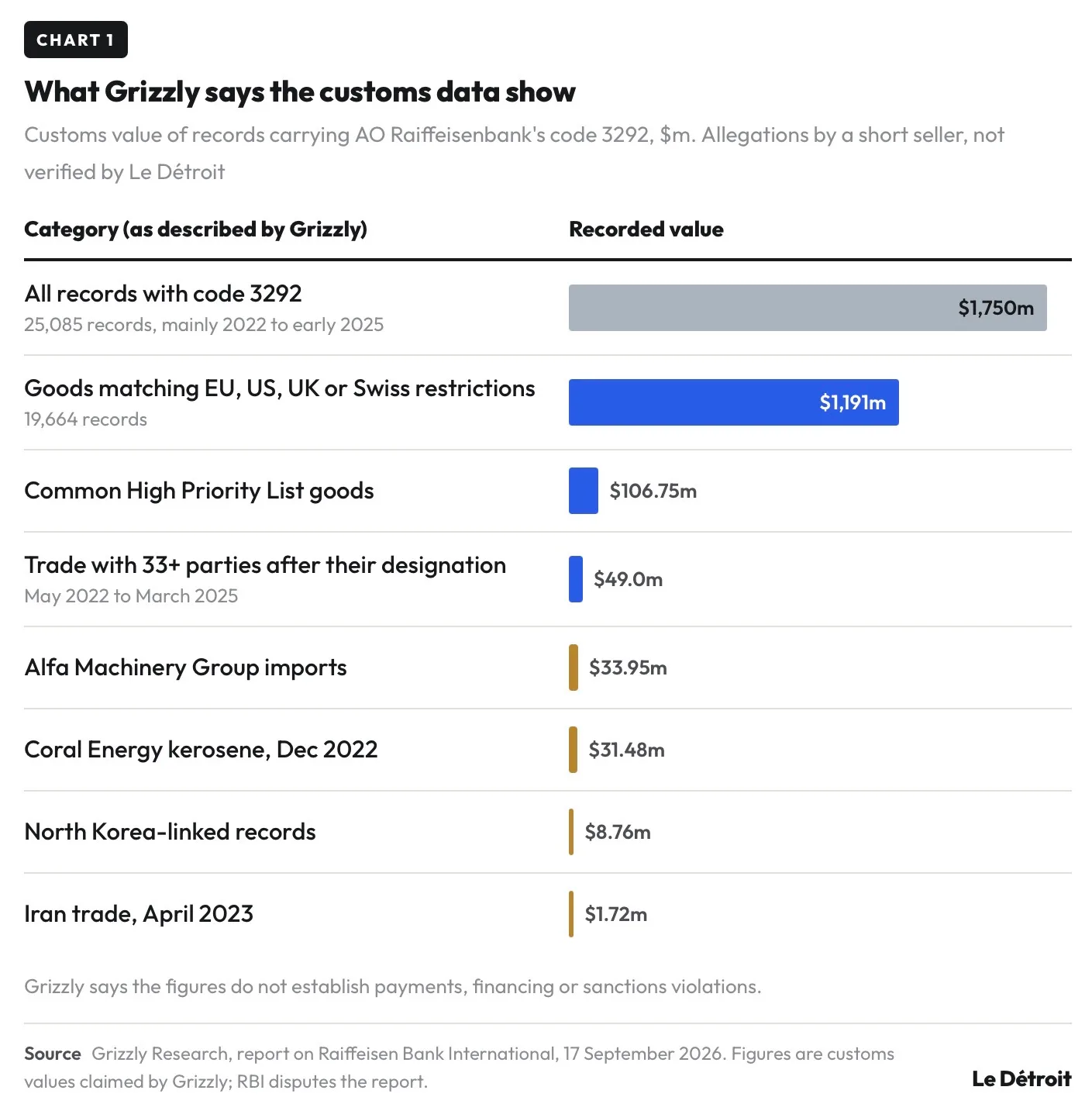
The core of the report is data, not testimony. Grizzly says it examined Russian customs records "covering principally 2022 to early 2025", obtained from a commercial database whose provider later said the authorities had restricted access. It found 25,085 records, worth about $1.75bn, that carry the number 3292. That is AO Raiffeisenbank's general banking licence number, as listed on the bank's own website. Grizzly says the number appears in the bank-identification part of the contract references that Russian traders file. Some declarations show it in what Grizzly calls "transaction-passport" fields.
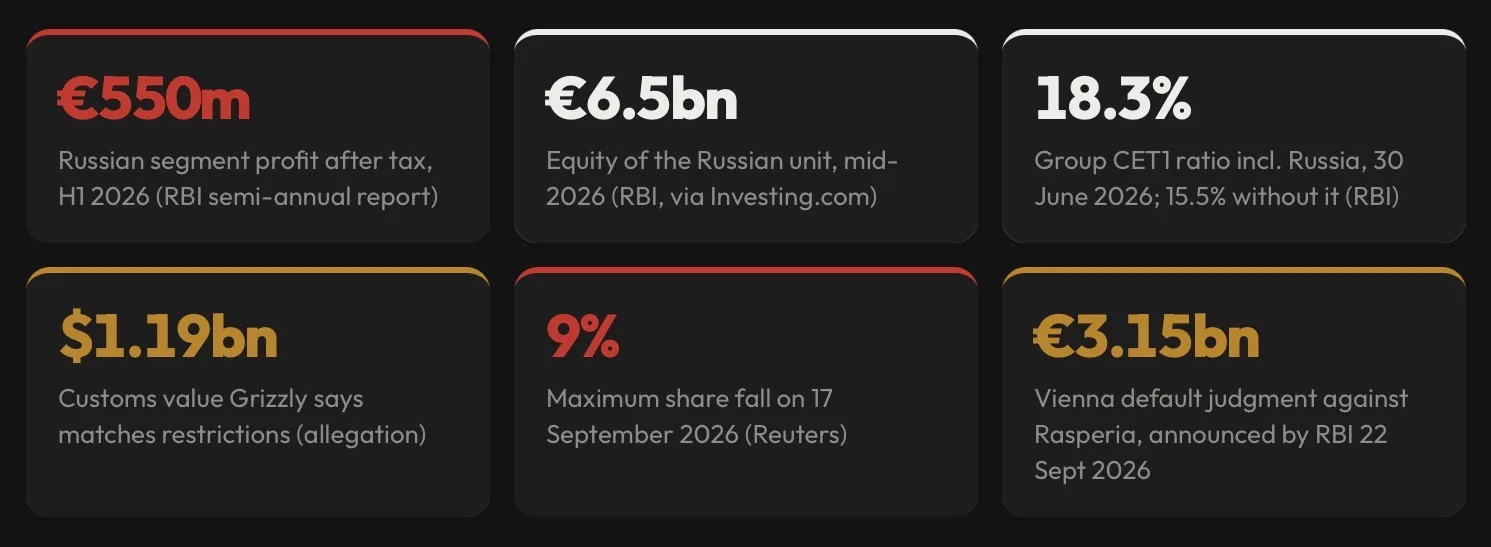
Of those records, Grizzly says 19,664, worth $1.19bn or 68% of the value, match goods restricted by the EU, the United States, the United Kingdom or Switzerland. It puts $106.75m in categories on the Common High Priority List, the list of items Western governments consider most important to Russia's weapons production.
The report is careful about what this proves. In its own words: "These figures measure recorded customs value. They do not establish payments, financing, bank revenue, or sanctions violations." It adds that "the bank reference alone does not prove continued servicing or payment handling". Le Détroit has not been able to inspect the underlying customs database.
2. The named counterparties and the undercover calls
Grizzly names companies and goods. It says Alfa Machinery Group, which the US sanctioned in November 2023, accounts for $33.95m of matching imports, and that a Chinese supplier shipped it CNC lathes in March 2025, when both were under US sanctions. It lists thermal and optical weapon sights imported by two firms and declared as sights for hunting and sporting weapons, worth $493,059 and $144,566.
It also says at least 33 parties under US, EU, UK or Ukrainian sanctions appear in records carrying the code after the date they were sanctioned, for $49m of trade between May 2022 and March 2025. One example is AURUS, the maker of President Vladimir Putin's limousines, which Grizzly says imported $38,268.05 of stamped metal parts on 6 January and 19 March 2025, about a year after its designation.
A further strand concerns Coral Energy, an oil trader later renamed 2Rivers, which Grizzly, citing Britain's National Crime Agency, places in a network running more than 100 shadow-fleet tankers. Grizzly says customs records from December 2022 show $31.48m of kerosene and that by the end of May 2024 Raiffeisen had "€2.2 million in loans outstanding to Coral's traders". Grizzly cites reporting by the Financial Times, Le Monde and the Wall Street Journal for the background.
The report goes beyond data. Grizzly says its staff posed as a buyer planning to sell goods to Russian military customers and ship the rest to Iran, and that a manager at the Russian unit agreed. It says that posing as representatives of a charitable fund raising money for drones for the war, it was told nothing stopped it opening an account, and that the bank reserved account details for 14 days. These accounts come only from Grizzly. They have not been tested by any regulator or court, and Le Détroit could not verify them.

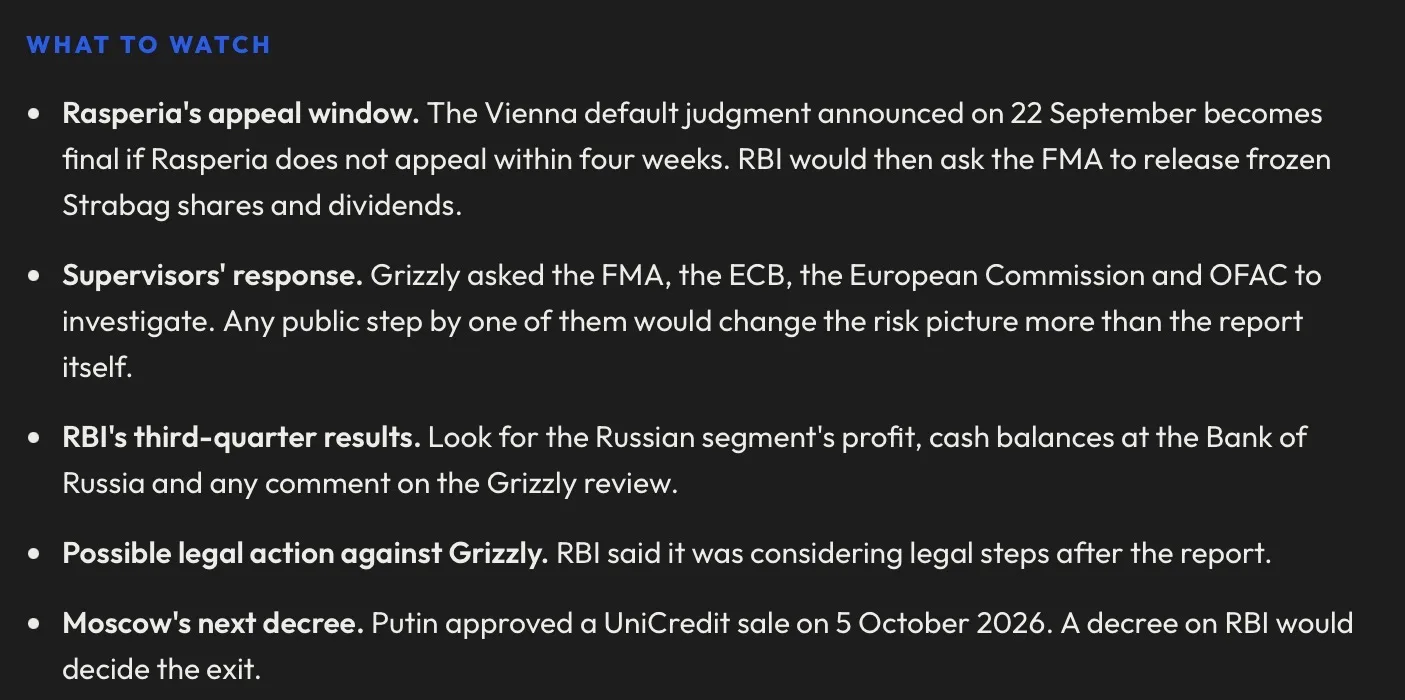
Grizzly also alleges smaller links to Iran and North Korea in the customs data: $1.72m of trade with Iran in April 2023, mostly polystyrene, and about $8.76m of North Korea-linked records. It argues that liability would fall on the parent in Vienna, citing the EU rule that requires EU companies to use their "best efforts" to stop subsidiaries abroad from undermining sanctions, and calls on Austria's Financial Market Authority (FMA), the ECB, the European Commission and OFAC to open inquiries.
3. RBI's response
RBI rejected the report on the day. According to Reuters, the bank said it "categorically denies the allegations" and that the report "claimed to identify companies that were never its customers". Investing.com reported that RBI said an initial review had found a number of factually incorrect and misleading statements.

The shares fell as much as 9% on 17 September, according to Reuters. Investing.com reported a fall of more than 8%; figures varied with the time of day. On 5 October, Reuters reported that RBI had completed an internal review of almost 200 specific points in the report, including dual-use goods, and concluded that the bank had at all times acted in line with its compliance framework and sanctions policies, which it says are based on EU, US and UK rules. The bank had earlier said it was considering legal steps against Grizzly.
Bloomberg Intelligence analysts, as summarised by Meduza, argued that Grizzly may overstate the sanctions risk, because transactions through a Russian subsidiary are not in themselves evidence of evasion. Meduza added that the bigger risk lay in closer scrutiny by OFAC or the ECB, which could further complicate an exit from Russia. No regulator has publicly announced an investigation in response to the report as of 9 October 2026, as far as Le Détroit could establish.
4. Why this bank matters to Russia
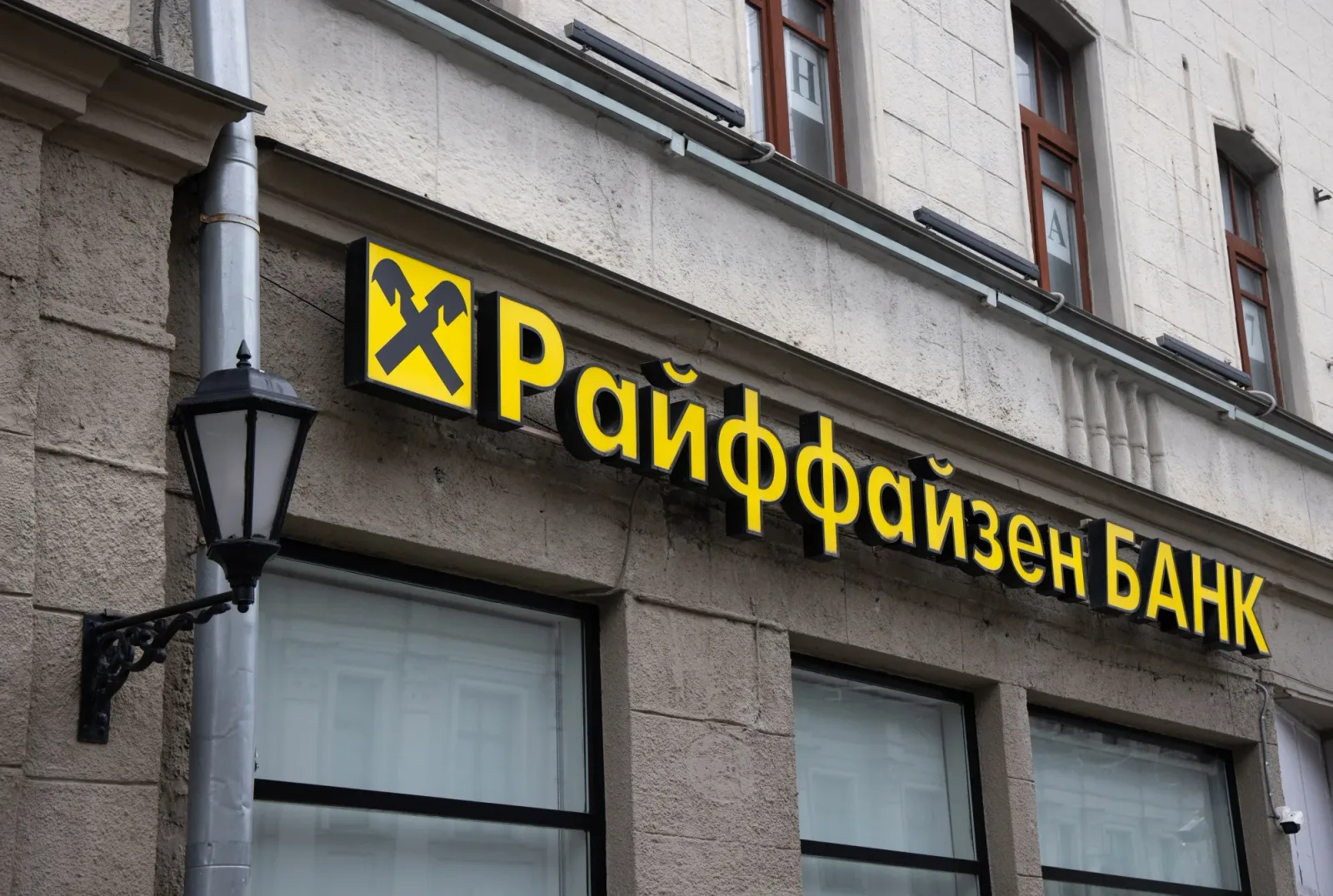
The reason the allegations draw attention is RBI's position. AO Raiffeisenbank is the largest Western bank still operating in Russia and, according to Reuters, the largest lender there not subject to the sanctions that have isolated Russian rivals. That makes it useful for trade payments, including gas. Reuters reported in October 2025 that the bank processes payments for fuel deliveries through the TurkStream pipeline, Moscow's only remaining gas route to the EU. In 2023 the Russian central bank counted it among only two foreign banks on its list of systemically important lenders.
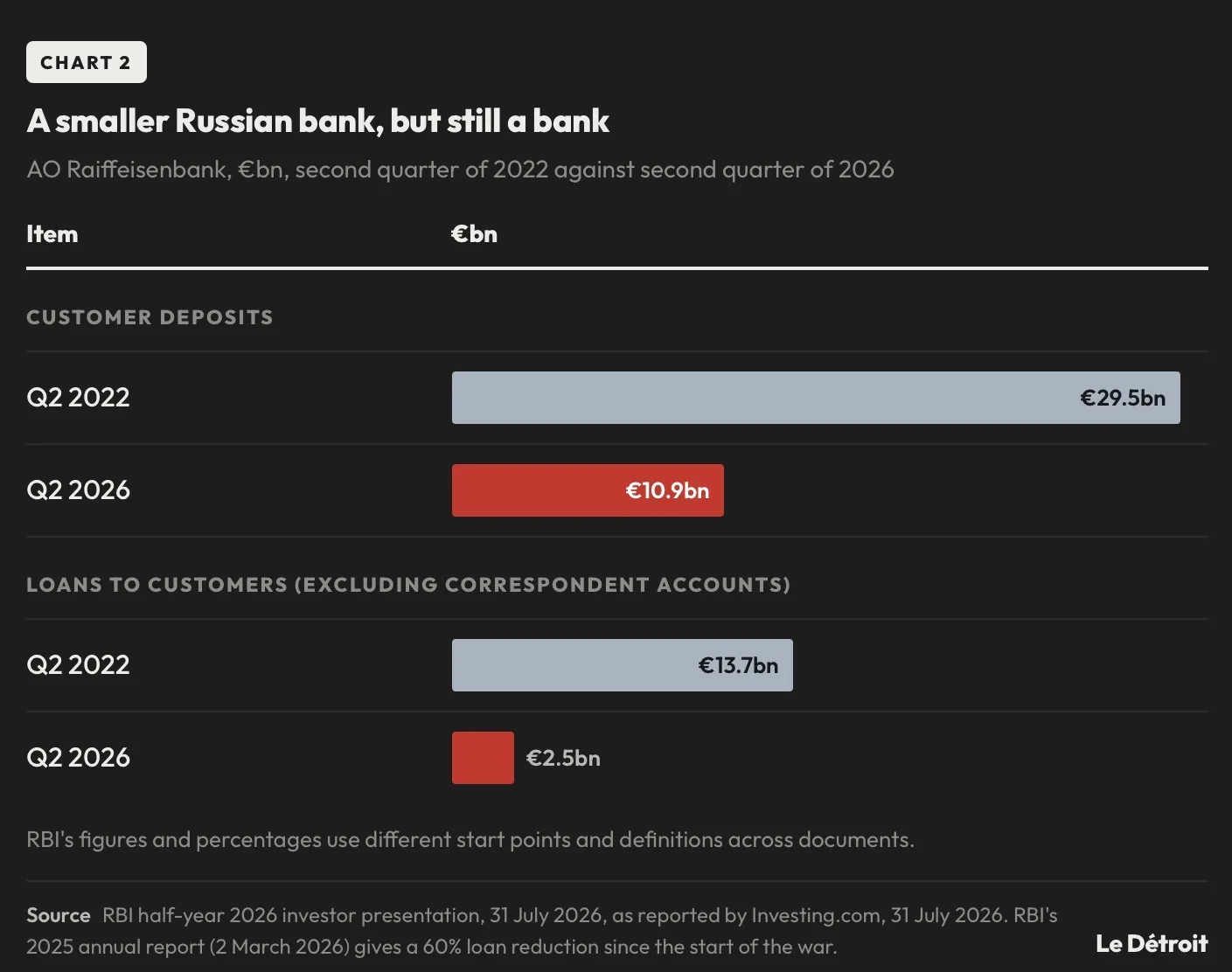
RBI says it has cut this role sharply. Its 2025 annual report says payments are offered "to a very limited extent only and in close coordination with the ECB", and that lending has been "suspended almost completely". RBI figures reported by Investing.com show loans to customers in Russia down from €13.7bn in the second quarter of 2022 to €2.5bn by mid-2026, and customer deposits down from €29.5bn to €10.9bn.
5. Profits it cannot bring home
The Russian unit has been very profitable since 2022. The Financial Times reported in March 2023 that it earned about €2.2bn in 2022, around 60% of group earnings. Reuters reported that Russia provided about half of group profit in the first quarter of 2024, as fees on payments abroad rose.
RBI now reports headline results excluding Russia, but its filings allow a comparison. For the first half of 2026, its semi-annual report shows a Russian segment profit after tax of €550m, against a loss of €437m a year earlier, when RBI wrote off €1,269m of expected proceeds from its claim on Rasperia's Austrian assets. Russian net interest income fell to €780m from €898m, a drop of 13%, which matches Grizzly's own figure.
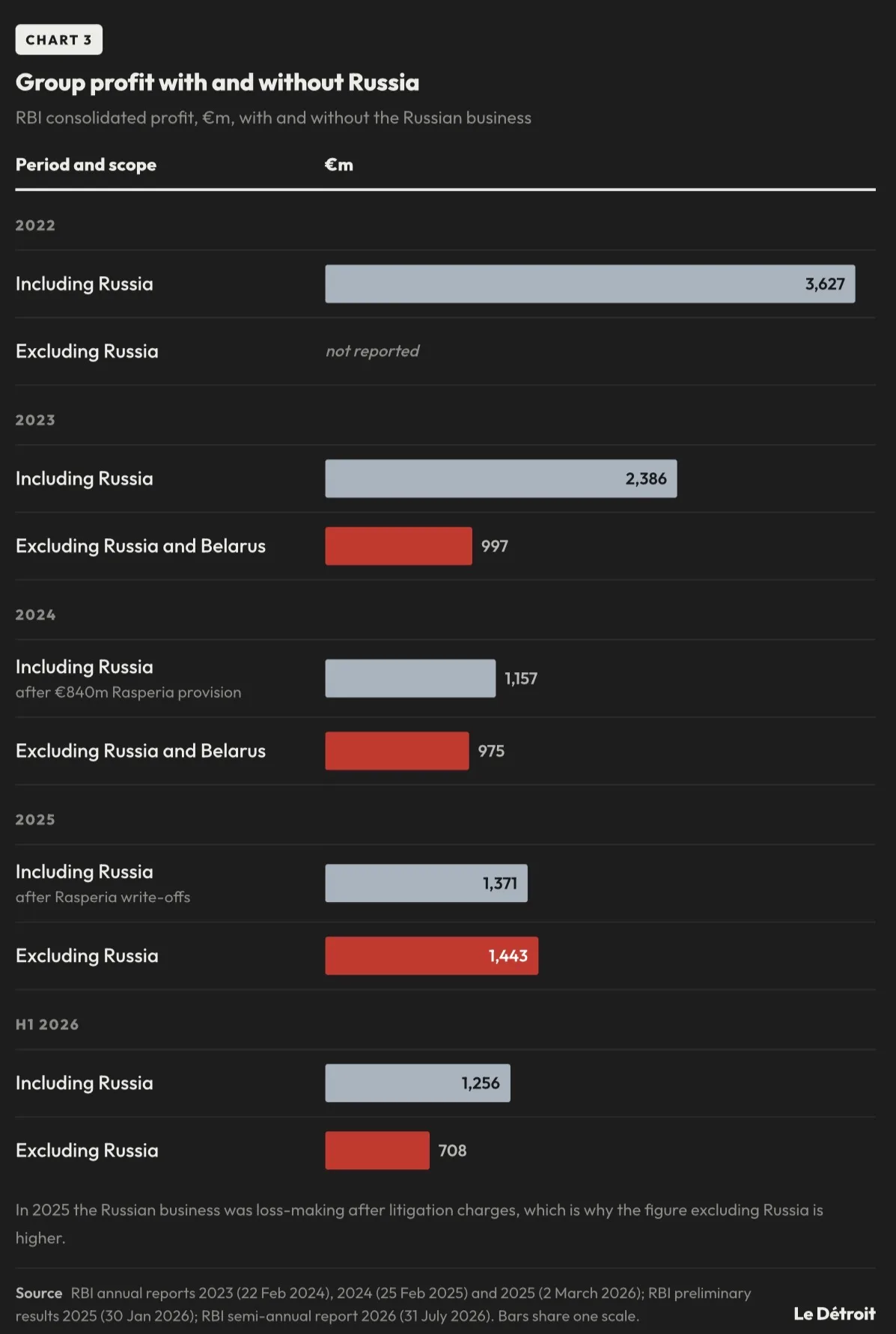
Those profits stay in Russia. Russian rules adopted after the invasion stop the unit from paying dividends to Vienna, the FT reported in 2023, and Reuters estimated in October 2025 that about €7bn of profit had accumulated there since the invasion. RBI says the Russian unit invests its assets with the central bank, at an average rate of 19% in 2025, and does not pay customers interest on deposits. The unit had equity of €6.5bn at mid-2026, more than its customer loans.
Grizzly adds its own estimate: about €12.6bn of cash, central-bank balances and demand deposits in Russia, including roughly RUB 1tn (about €11.3bn) in one account at the Bank of Russia at 30 June 2026. It contrasts this with roughly €735m that RBI reports as restricted cash. The two figures measure different things, and RBI has not commented on Grizzly's calculation, as far as we could find. RBI's capital disclosures show the stake: a CET1 ratio of 18.3% including Russia at 30 June 2026, and 15.5% excluding it.
6. Washington and Frankfurt turn the screws
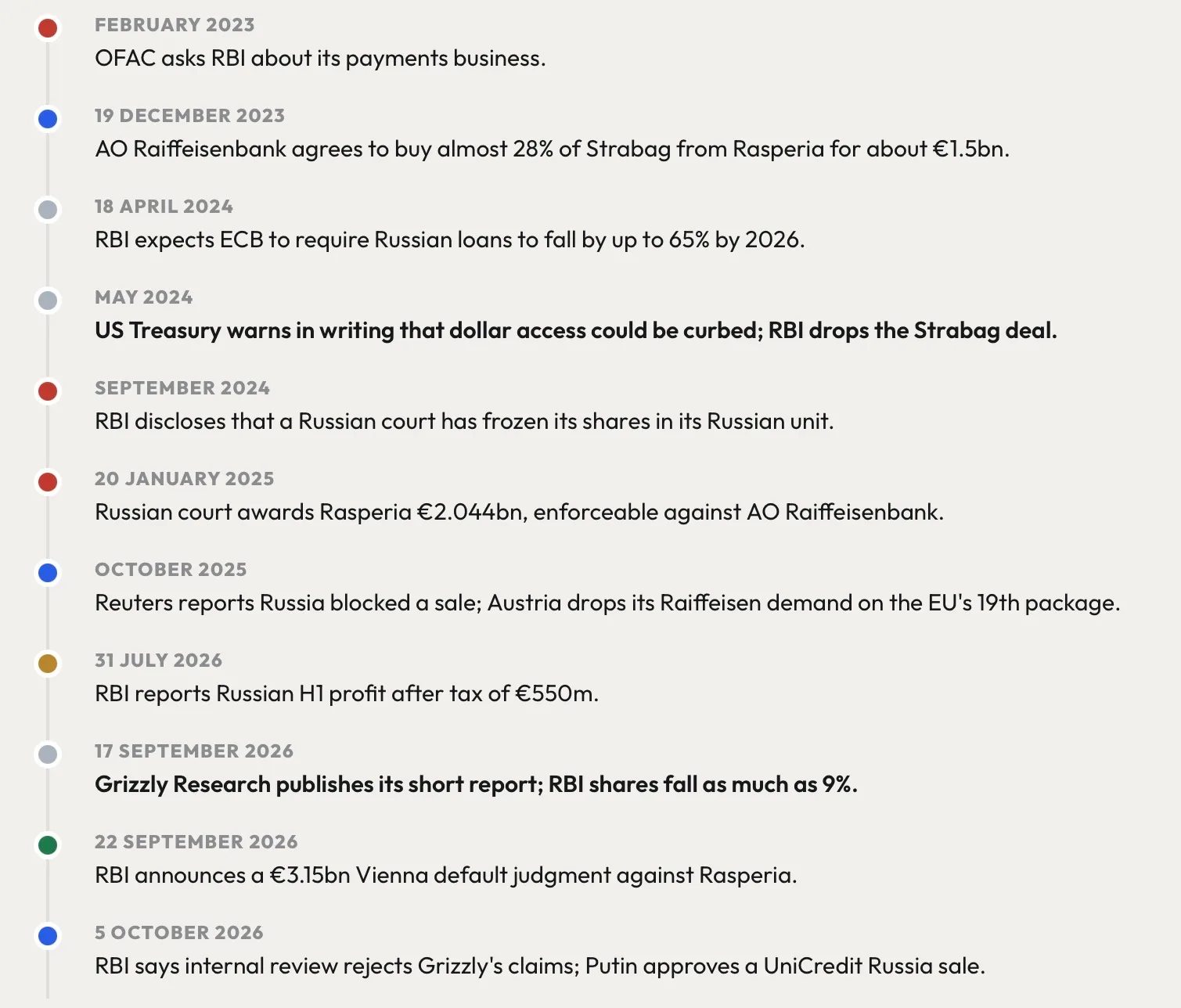
Regulatory pressure began early. In February 2023, the US Treasury's Office of Foreign Assets Control (OFAC) sent RBI a request for information about its payments business. Reuters later reported that the inquiry covered its business in Russia, Ukraine's partly occupied Donbas region and Syria. Austria's finance ministry said at the time that the inquiry was "a normal process that gives no cause for concern". In March 2023, according to sources cited by Reuters, the ECB pressed RBI to quit Russia.
The ECB pressure became formal in 2024. On 18 April 2024 RBI said it expected the ECB to require that Russian customer loans fall by up to 65% by 2026 compared with the third quarter of 2023, and that international payments from Russia also fall significantly. RBI's preliminary 2025 results say "all business reduction targets were met in 2025 and the restrictions will remain in force in 2026".
Washington's sharpest move came in May 2024. Reuters reported that Deputy Treasury Secretary Wally Adeyemo wrote to RBI warning that its access to the US financial system could be restricted, citing the executive order authorising US secondary sanctions on foreign financial institutions. Reuters later described it as a written ultimatum also sent to the ECB and the Austrian government. Reuters reported in September 2026 that the threat was never carried out.

7. Strabag, Deripaska and the Rasperia trap
A deal was part of the US concern. Reuters reported that the May 2024 letter cited RBI's expansion in Russia and a $1.5bn deal with a sanctioned Russian tycoon. On 19 December 2023, RBI announced that AO Raiffeisenbank would buy almost 28% of Strabag, an Austrian construction group, from Rasperia Trading Limited for about €1.5bn. Reuters described the deal as linked to Oleg Deripaska, a sanctioned Russian businessman; RBI said Rasperia was attributed to a sanctioned person and that a restructuring was pending. The plan would have let RBI turn trapped Russian money into an asset in Austria. The US Treasury said the stake belonged to Deripaska; his spokesperson told Reuters he had "zero interest" in Strabag at that point.
RBI dropped the deal in May 2024, days after the US letter arrived according to Reuters, saying it could not obtain the "required comfort". Rasperia then sued in Russia. In September 2024 RBI disclosed that a Russian court had frozen its shares in its Russian unit, which Reuters said ruled out a sale for now. On 20 January 2025 a Russian court ordered Strabag and its Austrian core shareholders to pay Rasperia €2.044bn, enforceable against AO Raiffeisenbank's assets. RBI's 2025 annual report says two Russian proceedings produced penalties totalling about €2.5bn.
RBI's answer has been to pursue Rasperia's frozen Austrian assets: 28.5 million Strabag shares, dividends since 2021 and a 2024 capital distribution, all frozen under EU sanctions. Austria tried to help in October 2025 by holding up the EU's 19th sanctions package, asking for assets to be unfrozen to compensate RBI. Other governments refused, and Austria approved the package without it.
RBI then went to court in Vienna. On 22 September 2026 RBI announced that the Vienna Regional Court for Civil Matters had issued a default judgment ordering Rasperia to pay about €3.15bn. If Rasperia does not appeal within four weeks, RBI plans to ask the FMA, Austria's sanctions authority, to release the frozen assets. Whether a sanctions authority will hand over a sanctioned party's shares in this way is the open question.
8. An exit Moscow controls
RBI has said since 2023 that it wants to leave Russia, through a sale or a spin-off of the bank. Three years later it has done neither. Reuters reported in October 2025 that Russian authorities blocked a sale to a local buyer, according to a source, out of fear that a transfer to Russian investors could bring Western sanctions on RBI. Any sale needs Moscow's approval.
RBI now describes a three-part approach: run the Russian business down with ring-fencing as the base case, recover value through legal claims, and keep trying to sell. Its dividend decisions are based on capital excluding Russia. On 5 October 2026 the chief executive, Michael Höllerer, said the bank did not yet see signs of a possible forced seizure of its Russian business, according to Reuters, and called settling the Rasperia dispute a priority.

The same day, Reuters reported that Putin had signed a decree approving the reorganisation and later sale of UniCredit's Russian unit, with UniCredit keeping its payments arm. That shows Moscow can approve exits when it chooses. RBI has received no such approval.
9. What is established, what is alleged, and our analysis
Established. RBI still owns a large Russian bank that earned €550m after tax in the first half of 2026. It cannot repatriate the profits or sell the unit without Moscow's consent. US and European supervisors have pressed it to shrink since 2023, and RBI says it met the ECB's reduction targets. The Strabag plan collapsed under US pressure and led to Russian court awards above €2bn that are enforceable against the unit.
Alleged. Grizzly's customs findings, its counterparty list and its undercover accounts are allegations by a firm that profits from a lower share price. RBI denies them. No authority has found that RBI or its Russian unit breached sanctions in relation to these claims, and Grizzly itself says its data do not prove payments or violations.
Our analysis. The report's most important contribution is not the headline number but the method: using the bank's registration code in customs references to map which trade flows touched it. If that link holds, it gives supervisors a way to test RBI's stated controls against real shipments. If it does not, because a code on a declaration does not mean the bank moved money, the figures say little about the bank's conduct. That is a question only authorities with access to the bank's own records can settle. In the meantime, the Russian unit remains a large asset that RBI cannot sell and that could become a liability under any new sanctions decision.