
1. The decision
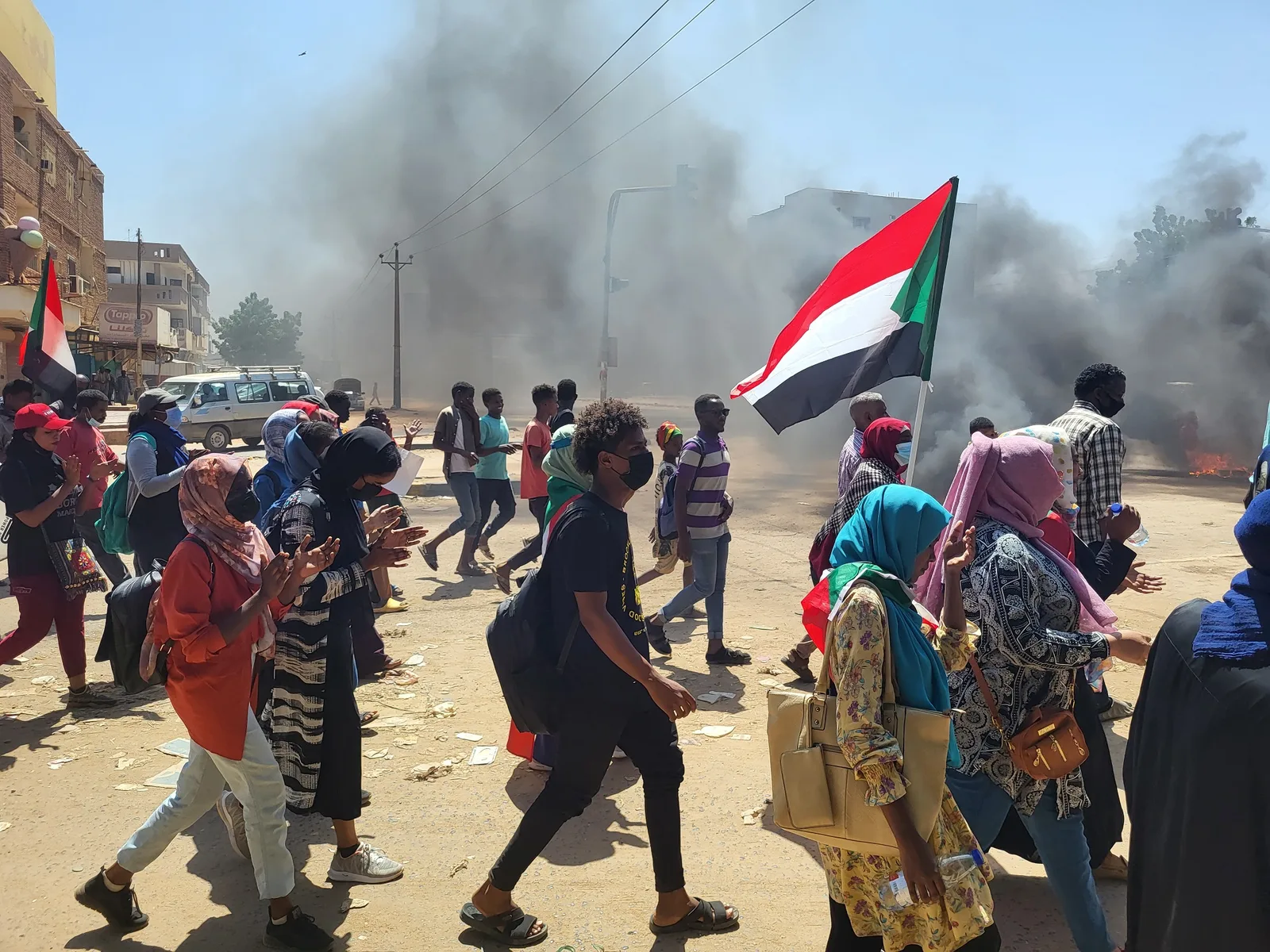
On Monday 21 September, Sudan's army-aligned government announced it would replace the national currency. The decision followed a meeting of the committee in charge of the currency change, chaired by Lieutenant General Ibrahim Jaber Ibrahim, a member of the Transitional Sovereignty Council, in the presence of ministers and the governor of the Central Bank of Sudan. Government spokesperson and information minister Khalid al-Aiser denounced what he called an "economic war" waged against the Sudanese people, alongside the fighting on the ground and in the media, according to RFI.
He said the meeting was the culmination of more than a year and a half of consultations since exchanges began in several states, and that it covered arrangements for the replacement in "secure states", gold smuggling and the push for citizens to open bank accounts and pay digitally. None of the reports published so far give a date, denominations or an exchange mechanism.
2. The collapse behind it
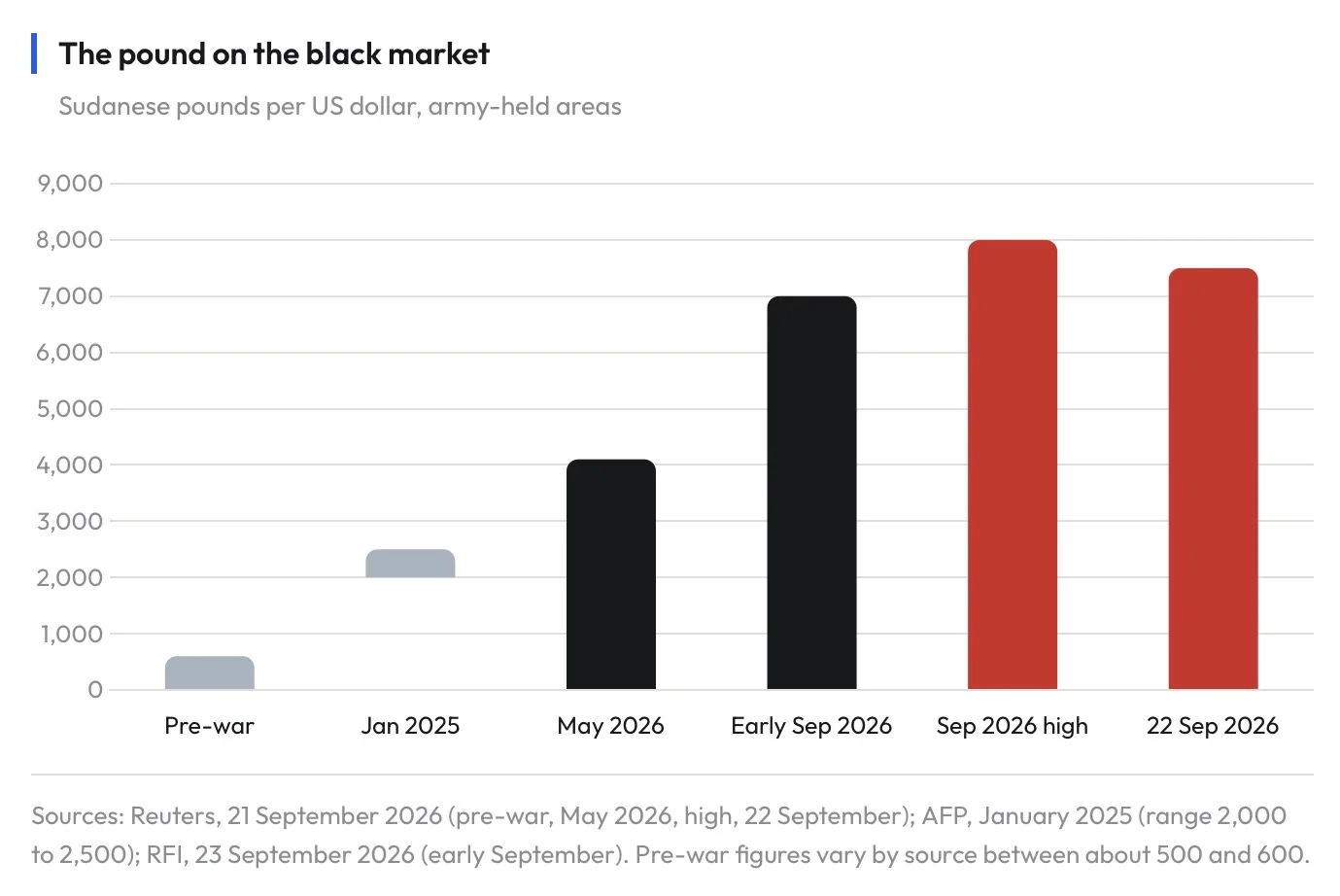
According to Reuters, the pound has lost nearly half its value in army-held territory since the start of the summer, one of the sharpest falls since the war between the army and the paramilitary Rapid Support Forces began in April 2023. On the black market it traded around 7,500 to the dollar on Tuesday, after touching 8,000, against 4,100 in May. Before the war, it traded at about 600.
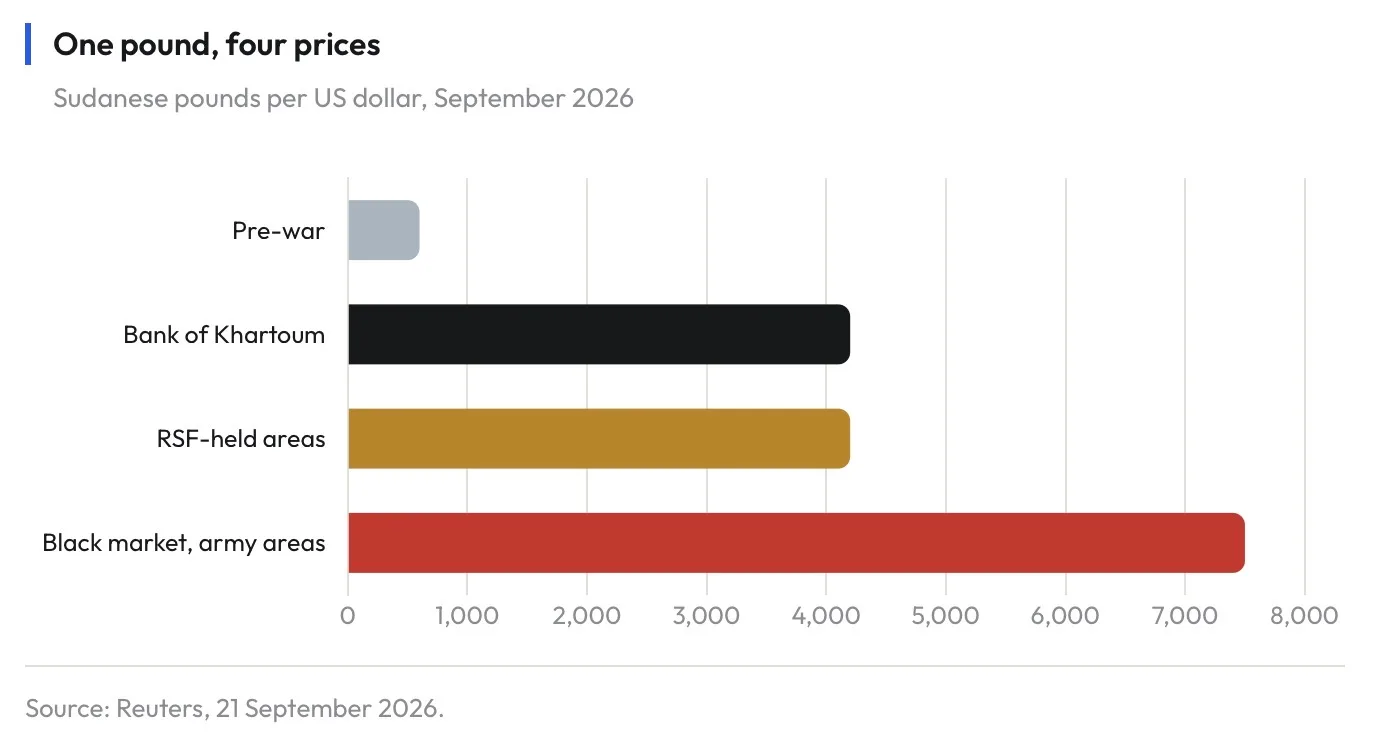
The central bank no longer updates the official exchange rate. The Bank of Khartoum, the country's largest bank, offers 4,200. In areas held by the RSF, Reuters reports the pound has stayed relatively stable at about 4,200 in recent months.
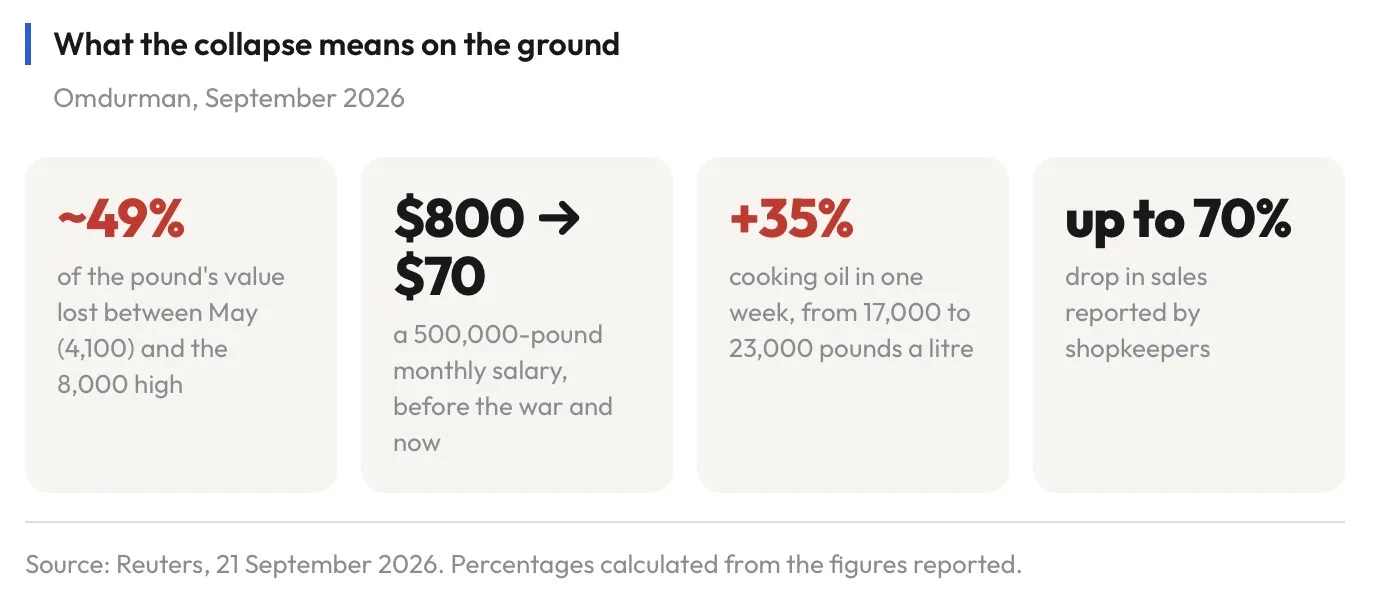
RFI reports that inflation came close to 100 percent last year, that traders across Khartoum's three cities have launched an open-ended strike against soaring prices, and that Finance Minister Gibril Ibrahim pledged at a UNDP meeting on Tuesday to bring inflation below 60 percent by the end of 2026. Importers pay for fuel and wheat with dollars bought on the black market, a former central bank official told Reuters. RFI adds that the war in Iran and higher oil prices are feeding the crisis.
3. Why the money is missing
The deeper cause is what Suliman Baldo, head of the Sudan Transparency and Policy Tracker, calls the "economic partition" of the country. Large parts of Sudan's gold, livestock, oilseeds and gum arabic are produced in RSF-held areas, depriving the army-aligned government of export revenue.
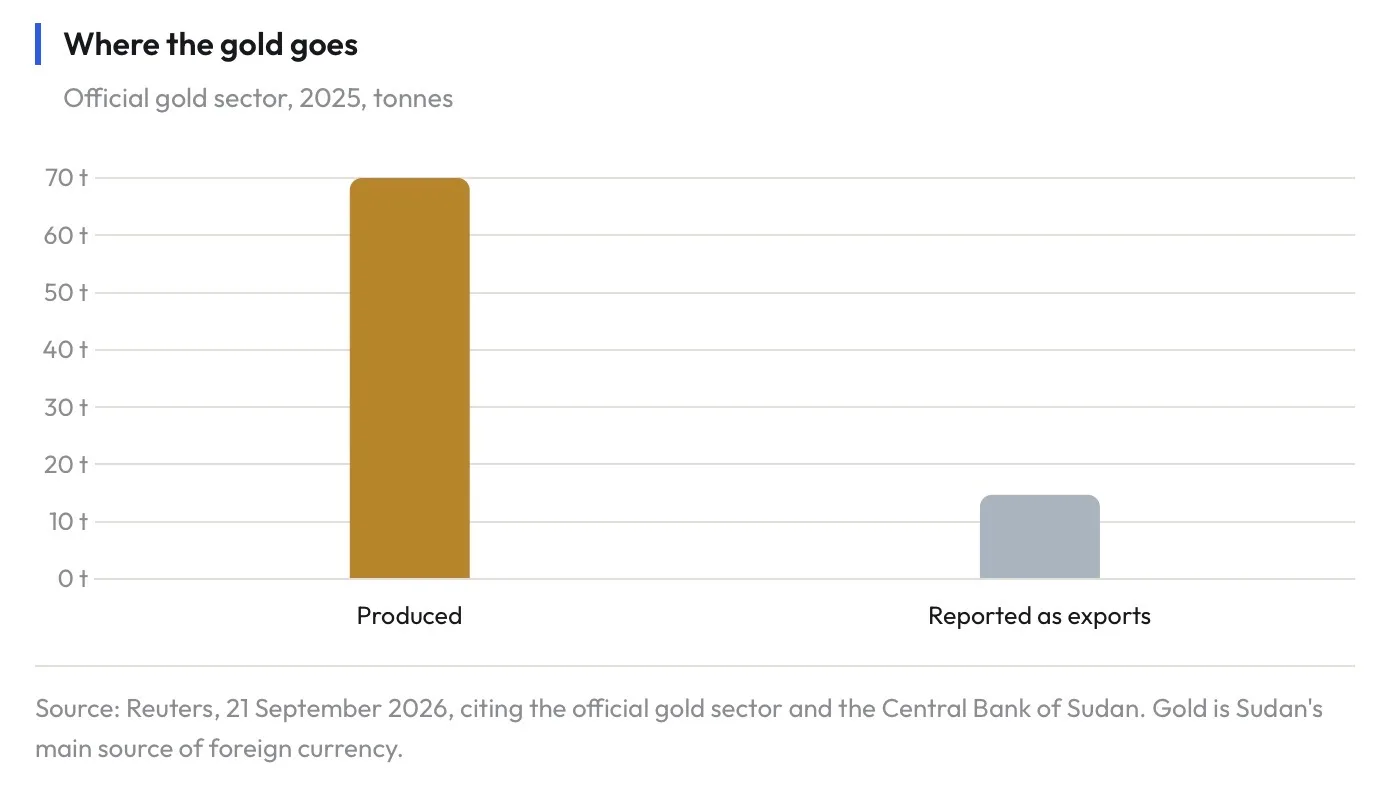
Even in army-held territory, much of what is produced does not reach the state budget, Baldo told Reuters, but is diverted to weapons purchases or patronage networks. Until that changes, he said, there will be no stable economy in Sudan. Meanwhile demand is rising: according to the International Organization for Migration, about 5 million of the 14 million people displaced by the war have returned home, mainly to areas the army retook.

4. The last currency change
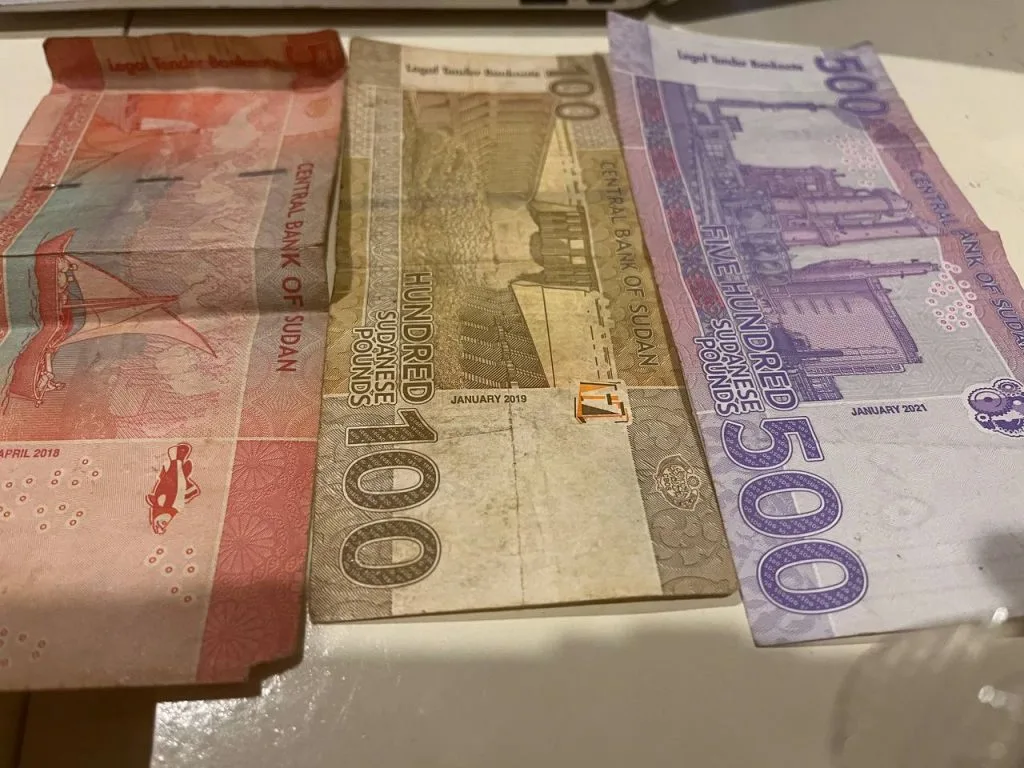
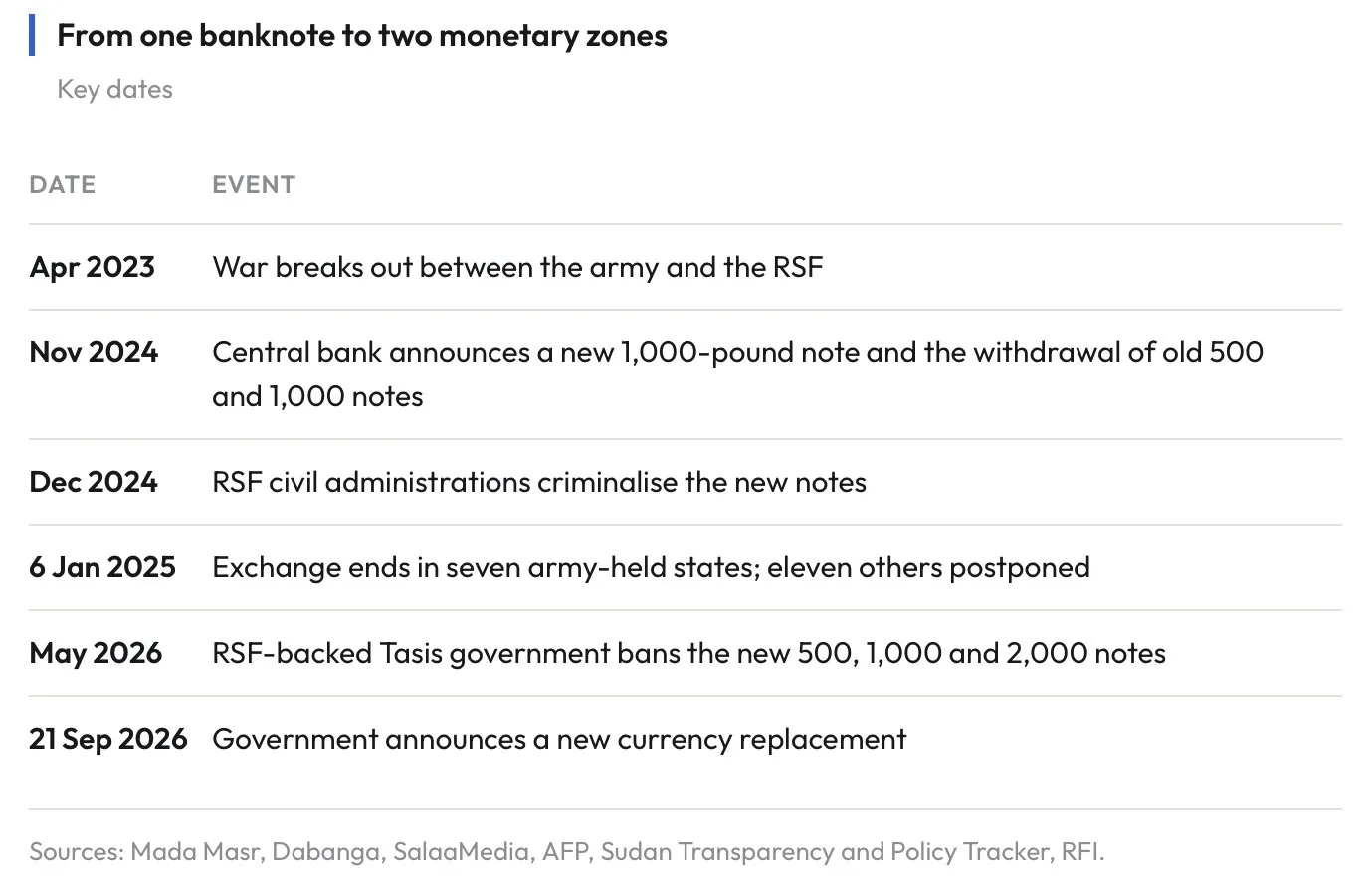
This is not the first attempt. In November 2024, the central bank announced a new 1,000-pound note, printed in Russia, and the withdrawal of the old 1,000 and 500 notes. The exchange ran in seven army-held states and ended on 6 January 2025; eleven other states were postponed, including Darfur. Holders had to open bank accounts to swap their notes, and in Port Sudan, AFP reported, banks ran short of new cash.
The RSF rejected the move. In December 2024, its civil administrations criminalised the possession and circulation of the new notes, with prison or fines. In May 2026, the RSF-backed Tasis government banned the new 500, 1,000 and 2,000 notes in its territory. The Sudan Transparency and Policy Tracker's conclusion: one country with two currencies.
The stated aims then were to draw cash into the banking system, fight counterfeiting and neutralise funds looted by the RSF. Analysts quoted by AFP saw a war measure: an attempt to weaken the RSF with a more dominant currency and to bolster the army's war chest. RFI reports the same logic today: Khartoum hopes a new currency will weaken RSF finances.
5. The risks
A currency is a promise backed by revenue. Sudan's government is changing the promise without recovering the revenue.
WHAT TO WATCH
The details. Denominations, deadlines and which states are covered.
The RSF response, and whether the Tasis government bans the new notes as it did in May.
The black-market rate, the only real-time measure of confidence, now that the central bank no longer publishes an official one.
The traders' strike in Khartoum, and whether it spreads.
Gibril Ibrahim's 60 percent inflation target for the end of 2026.