1. A number from a speech
Ask how much money is laundered in the world and you will almost always get the same answer: 2 to 5 percent of global GDP. On the website of the United Nations Office on Drugs and Crime (UNODC), it reads "$800 billion - $2 trillion in current US dollars". The figure appears in bank reports, parliamentary debates and compliance training courses. It has a precise origin, and it was never a measurement.
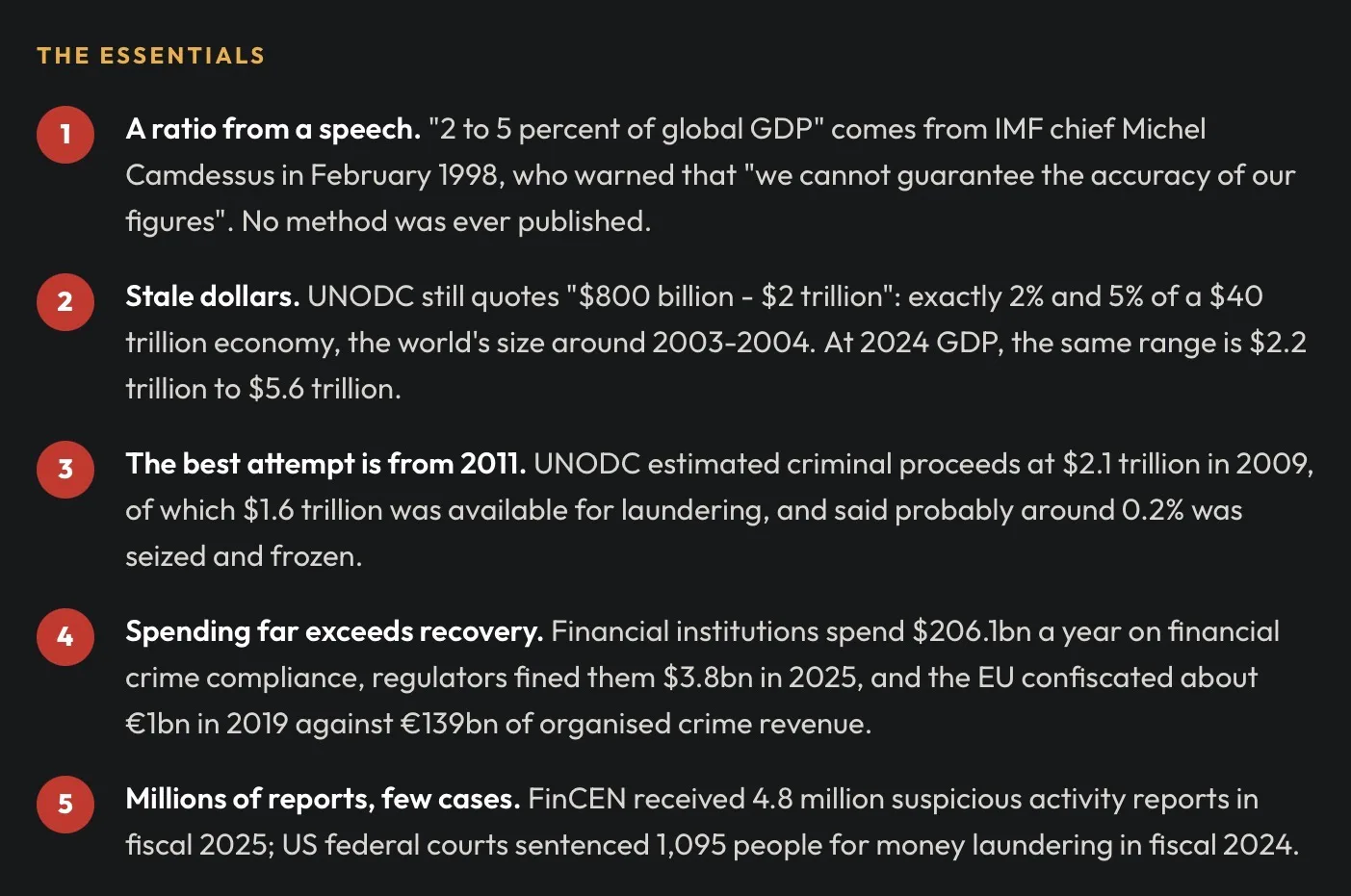
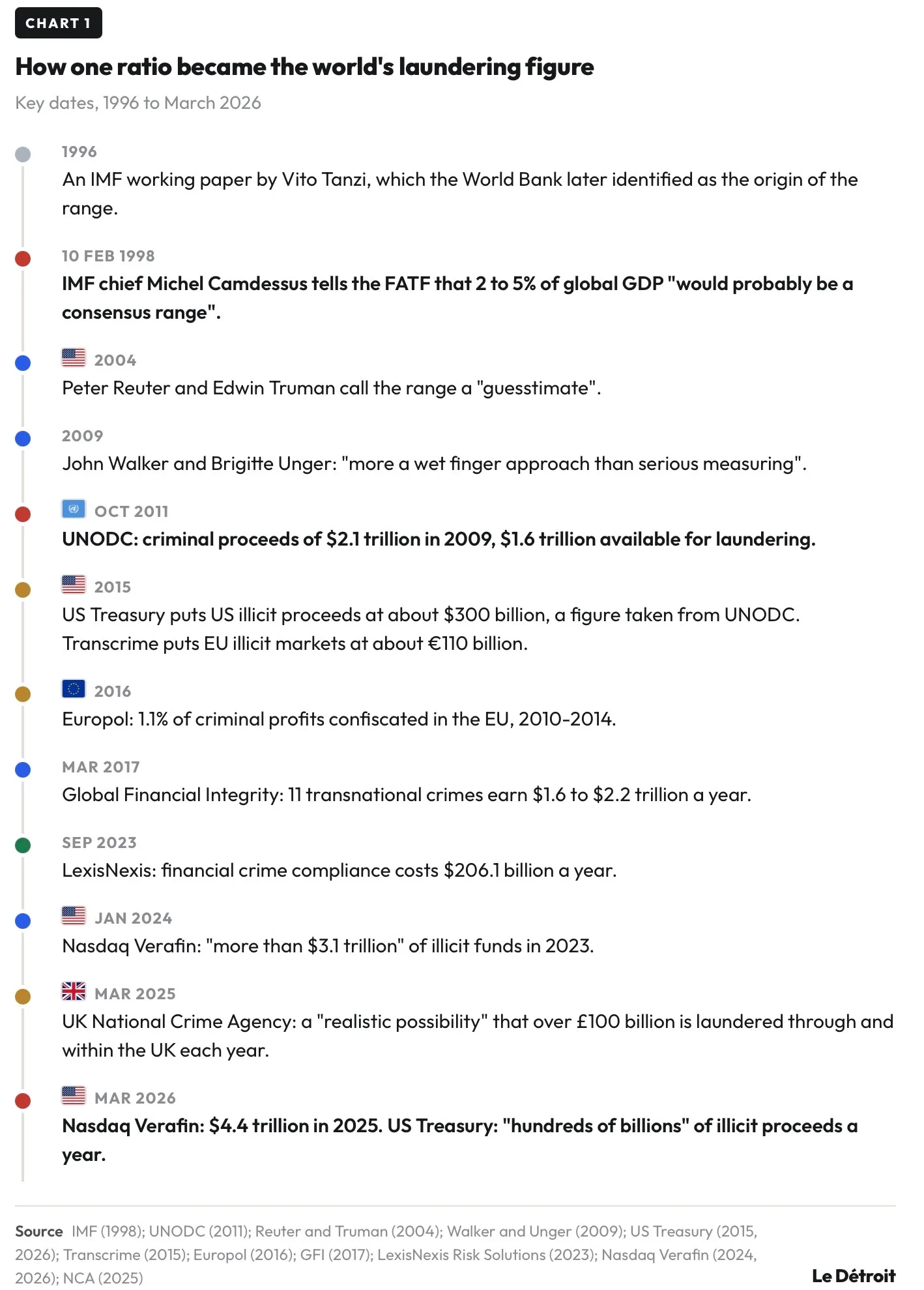
On 10 February 1998, Michel Camdessus, then managing director of the International Monetary Fund, addressed the plenary meeting of the Financial Action Task Force (FATF), the global anti-money laundering body, in Paris. He offered the range in a single sentence, and he hedged it.

The speech cites no data and no method. Thirteen years later, UNODC itself pointed to "the lack of supporting material and methodology documenting how it was established", adding that, according to the World Bank, the range dated back to research by the economist Vito Tanzi published in an IMF working paper in 1996. Academics were blunter. Peter Reuter and Edwin Truman called it a "guesstimate" in 2004. John Walker and Brigitte Unger wrote in 2009 that the method "seems more a wet finger approach than serious measuring."
2. Same percentages, very different dollars
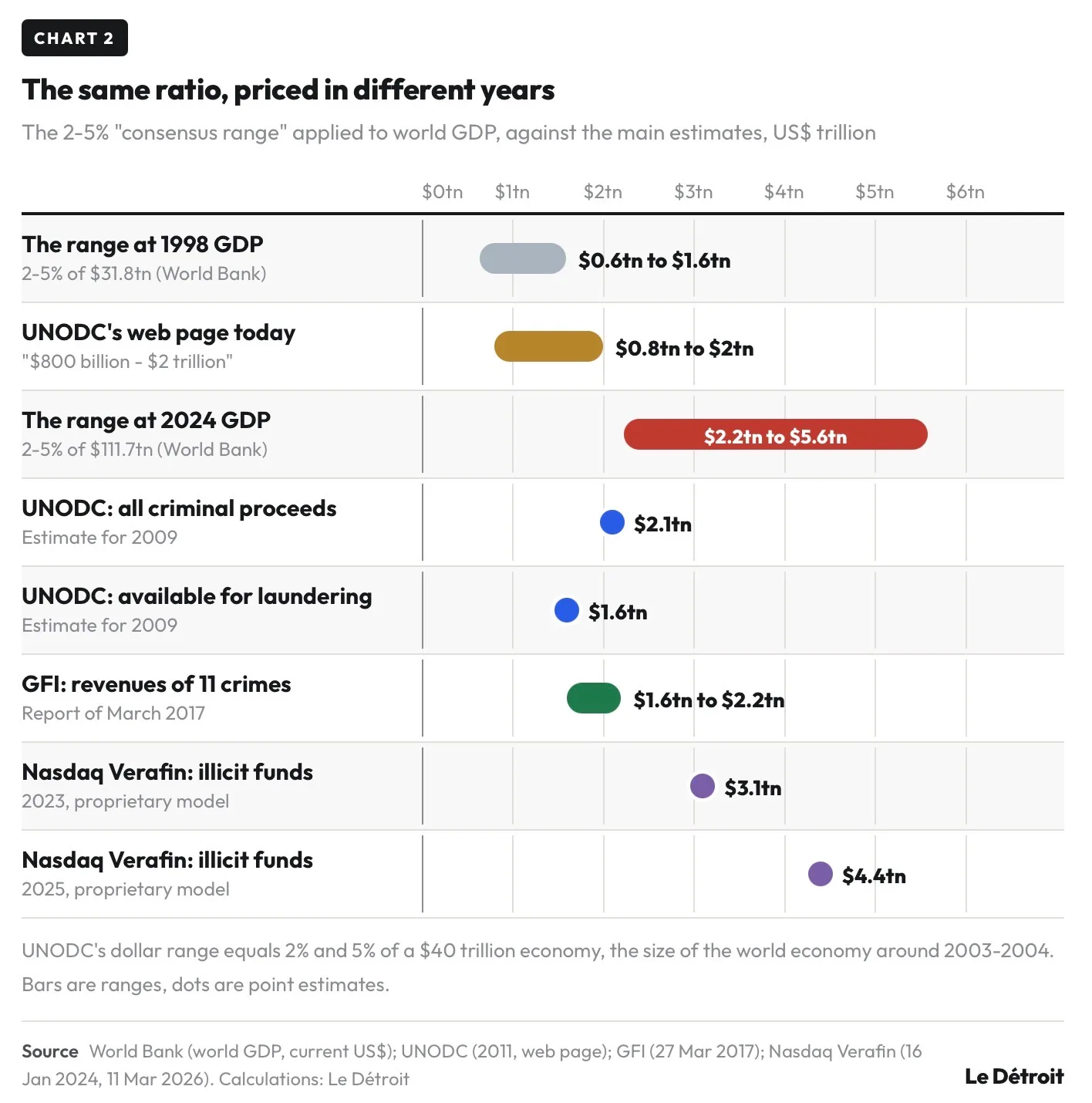
The dollar range has not kept pace with its own percentages. "$800 billion - $2 trillion" is exactly 2% and 5% of a $40 trillion economy, which is roughly the size of the world economy in 2003 and 2004, when World Bank data put global output at about $39 trillion and $44 trillion. Applied to 1998, the range is $0.64 trillion to $1.59 trillion; the FATF, using the statistics of the time, gave $590 billion to $1.5 trillion. Applied to 2024, when world GDP was about $111.7 trillion, it becomes $2.2 trillion to $5.6 trillion.
If the consensus range were right, the "2 trillion" that headlines repeat would now be the floor, not the ceiling. That is not an argument for a bigger number. It shows that the figure is a ratio from 1998, multiplied by whatever GDP the writer has to hand.
3. What the serious attempts found
UNODC tried to do better in October 2011. A meta-analysis of existing studies led it to conclude that "all criminal proceeds are likely to amount to some 3.6% of global GDP (2.3%-5.5%), equivalent to about US$2.1 trillion (2009)". The amount available for laundering through the financial system was put at 2.7% of GDP, or $1.6 trillion, near the lower end of the IMF range. Illicit drugs accounted for about a fifth of all crime proceeds. And, the report added, "much less than 1% (probably around 0.2%) of the proceeds of crime laundered via the financial system are seized and frozen."
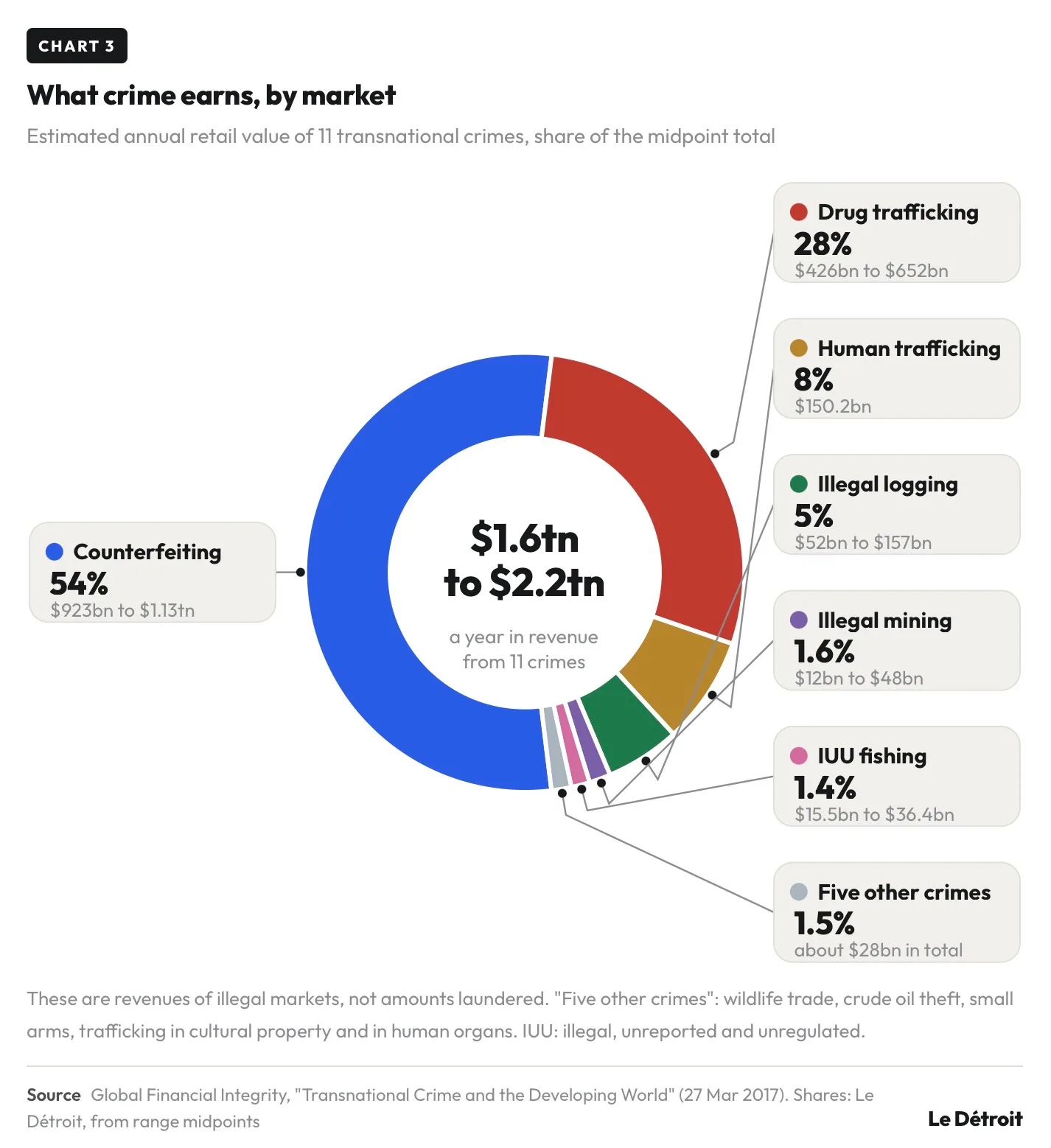
A second family of estimates prices the crimes themselves. Global Financial Integrity (GFI), a Washington research group, estimated in March 2017 that eleven transnational crimes generate $1.6 trillion to $2.2 trillion a year. Counterfeiting accounts for about half of that, drug trafficking for more than a quarter. These are revenues of illegal markets, not sums laundered: a fake handbag's sale price is not the same thing as money passing through a bank.
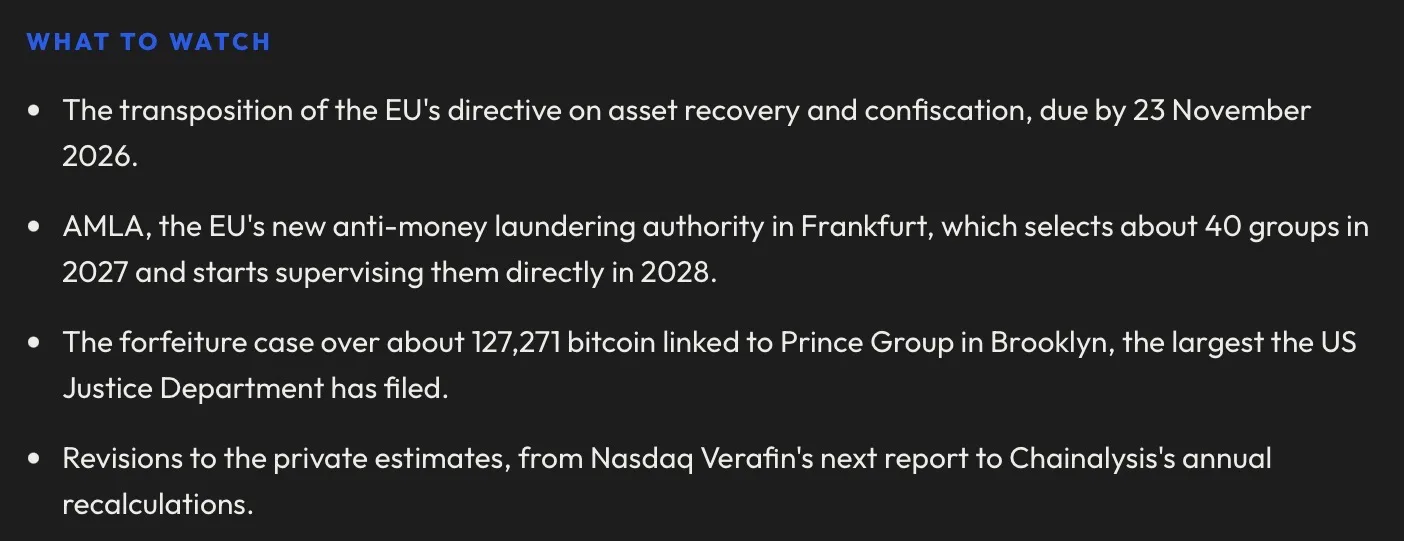
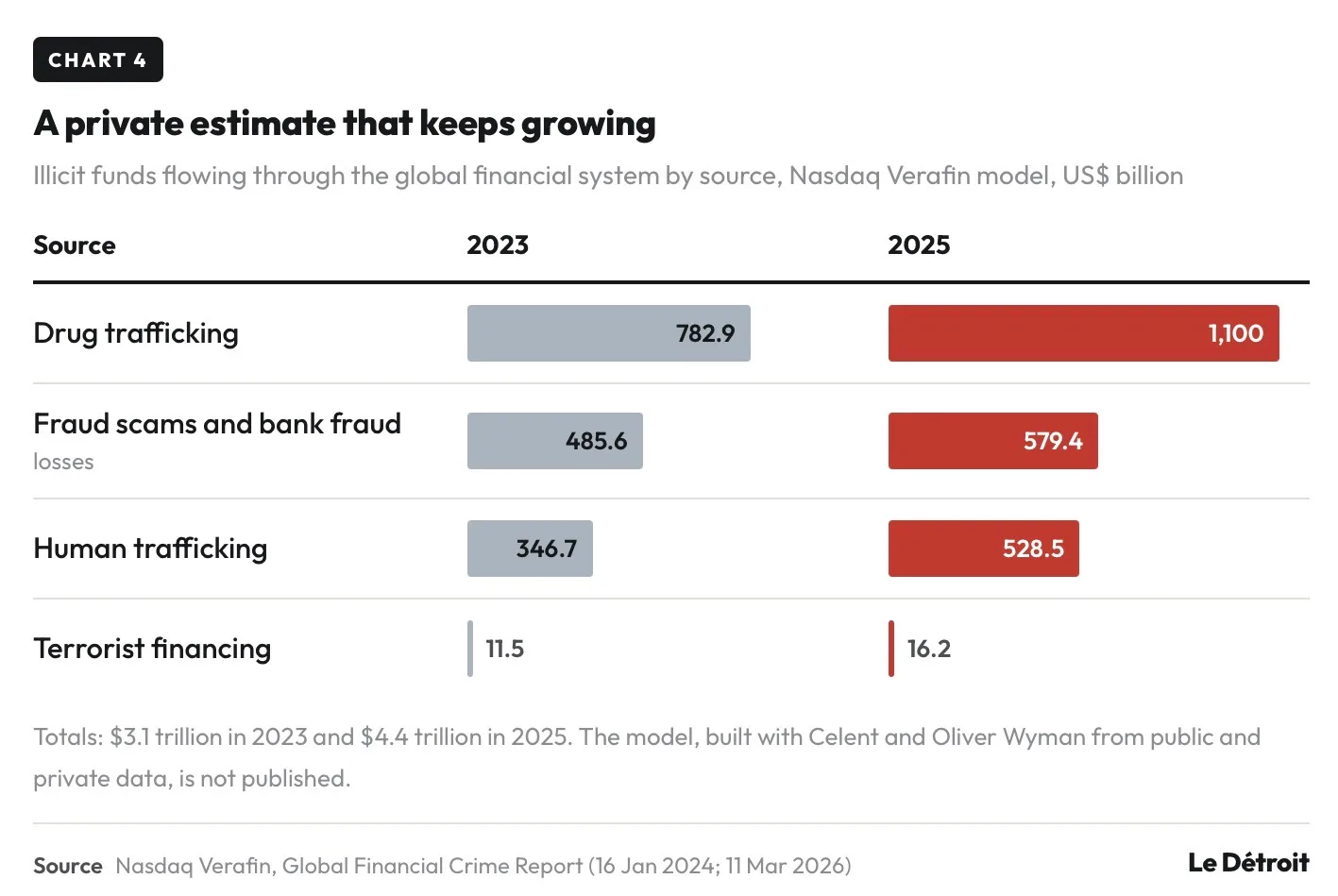
The most recent figures come from the private sector. Nasdaq Verafin, which sells financial crime software to banks, estimated in January 2024 that "more than $3.1 trillion in illicit funds flowed through the global financial system" in 2023. Its second edition, published on 11 March 2026, put the figure for 2025 at $4.4 trillion, including $1.1 trillion from drug trafficking, $528.5 billion from human trafficking and $579.4 billion in fraud losses. The model, built with the consultancies Celent and Oliver Wyman from public and private data, is not published. Measured against world GDP, both totals land inside the old range, at roughly 3% and 4%.
4. Where governments dare to put a number
National authorities are more cautious, and their caution is telling. The US Treasury's 2015 National Money Laundering Risk Assessment estimated that "about $300 billion is generated annually in illicit proceeds" in the United States, a figure it took from UNODC rather than calculated itself. The 2022 and 2024 editions gave no total. The 2026 edition, published in March, says only that "fraud and drug trafficking generate hundreds of billions of dollars in illicit proceeds each year".
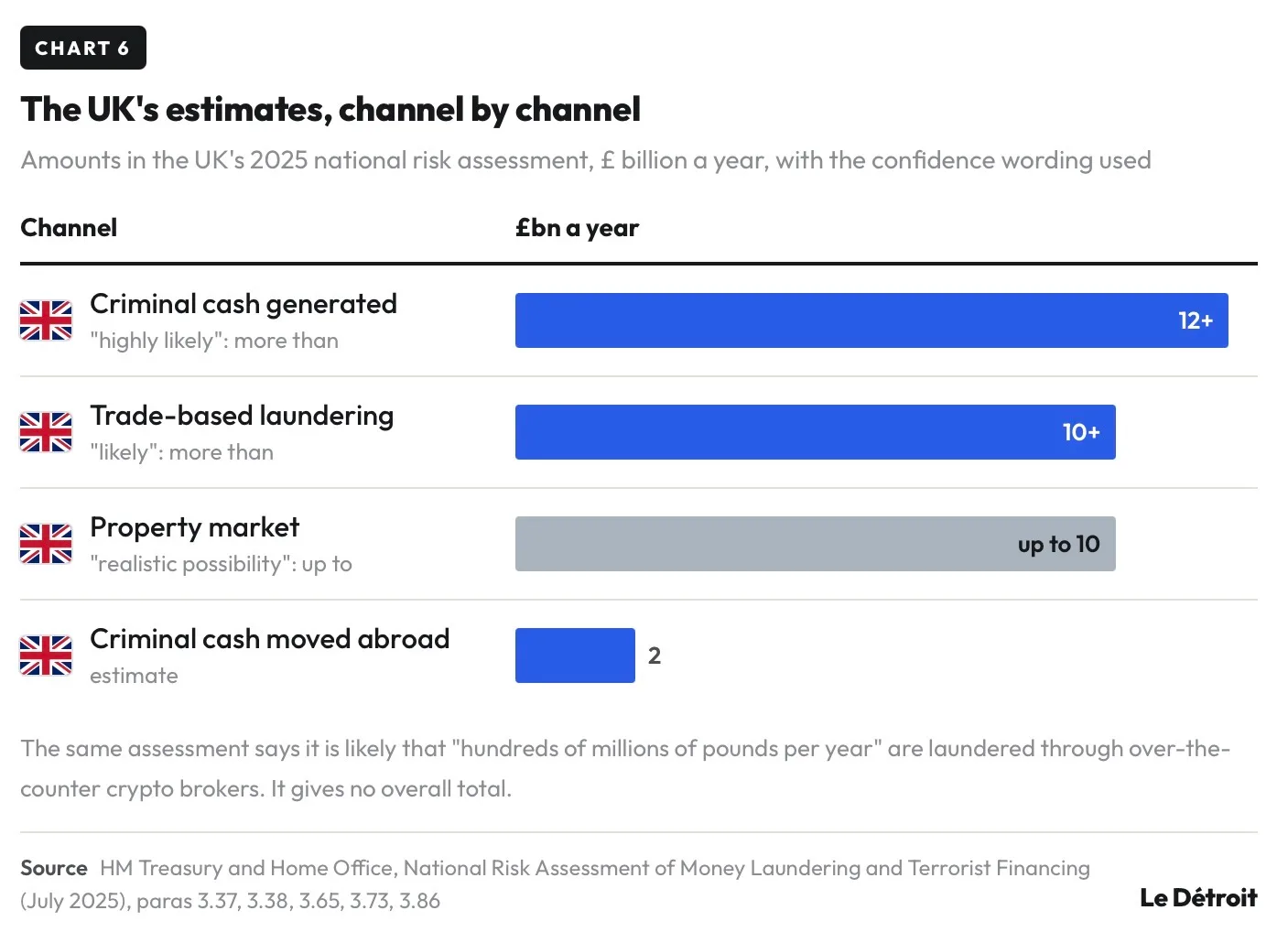
In Britain, the National Crime Agency (NCA) judged in its 2025 strategic assessment that "it is a realistic possibility that over £100 billion is laundered through and within the UK or UK-registered corporate structures each year". On the probability scale used by British intelligence, a realistic possibility means roughly 40% to under 50%. The government's own risk assessment, published in July 2025, gives no total at all, only estimates by channel.
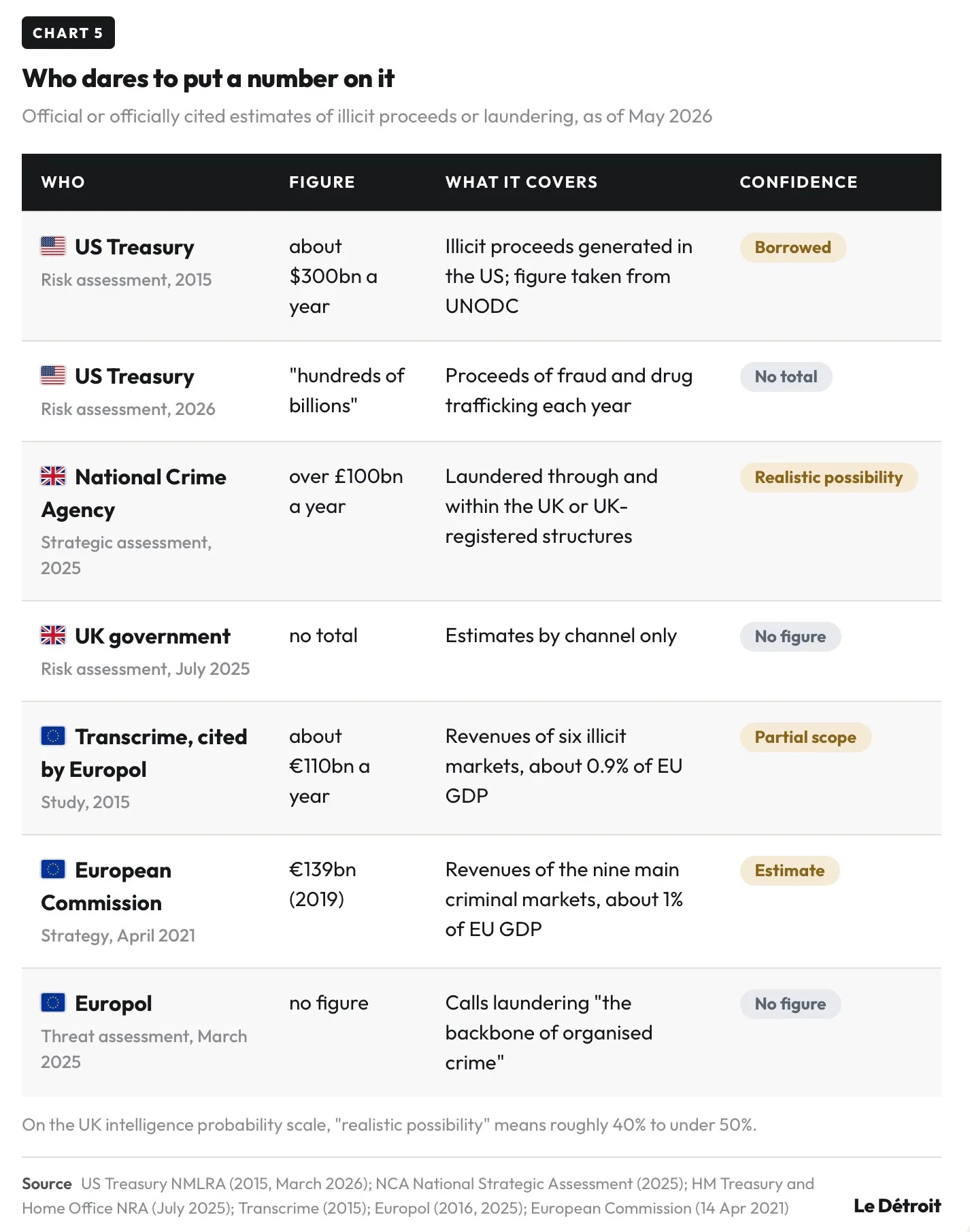
In the European Union, the reference point remains a 2015 study by Transcrime, an Italian research centre, which found that the main illicit markets generate about €110 billion a year, about 0.9% of GDP in Europol's reading. The study only covered markets with data for every member state, so it leaves out human trafficking and extortion, among others. The European Commission later used €139 billion for 2019. Europol's 2025 threat assessment, which calls money laundering "the backbone of organised crime", gives no estimate of total criminal proceeds or of money laundered.
5. The laundromats
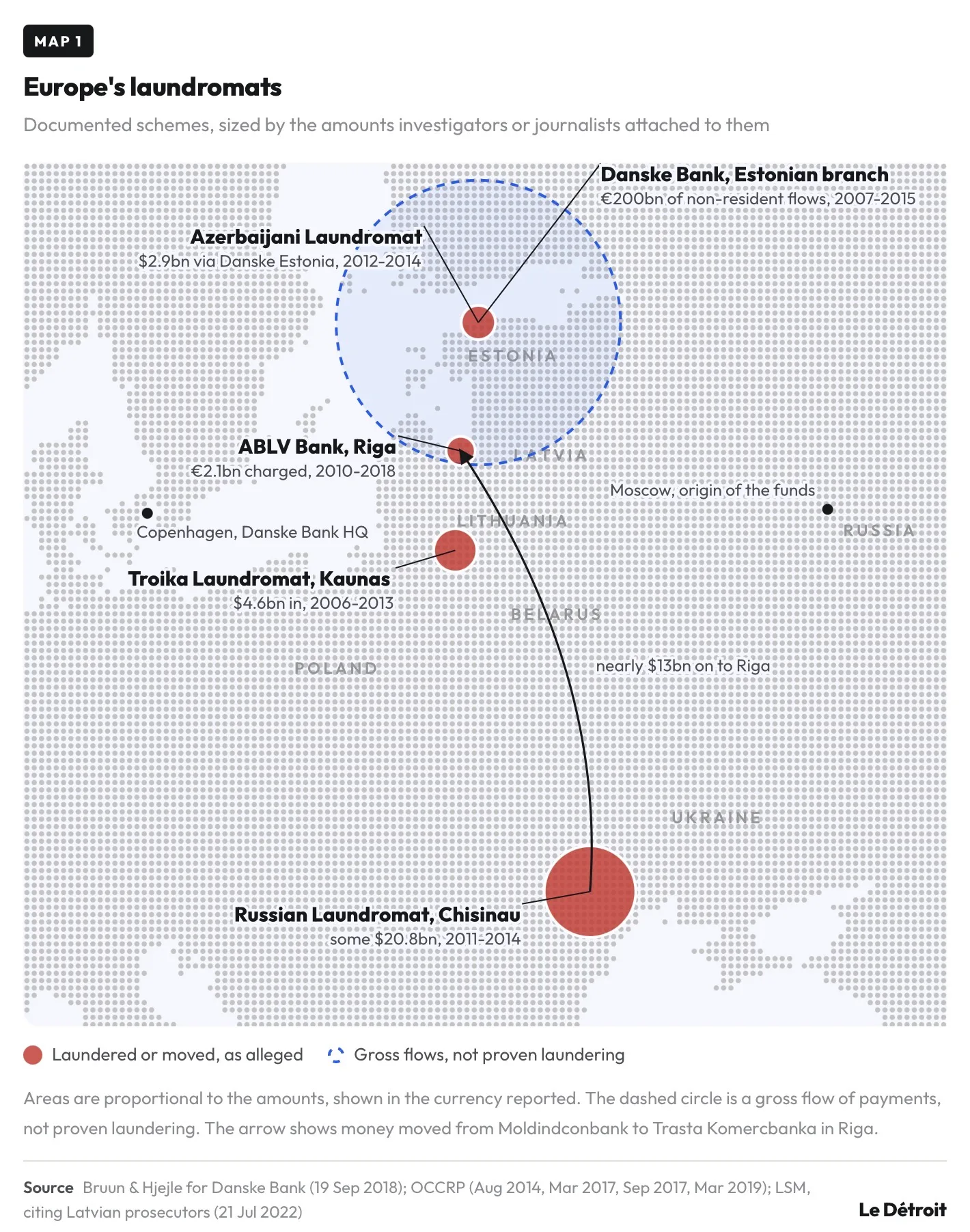
Individual cases show what the aggregates cannot. Between 2007 and 2015, non-resident customers moved about €200 billion through the Estonian branch of Danske Bank, according to the law firm Bruun & Hjejle, which the bank hired to investigate. That is a gross flow of payments, not proven laundering. Swedbank's Baltic subsidiaries handled €17.8 billion of incoming and €18.9 billion of outgoing high-risk payments between March 2014 and March 2019, according to the law firm Clifford Chance.
The schemes documented inside those flows are smaller, but precise. The "Russian Laundromat", exposed by the Organized Crime and Corruption Reporting Project (OCCRP), laundered "some $20.8 billion" out of Russia using fake debts certified by Moldovan courts, wired through Moldindconbank and, for nearly $13 billion, on to Trasta Komercbanka in Riga. The "Azerbaijani Laundromat" handled $2.9 billion through Danske's Estonian branch between 2012 and 2014. The "Troika Laundromat" moved $4.6 billion into a network of at least 75 offshore companies, many of them banking at Ukio Bankas in Lithuania, between 2006 and 2013. In Latvia, prosecutors charged former senior staff of ABLV Bank in 2022 with laundering €2.1 billion.
Outside Europe, the US Justice Department says more than $4.5 billion was allegedly misappropriated from Malaysia's 1MDB fund between 2009 and 2015. FinCEN, the US Treasury's financial intelligence unit, found that Cambodia's Huione Group laundered at least $4 billion of illicit proceeds between August 2021 and January 2025. TD Bank's failures let three networks move more than $670 million between 2019 and 2023, while about $18.3 trillion of its transactions went unmonitored. And when the FinCEN Files leaked in 2020, the International Consortium of Investigative Journalists counted more than $2 trillion of transactions flagged by banks as possibly suspicious between 1999 and 2017, while noting that such reports are not necessarily evidence of wrongdoing.
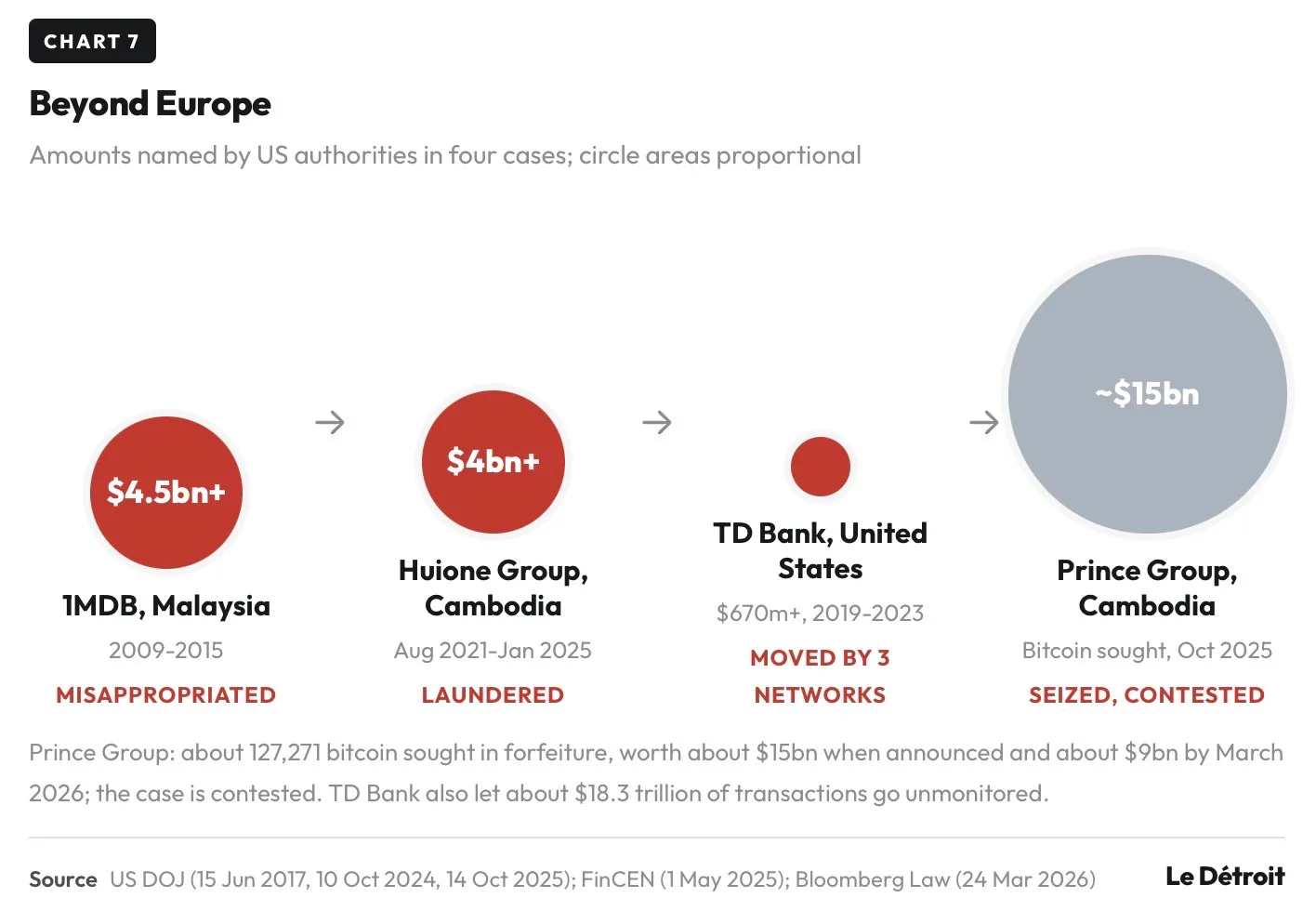
Taken one by one, the documented schemes run to billions or tens of billions of dollars, not trillions. Each came to light through a leak, a whistleblower or a regulator, and each ran for years inside banks that had anti-money laundering programmes. The cases show that the scale is real. They cannot show how much remains undetected.
6. The iceberg
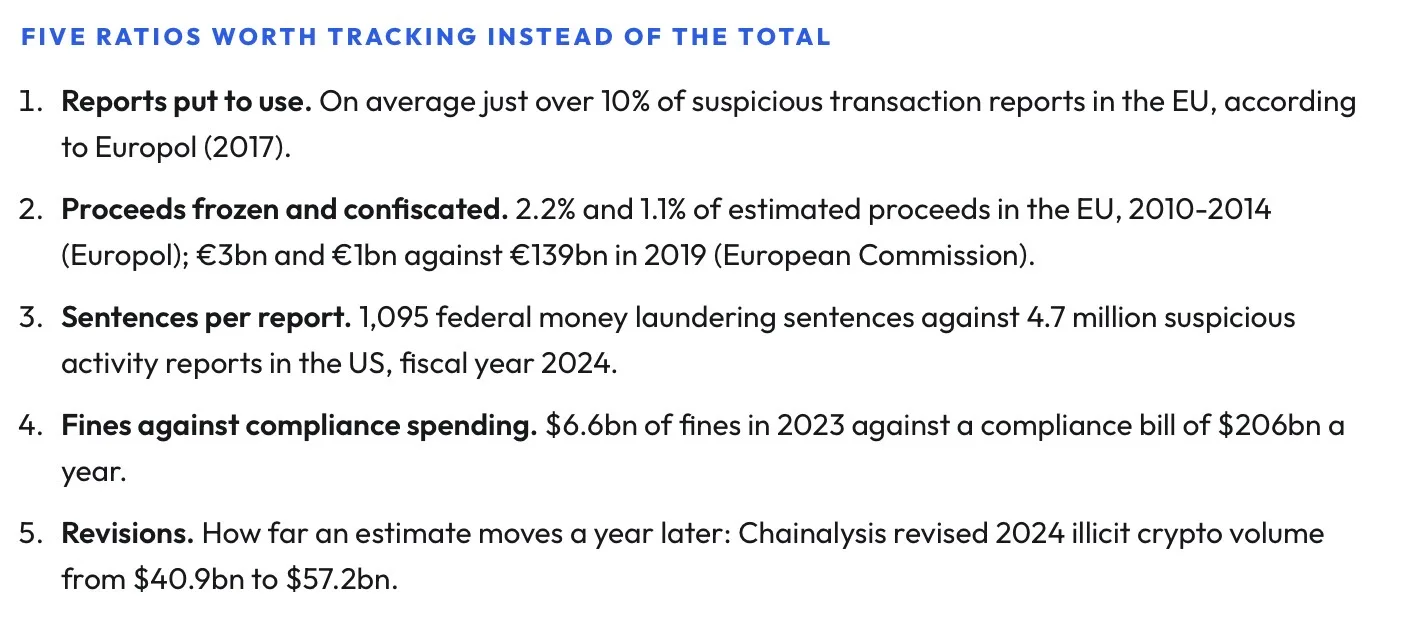
Europe is the one region that has tried to measure what it recovers. Europol's study of 2010 to 2014 found that 2.2% of estimated criminal proceeds were provisionally seized or frozen and 1.1% finally confiscated: "98.9% of estimated criminal profits are not confiscated and remain at the disposal of criminals." The European Commission updated the picture in 2022. Organised crime generates at least €139 billion a year; in 2019, authorities froze €3 billion and confiscated about €1 billion.
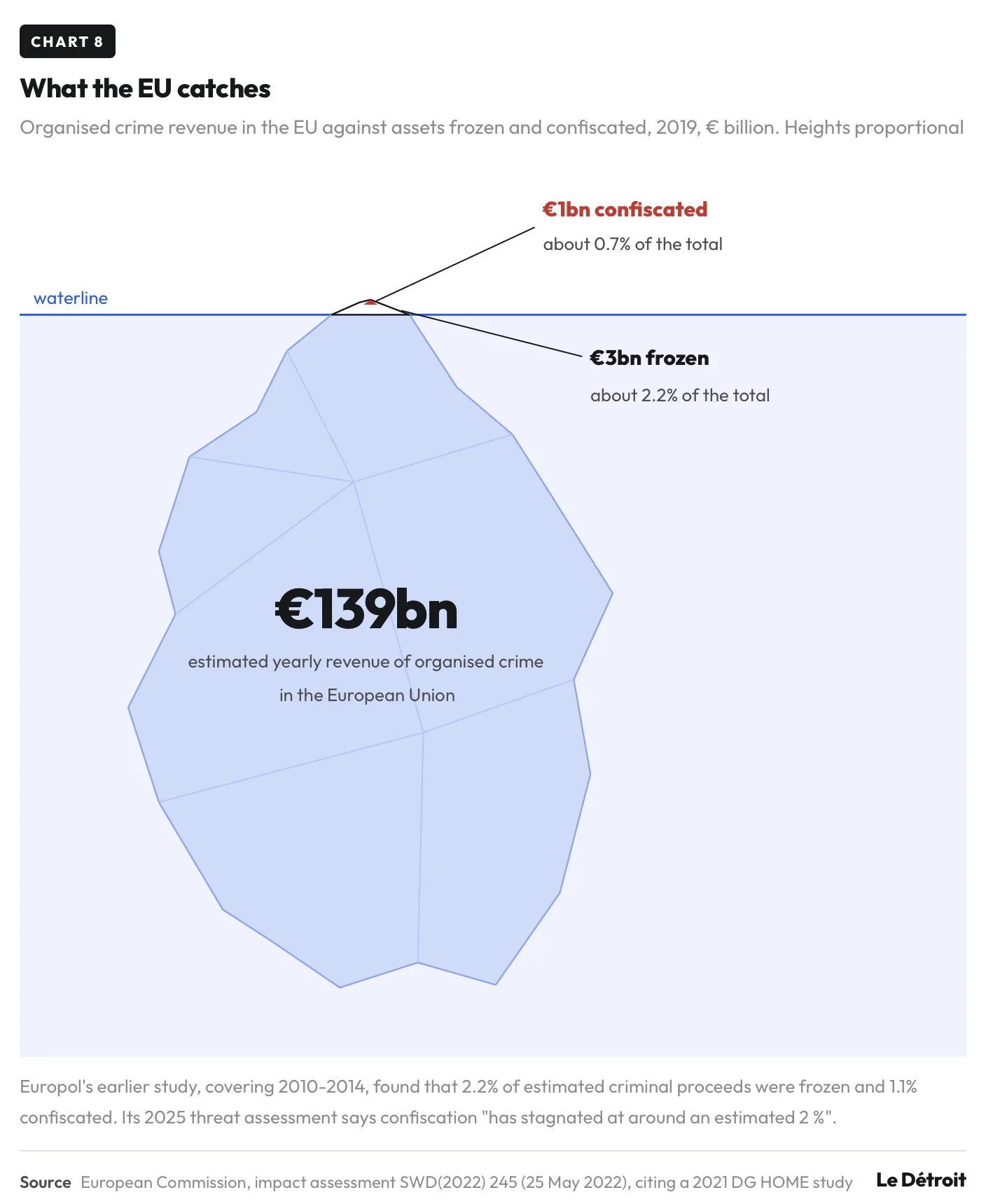
The rate has hardly moved. Europol's 2025 threat assessment says that, "despite substantial investments in resources and legislative frameworks, the confiscation of criminal proceeds has stagnated at around an estimated 2 %", without citing a new dataset. The EU's answer is a new directive on asset recovery and confiscation, Directive (EU) 2024/1260 of 24 April 2024, which member states must transpose by 23 November 2026.
7. Millions of reports, a thousand sentences
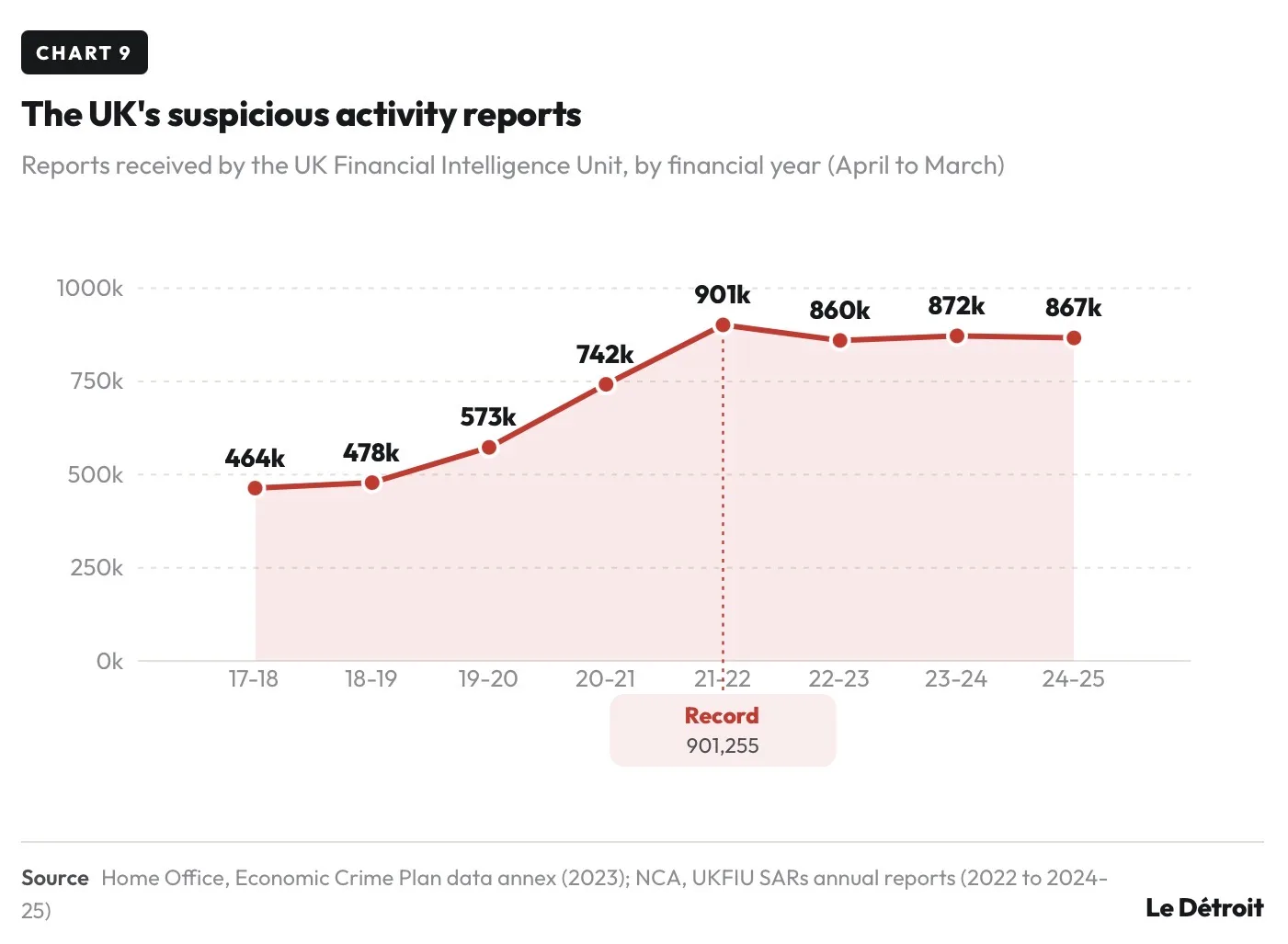
The system's main detection tool is the suspicious activity report, filed by banks and other businesses with national financial intelligence units. In the United States, FinCEN received about 4.3 million in fiscal year 2022, 4.6 million in 2023, 4.7 million in 2024 and 4.8 million in 2025. In Britain, reports rose from 478,437 in 2018-19 to a record 901,255 in 2021-22 and stood at 866,616 in 2024-25. Across the EU, the latest Europol count found 960,463 reports in 2014; on average, Europol says, "just over 10%" of reports are put to use, a rate it says has held since 2006.
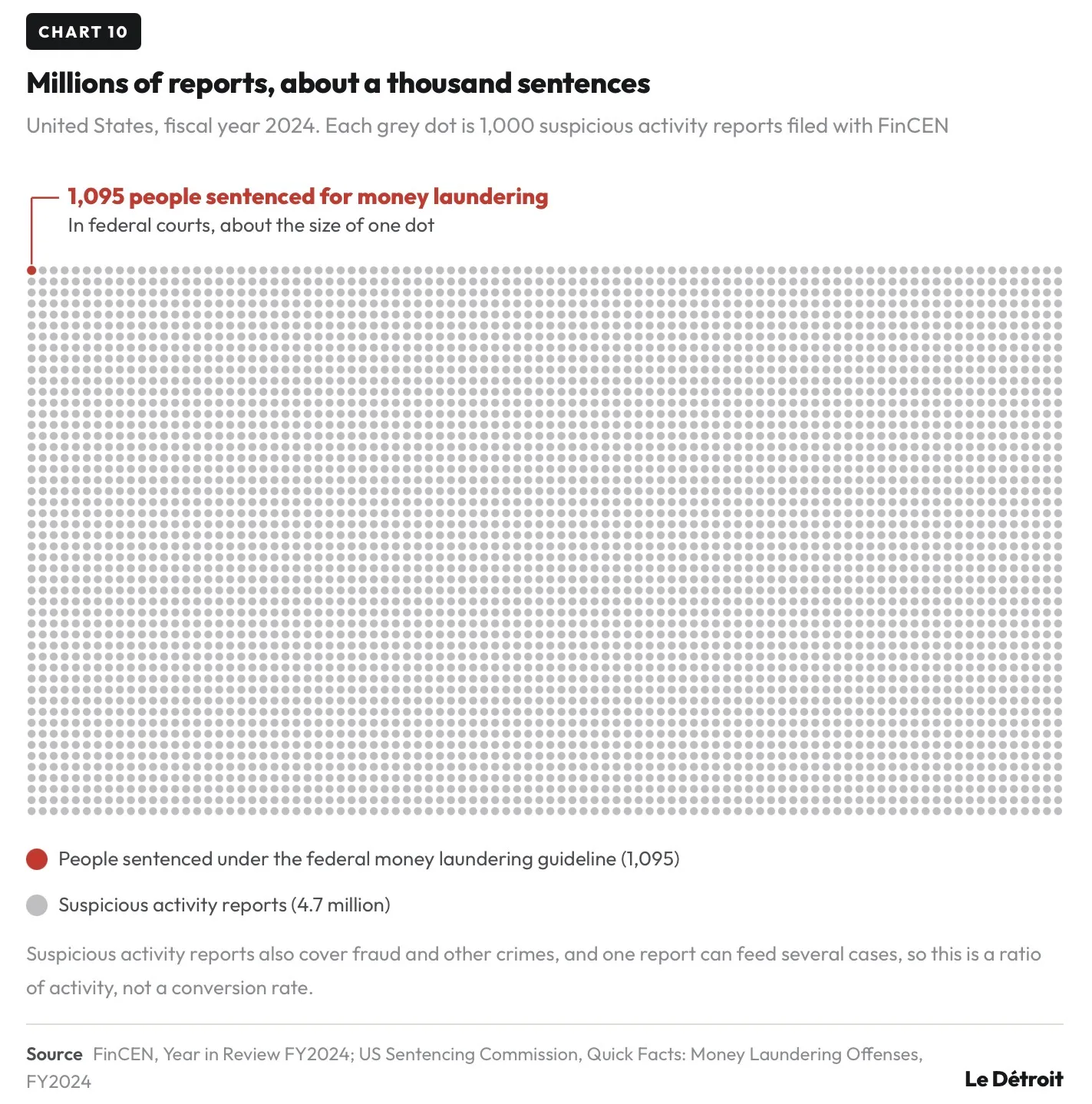
At the other end of the chain, the US Sentencing Commission recorded 1,095 money laundering cases among the 61,678 federal sentencings reported to it in fiscal year 2024, up from 755 in 2020. That is roughly one sentence for every 4,300 suspicious activity reports. The comparison is crude: reports also cover fraud and other crimes, and laundering is often prosecuted under other charges. But the scale of the gap is the point.
8. The bill
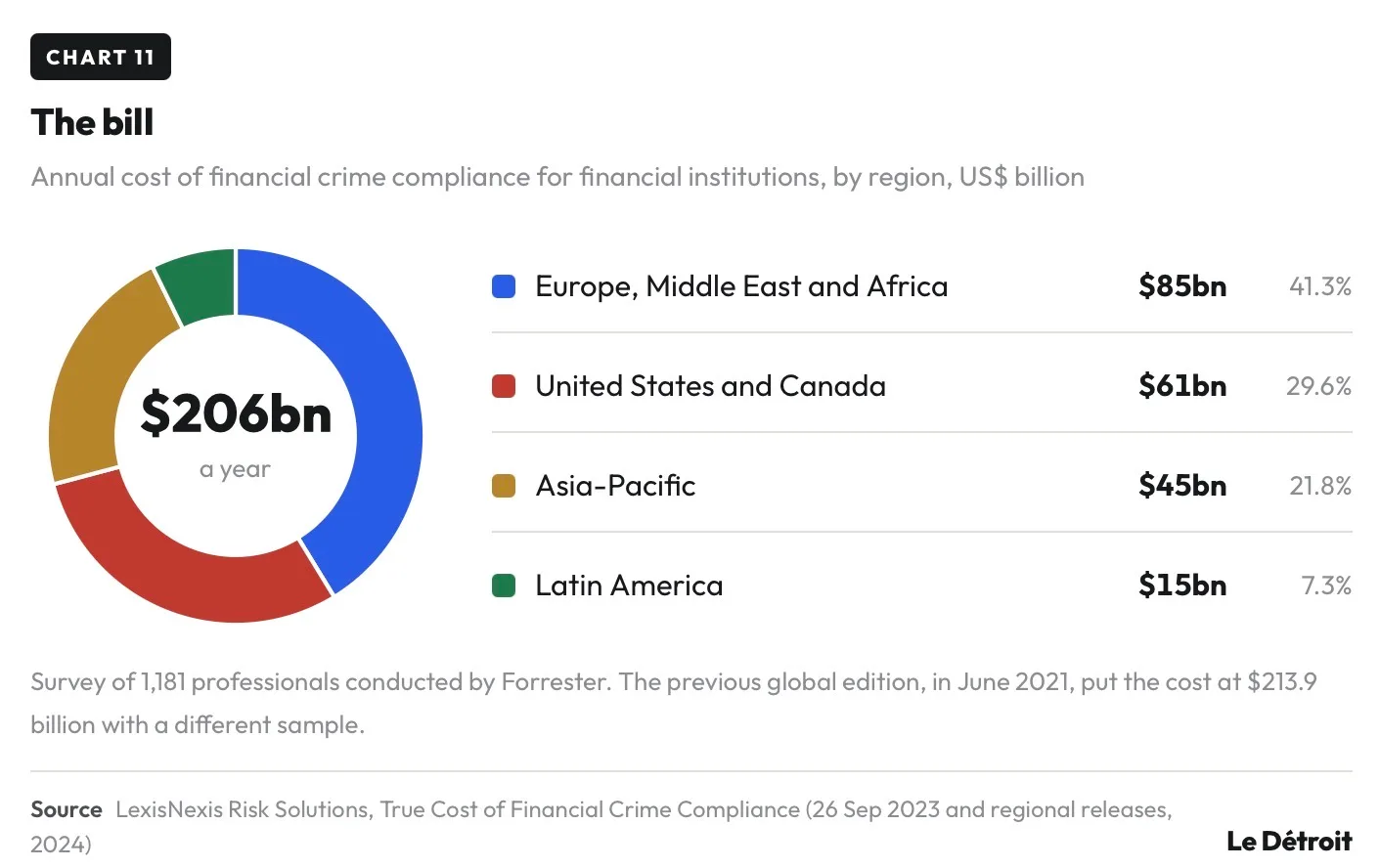
Fighting money laundering is expensive. Financial institutions spend $206.1 billion a year on financial crime compliance, according to a survey of 1,181 professionals carried out by Forrester for LexisNexis Risk Solutions and published in September 2023, below the $213.9 billion of the previous global edition, in 2021, which surveyed a different sample. Europe, the Middle East and Africa account for $85 billion, the United States and Canada for $61 billion.
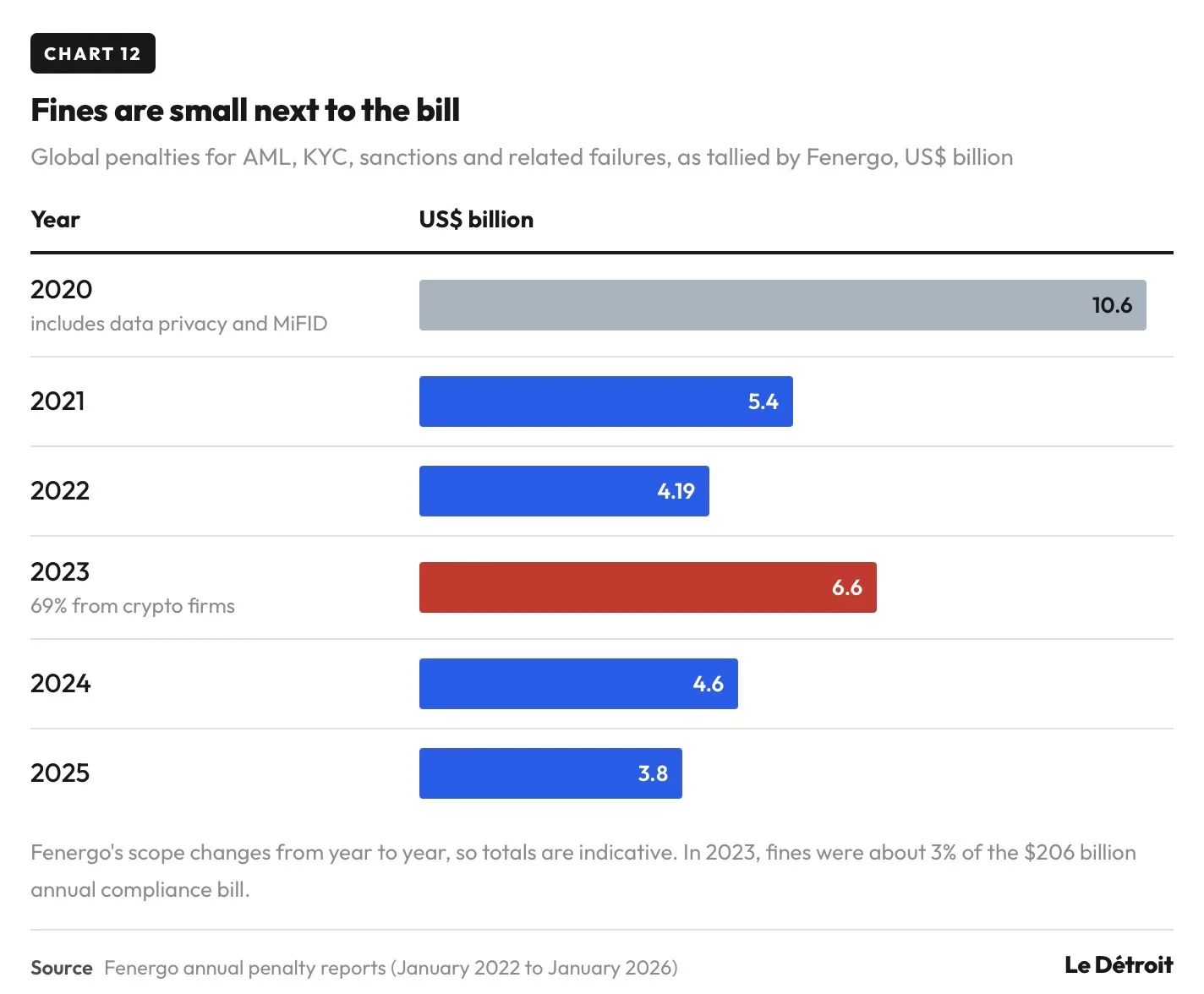
Penalties are much smaller. Fenergo, a compliance software company that tallies them, counted $6.6 billion of fines for anti-money laundering, know-your-customer and sanctions failures in 2023, when crypto firms, led by Binance, accounted for 69% of the total. The figure fell to $4.6 billion in 2024 and $3.8 billion in 2025. Even in 2023, fines were about 3% of the annual compliance bill.
9. Crypto: the fastest-growing slice
Crypto is the one channel where flows can be counted on a public ledger, with the help of attribution by analytics firms. Chainalysis found that illicit addresses received "at least $154 billion in 2025", which it calls a 162% increase on 2024, driven largely by flows to sanctioned entities. Stablecoins accounted for 84% of that volume. TRM Labs put the 2025 total at $158 billion. Chainalysis also estimates that the on-chain laundering ecosystem grew "from $10 billion in 2020 to over $82 billion in 2025".
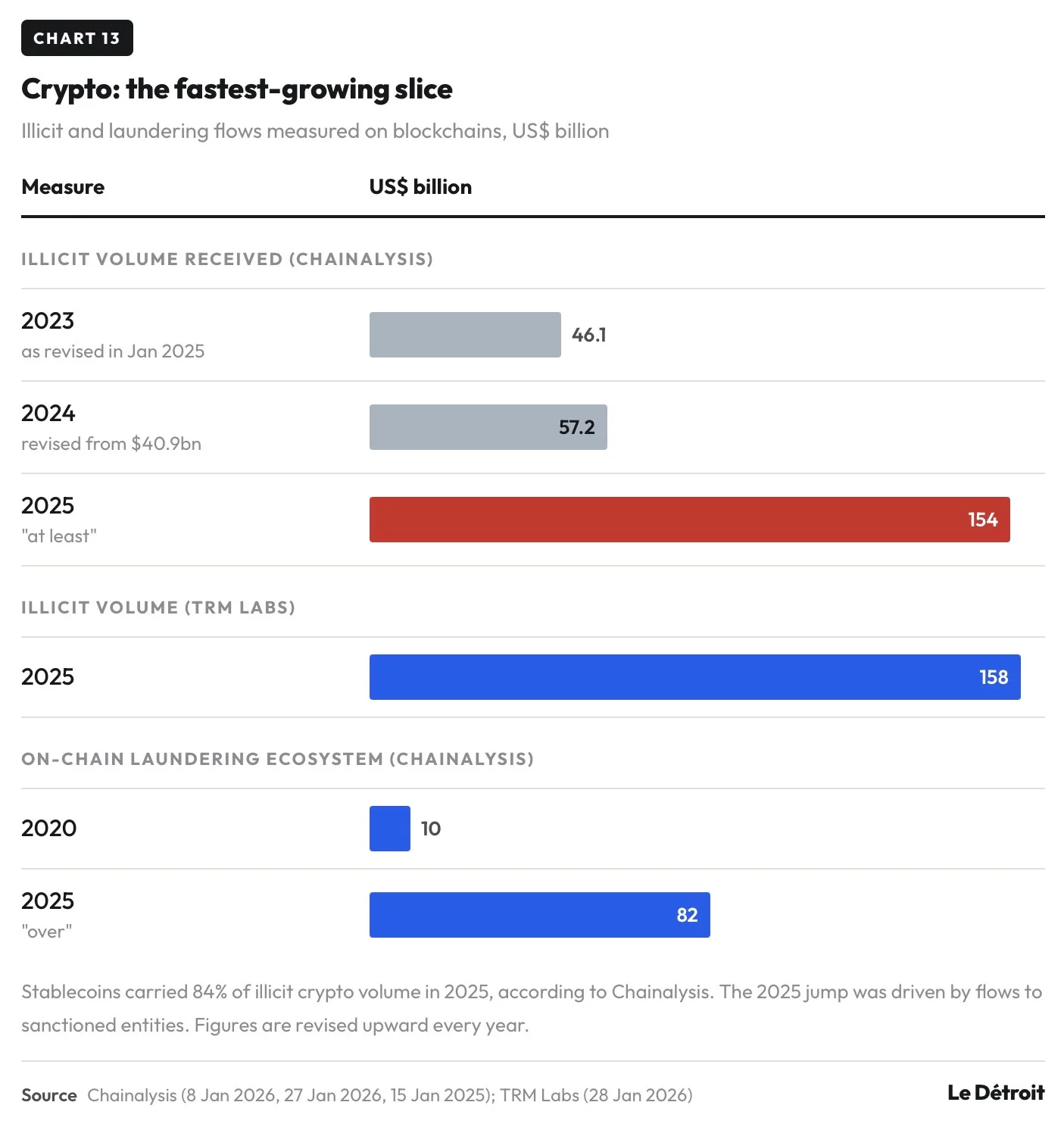
Even so, crypto is a slice, not the whole. Chainalysis's $82 billion for 2025 would be under 2% of Nasdaq Verafin's $4.4 trillion estimate for the same year. And the figures move: Chainalysis's estimate for 2024 rose from $40.9 billion to $57.2 billion in a single year of revisions.
10. Why the total matters less than the ratios
The institutions that quote the numbers know their limits. The FATF says that "it is therefore impossible to produce a definitive estimate of the amount of money that is globally laundered every year" and that it "does not publish any figures in this regard". A 2006 report for the Dutch finance ministry, led by Brigitte Unger, found that such figures "arbitrarily circulate like magic figures throughout the world". Peter Reuter went further in 2013: "knowing how much money is laundered serves no important policy purpose", he wrote, adding that "we have no methodology that plausibly would produce credible numbers."