1. Two cases, one pattern
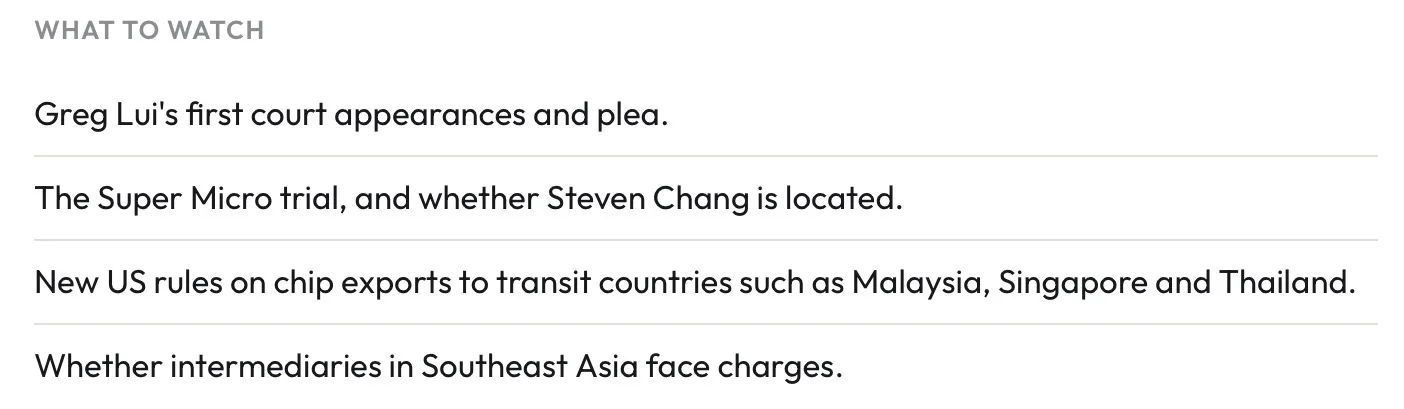
Since 2022, the United States has banned the export of its most advanced AI chips to China without a licence. The two cases now before US courts show how that ban is allegedly circumvented, and how much money is at stake. All defendants are presumed innocent unless proven guilty.
2. Case one: the broker
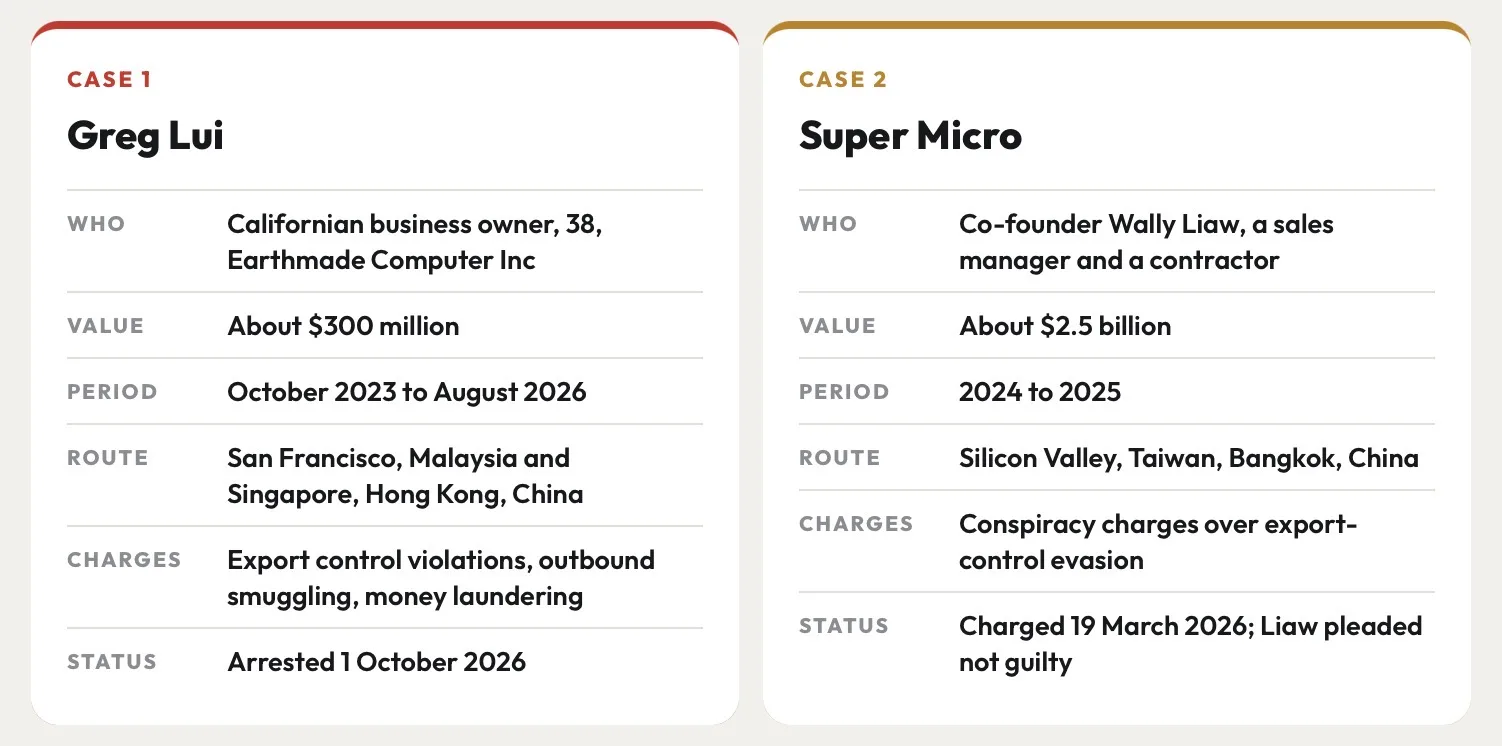
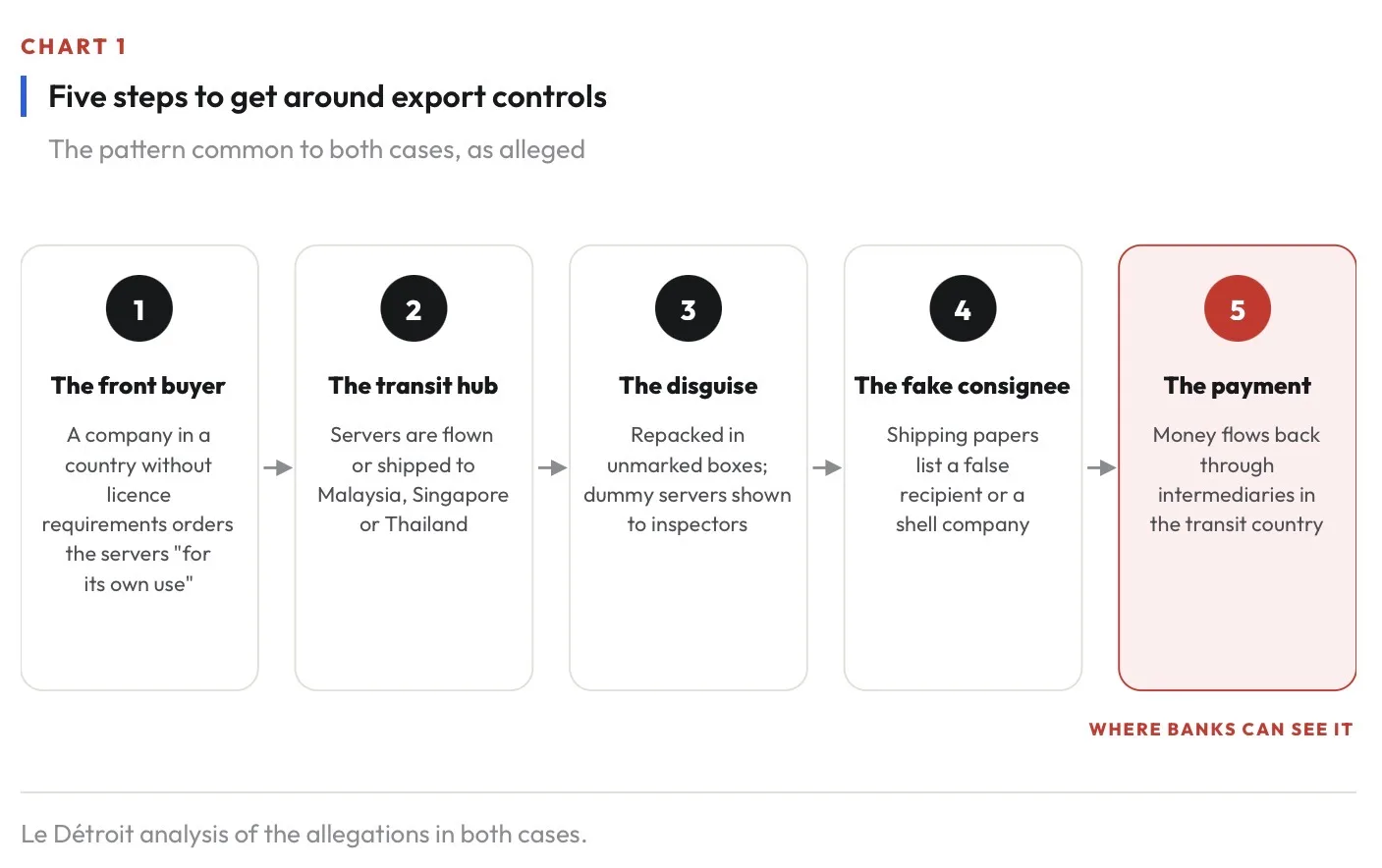
According to prosecutors, Greg Lui used his company, Earthmade Computer Inc, to order servers in the United States containing Nvidia A100 and H100 data-centre chips, as well as RTX 4090 and RTX 5090 graphics cards. The hardware was sent to Malaysia and Singapore, which do not require a US Commerce Department licence, and companies there forwarded it to China.
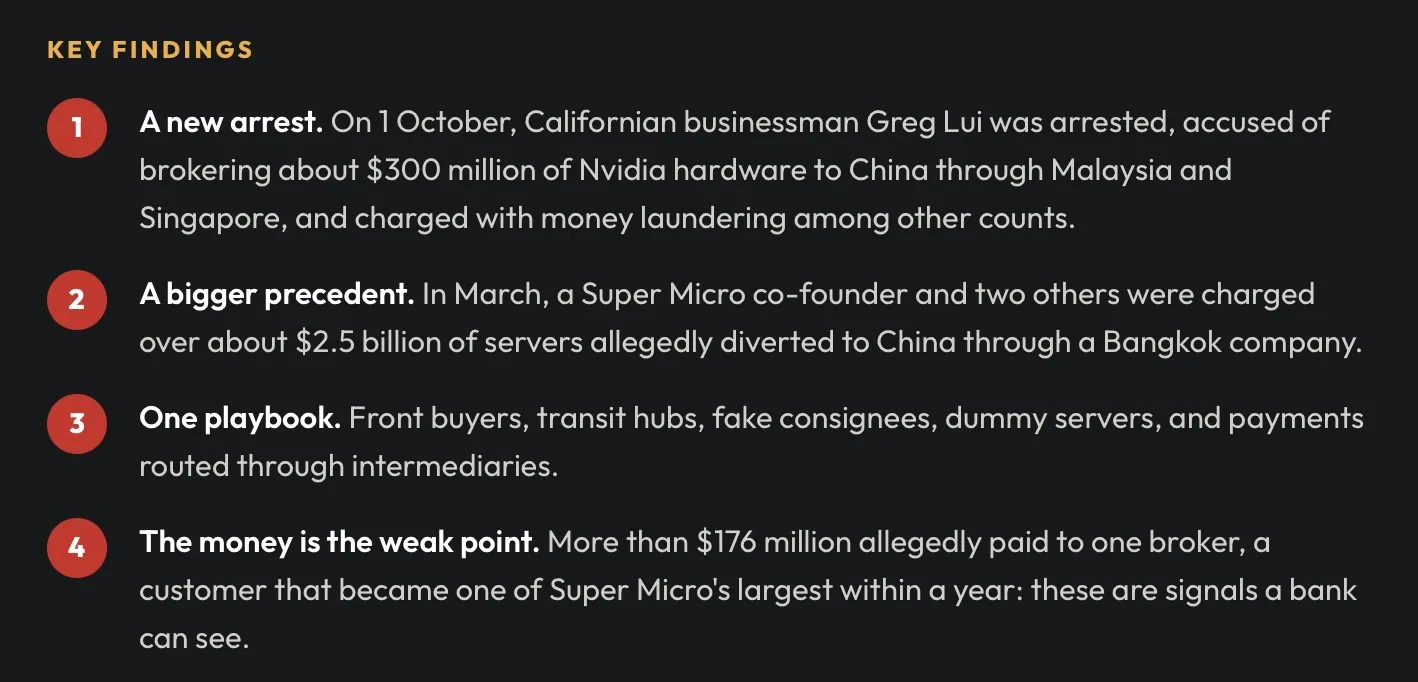
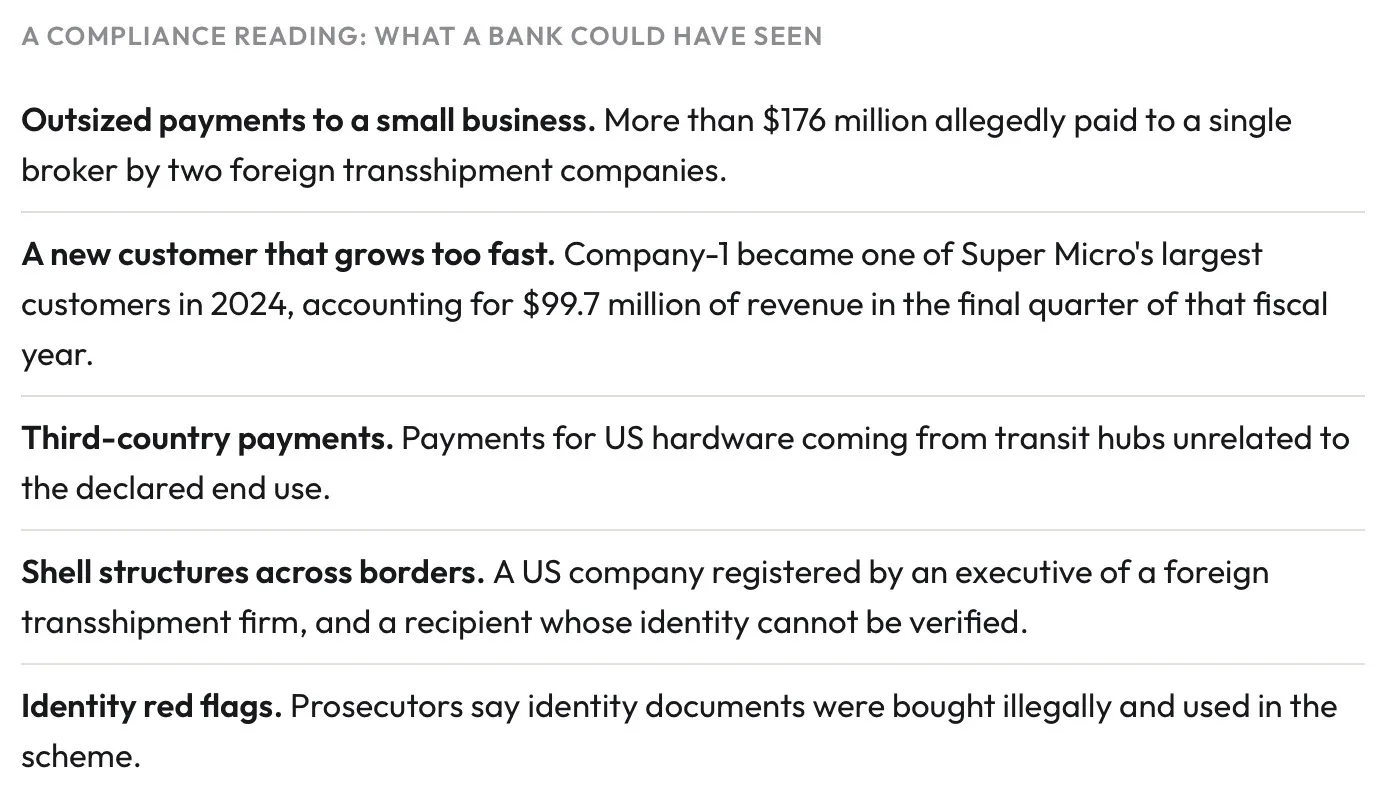
Prosecutors say Lui received more than $176 million from two Malaysian transshipment companies, which he introduced to US suppliers, brokering sales of almost $300 million in total. Court documents tie the export of 92 servers from San Francisco International Airport to Kuala Lumpur, ordered by Earthmade, with the consignee for the onward shipment from Malaysia to Hong Kong listed as a Chinese customer.
The paperwork was allegedly falsified at several levels. Lui is accused of instructing a US front company to list the recipient of a shipment as "Jackie Lui", presented as the chief executive of "Topmost", a company registered in California by the chief technology officer of one of the Malaysian transshipment companies. Prosecutors also allege he illegally bought identity documents in 2021 that were used in the scheme.
He is charged with violating the Export Control Reform Act and the Export Administration Regulations, outbound smuggling, and money laundering: up to 50 years in prison combined. "SI is the defining technology of the era," said Assistant Attorney General John A. Eisenberg, using the US government's term for "super intelligence".
3. Case two: the giant
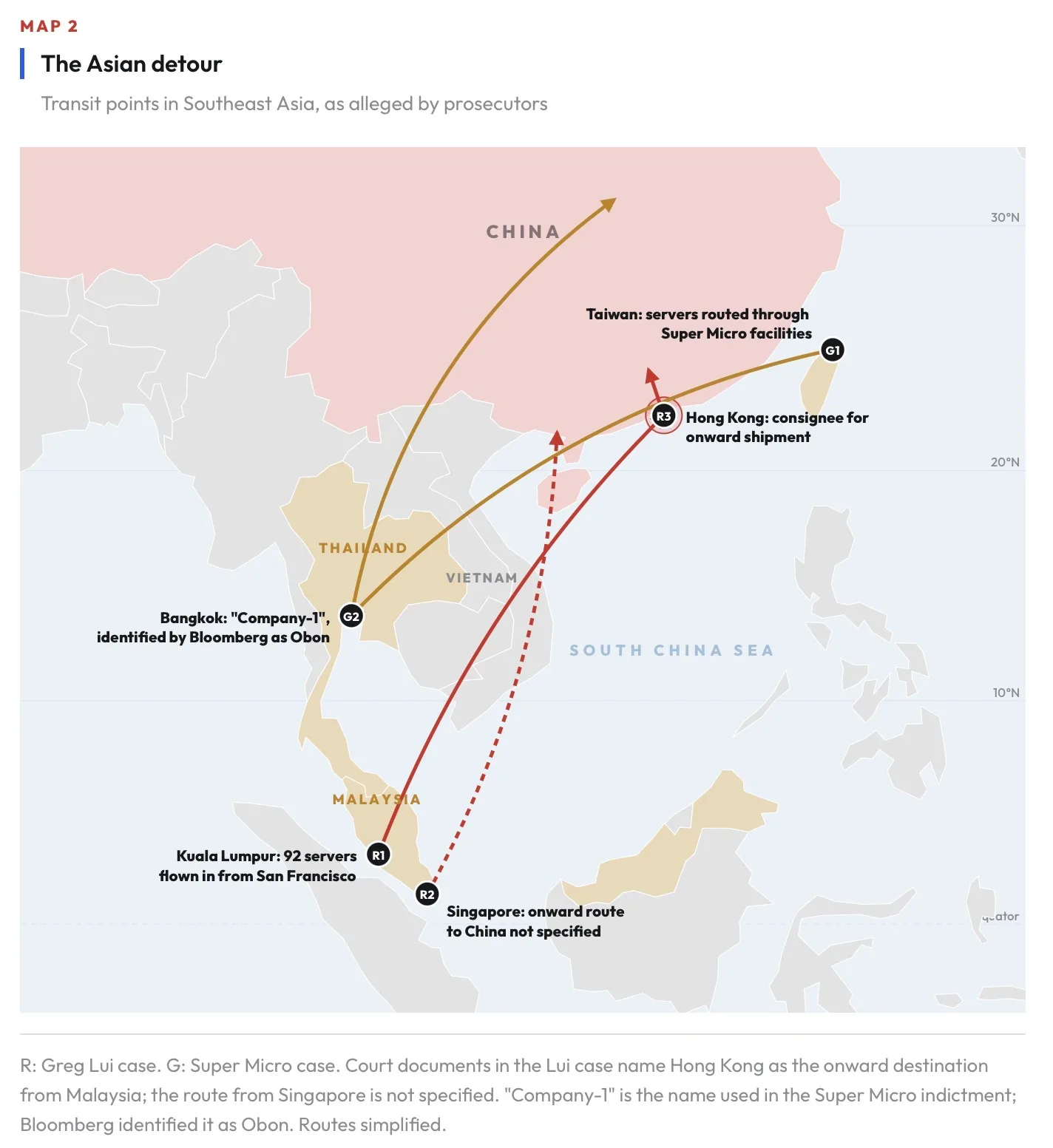
The Super Micro case is eight times larger. In March, federal prosecutors in Manhattan charged Yih-Shyan "Wally" Liaw, a co-founder of the server maker, sales manager Ruei-Tsang "Steven" Chang and contractor Ting-Wei "Willy" Sun. Liaw and Sun were arrested; Chang remained a fugitive. Super Micro itself was not charged; it placed the employees on leave and terminated Sun's contract.
According to the indictment, servers assembled in the United States were routed through Super Micro facilities in Taiwan to a Southeast Asian company, "Company-1", which ordered them "for its own use". They were then repacked in unmarked boxes and forwarded to customers in China. Company-1 bought about $2.5 billion of servers in 2024 and 2025, including at least $510 million sent to China in just three weeks between late April and mid-May 2025. Bloomberg identified Company-1 as Obon, a Bangkok company connected to Thailand's sovereign AI initiatives.
The hair dryer
To fool inspectors, the defendants allegedly staged thousands of dummy servers, non-working replicas, at the Southeast Asian company's warehouses. Surveillance cameras recorded a hair dryer being used "to remove and affix labels and serial number stickers to the server boxes and to the dummy servers," according to the indictment. During one audit, Super Micro's compliance employee was off site, "enjoying entertainment" paid for by the Southeast Asian company, prosecutors say.
4. The playbook
5. Follow the money
Export-control evasion is usually described as a customs problem. Both cases show it is also a financial one: someone has to pay for the hardware, and someone has to get paid. That is why Greg Lui faces a money laundering charge, and why banks are often the first to see the signals.
6. The bigger picture
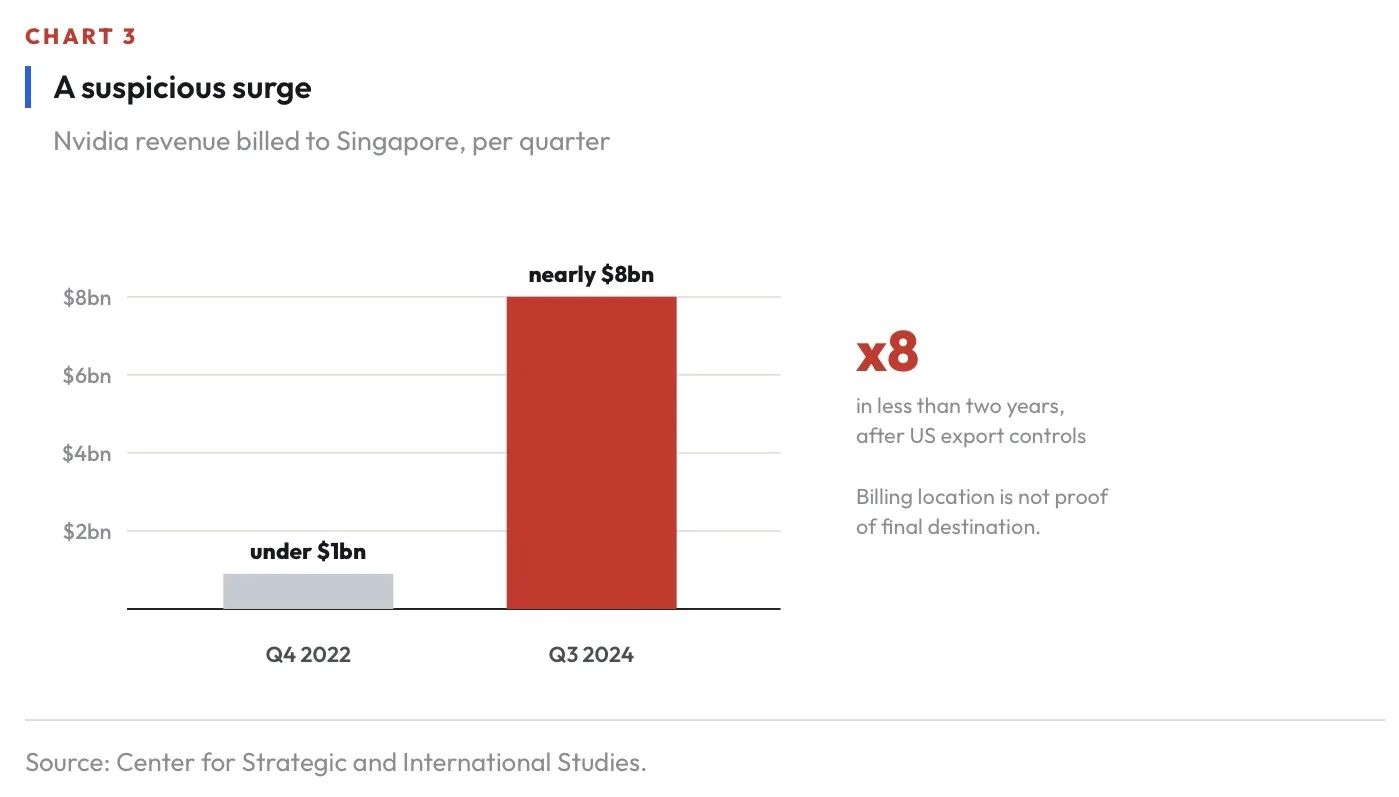
These cases are unlikely to be isolated. The Center for Strategic and International Studies has pointed to a striking number: Nvidia's revenue billed to Singapore rose from less than $1 billion in the fourth quarter of 2022 to nearly $8 billion in the third quarter of 2024, after US export controls took effect. The think tank stressed that billing location is not proof of final destination, but questioned whether Singapore even had the power capacity to run that many chips. The Information has reported at least eight Chinese AI chip-smuggling networks, each handling deals worth more than $100 million.